Mark Linsenmayer, Erica Spyres, and Brian Hirt discuss Michael Schur’s NBC TV show. Is it good? (Yes, or we wouldn’t be covering it?) Is it actually a sit-com? Does it effectively teach philosophy? What did having actual philosophers on the staff (after season one) contribute, and was that enough? We talk TV finales, the dramatic impact of the show’s convoluted structure, the puzzle of heaven being death, and more.
If you like the show, you should also check out The Official Good Place Podcast, especially the interviews with Schur himself. There are also supplementary educational videos with professor Todd May like this one on existentialism.
“What is important is seldom urgent,” said Dwight D. Eisenhower, “and what is urgent is seldom important.” Or at least many believe Eisenhower said that, even if he might have been quoting someone else. Whether or not the 34th President of the United States of America ever spoke those exact words, he must have had a highly effective method of dealing with life’s tasks. During Eisenhower’s two terms in office, writes Atomic Habits author James Clear, “he launched programs that directly led to the development of the Interstate Highway System in the United States, the launch of the internet (DARPA), the exploration of space (NASA), and the peaceful use of alternative energy sources (Atomic Energy Act).”
Eisenhower accomplished all that after “planning and executing invasions of North Africa, France, and Germany” as Supreme Commander of the Allied Forces in Europe during World War II” (and while being the most avid golfer ever to reside in the White House).
Though we may never boast such a range of accomplishments ourselves, we can still inject a shot of Eisenhowerian productivity into our lives with the “Eisenhower Matrix” — or, in the plainer phrasing “Ike” might have preferred, the “Eisenhower Box.”
Its vertical axis of importance and horizontal axis of urgency create four boxes for categorizing tasks. Clear explains these categories as follows:
Urgent and important (tasks you will do immediately)
Important, but not urgent (tasks you will schedule to do later)
Urgent, but not important (tasks you will delegate to someone else)
Neither urgent nor important (tasks that you will eliminate)
Important tasks, writes Lifehacker’s Thorin Klosowski, “are things that contribute to our long-term mission, values, and goals,” pursuits that put us into a “responsive mode, which helps us remain calm, rational, and open to new opportunities.” At Business Insider, Drake Baer provides examples of all four categories of tasks. The urgent and important include “attending to a crying baby, tackling a crisis at work, and mailing your rent check.” The important but not urgent include “saving for the future, getting enough exercise, sleeping your seven to nine hours a night.” The urgent but not important include “booking a flight, sharing an article, answering a phone call.” The neither urgent nor important include “watching Game of Thrones, checking your Facebook, eating cookies.”
Eisenhower had it easy, you may say: he lived before binge-watching, before social media, and before cookies were quite so addictive. Hence the greater importance today of a time-management system with the stark clarity of the Eisenhower Matrix, and not just for presidents. (Barack Obama, Baer points out, made time for dinner with the family when he was in the White House as well as an hour’s workout every evening, both important but not urgent tasks.) So as not to lose sight of what’s important, Clear recommends keeping in mind two questions: “What am I working toward?” and “What are the core values that drive my life?” And though Eisenhower didn’t have to deal with nuisances like app notifications, he also didn’t get to see the day when a productivity app (whose explanation of the Eisenhower Matrix appears at the top of the post) has his name on it.
Based in Seoul, Colin Marshall writes and broadcasts on cities, language, and culture. His projects include the book The Stateless City: a Walk through 21st-Century Los Angeles and the video series The City in Cinema. Follow him on Twitter at @colinmarshall or on Facebook.
A recent executive order stating that “the classical architectural style shall be the preferred and default style” for federal buildings in the U.S. has reminded some of other executives who enforced neoclassicicism as the state’s official aesthetic dogma. In the case of the U.S., however, neoclassical building does not draw from ancient sources, but from “a 19th century interpretation of what people were doing in Rome and Athens millennia ago,” as Steve Rose writes at The Guardian.
In other words, contemporary “classical architectural style” in the U.S. is a copy of a copy. Kitsch. But maybe the creation of simulations is what America does best, though not typically under threat of government sanction should one do otherwise. “Living in the relatively youthful country that’s a mere 241 years old,” Isaac Kaplan wrote at Artsy in 2017, “it’s understandable that some Americans might decide to import a little extra history from abroad,” by making versions of ancient monuments in their backyard.
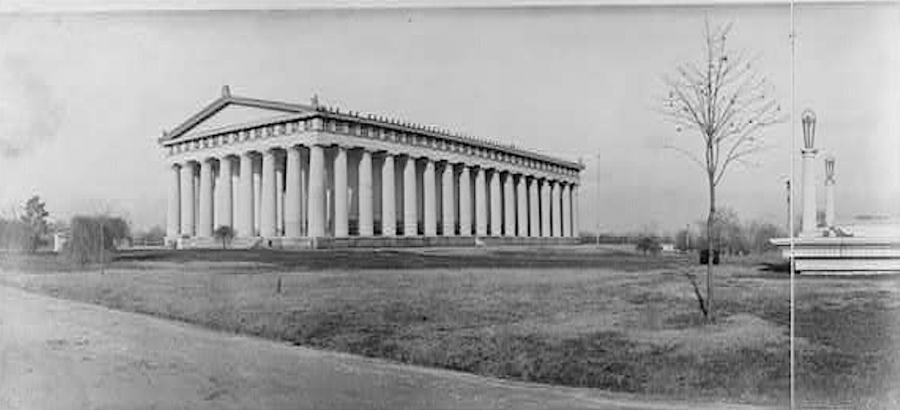
Such buildings span the country, from offbeat roadside attractions to the most expensive and elaborate recreations. “There is a faux-Venice in Las Vegas, and a Stonehenge II in Texas.” And in Nashville, Tennessee: a full-scale replica of the Parthenon, built in 1897 for the Centennial Exposition celebrating the state’s 100th anniversary. The detailed re-creation went further than imitating a ruin. It “restored the aspects of the original Parthenon that were lost or damaged” in an interpretive re-creation of what it might have looked like.
The building held the Exposition’s art gallery and “spoke to the city’s self-declared reputation as the ‘Athens of the South.’” (Memphis countered the grand architectural gesture by building a pyramid; Athens, Georgia, however, did not respond in kind.) Constructed out of concrete, and not built to outlast the celebrations, the replica began to fall apart soon afterwards, prompting a restoration effort in 1920 aimed at making the Nashville Parthenon as “enduring and as historically true to the original Parthenon as possible.”
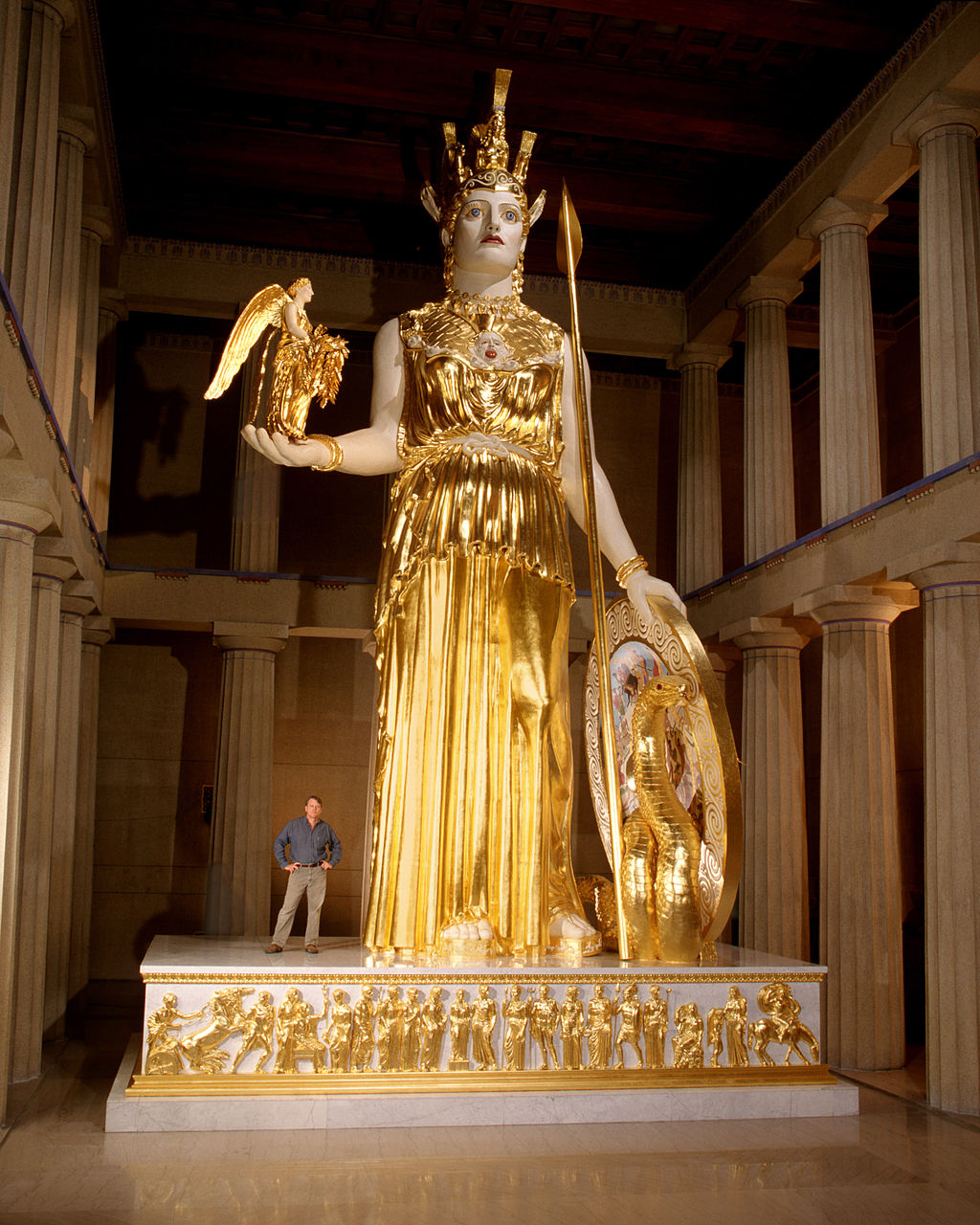
The Great Depression halted plans for an enormous statue of Athena, meant to recreate one that once stood inside the original Parthenon, but after decades of donations it was finally unveiled in 1990. Standing 42 feet high, the massive figure holds a 6‑foot-4-inch statue of the goddess Nike in her hand. Unlike 19th century neoclassical recreations, Athena “boasts a major historical detail: polychromy,” painted in bright greens, reds, and blues, righting “the long-held and historically incorrect view of the ancient past as one dominated by whiteness.”
See more photographs from 1909 at the Library of Congress digital collections, of the replica of a temple originally dedicated to honoring the female personification of wisdom. And at the top, see a much more recent photo of the restored building. The Nashville Parthenon is still in business, charging reasonable admission for a view tourists could never get in Athens, as well as a permanent collection of 63 paintings by American artists and galleries housing temporary shows and exhibits.
Among historians of European Christianity, it long seemed a settled question that Irish Catholicism, the so-called “Celtic Rite,” differed significantly in the middle ages from its Roman counterpart. This despite the fact that the phrase Celtic Rite “must not be taken to imply any necessary homogeneity,” notes the Catholic Encyclopedia, “for the evidence such as it is, is in favour of considerable diversity.” Far from an insular religion, Irish Catholicism spread to France, Germany, Switzerland, Italy, and Northern Spain through the missions of St. Columbanus and others, and both influenced and absorbed the Continent’s practices throughout the medieval period.
To varying degrees, all of the scholars represented in this collection write to counter the essentializing “quest for what might be unique or ‘other’ about Ireland and Irish culture” among all other European national and religious histories.
Buckley’s writing on the veneration of Irish saints has made a significant contribution to this effort, and her decade and a half of archival work has helped create the Amra project, which aims “to digitize and make freely available online over 300 manuscripts containing liturgical material associated with some 40 Irish saints which are located in research libraries across Europe.” So write Medievalists.net, who also point out some of the most exciting aspects of this accessible resource:
The digital archive, when completed, will also incorporate recordings and performing editions of all the chants and prayers from the original manuscripts, as well as translations of the Latin texts into a number of European languages. In this way, contemporary audiences can enjoy first-hand the devotional songs associated with Irish saints, bringing them out of their slumber after more than half a millennium.
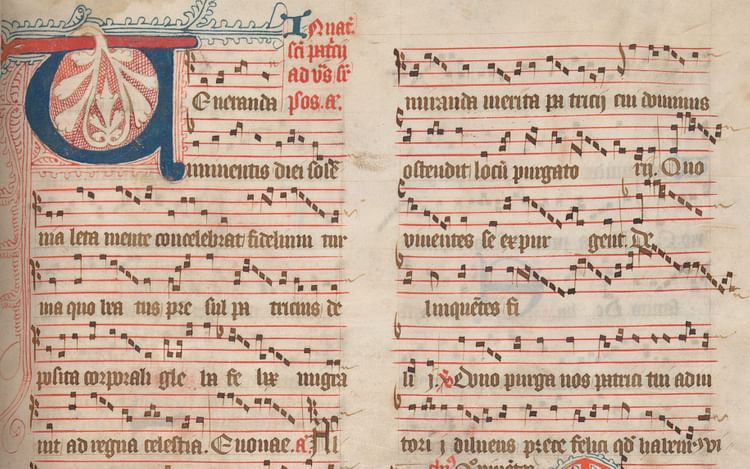
You can hear one antiphonal chant, “Magni patris/Mente mundi,” from the Office St. Patrick, just above. Perhaps unsurprisingly, “no other Irish saint is represented so extensively or with such variety in medieval liturgical sources,” writes Buckley. Manuscript hymns, prayers, and offices for Patrick have been found in Dublin, Oxford, Cambridge, the British Library, and “in the Vienna Schottenkloster dating from the time of its foundation by Irish Benedictine monks in the twelfth century.” (See the opening of the Office of St. Patrick, “Venerenda imminentis,” from a late-15th century manuscript, at the top.)
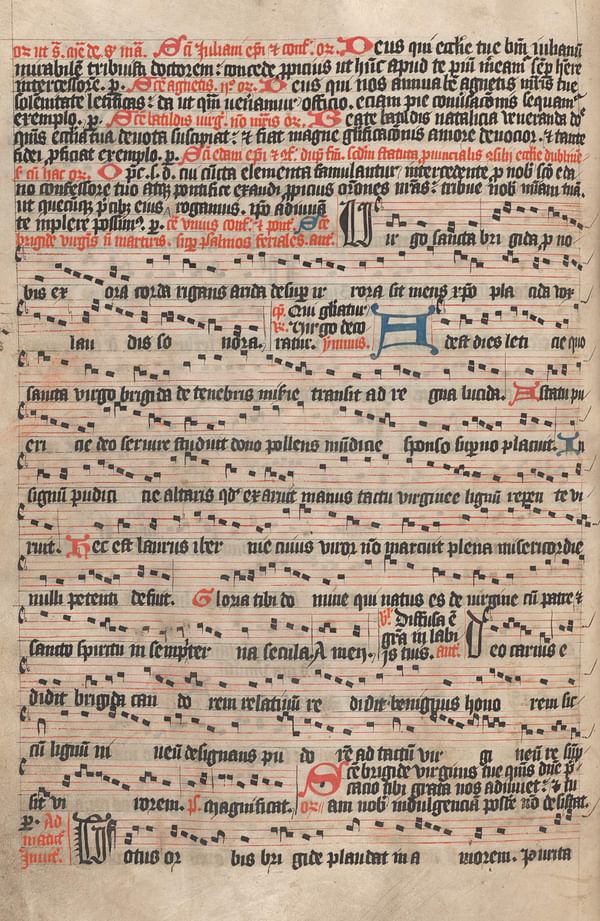
Other saints represented in the archival material include Brigit, Colmcille, Columbanus, Canice, Declan, Ciaran, Finian, and Laurence O’Toole. The missionary monks all received their own “offices,” liturgical ceremonies performed on their feast days. Many of the manuscripts, such as the opening of the Office of St. Brigit, above, contain musical notation, allowing musicologists like Buckley to recreate the sound of Irish Catholicism as it existed in Ireland, Britain, and Continental Europe several hundred years ago.
The project is developing a digital archive of such recordings, as well as “a fully searchable database,” Medievalists.net notes, with “interactive maps showing the geographical distribution of the cults of Irish saints across Europe, and of the libraries where the manuscripts are now housed. A series of documentary films is also envisaged.” You don’t have to be a specialist in the history of the Irish Church, or an Irish Catholic, for that matter, to get excited about the many ways such a rich resource will bring this medieval history to new life.
Even if you don’t know much about Korea, or indeed about film, it’s safe to say that you know at least one Korean film: Bong Joon-ho’s Parasite, which has circled the world gathering acclaim and awards since its release last spring. First it won the Palme d’Or at the Cannes Film Festival, becoming the first Korean production to do so; more recently, it made film history even more dramatically at the Academy Awards. There it won Oscars not just for Best International Feature Film, Best Original Screenplay, and Best Director, but also Best Picture, becoming the first non-English-language film to do so. For many viewers, Parasite and its director seem to have come out of nowhere, but lovers of Korean cinema know full well that they come out of a rich tradition — and a robust industry.
Maybe you thrilled to Bong’s suspenseful, funny, and violent tale of class warfare as much as the Academy did. Maybe you’ve even seen the work of Bong’s contemporaries: Park Chan-wook, he of the controversial hit Oldboy; the even more transgressive Kim Ki-duk; the prolific Hong Sangsoo, with his Woody Allen-meets-Éric Rohmer sensibility.
But do you know their sonsaengnim, the generations of Korean filmmakers who went before them? Now you can, no matter where in the world you are, on the Korean Film Archive’s Youtube channel. There, at no charge, you can experience decades of Korean cinema and hundreds of works of Korean cinematic art, including but not limited to those of mid-20th-century masters like Kim Ki-young, Im Kwon-taek, and my personal favorite Kim Soo-yong, director of haunting, even brazen pictures of the 1960s and 70s like Mist and Night Journey.
I actually met the then-octogenarian Kim Soo-yong a few years ago, when he called me over to his table out of curiosity about what a foreigner was doing at a screening of Mist. It happened at the Korean Film Archive’s cinematheque (known as Cinematheque KOFA) here in Seoul, where I’ve lived for the past few years. During that time I’ve also been writing a Korea Blog for the Los Angeles Review of Books, which occasionally features essays on the classic Korean films made available online by the Korean Film Archive. I began the series with Night Journey, and more recently have written up pictures like the 1960s neorealist cry of agony Aimless Bullet, the 1970s college-under-dictatorship comedy The March of Fools, the 1980s Westernization comedy Chil-su and Man-su, the 1990s food-sex-horror satirical mixture 301, 302, and others.
Based in Seoul, Colin Marshall writes and broadcasts on cities, language, and culture. His projects include the book The Stateless City: a Walk through 21st-Century Los Angeles and the video series The City in Cinema. Follow him on Twitter at @colinmarshall or on Facebook.
Whoever Bob Marley was singing for, it could sound like he’s singing for all of us. Of course, this is received opinion, on the other side of almost 50 years of Marley worship since the Wailers crossed over to a rock audience with Catch a Fire and Clapton’s cover of “I Shot the Sheriff.” Calling Marley an icon is perhaps ironically accurate in ways he would never condone. In death he has become a brand.
Though he wrote some beautiful love songs, Marley also didn’t water down his message to Rastafarian true believers, nor temper his pan-Africanism for scores of new white fans when fame struck. Like the waves of reggae bands that broke into the international scene in the 70s, the cultural particularities of Marley’s religion and politics didn’t seem much hindrance to his wide appeal.
Proof is in the listening, and no song in the Marley oeuvre seems more pointedly directed to the historic black experience—even quoting Marcus Garvey—while also appealing to universal sentiments, than “Redemption Song.” (To very different emotional effect, U2’s “Sunday Bloody Sunday” comes to mind as accomplishing a similar feat.)
The song telegraphs a kind of wise but tender strength, announces its intentions with confident candor, and invites its listeners, all of them, to join in. The references may not be part of your experience, but if this can be redeemed, Marley suggests, maybe everything can.
In its essentials, “Redemption Song” is classic Marley—tough-minded but gentle, hopeful but real, and pure melodic genius. But musically, it’s a significant departure, and perhaps a knowing farewell to the world, as the last song to appear on the Wailers’ twelfth and final album, 1980’s Uprising,
“While there’s no indication that Marley knew for sure that the song would be his last recorded document,” writes Jim Beviglia at American Songwriter, “the contemplative mood of Uprising and the fact that he had been battling the cancer for years seems to suggest that he knew the end was near.”
The song’s “empathetic strains and social concerns, along with its campfire sing-along quality,” has made it a favorite to cover almost since its release. Now, in its 40th year anniversary, it’s finally got a proper video, thanks to French artists Octave Marsal and Theo De Gueltzl. The “breathtaking animation,” notes Twisted Sifter, features “2,747 original drawings” and “uses powerful symbols to amplify the magnitude of the song’s timeless lyrics and importance in today’s world.”
Its black and white imagery directly references the Rastafarian themes and Middle Passage experience in Marley’s lyrics, but pulls back now and then to show his stadium-sized crowds, and the whole Earth, as if to say, “this is a global story.” The video is the first in a year-long celebration of Marley’s 75th birthday, which would have been February 6th, 2020. Learn more about upcoming events here.
Boethius, Henry David Thoreau, Antonio Gramsci, Martin Luther King, Jr…. It’s possible, if one tried, to draw other comparisons between these disparate figures, but readers familiar with the work of all four will immediately recognize their most obvious literary commonality: all wrote some of their most impassioned and persuasive work while unjustly confined to a cell.
In the case of Bertrand Russell, however, perhaps one of the most famous figures in 20th century philosophy and intellectual life more generally, periods of incarceration in Brixton prison in 1918 and, forty-three years later, in 1961, play a minimal role in the larger drama of his writing life, despite the fact that he did a good deal of writing, including some significant philosophical work, behind bars.
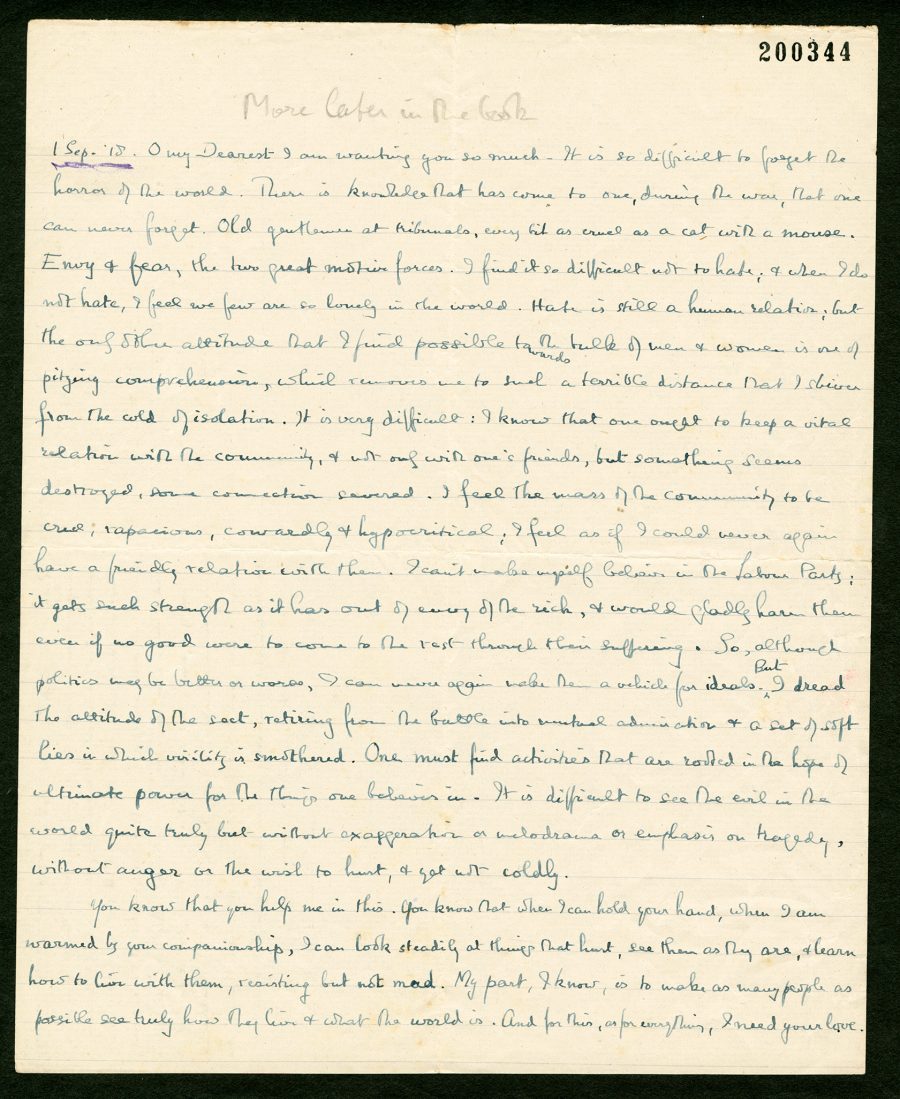
The contents of the letters reveal other reasons that Russell’s prison writing isn’t better known. He did plenty of impassioned and persuasive writing for the public outside of a prison cell—publishing fiery books, essays, and lectures against war and propaganda and in defense of free thought throughout his life. Behind bars, however, Russell’s writing turned almost solely professional and personal, in letters addressed primarily to “his then lover Lady Constance Malleson (known as ‘Colette’) and his former lover, aristocrat and socialite Lady Ottoline Morrell.”
The 105 letters “reveal the private thoughts of one of the 20th century’s most public figures and provide an interesting window on Russell’s inner life,” says Andrew Bone, Senior Research Associate at McMaster’s Bertrand Russell Research Centre. Most of the letters “were written in secret,” Balch notes, “and smuggled out of Brixton by Russell’s friends, concealed between the uncut pages of books.” Russell was only allowed one letter per week; officially sanctioned correspondence is written on prison stationary and bears the Brixton governor’s initials.
A lifelong pacifist, Russell was first jailed for six months in 1918 for a speech opposing U.S. entry into World War I. “I found prison in many ways quite agreeable,” he later wrote in his autobiography. “I had no engagements, no difficult decisions to make, no fear of callers, no interruptions to my work. I read enormously; I wrote a book, ‘Introduction to Mathematical Philosophy’… and began the work for ‘Analysis of Mind,’” a project that never reached fruition. In 1961, at age 89, he was jailed for seven days for participating in a London anti-nuclear demonstration.
During his first stay as a prisoner of Brixton’s “first division,” Russell was “allowed to furnish his cell, wear civilian clothes, purchase catered food, and most importantly, be exempted from prison work while he pursued his profession as an author,” as the Bertrand Russell Research Centre points out. It’s little wonder he looked forward to the experience as a “holiday from responsibility,” he wrote in a letter to his brother, Frank, four days after he began his sentence.
Russell may not have suffered—or acquired a heightened sense of political urgency—while behind bars (at one point he was heard laughing out loud and had to be reminded by the warden that “prison is a place of punishment”). But his prison letters offer significant insight into not only the deeply emotional relationships he had with Malleson and Morrell, but also his relationship with other members of the famous Bloomsbury group and “literary celebrities such as D.H. Lawrence, and T.S. Eliot,” writes Balch, “many of whom are referenced in the letters.”
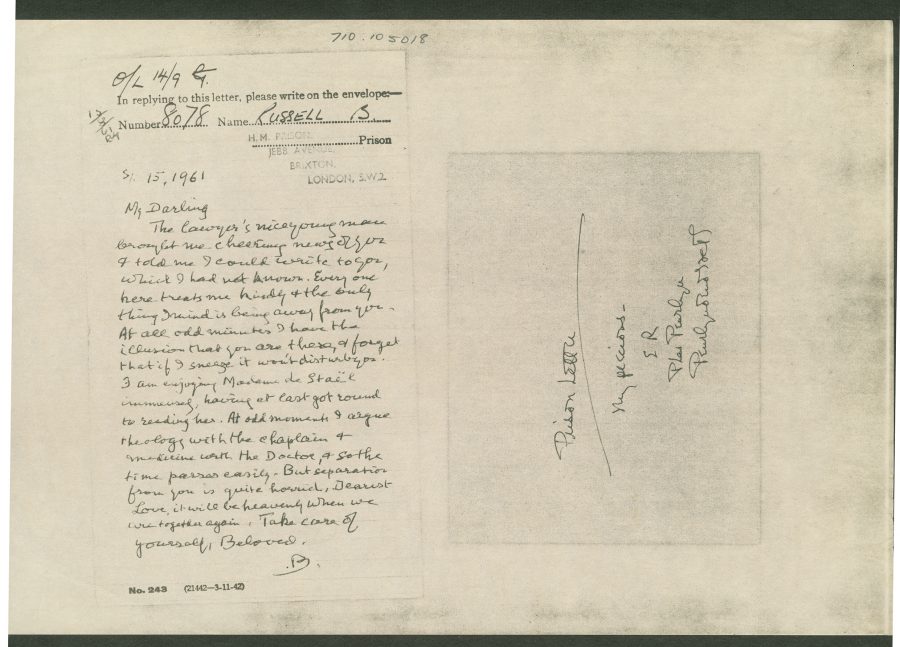
The 104 letters from 1918, including Russell’s correspondence with his brother, his publisher, The Nation magazine and others, are all available in original scans with transcriptions and annotations at the McMaster University Bertrand Russell Research Centre site. The final letter, number 105, the sole piece of correspondence from Russell’s weeklong stay in Brixton in 1961, is addressed to his wife Edith.
My Darling,
The lawyer’s nice young man brought me cheering news of you and told me I could write to you, which I had not known. Every one here treats me kindly and the only thing I mind is being away from you. At all odd minutes I have the illusion that you are there, and forget that if I sneeze it won’t disturb you. I am enjoying Madame de Staël immensely, having at last got round to reading her. At odd moments I argue theology with the chaplain and medicine with the Doctor, and so the time passes easily. But separation from you is quite horrid, Dearest Love, it will be heavenly when we are together again. Take care of yourself, Beloved.
B.
As in most of the earlier letters, Russell avoids politics and keeps things personal. But as in nearly all of his writing, the prose is lively, evocative, and poignant, revealing much about the personality behind it. While these letters may never achieve the status of great literature, by virtue of their private nature and their minor role in Russell’s major canon, that does not mean they aren’t a joy to read, for students of Bertrand Russell and anyone else who appreciates the workings of a brilliant philosophical and ethical mind. Enter the Brixton Letter archivehere.
In popular histories of the mobile phone, and of the smartphone in particular, you will rarely see mention of IBM’s 1992 Simon, a smartphone invented before the word “smartphone.” “You could… use the Simon to send and receive emails, faxes, and pages,” writes Business Insider. “There were also a suite of built-in features including a notes collection you could write in [with a stylus], an address book that looked like a file folder, calendar, world clock, and a way to schedule appointments.”
Nifty, eh? But the Simon was born too soon, it seems, and its unsexy design—like a cordless handset with a long, rectangular screen where the number pad would be—proved less than enticing. “IBM did manage to sell approximately 50,000 units,” a pitiful number next to the iPhone’s first year sales of 6.1 million. The Simon was an evolutionary dead end, while the iPhone and its imitators changed the definition of the word “phone.”
No longer is it necessary even to specify that one’s telephone is of the “smart” variety. We can spend all day on our devices without ever making or answering a call. Is this development a good thing? No matter how we ask or answer the question, it may do little to change the course of technological development or our dependence on the touchscreen computers in our pockets.
That is, unless we have the ability to redesign our mobile phone ourselves, as Justine Haupt—a scientist in the Instrumentation Division at the Brookhaven National Laboratory—has done. You’ll find no mention of anything like her rotary cellphone in any history of mobile telecommunications. No one would have seriously considered building such a thing, except as an anachronistic novelty.
But Haupt’s rotary cellphone is not a visual gag or piece of conceptual art. It’s a working device she built, ostensibly, for serious reasons. “In a finicky, annoying, touchscreen world of hyperconnected people using phones they have no control over or understanding of,” she writes, “I wanted something that would be entirely mine, personal, and absolutely tactile, while also giving me an excuse for not texting.”
Haupt’s reasoning calls to mind J.G. Ballard’s comments on the car as “the last machine whose basic technology and function we can all understand.” She lays out the rotary cellphone’s impressive features in the bulleted list below:
Real, removable antenna with an SMA connector. Receptions is excellent, and if I really want to I could always attach a directional antenna.
When I want a phone I don’t have to navigate through menus to get to the phone “application.” That’s bullshit.
If I want to call my husband, I can do so by pressing a single dedicated physical key which is dedicated to him. No menus. The point isn’t to use the rotary dial every single time I want to make a call, which would get tiresome for daily use. The people I call most often are stored, and if I have to dial a new number or do something like set the volume, then I can use the fun and satisfying-to-use rotary dial.
Nearly instantaneous, high resolution display of signal strength and battery level. No signal metering lag, and my LED bargraph gives 10 increments of resolution instead of just 4.
The ePaper display is bistatic, meaning it doesn’t take any energy to display a fixed message.
When I want to change something about the phone’s behavior, I just do it.
The power switch is an actual slide switch. No holding down a stupid button to make it turn off and not being sure it really is turning off or what.
I wouldn’t hold my breath for a production run, but “it’s not just a show-and-tell piece,” Haupt insists. “It fits in a pocket; it’s reasonably compact; calling the people I most often call if faster than with my old phone, and the battery lasts almost 24 hours.” For the rest of us, it’s a conversation starter: in less obviously quirky, retro ways, how could we reimagine mobile phones to make them less “smart” (i.e. less distracting and invasive) and more personal and customizable, while also enhancing their core functionality as devices that keep us connected to important people in our lives?
We're hoping to rely on loyal readers, rather than erratic ads. Please click the Donate button and support Open Culture. You can use Paypal, Venmo, Patreon, even Crypto! We thank you!
Open Culture scours the web for the best educational media. We find the free courses and audio books you need, the language lessons & educational videos you want, and plenty of enlightenment in between.








#/media/File:Parthenon,_Nashville.JPG)
#/media/File:Athena_Parthenos_LeQuire.jpg)