As non-essential workers adjusted to spending more time at home, their ears adjusted to the increasingly non-foreign sound of birdsong outside their windows.
Those sweet tweets are no doubt largely responsible for the record breaking turnout at this year’s Global Big Day, the Cornell Lab of Ornithology’s annual birding event, held earlier this spring.
50,000 participants logged 2.1 million individual observations, and 6,479 species.
Apparently, there are even more birds in this world than there are sourdough starters…
…though for the immediate future, civic-minded birdwatchers will be confining their observations to the immediate vicinity, as a matter of public health.
We look forward to the day when bird enthusiasts residing outside of Belize, Mexico, or Guatemala can again travel to the Yucatán Peninsula in hopes of a face-to-face encounter with the Black Cat Bird.
Til then, the animated video above, in which a Black Catbird unwittingly duets with Belize’s Garifuna Collective, makes a soothing place holder.
A Black-cheeked Ant-Tanager joins NILLO, a producer and DJ from Costa Rica who draws musical inspiration from the tribal communities around him.
Siete Catorce, a producer who helped popularize the popular border genre known as ruidosón—a mix of cumbia and prehispanic tribal sounds—is paired with a Yellow-headed Parrot.
Jordan “Time Cow” Chung of Equiknoxx seamlessly integrates a Jamaican Blackbird into his unique brand of organic, experimental dancehall.
There’s something really nice about focusing on endangered species and songs that are disappearing and not being preserved and to use music to raise awareness about the species. I believe music has a big power for social activism and social change and for environmental change.
Listen to A Guide to the Birdsong of Mexico, Central America & the Caribbean for free on Spotify.
Buy the album or individual tracks on Bandcamp to benefit the charities above.
Robin Perkins’ limited edition prints of the featured birds also benefit the bird-focused regional charities and can be purchasedhere.
Debates about whether a guitarist is underrated often involve a lot of posturing and needless name-dropping—they don’t tend to go anywhere, in other words. This is not the case with Peter Green, founder and former singer, songwriter, and guitarist for Fleetwood Mac, who died this past weekend. He is, probably most definitely, “the most underrated guitarist in British Blues,” argues the Happy Bluesman, or at least he became so in the last decades of his life.
Green experienced a tragic end to his career with Fleetwood Mac when his mental health declined precipitously in 1970, and he was eventually diagnosed with schizophrenia. His legend lived long among musicians (and fans of the band who preferred their early work), but Green more or less disappeared from public view, even after releasing a handful of solo albums in a period of recovery.
Fleetwood Mac, the group he founded and carried to its first years of major stardom became, of course, “a household name, widely recognized as one of the best soft rock bands ever for hits like ‘The Chain,’ ‘Go Your Own Way,’ and ‘Everywhere’”—songs Peter Green had nothing to do with, though he had the soft rock chops, as the melancholy “Man of the World” beautifully demonstrates. Hear him in some of his other finest moments in the band, including a phenomenal “Black Magic Woman” at the top, before Carlos Santana made the song his signature.
The argument for Green’s most underrated-ness as a blues guitarist is more than compelling, with endorsements from B.B. King—who said Green had “the sweetest tone I ever heard”—and John Mayall, who said he was better than Clapton when Green joined the Bluesbreakers at age 20. After founding Fleetwood Mac, Green wrote “Black Magic Woman,” sent a guitar instrumental, “Albatross,” to the top of the British Charts in 1969 and, that same year, recorded at Chess Records with, among other blues legends, Willie Dixon and Buddy Guy.
Was he the “best” British blues guitarist? He was “the only one who gave me the cold sweats,” King confessed, which sure is something, even if you prefer Clapton or Jeff Beck. Is he the most underrated? Probably most definitely. “Within a few short years, Peter Green had achieved greater commercial success than two of the world’s most famous bands,” selling more records in 1969 than “both The Rolling Stones and The Beatles, combined.” Then he disappeared.
Green is receiving the recognition in death that eluded him in his last years, though fame never seemed to truly motivate him at any time in his life. Fellow musicians have spared no superlatives in online memorials, including Metallica’s Kirk Hammett, not known for going anywhere near an early Fleetwood Mac sound. But Green was a consummate musician’s musician (he named his band after the rhythm section!), and he earned the respect of serious rock artists and serious blues artists and serious metal artists.
A longtime friend and admirer, Hammett owns Green’s ’59 Gibson Les Paul (nicknamed “Greeny”). He recently covered Green’s last Fleetwood Mac song—“The Green Manalishi (With the Two Prong Crown)”—live onstage and was collaborating on new material with his idol. “Our loss is total,” Hammett wrote in tribute, perhaps the most succinct and devastating tribute among so many. Fleetwood Mac would never have existed without him. And his influence on the British Blues and beyond goes even deeper. See Green revisit his lovely “Man of the World” in a more recent performance, just below. He steps back from the fiery leads, playing subtle rhythm parts, but he still has the old magic in his fingers.
Earlier this month, Stanford’s Online High School offered (in partnership with Stanford Continuing Studies) a free, five-day course “Teach Your Class Online: The Essentials.” With many schools starting the next academic year online, this course found a large audience. 7,000 teachers signed up. Aimed at middle and high school teachers, the course covered “general guidelines for adapting your course to an online format, best practices for varied situations, common pitfalls in online course design, and how to troubleshoot student issues online.”
The videos from “Teach Your Class Online: The Essentials” are all now available online. You can watch them in sequential order, moving from top to bottom, here. Or watch them on this Stanford hosted page. Day 1 (above) provides a general introduction to teaching online. See topics covered in Days 2–5 below.
Please feel free to share these videos with any teachers. And if anyone watches these lectures and takes good class notes (ones other teachers can use), please let us know. We would be happy to help share them with other teachers.
Finally, just to give you a little background, Stanford’s Online High School has operated as a fully-online, independent, accredited high school since 2006. Stanford Continuing Studies provides open enrollment courses to adults worldwide. All of its courses are currently online. For anyone interested, Coursera also offers a specialization (a series of five courses) on online learning called the Virtual Teacher. It can be explored here.
Day 2
Getting Specific: Situations and Tools
Science: Labs in Online Pedagogy
Day 3
Online Classroom Example Clips
Building and Maintaining a Classroom
Community
Day 4
Review of Submitted Sample Lesson Drafts
Troubleshooting Obstacles to Success in the Online Environment
Day 5
Math: Using Writing Tablets and Whiteboards
Modern Languages: Tips for Highly Interactive Class During Which Students Actively Speak and Write in the Target Language
Humanities: Productive Classroom Conversations About Challenging Subjects
Every city needs its ideal observer. Moreover, a city needs an ideal observer for each of its eras, and ideally each of its eras will have an ideal observer in each major medium. Booming with industry in the mid-19th century and daily absorbing more of what must have seemed like the entire world, New York fairly demanded the celebratory poetic capacity of Walt Whitman. In time, Whitman’s 1860 poem “Mannahatta” would inspire two visual artists to capture the city in another time, and through a brand new medium. Begun in 1920 as a collaboration by photographer-painter Charles Sheeler and photographer Paul Strand, Manhatta (note the slightly different spelling) made cinematic history as the first American avant-garde film.
It also delivered a kind overture for the “city symphony,” a genre of film that would, over the rest of the decade, test the potential of the motion picture by using it to capture the unprecedented dynamism of metropolises around the world. (You can see many more of them here at Open Culture.)
Manhatta is poetic in its use of imagery — Strand, after all, was the author of the iconic 1915 photograph Wall Street, New York — but as the Museum of Modern Art says, “for all its art, Manhatta is also documentary. It leads viewers through a day in the life of Manhattan, introduced by lines from one of Whitman’s many odes to his beloved home: ‘City of the world (for all races are here) / City of tall facades of marble and iron, / Proud and passionate city.’ ”
Whitman’s words appear on intertitles throughout the film, paying tribute to “the shovel, the derrick, the wall scaffold, the work of walls and ceilings” and “shapes of the bridges, vast frameworks, girders, arches” between shots of New York Harbor, the Staten Island Ferry terminal, the Brooklyn Bridge, and other of the city’s marvels of infrastructure and architecture. (Above, thanks to Aeon, you can watch a digitally-restored version of Manhatta, with a newly commissioned score by composer William Pearson.) The last of these 65 shots captures a sunset view from a skyscraper, a kind of building that Whitman, who died in 1892, would scarcely have imagined. But he surely believed that this “modern Babylon-on-the-Hudson,” as Manhatta bills it, would never cease to grow fuller, taller, and mightier, taking forms in the future unpredictable even by the ideal observers of its past.
Based in Seoul, Colin Marshall writes and broadcasts on cities, language, and culture. His projects include the book The Stateless City: a Walk through 21st-Century Los Angeles and the video series The City in Cinema. Follow him on Twitter at @colinmarshall, on Facebook, or on Instagram.
“Gentle, unassuming and private.” These are the words David Gilmour chose in his eulogy of Richard Wright, Pink Floyd’s keyboard player and co-songwriter, who joined the band in 1964 and stayed with them through all of their major albums, leaving after The Wall and rejoining for A Momentary Lapse of Reason. Wright was the quiet one; drummer Nick Mason compared him to George Harrison, and like Harrison, he was also Pink Floyd’s secret weapon, helping to deliver many of their most career-defining songs.
Wright may rarely get much mention in songwriting tributes to Pink Floyd’s warring leaders or its tragic elfin first singer/songwriter Syd Barrett (“had his profile been any lower,” one obituary put it, “he would have been reported missing.”), but his “soulful voice and playing were vital, magical components of our most recognized Pink Floyd sound,” Gilmour went on. “In my view, all of the greatest PF moments are the ones where he is in full flow.”
Wright’s jazz training gave an improvisatory bent. His formal music education gave him an ear for composition. He was the band’s most versatile musician, playing dozens of instruments in addition to his signature Farfisa organ, and he was equally at home writing orchestral pieces or falling into whatever groove the band cooked up, as on their sixth studio album, Meddle, which emerged from several stages of experimental methods and happy accidents like the “ping” sound Wright’s piano makes at the beginning of the sprawling epic “Echoes,” the 23-minute second side of the album.
The song continued to grow, overdub by overdub. Waters wrote lyrics, Gilmour experimented with a sound effect he’d stumbled on by plugging his wah-wah pedal in backwards. If you ask Wright, as Mojo did in their final interview with him in 2008, the year of his death, it was largely his piece. Or at least, “the whole piano thing at the beginning and the chord structure for the song is mine.”
Like so many of Wright’s compositions, “Echoes” is also a showcase for Gilmour’s soaring solos and delicate rhythm playing. The interplay between the two musicians is on transcendent display in Wright’s final, live 2006 performance of the song before he succumbed to cancer two years later, for an audience of 50,000 at the Gdańsk Shipyard in Poland, recorded on the last show of Gilmour’s On an Island tour.
This is really great stuff. The filmed performance, which appears on Gilmour’s album and concert film Live inGdańsk, shows both Wright and Gilmour in top form, trading solos and creating the kind of atmosphere only those two could. Gilmour has said he’ll never perform the song again without Wright. It’s hard to imagine that he even could.
The band closed with the 20-plus-minute “Echoes” every night of the tour, and Wright brought out his old Farfisa just for the song. Given how long Gilmour and Wright had been completing each other’s virtuoso strengths as co-creators of instrumental moods, every performance on the tour was surely something special. But in hindsight, none are as moving as this one—the last time fans would ever have the experience of seeing Pink Floyd, or one version of them, recreate the magic of “Echoes” live onstage.
Just as Bohemian Rhapsodyintroduced Freddy Mercury to an unsuspecting generation of young fans, last year’s Elton John biopic, Rocketman, has netted its subject a host of fresh admirers.
John’s newest fans were born into a far different world than the one that was astounded when he declared, in a 1976 interview with Rolling Stone, that he was bisexual.
To date, the Elton John AIDS Foundation has raised over $450,000,000 to support HIV-related programs in fifty-five countries, and is now doubling down with coronavirus relief efforts for the population it has long served.
To that end, Sir Elton is revisiting six of his most iconic performances over the last half-century, posting a concert in its entirety to his Youtube channel every week in hope that viewers will be moved to make a donation at concert’s end.
(As further incentive, an anonymous supporter has pledged to match donations up to $250,000.)
Each concert streams for 72 hours, but clips of individual songs linger longer.
Last week the Classic Concert Series turned the dial back 30 years to find Sir Elton playing a 1st-century Roman amphitheater—Italy’s Arena di Verona—as part of his 130-show Reg Strikes Back tour. His interplay with singers Mortonette Jenkins, Marlena Jeter, and Kudisan Kai during an 8‑minute gospel-tinged spin on “Sad Songs (Say So Much),” above, is a highlight of the 22-song set.
The series kicked off at the Playhouse Theater in Edinburgh in 1976 as “Don’t Go Breaking My Heart” was topping the charts, and continues to the Sydney Entertainment Center ten years further on, when Sir Elton defied doctor’s orders, performing despite vocal nodules.
The following week, we’ll enter the 21st-century with a pitstop at Madison Square Garden before the series comes to a close at the Great Amphitheater in Ephesus, Turkey.
Who won the U.S. Civil War? “The north, of course,” you say… but ah… if you did not know the answer, you would have reason to be confused. Who loses a war and puts up statues of its heroes on the victor’s land? In the south, say, in Northern Virginia, you’ll find public shrines to Stonewall Jackson, public highways named for Jefferson Davis, and public schools named after Robert E. Lee and J.E.B. Stewart. These are not historical monuments, i.e. preserved battlefields, graveyards, or historic homes. They were erected decades after the war. You’ll find them in California, Oregon, and Washington state, which did not exist at the time.
Next question: who did the Confederacy fight in the Civil War? The Union, of course. But the leaders of the region also warred with another enemy, as they had for over two hundred years: millions of enslaved people kept in brutal subjection. In many respects, they won this war, though they lost the privileges of legal slavery. Once Andrew Johnson came to power, the south reinstituted conditions that were often more or less the same for Black people as they had been before the war. Grant struggled to reverse the tide, but Reconstruction ultimately failed.
This is the victory the south commemorated when organizations like the United Daughters of the Confederacy and Sons of Confederate Veterans put up monuments to southern generals all over the country. It is the victory invoked by the Battle Flag of the Army of Northern Virginia (or the “Confederate Flag”). A defiance of multi-racial democracy and a government that serves the needs of all its citizens; a menacing promotion of white supremacist mythology, maintained with public funds on public lands. Those symbols include:
780 monuments, more than 300 of which are in Georgia, Virginia or North Carolina;
103 public K‑12 schools and three colleges named for Robert E. Lee, Jefferson Davis or other Confederate icons;
80 counties and cities named for Confederates;
9 observed state holidays in five states; and
10 U.S. military bases.
But, no, one might say, these are observances for the southern dead, who were, after all, Americans too. This is what we’ve heard, over and over. It was a hoary old story when W.E.B. Du Bois heard it in the early decades of the twentieth century. “Lost Cause” ideology had done its work, flooding the culture with sympathetic portrayals of the Confederacy, a wave of propaganda that reached its apex in the spectacle of 1915’s Birth of a Nation (first titled The Clansman), responsible for resurrecting the Ku Klux Klan.
The story went something like this: “No nobler young men ever lived; no braver soldiers ever answered the bugle call nor marched under a battle flag,” proclaimed southern industrialist Julian Carr at the 1913 dedication of Confederate statue Silent Sam, which stood on the campus of the University of North Carolina in Chapel Hill until activists tore it down recently. “They fought, not for conquest, not for coercion, but from a high and holy sense of duty. They were like the Knights of the Holy Grail.”
Carr goes on like this at length, reciting poetry and making constant references to Greek heroes and gods. His purpose, he says, is to memorialize “the Sacred Cause.” But he never says what that cause is, though he has many exalted words for “the noble women of my dear Southland, who are to-day as thoroughly convinced of the justice of that cause.” The speech is boilerplate Confederate apologism: an almost hysterically bombastic defense of the south that never once mentions slavery.
Yet in an odd moment, Carr breaks off—during a rant about “what the Confederate soldier meant to the welfare of the Anglo Saxon race”—to make a “rather personal… allusion” for seemingly no reason:
One hundred yards from where we stand, less than ninety days perhaps after my return from Appomattox, I horse-whipped a negro wench until her skirts hung in shreds, because upon the streets of this quiet village she had publicly insulted and maligned a Southern lady, and then rushed for protection to these University buildings where was stationed a garrison of 100 Federal soldiers. I performed the pleasing duty in the immediate presence of the entire garrison, and for thirty nights afterwards slept with a double-barrel shot gun under my head.
What does it say about his audience that Carr thinks this admission reflects well on him? Du Bois understood it. He had diagnosed the fear and violent hatred men like Carr embodied and seen their cowardice and desperate overcompensation. “They preach and strut and shout and threaten,” he wrote in The Souls of White Folk, “crouching as they clutch at rags of facts and fancies to hide their nakedness, they go twisting, flying by my tired eyes and I see them ever stripped—ugly, human.”
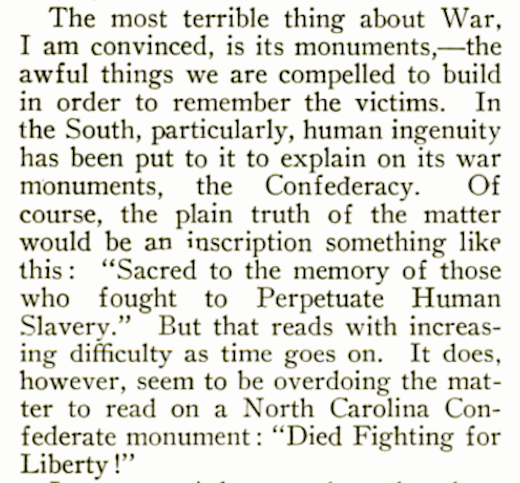
Du Bois knew what Confederate monuments were meant to represent. In 1931, he cut to the heart of the matter in brief remarks published in The Crisis (top). “Du Bois pushes right back against the myth of the Lost Cause,” writes historian Kevin M. Levin. “He refuses to draw a distinction between the Confederate government and men in the ranks,” as represented by statues like Silent Sam. “Du Bois clearly understood that as long as white southerners were able to mythologize the war through their monuments, African Americans would remain second class citizens.”
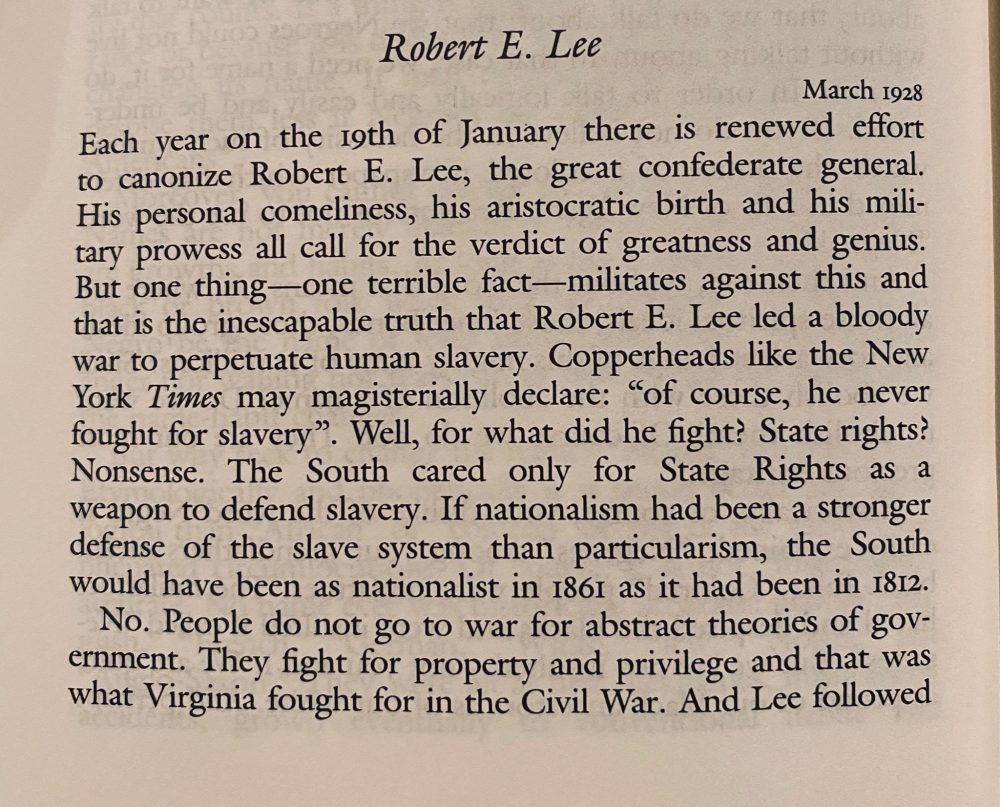
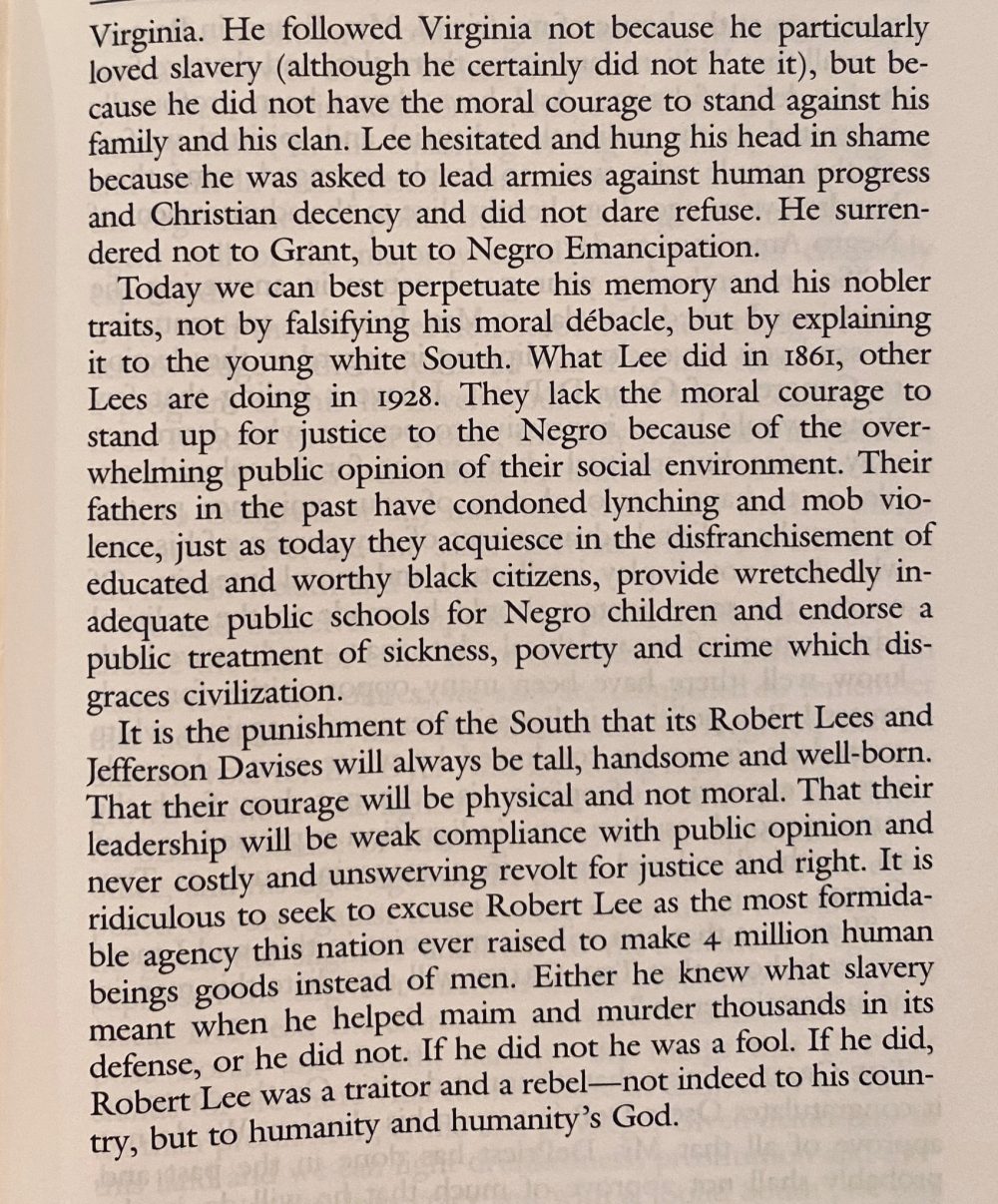
Three years earlier, Du Bois had written many choice words about attempts to deify Confederate leaders like Robert E. Lee (who himself opposed monuments). He also countered the argument that the war was about “States Rights” in one incisive sentence: “If nationalism had been a stronger defense of the slave system than particularism, the South would have been as nationalist in 1861 as it had been in 1812.” None of the high-flown rhetoric about “the cause” of governing principles had anything to do with it, Du Bois argues. “People do not go to war for abstract theories of government. They fight for property and privilege.”
One statue in North Carolina, Du Bois notes wryly in his Crisis remarks, goes so far as to claim that Confederate soldiers “Died Fighting for Liberty!” This would not strike Lost Cause defenders like Carr as ironic. They too fought for liberty, of a kind—the freedom to punish, kill, imprison, exploit, disenfranchise, and otherwise terrorize and impoverish Black Americans at will.
We're hoping to rely on loyal readers, rather than erratic ads. Please click the Donate button and support Open Culture. You can use Paypal, Venmo, Patreon, even Crypto! We thank you!
Open Culture scours the web for the best educational media. We find the free courses and audio books you need, the language lessons & educational videos you want, and plenty of enlightenment in between.