Hear Brian Eno’s Rarely-Heard Cover of the Johnny Cash Classic, “Ring of Fire”

“Ring of Fire” has been cov­ered many times and in many ways since John­ny Cash released it in 1963. But for all its recog­ni­tion as one of his sig­na­ture songs, Cash’s “Ring of Fire” is itself a cov­er — or anoth­er inter­pre­ta­tion, in any case, of a tune orig­i­nal­ly writ­ten by Cash’s wife June Carter and song­writer Mer­le Kil­go­re for June’s sis­ter, Ani­ta Carter. Though it made noth­ing like the mark Cash’s record­ing did, the orig­i­nal “Ring of Fire” has its appre­ci­a­tors, a group that may well include Bri­an Eno. Or at least one feels an affin­i­ty between Ani­ta Carter’s take on the song and Eno’s own, the lat­ter of which you can lis­ten to above.

Unlike­ly enough to begin with, in an artis­tic sense, the record­ing’s avail­abil­i­ty on the inter­net has saved it from near-com­plete obscu­ri­ty. “In 1990, Bri­an Eno and John Cale made a won­der­ful exper­i­men­tal pop/art rock record called Wrong Way Up, released by Warn­er Bros. Records,” writes Boing Boing’s David Pescovitz.

“At the time, the label would send out 7” records to alt.rock/college radio sta­tions to pro­mote their new releas­es. The pro­mo series, called Soil Sam­ples, fea­tured dif­fer­ent artists on each side of the record per­form­ing songs that weren’t includ­ed on their new albums.” Cale’s con­tri­bu­tion to the sam­ple was an instru­men­tal called “Shuf­fle Down to Wood­bridge,” and the flip side of this translu­cent-vinyl rar­i­ty fea­tured “Mer­ry Christ­mas” by the two-man Amer­i­cana group House of Freaks.

As the leg­end goes — for every sto­ry con­nect­ed with John­ny Cash becomes a leg­end — the idea for how to do “Ring of Fire” came to the Man in Black in a dream. The “Mex­i­can horns” that had risen up from his sub­con­scious “sound like they’ve stum­bled in from some­where else on the radio dial and are try­ing des­per­ate­ly not to fall over Cash’s stan­dard shave-and-a-hair­cut clomp­ing beat,” writes The Atlantic’s Noah Berlatsky. “Cash, for his part, turns in one of the most awk­ward vocals of his career.” And yet “all those ele­ments knock­ing against each oth­er,” he con­tin­ues “fit the song’s lyrics per­fect­ly.” Eno’s flow­ing, lan­guid, Mex­i­can-horn-free record­ing may sound more like the orig­i­nal “Ring of Fire” than any oth­er cov­er, but it also befits its artist, the man who pop­u­lar­ized ambi­ent music. Nei­ther Cash nor Eno sing like men espe­cial­ly sub­ject to “wild desire,” but what song isn’t enriched by a bit of coun­ter­point?

via Boing Boing

Relat­ed Con­tent:

John­ny Cash Sings “Man in Black” for the First Time, 1971

John­ny Cash & Joe Strum­mer Sing Bob Marley’s “Redemp­tion Song” (2002)

Inside the 1969 Bob Dylan-John­ny Cash Ses­sions

Watch John­ny Cash’s Poignant Final Inter­view & His Last Per­for­mance: “Death, Where Is Thy Sting?” (2003)

Bri­an Eno Lists the Ben­e­fits of Singing: A Long Life, Increased Intel­li­gence, and a Sound Civ­i­liza­tion

Based in Seoul, Col­in Mar­shall writes and broad­casts on cities, lan­guage, and cul­ture. His projects include the book The State­less City: a Walk through 21st-Cen­tu­ry Los Ange­les and the video series The City in Cin­e­ma. Fol­low him on Twit­ter at @colinmarshall, on Face­book, or on Insta­gram.

Hear the Voices of Americans Born in Slavery: The Library of Congress Features 23 Audio Interviews with Formerly Enslaved People (1932–75)

“Dur­ing the last three decades of legal slav­ery in Amer­i­ca,” writes Lucin­da MacK­ethan at the Nation­al Human­i­ties Cen­ter, “African Amer­i­can writ­ers per­fect­ed one of the nation’s first tru­ly indige­nous gen­res of writ­ten lit­er­a­ture: the North Amer­i­can slave nar­ra­tive.” These heav­i­ly medi­at­ed mem­oirs were the only real first­hand accounts of slav­ery most Amer­i­cans out­side the South encoun­tered. Their authors were urged by abo­li­tion­ist pub­lish­ers to adopt con­ven­tions of the sen­ti­men­tal nov­el, and to fea­ture showy intro­duc­tions by white edi­tors to val­i­date their authen­tic­i­ty.

Fugi­tive slave nar­ra­tives did not nec­es­sar­i­ly give white Amer­i­cans new infor­ma­tion about slavery’s wrongs, but they served as “proof” that enslaved peo­ple were, in fact, peo­ple, with feel­ings and intel­lects and aspi­ra­tions just like theirs. Ex-enslaved writ­ers like Fred­er­ick Dou­glass and Har­ri­et Jacobs sen­sa­tion­al­ized read­ers with sto­ries of the phys­i­cal and sex­u­al vio­lence of slav­ery, and their sto­ries became abo­li­tion­ists’ most potent weapon. The form suc­ceed­ed as much on dra­mat­ic effect as on its doc­u­men­tary val­ue.

Dou­glas and Jacobs were excep­tion­al in that they had learned to read and write and escaped their ter­ri­ble con­di­tions through strength of will, inge­nu­ity, the kind­ness­es of oth­ers, and sheer luck. Most were not so for­tu­nate. But we now have access to many more first­hand accounts—thanks to the work of the Fed­er­al Writ­ers Project (FWP) of the Works Progress Admin­is­tra­tion and oth­ers, who record­ed thou­sands of inter­views with for­mer­ly enslaved peo­ple liv­ing well into the 20th cen­tu­ry, all from the first gen­er­a­tion to out­live slav­ery.

Ted Kop­pel debuted some clips of those record­ings to his Night­line audi­ence in the 1999 episode above. “They are haunt­ing voic­es,” he says, then pref­aces the tape with “brace your­selves for a minor mir­a­cle.” What is mirac­u­lous about the fact that peo­ple who were born in slav­ery lived into the age of audio record­ing? Per­haps one rea­son it seems so is that we are con­di­tioned to think of legal enslave­ment and its effects as reced­ing fur­ther back in time than they actu­al­ly do. In the 1930s, the FWP filed tran­scripts of over 2,300 inter­views and 500 black-and-white pho­tographs of peo­ple born into slav­ery.

Also, in the 30s, eth­nol­o­gists like Zora Neale Hurston and the Lomax­es began record­ing audio inter­views with for­mer­ly enslaved peo­ple like Foun­tain Hugh­es, fur­ther up, born in Char­lottesville, Vir­ginia. Record­ed in 1949, he is fear­ful­ly reluc­tant to talk about his expe­ri­ence but vocal about it nonethe­less: ““You was­n’t no more than a dog to some of them in them days. You was­n’t treat­ed as good as they treat dogs now. But still I did­n’t like to talk about it. Because it makes, makes peo­ple feel bad you know. Uh, I, I could say a whole lot I don’t like to say. And I won’t say a whole lot more.”

The Library of Con­gress puts the 23 sur­viv­ing record­ings in con­text:

The record­ings of for­mer slaves in Voic­es Remem­ber­ing Slav­ery: Freed Peo­ple Tell Their Sto­ries took place between 1932 and 1975 in nine states. Twen­ty-three inter­vie­wees dis­cuss how they felt about slav­ery, slave­hold­ers, coer­cion of slaves, their fam­i­lies, and free­dom. Sev­er­al indi­vid­u­als sing songs, many of which were learned dur­ing the time of their enslave­ment. It is impor­tant to note that all of the inter­vie­wees spoke six­ty or more years after the end of their enslave­ment, and it is their full lives that are reflect­ed in these record­ings. The indi­vid­u­als doc­u­ment­ed in this pre­sen­ta­tion have much to say about liv­ing as African Amer­i­cans from the 1870s to the 1930s, and beyond.

Only sev­en of these voic­es have been matched with pho­tographs. Many of these mean and women were inter­viewed else­where, but on the whole, lit­tle bio­graph­i­cal infor­ma­tion about them exists. The final inter­vie­wee, Char­lie Smith, record­ed in 1975, was the sub­ject of a book and numer­ous mag­a­zine arti­cles. He died four years lat­er at 137 years old. Hear all of the audio inter­views with for­mer­ly enslaved peo­ple at the Library of Congress’s Voic­es Remem­ber­ing Slav­ery project and find resources for teach­ers here.

Relat­ed Con­tent:

The Names of 1.8 Mil­lion Eman­ci­pat­ed Slaves Are Now Search­able in the World’s Largest Genealog­i­cal Data­base, Help­ing African Amer­i­cans Find Lost Ances­tors

What the Text­books Don’t Tell Us About The Atlantic Slave Trade: An Ani­mat­ed Video Fills In His­tor­i­cal Gaps

The Atlantic Slave Trade Visu­al­ized in Two Min­utes: 10 Mil­lion Lives, 20,000 Voy­ages, Over 315 Years

The “Slave Bible” Removed Key Bib­li­cal Pas­sages In Order to Legit­imize Slav­ery & Dis­cour­age a Slave Rebel­lion (1807)

1.5 Mil­lion Slav­ery Era Doc­u­ments Will Be Dig­i­tized, Help­ing African Amer­i­cans to Learn About Their Lost Ances­tors

Josh Jones is a writer and musi­cian based in Durham, NC. Fol­low him at @jdmagness

The End of an Era: A Short Film About The Last Day of Hot Metal Typesetting at The New York Times (1978)

This is usu­al­ly what hap­pens when I write a piece for Open Cul­ture: As I drink an over­priced cof­fee at my local cof­fee shop, I research a top­ic on the inter­net, write and edit an arti­cle on Microsoft Word and then copy and paste the whole thing into Word­Press. My edi­tor in Open Cul­ture’s gleam­ing inter­na­tion­al head­quar­ters up in San Fran­cis­co gives it a look-over and then, with the push of a but­ton, pub­lish­es the arti­cle on the site.

It’s sober­ing to think what I casu­al­ly do over the course of a morn­ing would require the effort of dozens of peo­ple 40+ years ago.

Until the 1970s, with the rise in pop­u­lar­i­ty of com­put­er type­set­ting, news­pa­pers were print­ed the same way for near­ly a cen­tu­ry. Lino­type machines would cast one line at a time from molten lead. Though an improve­ment from hand­set type, where print­ers would assem­ble lines of type one char­ac­ter at a time, lino­type still required numer­ous skilled print­ers to assem­ble each and every news­pa­per edi­tion.

The New York Times tran­si­tioned from that ven­er­at­ed pro­duc­tion method to com­put­er type­set­ting on Sun­day, July 2, 1978. David Loeb Weiss, a proof­read­er at the Times, doc­u­ment­ed this final day in the doc­u­men­tary Farewell — Etaoin Shrd­lu.

The title of the movie, by the way, comes from the first two lines of a printer’s key­board, which are arranged accord­ing to a letter’s fre­quen­cy of use. When a print­er typed “etaoin shrd­lu,” it meant that the line had a mis­take in it and should be dis­card­ed.

Watch­ing the movie, you get a sense of just how much work went into each page and how print­ers were skilled crafts­men. (You try spot­ting a typo on a page of upside down and back­wards type.) The film also cap­tures the furi­ous ener­gy and the cacoph­o­ny of clinks and clanks of the com­pos­ing room. You can see just how much phys­i­cal work was involved. After all, each page was print­ed off of a 40-pound plate made of lead.

The tone of the movie is under­stand­ably melan­choly. The work­ers are bid­ding farewell to a job that had exist­ed for decades. “All the knowl­edge I’ve acquired over my 26 years is all locked up in a lit­tle box now called a com­put­er,” notes one print­er. “And I think most jobs are going to end up the same way.” Some­one else wrote the fol­low­ing on the com­pos­ing room’s chalk­board. “The end of an era. Good while it last­ed. Cry­ing won’t help.”

You can watch the full doc­u­men­tary above. It will also be added to our list of 200 Free Doc­u­men­taries, a sub­set of our meta col­lec­tion, 4,000+ Free Movies Online: Great Clas­sics, Indies, Noir, West­erns, Doc­u­men­taries & More.

Note: This post orig­i­nal­ly appeared on our site in August 2015.

Relat­ed Con­tent:

Dis­cov­er the Inge­nious Type­writer That Prints Musi­cal Nota­tion: The Keaton Music Type­writer Patent­ed in 1936

Friedrich Nietzsche’s Curi­ous Type­writer, the “Malling-Hansen Writ­ing Ball”

The Art of Col­lo­type: See a Near Extinct Print­ing Tech­nique, as Lov­ing­ly Prac­ticed by a Japan­ese Mas­ter Crafts­man

The Endur­ing Ana­log Under­world of Gramer­cy Type­writer

Mark Twain Wrote the First Book Ever Writ­ten With a Type­writer

Jonathan Crow is a Los Ange­les-based writer and film­mak­er whose work has appeared in Yahoo!, The Hol­ly­wood Reporter, and oth­er pub­li­ca­tions. You can fol­low him at @jonccrow. And check out his blog Veep­to­pus, fea­tur­ing lots of pic­tures of vice pres­i­dents with octo­pus­es on their heads.  The Veep­to­pus store is here.

How Georgia O’Keeffe Became Georgia O’Keeffe: An Animated Video Tells the Story

When Geor­gia O’Keeffe first saw the home in Abiquiú, in North­ern New Mex­i­co that she would pur­chase from the Catholic Church in 1945 “the 5,000-square-foot com­pound was in ruins,” writes the Geor­gia O’Keeffe Muse­um. The artist imme­di­ate­ly seized on its poten­tial: “As I climbed and walked about in the ruin,” she remem­bers, “I found a patio with a very pret­ty well house and buck­et to draw up water. It was a good-sized patio with a long wall with a door on one side. That wall with a door in it was some­thing I had to have.”

Des­ig­nat­ed a Nation­al His­toric Land­mark in 1998, the “pueblo-style adobe (mud brick) hacien­da” became one of the most renowned of artists’ hous­es, asso­ci­at­ed as close­ly with O’Keeffe as Fri­da Kahlo’s Blue House is with her work. O’Keeffe moved to the South­west for good in 1949, three years after her hus­band Alfred Stieglitz’s death. Her spir­i­tu­al con­nec­tion to the region began with a vis­it to Taos in 1929, and she con­tin­ued to vis­it and paint the area through­out the 30s and 40s.

The sto­ry about her dis­cov­ery of the famous house—photographed hun­dreds of times by her and dozens of others—seems emblem­at­ic of the decades of deci­sive, mature paint­ing and pho­tog­ra­phy. Her vision seems supreme­ly con­fi­dent and entire­ly sui gener­is—a pas­sion­ate way of see­ing as dis­tinc­tive as van Gogh’s. But like van Gogh, and every oth­er famous artist, O’Keeffe served an appren­tice peri­od, which at the turn of the 20th cen­tu­ry meant learn­ing clas­si­cal tech­niques. Once in New York, she became known for exper­i­men­tal paint­ings of sky­scrap­ers and her stun­ning abstract flow­ers.

In the TED-Ed les­son above by Iseult Gille­spie, we learn how O’Keeffe turned her ear­ly for­mal train­ing into her first series of abstract draw­ings, in char­coal. These works “defy easy clas­si­fi­ca­tion, sug­gest­ing, but nev­er quite match­ing, any spe­cif­ic nat­ur­al ref­er­ence.” O’Keeffe mailed the draw­ings to a friend in New York, who showed them to Stieglitz, who “became entranced.” Soon after, he arranged her first exhib­it. Her stu­dent days at an end, she moved to New York in 1918 and quick­ly became asso­ci­at­ed with a cir­cle of Amer­i­can Mod­ernists.

She mar­ried Stieglitz, but O’Keeffe’s path would take her away from her hus­band, and from the met­ro­pol­i­tan cen­ters most asso­ci­at­ed with ear­ly 20th cen­tu­ry Mod­ernism, and into the her­met­ic desert soli­tude for which she became known—a path the painter Agnes Mar­tin would fol­low decades lat­er. O’Keeffe’s process was that of a desert ascetic—“based on rit­u­al and close obser­va­tion. She paid metic­u­lous atten­tion to small details, and spent hours mix­ing paints to find exact­ly the right col­ors.” She kept track of her blaz­ing palette with hand­made col­or cards.

O’Keeffe’s work has often been reduced to pruri­ent spec­u­la­tion about the resem­blance of her flow­ers to female gen­i­talia, a Freudi­an lens she cat­e­gor­i­cal­ly dis­missed: “She resent­ed the male gaze that dom­i­nat­ed the art world and demand­ed her work be respect­ed for its emo­tion­al evo­ca­tion of the nat­ur­al world.” See high-res­o­lu­tion scans of O’Keeffe’s body of work, from the 1900s to the 1980s, at the Geor­gia O’Keeffe Col­lec­tions Online and learn more about her at the Geor­gia O’Keeffe Muse­um Library and Archive.

Relat­ed Con­tent:

The Real Geor­gia O’Keeffe: The Artist Reveals Her­self in Vin­tage Doc­u­men­tary Clips

Geor­gia O’Keeffe: A Life in Art, a Short Doc­u­men­tary on the Painter Nar­rat­ed by Gene Hack­man

Fri­da Kahlo Writes a Per­son­al Let­ter to Geor­gia O’Keeffe After O’Keeffe’s Ner­vous Break­down (1933)

Josh Jones is a writer and musi­cian based in Durham, NC. Fol­low him at @jdmagness

Martin Amis Explains His Method for Writing Great Sentences

Why does Mar­tin Amis writes sen­tences well? As a nov­el­ist, he nat­u­ral­ly has a high degree of pro­fes­sion­al inter­est in the mat­ter. But why does he write sen­tences so well? One might put forth the influ­ence of his father Kings­ley Amis, author of Lucky Jim, an endur­ing con­tender for the title of the fun­ni­est nov­el in the Eng­lish lan­guage. But giv­en how sel­dom one acclaimed nov­el­ist sires anoth­er — an event, in fact, near­ly unheard of — the her­i­tabil­i­ty of lit­er­ary tal­ent remains unknow­able. As for the direct influ­ence of Amis père on Amis fils, we can almost entire­ly rule it out: not only did Kings­ley nev­er encour­age Mar­tin to fol­low in his foot­steps, only once did he offer any kind of writer­ly advice.

“We sat in high-bour­geois splen­dor, my father and I,” writes the younger Amis in his mem­oir Expe­ri­ence, “hav­ing a pre-lunch drink and talk­ing about his first pub­lished sto­ry, ‘The Sacred Rhi­no of Ugan­da’ (1932: he was ten).” The father-son dia­logue runs as fol­lows:

— It was awful in all the usu­al ways. And full of false quan­ti­ties. Things like: ‘Rag­ing and curs­ing in the blaz­ing heat …’

— What’s wrong with that? I mean I can see it’s old fash­ioned …

— You can’t have three ings like that.

— Can’t you?

— No. It would have to be: ‘Rag­ing and curs­ing in the … intol­er­a­ble heat.’

You couldn’t have three ings like that. And some­times you couldn’t even have two. The same went for -ics, -ives, -lys and -tions. And the same went for all pre­fix­es too.

43 years lat­er, Mar­tin Amis would find him­self in the role of lit­er­ary advice-giv­er, deliv­er­ing his father’s prin­ci­ple of writ­ing onstage at the Chica­go Human­i­ties Fes­ti­val. The process of imbu­ing every sen­tence with “min­i­mum ele­gance and eupho­ny,” he says in the clip above (drawn from a longer inter­view view­able here) involves “say­ing the sen­tence, sub­vo­cal­iz­ing it in your head until there’s noth­ing wrong with it. This means not repeat­ing in the same sen­tence suf­fix­es and pre­fix. If you’ve got a con­found, you can’t have a con­form. If you’ve got invi­ta­tion, you can’t have exe­cu­tion. You can’t repeat those, or an -ing, or a -ness: all that has to be one per sen­tence. I think the prose will give a sort of plea­sure with­out you being able to tell why.”

Clear­ly writ­ing a sen­tence that has “noth­ing wrong with it” goes well beyond adher­ing to the rules of spelling and gram­mar. And even after you’ve elim­i­nat­ed all ungain­ly rep­e­ti­tion, you may still have con­sid­er­able work to do before the sen­tence ris­es to a stan­dard worth uphold­ing. There are oth­er ques­tions to ask: do you, for exam­ple, tru­ly pos­sess each and every one of the words you’ve used, not just in mean­ing but sound and rhythm? In order to do so, Amis rec­om­mends acquaint­ing your­self more inti­mate­ly with the dic­tio­nary and the­saurus. If all this makes the task of the aspir­ing writer sound need­less­ly daunt­ing, fol­low instead the much sim­pler advice Amis pro­vides in the clip just above: “Get to the end of the nov­el, then wor­ry, because you’ve got some­thing in front of you that you can work on. Save the anx­i­ety for the end.”

Relat­ed Con­tent:

Mar­tin Amis Explains How to Use a The­saurus to Actu­al­ly Improve Your Writ­ing

Nor­man Mail­er & Mar­tin Amis, No Strangers to Con­tro­ver­sy, Talk in 1991

Writ­ing Tips by Hen­ry Miller, Elmore Leonard, Mar­garet Atwood, Neil Gaiman & George Orwell

V.S. Naipaul Cre­ates a List of 7 Rules for Begin­ning Writ­ers

Nietzsche’s 10 Rules for Writ­ing with Style (1882)

5 Won­der­ful­ly Long Lit­er­ary Sen­tences by Samuel Beck­ett, Vir­ginia Woolf, F. Scott Fitzger­ald & Oth­er Mas­ters of the Run-On

Based in Seoul, Col­in Mar­shall writes and broad­casts on cities, lan­guage, and cul­ture. His projects include the book The State­less City: a Walk through 21st-Cen­tu­ry Los Ange­les and the video series The City in Cin­e­ma. Fol­low him on Twit­ter at @colinmarshall, on Face­book, or on Insta­gram.

Neil Armstrong Sets Straight an Internet Truther Who Accused Him of Faking the Moon Landing (2000)

Image via Wiki­me­dia Com­mons

Peo­ple have been grad­u­at­ing from col­lege this year who are as old as the role of inter­net truther. It is a ven­er­a­ble hob­by (some might call it a cult) lead­ing increas­ing num­bers of peo­ple to bizarre con­clu­sions drawn from dubi­ous evi­dence prof­fered by spu­ri­ous sources; peo­ple con­vinced that some wild alle­ga­tion or oth­er must be true because they saw it on the Inter­net, shared by peo­ple they knew and liked.

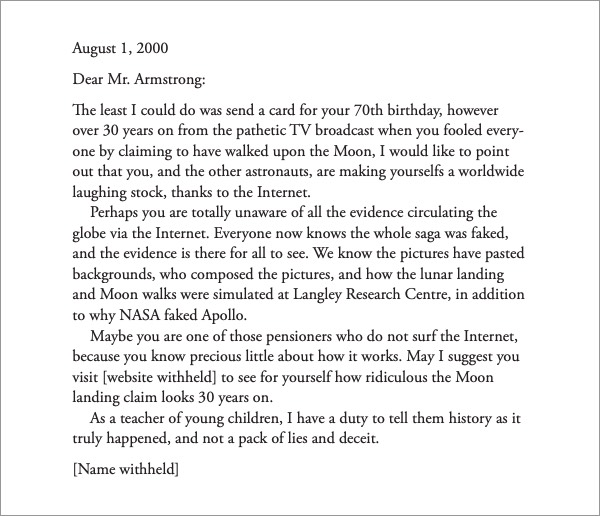
Twen­ty years ago, one pio­neer­ing truther wrote Mr. Neil Arm­strong to put him in his place about that bug­bear, the faked moon land­ing. The author of the let­ter, a Mr. Whit­man, iden­ti­fies him­self as a “teacher of young chil­dren” charged with “a duty to tell them his­to­ry as it tru­ly hap­pened, and not a pack of lies and deceit.” His let­ter shows some dif­fi­cul­ty with gram­mar, and even more with crit­i­cal think­ing and stan­dards of evi­dence.

Mr. Whit­man makes his accu­sa­tions with cer­tain­ty and smug­ness. “Per­haps you are total­ly unaware,” he writes, “of all the evi­dence cir­cu­lat­ing the globe via the Inter­net,” which he then sum­ma­rizes.

He also sends Neil Armstrong—an astro­naut who either walked on the Moon or engaged in per­haps the great­est con­spir­a­cy in history—a URL, “to see for your­self how ridicu­lous the Moon land­ing claim looks 30 years on.” Whit­man sent Arm­strong the let­ter on the astro­naut’s 70th birth­day.

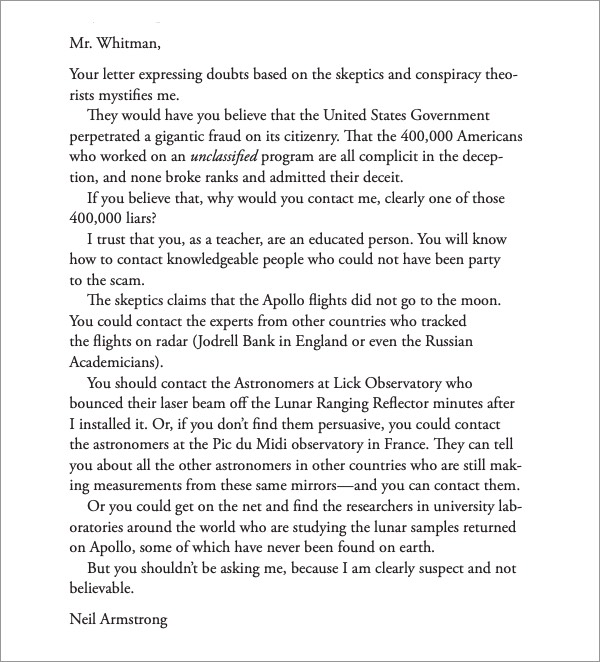
Armstrong’s response, via Let­ters of Note, can be read in full above. Per­haps Mr. Whit­man learned some­thing from the exchange—or had a moment of clar­i­ty about his meth­ods of inves­ti­ga­tion. One can hope. In any case, Armstrong’s unspar­ing reply serves as a tem­plate for responding—should some­one be so inclined—to inter­net truthers armed with wild con­spir­a­cy the­o­ries 20 years lat­er. These let­ters have been col­lect­ed in A Reluc­tant Icon: Let­ters to Neil Arm­strong.

via Kot­tke

Relat­ed Con­tent: 

Stan­ley Kubrick Faked the Apol­lo 11 Moon Land­ing in 1969, Or So the Con­spir­a­cy The­o­ry Goes

Watch the Orig­i­nal TV Cov­er­age of the His­toric Apol­lo 11 Moon Land­ing: Record­ed on July 20, 1969

Every Har­row­ing Sec­ond of the Apol­lo 11 Land­ing Revis­it­ed in a New NASA Video: It Took Place 50 Years Ago Today (July 20, 1969)

Josh Jones is a writer and musi­cian based in Durham, NC. Fol­low him at @jdmagness

Pretty Much Pop: A Culture Podcast #49 Considers Conspiracy Theories as Pop

Ex-philoso­pher Al Bak­er works at the UK-based Log­i­cal­ly, a com­pa­ny that fights mis­in­for­ma­tion.

He joins your hosts Mark Lin­sen­may­er, Eri­ca Spyres, and Bri­an Hirt to try to answer such ques­tions as: What’s the appeal of con­spir­a­cy the­o­ries? How sim­i­lar is being con­sumed them to being a die-hard fan of some pop cul­ture prop­er­ty? What’s the rela­tion between per­ni­cious con­spir­a­cy the­o­ries and fun spec­u­la­tion (like, maybe Elvis is alive)? Is there a harm­less way to engage in con­spir­a­cy the­o­riz­ing as a hob­by? Is some­thing still a con­spir­a­cy the­o­ry in the pejo­ra­tive sense if it turns out to be true?

We touch on echo cham­bers, the role of irony and humor in spread­ing these the­o­ries, how both oppo­nents and pro­po­nents claim to be skep­tics, Dan Brown Nov­els, Tom Han­ks, the Mel Gib­son film Con­spir­a­cy The­o­ry, and doc­u­men­taries like Behind the Curve (about Flat Earth­ers) and The Fam­i­ly.

For expert opin­ions on the psy­chol­o­gy of con­spir­a­cy the­o­ries, try The Con­ver­sa­tion’s Antill Pod­cast, which had a whole series on this top­ic. For even more pod­cast action, try FiveThir­tyEight, BBC’s The Why Fac­tor pod­cast, Skep­toid, and The Infi­nite Mon­key Cage.

Here are some more arti­cles:

If you enjoy this, try Pret­ty Much Pop #14 on UFOs. The Par­tial­ly Exam­ined Life episodes referred to in this dis­cus­sion are #96 on Oppen­heimer and the Rhetoric of Sci­ence Advis­ers and #82 on Karl Pop­per.

Learn more at prettymuchpop.com. This episode includes bonus dis­cus­sion that you can only hear by sup­port­ing the pod­cast at patreon.com/prettymuchpop. This pod­cast is part of the Par­tial­ly Exam­ined Life pod­cast net­work.

Pret­ty Much Pop: A Cul­ture Pod­cast is the first pod­cast curat­ed by Open Cul­ture. Browse all Pret­ty Much Pop posts or start with the first episode.

The World According to Le Corbusier: An Animated Introduction to the Most Modern of All Architects

Among mod­ern archi­tects, was any archi­tect ever so moder­ni­ty-mind­ed as Charles-Édouard Jean­neret, bet­ter known a Le Cor­busier? Like many cul­tur­al fig­ures well-known out­side their field — Franz Kaf­ka, George Orwell, David Lynch — his name has long since been adjec­tivized, though nowa­days the term “Cor­bu­sian” is sel­dom used as a com­pli­ment. Many a self-described oppo­nent of mod­ern archi­tec­ture, what­ev­er they con­sid­er mod­ern archi­tec­ture to be, points to Le Cor­busier as the orig­i­na­tor of all the inhu­man­i­ty of build­ings designed over the past 90 years, and espe­cial­ly the sec­ond half of the 20th cen­tu­ry: their drab col­ors (or lack there­of), their depress­ing aus­ter­i­ty, their for­bid­ding scale, their dark cor­ri­dors, their leaky roofs. But how much, real­ly, is he to blame?

“Le Cor­busier rec­om­mend­ed that the hous­es of the future be ascetic and clean, dis­ci­plined and fru­gal,” says The Book of Life, the com­pan­ion site to Alain de Bot­ton’s School of Life. Remem­bered as an archi­tect but both an artist and engi­neer at heart, he thought that “true, great archi­tec­ture – mean­ing, archi­tec­ture moti­vat­ed by the quest for effi­cien­cy – was more like­ly to be found in a 40,000-kilowatt elec­tric­i­ty tur­bine or a low-pres­sure ven­ti­lat­ing fan” than in the cap­i­tals of old Europe. For inspi­ra­tion he looked to mod­ern machines, espe­cial­ly those that had begun appear­ing in the sky in his youth: “he observed that the require­ments of flight of neces­si­ty rid air­planes of all super­flu­ous dec­o­ra­tion,” says de Bot­ton in the ani­mat­ed School of Life primer above, “and so unwit­ting­ly trans­formed them into suc­cess­ful pieces of archi­tec­ture.”

Hence Le Cor­busier’s infa­mous pro­nounce­ment that “a house is a machine for liv­ing in,” which first appeared in his 1923 man­i­festo Vers une archi­tec­ture (Towards an Archi­tec­ture). Le Cor­busier was a writer — and a painter, and a fur­ni­ture design­er, and an urban plan­ner — as much as he was an archi­tect. “The prob­lem is that both his detrac­tors and his acolytes want to believe that his writ­ten man­i­festos, urban­is­tic visions, utopi­an ide­olo­gies and the­o­ries are com­pat­i­ble with his build­ings,” writes Jonathan Meades, some­time archi­tec­tur­al crit­ic and full-time res­i­dent of Le Cor­busier’s Unité d’habi­ta­tion apart­ment block in Mar­seilles. But “Le Cor­busier, writer, has lit­tle in com­mon with Le Cor­busier, mak­er of the century’s most pro­found­ly sen­su­ous, most mov­ing archi­tec­ture”: one was a “self-adver­tis­ing pro­pa­gan­dist,” the oth­er “an artist-crafts­man of peer­less orig­i­nal­i­ty.”

Le Cor­busier’s head­line-mak­ing urban-renew­al pro­pos­als includ­ed, Meades writes, “the destruc­tion of the Right Bank in Paris and its replace­ment with ranks of cru­ci­form sky­scrap­ers”; he also pro­posed demol­ish­ing Man­hat­tan, as de Bot­ton says, “to make way for a fresh and more ‘Carte­sian’ attempt at urban design.” Le Cor­busier’s utopi­an dreams of colos­sal sky­scrap­ers placed in the mid­dle of vast green park­land and sur­round­ed by ele­vat­ed free­ways led, in this telling, to “the dystopi­an hous­ing estates that now ring his­toric Paris, the waste­lands from which tourists avert their eyes in con­fused hor­ror and dis­be­lief on their way into the city.” But if cities can still use Le Cor­busier’s plan­ning ideas as a neg­a­tive exam­ple, they have more to learn from the pos­i­tive exam­ple of his aes­thet­ic sen­si­bil­i­ty, which remains exhil­a­rat­ing today, even amid a kind of moder­ni­ty the man him­self could nev­er have imag­ined.

Relat­ed Con­tent:

Watch 50+ Doc­u­men­taries on Famous Archi­tects & Build­ings: Bauhaus, Le Cor­busier, Hadid & Many More

Vis­it the Homes That Great Archi­tects Designed for Them­selves: Frank Lloyd Wright, Le Cor­busier, Wal­ter Gropius & Frank Gehry

An Espres­so Mak­er Made in Le Corbusier’s Bru­tal­ist Archi­tec­tur­al Style: Raw Con­crete on the Out­side, High-End Parts on the Inside

Every­thing You Ever Want­ed to Know About the Beau­ty of Bru­tal­ist Archi­tec­ture: An Intro­duc­tion in Six Videos

The Mod­ernist Gas Sta­tions of Frank Lloyd Wright and Mies van der Rohe

Mod­ernist Bird­hous­es Inspired by Bauhaus, Frank Lloyd Wright and Joseph Eich­ler

Based in Seoul, Col­in Mar­shall writes and broad­casts on cities, lan­guage, and cul­ture. His projects include the book The State­less City: a Walk through 21st-Cen­tu­ry Los Ange­les and the video series The City in Cin­e­ma. Fol­low him on Twit­ter at @colinmarshall, on Face­book, or on Insta­gram.

« Go BackMore in this category... »
Quantcast