From the mighty Maya civilization, which dominated Mesoamerica for more than three and a half millennia, we have exactly four books. Only one of them predates the arrival of Spanish conquistadors in the sixteenth century: the Códice Maya de México, or Maya Codex of Mexico, which was created between 1021 and 1152. Though incomplete, and hardly in good shape otherwise, its artwork — colored in places with precious materials — vividly evokes an ancient worldview now all but lost. In the video above from the Getty Museum and Smarthistory, art historians Andrew Turner and Lauren Kilroy-Ewbank tell us what we’re looking at when we behold the remains of this sacred Mayan book, the oldest ever found in the Americas.
“This book has a controversial history,” says Turner. “It was long considered to be a fake due to the strange circumstances in which it surfaced.” After its discovery in a private collection in Mexico City in the nineteen-sixties, it was rumored to have been looted from a cave in Chiapas.
At first pronounced a fake by experts, due to its lack of resemblance to the other extant Mayan texts, it was only verified as the genuine article in 2018. For a non-specialist, the question remains: what is the Códice about? Its purpose, as Kilroy-Ewbank puts it, is astronomical, relaying as it does “information about the cycle of the planet Venus” — which, as Turner adds, “was considered a dangerous planet” by the Mayans.
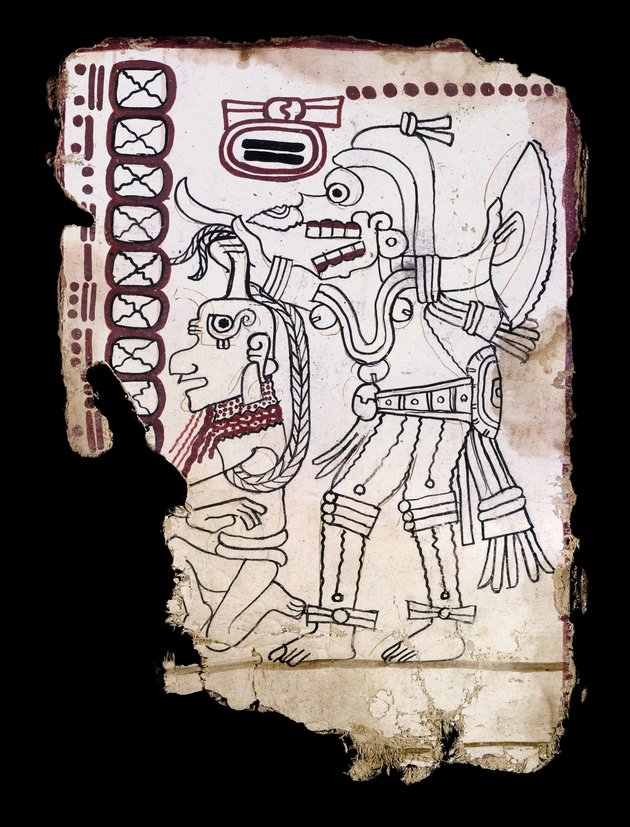
The Códice contains records of Venus’ 584-day cycle over the course of 140 years, testifying to the scrutiny Mayan astronomers gave to its complicated pattern of rising and falling. They thus managed to determine — as many ancient civilizations did not — that it was both the Morning Star and the Evening Star, although they seem to have been more interested in what its movements revealed about the intentions of the deities they saw as controlling it, and thus the likelihood of events like war or famine. Those gods weren’t benevolent: one page shows “a frightful skeletal deity that has a blunt knife sticking out of his nasal cavity,” holding “a giant jagged blade up” with one hand and “the hair of a captive whose head he’s freshly severed” with the other. That’s hardly the sort of image that comes to our modern minds when we gaze up at the night sky, but then, we don’t see things like the Mayans did.
via Aeon
Related content:
A 400-Year-Old Ring that Unfolds to Track the Movements of the Heavens
The Ancient Astronomy of Stonehenge Decoded
How the Ancient Mayans Used Chocolate as Money
Based in Seoul, Colin Marshall writes and broadcasts on cities, language, and culture. His projects include the Substack newsletter Books on Cities and the book The Stateless City: a Walk through 21st-Century Los Angeles. Follow him on the social network formerly known as Twitter at @colinmarshall.




Article doesn’t mention WHY we have only four codices, the organized destruction of countless hundreds of volumes by priests and friars of the Catholic church, one of history’s greatest crimes against knowledge.
The oldest book of America is translated in over 115 languages. The above book might be old but not as old as.…you know!
“That’s hardly the sort of image that comes to our modern minds when we gaze up at the night sky, but then, we don’t see things like the Mayans did.”
You know… There are some things that make me stop and ask, “Why WOULDN’T you want to stop and be grateful we don’t see things the way some other culture does?” Especially when the other culture was known for its bloodthirsty ways and violence. The Aztecs were well-known for their human sacrifices of thousands “for a bountiful harvest”. Young souls… their future. It’s no wonder they died out, and their culture is buried in the jungle. People who sacrifice their youth are bound to be undone. This thought rules my mind when I see archeologists “ooh-ing and ahh-ing” over some mural of a savage priest holding a severed head over a river of blood, calling it “beautiful”. I think, personally, some things were meant to stay buried. Human sacrifice is one of those things.
Agreed 100%
What about modern day governments who sacrifice their people to the corporations that it serves. or who sacrifice their youth by sending them to war. or who sacrifice other people’s youth by allowing other countries to bomb the life out of them. or what about a country who inslaves others and mass murders natives in order to manifest a self serving destiny. the savagery continues.
Actually the few remaining codixes and other relics belonging to the Mexica are in places like France, Italy, Spain, Germany, Austria, the Vatican, and they refuse to return them. Stolen artifacts.
The Book of Mormon is a record of the first Americans to arrive on this continent 600 BC. They left the Middle East and cross the ocean under the direction of the Lord because Jerusalem was being destroyed. Jesus Christ visited these people after he was resurrected. The American Indians were decendants of these people. The Book of Mormon is the oldest book about ever written about the Americas and it is available in over 200 languages.
The Mayans are alive and well and unlike their spanish invaders created astronomically correct records in their books and the calender still in use today. All hundreds of years before the bible and its swath of destroying cultures or trying to. They are all still alive.