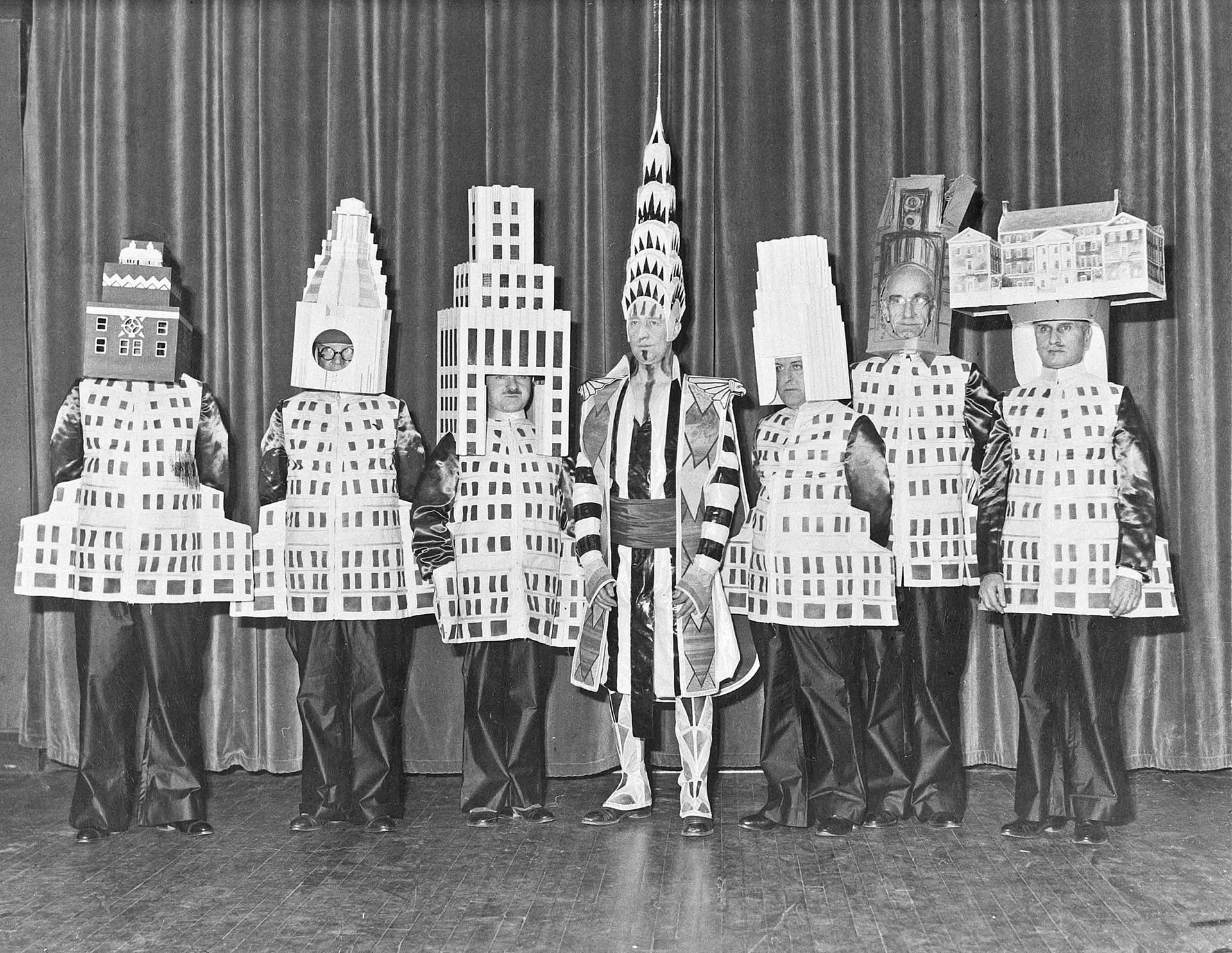
Famous Architects Dress as Their Famous New York City Buildings (1931)

On Jan­u­ary 13, 1931, the Soci­ety of Beaux-Arts Archi­tects held a ball at the Hotel Astor in New York City. Accord­ing to an adver­tise­ment for the event, any­one who paid $15 per tick­et (big mon­ey dur­ing the Depres­sion) could see a “hilar­i­ous mod­ern art exhi­bi­tion” and things “mod­ernistic, futur­is­tic, cubis­tic, altru­is­tic, mys­tic, archi­tis­tic and fem­i­nis­tic.” Atten­dees also got to wit­ness more than 20 famous archi­tects dressed as build­ings they had designed—buildings that would become fix­tures of the New York City sky­line.

In the pic­ture above, we have from left to right: A. Stew­art Walk­er as the Fuller Build­ing (1929), Leonard Schultze as the Wal­dorf-Asto­ria Hotel (1931), Ely Jacques Kahn as the Squibb Build­ing (1930), William Van Alen as the Chrysler Build­ing (1930), Ralph Walk­er as 1 Wall Street (1931), D.E. Ward as the Met­ro­pol­i­tan Tow­er and Joseph H. Freed­lan­der as the Muse­um of the City of New York (1930).

A 2006 arti­cle in The New York Times notes that the event, now con­sid­ered “one of the most spec­tac­u­lar par­ties of the last cen­tu­ry,” was cov­ered by WABC radio. A few pho­tographs remain, like the one above. As does a tan­ta­liz­ing short bit of video.

If you would like to sign up for Open Culture’s free email newslet­ter, please find it here. It’s a great way to see our new posts, all bun­dled in one email, each day.

If you would like to sup­port the mis­sion of Open Cul­ture, con­sid­er mak­ing a dona­tion to our site. It’s hard to rely 100% on ads, and your con­tri­bu­tions will help us con­tin­ue pro­vid­ing the best free cul­tur­al and edu­ca­tion­al mate­ri­als to learn­ers every­where. You can con­tribute through Pay­Pal, Patre­on, and Ven­mo (@openculture). Thanks!

via NYT

Relat­ed Con­tent:

Archi­tect Breaks Down the Design Of Four Icon­ic New York City Muse­ums: the Met, MoMA, Guggen­heim & Frick

Archi­tect Breaks Down Five of the Most Icon­ic New York City Apart­ments

An Immer­sive, Archi­tec­tur­al Tour of New York City’s Icon­ic Grand Cen­tral Ter­mi­nal

A Whirl­wind Archi­tec­tur­al Tour of the New York Pub­lic Library–“Hidden Details” and All


What’s Entering the Public Domain in 2025: Hemingway’s A Farewell to Arms, Faulkner’s The Sound and the Fury, Early Hitchcock Films, Tintin and Popeye Cartoons & More

Each Pub­lic Domain Day seems to bring us a rich­er crop of copy­right-lib­er­at­ed books, plays, films, musi­cal com­po­si­tions, sound record­ings, works of art, and oth­er pieces of intel­lec­tu­al prop­er­ty. This year hap­pens to be an espe­cial­ly notable one for con­nois­seurs of Bel­gian cul­ture. Among the char­ac­ters enter­ing the Amer­i­can pub­lic domain, we find a cer­tain boy reporter named Tintin, who first appeared — along with his faith­ful pup Milou, or in Eng­lish, Snowy — in the Jan­u­ary 10th, 1929 issue of Le Petit Vingtième, the chil­dren’s sup­ple­ment of the news­pa­per Le Vingtième Siè­cle.

Now, here in le vingt-et-unième-siè­cle, that first ver­sion of Tintin can be rein­vent­ed in any man­ner one can imag­ine — at least in the Unit­ed States. In the Euro­pean Union, as the Duke Cen­ter for the Study of the Pub­lic Domain direc­tors Jen­nifer Jenk­ins and James Boyle note in their Pub­lic Domain Day blog post for this year, that Tintin remains under copy­right until 2054, a date based on his cre­ator Hergé hav­ing died in 1983. The thor­ough­ly Amer­i­can com­ic-strip hero Pop­eye also made his debut in 1929, but as Jenk­ins and Boyle has­ten to add, while that “Pop­eye 1.0 had super­hu­man capa­bil­i­ties, he did not derive them from eat­ing spinach until 1931.” Even so, “it appears that the copy­right in this 1931 com­ic strip was not renewed — if this is true, Popeye’s spinach-fueled strength is already in the pub­lic domain.”

This year also brings a devel­op­ment in a sim­i­lar mat­ter of detail relat­ed to no less a car­toon icon than Mick­ey Mouse: last year freed the first ver­sion of Mick­ey Mouse, his riv­er-nav­i­gat­ing, farm-ani­mal-bash­ing Steam­boat Willie incar­na­tion. “In 2025 we wel­come a dozen new Mick­ey Mouse films from 1929,” write Jenk­ins and Boyle, “Mick­ey speaks his first words – ‘Hot dogs! Hot dogs!’ – and debuts his famil­iar white gloves. That ver­sion of Mick­ey is now offi­cial­ly in the pub­lic domain.”

This Pub­lic Domain Day also brings us lit­er­ary works like Faulkn­er’s The Sound and the Fury, Hem­ing­way’s A Farewell to Arms, Woolf’s A Room of One’s Own (as well as detec­tive nov­els from Agatha Christie and the pseu­do­ny­mous Ellery Queen, once the biggest mys­tery writer in Amer­i­ca); the first sound films by Alfred Hitch­cock, John Ford, and the Marx Broth­ers; musi­cal com­po­si­tions like “Sin­gin’ in the Rain,” Gersh­win’s An Amer­i­can in Paris, and Rav­el’s Boléro; actu­al record­ings of Rhap­sody in Blue and “It Had To Be You”; and Sur­re­al­ist works of art by Sal­vador Dalí and — pend­ing fur­ther inves­ti­ga­tion into their copy­right sta­tus — per­haps even René Magritte, whose L’empire des lumières just sold for a record $121 mil­lion. Who knows? 2025 could be the year we all look to Bel­gium for inspi­ra­tion.

For more on what’s enter­ing the pub­lic domain today, vis­it this Duke Uni­ver­si­ty web­site.

Relat­ed Con­tent:

Hergé Draws Tintin in Vin­tage Footage (and What Explains the Character’s Endur­ing Appeal)

An Intro­duc­tion to René Magritte, and How the Bel­gian Artist Used an Ordi­nary Style to Cre­ate Extra­or­di­nar­i­ly Sur­re­al Paint­ings

William Faulkn­er Reads His Nobel Prize Speech

Alfred Hitch­cock Presents Some of the First Words Ever Spo­ken on Film .… and They’re Saucy Ones (1929)

An Ear­ly Ver­sion of Mick­ey Mouse Enters the Pub­lic Domain on Jan­u­ary 1, 2024

What’s Enter­ing the Pub­lic Domain in 2024: Enjoy Clas­sic Works by Vir­ginia Woolf, Char­lie Chap­lin, Buster Keaton, D. H. Lawrence, Bertolt Brecht & More

Based in Seoul, Col­in Marshall writes and broad­casts on cities, lan­guage, and cul­ture. His projects include the Sub­stack newslet­ter Books on Cities and the book The State­less City: a Walk through 21st-Cen­tu­ry Los Ange­les. Fol­low him on the social net­work for­mer­ly known as Twit­ter at @colinmarshall.

« Go Back
Quantcast

