Americans of a certain age may well remember growing up with an Apple II in the classroom, and the perpetual temptation it held out to play The Oregon Trail, Number Munchers, or perhaps Lode Runner. More than a few recess gamers went on to computer-oriented careers, but only the most curious sought an answer to the question implied in the machine’s name: was there an Apple I? Half a century after the foundation of Apple, Inc., then known as Apple Computer, the product that launched what’s now one of the world’s most valuable companies remains very much an obscurity. Unless you frequent computer museums, you’re unlikely ever to have laid eyes on an Apple I, let alone used one. Even if one of the existing models were to come on the market, you’d need about half a million dollars to buy it.
It’s actually easier to buy the parts that went into an Apple I and build it yourself — which, as demonstrated by the 8‑Bit Guy in the video above, still isn’t easy at all. Yet it does convey something of what Apple’s very first customers would have experienced in 1976, when do-it-yourself was the order of the day in computing.
When I bought the MacBook on which I’m writing this post, I simply opened it up and, naturally, found it ready to use. That would scarcely have been imaginable to computer enthusiasts of the mid-seventies, accustomed as they were to soldering individually purchased chips onto electronics boards by hand. The Apple I marked a great leap forward in convenience by coming already assembled, albeit without a monitor, a keyboard, or even a case; the purchase price of USD $666.66 (closer to $4,000 today) just got you the board. But what a board.
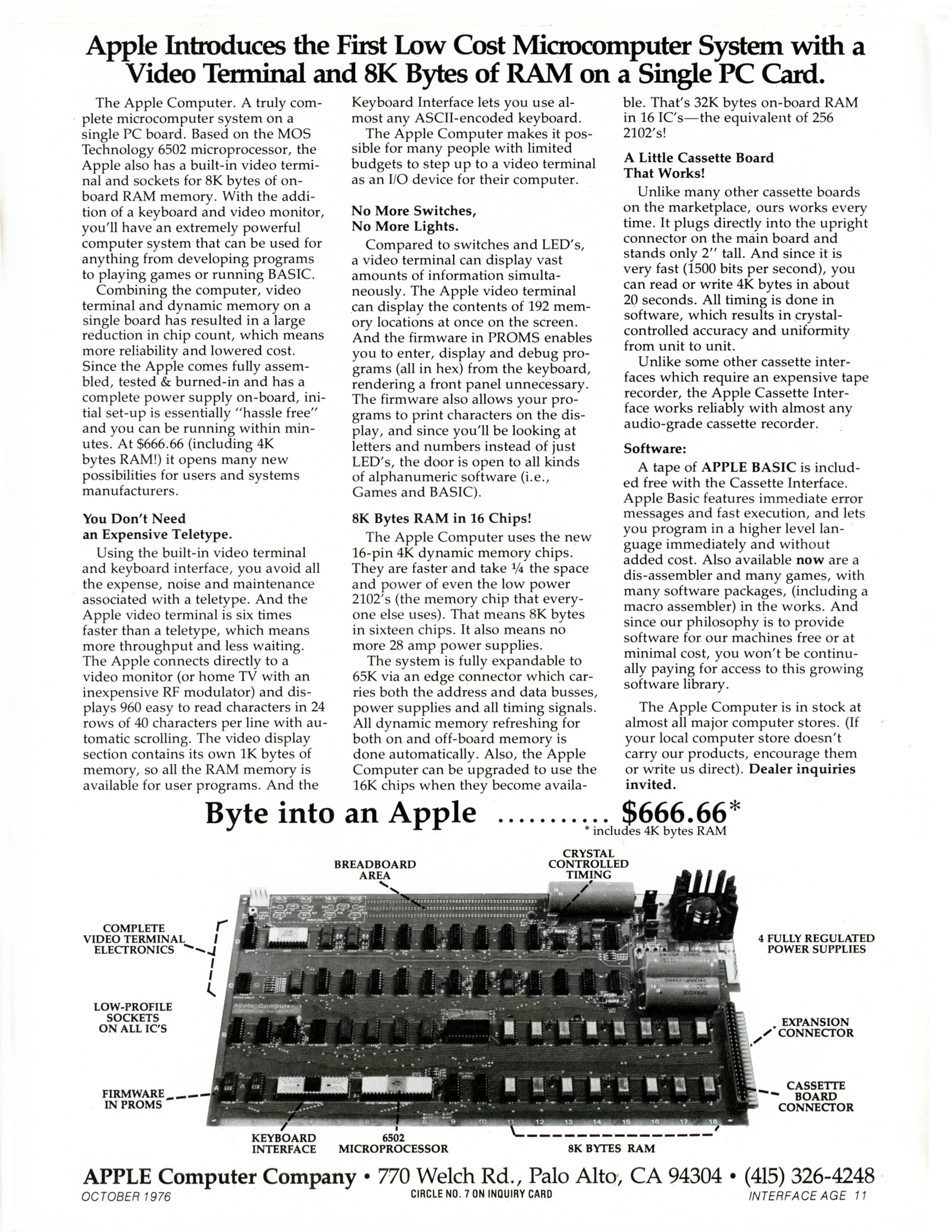
Though we remember Steve Jobs as the mastermind, the Apple I is a tour de force of the engineering genius of his business partner Steve Wozniak. When the Steves debuted it at the Homebrew Computer Club in July of 1976, the relatively small number of chips and advanced functions (BASIC programming! Cassette-tape data storage! Actual video output, if only of teletype-like scrolling text!) created a considerable demand then and there. We often hear of Jobs and Wozniak starting Apple in a garage, and it was in that garage (as well as the house’s living room) that the first Apple I boards were put together. Ultimately, 200 were sold before the Apple II arrived the following year. Apple’s first computer may look intimidating to most of today’s Mac users. But consider the company’s reputation for minimalism, accessibility, and a knack for capturing the consumer’s imagination: all qualities present on that board 50 years ago.
Related content:
Before The Simpsons, Matt Groening Illustrated a “Student’s Guide” for Apple Computers (1989)
Discovered: The User Manual for the Oldest Surviving Computer in the World
Based in Seoul, Colin Marshall writes and broadcasts on cities, language, and culture. He’s the author of the newsletter Books on Cities as well as the books 한국 요약 금지 (No Summarizing Korea) and Korean Newtro. Follow him on the social network formerly known as Twitter at @colinmarshall.




Leave a Reply