It’s no small project to found a new society, especially when you’re doing it on the scale of a place like Russia. Apart from the considerable practical challenges it entails, there’s also the need for symbols bold enough to represent the underlying ideal. The avant-garde artist Vladimir Tatlin took it upon himself to create just such a symbol in the years after the Russian Revolution. The result is officially known as the Monument to the Third International, named for the organization tasked with the promotion of world communism (often abbreviated to Comintern). But it’s more commonly referred to as Tatlin’s Tower, perhaps in tribute to the artist’s particular vision — one too ambitious for its real-life construction even to begin.
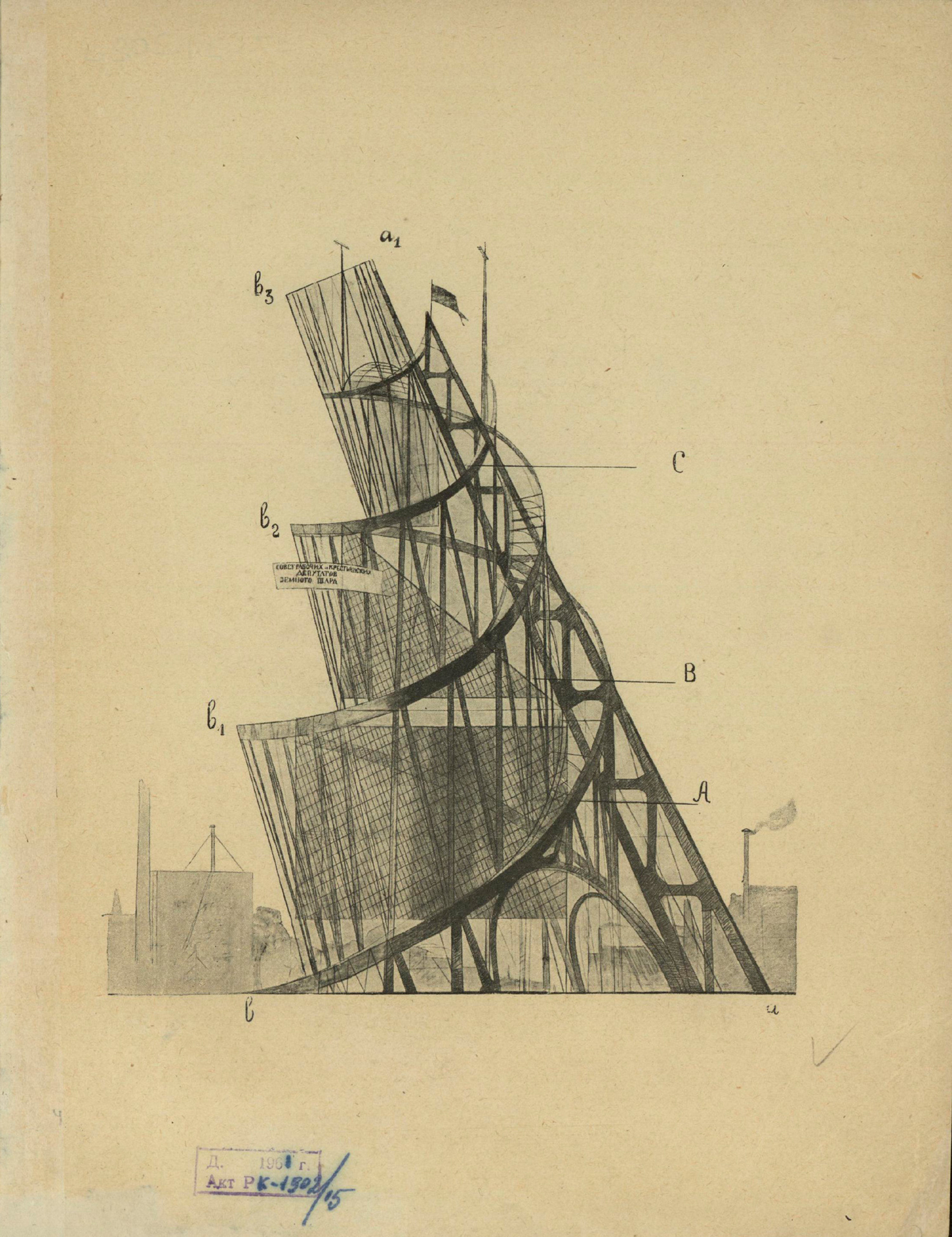
“As part of a large-scale program to replace old czarist monuments with monuments to the revolution, the huge structure was both a symbolic sculpture and functional architecture,” write Smarthistory’s Charles Cramer and Kim Grant. “Designed to straddle the Neva river in St. Petersburg, the 1300 foot (400 meter) iron and glass Monument would surpass Paris’s Eiffel Tower in both scale and complexity.”
Indeed, it would stand taller than the yet-to-be-constructed Empire State Building, at least if you don’t count its antenna. Consisting of “a contracting double helix that spirals upward, supported by a huge diagonal girder,” Tatlin’s Tower would contain four sub-structures, each rotating at a different speed.
Yes, rotating, and “completing a full revolution in accordance with the importance of the institutions conducting their business on the inside,” as Tim Brinkof writes at Big Think. “The cube that contains the legislature would have completed a full rotation once per year. The pyramid above, housing the offices of party executives, would have needed a month. The information center, located at the very peak, would have rotated once a day, offering a 360-degree view of Petrograd,” as St. Petersburg was known in 1920. (It would be re-named Leningrad in 1924 before going back to St. Petersburg in 1991, after the end of the Soviet era.) You can learn more about how it all worked from the Architecture Enthusiast video at the top of the post, and the one from Sideprojects just above.
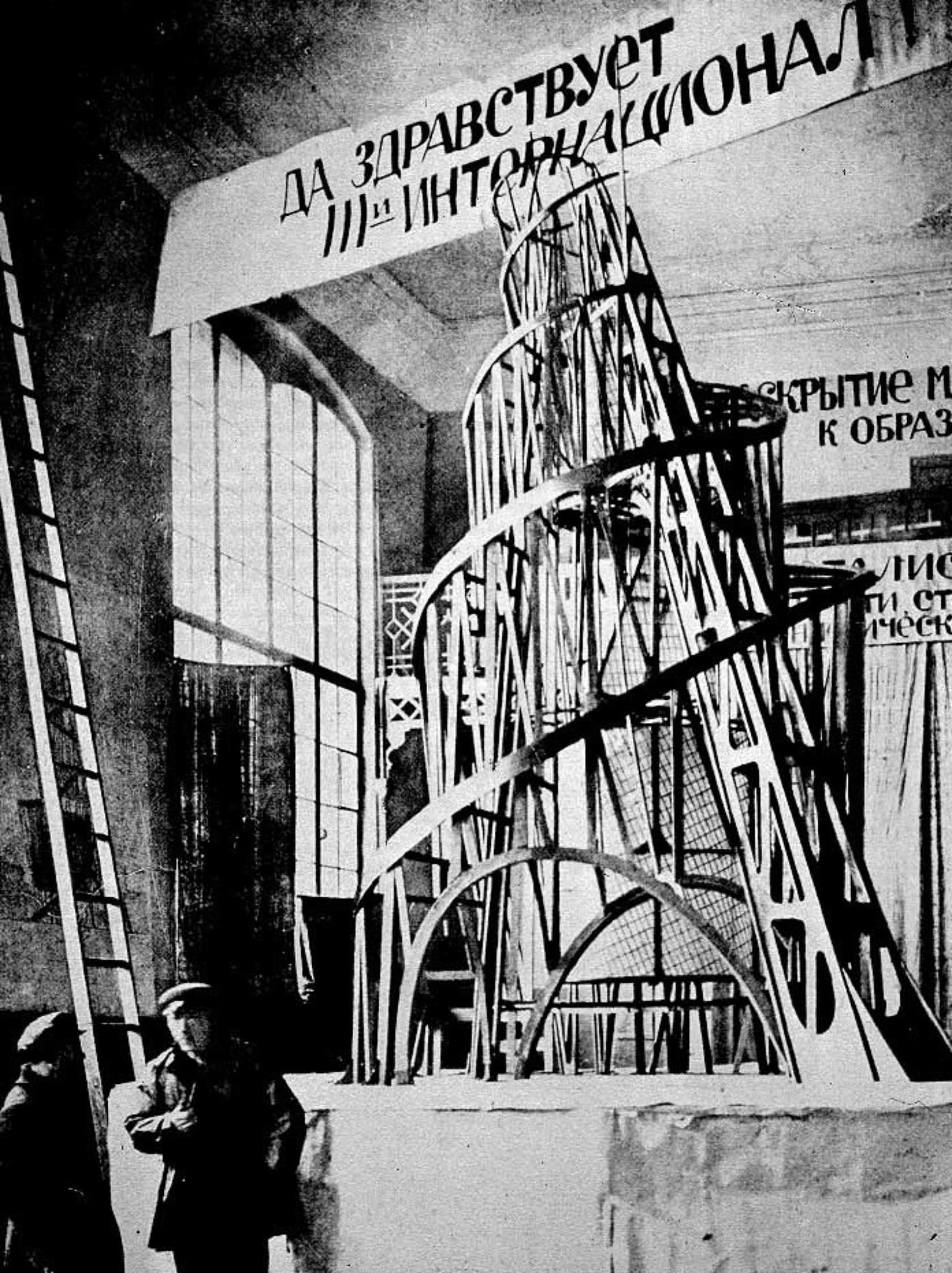
“Tatlin’s Tower was designed during a time when Communist rule was still nascent and party leaders sought to establish a new and distinctly socialist identity through art,” writes Brinkof. Idealized representations of the ruling class having been aggressively scrapped along with the ruling class itself, the Bolsheviks welcomed any style that could shore up their revolutionary cause, total abstraction included. Alas, though many party officials approved of Tatlin’s design, they commanded nothing like the resources to build it: “Russia would go bankrupt if it tried to acquire the insane amounts of steel and iron needed for the tower’s skeletal framework.” Perhaps Leon Trotsky, one of the project’s dissenters, was right when he called it “impractical and romantic” — and perhaps those are the very qualities that keep Tatlin’s Tower an object of fascination more than a century later.
Related content:
The Utopian, Socialist Designs of Soviet Cities
What Makes Kazimir Malevich’s Black Square (1915) Not Just Art, But Important Art
The Futurist Architectural Designs Created by Étienne-Louis Boullée in the 18th Century
Based in Seoul, Colin Marshall writes and broadcasts on cities, language, and culture. He’s the author of the newsletter Books on Cities as well as the books 한국 요약 금지 (No Summarizing Korea) and Korean Newtro. Follow him on the social network formerly known as Twitter at @colinmarshall.




Leave a Reply