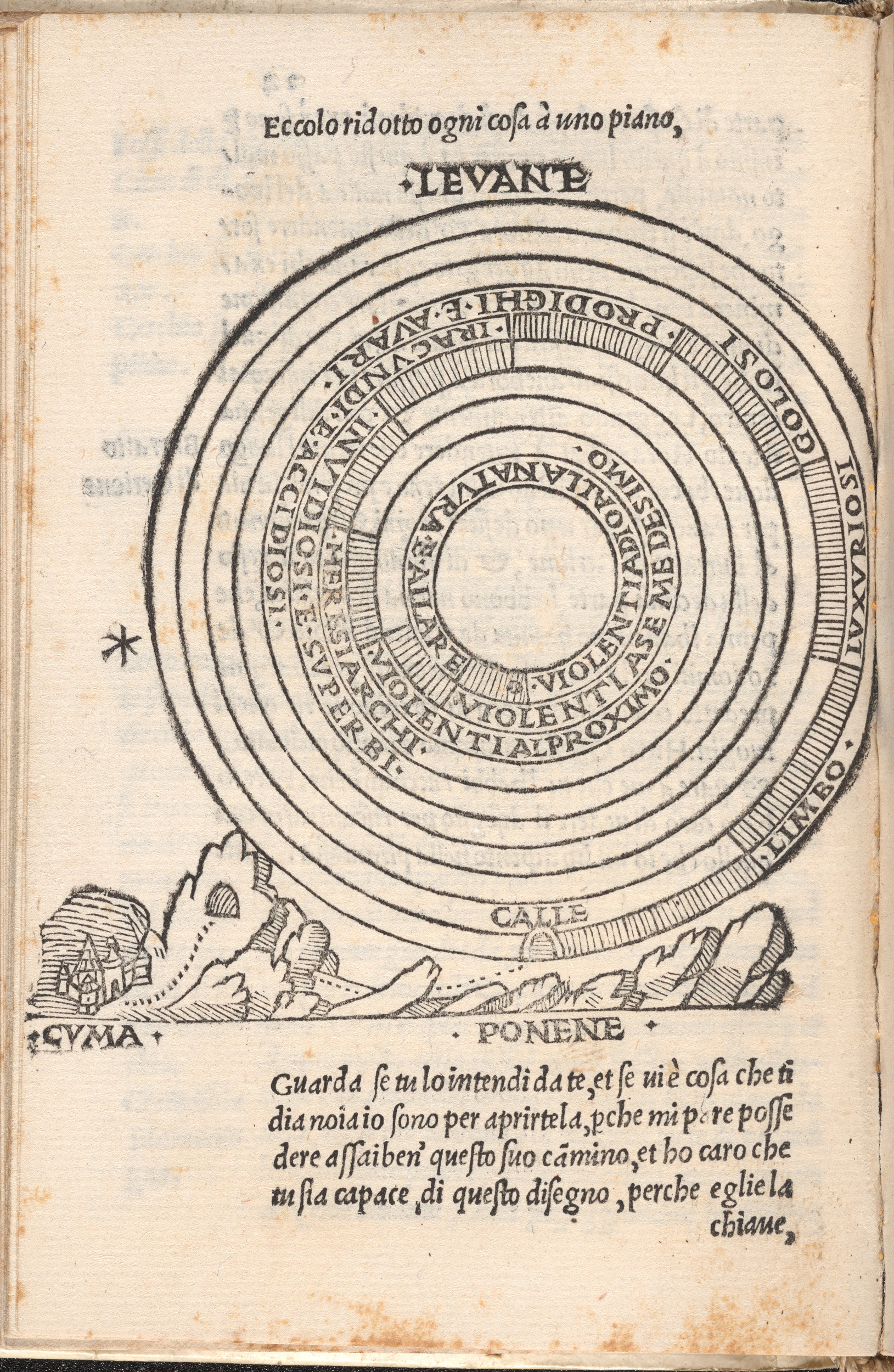
We venerate Galileo Galilei for daring to speak the scientific truth in the face of severe institutional opposition. He publicly acknowledged that the Earth revolves around the Sun in a time when the Church would rather he didn’t, displaying a bloody-mindedness that he seems to have acquired with age. Decades earlier, in the first stage of his career, he found himself (circa 1588) tasked by the Florentine Academy with calculating the precise dimensions of hell as described in Dante’s Divine Comedy. Dutifully applying himself to this now-absurd-sounding work, he determined that the underworld’s roof had to be centered in Jerusalem, as wide as the radius of the entire Earth, and no less than 600 kilometers thick.
Not that any of this was based on frivolous reasoning. As a model for the dimensions of hell’s roof, for instance, Galileo looked over to Filippo Brunelleschi’s dome, which had topped the Florence Cathedral for a century and a half at that point. Galileo’s calculations of hell’s dimensions contradicted an earlier model proposed by the scholar Alessandro Vellutello. Instead, they supported a model developed by architect Antonio Manetti, whose drawings appear here.
That Manetti was a fellow Florentine, and Vellutello was from Florence’s longtime rival Lucca could well have counted among the motivating factors. But we must bear in mind that, in the sixteenth century, people really did want to get these facts straight — if “facts” be the proper term.
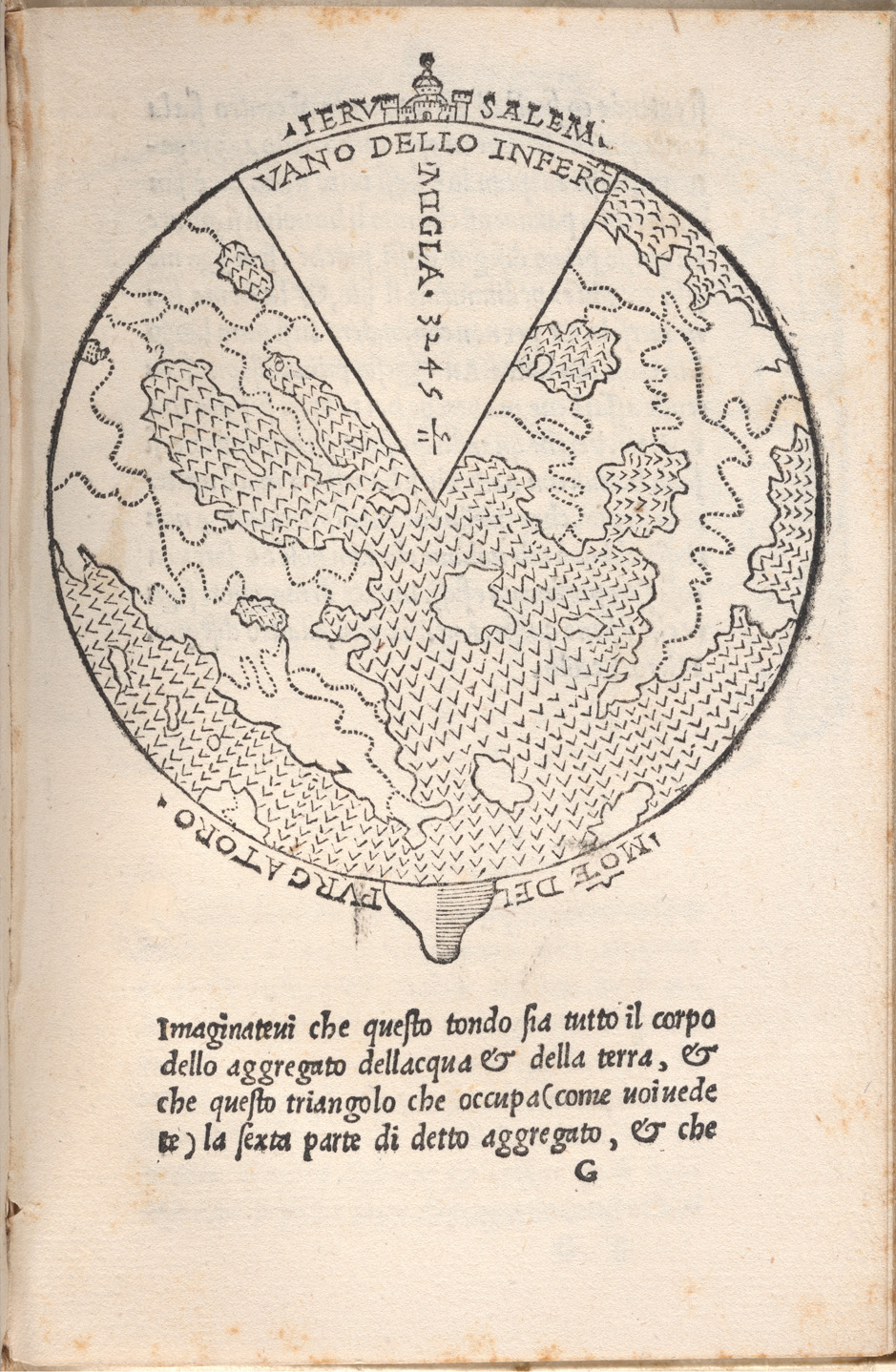
The attempt to reconcile scripture with objectivity absorbed the lives of many highly intelligent people throughout the Middle Ages and the Renaissance. However hopeless that goal could be, the thought Galileo devoted to the problem may have resulted in a genuine breakthrough. Mathematician and science historian Mark Peterson, previously featured here on Open Culture, has argued that his calculations of Dante’s non-Euclidean, topology-curved universe — as we might plausibly describe it today — laid out the basis for what would become mathematical physics. In any case, the young Galileo’s lectures at the Florentine Academy landed him a job as a mathematics lecturer at the University of Pisa, as good a reason as any for him to keep his private doubts to himself. When it comes to science and religion, as he must have known, you’ve got to pick your battles.
Related content:
Dante’s Divine Comedy: A Visitor’s Guide to Hell, Purgatory & Paradise
Physics from Hell: How Dante’s Inferno Inspired Galileo’s Physics
Beautiful 19th Century Maps of Dante’s Divine Comedy: Inferno, Purgatory, Paradise & More
A Digital Archive of the Earliest Illustrated Editions of Dante’s Divine Comedy (1487–1568)
Based in Seoul, Colin Marshall writes and broadcasts on cities, language, and culture. He’s the author of the newsletter Books on Cities as well as the books 한국 요약 금지 (No Summarizing Korea) and Korean Newtro. Follow him on the social network formerly known as Twitter at @colinmarshall.




Leave a Reply