Dei Gaztelumendi is a young Spanish artist. He was commissioned recently to create a cover illustration for the comic book magazine Xabiroi, and decided to make a time-lapse video of the process. The result is a fascinating look at how the artist begins with a rough sketch on paper and then builds layer upon layer of detail using the Adobe Creative Suite software. Thirty hours of work are compressed into 11 minutes. “A lot of emotion went into this painting,” Gaztelumendi said on his blog, “since I made it as a gift to one of my buddies, who tragically lost a leg in a motorbike accident about a year ago.” Gaztelumendi was born in San Sebastian, Basque Country, Spain in 1987, and began illustrating children’s books as a teenager. He studied animation at Sheridan College in Ontario, Canada, where his thesis film was a whimsical tale called Earlth & Moonch. Since graduating with high honors last year, Gaztelumendi has been working as a commercial illustrator, specializing in creature and character art. You can see more of his work at Deisign.com.
A Brief Visual Introduction to Saul Bass’ Celebrated Title Designs
Title sequences begin and end every movie. They can be “engaging or wildly entertaining … or simply drop dead beautiful.” They can “ooze with visual poetry and sophisticated imagery.” And they can put the audience in the right mood for the movie, or close it in the right way, says the web site Forget the Films, Watch the Titles.
When it comes to title design, no one did it better than Saul Bass (1920–1996). During his long career in Hollywood, Bass designed sequences for Otto Preminger’s The Man with the Golden Arm (full movie here), Scorsese’s Goodfellas and Cape Fear, Kubrick’s Spartacus, and several films by Alfred Hitchcock. And that’s just beginning to scratch the surface.
Created by Ian Albinson, the montage above offers a brief visual history of Bass’s most celebrated work, stitching together designs from 25 films. (Find the full film list here.) If this whets your appetite, you’ll want to check out the newly-published book Saul Bass: A Life in Film & Design and this web site dedicated to Bass’s title design. And don’t miss our big collection of Free Movies Online.
If you would like to support the mission of Open Culture, consider making a donation to our site. It’s hard to rely 100% on ads, and your contributions will help us continue providing the best free cultural and educational materials to learners everywhere. You can contribute through PayPal, Patreon, and Venmo (@openculture). Thanks!
The World’s Highest Artificial Tornado
The Mercedes-Benz Museum in Stuttgart, Germany, is a remarkable structure. Designed by Ben van Berkel and Caroline Bos of the Dutch firm UN Studio, the building received rave reviews when it opened in May of 2006. Influenced by Frank Lloyd Wright’s Guggenheim Museum in New York, the building was described as “jet-age baroque” by The Guardian architecture critic Jonathan Glancey. “It twists and turns with breathtaking complexity,” Glancey wrote in 2006, “clever as a conjuring trick.”
The architects needed a bit of magic to bring the museum’s open plan into compliance with fire codes. Like in the Guggenheim, the interior is one continuously unfolding space that spirals around a central atrium. As a consequence there could be no fire doors to contain smoke if a blaze broke out in one section of the building. To solve the problem, UN Studio hired the engineering firm Imtech to design a system that would draw smoke away from all areas of the museum, allowing people to escape.
The result is the world’s largest man-made air vortex, a 112-foot-high tornado that automatically activates in the event of a fire, drawing smoke into the center of the atrium and moving it upward through an axial fan in the ceiling. An array of 144 outlets in the surrounding walls emit powerful jets of air to generate a central region of low pressure, just like in a real tornado. Imtech engineers perfected the design using computational fluid dynamic (CDF) simulations and laboratory models. The firm has created similar systems for airports in several German cities, including Düsseldorf and Hamburg. You can watch the tornado at the Mercedes-Benz Museum in action above.
Related Content:
A Day in Venezia
3,000,000 tourists move through Venice each year. The flood starts during the spring and peaks in summer, then recedes during the cooler months, giving the local residents a little peace. True, the city, made up of 124 islands, 183 canals and 438 bridges, is radiant during the summer. (Just watch below.) But the “Queen of the Adriatic” takes on a different beauty in the winter, something that a tourist, who simply goes by FKY, captures in an artful video above. Enjoy, and if you want to know more about the architectural wonders of this 1500-year-old city, don’t miss How Venice Works.
Mankind’s First Steps on the Moon: The Ultra High Res Photos
In 1961, John F. Kennedy asked a lot of the U.S. space program when he declared: “I believe that this nation should commit itself to achieving the goal, before this decade is out, of landing a man on the Moon and returning him safely to the Earth.” NASA hit that ambitious target with a few months to spare. On July 20, 1969, the Apollo 11 landed on the moon and Neil Armstrong and Buzz Aldrin took their famous first steps on the desolate lunar surface. The original video is grainy, hard to see. But the photos taken during the mission are anything but. To celebrate the 40th anniversary of the moon landing (back in 2009), the folks at SpaceRip stitched together a collection of high resolution photos from the Apollo 11 mission, then set the slideshow to Chopin’s Trois nouvelles études, 2nd in A flat major. You can find this clip housed in our collection of Great Science Videos.
Related Content:
Touring the Earth from Space (in HD)
The Best of NASA Space Shuttle Videos (1981–2010)
Seeing Double: The Lake Twins Meet the Cholmondeley Ladies
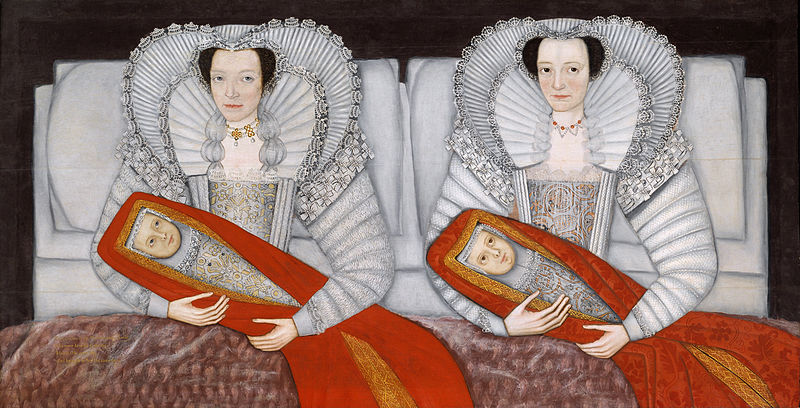
Phoebe and Lydia Lake are artists. They’re also identical twins, which means they know a thing or two about symmetry. So last year, when they were 20 years old, the Tate Britain decided to film their first encounter with one of the museum’s most famous holdings, The Cholmondeley Ladies, painted sometime around 1600–1610 by an unknown artist. An inscription describes the ladies as members of the Cholmondeley family (pronounced “Chumley”) who were born on the same day, married on the same day and “brought to bed” (gave birth) on the same day. The sharply defined, rigidly symmetric composition depicts two very similar but not identical women (perhaps fraternal twins) dressed in exquisite Jacobean finery, holding their babies. In his essay, “The Perception of Symmetry,” arts writer Michael Bird describes his own first reaction to the painting when he was a boy:
The two wintry revenants, propped elbow to elbow in bed with their glowing babies, made a deep impression. The blanched gorgeousness of their outfits, blooded by the hot royal red of the christening gowns, was part of it. So was the spooky incongruity of vivid faces looking out from the picture’s steam-ironed one-dimensionality, as though two people were standing behind it, sticking their heads through holes in the board. Mainly, though, it was their doubleness.
Striking Posters From Occupy Wall Street: Download Them for Free

Occupy Wall Street and the global Occupy Movement have inspired some striking artwork. Graphic artists from around the world (including Shepard Fairey mentioned here earlier today) have contributed their talents to the movement. Many of their posters are available for free or at low cost, either directly from the artist or through organizations like Occuprint and OccupyTogether. You can post them in your town.
New Yorker cover artist and book illustrator Eric Drooker has created several beautiful posters, including the one above. You can download a high-resolution copy suitable for printing at OccupyTogether.org.
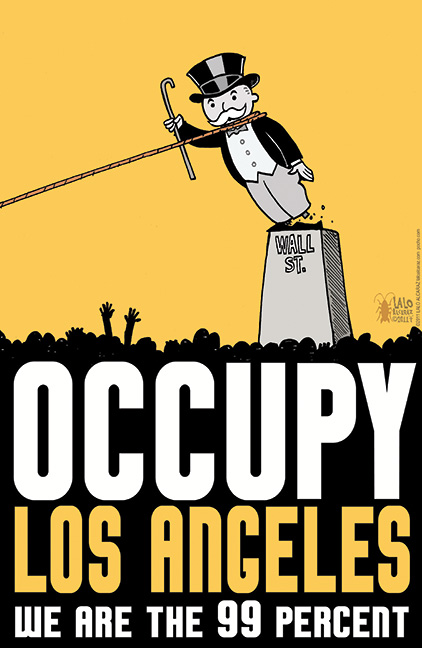
The noted Los Angeles graphic artist, cartoonist and radio personality Lalo Alcaraz created this parody of the toppling of the Saddam Hussein statue in Baghdad for Occupy Los Angeles. In a message on his website, Alcaraz invites people to distribute the image.
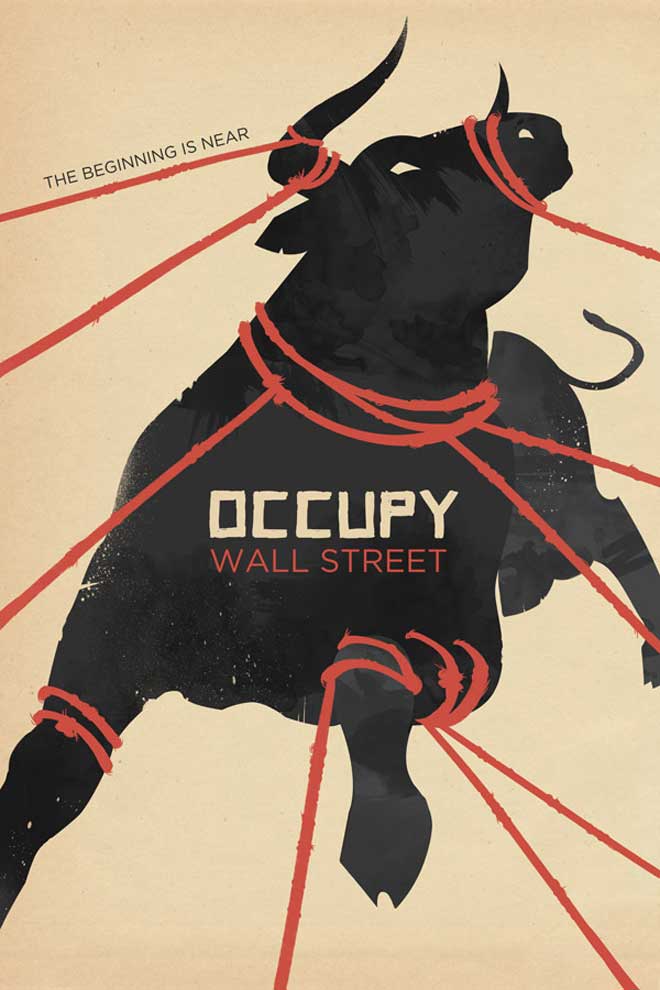
Alexandra Clotfelter is a student of advertising design and illustration at the Savannah College of Art and Design in Georgia. Since donating her design, “The Beginning is Near,” to Occuprint.org, it has become one of the most popular posters to emerge from the movement. In response to requests, Clotfelter is offering a high-quality Giclee print for sale, with a portion of the profits going to support Occuprint’s project of distributing free posters worldwide.
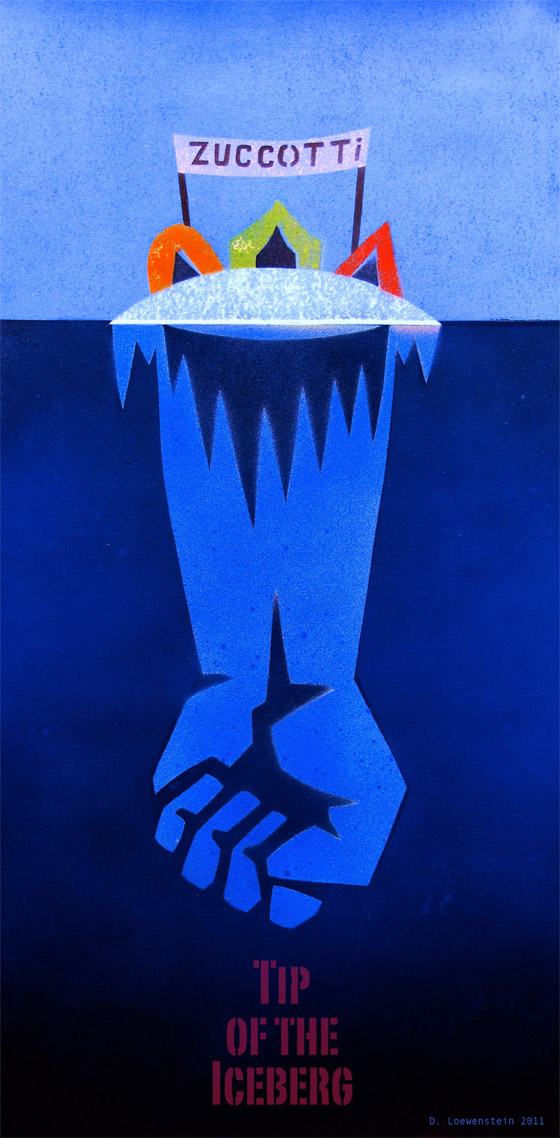
In this poster, Zucotti Park is portrayed as the “Tip of the Iceberg.” Indeed, the Occupy movement extends to places like Lawrence, Kansas, where muralist, printmaker and writer Dave Loewenstein is based. Loewenstein’s design is available for free at Occuprint.org.

Poster artist Rich Black of Berkeley, California created this image for Occupy Oakland. It’s available for free download at Occuprint.org.
To see a variety of Occupy posters by other artists (and to download them for free) you can visit Occuprint.org and OccupyTogether.org.
And don’t miss our post earlier today: Shepard Fairey Caves In, Revises Occupy Wall Street Poster.
Shepard Fairey Caves In, Revises Occupy Wall Street Poster
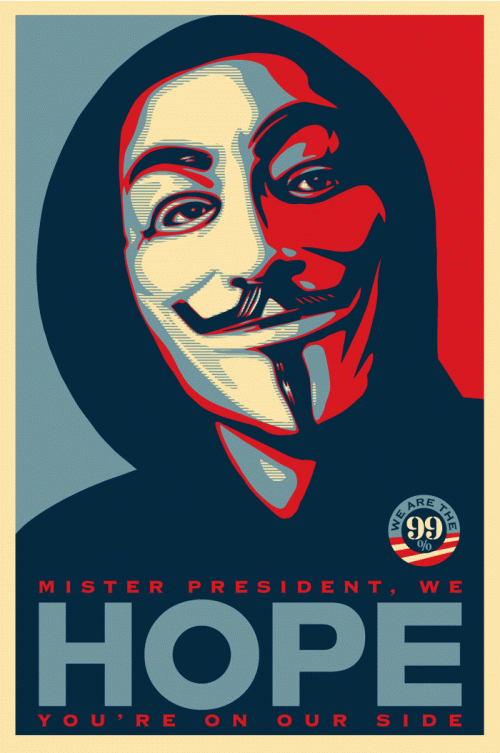
Shepard Fairey’s famous 2008 Obama “Hope” poster has been the source of countless imitations and parodies. Last week Fairey released his own parody for Occupy Wall Street, replacing Obama’s head with a hooded figure in a Guy Fawkes mask, along with the words, “Mister President, We HOPE You’re On Our Side.” As Fairey explained on his website, “I see Obama as a potential ally of the Occupy movement if the energy of the movement is perceived as constructive, not destructive.”
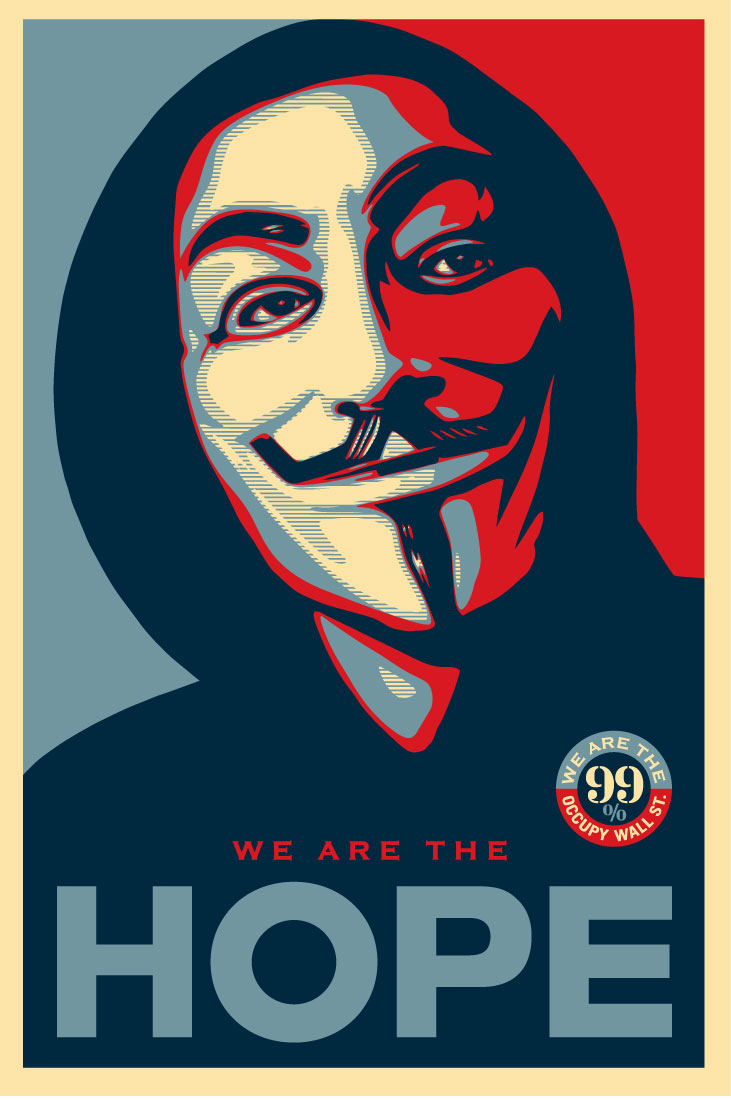
Not everyone agreed. Yesterday, after a series of discussions with one of the organizers of the purportedly leaderless movement, Fairey announced he was backing down and dropping the provocative message to the president and replacing it with “We Are The HOPE.” A few of the movement’s organizers reportedly thought Fairey’s poster implied that Occupy Wall Street either supported Obama or was begging for his support.
“As Obama has raised more money from Wall Street than any other candidate in history, it would make us naive hypocrites to support him under present circumstances,” the anonymous organizer wrote to Fairey. “As for the design, the fact that you put the 99% inside the Obama O is crossing a sacred line. While it definitely looks cool, whether intended or not, this sends a clear message that Obama is co-opting OWS.”
“I have no interest in pandering to Obama,” responded Fairey. “I see my image as a reminder to him that he has alienated his populist progressive supporters.”
But Fairey submitted to the pressure and changed his design anyway. You can read more about the exchange here, and see the altered version of Fairey’s poster below.
For more Occupy Wall Street posters, stay tuned for our post coming later today.…
Support Us
We're hoping to rely on loyal readers, rather than erratic ads. Please click the Donate button and support Open Culture. You can use Paypal, Venmo, Patreon, even Crypto! We thank you!

About Us

Open Culture scours the web for the best educational media. We find the free courses and audio books you need, the language lessons & educational videos you want, and plenty of enlightenment in between.
Advertise With Us


