It all started when filmmaker Spike Jonze (Being John Malkovich, Where the Wild Things Are) met handbag designer Olympia Le-Tan and asked her to create a Catcher in the Rye embroidery for his wall. She asked him to collaborate on a film in return. And so Jonze and Le-Tan, together with French director Simon Cahn, spent six months writing a script, then animating 3,000 pieces of felt cut by Le-Tan herself. The result is Mourir Auprès de Toi (To Die By Your Side), a short stop motion film set inside the famous Parisian bookstore, Shakespeare and Company, and it features a skeleton, his lover, and some famous book covers that spring to life.
If you would like to support the mission of Open Culture, consider making a donation to our site. It’s hard to rely 100% on ads, and your contributions will help us continue providing the best free cultural and educational materials to learners everywhere. You can contribute through PayPal, Patreon, and Venmo (@openculture). Thanks!
Novels — they’re in inevitable decline. They can’t compete with the movie screen, the TV screen and now the computer screen. Give things 25 years, and there will be just a small cult of readers left. That’s the prediction of American author, Philip Roth, who has 27 novels to his credit. And apparently, Roth is personally hastening the process. Earlier this year, he told a reporter for the Financial Times: “I’ve stopped reading fiction. I don’t read it at all. I read other things: history, biography. I don’t have the same interest in fiction that I once did.” When asked why, he quipped: “I don’t know. I wised up … ”
For Paul Auster, another productive novelist, the reports of the novel’s death are greatly exaggerated. Humans hunger for stories. They always will. And, the novel, it knows how to adapt and survive. Will it survive with the help of technology? Auster might not be the best person to ask. He owns neither a computer nor a mobile phone. Lucky man.
Bonus: You can listen to Paul Auster read The Red Notebook, a collection of short stories published in 2002, right here. (He starts reading at around the 8:30 mark.) We have it listed in our collection of Free Audio Books.
Time to resurrect another suddenly relevant item we first mentioned back in 2009…
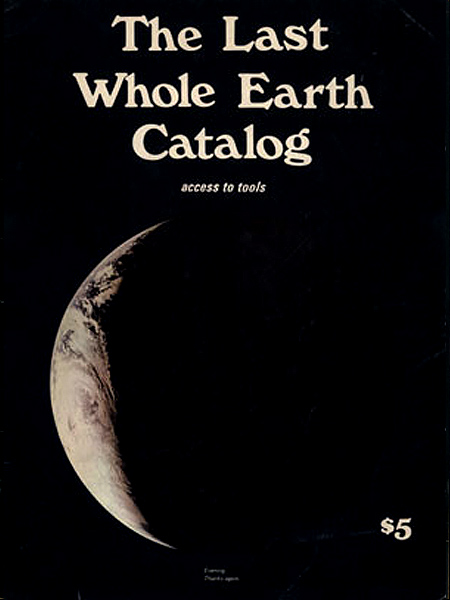
Between 1968 and 1972, Stewart Brand published The Whole Earth Catalog. For Kevin Kelly, the Catalog was essentially “a paper-based database offering thousands of hacks, tips, tools, suggestions, and possibilities for optimizing your life.” For Steve Jobs, it was a “Bible” of his generation, a life ‑transforming publication. Speaking to Stanford graduates in 2005, in what Ken Auletta has called the “Gettysburg Address of graduation-speechism,” Jobs explained why he drew inspiration from this intellectual creation of the 60s counterculture:
When I was young, there was an amazing publication called The Whole Earth Catalog, which was one of the bibles of my generation. It was created by a fellow named Stewart Brand not far from here in Menlo Park, and he brought it to life with his poetic touch. This was in the late 1960’s, before personal computers and desktop publishing, so it was all made with typewriters, scissors, and polaroid cameras. It was sort of like Google in paperback form, 35 years before Google came along: it was idealistic, and overflowing with neat tools and great notions.
Stewart and his team put out several issues of The Whole Earth Catalog, and then when it had run its course, they put out a final issue. It was the mid-1970s, and I was your age. On the back cover of their final issue was a photograph of an early morning country road, the kind you might find yourself hitchhiking on if you were so adventurous. Beneath it were the words: “Stay Hungry. Stay Foolish.” It was their farewell message as they signed off. Stay Hungry. Stay Foolish. And I have always wished that for myself. And now, as you graduate to begin anew, I wish that for you.
The good news is that The Whole Earth Catalog and some related publications are available online. You can read them for free, or download them for a fee. We suggest diving in right here, in Fall 1968, where it all begins. Enjoy.…
We all know where books come from: a human and a muse meet, fall in love, and two months to twenty years later, a book is born. Then, as with other varieties of babies, the sleepless nights start as a writer searches for a home for the book, collecting rejections like badges of honor, testaments to determination.
Well, that was the old-fashioned way. We’ve all heard how the internet has leveled the playing field, allowing anybody to publish work and find an audience. However, this easier path to publication hasn’t necessarily solved an even older writer’s conundrum: How to pay for it.
That is, how to make enough money to sustain yourself as you write (day jobs aside). And so writers must become even wilier. Though you may make money from the sale of a book, how do you fund yourself before the book?
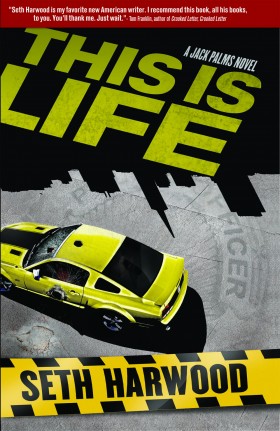
Seth Harwood, the author of three books, is at the front of the movement to find alternate and creative ways of not only reaching audiences, but pursuing the writing life. Since graduating from the Iowa Writers Workshop in 2002, Harwood has built up a loyal fan base—his “Palms Mamas and Palms Daddies” (named for one of his protagonists, Jack Palms)—through social media and free podcasting. Harwood is sustaining a writing life along a path that is likely to be more and more common for writers.
After offering his first novel, Jack Wakes Up, as a free audiobook, Harwood published it in paperback with Breakneck Books in 2008. The Amazon sales, pushed by Palms Mamas and Palms Daddies, landed the book in #1 in Crime/Mystery and #45 overall, bringing the attention of Random House, who re-published the book one year later.
Looking outside mainstream avenues, Harwood secured funding for publication of his next venture, Young Junius, with Tyrus Books by preselling signed copies through Paypal—before the books existed in physical form. And now he is one of the early adopters of using Kickstarter to pay for the gestation and birth of not one book—but five previously-written works in the next six months–as he puts it, “raising the fixed costs of bringing these books to the marketplace.” His Kickstarter campaign based around This Is Life, the sequel to Jack Wakes Up was—impressively—fully funded within 25 hours—and with a few days still left to go, it has exceeded the original goal by over $2000.
What can a writer offer besides an autographed copy of the to-be-written book, or a mention in the acknowledgements? For Harwood’s project, the pledges range from a dollar to $999, with thank-yous spanning from the aforementioned to—at the $999 end—an original novella written according to the donor’s wishes and published as a one-off hardcover.
Indeed, now more than ever, it seems essential for authors to meet readers at least half-way. Harwood considers himself an “author-preneur,” developing new business models as he publishes his books. As he sees it, innovation comes much more easily to an author acting alone, than to a large publishing company or big corporation. He aims for the new models as he sees them developing, knowing he’s got to go out and find readers himself. As Coelho declares, “The ivory tower does not exist anymore.”
This post was contributed by Shawna Yang Ryan. Her novel Water Ghosts was a finalist for the 2010 Asian American Literary Award. In 2012, she will be the Distinguished Writer in Residence at the University of Hawai’i at Manoa.
Late last week, Stephen King treated an audience at George Mason University to a 10-minute reading from his upcoming book Dr. Sleep . It’s not just any other book. It’s the sequel to The Shining, his 1977 thriller that Stanley Kubrick fammously adapted to film. (Don’t miss Making the Shining here.)
King first started talking about a sequel in 2009, and now we’re getting our first taste of what’s to come. At long last, you will know what happened to Danny Torrance.
John Hodgman, your favorite quirky, mustachioed humorist, made an appearance at the Maker Faire festival in NYC earlier this month. And, in the DIY spirit of the event, he gave a 30+ minute comic riff on material appearing in his upcoming book That is All — a compendium of “complete world knowledge” that can help you survive an apocalypse. The better part of the talk focuses, quite naturally, on the magic of magic tricks — something we all need to know more about…
Get ready for it. This week, Knopf will release Paulo Coelho’s latest novel, Aleph. And we’re taking bets on three questions. How many copies will be legally sold? (The Alchemist has sold more than 65 million copies.) How many copies will be pirated and given away? And to what extent will the circulation of illegal copies actually benefit legit sales?
In recent years, Coelho has become something of a willing conspirator in the pirating of his own work. Sometimes he links on his own blog to pirated copies floating around the web. Other times he makes the texts available (in multiple languages) in a nice shareable widget.
Coelho explains how his adventures in self-pirating got underway in a Q&A appearing in yesterday’s New York Times.
Q. You’ve also had success distributing your work free. You’re famous for posting pirated version of your books online, a very unorthodox move for an author.
A. I saw the first pirated edition of one of my books, so I said I’m going to post it online. There was a difficult moment in Russia; they didn’t have much paper. I put this first copy online and I sold, in the first year, 10,000 copies there. And in the second year it jumped to 100,000 copies. So I said, “It is working.” Then I started putting other books online, knowing that if people read a little bit and they like it, they are going to buy the book. My sales were growing and growing, and one day I was at a high-tech conference, and I made it public.
Q. Weren’t you afraid of making your publisher angry?
A. I was afraid, of course. But it was too late. When I returned to my place, the first phone call was from my publisher in the U.S. She said, “We have a problem.”
Q. You’re referring to Jane Friedman, who was then the very powerful chief executive of HarperCollins?
A. Yes, Jane. She’s tough. So I got this call from her, and I said, “Jane, what do you want me to do?” So she said, let’s do it officially, deliberately. Thanks to her my life in the U.S. changed.
The rest of the interview continues here. And, in the meantime, you can find several Coelho books catalogued in our collection of Free eBooks.
We're hoping to rely on loyal readers, rather than erratic ads. Please click the Donate button and support Open Culture. You can use Paypal, Venmo, Patreon, even Crypto! We thank you!
Open Culture scours the web for the best educational media. We find the free courses and audio books you need, the language lessons & educational videos you want, and plenty of enlightenment in between.