Stephen Colbert Reads Flannery O’Connor’s Darkly Comedic Story, “The Enduring Chill”

A good man is hard to find… a good man who can hold an audi­ence rapt by read­ing aloud for over an hour is hard­er still.

Soon-to-be Late Show host Stephen Col­bert acquits him­self quite nice­ly with Flan­nery O’Connor’s 1958 short sto­ry “The Endur­ing Chill,” above.

The tale of an ail­ing New York-based playwright’s unwill­ing return to his ances­tral home is a nat­ur­al fit for Col­bert, raised in Charleston, South Car­oli­na by North­ern par­ents. Record­ed at the behest of Select­ed Shorts, a pub­lic radio pro­gram where­in well known per­form­ers inter­pret con­tem­po­rary and clas­sic short fic­tion, the story—hand picked by Colbert—is a risky choice for 2015.

Like all of O’Connor’s work, it’s dark­ly comedic, and rife with rich char­ac­ter­i­za­tions. It also makes repeat­ed ref­er­ence to “Negroes,” two of whom the reader—in Col­bert’s case, a white man—is tasked with bring­ing to life. In this cur­rent cli­mate, I sus­pect most white come­di­ans would’ve played it safe with O’Connor’s lurid crowd pleas­er, “A Good Man is Hard to Find,” a sta­ple of high school read­ing lists, which you can hear O’Con­nor, her­self, read here.

Col­bert sails through by bring­ing his North­west­ern Uni­ver­si­ty the­ater train­ing to bear. (O’Connor was a favorite of the Per­for­mance Stud­ies depart­ment dur­ing his time there.)

Hav­ing spent years embody­ing a right wing wind­bag on his satir­i­cal Col­bert Report, the come­di­an clear­ly rel­ish­es the oppor­tu­ni­ty to tack­le a vari­ety of roles, includ­ing the main character’s will­ful­ly super­fi­cial moth­er, his sour sis­ter, and the afore­men­tioned pre-Civ­il Rights-era African-Amer­i­can men, work­ers in the hero’s mother’s dairy barn. The Catholic Col­bert also has fun with an unex­pect­ed­ly less-than-eru­dite Jesuit priest.

Grow­ing up in South Car­oli­na, Col­bert made a con­scious deci­sion to steer clear of a South­ern accent, but his pro­nun­ci­a­tion of the word “poem” is a hall­mark of authen­tic here.

As for O’Connor, she gets in a not-so-sub­tle jab at Gone with the Wind, as well as the sort of read­er who, try­ing to be help­ful, coun­sels an aspi­rant South­ern writer to “put the War in there.”

Some­thing tells me these two would have hit it off…I would’ve loved to hear him inter­view her along with George Clooney, Amy Schumer, and oth­er first week guests.

Col­bert’s read­ing of “The Endur­ing Chill” will be added to our col­lec­tion, 1,000 Free Audio Books: Down­load Great Books for Free.

via Metafil­ter

Relat­ed Con­tent:

Flan­nery O’Connor: Friends Don’t Let Friends Read Ayn Rand (1960)

Stephen Col­bert Reads Ray Brad­bury Clas­sic Sci-Fi Sto­ry “The Veldt”

Rare 1959 Audio: Flan­nery O’Connor Reads ‘A Good Man is Hard to Find’

Stephen Col­bert & Louis CK Recite The Get­tys­burg Address, With Some Help from Jer­ry Sein­feld

Ayun Hal­l­i­day is an author, illus­tra­tor and per­former who revis­its her low bud­get back­pack­er trav­els in the new edi­tion of No Touch Mon­key! And Oth­er Trav­el Lessons Learned Too Late . Fol­low her @AyunHalliday


Woody Allen Tells a Classic Joke About Hemingway, Fitzgerald & Gertrude Stein in 1965: A Precursor to Midnight in Paris

The char­ac­ter we know as “Woody Allen,” the per­sona we see in his films, the stam­mer­ing neu­rot­ic weighed down by exis­ten­tial angst and a des­per­ate horni­ness laced with intel­lec­tu­al­i­ty, was cre­at­ed not in his movies, but in his stand-up, record­ings of which have been in and out of cir­cu­la­tion since 1964. (They’re now avail­able here.)

The direc­tor is report­ed­ly even more embar­rassed of these record­ings than his films–and any­one who has seen his sit-down with crit­ic Mark Cousins can attest, he can’t even stand to watch his films–but maybe that’s about the per­for­mance itself, and not the mate­r­i­al.

I say that because in the clip above, a rou­tine that Allen loved enough that he often used it to end his sets in the 60s, we can see the nascent idea for his Oscar-win­ning 2011 film Mid­night in Paris.

Riff­ing on The Lost Gen­er­a­tion, he imag­ines him­self back in time, carous­ing with Hem­ing­way, Gertrude Stein, Picas­so, F. Scott and Zel­da Fitzger­ald, and famed Span­ish bull­fight­er Manolete. It’s a one-two-three-and punch­line joke we won’t ruin, but it’s inter­est­ing that con­scious­ly or sub­con­scious­ly, this idea returned some five decades lat­er to be fleshed out into one of Allen’s best late-peri­od films. Was he always think­ing of this rou­tine as a some­day film? In inter­views from the time of the film’s release, he nev­er men­tions the stand-up bit.

Cre­at­ing art is often like com­post­ing, and one nev­er knows what might float to the top after years of influ­ences and absorp­tion. Lis­ten­ing to his stand-up, one can find the joke that he recy­cled for Annie Hall (“I was thrown out of NYU my fresh­man year, I cheat­ed on my meta­physics final in col­lege, I looked with­in the soul of the boy sit­ting next to me.”).

There’s also this rou­tine about a scary sub­way ride:

The scene was lat­er recre­at­ed in Bananas with a young Sylvester Stal­lone.

Allen’s pre-film career, when he was writ­ing for tele­vi­sion and his own stand-up, when his goals were to “write for Bob Hope and host the Oscars” makes for fas­ci­nat­ing read­ing, and we’ll leave you with this his­to­ry from WMFU. Nerdist has more thoughts on the rela­tion­ship between The Lost Gen­er­a­tion joke and Mid­night in Paris here.

Relat­ed Con­tent:

Woody Allen Lists the Great­est Films of All Time: Includes Clas­sics by Bergman, Truf­faut & Felli­ni

Woody Allen’s Type­writer, Scis­sors and Sta­pler: The Great Film­mak­er Shows Us How He Writes

Watch an Exu­ber­ant, Young Woody Allen Do Live Stand Up on British TV (1965)

Ted Mills is a free­lance writer on the arts who cur­rent­ly hosts the FunkZone Pod­cast. You can also fol­low him on Twit­ter at @tedmills, read his oth­er arts writ­ing at tedmills.com and/or watch his films here.

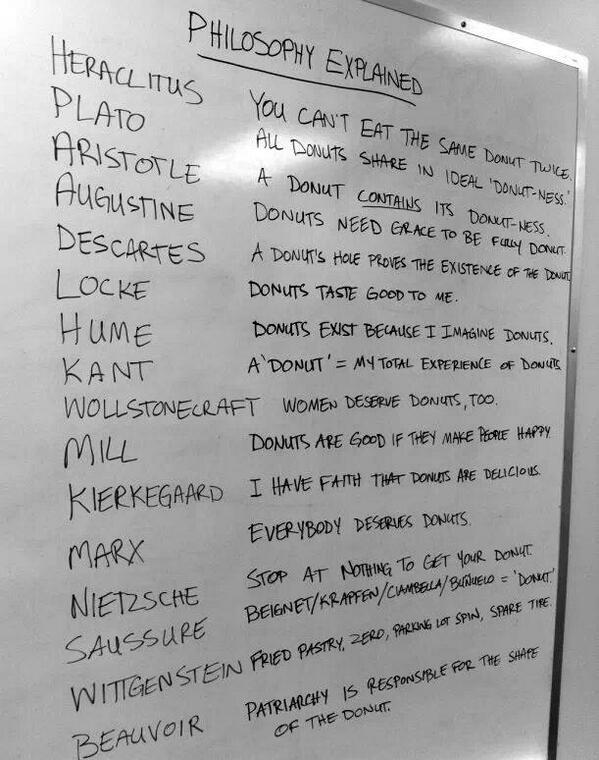
Philosophy Explained With Donuts

philosophy donuts

We’ve all seen them, on the board­walks of Venice Beach or of the Jer­sey Shore: poop-joke t‑shirts that state the gist of var­i­ous world reli­gions or philoso­phies by ref­er­ence to the afore­men­tioned bod­i­ly func­tion. Clever they aren’t, but the form adapts to anoth­er, more taste­ful for­mu­la­tion (pun most def­i­nite­ly intend­ed) in the list above, which briefly describes the philo­soph­i­cal pro­grams of six­teen promi­nent West­ern thinkers with ref­er­ence to that uni­ver­sal­ly beloved food, the donut. To wit: pre-Socrat­ic Greek philoso­pher Her­a­cli­tus gets summed up with “You can’t eat the same donut twice,” a twist on one of his famous few apho­risms. Lud­wig Wittgen­stein’s phi­los­o­phy becomes an ellip­ti­cal series of pos­si­ble donuts in var­i­ous lan­guage games: “Fried Pas­try, Zero, Park­ing lot spin, Spare tire.” And so on.

No need to point out the over­sim­pli­fi­ca­tion inher­ent in this strat­e­gy; that’s kind of the point. It’s a joke, after all, but one the author—whoever that is—clearly intends as a means of break­ing the ice and get­ting down to more seri­ous explo­rations. But what if the donut is the seri­ous explo­ration? Such is the case in a 2001 arti­cle pub­lished in the jour­nal Basic Objects: Case Stud­ies in The­o­ret­i­cal Prim­i­tives by Colum­bia phi­los­o­phy pro­fes­sor Achille C. Varzi.

Sim­ply titled (in the British spelling) “Dough­nuts,” Varzi’s paper explores the donut, or “torus” in the lan­guage of topog­ra­phers, as a the­o­ret­i­cal object for an onto­log­i­cal thought exper­i­ment. In short, he asks whether or not we can say that the donut hole is an actu­al exist­ing enti­ty or sim­ply a fig­ure of speech, a “façon de par­ler.” In the tra­di­tion­al view, that of the topog­ra­phers, who prac­tice “a sort of rub­bery geom­e­try…. The only thing that mat­ters is the edi­ble stuff. The hole is a mere façon de par­ler.”

On anoth­er, more three-dimen­sion­al view of the rela­tion­ship “between void and mat­ter,” things look dif­fer­ent: “We must be very seri­ous about treat­ing them [donut holes] as ful­ly-fledged enti­ties, on a par with the mate­r­i­al objects that sur­round them.” The real exis­tence of the hole can­not be eas­i­ly dis­missed with­out run­ning into a prob­lem, “the dilem­ma of every elim­i­na­tive strat­e­gy: if suc­cess­ful, it ends up elim­i­nat­ing every­thing just in order to elim­i­nate noth­ings.” No hole, no donut. (Though, as Simone De Beau­voir appar­ent­ly rec­og­nized, “Patri­archy is respon­si­ble for the shape of the donut.”) The donut hole the­sis also forms part of the argu­ment in an aca­d­e­m­ic phi­los­o­phy paper from 2012 enti­tled “Being Pos­i­tive About Neg­a­tive Facts” from Phi­los­o­phy & Phe­nom­e­no­log­i­cal Research. On the way to show­ing that “neg­a­tive facts exist in the usu­al sense of exis­tence,” authors Stephen Bark­er and Mark Jago, both of the Uni­ver­si­ty of Not­ting­ham, come to sim­i­lar con­clu­sions about the donut, with ref­er­ence to ear­li­er work by Varzi:

Holes pose some­thing of a philo­soph­i­cal quandary and, per­haps as a result of their mys­tery, are often treat­ed as imma­te­r­i­al enti­ties (Casati and Varzi 1994). Yet we seem to be able to per­ceive holes, gaps, dents and the like. The view of holes as imma­te­r­i­al objects is, we think, very much in line with think­ing of the neg­a­tive as the meta­phys­i­cal­ly undead. Giv­en our accep­tance of neg­a­tive facts, we can offer a sto­ry about holes on which they are mate­r­i­al enti­ties. If there is a donut hole then there is a spa­tial region involv­ing the instan­ti­a­tion of donut-dough which is inti­mate­ly con­nect­ed with an absence there­of.

Make of these claims what you will, but I think what we see in both essays is that seri­ous inter­est in a friv­o­lous object can pro­duce illu­mi­nat­ing dis­cus­sion. That describes the the­sis of the site Improb­a­ble Research, who bring us both of these donut exam­ples; their motto—“Research that makes peo­ple LAUGH and then THINK.” I don’t know if either essay—or even the donut joke at the top of the page—really makes for ha-ha laughs so much, but these argu­ments about the mate­r­i­al exis­tence of the imma­te­r­i­al space of donut holes cer­tain­ly chal­lenged my think­ing.

via Improb­a­ble Research

Relat­ed Con­tents:

140+ Free Online Phi­los­o­phy Cours­es

Phi­los­o­phy Ref­er­ee Hand Sig­nals

Mon­ty Python’s Best Phi­los­o­phy Sketch­es

The Epis­te­mol­o­gy of Dr. Seuss & More Phi­los­o­phy Lessons from Great Children’s Sto­ries

The His­to­ry of Phi­los­o­phy, from 600 B.C.E. to 1935, Visu­al­ized in Two Mas­sive, 44-Foot High Dia­grams

Josh Jones is a writer and musi­cian based in Durham, NC. Fol­low him at @jdmagness

Karaoke-Style, Stephen Colbert Sings and Struts to The Rolling Stones’ “Brown Sugar”

Lit­tle known fact, dur­ing his high school days, Stephen Col­bert was the front man of a Rolling Stones cov­er band. And, appear­ing on Howard Stern on Tues­day, just weeks before tak­ing over The Late Show, Col­bert proved it, singing and doing a jig to “Brown Sug­ar.” He moves like Jag­ger, and it’s fun to watch.

The Late Show with Stephen Col­bert starts Tues­day, Sep­tem­ber 8th — right after Labor Day.

Relat­ed Con­tent

Stephen Col­bert & Neil deGrasse Break Down Our Awe­some 3 Bil­lion-Mile Jour­ney to Plu­to

Stephen Col­bert Reads Ray Brad­bury Clas­sic Sci-Fi Sto­ry “The Veldt”

Stephen Col­bert & Louis CK Recite The Get­tys­burg Address, With Some Help from Jer­ry Sein­feld

Sarcasm Can Boost Creativity According to Research From Harvard & Columbia Business Schools

bill murray sarcasm

Under­ly­ing image by Gage Skid­more.

Echo­ing Bill Mur­ray, the Urban Dic­tio­nary defines sar­casm as “your body’s nat­ur­al defense against stu­pid,” not­ing that it’s “the high­est form of wit” in coun­tries like the UK, but the low­est in Amer­i­ca, owing to the population’s inabil­i­ty to detect whether or not one is being sar­cas­tic.

Exam­ple:
Idiot: I beat up a ten-year-old today.

You: (with a hint of sar­casm) That’s impres­sive!

Idiot: I know, right!

A new study by Francesca GinoAdam Galin­sky, and Li Huang, of Har­vard, Colum­bia and INSEAD busi­ness schools, respec­tive­ly, sug­gests that the use of sar­casm pro­motes cre­ativ­i­ty for those on the giv­ing and receiv­ing end of sar­cas­tic exchanges.

Gino told the Har­vard Gazette, “To cre­ate or decode sar­casm, both the expressers and recip­i­ents of sar­casm need to over­come the con­tra­dic­tion (i.e., psy­cho­log­i­cal dis­tance) between the lit­er­al and actu­al mean­ings of the sar­cas­tic expres­sions. This is a process that acti­vates and is facil­i­tat­ed by abstrac­tion, which in turn pro­motes cre­ative think­ing.”

Galin­sky added, the givers and receivers in sar­cas­tic exchanges “sub­se­quent­ly per­formed bet­ter on cre­ativ­i­ty tasks than those in the sin­cere con­di­tions or the con­trol con­di­tion. This sug­gests that sar­casm has the poten­tial to cat­alyze cre­ativ­i­ty in every­one.” “That being said, although not the focus of our research, it is pos­si­ble that nat­u­ral­ly cre­ative peo­ple are also more like­ly to use sar­casm, mak­ing it an out­come instead of [a] cause in this rela­tion­ship.”

The evi­dence cer­tain­ly seems sol­id in the hands of mas­ter prac­ti­tion­ers such as Louis CK, Sarah Sil­ver­man, and the staff of The Onion, not to men­tion new­com­er Shirley Jester, an ani­mat­ed Sar­cas­tic Foul-Mouthed Teenage Come­di­an Girl from the Renais­sance.

Things get a bit murki­er when ama­teurs attempt to adopt their idols’ caus­tic pos­es. Tone and intent are eas­i­ly mis­con­strued. Feel­ings get hurt.

Is sar­casm best left to the pro­fes­sion­als?

Not nec­es­sar­i­ly. Gino and Galinksy found that the degree of trust between express­er and recip­i­ent deter­mines how sar­casm is received. In oth­er words, know your audi­ence.

Even at its mean­est, sarcasm—from the Greek and Latin for “to tear flesh”—involves abstrac­tion, a hall­mark of cre­ative think­ing.

Mean­while, you can review Clin­i­cal Psy­chol­o­gist Chris Ful­ton’s “Try that again method,” below, one of many strate­gies for han­dling “sar­cas­tic and sassy teenagers.” Cre­ativ­i­ty be squelched.

Cue a mil­lion teenage eye rolls, and check out Gino and Galinksy’s find­ings here.

via the Har­vard Gazette

Relat­ed Con­tent:

John Cleese’s Phi­los­o­phy of Cre­ativ­i­ty: Cre­at­ing Oases for Child­like Play

The Psy­chol­o­gy of Messi­ness & Cre­ativ­i­ty: Research Shows How a Messy Desk and Cre­ative Work Go Hand in Hand

The Most “Intel­lec­tu­al Jokes”: Our Favorite Open Cul­ture Read­er Sub­mis­sions

The Two Gentlemen of Lebowski: What If The Bard Wrote The Big Lebowski?

We live in an age of mash ups. A few years ago some mal­con­tent came up with Pride and Prej­u­dice and Zom­bies. Our cities are teem­ing with food trucks hawk­ing Kore­an tacos and ramen burg­ers. And chess box­ing is appar­ent­ly a thing. So per­haps it isn’t sur­pris­ing that some evil genius would merge the most quotable movie of the past 20 years, The Big Lebows­ki, with William Shake­speare.

The result­ing book, writ­ten by Adam Bertoc­ci, is called Two Gen­tle­men of Lebows­ki, and it does a sur­pris­ing­ly good job of cap­tur­ing the lan­guage of the Bard while stay­ing true to the orig­i­nal movie. The author report­ed­ly wrote the first draft of the book in a sin­gle sleep­less week­end. An impres­sive feat that the author dis­miss­es in an inter­view with CNN that you can see above.

“Any­body could, giv­en the lack of a social life,” dead­pans Bertoc­ci, “take a week­end with a movie they admired and an author that they knew well and make a sim­i­lar­ly lengthy mash up of it.”

In Bertocci’s fevered rework­ing (read the first 3 scenes for free here), the Dude is recast as The Knave. His bel­liger­ent best friend is Sir Wal­ter of Poland. The hap­less Don­nie is Sir Don­ald of Greece. Knox Har­ring­ton, Mauve’s grat­ing­ly gig­gly con­cep­tu­al artist friend, is in this ver­sion a tapes­try artist. And of course, Da Fino, the PI, who shad­ows the Dude in the movie, is list­ed sim­ply as Broth­er Sea­mus.

But where Bertoc­ci real­ly shines is in his clever appro­pri­a­tion of Shake­speare­an lan­guage. The film’s copi­ous pro­fan­i­ty has been replaced with more Bard-wor­thy epi­thets like “rash egg” or “var­let.” The word “ver­i­ly” pep­pers the Knave’s dia­logue as the word “like” pep­pers the Dude’s. And when Wal­ter wax­es poet­ic about the rules of bowl­ing, he does so in iambic pen­tame­ter.

To get a sense of the dif­fer­ences, com­pare the clip above from the movie with the Bard-ofied text of the same scene below.

THE KNAVE’s house. Enter THE KNAVE, car­ry­ing parcels, and BLANCHE and WOO. They fight.

BLANCHE
Whith­er the mon­ey, Lebows­ki? Faith, we are as ser­vants to Bon­nie;
promised by the lady good that thou in turn were good for’t.

WOO
Bound in hon­our, we must have our bond; cursed be our tribe
if we for­give thee.

BLANCHE
Let us soak him in the cham­ber-pot, so as to turn his head.

WOO
Aye, and see what vapouris­es; then he will see what is foul.

They insert his head into the cham­ber-pot.

BLANCHE
What dread­ful noise of waters in thine ears! Thou hast cool’d
thy head; think now upon dri­er mat­ters.

WOO
Speak now on ducats else again we’ll thee duck­est; whith­er the
mon­ey, Lebows­ki?

THE KNAVE
Faith, it awaits down there some­place; prithee let me glimpse
again.

WOO
What, thou rash egg! Thus will we drown thine excla­ma­tions.

They again insert his head into the cham­ber-pot.

BLANCHE
Tri­fle not with the fury of two des­per­ate men. Long has thy
wife sealed a bond with Jaques Tree­horn; as blood is to blood,
sure­ly thou owest to Jaques Tree­horn in rec­om­pense.

WOO
Rise, and speak wise­ly, man—but hark;
I see thy rug, as woven i’the Ori­ent,
A trea­sure from abroad. I like it not.
I’ll stain it thus; to dead­beats ever thus.

He stains the rug.

THE KNAVE
Sir, prithee nay!

BLANCHE
Now thou seest what hap­pens, Lebows­ki, when the agree­ments
of hon­ourable busi­ness stand com­pro­mised. If thou wouldst
treat mon­ey as water, flow­ing as the gen­tle rain from heav­en,
why, then thou know­est water begets water; it will be a watery
grave your rug, drown’d in the weep­ing brook. Pray remem­ber,
Lebows­ki.

THE KNAVE
Thou err’st; no man calls me Lebows­ki. Hear right­ly, man!—for
thou hast got the wrong man. I am the Knave, man; Knave in
nature as in name.

BLANCHE
Thy name is Lebows­ki. Thy wife is Bon­nie.

THE KNAVE
Zounds, man. Look at these unwor­thi­est hands; no gaudy gold
pro­fanes my lit­tle hand. I have no hon­our to con­tain the ring. I
am a bach­e­lor in a wilder­ness. Behold this place; are these the
tow­ers where one may glimpse Geof­frey, the mar­ried man? Is
this a court where mis­tress­es of com­mon sense are hid? Not for
me to hang my bugle in an invis­i­ble baldric, sir; I am loath to
take a wife, or she to take me until men be made of some oth­er
met­tle than earth. Hark, the lid of my cham­ber-pot be lift­ed!

Per­son­al­ly, I’m hop­ing that the Globe The­atre stages a ver­sion of this.

While you are wait­ing for that to hap­pen, you can see anoth­er scene from Two Gen­tle­men from Lebows­ki above where The Knave and Sir Wal­ter com­mis­er­ate about a rug, which was besmirched by a “most mis­er­able tide.”

Relat­ed Con­tent:

The Big Lebows­ki Reimag­ined as a Clas­sic 8‑Bit Video Game

Watch the Coen Broth­ers’ TV Com­mer­cials: Swiss Cig­a­rettes, Gap Jeans, Tax­es & Clean Coal

Jonathan Crow is a Los Ange­les-based writer and film­mak­er whose work has appeared in Yahoo!, The Hol­ly­wood Reporter, and oth­er pub­li­ca­tions. You can fol­low him at @jonccrow. And check out his blog Veep­to­pus, fea­tur­ing lots of pic­tures of vice pres­i­dents with octo­pus­es on their heads.  The Veep­to­pus store is here.

The Evolution of Chuck Jones, the Artist Behind Bugs Bunny, Daffy Duck & Other Looney Tunes Legends: A Video Essay

Not­ed car­toon per­son­al­i­ty Bugs Bun­ny has war­bled his way through Wag­ner­ian opera, played every defen­sive posi­tion known to base­ball, styled a monster’s hair…is there any­thing that was­cal­ly wab­bit can­not do?

Yes, in fact. Accord­ing to his long time direc­tor, ani­ma­tor Chuck Jones, Bugs could nev­er pick a fight. Unlike his hair trig­ger Looney Tunes col­league, Daffy Duck, the bun­ny had to be pro­voked before enter­ing the fray. That applies whether he’s a box­er, a gang­ster, or imper­son­at­ing the biggest movie stars of his day.

Abid­ing by the strong rules he estab­lished for the char­ac­ters in the Looney Tunes sta­ble was crit­i­cal to his com­ic approach, as Jones explains in the above video essay, a bit of a depar­ture for Tony Zhou’s cel­e­brat­ed cin­e­ma series, Every Frame a Pic­ture. Rather than exam­ine the fram­ing and tim­ing of “one of the all-time mas­ters of visu­al com­e­dy,” this time Zhou delves into the evo­lu­tion of his subject’s artis­tic sen­si­bil­i­ties.

Like all good direc­tors, Jones learned from his actors–in this case, ani­mat­ed, and not all of them his babies. Bugs and Daffy were the brain­chil­dren of the great Tex Avery. Friz Fre­leng cre­at­ed Yosemite Sam and everyone’s favorite stut­ter­ing pig, Porky.

Jones teased out the desires that became the pri­ma­ry engines for those char­ac­ters’ phys­i­cal­i­ty as well as their behav­ior. Daffy comes off as an unhinged lunatic in his ear­ly appear­ances. His com­ic poten­tial grew once Jones reframed him as a con­niv­er who’d do any­thing in pur­suit of wealth and glo­ry.

Once the char­ac­ters’ moti­va­tions were clear, Jones could mess around with the ol’ one-two punch. It’s a clas­sic com­ic struc­ture, where­in real­i­ty wreaks hav­oc on the audience’s expec­ta­tions about how things should unfold. Then again, a child can tell you what dri­ves Jones’ cre­ation, the pas­sion­ate French skunk, Pepé Le Pew, as well as how those amorous ambi­tions of his are like­ly to work out. Fun­ny! Depend­ably so!

Zhou also draws atten­tion to the evo­lu­tion of the char­ac­ters’ expres­sions, from the antic to the eco­nom­i­cal. John Belushi was not the only com­ic genius to under­stand the pow­er of a raised eye­brow.

Relat­ed Con­tent:

Chuck Jones’ 9 Rules For Draw­ing Road Run­ner Car­toons, or How to Cre­ate a Min­i­mal­ist Mas­ter­piece

How to Draw Bugs Bun­ny: A Primer by Leg­endary Ani­ma­tor Chuck Jones

The Strange Day When Bugs Bun­ny Saved the Life of Mel Blanc

Ayun Hal­l­i­day is an author, illus­tra­tor, and Chief Pri­ma­tol­o­gist of the East Vil­lage Inky zine. Fol­low her @AyunHalliday

David Bowie, Mick Jagger, Queen & Elvis Presley Star in Delightfully Absurd Musicless Music Videos

Some­time in the last decade, as both YouTube and smart phones became our pri­ma­ry means of cul­tur­al trans­mis­sion, the iso­lat­ed vocal track meme came into being, reach­ing its sum­mit in the sub­lime ridicu­lous­ness of David Lee Roth’s unadorned “Run­ning With the Dev­il” vocal tics. His yelps, howls, and “Whoooohoooos!” pro­duced the very best ver­sion of that vir­tu­al nov­el­ty known as the sound­board app, and wel­comed many a caller to many a kooky voice­mail greet­ing. The iso­lat­ed track has since become a phe­nom­e­non wor­thy of study, and we’ve done our share here of por­ing over var­i­ous voic­es and instru­ments stripped from their song’s con­text and placed before us in ways we’d nev­er heard before.

Per­haps seri­ous analy­sis too shall be the fate of a goofy visu­al meme that also thrives on the ridicu­lous­ness of pop music’s pre­sen­ta­tion: the musi­c­less music video. The idea is a sim­i­lar one, iso­lat­ing the image instead of the sound: pop­u­lar videos, already weird­ly over the top, become exer­cis­es in chore­o­graphed awk­ward­ness or voy­ages into uncan­ny val­leys as we watch their stars pose, preen, and con­tort them­selves in weird cos­tumes for seem­ing­ly no rea­son, accom­pa­nied only by the mun­dane sounds of their shuf­fling feet and grunts, belch­es, ner­vous laugh­ter, etc. Take the par­tic­u­lar­ly fun­ny exam­ples here: Mick Jag­ger and David Bowie pranc­ing through the bizarre “Danc­ing in the Streets” video (orig­i­nal here); the mem­bers of Queen per­form­ing domes­tic chores in “I Want to Break Free” (orig­i­nal); Elvis Pres­ley squeak­ing and spas­ming onstage in a TV take of “Blue Suede Shoes”; Nir­vana mop­ing and sway­ing in that high school gym while a near­by cus­to­di­an goes about his busi­ness…..

Though these skewed re-eval­u­a­tions of famous moments in pop his­to­ry make use of a sim­i­lar premise as the iso­lat­ed track, the sounds we hear are not—as they some­times seem—vérité audio record­ings from the videos’ sets. They are the cre­ation of Aus­tri­an sound design­er, edi­tor, and mix­er Mario Wienerroither, who, The Dai­ly Dot informs us, “works from a sound library that he’s spent years amass­ing.” The results, as you will hear for your­self, “range from humor­ous to dis­turb­ing and every­where in between.” Musi­c­less music videos remind us of how sil­ly and arti­fi­cial these kinds of staged, mimed pseu­do-per­for­mances real­ly are—they only become con­vinc­ing to us through the mag­i­cal edit­ing togeth­er sound and image on cue and on beat.

Wienerroither began his project with the Queen video, inspired when he caught it play­ing while his TV was on mute. The moment, he says, was “a vital spark.” Since then, dozens of musi­c­less music videos, and TV and film clips, have popped up on YouTube (see a size­able playlist here.) One of the most awk­ward, The Prodi­gy’s “Firestarter,” helped rock­et the phe­nom­e­non into major pop­u­lar­i­ty. Imi­ta­tors have since post­ed musi­c­less videos of the Friends intro and Miley Cyrus’ “Wreck­ing Ball.” What can we learn from these videos? Noth­ing, per­haps, we did­n’t already know: that pop cul­ture’s most endur­ing moments are also its most absurd, that nos­tal­gia is a dish best served remixed, that the internet—a pow­er­ful force for good as well as ill—is often at its best when it is a pow­er­ful force for weird. Though the medi­um may be friv­o­lous, these are mes­sages worth remem­ber­ing.

Relat­ed Con­tent:

Lis­ten to Fred­die Mer­cury and David Bowie on the Iso­lat­ed Vocal Track for the Queen Hit ‘Under Pres­sure,’ 1981

Kurt Cobain’s Iso­lat­ed Vocal Track From ‘Smells Like Teen Spir­it,’ 1991

Hear Iso­lat­ed Gui­tar Tracks From Some of Rock’s Great­est: Slash, Eddie Van Halen, Eric Clap­ton & More

Josh Jones is a writer and musi­cian based in Durham, NC. Fol­low him at @jdmagness

« Go BackMore in this category... »
Quantcast