The Rise of Webcomics: PBS’ Off Book Series Explores the Emergence of New Popular Art Form

I’m a paper loy­al­ist by age and incli­na­tion. I don’t begrudge those who do the bulk of their read­ing dig­i­tal­ly, I just pre­fer the famil­iar­i­ty and object-ness of the print­ed page. As a lover of comics and graph­ic nov­els, my brick and mor­tar needs are more than met by the com­par­a­tive wealth of indie shops and fes­ti­vals here in New York City, as well as its belea­guered pub­lic library sys­tem.

I could­n’t help notic­ing, though, that many of the new­er titles I favor got their start online. The pro­po­nents of the form who dis­cuss the Rise of Web­comics for PBS’ Off Book series make a com­pelling case for explor­ing that realm a bit more ful­some­ly.

Many artists who put their stuff up on the web ben­e­fit from the imme­di­a­cy of the act and the—theoretically—larger audi­ence. But pub­lish­ing in this for­mat also opens it up for Sam Brown and Andrew Hussie to cre­ate a large body of work based on read­er sug­ges­tions. Hussie takes full advan­tage of the mul­ti plat­form pos­si­bil­i­ties. Lucy Knis­ley, no stranger to edi­to­r­i­al refine­ment in a more tra­di­tion­al pub­li­ca­tion mod­el, gives her mon­sters of the id free rein online. And Nick Gure­witch’s Per­ry Bible Fel­low­ship (though he yanked a cou­ple of them offline to “make the book more spe­cial”) is the ves­sel into which his tor­rent of hilar­i­ous, dis­so­cia­tive ideas flows.

Relat­ed Con­tent:

Free Gold­en Age Comics

The Con­fes­sions of Robert Crumb: A Por­trait Script­ed by the Under­ground Comics Leg­end Him­self (1987)

The Art of Illus­tra­tion: Four Illus­tra­tors Intro­duce You to the Awe-Inspir­ing State of Their Art

Join Car­toon­ist Lyn­da Bar­ry for a Uni­ver­si­ty-Lev­el Course on Doo­dling and Neu­ro­science

Ayun Hal­l­i­day’s favorite web­com­ic (until now the only one she read) remains Hyper­bole and a Half.

The Confessions of Robert Crumb: A Portrait Scripted by the Underground Comics Legend Himself (1987)

Any­one who’s seen Crumb, Ter­ry Zwigoff’s 1994 doc­u­men­tary about under­ground comics leg­end, R. Crumb, may con­sid­er them­selves fair­ly con­ver­sant in both the art and the off­beat exis­tence of the vin­tage-record-rever­ing sex­u­al adven­tur­er and self-pro­claimed wimp.

But does a trav­el­er pass up the oppor­tu­ni­ty to vis­it Paris sim­ply because he’s been there once before?

Unless you’re a vir­gin to the sub­ject, The Con­fes­sions of Robert Crumb, a BBC doc whose release pre­dat­ed that of Zwigof­f’s defin­i­tive por­trait by sev­en years, will con­tain no major rev­e­la­tions. It’s still a lot of fun though, per­haps more so for hav­ing been script­ed by its main attrac­tion.

Crumb and his wife, fel­low car­toon­ist, Aline Komin­sky Crumb, were uneasy with Zwigof­f’s por­tray­al, a reac­tion they doc­u­ment­ed in Head for the Hills!, a joint­ly authored, two-page com­ic in the New York­er. Their objec­tions ulti­mate­ly lay with the noto­ri­ety the film would con­fer on them. Fame for Crumb is a mon­ster-mak­ing drain on cre­ativ­i­ty. (“And I guar­an­tee we won’t earn an extra dol­lar as a result of this won­der­ful expo­sure,” Aline adds in a word bub­ble, an obser­va­tion the Crumb blog gives the lie to, near­ly twen­ty years out.)

But in terms of what he was will­ing to own up to on cam­era, Crumb the screen­writer is far from a shrink­ing vio­let. The talk­ing heads are min­i­mized and the extend­ed fam­i­ly kept to the shad­ows, but he’s frank about the erot­ic pre­oc­cu­pa­tions that fig­ure promi­nent­ly in his work and have raised more than a few fem­i­nist hack­les over the years. One might even say he plays it up in goofy staged bits, such as the one where he dons a lab coat to exam­ine the pow­er­ful rear and kid­ney bean-shaped pelvic tilt of an impas­sive mod­el clad in 80s-style Jane Fon­da Work­out wear. As social mal­adroits go, he’s not afraid to wear a lamp­shade on his head.

He also reveals him­self as a life­long learn­er, avid­ly research­ing his non-flesh-relat­ed pas­sions. His inter­ests are infec­tious. One hour with Crumb and you may find your­self spend­ing the next two or three on eso­teric top­ics rang­ing from James Gill­ray to Har­ry Roy and his Bat Club Boys.

You can find The Con­fes­sions of Robert Crumb list­ed in our col­lec­tion of 55o Free Online Movies.

Relat­ed Con­tent:

Record Cov­er Art by Under­ground Car­toon­ist Robert Crumb

The Inscrutable Imag­i­na­tion of the Late Com­ic Artist Mœbius

Vis­it the World of Lit­tle Nemo Artist Win­sor McCay: Three Clas­sic Ani­ma­tions and a Google Doo­dle

Ayun Hal­l­i­day is a fem­i­nist and a long term Robert Crumb fan.

The Art of Illustration: Four Illustrators Introduce You to the Awe-Inspiring State of Their Art

Con­tem­pla­tive types used to los­ing them­selves in an image may wish to have a motion sick­ness bag on hand when view­ing The Art of Illus­tra­tion, the lat­est entry in Off Book, a PBS web series explor­ing cut­ting edge art and inter­net cul­ture. The edit­ing seems even more ver­tig­i­nous than in episodes devot­ed to indie video game design­ers and glitch artists. The score recalls R. Crum­b’s exis­ten­tial hor­ror inside a mod­ern night­club.

Watch it any­way, for the inter­vie­wees thoughts on the state of illus­tra­tion.

Pro­fes­sor Steven Guar­nac­cia of the The New School’s Illus­tra­tion Pro­gram describes how illus­tra­tion’s cre­ative poten­tial explod­ed once pho­tog­ra­phy became the prime way of doc­u­ment­ing celebri­ty appear­ances and oth­er such news­wor­thy visu­als.

Edi­to­r­i­al Illus­tra­tor Yuko Shimisu inter­nal­izes those obser­va­tions, throw­ing shade on any idea she feels would look bet­ter in pho­to form. Shimisu, like all of the artists fea­tured in the short video, uses tra­di­tion­al media to make her draw­ings, but col­ors them dig­i­tal­ly. The form may pre­date pho­tog­ra­phy, but Shimisu implies that any prac­ti­tion­er unwill­ing to embrace the trend toward new media will find them­selves going the way of the dodo, as edi­to­r­i­al gigs migrate onto tablets and even small­er dig­i­tal devices.

Mean­while over at DC Comics, Sean Mur­phy has yet to dis­cov­er a super­pow­er capa­ble of speed­ing up the work that goes into ren­der­ing a sto­ry in com­ic book for­mat. The facial expres­sions, grand per­spec­tives, and moody light­ing that are his stock in trade could the­o­ret­i­cal­ly be cap­tured with a shut­ter click, but at what cost to the over­all nar­ra­tive?

And then there’s the inim­itable Mol­ly Crabap­ple, pur­vey­or of Vic­to­ri­an-fla­vored kink and founder of Dr. Sketchy’s Anti-Art School, whose Occu­py Wall Street posters chal­lenged the visu­al bound­aries of activist art. Find­ing a per­son­al style one can blow up into a brand is not just a choice, she implies. It’s one’s best hope of sur­vival in a sea flood­ed with com­peti­tors.

- Ayun Hal­l­i­day pub­lish­es her illus­trat­ed zine, The East Vil­lage Inky the old fash­ioned way, then pro­motes it across all man­ner of dig­i­tal plat­forms, includ­ing @AyunHalliday.

Join Cartoonist Lynda Barry for a University-Level Course on Doodling and Neuroscience

lyndabarry

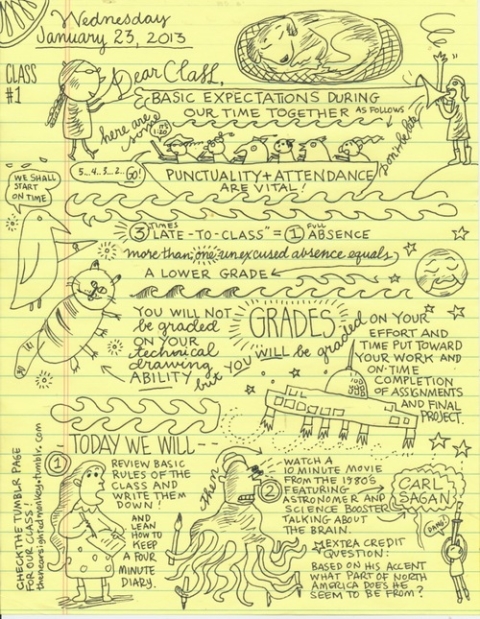
Car­toon­ist Lyn­da Bar­ry, who has helped legions of adults grope their way back to the unself­con­scious cre­ativ­i­ty of child­hood, is teach­ing at the uni­ver­si­ty lev­el. Bar­ry’s Unthink­able Mind course is designed to appeal to stu­dents of the human­i­ties.  Also hard­core sci­ence majors, the sort of lab-coat­ed spec­i­mens the first group might refer to as “brains.” The instruc­tor describes her Uni­ver­si­ty of Wis­con­sin spring semes­ter offer­ing thus:

A writ­ing and pic­ture-mak­ing class with focus on the basic phys­i­cal struc­ture of the brain with empha­sis on hemi­spher­ic dif­fer­ences and a par­tic­u­lar sort of insight and cre­ative con­cen­tra­tion that seems to come about when we are using our hands (the orig­i­nal dig­i­tal devices) —to help us fig­ure out a prob­lem.

The twen­ty-one grads and under­grads accept­ed into Pro­fes­sor Bar­ry’s course have been warned, via the illus­trat­ed let­ter above,  hand­writ­ten on legal paper, that the work­load will be heavy.

lyndabarry2

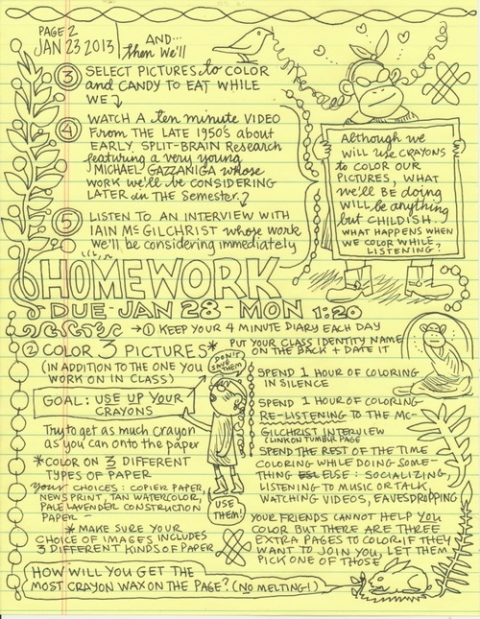
You should be warned as well, if you elect to audit this course from home. Enroll­ment is not nec­es­sary. Pro­fes­sor Bar­ry will be post­ing her week­ly assign­ments and cur­ricu­lum mate­ri­als on her tum­blr, a forum where her abid­ing inter­est in sci­ence is as appar­ent as her devo­tion to undi­rect­ed doo­dling. Your first assign­ment, post­ed above, requires a box of crayons, the col­or­ing pages of your choice, down­loaded to four types of paper, and a sig­nif­i­cant chunk of time set aside for brain-relat­ed arti­cles and vin­tage videos star­ring Cog­ni­tive Neu­ro­sci­en­tist Michael Gaz­zani­ga and astronomer Carl Sagan. You should also be com­mit­ted to keep­ing a four-minute diary and serv­ing as your own guinea pig.

Who’s in?

A big H/T @kirstinbutler

Relat­ed Con­tent

Car­toon­ist Kate Beat­on Plays on Lit­er­ary Clas­sics — The Great Gats­by, Julius Cae­sar & More

Steven Pinker Explains the Neu­ro­science of Swear­ing (NSFW)

Carl Sagan’s Under­grad Read­ing List: From Pla­to and Shake­speare, to Hux­ley and Gide

- Ayun Hal­l­i­day ‘s most recent book is Peanut.

Gary Larson’s The Far Side Comes Alive in Series of Animated Cartoons

It used to be that you could­n’t go into a book­store this time of year with­out being lit­er­al­ly sur­round­ed by Gary Lar­son­’s The Far Side. His cal­en­dars and books were mas­sive best sell­ers and his sin­gle-pan­el comics seemed to be every­where, taped to cubi­cle walls and pinned to bul­letin boards. Lar­son­’s hilar­i­ous­ly sub­ver­sive sense of empathy–his way of ren­der­ing peo­ple with the detach­ment of an ento­mol­o­gist while invest­ing his ani­mal char­ac­ters with the most sym­pa­thet­ic of human traits–endeared him to mil­lions.

But in 1995, after 15 years of strug­gle against grind­ing dead­lines, Lar­son called it quits. Since then he’s been about as reclu­sive as Gre­ta Gar­bo or J.D. Salinger. And while Lar­son­’s cal­en­dars and books con­tin­ued to appear for some years after his retire­ment, The Far Side is not much in evi­dence these days. Which is sad. You can’t buy your friends a 2013 Far Side desk cal­en­dar this hol­i­day sea­son, but per­haps you can share this: a few twist­ed scenes from Lar­son­’s 1994 ani­mat­ed film, Tales From the Far Side. The film was orig­i­nal­ly aired as a Hal­loween spe­cial on CBS. The clip above begins on a fit­ting­ly nos­tal­gic note.

Relat­ed con­tent:

Jazz Toons: Allen Mezquida’s Jour­ney from Bebop to Smigly

Nine Classic Superman Cartoons Restored and Now on YouTube

At the top of this post, you can watch 1941’s Super­man, a short nom­i­nat­ed for an Acad­e­my Award and (accord­ing to 1,000 ani­ma­tion pro­fes­sion­als) the 33rd great­est car­toon of all time. When you’ve done that, how about eight more of the Man of Steel’s most aes­thet­i­cal­ly dis­tinc­tive, pristine­ly restored ani­mat­ed adven­tures? Warn­er Broth­ers has just post­ed them, free for the watch­ing, to their YouTube chan­nel. They orig­i­nal­ly came out of Fleis­ch­er Stu­dios, which ani­ma­tion buffs will know meant a true mark of qual­i­ty back then. “Then,” in this case, means the ear­ly 1940s, and these Fleis­ch­er-pro­duced Super­man shorts brazen­ly bear the styl­is­tic mark of that era. But if their rich, clean-lined look burst­ing with Tech­ni­col­or strikes our eyes today as vin­tage, it also has a cer­tain retro time­less­ness — if that does­n’t sound like too much of a con­tra­dic­tion in terms. No won­der they call this the Gold­en Age of Ani­ma­tion.

Just below, you’ll find Fleis­cher’s sec­ond Super­man short, Mechan­i­cal Mon­sters, in which our hero bat­tles exact­ly those. After it came Bil­lion Dol­lar Lim­it­ed, The Arc­tic GiantThe Bul­leteers, The Mag­net­ic Tele­cope, Elec­tric Earth­quakeVol­cano, and Ter­ror On The Mid­way and more— all with­in a span of under two years.

After 1942, Para­mount hand­ed the Super­man con­tract to Famous Stu­dios, which rose out of Fleis­cher’s dis­so­lu­tion. Eight addi­tion­al shorts emerged, none now held in regard near­ly as high as any of the Fleis­ch­er pro­duc­tions.

Where Fleis­ch­er pos­sessed a sur­feit of imag­i­na­tion, Famous seemed to suf­fer a deficit. (Their Sec­ond World War-themed Super­man debut was titled Japo­teurs.) But those first eight have enjoyed a long lifes­pan, par­tic­u­lar­ly as high-pro­file influ­ences. The Super­man ani­mat­ed tele­vi­sion series of the 1990s owes them a debt, as does even that same decade’s Bat­man series. Fans of Japan­ese ani­ma­tion will rec­og­nize the lar­ce­nous robots of Mechan­i­cal Mon­sters in Hayao Miyaza­k­i’s series Lupin III and fea­ture Cas­tle in the Sky, and even the thor­ough­ly irrev­er­ent Fox car­toon The Tick paid them homage. So, Hol­ly­wood types strain­ing to dream up the next Super­man fran­chise reboot: spend time with these still-enter­tain­ing, still-impres­sive pieces of ani­ma­tion, Hol­ly­wood car­toons like noth­ing Hol­ly­wood has put out since.

If you would like to sign up for Open Culture’s free email newslet­ter, please find it here. It’s a great way to see our new posts, all bun­dled in one email, each day.

If you would like to sup­port the mis­sion of Open Cul­ture, con­sid­er mak­ing a dona­tion to our site. It’s hard to rely 100% on ads, and your con­tri­bu­tions will help us con­tin­ue pro­vid­ing the best free cul­tur­al and edu­ca­tion­al mate­ri­als to learn­ers every­where. You can con­tribute through Pay­Pal, Patre­on, and Ven­mo (@openculture). Thanks!

via Car­toon Brew

Relat­ed con­tent:

The Best Ani­mat­ed Films of All Time, Accord­ing to Ter­ry Gilliam

When Super Heroes Get Old and Retire to Mia­mi

Free Gold­en Age Comics

Free Vin­tage Car­toons: Bugs Bun­ny, Bet­ty Boop and More

Col­in Mar­shall hosts and pro­duces Note­book on Cities and Cul­ture. Fol­low him on Twit­ter at @colinmarshall.

Japanese Cartoons from the 1920s and 30s Reveal the Stylistic Roots of Anime

Those who have become inter­est­ed in Japan in the past twen­ty years have done so, like­ly as not, because of Japan­ese ani­ma­tion, best known by the Japan­ese term “ani­me.” And why not? Japan’s take on the car­toon has at this point evolved so high and so dis­tant from its west­ern coun­ter­parts that you some­times can’t help star­ing, trans­fixed. Even the word “car­toon” now seems too friv­o­lous to apply. Roll the clock back eighty or nine­ty years, and Japan­ese ani­ma­tion looks decid­ed­ly more… car­toon­ish. But even then, you can eas­i­ly see an excit­ing­ly dif­fer­ent aes­thet­ic in play. First behold the short above, which since its 1933 pro­duc­tion has become a sur­pris­ing­ly pop­u­lar watch on Youtube. Seem­ing­ly influ­enced by the Amer­i­can ani­ma­tion of the time, this fable of fox ver­sus rac­coon still gar­ners acclaim with its craft. Acclaim from com­menters, any­way: “Much smoother than the cur­rent ani­mes,” writes one. “Not only the qual­i­ty. Sto­ry is also fun­ny and peace­ful.”

Go back a few years fur­ther, to 1929, and you find a strik­ing­ly more for­eign view­ing expe­ri­ence in The Stolen Lump. Tak­ing the form of a stan­dard live-action silent pic­ture, with inter­ti­tles and every­thing, the film adapts a fairy tale about an old man who hap­pens upon a pack of ten­gu. He asks these super­nat­ur­al crea­tures to remove what looks like a goi­ter from his face, but when they do, he inspires jeal­ousy in his vil­lage. Final­ly, for an offer­ing that will seem mod­ern by com­par­i­son, watch Pri­vate Norakuro, from 1935, below. It orig­i­nal­ly appeared as just one sto­ry, in one medi­um of sev­er­al, of the prat­fall-heavy mil­i­tary adven­tures of the tit­u­lar anthro­po­mor­phic pup­py. Cre­ator  Sui­hō Tagawa drew the humor from his own time in the Impe­r­i­al Japan­ese Army, to the delight of Japan­ese read­ers and view­ers. The delight last­ed up until World War II, any­way, when the coun­try stopped look­ing so kind­ly on mil­i­tary satire. But Norakuro would soon emerge from retire­ment, going on to star in major ani­mat­ed films and serve as a mas­cot of the Japan Self Defense Force.

Relat­ed con­tent:

The Ear­ly Days of Ani­ma­tion Pre­served in UCLA’s Video Archive

The Best Ani­mat­ed Films of All Time, Accord­ing to Ter­ry Gilliam

Ger­tie the Dinosaur: The Moth­er of all Car­toon Char­ac­ters

Lots of Free Ani­mat­ed Films in our col­lec­tion of 500 Free Movies Online

Col­in Mar­shall hosts and pro­duces Note­book on Cities and Cul­ture. Fol­low him on Twit­ter at @colinmarshall.

The Comic Biography of Underground Publisher & Political Writer, John Wilcock

He describes him­self as a “peri­patet­ic patri­arch of the free press,” and so he may be. John Wilcock, a British ex-pat who helped found the Vil­lage Voice in 1955 went to work as the New York Times’ trav­el edi­tor. His Europe on $5 a Day was sem­i­nal in the trav­el guide­book pub­lish­ing world. His sub­se­quent Mex­i­co on $5 a Day was a trail­blaz­er.

Wilcock, who lives in Cal­i­for­nia and pub­lish­es the online Ojai Orange, was the ulti­mate gad­fly. His 1971 Auto­bi­og­ra­phy and Sex Life of Andy Warhol includ­ed inter­views with Nico, Lou Reed and oth­er asso­ciates of the enig­mat­ic artist. Wilcock was also a found­ing edi­tor, with Warhol, of Inter­view Mag­a­zine in 1969. He accom­pa­nied Warhol out the night that the Vel­vet Under­ground played its first gig and wrote lin­er notes for Nico.

Pub­lished online in graph­ic nov­el form, John Wilcock: The New York Years chron­i­cles this peri­od in Wilcock­’s life with an exten­sive inter­view and sump­tu­ous car­toon illus­tra­tions by artists Ethan Per­soff and Scott Mar­shall. Chap­ters one and two are deli­cious­ly fun read­ing, as Wilcock recounts his arrival in New York City from Eng­land and his ear­ly inter­views with Leonard Bern­stein, Rock Hud­son and Mil­ton Berle and launch­ing the Vil­lage Voice.

It’s an impres­sive site that cap­tures the Bohemi­an cir­cles Wilcock moved in. Per­soff and Mar­shall have just released chap­ter three, which includes Wilcock’s time edit­ing Nor­man Mail­er and his inter­views with actor Jean Shep­herd and Mar­i­lyn Mon­roe. Stay tuned for more. Chap­ter three brings us up to 1957 so there should be plen­ty more to share.

Kate Rix is free­lance writer. Find more of her work at

« Go BackMore in this category... »
Quantcast