How Did Hitler Rise to Power? : New TED-ED Animation Provides a Case Study in How Fascists Get Democratically Elected

How does one rise to pub­lic office? In part, by flat­ter­ing the sen­si­bil­i­ties of those one seeks to serve.

Do you appeal to their high­er nature, their sense of civic respon­si­bil­i­ty and inter­con­nect­ness?

Or do you cap­i­tal­ize on pre-exist­ing bias­es, stok­ing already sim­mer­ing fears and resent­ments to the boil­ing point?

The world paid a ghast­ly price when Germany’s Chan­cel­lor and even­tu­al Führer Adolf Hitler proved him­self a mas­ter of the lat­ter approach.

It seems like we’ve been hear­ing about Hitler’s rise to pow­er a lot late­ly… and not in antic­i­pa­tion of the fast-approach­ing 80th anniver­sary of the 1936 Olympic Games in Berlin.

We must always resist the temp­ta­tion to over­sim­pli­fy his­to­ry, espe­cial­ly when doing so serves our own ends. There are way too many con­tribut­ing fac­tors to Hitler’s ascen­dan­cy to squeeze into a five minute ani­ma­tion.

On the oth­er hand, you can’t dump a ton of infor­ma­tion on people’s heads and expect them to absorb it all in one sit­ting. You have to start some­where.

TED-Ed les­son plan­ners Alex Gendler and Antho­ny Haz­ard, in col­lab­o­ra­tion with the Uncle Gin­ger ani­ma­tion stu­dio, offer a very cogent expla­na­tion of how “a tyrant who orches­trat­ed one of the largest geno­cides in his­to­ry” achieved such a calami­tous­ly pow­er­ful posi­tion. All in a demo­c­ra­t­ic fash­ion.

When view­ers have more than five min­utes to devote to the sub­ject, they can delve into addi­tion­al resources and par­tic­i­pate in dis­cus­sions on the sub­ject.

The video doesn’t touch on Hitler’s men­tal ill­ness or the par­tic­u­lars of Weimar era polit­i­cal struc­tures, but even view­ers with lim­it­ed his­tor­i­cal con­text will walk away from it with an under­stand­ing that Hitler was a mas­ter at exploit­ing the Ger­man majority’s mood in the wake of WWI. (A 1933 cen­sus shows that Jews made up less than one per­cent of the total pop­u­la­tion.)

Hitler’s rep­u­ta­tion as a charis­mat­ic speak­er is dif­fi­cult to accept, giv­en hind­sight, mod­ern sen­si­bil­i­ties, and the herky-jerky qual­i­ty of archival footage. He seems unhinged. How could the crowds not see it?

Per­haps they could, Gendler and Haz­ard sug­gest. They just did­n’t want to. Busi­ness­men and intel­lec­tu­als, want­i­ng to back a win­ner, ratio­nal­ized that his more mon­strous rhetoric was “only for show.”

Quite an atten­tion-get­ting show, as it turns out.

Could it hap­pen again?  Gendler and Haz­ard, like all good edu­ca­tors, present stu­dents with the facts, then open the floor for dis­cus­sion.

Relat­ed Con­tent:

Rare 1940 Audio: Thomas Mann Explains the Nazis’ Ulte­ri­or Motive for Spread­ing Anti-Semi­tism

How Jazz-Lov­ing Teenagers–the Swingjugend–Fought the Hitler Youth and Resist­ed Con­for­mi­ty in Nazi Ger­many

Noam Chom­sky on Whether the Rise of Trump Resem­bles the Rise of Fas­cism in 1930s Ger­many

Ayun Hal­l­i­day is an author, illus­tra­tor, and Chief Pri­ma­tol­o­gist of the East Vil­lage Inky zine. Fol­low her @AyunHalliday

Octavia Butler’s 1998 Dystopian Novel Features a Fascistic Presidential Candidate Who Promises to “Make America Great Again”

628px-Butler_signing

Image by Niko­las Couk­ouma, via Wiki­me­dia Com­mons

The Inter­net has been abuzz and atwit­ter these past few months with sto­ries about prophet­ic pre­dic­tions of the rise of Trump, buried in ancient texts like Back to the Future II, and an episode of The Simp­sons from 2000. Then there’s Mike Judge’s now ten-year-old satire Idioc­ra­cy. While not specif­i­cal­ly mod­eled after a Trump pres­i­den­cy, its depic­tion of the coun­try as a vio­lent, back­ward dystopia, armed and cor­po­rate-brand­ed to the teeth, sure does resem­ble the kind of place many imag­ine Trump and his sup­port­ers might build. These allu­sions and direct ref­er­ences don’t nec­es­sar­i­ly pro­vide evi­dence of the writ­ers’ clair­voy­ance; after all, Trump has threat­ened us with his can­di­da­cy since 1988, with most­ly unse­ri­ous state­ments. But they do show us that we’ve seen this ver­sion of the future com­ing for the last thir­ty years or so.

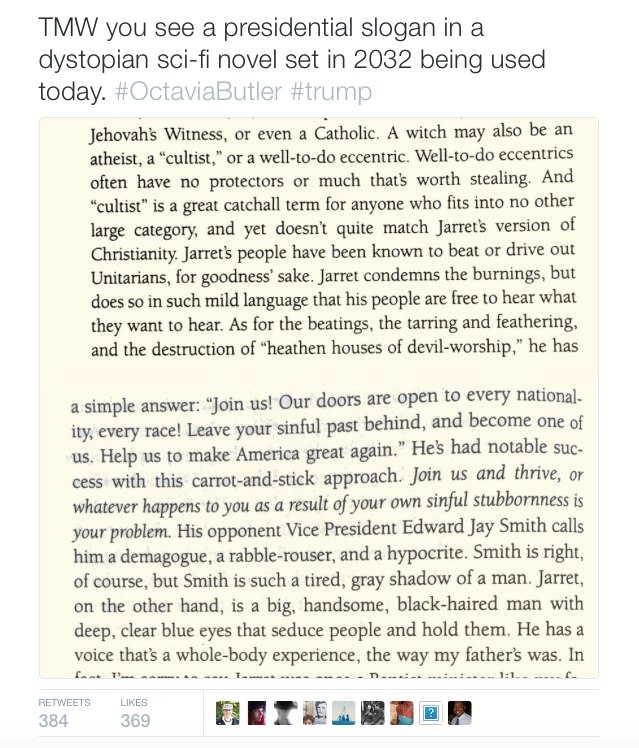
One pre­dic­tion you may have missed, how­ev­er, offers us a much more sober take on the rise of a fright­en­ing neo-fas­cist dur­ing a time of fear and civ­il unrest. As Twit­ter user @oligopistos point­ed out, in the sec­ond book of her Earth­seed series, The Para­ble of the Tal­ents (1998), Hugo and Neb­u­la-award win­ning sci­ence fic­tion writer Octavia But­ler gave us Sen­a­tor Andrew Steele Jar­ret, a vio­lent auto­crat in the year 2032 whose “sup­port­ers have been known… to form mobs.” Jarret’s polit­i­cal oppo­nent, Vice Pres­i­dent Edward Jay Smith, “calls him a dem­a­gogue, a rab­ble-rouser, and a hyp­ocrite,” and—most presciently—Jarret ral­lies his crowds with the call to “make Amer­i­ca great again.”

butler tweet
Though Trump has trade­marked it, the slo­gan did not orig­i­nate with him, nor even with Butler’s Jar­ret character—the 1980 Rea­gan-Bush cam­paign used it, as Matt Taib­bi point­ed out Rolling Stone last year. (His­to­ri­ans have even shown that anoth­er of Trump’s slo­gans, “Amer­i­ca First,” was used by Charles Lind­bergh and “Nazi-friend­ly Amer­i­cans in the 1930s.”) Again, pro­to-Trump­ism has been in the zeit­geist for a long time. While But­ler may have used “Make Amer­i­can Great Again” from her mem­o­ry of Rea­gan’s first cam­paign, the way her char­ac­ter employs it speaks to our moment for a num­ber of rea­sons.

It’s true that Sen­a­tor Jar­ret dif­fers from Trump in some sig­nif­i­cant ways: “Jarret’s beef is with Cana­da instead of Mex­i­co,” writes Fusion, and “instead of busi­ness acu­men as his main cre­den­tial, reli­gion is Jarret’s stump. He’s the head of a group called Chris­t­ian Amer­i­ca, which is intol­er­ant of oth­er reli­gious views, and whose sup­port­ers burn ‘witches’—meaning Mus­lims, Jews, Hin­dus and Buddhists—at the stake.” Our cur­rent can­di­date may have co-opt­ed the reli­gious right, but he doesn’t speak their lan­guage at all. Nonethe­less, he has made promis­es that give sec­u­lar­ists and non-Chris­tians chills, and reli­gious intol­er­ance has formed the back­bone of his cam­paign and of the rhetoric that has dri­ven his par­ty to the far right.

Jar­ret and the fanati­cism he inspires become cen­tral the nov­el­’s sto­ry, but the cru­cial back­ground in Butler’s 1998 depic­tion of a post-apoc­a­lyp­tic 2032 are the con­di­tions she iden­ti­fies as giv­ing rise to the Sen­a­tor’s rule (and which she described in the first book, Para­ble of the Sow­er). In Tal­ents, the narrator’s father Tay­lor Franklin Bankole writes,

I have read that the peri­od of upheaval that jour­nal­ists have begun to refer to as “the Apoc­a­lypse” or more com­mon­ly, more bit­ter­ly, “the Pox” last­ed from 2015 through 2030—a decade and a half of chaos…. I have also read that the Pox was caused by acci­den­tal­ly coin­cid­ing cli­mat­ic, eco­nom­ic, and soci­o­log­i­cal crises. It would be more hon­est to say that the Pox was caused by our own refusal to deal with obvi­ous prob­lems in those areas. We caused the prob­lems: then we sat and watched as they grew into crises.

In Butler’s fic­tion, the rise of Sen­a­tor Jar­ret and his mobs is an out­come of the same kinds of impend­ing crises we face now, and that far too many of our lead­ers duti­ful­ly ignore as they stage increas­ing­ly acri­mo­nious and bizarre forms of polit­i­cal the­ater. Butler’s indi­rect warn­ing to us in Para­ble of the Tal­ents may be less about the dem­a­gog­ic leader and his cult—though they pose the most dire exis­ten­tial threat in the book—than about the caus­es and con­di­tions that cre­at­ed “the Pox,” the kind of social col­lapse that Kurt Von­negut warned of ten years before But­ler in his time-cap­sule let­ter to the peo­ple of 2088, vague­ly iden­ti­fy­ing sim­i­lar kinds of “cli­mat­ic, eco­nom­ic, and soci­o­log­i­cal” crises to come. Would that we could aban­don emp­ty spec­ta­cle and heed these Cas­san­dras of the near future.

via The Huff­in­g­ton Post

Relat­ed Con­tent:

In 1988, Kurt Von­negut Writes a Let­ter to Peo­ple Liv­ing in 2088, Giv­ing 7 Pieces of Advice

Isaac Asi­mov Pre­dicts in 1964 What the World Will Look Like Today

Noam Chom­sky on Whether the Rise of Trump Resem­bles the Rise of Fas­cism in 1930s Ger­many

Josh Jones is a writer and musi­cian based in Durham, NC. Fol­low him at @jdmagness

Brexit 101: The UK’s Stunning Vote Explained in 4 Minutes

The Brex­it votes have been count­ed. The Brits have decid­ed to leave the Euro­pean Union. And the finan­cial mar­kets are tak­ing it hard. Right now, futures on the Lon­don stock exchange are down 8%. The pound is down 9.8 per­cent, more than dou­ble its pre­vi­ous record decline of 4.1 per­cent. We’re liv­ing in inter­est­ing times.

No doubt, some of you are sud­den­ly won­der­ing, what exact­ly is Brex­it? And what’s at stake? Up top, you can watch a four-minute primer cre­at­ed by The Wall Street Jour­nal. Bloomberg has its own two-minute ver­sion here (or view below). The Toron­to Star breaks down Brex­it in 13 points. And The Guardian went so far as to cre­ate a guide just for Amer­i­cans. (For any­one who wants to dis­sect the pro­pa­gan­da for leav­ing Brex­it, you can watch the fea­ture-length doc­u­men­tary film, Brex­it: The Moviereleased last month.) Please feel free to add oth­er primers in the com­ments below.

For Amer­i­cans read­ing this, I’d point out that Brex­it and Trump share some impor­tant things in com­mon: they’re both about putting up walls, plac­ing blame on immi­grants and minori­ties; exploit­ing the resent­ments of the eco­nom­i­cal­ly dis­ad­van­taged; dis­miss­ing experts and estab­lish­ment fig­ures; and risk­ing upend­ing a frag­ile world order. How Eng­land looks on June 24th is per­haps a small pre­view of how Amer­i­ca might look on Novem­ber 9th. Only there will be tril­lions more at stake.

If you would like to sign up for Open Culture’s free email newslet­ter, please find it here. It’s a great way to see our new posts, all bun­dled in one email, each day.

If you would like to sup­port the mis­sion of Open Cul­ture, con­sid­er mak­ing a dona­tion to our site. It’s hard to rely 100% on ads, and your con­tri­bu­tions will help us con­tin­ue pro­vid­ing the best free cul­tur­al and edu­ca­tion­al mate­ri­als to learn­ers every­where. You can con­tribute through Pay­Pal, Patre­on, and Ven­mo (@openculture). Thanks!

by | Permalink | Make a Comment ( 12 ) |

Jon Stewart Resurfaces and Breaks Down the 2016 Election: The “Man Baby” v. the “Inauthentic”

It’s a farce of an elec­tion, and the only thing that could make it bear­able is The Dai­ly Show with Jon Stew­art. (Sor­ry Trevor Noah.) But, alas, Stew­art retired from the show ear­li­er this year, leav­ing us starv­ing for some inci­sive com­ic relief.

But here’s a momen­tary respite.

Two days ago, Stew­art appeared on “The Axe Files,” a pod­cast host­ed by David Axel­rod, once the Chief Strate­gist for Barack Oba­ma’s pres­i­den­tial cam­paigns, and now the Direc­tor of the Insti­tute of Pol­i­tics at the Uni­ver­si­ty of Chica­go. The pod­cast fea­tures intel­li­gent con­ver­sa­tions with key fig­ures in the polit­i­cal world. And they often put a human face on polit­i­cal fig­ures you might oth­er­wise dis­dain. If you want to feel a lit­tle bet­ter about Amer­i­can pol­i­tics, you can lis­ten to archived episodes here.

If you would like to sign up for Open Culture’s free email newslet­ter, please find it here. It’s a great way to see our new posts, all bun­dled in one email, each day.

If you would like to sup­port the mis­sion of Open Cul­ture, con­sid­er mak­ing a dona­tion to our site. It’s hard to rely 100% on ads, and your con­tri­bu­tions will help us con­tin­ue pro­vid­ing the best free cul­tur­al and edu­ca­tion­al mate­ri­als to learn­ers every­where. You can con­tribute through Pay­Pal, Patre­on, and Ven­mo (@openculture). Thanks!

by | Permalink | Make a Comment ( 1 ) |

Edward Snowden & Jean-Michel Jarre Record a Techno Protest Song, “Exit”

For his new album, Elec­tron­i­ca Vol­ume II: The Heart Of Noise, Jean-Michel Jarre, a pio­neer in elec­tron­ic and ambi­ent music, col­lab­o­rat­ed on a record­ing with Edward Snow­den, the for­mer CIA com­put­er ana­lyst-turned-whistle­blow­er. Cue up their song, “Exit,” above.

At first glance, it per­haps seems like an unlike­ly pair­ing. But if you give Jarre, the son of a French resis­tance fight­er, a chance to explain, it all makes per­fect sense. Recent­ly, he told The Guardian:

The whole Elec­tron­i­ca project is about the ambigu­ous rela­tion­ship we have with tech­nol­o­gy: on the one side we have the world in our pock­et, on on the oth­er, we are spied on con­stant­ly. There are tracks about the erot­ic rela­tion­ship we have with tech­nol­o­gy, the way we touch our smart­phones more than our part­ners, about CCTV sur­veil­lance, about love in the age of Tin­dr. It seemed quite appro­pri­ate to col­lab­o­rate not with a musi­cian but some­one who lit­er­al­ly sym­bol­is­es this crazy rela­tion­ship we have with tech­nol­o­gy.

A lot of what Jarre and Snow­den were try­ing to accom­plish with the song–musically, con­cep­tu­al­ly, ide­o­log­i­cal­ly, etc.–gets explained in the video below. Lis­ten­ing to Snow­den talk about the mean­ing of the song’s title (“Exit” means “things have to change,” “it’s time to leave, it’s time to do some­thing else, it’s time to find a bet­ter way”), you’ll get the sense that “Exit” is an elec­tron­ic protest song befit­ting our dig­i­tal age. Out with the folk music, in with the tech­no.

Elec­tron­i­ca Vol­ume II: The Heart Of Noise also fea­tures songs with the Pet Shop Boys, Gary Numan and the rap­per Peach­es.

Relat­ed Con­tent:

Whistle­blow­ing Is Not Just Leak­ing — It’s an Act of Polit­i­cal Resis­tance. Read Snow­den’s first long form essay, released just last week.

Recall­ing Albert Camus’ Fash­ion Advice, Noam Chom­sky Pans Glenn Greenwald’s Shiny, Pur­ple Tie

The His­to­ry of Elec­tron­ic Music in 476 Tracks (1937–2001)

Hear Sev­en Hours of Women Mak­ing Elec­tron­ic Music (1938- 2014)

How the Moog Syn­the­siz­er Changed the Sound of Music

Spike Lee Directs, “Wake Up,” a Five-Minute Campaign Film for Bernie Sanders

Ear­li­er this month Spike Lee and Bernie Sanders, two Brook­lyn natives, sat down and talked about pol­i­tics and the state of our nation. Now, with the New York pri­ma­ry right around the cor­ner, Spike drew on his film­mak­ing tal­ents and direct­ed a five-minute polit­i­cal cam­paign film for Bernie. It’s called sim­ply “Wake Up,” and it fea­tures cameos by Dr. Cor­nel West, Susan Saran­don, and Har­ry Bela­fonte.

I can’t recall anoth­er instance where a major film­mak­er shot an ad for a pres­i­den­tial can­di­date. If we’re over­look­ing some­thing obvi­ous (or less obvi­ous), let us know in the com­ments and we’ll maybe fea­ture it dur­ing this cam­paign sea­son.

If you would like to sign up for Open Culture’s free email newslet­ter, please find it here. It’s a great way to see our new posts, all bun­dled in one email, each day.

If you would like to sup­port the mis­sion of Open Cul­ture, con­sid­er mak­ing a dona­tion to our site. It’s hard to rely 100% on ads, and your con­tri­bu­tions will help us con­tin­ue pro­vid­ing the best free cul­tur­al and edu­ca­tion­al mate­ri­als to learn­ers every­where. You can con­tribute through Pay­Pal, Patre­on, and Ven­mo (@openculture). Thanks!

Relat­ed Con­tent:

Spike Lee Inter­views Bernie Sanders: Two Guys from Brook­lyn Talk About Edu­ca­tion, Inequal­i­ty & More

Bernie Sanders: I Will Be an Arts Pres­i­dent

Spike Lee’s List of 95 Essen­tial Movies – Now with Women Film­mak­ers

Bernie Sanders Sings “This Land is Your Land” on the Endear­ing­ly Bad Spo­ken Word Album, We Shall Over­come

Allen Ginsberg’s Hand­writ­ten Poem For Bernie Sanders, “Burling­ton Snow” (1986)

by | Permalink | Make a Comment ( 1 ) |

Spike Lee Interviews Bernie Sanders: Two Guys from Brooklyn Talk About Education, Inequality & More

With the New York pri­ma­ry com­ing up, Spike Lee and Bernie Sanders–the film­mak­er and the politician–sat down and talked about pol­i­tics and the state of our nation. At the 15 minute mark, the two Brook­lyn natives turned to edu­ca­tion (some­thing that undoubt­ed­ly con­cerns many read­ers here) and the impor­tance of mak­ing our pub­lic uni­ver­si­ties actu­al­ly acces­si­ble to the pub­lic. Such a rad­i­cal thought? You can read a tran­script of the con­ver­sa­tion over at The Hol­ly­wood Reporter.

If you would like to sign up for Open Culture’s free email newslet­ter, please find it here. It’s a great way to see our new posts, all bun­dled in one email, each day.

If you would like to sup­port the mis­sion of Open Cul­ture, con­sid­er mak­ing a dona­tion to our site. It’s hard to rely 100% on ads, and your con­tri­bu­tions will help us con­tin­ue pro­vid­ing the best free cul­tur­al and edu­ca­tion­al mate­ri­als to learn­ers every­where. You can con­tribute through Pay­Pal, Patre­on, and Ven­mo (@openculture). Thanks!

Relat­ed Con­tent:

Bernie Sanders: I Will Be an Arts Pres­i­dent

Spike Lee’s List of 95 Essen­tial Movies – Now with Women Film­mak­ers

Bernie Sanders Sings “This Land is Your Land” on the Endear­ing­ly Bad Spo­ken Word Album, We Shall Over­come

Allen Ginsberg’s Hand­writ­ten Poem For Bernie Sanders, “Burling­ton Snow” (1986)

by | Permalink | Make a Comment ( 6 ) |

Michio Kaku & Noam Chomsky School Moon Landing and 9/11 Conspiracy Theorists

Who real­ly killed John F. Kennedy? Did Amer­i­ca real­ly land on the moon? What real­ly brought down the Twin Tow­ers? Few mod­ern phe­nom­e­na pos­sess the sheer fas­ci­na­tion quo­tient of con­spir­a­cy the­o­ries. If you believe in them, you’ll of course dig into them obses­sive­ly, and if you don’t believe in them, you sure­ly feel a great curios­i­ty about why oth­er peo­ple do. Sci­ence writer and Skep­tic mag­a­zine Edi­tor in Chief Michael Sher­mer falls, need­less to say, into the sec­ond group; so far into it that exam­in­ing con­spir­a­cy the­o­ries and those who sub­scribe to them has become one of his best-known pro­fes­sion­al pur­suits since at least 1997, the year of his straight­for­ward­ly titled book Why Peo­ple Believe Weird Things.

On the 50th anniver­sary of JFK’s assas­si­na­tion, Sher­mer wrote an arti­cle in the Los Ange­les Times about the rea­sons that event has drawn so many avid con­spir­a­cy the­o­rists over the past half-decade. First: their cog­ni­tive dis­so­nance result­ing from the two seem­ing­ly incom­pat­i­ble ideas, that of JFK “as one of the most pow­er­ful peo­ple on Earth” and JFK “killed by Lee Har­vey Oswald, a lone los­er, a nobody.” Sec­ond: their par­tic­i­pa­tion in a mono­log­i­cal belief sys­tem, “a uni­tary, closed-off world­view in which beliefs come togeth­er in a mutu­al­ly sup­port­ive net­work.” Third: their con­fir­ma­tion bias, or “the ten­den­cy to look for and find con­firm­ing evi­dence for what you already believe” — the umbrel­la man, the grassy knoll — “and to ignore dis­con­firm­ing evi­dence.”

These fac­tors all come into play with the oth­er major Amer­i­can con­spir­a­cy the­o­ries as well. In the pod­cast clip at the top of the post, you can hear physi­cist Michio Kaku try­ing to set straight a moon land­ing con­spir­a­cy the­o­rist. They argue that man has nev­er set foot on the moon, but that the gov­ern­ment instead hood­winked us into believ­ing it with an elab­o­rate audio­vi­su­al pro­duc­tion (direct­ed, some the­o­rists insist, by none oth­er than Stan­ley Kubrick, who sup­pos­ed­ly “con­fessed” in fake inter­view footage that recent­ly made the inter­net rounds). Should you require fur­ther argu­ment to the con­trary, have a look at S.G. Collins’ Moon Hoax Not just above.

No high­er-pro­file set of con­spir­a­cy-the­o­ry move­ment has come out of recent his­to­ry than the 9/11 Truthers, who may dif­fer on the details, but who all gath­er under the umbrel­la of believ­ing that the events of that day hap­pened not because of the actions of a con­spir­a­cy of for­eign ter­ror­ists, but because of a con­spir­a­cy with­in the Unit­ed States gov­ern­ment itself. In the Q&A footage above (orig­i­nal­ly uploaded, in fact, by a believ­er), one such the­o­rist stands up and asks lin­guist and activist Noam Chom­sky to join in on the move­ment, point­ing to a cov­er-up of the man­ner in which 7 World Trade Cen­ter col­lapsed — a big “smok­ing gun” of the larg­er con­spir­a­cy, in their eyes.

This prompts Chom­sky to offer an expla­na­tion of how sci­en­tists and engi­neers actu­al­ly go look­ing for the truth. Have they elim­i­nat­ed entire­ly their cog­ni­tive dis­so­nance, mono­log­i­cal belief sys­tems, and con­fir­ma­tion bias­es? No human could ever do that per­fect­ly — indeed, to be human is to be sub­ject to all these dis­tort­ing con­di­tions and more — but the larg­er enter­prise of sci­ence, at its best, frees us lit­tle by lit­tle from those very shack­les. What a shame to vol­un­tar­i­ly clap one­self back into them.

Relat­ed Con­tent:

Michio Kaku Schools a Moon Land­ing-Con­spir­a­cy Believ­er on His Sci­ence Fan­tas­tic Pod­cast

Stan­ley Kubrick Faked the Apol­lo 11 Moon Land­ing in 1969, Or So the Con­spir­a­cy The­o­ry Goes

Noam Chom­sky Schools 9/11 Truther; Explains the Sci­ence of Mak­ing Cred­i­ble Claims

Based in Seoul, Col­in Mar­shall writes and broad­casts on cities and cul­ture. He’s at work on a book about Los Ange­les, A Los Ange­les Primer, the video series The City in Cin­e­ma, the crowd­fund­ed jour­nal­ism project Where Is the City of the Future?, and the Los Ange­les Review of Books’ Korea Blog. Fol­low him on Twit­ter at @colinmarshall or on Face­book.

« Go BackMore in this category... »
Quantcast