Mike Rugnetta, the fast-talking host of PBS’s Idea Channel, theorizes that the 20-year-old film is a great, possibly inadvertent commentary on the dangers of global market capitalism. His merry spoiler-packed video touches on such phenomena as risky investments, the subprime mortgage crisis, and the havoc that can be wreaked by a disgruntled employee. He hales both Richard Attenborough’s park owner character and Director Spielberg as egotistical madmen chasing monstrous profits. His kitchen sink approach inevitably leads to appearances by both Barney and Slovenian philosopher and cultural critic Slavoj Žižek.
Rugnetta is quick (of course) to point out that he could come up with similar hypotheses for such comparatively fresh releases as World War Z (wage slavery), Iron Man (glory be to the world-saving entrepreneur), and Pacific Rim (the global market will unite us all)… but why, when Jurassic Park’s got enduring, market-tested crowd-pleasers?
We’ve already featured former Black Flag frontman and current spoken-word artist Henry Rollins explaining why, to his mind, only education can restore democracy. He also believes it can cure something he calls “disaster capitalism,” and you can hear more from him about it in the Big Think video above. He addresses, in his characteristically straightforward manner, the questions of what exactly ails the American economy, how that ailment might have come about, and how the country can educate itself back to health. We may individually get our educations now, he grants, but “how long will it be until America fiscally turns itself around” to the point of repaying “the risk of the investment on that student loan to get a person through four years of college? Will that person get a job where paying off that loan and getting a house and affording a family, will that be a possibility? In the present America, it doesn’t look like it is.”
Seeing a dire national situation, Rollins recommends doing like China, but not in the way you might assume. He suggests looking “500 years at a time,” much farther up the road than we have of late. “I’d be looking up the road so far my eyes would fall out of my head.” He wants the country to become “like Europe, where they’ll educate your kid until his head explodes,” producing “three doctors per floor of every apartment building” and doing so by making “college tuition either free or really low.” Generally thought of as liberal, Rollins sums this up in a way that might appeal to his ideological opponents: “If you have a country full of whip-crack smart people, you have a country the rest of the world will fear. They will not invade a country of educated people because we are so smart we’ll build a laser that will burn you, the enemy, in your sleep before you can even mobilize your air force to kill us. We will kill you so fast because we are so smart and we will have foreign policy that will not piss you off to the point to where you have to attack us.”
Russian punk performance art collective Pussy Riot will not be deterred. Despite two of their members still languishing in prison labor camps for a musical protest in Moscow’s Cathedral of Christ the Savior, the band continues to rail against its country’s corruption and abuses. This time, in their first music video in almost a year, they take on the Russian oil industry and other targets in the song above called “Like in a Red Prison.” The Wall Street Journal writes:
The confusing and caustic lyrics to the hard-to-listen-to song decry sexism, “homophobic vermin,” actor Gerard Depardieu (a recent recipient of Russian citizenship courtesy of Mr. Putin), and likens Russia’s president to the Ayatollah of Iran.
I don’t find the song hard to listen to at all—quite the contrary—and the video’s pretty exhilarating too, with the band members, in trademark multi-colored balaclavas, clambering atop an oil derrick and defacing a portrait of oil executive Igor Sechin and a head of the Investigative Committee (Russia’s FBI). Definitely a lot going on here, but the central focus is the critique of Russian big oil. The band explains on their site that “Russia’s revenues from the oil industry amounted to 7 trillion rubles ($216 billion), but only Russian President Vladimir Putin and ‘several of his friend see this’” [sic]. The new song’s lyrics were partly written by one of the still-imprisoned members, Nadezhda Tolokonnikova.
Her appetite for digital dialogue with admirers and accusers alike calls to mind fellow shrinking violet Courtney Love. Her refusal to let anyone but Amanda Palmer speak for Amanda Fucking Palmer has given rise to an army of trolls, who gleefully find proof of monstrous ego in her most innocuous of moves. It’s the price of allowing the public complete access to “Do It With a Rockstar,” if you will.
As noted in her keynote speech (above) at the recent Muse and the Marketplace literary conference, “with the internet you do not get to choose.” This applies whether one is generating content or leaving nasty comments. Her remarks touch upon her most recent firestorm, a direct trail leading back to “A Poem for Dzhokar,” a hastily composed and posted attempt to put herself in the shoes of the suspected Boston Marathon bomber as he lay in a boat, awaiting capture.
Clearly, someone with her experience does not slap such a hot potato online innocent of the consequences. She got plenty of lumps, and whether or not the majority of them were deserved is a matter of personal opinion. More than 2300 people quickly logged on to voice these aforementioned opinions, some supportive, some taking the form of mocking haikus, which Palmer appreciated, especially since it was, at the time, National Poetry Month.
It seems to me that any time her ass is hanging out her giant heart’s not far behind. Listen to her speech, and see if you don’t find her attitude ultimately inspiring, especially for those artists interested in connecting with a larger audience. (The presentation’s so restrained, you can turn your back on the screen, turn your attention to some pedestrian task, and enjoy her thoughts podcast-style. )
It turns out that the fleeting pronouncements we post on Twitter are catnip for academics and others eager to find the elusive pulse of American society. Since Twitter launched in 2006, researchers have been hard at work figuring out how to turn those 140-character musings into tea leaves with something meaningful to say about us all.
Here come three new projects that claim to provide a window into the American soul through Twitter. Whether they succeed or not, well, that’s still unclear. (And, by the way, you can start following Open Culture on Twitter here.)
They looked at two things: Hurricane Sandy (top) and the 2012 Presidential Election (above). Using Twitter’s “garden hose feed”—a random sampling of 10 percent of the roughly 500 million tweets sent every day—researchers color-coded tweets red for negative tone and blue for positive and showed the shifting concentrations of Twitter activity across the country. It looks like a map of a talking weather system as occasional dialogue boxes open up to show representative tweets. Researcher Kalev Leetaru argues that tracking Twitter activity gives us the potential to track the heartbeat of society.
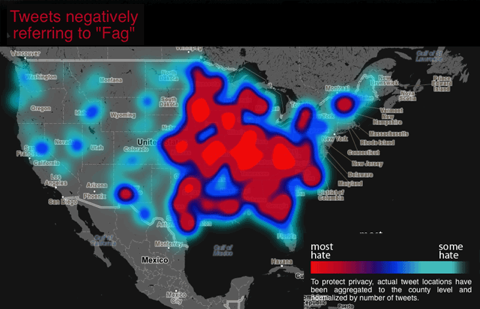
Two other projects look in an on-going way at tweet “tone,” or the negativity/positivity of messages. One spin on this research is the Geographic Hate Map (sample map above), a project by Dr. Monica Stephens of Humboldt State University in Northern California. To begin their work, Stephens and her team accessed a massive database of geographically tagged tweets sent between June, 2012 and April, 2013.
They used only tweets that contained any of ten “hate words.” They read each tweet to be sure the words were used in a negative way and built a map based on where the tweets came from. Then they aggregated to the county level and normalized for the amount of twitter traffic in that area so that densely populated areas don’t look more racist or homophobic by default.
Then there’s the glass half full. The Hedonometer measures happiness, or lack thereof, as expressed by tweets, calculating averages based on what the researchers call “word shifts” (watch an explanation above). This research project, put together by the University of Vermont Complex Systems Center, uses the same garden hose feed as the Global Twitter Heartbeat. This project searches for frequently used words to measure how good a day Twitter users are having. Since 2008 the Hedonometer has kept track of how often words like “happy,” “yes,” and “love” pop up in tweets, as opposed to “hate,” “no,” and “unhappy.” The saddest day on Hedonometer record so far is April 15, 2013, the day bombs exploded at the Boston Marathon finish line. Christmas Day tends to rank as the happiest day of the year.
To be sure, any tool that uses tweets for data is measuring a very young and specific subgroup of people. Tweets are not a reliable measure of anything, really, but maybe with some tweaking, these research models will come up with something interesting.
The United States has only five percent of the world’s population, but somewhere between 35 and 50 percent of the world’s privately owned guns. Is it a surprise, then, that we have significantly higher rates of gun violence?
According to research published by the National Institutes of Health, homicide rates in the U.S. are 6.9 times higher than they are in other high-income nations. For 15- to 24-year-olds, the homicide rate is 42.7 times higher. Firearm suicide rates are 5.8 times higher in America than in other countries, even though the overall suicide rates are 30 percent lower.
A succession of high-profile massacres–Columbine, Virginia Tech, Sandy Hook–has taken place against a baseline of daily gun deaths that rarely make the national headlines: murders, suicides, accidental killings. Since the December 14 mass murder at Sandy Hook Elementary School in Newtown, Connecticut, in which 20 children and six adults were gunned down by a heavily armed man, there have been well over 3,300 gun-related deaths in America. If current trends continue, gun deaths are projected to exceed traffic deaths for the first time by the year 2015.
So what is being done? At the federal level, nothing.
Earlier this month the Senate not only struck down legislation to ban assault weapons and high-capacity gun magazines, it also struck down–at the will of a 45-member minority–a bipartison compromise to expand background checks for gun buyers, a measure supported by 90 percent of the American people.
In response to the paralysis (some would say cowardice) on Capitol Hill, a group of 23 prominent cartoonists, including Garry Trudeau, Ruben Bolling, Art Spiegelman and Tom Tomorrow, have joined forces to fight back against the gun lobby. The cartoon (above) was organized by Mayors Against Illegal Guns, and is narrated by actors Julianne Moore and Philip Seymour Hoffman.
“Enough. Demand action,” say Moore and Hoffman. “As a dad, as a mom, as a husband, as a wife, as a family, as a friend. As an American. It’s time. We can’t back down. It’s time for our leaders to act right now. Demand action”
If you would like to support the mission of Open Culture, consider making a donation to our site. It’s hard to rely 100% on ads, and your contributions will help us continue providing the best free cultural and educational materials to learners everywhere. You can contribute through PayPal, Patreon, and Venmo (@openculture). Thanks!
In the early ’90s, the so-called “Iron Archives” of Russian political documents from the Cold War era opened up to historians, shedding light on the earliest days of Mao Zedong and Joseph Stalin’s diplomatic alliance.
But not all of the Russian documents were declassified at that time. The Woodrow Wilson International Center for Scholars has launched a new digital archive containing recently declassified materials from some 100 different international collections, including a cable Mao sent to Commander Filippov (Stalin’s alias) eagerly detailing his plans to study Russia and complaining about his poor health.
The subsequent exchange between the two world leaders is as banal as their later correspondence would be ideological. Mao suggests, once his health improves, that they use the aerodrome in Weixian for his departure and he includes the exact dimensions of the landing strip. One wonders whether Obama and Israeli President Shimon Peres worked so closely together on travel details for their meetings in March.
The details contained in the thousands of cables, telegrams and memos are part of the fun. Other documents exchanged between the KGB chairman and East German Minister in July, 1981 include blunt language about the difficulties of reading the Reagan Administration’s intentions and the importance of quashing the Polish Solidarity Movement.
Because the world’s biggest issues tend to have long roots, there is a lot of material here that echoes today’s headlines. Here, the Soviet Minister of Foreign Affairs records a 1958 memo about his assessment of North Korea’s plans for a nuclear program.
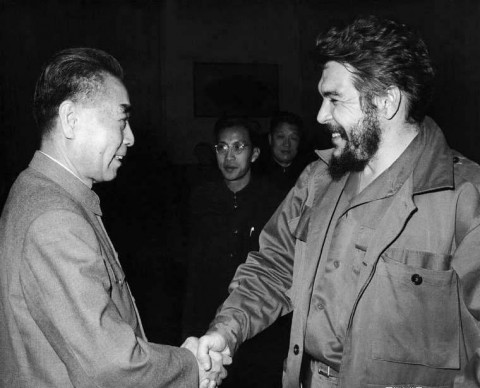
During a 1960 global communist delegation meeting, Mao Zedong spoke at length with Che Guevara about sugar sales, American influence and counter-revolutionaries.
As a side note, the Wilson Center is a one of the more intellectual memorials to an American president. Woodrow Wilson was, after all, the only President of the United States to hold a Ph.D. The Center is one of the world’s top think tanks, with research and projects focused on U.S.-Russia relations, the Middle East, North Korea and, oddly, emerging nanotechnologies. But, of course, the Wilson Center is more known for its centrist analysis of international diplomacy issues.
The new digital archive (whose tagline is “International History Declassified”) offers several ways to search: by place, year (beginning with1938) or subject. For scholars or history buffs, this is a trove worth browsing.
Kate Rix writes about education and digital media. Visit her website: .
This week, the Supreme Court is hearing arguments about gay rights in America. And, no matter how the court decides, these cases will enter the history books. Will the court lead the nation in making equality available for all, as it did during the civil rights era? Or will the nation be forced to lead the court into modernity during the years ahead? That we will soon find out.
Usually the court delays the release of audio recordings of oral arguments. But, acknowledging the importance of these particular cases, SCOTUS is making this week’s arguments immediately available. You can listen to the debates over Prop. 8 here or below. DOMA arguments will appear here. And it’s also now below.
We're hoping to rely on loyal readers, rather than erratic ads. Please click the Donate button and support Open Culture. You can use Paypal, Venmo, Patreon, even Crypto! We thank you!
Open Culture scours the web for the best educational media. We find the free courses and audio books you need, the language lessons & educational videos you want, and plenty of enlightenment in between.