Hans Rosling knows how to make a concise, powerful point. His mastery of statistics and visual aids doesn’t hurt. Behold, for instance, the Karolinska Institute Professor of International Health visualizing the health of 200 countries over 200 years with 120,000 data points. His ability to condense vast amounts of information into short bursts while providing the widest possible context for his points naturally endears him to the TED audience, which values counterintuitive intellectual impact delivered with the utmost succinctness. We previously featured a TED Talk from wherein the excitable professor explains world population growth and prosperity with props bought at IKEA. (The man comes from Sweden, after all. One must represent.) Now, on Bill Gates’ Youtube channel, you can watch Rosling’s shortest and slickest video yet: “The River of Myths.”
Opening with a visualization of 1960’s world child mortality numbers graphed against the number of children born per woman, Rosling uses his signature method of statistical-animation showmanship to explode myths about the potential of developing nations. We see that, as a country’s wealth rises, its health rises; as its health rises, its child mortality drops; and as its child mortality drops, so does its number of children born per woman, which leads to a sustainable overall population size. He then examines the separate regions of Ethiopia, formerly a developmental laggard, showing that the capital Addis Ababa ranks reproductively among the developed nations, while only remote regions lag behind. “Most people think the problems in Africa are unsolvable, but if the poorest countries can just follow the path of Ethiopia, it’s fully possible that the world will look like this by 2030.” We then see a projection of all the world’s nations clustered in the small-family, low-mortality corner of the graph. “But to ensure this happens, we must measure the progress of countries. It’s only by measuring we can cross the river of myths.” Have you heard a more powerful argument for the usefulness of statistics lately?
Colin Marshall hosts and produces Notebook on Cities and Culture and writes essays on literature, film, cities, Asia, and aesthetics. He’s at work on a book about Los Angeles, A Los Angeles Primer. Follow him on Twitter at @colinmarshall.
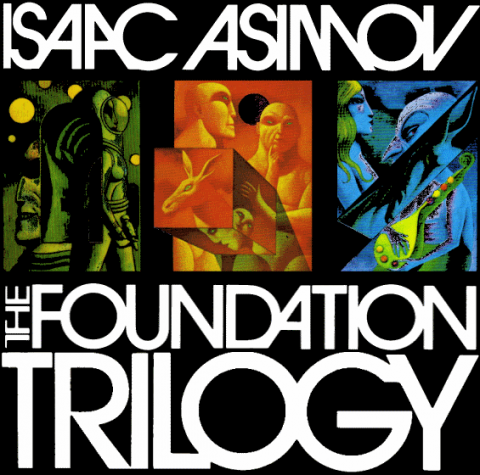
Tireless New York Times columnist and Nobel-prize winning Princeton economist Paul Krugman has long played the role of Cassandra, warning of disasters while the architects of policy look on, shake their heads, and ignore him. I’ve sometimes wondered how he stands it. Well, it turns out that, like many people, Krugman’s long view is informed by epic narrative. Only in his case, it’s neither ancient scripture nor Ayn Rand. It’s the Isaac Asimov-penned FoundationTrilogy, which Krugman, in a recent Guardian piece, dissects in detail as a series that informed his views as a teenager, and has stayed with him for four and a half decades.
The hero of the trilogy, Hari Seldon, is a mathematician, whose particular branch of mathematics, called psychohistory, allows him to make massive, large-scale predictions of the future. This science informs “The Seldon Plan” that silently guides the coming of a new Galactic Empire thousands of years into the future. If it sounds a bit arid in paraphrase, it isn’t, even though Asimov’s characters tend to be thin and his descriptions lack in poetry. “Tolstoy this isn’t,” Krugman tells us.
But the novels work as brilliant speculative fiction, tethered to the familiar history of Western civilization by resonances with ancient Rome, mercantile Europe, and old New York. Instead of space opera or fantasy, Krugman describes Asimov’s fiction as anti-action, anti-prophecy. The protagonist’s “prescience comes from his mathematics.” And this, believe it or not, is fascinating, at least for Krugman. Because for him they function as reminders that “it’s possible to have social science with the power to predict events and, maybe, to lead to a better future.” Krugman writes:
They remain, uniquely, a thrilling tale about how self-knowledge – an understanding of how our own society works – can change history for the better. And they’re every bit as inspirational now as they were when I first read them, three-quarters of my life ago.
He admits that the sentiments of Asimov’s fiction present us with a “very bourgeois version of prophecy,” but then, economics is a very bourgeois science, mostly concerned with one emotion, “greed.” Nonetheless, Krugman believes in the power of “good economics to make correct predictions that are very much at odds with popular prejudices.” And we could all do with fewer of those.
Asimov’s Hugo-winning trilogy was adapted for eight, one-hour radio-drama episodes in 1973. Listen to the first installment above, and download or stream the remaining episodes at the links below:
Part 1 |MP3| Part 2 |MP3| Part 3 |MP3| Part 4 |MP3| Part 5 |MP3| Part 6 |MP3| Part 7 |MP3| Part 8 |MP3|
Or listen to the Spotify version up top.
You can find this audio listed in our collection of Free Audio Books.
Josh Jones is a doctoral candidate in English at Fordham University and a co-founder and former managing editor of Guernica / A Magazine of Arts and Politics.
Now is your chance to delve into Ariely’s research and discover precisely how emotion shapes economic decisions in financial and labor markets, and in our everyday lives. The six-week course (described in more detail here) doesn’t begin until March 25th, but you can reserve your seat today. It’s all free. And keep in mind that students who master the materials covered in the class will receive a certificate at the end of the course.
Other potentially interesting MOOCs coming early next year include:
A great year for open education got even better with the launch of Marginal Revolution University. Founded by Tyler Cowen and Alex Tabarrok, two econ professors at George Mason University, MRUniversity promises to deliver free, interactive courses in the economics space. And they’re getting started with a course on Development Economics, a subdiscipline that explores why some countries grow rich and others remain poor. In short, issues that have real meaning for everyday people worldwide.
1. The product is free, and we offer more material in less time.
2. Most of our videos are short, so you can view and listen between tasks, rather than needing to schedule time for them. The average video is five minutes, twenty-eight seconds long. When needed, more videos are used to explain complex topics.
3. No talking heads and no long, boring lectures. We have tried to reconceptualize every aspect of the educational experience to be friendly to the on-line world.
4. It is low bandwidth and mobile-friendly. No ads.
5. We offer tests and quizzes.
6. We have plans to subtitle the videos in major languages. Our reach will be global, and in doing so we are building upon the global emphasis of our home institution, George Mason University.
7. We invite users to submit content.
8. It is a flexible learning module. It is not a “MOOC” per se, although it can be used to create a MOOC, namely a massive, open on-line course.
9. It is designed to grow rapidly and flexibly, absorbing new content in modular fashion — note the beehive structure to our logo. But we are starting with plenty of material.
10. We are pleased to announce that our first course will begin on October 1.
Back in 2011 The Open University released an engaging series of animated intellectual puzzles called 60-Second Adventures in Thought, narrated by the British comedian and writer David Mitchell. The series offered a witty and fast-paced trip through some of the most famous paradoxes and thought experiments in the history of ideas. This week the same team is back with six new adventures, this time focused on economics. As the introduction on the OU channel at YouTube says:
Ever shaken an invisible hand? Been flattened by a falling market? Or wondered what took the bend out of Phillips’ curve? David Mitchell helps reveal some of the great dilemmas faced by governments trying to run an economy–whether to save or spend, control inflation, regulate trade, fix exchange rates, or just leave everyone to get on with it and not intervene. You’ll learn why Adam Smith put such a high price on free markets, how Keynes found a bold new way to reduce unemployment, and what economists went on to discover about the impact of policy on people’s and businesses’ behavior–which may not always be entirely rational.
60-Second Adventures in Economics is a fast and fun way to acquaint yourself with a few of the fundamental ideas in economics. All six episodes are here, beginning with “The Invisible Hand,” above, and continuing below.
When someone questions the effectiveness of Keynesian economics, the obvious reply is: Remember World War II?
The British economist John Maynard Keynes argued that there is a role for government intervention when aggregate demand for goods and services drops, as it did during the Great Depression. Without increased public spending to make up for decreased private spending, he said, an economy will slide into a vicious circle of low demand and low output, ensuring a prolonged period of high unemployment. Government thrift at such times will only deepen the problem. “The boom, not the slump,” said Keynes, “is the right time for austerity.”
In 1939 dark clouds of war were gathering over Europe, but Keynes saw a silver lining: an opportunity to prove his theory correct. He believed that the massive government-funded war mobilization would finally give sufficient stimulus to end the Great Depression. On May 23 of that year Keynes gave his famous BBC radio address, “Will Re-armament Cure Unemployment?” He said, in part:
It is not an exaggeration to say that the end of abnormal unemployment is in sight. And it isn’t only the unemployed who will feel the difference. A great number besides will be taking home better money each week. And with the demand for efficient labor outrunning the supply, how much more comfortable and secure everyone will feel in his job. The Grand Experiment has begun. If it works–if expenditure on armaments really does cure unemployment–I predict that we shall never go back all the way to the old state of affairs. Good may come out of evil. We may learn a trick or two, which will come in useful when the day of peace comes.
When the day of peace did come, the Great Depression was over and England and America were embarked on a long period of rising economic prosperity. In these times of recession and government austerity, it may be good to remember something else Keynes said in his radio address: “If we can cure unemployment for the wasted purposes of armaments, we can cure it for the productive purposes of peace.”
You can find Keynes’ classic work, The General Theory of Employment, Interest and Money, in our collection of Free eBooks.
Is it a tragedy? Is it a farce? In the land once called East Germany, in a town once called Karl-Marx-Stadt, a bank called Sparkasse Chemnitz ran an online poll letting customers vote for images to place on their credit cards. And the hands-down winner was Karl Marx, an ironic pick given that … well, you don’t need me to explain why.
In response to this selection, Planet Money has encouraged readers to post a tagline for the card on Twitter, using the hashtag #marxcard. Here are a few of our favorites so far:
There are Some Things Money Can’t Buy. Especially If You Abolish All Private Property.
From each according to their ability, to each according to his need. For everything else, there’s #Marxcard.
The Marx Card — Because Credit is the Opiate of the Masses.
The Karl Marx MasterCard — When You’re Short of Kapital
Got your own to suggest? cc: us on Twitter: @openculture
If you would like to support the mission of Open Culture, consider making a donation to our site. It’s hard to rely 100% on ads, and your contributions will help us continue providing the best free cultural and educational materials to learners everywhere. You can contribute through PayPal, Patreon, and Venmo (@openculture). Thanks!
We're hoping to rely on loyal readers, rather than erratic ads. Please click the Donate button and support Open Culture. You can use Paypal, Venmo, Patreon, even Crypto! We thank you!
Open Culture scours the web for the best educational media. We find the free courses and audio books you need, the language lessons & educational videos you want, and plenty of enlightenment in between.