From Travis Lee Ratcliff comes a video essay that explores the influence of Constantin Stanislavski, the Russian theatre director whose “system” of actor training shaped a generation of iconic American actors. Here’s how Ratcliff sets the stage for his video essay.
In the 1950s, a wave of “method actors” took Hollywood by storm.
Actors like James Dean, Marlon Brando, and Montgomery Clift, brought a whole new toolset and perspective on the actor’s craft to the films they performed in.
The foundation of their work, however, was laid in Russia more than fifty years prior to their stardom.
Stanislavski’s conception of “psychological realism” in performance challenged ideas about the essential features of the actor’s craft that had been held for centuries.
In theatre before Stanislavski, acting was defined as a craft of vocal and gestural training. The role the actor played was to give life to the emotions of the text in a broad illustrative fashion. Formal categories such as melodrama, opera, vaudeville, and musicals, all played to this notion of the actor as chief representer of dramatic ideas.
Stanislavski’s key insight was in seeing the actor as an experiencer of authentic emotional moments.
Suddenly the craft of performance could be about seeking out a genuine internal experience of the narrative’s emotional journey.
From this foundation, realism in performance began to flourish. This not only changed our fundamental idea of the actor but invited a reinvention of the whole endeavor of telling stories through drama.
Teachers would adopt Stanisvlaski’s methods and ideas and elaborate upon them in American theatre schools. The result, in the 1950s, would be a new wave of actors and a style of acting that emphasized psychological realism to a greater degree than their peers in motion pictures.
This idea of realism grew to dominate our notion of successful performances in cinema. Stanislavskian-realism is now central to the DNA of how we direct and read performances, whether we are conscious of it or not.
I think it is important to know this history and consider its revolutionary character. Understanding the nature of Stanislavski’s insights allows us to look at other unasked questions, other foundational elements of our craft that we might take for granted.
Beyond this, Ratliff also provides a list of Stanislavski’s books, which still provide “fascinating explorations of the craft of performance.” Check them out:
If you would like to support the mission of Open Culture, consider making a donation to our site. It’s hard to rely 100% on ads, and your contributions will help us continue providing the best free cultural and educational materials to learners everywhere. You can contribute through PayPal, Patreon, and Venmo (@openculture). Thanks!
I have often thought that eating some really serious brown bread is a bit like pushing a bike up a very steep hill, a hill called “health.” So what a surprise to find that in 2006 a poll of 1,000 Britons voted this 1973 ad for Hovis bread as the Favorite British Commercial of All Time. And none other than Ridley Scott directed it. Indeed, this story of a young lad delivering bread by bicycle up a steep cobblestone mining-town street is laced through with nostalgia and a sentimental use of Dvorak’s “New World” Symphony. (So beloved is it that Brits often request the classical work on radio as “the Hovis music.”)
Before Ridley Scott became a blockbuster film director, he cut his teeth by directing episodic television in the UK, and then forming an advertising production company with his brother Tony called RSA Films (Ridley Scott Associates). According to Scott, he was involved in the production of roughly 2,700 commercials over the company’s 10 years.
This iconic ad was one of several he directed that year for Hovis, but this is the one that stuck. It might be the simplicity of the ad, the Sisyphean struggle of its young protagonist (who at least gets to easily ride home), or any number of factors, but it would be a stretch to really see the auteur in this film. If anything, it’s reminiscent of his kitchen sink meets French New Wave short film from 1965, “Boy and Bicycle,” which is interesting more as an oddity and a starring vehicle for his brother than a great film.
The Independent tracked down the boy in the Hovis ad, Carl Barlow, who was 13 at the time, but is now 57 and a retired firefighter.
“It was pure fate that I got the part as the Hovis boy. I was down to the last three, and it turned out that one of the two boys couldn’t ride a bike, and the other wouldn’t cut his hair into the pudding bowl style — it was the Seventies after all. As the only boy who could ride a bike and would cut his hair, I got the part.”
This year, as part of an ad campaign for Evans Bicycles, Mr. Barlow made his way to the top of the hill one more time, with the help of an electric bike:
Finally, an iconic commercial invites parody, and, in fact, cherished comedians The Two Ronnies made fun of the Hovis ad in this brief skit from 1978.
Ted Mills is a freelance writer on the arts who currently hosts the FunkZone Podcast. You can also follow him on Twitter at @tedmills, read his other arts writing at tedmills.com and/or watch his films here.
His effortless impersonations of the celebrities of his day are not always politic (see Al Jolson) but there’s no denying that his impressions of Liberace, Edgar G. Robinson, Bing Crosby, and Hollywood Bowl conductor Leopold Stokowski introduced these personages to subsequent generations.
Clearly he was not working alone. In the 1981 interview with David Letterman below, Mel Blanc, who voiced Bugs, Daffy Duck, Porky Pig, Foghorn Leghorn and many other animated favorites demonstrated his versatility.
Blanc shaped the characters from the get go, inventing voices for character sketches and storyboards, though it was clear to him that tough nut Bugs should have an equally tough accent — either Brooklyn or the Bronx. (Rather than split hairs, he invented a hybrid.)
Hank Azaria, who is as central to The Simpsons’ mythology as Blanc is to Warner Brothers, marvels (up top) at Blanc’s ability to mimic one character imitating another, as Bugs and Daffy Duck do above.
Regionalism steered many of Blanc’s most memorable creations, from Foghorn Leghon’s Texas drawl to French loverboy, Pepe Le Pew.
Not since the height of the Rocky Horror Picture Show’s midnight screenings have I seen a crowd go so nuts for a film, but 2003’s The Room seems to have really hit a cultural nerve. And it’s only going to get bigger with the upcoming release of The Disaster Artist, James Franco and Seth Rogen’s retelling of how writer/director/star Tommy Wiseau made his so-bad-it’s‑brilliant film, based on the book by Greg Sestero and Tom Bissell.
Whereas Rocky Horror was an adaptation of an already successful East End musical, and a knowingly camp one at that, The Room is sui generis. As The Disaster Artist’s co-author Tom Bissell describes it, “It’s like a movie made by an alien who has never seen a movie but had movies thoroughly explained to him.”
The above video from Vox takes the uninitiated into the phenomenon of this piece of “paracinema”–any film that lies outside the mainstream–and tries to explain why The Room is so beloved while so many other bad films disappear into the ether.
One reason is its campy nature, though never knowingly so–Wiseau thought he was making something great. And because it’s so hard to find somebody so driven, yet so unaware of the basics of acting, storytelling, and moviemaking, The Room stands out compared to other films that try to be intentionally bad. You just can’t fake that kind of thing.
The other reason is what critic Pierre Bourdieu would call cultural capital. That’s the shared joy between fans, and the importance placed on dressing up like the characters, going to midnight screenings, and seeing who knows the most lines.
The current trailer for The Disaster Artist reframes the story as a typical Hollywood story, where one follows their dreams no matter what, and hints at how The Room’s plot mirrored actual events in Wiseau’s life.
Meanwhile, what is really getting the buzz is James Franco’s uncanny and spot-on portrayal of Wiseau and some of The Room’s recreated footage. It’s almost exact down to the second.
People’s love of The Room has led some to treat it like the work of art it so wanted to be. In YouTube essayist This Guy Edits’ video, he examines Wiseau’s blocking of a scene much like The Nerdwriter broke down Hitchcock’s blocking of Vertigo. Camp in this instance has birthed irony, but in the most loving way.
If you are new to The Room, please follow Tom Bissell’s advice and watch it for the first time at home, not at a midnight screening when you won’t hear any dialog and spoons are thrown at the screen. Hell, don’t even watch The Disaster Artist until you’ve sat down and watched Wiseau’s…masterpiece. (Yeah, we said it.)
Ted Mills is a freelance writer on the arts who currently hosts the artist interview-based FunkZone Podcast and is the producer of KCRW’s Curious Coast. You can also follow him on Twitter at @tedmills, read his other arts writing at tedmills.com and/or watch his films here.
There has maybe never been a better time to critically examine the granting of special privileges to people for their talent, personality, or wealth. Yet, for all the harm wrought by fame, there have always been celebrities who use the power for good. The twentieth century is full of such figures, men and women of conscience like Muhamad Ali, Nina Simone, and Paul Robeson—extraordinary people who lived extraordinary lives. Yet no celebrity activist, past or present, has lived a life as extraordinary as Josephine Baker’s.
Born Freda Josephine McDonald in 1906 to parents who worked as entertainers in St. Louis, Baker’s early years were marked by extreme poverty. “By the time young Freda was a teenager,” writes Joanne Griffith at the BBC, “she was living on the streets and surviving on food scraps from bins.” Like every rags-to-riches story, Baker’s turns on a chance discovery. While performing on the streets at 15, she attracted the attention of a touring St. Louis vaudeville company, and soon found enormous success in New York, in the chorus lines of a string of Broadway hits.
Baker became professionally known, her adopted son Jean-Claude Baker writes in his biography, as “the highest-paid chorus girl in vaudeville.” A great achievement in and of itself, but then she was discovered again at age 19 by a Parisian recruiter who offered her a lucrative spot in a French all-black revue. “Baker headed to France and never looked back,” parlaying her nearly-nude danse sauvage into international fame and fortune. Topless, or nearly so, and wearing a skirt made from fake bananas, Baker used stereotypes to her advantage—by giving audiences what they wanted, she achieved what few other black women of the time ever could: personal autonomy and independent wealth, which she consistently used to aid and empower others.
Throughout the 20s, she remained an archetypal symbol of jazz-age art and entertainment for her Folies Bergère performances (see her dance the Charleston and make comic faces in 1926 in the looped video above). In 1934, Baker made her second film Zouzou (top), and became the first black woman to star in a major motion picture. But her sly performance of a very European idea of African-ness did not go over well in the U.S., and the country she had left to escape racial animus bared its teeth in hostile receptions and nasty reviews of her star Broadway performance in the 1936 Ziegfeld Follies (a critic at Time referred to her as a “Negro wench”). Baker turned away from America and became a French citizen in 1937.
American racism had no effect on Baker’s status as an international superstar—for a time perhaps the most famous woman of her age and “one of the most popular and highest-paid performers in Europe.” She inspired modern artists like Picasso, Hemingway, E.E. Cummings, and Alexander Calder (who sculpted her in wire). When the war broke out, she hastened to work for the Red Cross, entertaining troops in Africa and the Middle East and touring Europe and South America. During this time, she also worked as a spy for the French Resistance, transmitting messages written in invisible ink on her sheet music.
Her massive celebrity turned out to be the perfect cover, and she often “relayed information,” the Spy Museum writes, “that she gleaned from conversations she overheard between German officers attending her performances.” She became a lieutenant in the Free French Air Force and for her efforts was awarded the Croix de Guerre and the Medal of the Resistance by Charles De Gaulle and lauded by George S. Patton. Nonetheless, many in her home country continued to treat her with contempt. When she returned to the U.S. in 1951, she entertained huge crowds, and dealt with segregation “head –on,” writes Griffith, refusing “to perform in venues that would not allow a racially mixed audience, even in the deeply divided South.” She became the first person to desegregate the Vegas casinos.
But she was also “refused admission to a number of hotels and restaurants.” In 1951, when employees at New York’s Stork Club refused to serve her, she charged the owner with discrimination. The Stork club incident won her the lifelong admiration and friendship of Grace Kelly, but the government decided to revoke her right to perform in the U.S., and she ended up on an FBI watch list as a suspected communist—a pejorative label applied, as you can see from this declassified 1960 FBI report, with extreme prejudice and the presumption that fighting racism was by default “un-American.” Baker returned to Europe, where she remained a superstar (see her perform a medley above in 1955).
She also began to assemble her infamous “Rainbow Tribe,” twelve children adopted from all over the world and raised in a 15th-century chateau in the South of France, an experiment to prove that racial harmony was possible. She charged tourists money to watch the children sing and play, a “little-known chapter in Baker’s life” that is also “an uncomfortable one,” Rebecca Onion notes at Slate. Her estate functioned as a “theme park,” writes scholar Matthew Pratt Guterl, a “Disneyland-in-the-Dordogne, with its castle in the center, its massive swimming pool built in the shape of a “J” for its owner, its bathrooms decorated like an Arpège perfume bottle, its hotels, its performances, and its pageantry.” These trappings, along with a menagerie of exotic pets, make us think of modern celebrity pageantry.
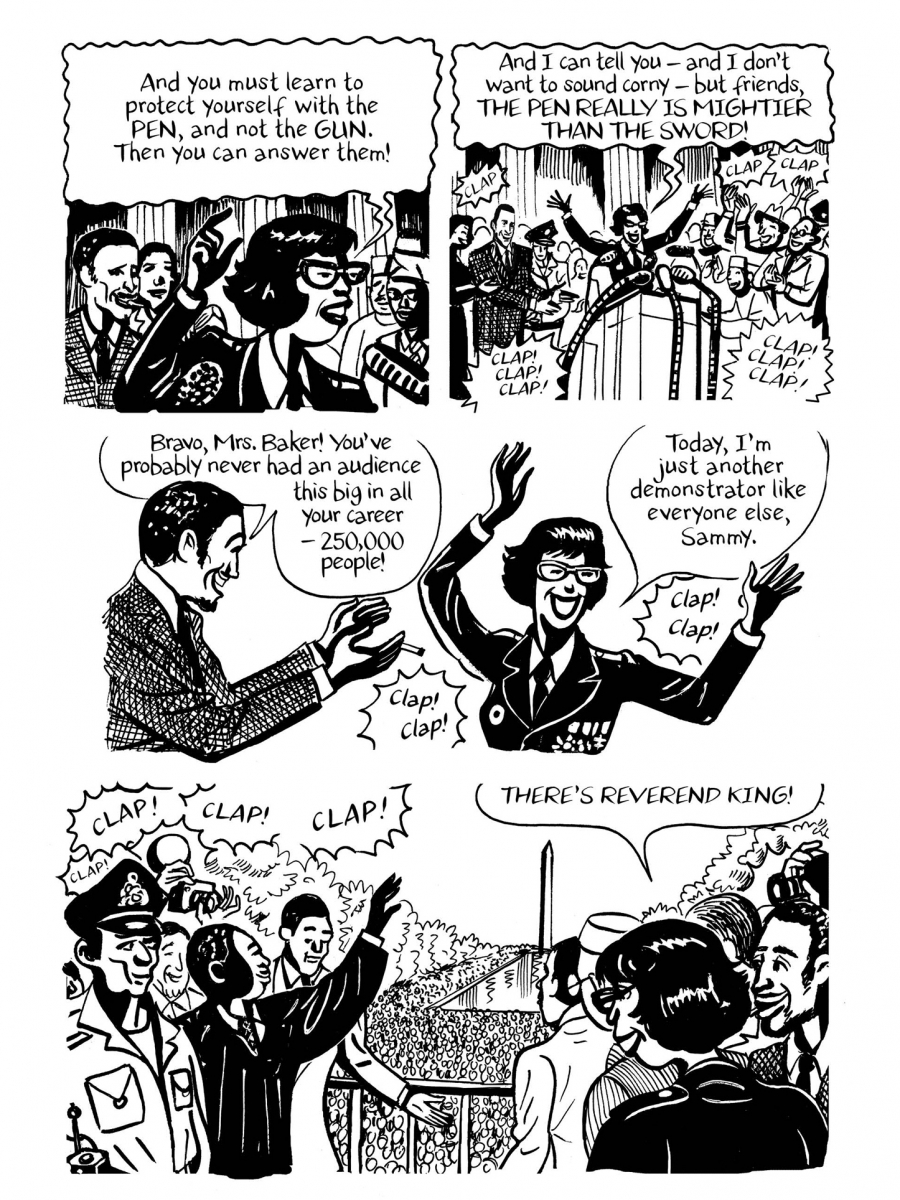
But for all its strange excesses, Guturl maintains, her “idiosyncratic project was in lockstep with the mainstream Civil Rights Movement.” She wouldn’t return to the States until 1963, with the help of Attorney General Robert Kennedy, and when she did, it was as a guest of Martin Luther King, Jr. and the organizers of the March on Washington, where, in her Free French Air Force uniform, she became the only woman to address the crowd. The visual recounting of that moment above comes from a new 600-page graphic biography that follows Baker’s “trajectory from child servant in St. Louis,” PRI writes, “to her days as a vaudeville performer, a major star in France, and later, a member of the French Resistance and an American civil rights activist.”
In her speech, she directly confronted the government who had turned her into an enemy:
They thought they could smear me, and the best way to do that was to call me a communist. And you know, too, what that meant. Those were dreaded words in those days, and I want to tell you also that I was hounded by the government agencies in America, and there was never one ounce of proof that I was a communist. But they were mad. They were mad because I told the truth. And the truth was that all I wanted was a cup of coffee. But I wanted that cup of coffee where I wanted to drink it, and I had the money to pay for it, so why shouldn’t I have it where I wanted it?
Baker made no apologies for her wealth and fame, but she also took every opportunity, even if misguided at times, to use her social and financial capital to better the lives of others. Her plain-speaking demands opened doors not only for performers, but for ordinary people who could look to her as an example of courage and grace under pressure into the 1970s. She continued to perform until her death in 1975. Just below, you can see rehearsal footage and interviews from her final performance, a sold-out retrospective.
The opening night audience included Sophia Lauren, Mick Jagger, Shirley Bassey, Diana Ross, and Liza Minelli. Four days after the show closed, Baker was found dead in her bed at age 68, surrounded by rave reviews of her performance. Her own assessment of her five-decade career was distinctly modest. Earlier that year, Baker told Ebony magazine, “I have never really been a great artist. I have been a human being that has loved art, which is not the same thing. But I have loved and believed in art and the idea of universal brotherhood so much, that I have put everything I have into them, and I have been blessed.” We might not agree with her critical self-evaluation, but her life bears out the strength and authenticity of her convictions.
Paul Thomas Anderson’s The Master focuses, with almost unbearable intensity, on two characters: Joaquin Phoenix’s impulsive ex-sailor Freddie Quell, and Philip Seymour Hoffman’s Lancaster Dodd, “the founder and magnetic core of the Cause — a cluster of folk who believe, among other things, that our souls, which predate the foundation of the Earth, are no more than temporary residents of our frail bodily housing,” writes The New Yorker’s Anthony Lane in his review of the film. “Any relation to persons living, dead, or Scientological is, of course, entirely coincidental.”
Before The Master came out, rumor built up that the film mounted a scathing critique of the Church of Scientology; now, we know that it accomplishes something, par for the course for Anderson, much more fascinating and artistically idiosyncratic.
Few of its gloriously 65-millimeter-shot scenes seem to have much to say, at least directly, about Scientology or any other system of thought. But perhaps the most memorable, in which Dodd, having discovered Freddie stown away aboard his chartered yacht, offers him a session of “informal processing,” does indeed have much to do with the faith founded by L. Ron Hubbard — at least if you believe the analysis of Evan Puschak, better known as the Nerdwriter, who argues that the scene “bears an unmistakable reference to a vital activity within Scientology called auditing.”
Just as Dodd does to Freddie, “the auditor in Scientology asks questions of the ‘preclear’ with the goal of ridding him of ‘engrams,’ the term for traumatic memory stored in what’s called the ‘reactive mind.’ ” By thus “helping the preclear relive the experience that caused the trauma,” the auditor accomplishes a goal that, in a clip Puschak includes in the essay, Hubbard lays out himself: to “show a fellow that he’s mocking up his own mind, therefore his own difficulties; that he is not completely adrift in, and swamped by, a body.” Scientological or not, such notions do intrigue the desperate, drifting Freddie, and although the story of his and Dodd’s entwinement, as told by Anderson, still divides critical opinion, we can say this for sure: it beats Battlefield Earth.
Based in Seoul, Colin Marshall writes and broadcasts on cities and culture. His projects include the book The Stateless City: a Walk through 21st-Century Los Angeles and the video series The City in Cinema. Follow him on Twitter at @colinmarshall or on Facebook.
Documentaries about film itself have existed for decades, but only with the advent of short-form internet video — preceded by the advents of powerful desktop editing software and high-quality home-video formats — did the form of the cinema video essay that we know today emerge. Over the past few years, the Youtube channel Every Frame a Painting has become one of the modern cinema video essay’s most respected purveyors, examining everything from how editors think to the bland music of superhero films to why Vancouver never plays itself to the signature technique of auteurs like Martin Scorsese, Jackie Chan, and, yes, Michael Bay.
Alas, Every Frame a Painting has come to an end. “When we started this YouTube project, we gave ourselves one simple rule: if we ever stopped enjoying the videos, we’d also stop making them,” says series co-creator Taylor Ramos. “And one day, we woke up and felt it was time.”
She says it in the never-produced script for a concluding episode, a text that takes us on a journey from Every Frame a Painting’s inception — born, as co-creator Tony Zhou puts it, out of frustration at having to “discuss visual ideas with non-visual people” — through its evolution into a series about film form rather than content (“most YouTube videos seemed to focus on story and character, so we went in the opposite direction”) to its conclusion.
Just as Every Frame a Painting’s episodes reveal to us how movies work, this final script reveals to us how Every Frame a Painting works — or more specifically, what factors led to its video essays looking and feeling like they do. “Nearly every stylistic decision you see about the channel ‚” Zhou says by way of giving one example, “was reverse-engineered from YouTube’s Copyright ID,” trying to find ways around the platform’s automatic copyright-violation detection system that would occasionally reject even the kind of fair use they were doing. Other choices they made more deliberately, such as to do old-fashioned library research whenever possible. “It’s very tempting to use Google because it’s so quick and it’s right there,” says Zhou in a much-highlighted passage, “but that’s exactly why you shouldn’t go straight to it.”
Based in Seoul, Colin Marshall writes and broadcasts on cities and culture. His projects include the book The Stateless City: a Walk through 21st-Century Los Angeles and the video series The City in Cinema. Follow him on Twitter at @colinmarshall or on Facebook.
Though only one process in a very long history of film coloring techniques, from hand-tinting to chemical and mechanical means, Technicolor has had the most influence of them all. During the Golden Age of cinema, the 1930s and 40s, the technology was “undoubtedly,” write Kristen Thompson and David Bordwell in their Film History, “the most striking innovation” of the era, and it came to dominate by way of massive hit films like The Wizard of Oz and Gone with the Wind. It didn’t hurt that “the Technicolor company monopolized the process, supplying all cameras, providing supervisors for each production, and processing and printing the film.”
But Technicolor didn’t arise overnight. Founded in 1914, the Technicolor company produced color films for two decades that were “still experimental,” notes Atlantic editor Adrienne LaFrance, “oftentimes to the point of being absurd.” But by the mid-30s, Technicolor No. IV—which used prisms to split the light onto three strips of film for the three primary colors—could produce hyperreal, strikingly beautiful images. By 1939, when audiences saw the yellow brick road, lion, scarecrow, green-faced wicked witch, and those sparkling ruby slippers come alive before their eyes, Technicolor had triumphed.
In the video essay above from Vox, Phil Edwards explains what this means, and how “the technology shaped the look of the twentieth century,” and debunks three misconceptions about The Wizard of Oz, including the idea that it was the first Technicolor movie. Edwards explains the origins of the company with three colleagues from M.I.T., from which the “Tech” part of the name derived, and how the three-strip process came into its own seven years before The Wizard of Oz, in a 1932 Disney cartoon called “Flowers and Trees.” This animation was the first to feature the three-strip innovation, which used an “insanely difficult” dye-transfer process. (In the follow-up video below, Edwards addresses comments, questions, and corrections to his essay above.)
Despite Technicolor IV’s advance, live-action films throughout the 30s still used earlier features of the technique, “amping up” the contrast with a black and white layer of film underneath the color. Other technical limitations contributed to Technicolor’s distinctive, eye-popping look. The Wizard of Oz, for example, does not actually move from black and white to color when Dorothy leaves her displaced Kansas house and walks into Oz. Instead, the filmmakers painted the set sepia and used a Judy Garland double (also painted). Massive, and massively loud, cameras and a considerable expense added more burdens for Technicolor filmmaking, but the advantages outweighed these problems, Edwards argues, including the ability to adjust the dyes to use color in strikingly different ways from movie to movie.
Brilliant, oversaturated greens, yellows, and reds in films like The Wizard of Oz and Singin’ in the Rain led to new ways of using color to tell stories, such as those perfected by Stanley Kubrick over 40 years after Technicolor IV’s debut. “The three-color process,” LaFrance explains, “created films punctuated by colors so electric they were surreal.” Imagine the effects of these visions on young impressionable audiences in the forties and fifties—who went on to design the look of the sixties and seventies. We may forget that the dawn of Technicolor “was itself a reflection of film processes that created a richer, color-flooded version of the real world,” yet both film and the design of the real world came to look the way they did due in large part to Technicolor film.
We're hoping to rely on loyal readers, rather than erratic ads. Please click the Donate button and support Open Culture. You can use Paypal, Venmo, Patreon, even Crypto! We thank you!
Open Culture scours the web for the best educational media. We find the free courses and audio books you need, the language lessons & educational videos you want, and plenty of enlightenment in between.