Today we think of music videos, perhaps quaintly and not always correctly, as the cradle of modern Hollywood’s sense-overloading, logic-sacrificing, teen-targeting, “quick-cut” style. But the medium, especially in its formative years, offered a wide-open canvas not just to hacks, but to auteurs as well. Case in point: the British director, artist, and writer Derek Jarman, well known for features like Caravaggio, The Last of England, and Blue, but maybe even better-known, depending on which circles you run in, for his short films meant to promote songs from a variety of musical-cultural figures: The Smiths, Marianne Faithfull, the Pet Shop Boys, Patti Smith, the Sex Pistols, Bryan Ferry. At the top of the post, we see Jarman pushing the boundaries of the music video, intentionally or unintentionally, as early as 1979, with a 12-minute visual suite interpreting not one but three of Faithfull’s songs.
Jarman goes a minute longer just above for another, 1986 three-parter: The Smiths’ “The Queen is Dead,” “Panic,” and “There is a Light that Never Goes Out,” songs which allow him to fully exercise his penchant for nostalgia-saturated styles of footage and acid criticism of the direction of England. He would also collaborate with his equally satirical countrymen the Pet Shop Boys in the late 1980s and early 1990s on no fewer than four separate videos, two of which, both from 1987, appear below: “Rent” and “It’s a Sin.” What’s more, he directed their 1989 live tour, which featured not only elaborate costumes but whole new short films projected onstage. With his combination of theatrical sense and interest in abstract visual expression, Jarman must have seemed a perfect fit for such an aesthetically minded outfit as the Pet Shop Boys. Those qualities also placed him well to define the nature of the music video itself — in which, at its best, we can still detect his influence today.
To some directors, the music heard in their films seems as (or more) important than the images seen or the dialogue spoken. Maybe you’d make that case about Jim Jarmusch after reading — or, more to the point, hearing — our post on the music in his movies. And surely many Quentin Tarantino fans would regard a Reservoir Dogs without “Stuck in the Middle with You” or a Pulp Fiction without “Misirlou” as not Reservoir Dogs or Pulp Fiction at all. In the booklet that comes with The Tarantino Connection, a collection of soundtrack songs from Tarantino’s movies,Tarantino describes his perhaps unsurprisingly musically-inspired method of film conception as follows: “One of the things I do when I am starting a movie, when I’m writing a movie or when I have an idea for a film is, I go through my record collection and just start playing songs, trying to find the personality of the movie, find the spirit of the movie. Then, ‘boom,’ eventually I’ll hit one, two or three songs, or one song in particular, ‘Oh, this will be a great opening credit song.’ ” Hence his use of Dick Dale, the “King of Surf Guitar,” for the opening credits of Pulp Fiction.
“Having ‘Misirlou’ as your opening credits is just so intense,” writes Tarantino. “It just says, ‘You are watching an epic, you are watching this big old movie just sit back.’ It’s so loud and blearing at you, a gauntlet is thrown down that the movie has to live up to.’ ” He goes on to describe the taking of songs and arranging them in a certain sequence in a movie as “just about as cinematic a thing as you can do. You are really doing what movies do better than any other art form; it really works in this visceral, emotional, cinematic way that’s just really special.” And did he already know, as he set Reservoir Dogs’ un-unseeable ear-slicing scene to that mellow, then twenty-year-old hit from Stealers Wheel, that “when you do it right and you hit it right then the effect is you can never really hear this song again without thinking about that image from the movie”? Certainly his use of Bobby Womack’s “Across 110th Street” has fused the song with Jackie Brown and not the eponymous 1972 picture for which Womack originally wrote it. And who has Kill Bill anddoesn’t associate it with Nancy Sinatra’s version of “Bang Bang (My Baby Shot Me Down)”? “I don’t know if Gerry Rafferty [a member of Stealers Wheel] necessarily appreciated the connotations that I brought to ‘Stuck in the Middle with You,’ ” Tarantino adds. “There is a good chance he didn’t.” But when it comes to understanding a song’s cinematic potential, Tarantino has long since proven he knows what he’s doing.
I watched Star Warsfor the first time in 1977 at the tender age of four. And like a lot of people in my generation and younger, that first time was a major, formative experience in my life. I got all the toys. I fantasized about being Han Solo. And during the summer of ’83, I blew my allowance by watching Return of the Jedi every day for a week in the theater. George Lucas’ epic space opera is the reason why I spent a lifetime watching, making and writing about movies. And if you asked any movie critic, fan or filmmaker who grew up in the ‘80s, they will probably tell you a similar story.
Over the years though, Lucas succumbed to the dark side of the Force. His prequel trilogy, starting with truly god awful The Phantom Menace (1999), is as visually overstuffed as it is cinematically inert. (Somewhere, there’s a dissertation to be written about how widespread feelings of betrayal from the prequels psychically prepared America for the anxiety and disappointments of the Bush administration.)
Worse, fans who want to console themselves by watching Star Wars as they remember seeing it back in the ‘80s are out of luck. Lucas has been quietly butchering the original movies by adding CGI, sound effects and even whole characters – like (gag) Jar Jar Binks — to successive special edition updates. The problem is these updated versions feel bifurcated. It’s as if two different movies with two different aesthetics were clumsily stitched together. Lucas’ spare, muscular compositions in the original movie sit uneasily next to its cartoony, over-wrought additions. Yet this Frankenstein version is the one that Lucas insists you watch. The original cut is just plain not for sale. Lucas even refused to give the National Film Registry the 1977 cut of Star Wars for future preservation. “It’s like this is the movie I wanted it to be,” said Lucas in an interview in 2004, “and I’m sorry if you saw half a completed film and fell in love with it, but I want it to be the way I want it to be.”
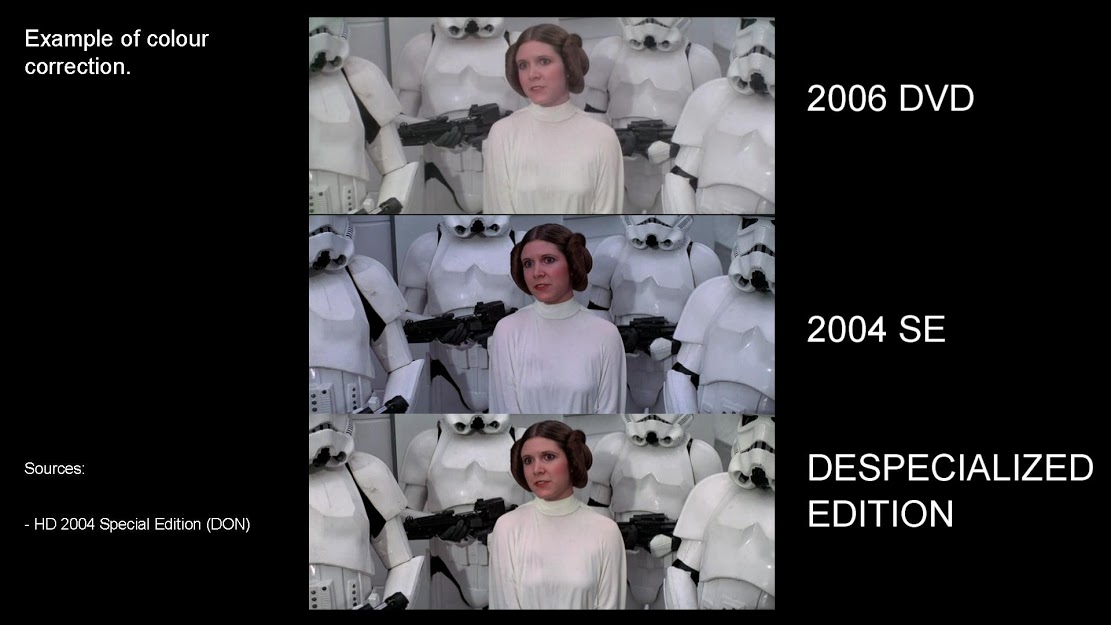
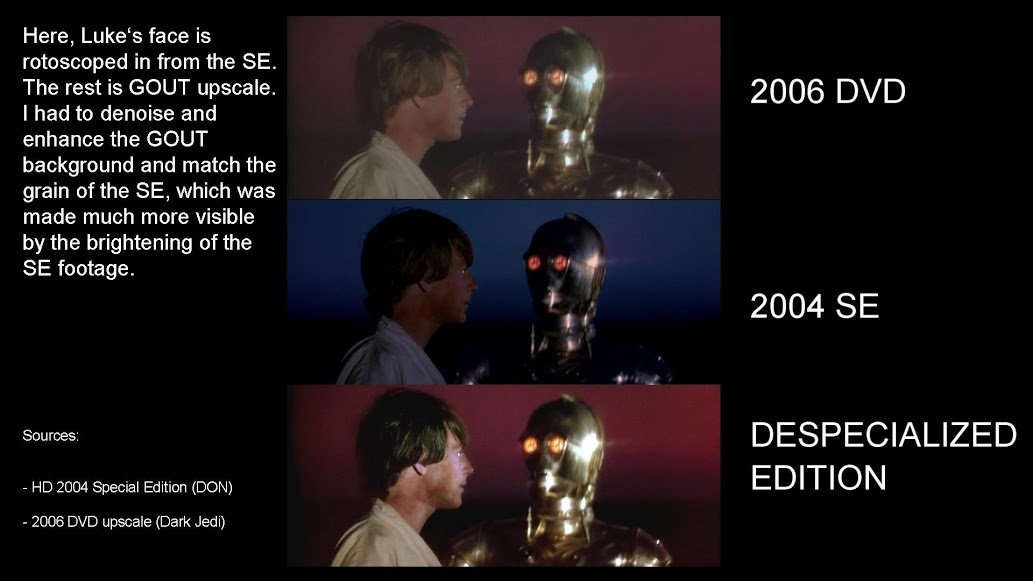
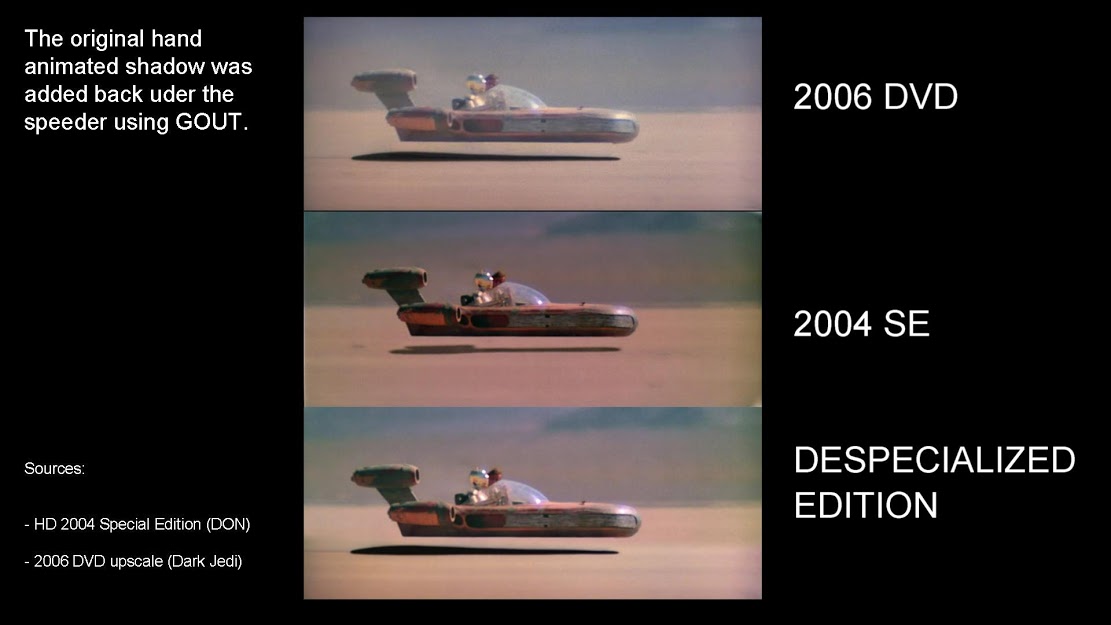
Thankfully, hardcore Star Wars fans are telling Lucas, respectfully, to go cram it. As Rose Eveleth in The Atlantic reports, a dedicated online community has set out to create a “despecialized” edition of Star Wars that strips away all of Lucas’s digital nonsense and restores the movie to its original 1977 state. The de facto leader of this movement is Petr Harmy, a 25-year-old guy from the Czech Republic who with the help of a legion of technically savvy film nerds has pieced together footage from existing prints and older DVD releases to create the Despecialized Edition v. 2.5. (Directions on where you can locate it are here.) Above Harmy talks in detail about how he accomplished this feat. And below you can see some side-by-side comparisons. More can be found on Petr Harmy’s page. Finally, in the comments section below, Harmy also points us toward pages with Despecialized stills for Star Wars and The Empire Strikes Back.
Jonathan Crow is a Los Angeles-based writer and filmmaker whose work has appeared in Yahoo!, The Hollywood Reporter, and other publications. You can follow him at @jonccrow. And check out his blog Veeptopus, featuring one new drawing of a vice president with an octopus on his head daily.
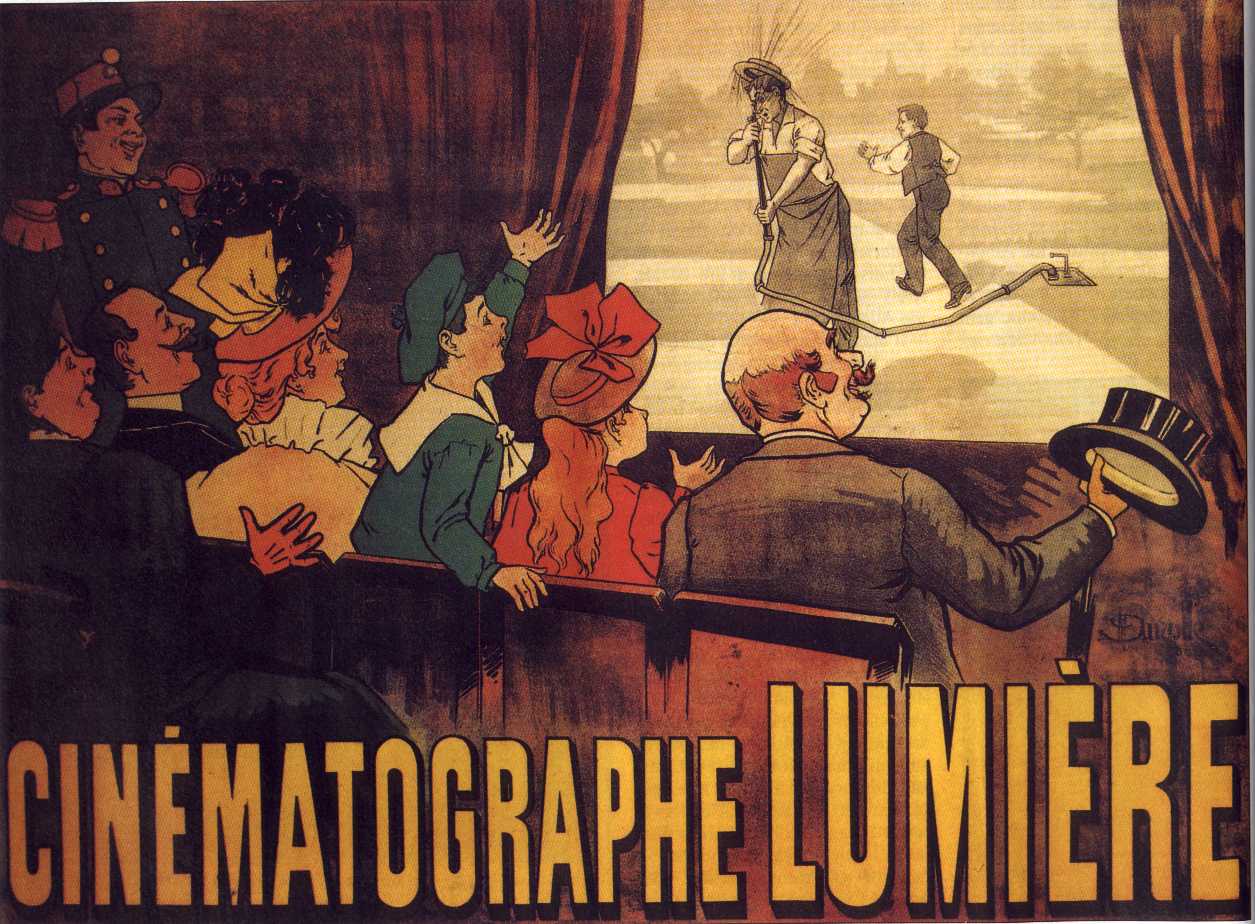
When Auguste and Louis Lumière unveiled their invention, the Cinématographe, at the Salon Indien du Grand Café in Paris on December 28, 1895, the art form of film was born. Prior to that, other inventors looked for ways to photographically capture motion in a commercially successful way but failed. Thomas Edison, for instance, hawked a device called the Kinetoscope that looked a bit like a View-Master strapped to a pulpit. It was big, bulky and, most importantly, offered an experience to a single viewer at a time. The Cinématographe, on the other hand, projected images on a wall, creating, for the first time ever, a movie audience.
The Lumière brothers screened 10 short films that night, each running about 50 seconds long. They are, as you might expect, about as primitive as you can get. Basic elements of cinema like editing or camera movement were decades away from evolving into the cinematic grammar that we take for granted today.
The Lumière brother’s first film was called Workers Leaving The Lumière Factory in Lyon (La Sortie des usines Lumière à Lyon) and that’s entirely what the short shows: a single static shot of dozens of men and women, all of whom seem to be wearing hats, leaving a factory for the day. It is a documentary in its most elemental form.
Above is The Waterer Watered (L’Arroseur arrosé), cinema’s first comedy. It shows a gardener watering some plants before a naughty kid steps on the hose, cutting off its flow. When the gardener looks down the nozzle, the kid takes his foot off the hose and Bam! — the world’s first example of someone getting punked on camera.
And below you can see the Lumière’s most famous early short, screened in early 1896. It shows a train arriving at a station. The camera was placed right at the edge of the platform so the train sweeps past the frame on a strong, dynamic diagonal. Legend has it that audiences thought that the train was coming straight at them and panicked. That’s probably not true but it did, for the first time, demonstrate the visual drama that can be created by a well-placed camera.
Jonathan Crow is a Los Angeles-based writer and filmmaker whose work has appeared in Yahoo!, The Hollywood Reporter, and other publications. You can follow him at @jonccrow. And check out his blog Veeptopus, featuring one new drawing of a vice president with an octopus on his head daily.
According to official propaganda, Kim Jong-Il was a remarkably impressive individual. He learned to walk when he was just three weeks old; he wrote 1,500 books while at university; and, during his first and only game of golf, he scored 11 holes in one. Yet for some reason becoming the world’s first North Korean professional golf player didn’t seem to interest Kim. He wanted to make movies. So, in 1978, while his father Kim Il-Sung was still the country’s supreme leader, Kim set out to modernize the film industry of the Democratic People’s Republic of Korea.
“The North’s filmmakers are just doing perfunctory work,” Kim said to South Korean film director Shin Sang-ok. “They don’t have any new ideas…their works have the same expressions, redundancies, the same old plots. All our movies are filled with crying and sobbing. I didn’t order them to portray that kind of thing.”
Of course, Kim’s bold plan to jumpstart the industry was to kidnap Shin and his wife, both celebrities in South Korea. He was abducted in Hong Kong and, when he had the temerity to try to escape, he ended up spending four years toiling in prison, subsisting on little more than grass and a little rice. Eventually, Shin was approached by Kim and given an offer he dare not refuse: make movies in North Korea.
Like the films cranked out in China during the height of the Cultural Revolution, North Korean movies are largely propaganda delivery systems designed exclusively for a domestic audience. After Shin’s kidnapping, DPRK movies started to get just a bit less didactic. Simon Fowler, who writes probably the only English-language blog on North Korean cinema, just wrote an article for The Guardian where he selected the best films to come out of the Hermit kingdom. You can watch a few of these movies here and find the others at The Guardian. They might be goofy, maudlin and ham-fisted, but for movie mavens and aficionados of Communist kitsch, they are fascinating.
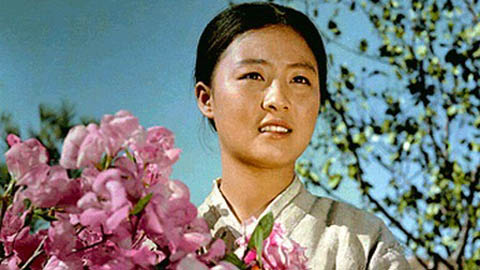
Perhaps the most important North Korean movie ever is The Flower Girl (1972). Watch it above. Set during Japan’s colonial occupation of Korea, the film follows a young woman who endures one injustice after another at the hands of the Japanese before Kim Il-Sung’s army marches into her village and saves the day. The movie set the template for many of the movies to come afterwards. As Fowler writes, “the importance of The Flower Girl within the DPRK cannot be overestimated. The star, Hong Yong-hee, adorns the one won bank note in North Korea, and is revered as a national hero. Although not always an easy watch, those wanting to learn more about the average North Koreans’ sensibilities could do far worse than to watch this picturesque but tragic film.”
Hong Kil Dong (1986) is clearly one of the movies Shin Sang-ok influenced; it foregrounded entertainment over ideology, a rarity at that point in the country’s film history. The movie is about a character from Korean literature who, like Robin Hood, not only robs from the rich and gives to the poor but knows how to deliver a beatdown. Hong plays out like a particularly low-budget Shaw Brothers kung fu spectacle with plenty of flying kicks, sword play and wire work.
And finally, there’s Pulgasari (1985), North Korea’s attempt at making a kaiju movie. Set in feudal times, the film is about a statue that comes to life, grows to monstrous proportions and, unable to sate its unquenchable thirst for metal, starts to smash things. Shin managed to get technical help for the movie from Toho, the same Japanese studio that cranked all those Godzilla movies. In fact, they even got veteran kaiju actor, Kenpachiro Satsuma, to don a rubber suit for this movie. Years later, Pulgasari was released in Japan about the same time as Roland Emmerich’s god awful Hollywood remake of Godzilla (not to be confused with Gareth Edward’s god awful Hollywood remake from earlier this year). Satsuma publically stated what a lot of Japanese privately thought – Pulgasari is better than Emmerich’s big-budget dud.
Not long after Shin completed Pulgasari, he and his wife managed to escape in Vienna thanks to the help of the CIA and a host of other unlikely parties. Kim Jong-Il might have had super human abilities, but talent retention did not seem to be one of them.
You can watch the three films listed above, plus Marathon Runner and Centre Forwardover at The Guardian.
Jonathan Crow is a Los Angeles-based writer and filmmaker whose work has appeared in Yahoo!, The Hollywood Reporter, and other publications. You can follow him at @jonccrow. And check out his blog Veeptopus, featuring one new drawing of a vice president with an octopus on his head daily.
Thanks to Laura Dern, David Lynch took the ALS Ice Bucket Challenge. And, of course, there’s a twist — which involves a double shot of espresso and Lynch playing “Somewhere Over the Rainbow” on the trumpet. If you ever wondered what Lynch looks like without his classic quiff, you won’t want to miss this one minute bit.
We still think of Orson Welles’ Citizen Kane as the most impressive debut in film history. In an alternate cinematic reality, however, Welles might have debuted not with a revolutionarily fragmented portrait of a tormented newspaper magnate, but a slapstick farce. This real 1938 production, titled — spare us your jokes — Too Much Johnson, ran aground on not just financial problems, but logistical ones. Welles conceived the film as part of a stage show for his Mercury Theatre company, they of the infamous War of the Worlds radio broadcast. An adaptation of William Gillette’s 1894 play of the same name about a philandering playboy on the run in Cuba, this then-state-of-the-art Too Much Johnson would have given its audiences a filmed as well as a live experience in one. Alas, when Welles had the money to complete post production, he found that the Connecticut theater in which he’d planned a pre-Broadway run didn’t have the ceiling height to accommodate projection.
Long presumed lost after a 1970 fire took Welles’ only print, Too Much Johnson resurfaced in 2008. After a restoration by the George Eastman House museum of film and photography (along with collaborators like Cinemazero and the National Film Preservation Foundation), the film made its debut at last year’s Pordenone Silent Film Festival. Though without its intended context — and for that reason never screened by Welles himself — the film nonetheless won no modest critical acclaim. The Guardian’s Peter Bradshaw calls it “breathlessly enjoyable viewing,” praising not just Welles but star Joseph Cotten’s “tremendous movie debut,” an ” affectionate romp through Keystone two-reelers, Harold Lloyd’s stunt slapstick, European serials, Soviet montage and, notably, Welles’s favoured steep expressionist-influenced camera angles.” Bright Lights Film Journal’s Joseph McBride frames it as “a youthful tribute not only to the spirited tradition of exuberant low comedy but also to the past of the medium [Welles] was about to enter.”
You can download the restored Too Much Johnson footage, and read more about the film and the project of bringing it back to light, at the National Film Preservation Foundation’s site. Or simply click here. (Don’t forget to spend a little time at their donation page as well, given the expense of a restoration like this.) Have a look at the 23-year-old Welles’ handiwork, laugh at its comedy, appreciate its ambition, and ask yourself: does this kid have what it takes to make it in show business?
It happened before, and it still happens now and again today, but in the second half of the twentieth century, auteurs really got into making commercials: Ingmar Bergman, Jean-Luc Godard, David Lynch. Not, perhaps, the first names in filmmaking you’d associate with commerciality, but there we have it. Where, though, to place Federico Fellini, director of La Dolce Vita, Satyricon, and Amarcord, movies that, while hardly assembled by the numbers, could never resist the entertaining and even pleasurable (or the somehow pleasurably displeasurable) spectacle? On one hand, Fellini went so far as to campaign against commercials airing during the broadcast of motion pictures; on the other hand, he made a few of the things, and not minor ones, either. In a post here on Fellini’s own commercials, Mike Springer referenced a trio shot for the Bank of Rome, quoting on the subject Fellini biographer Peter Bondanella, who notes their inspiration by “various dreams Fellini had sketched out in his dream notebooks,” and other Fellini biographer Tullio Kezich, who describes them as “the golden autumn of a patriarch of cinema who, for a moment, holds again the reins of creation.” Today, we present all three.
“Money is everywhere but so is poetry,” Fellini himself once said. “What we lack are the poets.” In these three spots, the creator synonymous with Italian auteurhood brings poetry and money together — even more so than most commercial-making “creative” filmmakers, given the overtly financial nature of the client’s business. You can read more about the project, “the last thing he did behind a camera,” at Sight & Sound: “In 1992, the year before his death, [Fellini] realised his best corporate work. [ … ] Here Fellini comprehended, skilfully conveyed and exposed the ultimate essence of advertising: the creation of needs and fears that the given product will magically solve.” The setup involves Paolo Villaggio as a nightmare-plagued man and Fernando Rey as his attentively listening analyst — and in addition to his professional interests, evidently quite a Bank of Rome enthusiast. The spot at the top of the post includes English subtitles, but as with Fellini’s features, even non-Italophones can expect rich, long-form (by commercial standards) audiovisual experiences watching the other two as well (above) — and ones, unlike any experience you’d have actually stepping into a bank, not quite of this reality. Today, we present all three, the last films Fellini ever made.
We're hoping to rely on loyal readers, rather than erratic ads. Please click the Donate button and support Open Culture. You can use Paypal, Venmo, Patreon, even Crypto! We thank you!
Open Culture scours the web for the best educational media. We find the free courses and audio books you need, the language lessons & educational videos you want, and plenty of enlightenment in between.