Sent back in time 600 years and tasked with building the world’s largest dome, how would most of us fare? Most of us, of course, are not trained architects or engineers, but then, neither was Filippo Brunelleschi. Known at the time as a goldsmith, Brunelleschi ended up winning the commission to build just such a colossal dome atop Florence’s Cattedrale di Santa Maria del Fiore, which itself had already been under construction for well over a century. The year was 1418, the dawn of the Italian Renaissance, but a break with medieval building styles had already been made, not least in the rejection of the kind of flying buttresses that had held up the stone ceilings of previous cathedrals. Brunelleschi had thus not just to build an unprecedentedly large dome, in accordance with a design drawn up 122 years earlier, but also to come up with the technology required to do so.
“He invented an ox-driven hoist that brought the tremendously heavy stones up to the level of construction,” architect David Wildman tells HowStuffWorks. Noticing that “marble for the project was being damaged as it was unloaded off of boats,” he also “invented an amphibious boat that could be used on land to transport the large pieces of marble to the cathedral.”
These and other new devices were employed in service of an ingenious structure using not just one dome but two, the smaller inner one reinforced with hoops of stone and chain. Built in brick — the formula for the concrete used in the Pantheon having been lost, like so much ancient Roman knowledge — the dome took sixteen years in total, which constituted the final stage of the Cattedrale di Santa Maria del Fiore’s generations-long construction.
Brunelleschi’s masterpiece, still the largest masonry dome in the world, has yet to quite yield all of its secrets: “There is still some mystery as to how all of the components of the dome connect with each other,” as Wildman puts it, thanks to Brunelleschi’s vigilance about concealing the nature of his techniques throughout the project. But you can see some of the current theories visualized (and, in a shamelessly fake Italian accent, hear them explained) in the National Geographic video at the top of the post. However he did it, Brunelleschi ensured that every part of his structure fit together perfectly — and that it would hold up six centuries later, when we can look at it and see not just an impressive church, but the beginning of the Renaissance itself.
Based in Seoul, Colin Marshall writes and broadcasts on cities, language, and culture. His projects include the Substack newsletterBooks on Cities, the book The Stateless City: a Walk through 21st-Century Los Angeles and the video series The City in Cinema. Follow him on Twitter at @colinmarshall or on Facebook.
In November 1965, after some hondling between the Carnegie Corporation and the Ford Foundation, a senior executive from Carnegie called former president of MIT James Killian with an invitation. Would Killian be interested in assembling a commission to study educational television with an eye toward strengthening the American system of learning on screen, and could he start right away? Killian jumped; a commission was formed; and two years, eight meetings, 225 interviews, and 92 site visits later, the Carnegie Commission’s report comes out, a bill gets written, the bill becomes law, and President Johnson is signing the 1967 Public Television Act to create public television and radio.
At the signing ceremony, Johnson said, “Today, we rededicate a part of the airwaves – which belong to all the people – and we dedicate them for the enlightenment of all the people. We must consider,” he said, “new ways to build a great network for knowledge – not just a broadcast system, but one that employs every means of sending and storing information that the individual can use.”
Heady stuff. But it gets even better:
Think of the lives that this would change:
The student in a small college could tap the resources of a great university. […]
The country doctor getting help from a distant laboratory or a teaching hospital;
A scholar in Atlanta might draw instantly on a library in New York;
A famous teacher could reach with ideas and inspirations into some far-off classroom, so that no child need be neglected.
Eventually, I think this electronic knowledge bank could be as valuable as the Federal Reserve Bank.
And such a system could involve other nations, too – it could involve them in a partnership to share knowledge and to thus enrich all mankind.
A wild and visionary idea? Not at all. Yesterday’s strangest dreams are today’s headlines and change is getting swifter every moment.
I have already asked my advisers to begin to explore the possibility of a network for knowledge – and then to draw up a suggested blueprint for it.
The system he was signing into law, Johnson said, “will be free, and it will be independent – and it will belong to all of our people.”
A new network for knowledge.
Imagine.
Fifty years later, totally (seemingly) unrelated, then MIT president Charles Vest went on to speak of something else, something that became MIT Open Courseware. Together with new foundations – this time the Hewlett Foundation and the Mellon Foundation led the way – Vest envisioned “a transcendent, accessible, empowering, dynamic, communally constructed framework of open materials and platforms on which much of higher education worldwide can be constructed or enhanced:”
A meta-university that will enable, not replace, residential campuses, that will bring cost efficiencies to institutions through the shared development of educational materials. That will be adaptive, not prescriptive. It will serve teachers and learners in both structured and informal contexts. It will speed the propagation of high-quality education and scholarship. It will build bridges across cultures and political boundaries. And it will be particularly important to the developing world.
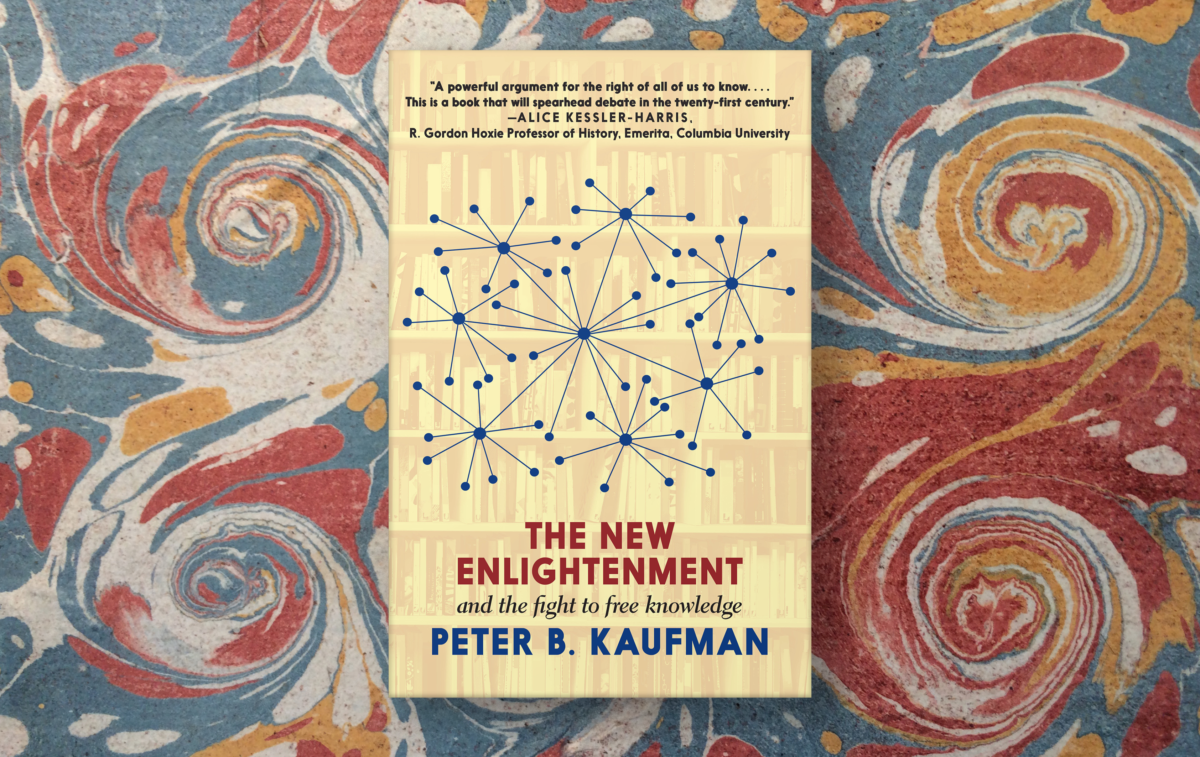
Today, in our time of severe truth decay, our great epistemic crisis, it might be time again to envision another intervention, formative and transformational as the establishment of public broadcasting, imaginative and daring as the launch of open courseware and the open education movement. Indeed, something as breathtaking as the events above, and their own vital forbear over a century ago – the founding of a network of public libraries across America and other parts of the world (which also happened with Andrew Carnegie’s financial support).
The original Enlightenment brought us Newton’s physics, Rousseau’s political philosophy, Linnaeus’s taxonomies, Montesquieu’s laws, the Declaration of Independence, the Declaration of the Rights of Man – it was the Age of Reason. Its founders – as we noted in [Parts 1 and II on] Open Culture – comprised between themselves what became known as the great Republic of Letters. They were all men, though; and they all were white; while they had access to their own means and to the mean of media production, and they delivered new systems of thinking much of the modern world is based on today, their circles were limited; their imaginations were not our imaginations.
Today we have a chance to do more – to take advantage of the cultures and communities that have arisen in the centuries and from the struggles since that time, to launch a new Enlightenment, and to realize perhaps in bolder and more secure ways this new network for knowledge. Video, more than text now, has taken over the internet; video is a new key to our networked world. The company Cisco Systems – which makes many of the devices that connect us – deploys a forecasting tool it calls the Visual Networking Index (VNI). The latest VNI tells us that there were 3.4 billion Internet users on the planet in 2017, almost half of the planet’s current population of 7.7 billion people. By 2022, there will be 4.8 billion Internet users: 60 percent of the planet, and more people in the world will be connected to the Internet than not. By 2022, more than 28 billion “devices and connections” will be online. And – here’s the kicker – video will make up 82 percent of global Internet traffic. Video is dominant already. During peak evening hours in the Americas, Netflix can account for as much as 40 percent of downstream Internet traffic, and Netflix – Netflix alone – constitutes 15 percent of Internet traffic worldwide. All this forecasting was completed before the pandemic; before 125 million cases of Corona virus; before 3 million deaths worldwide; before the explosion of Zoom.
We are living in a video age. What will be our next media intervention? How do knowledge institutions secure their deservedly central place in search and on the web? We need to look over our rights vis-à-vis the government and the giant companies that increasingly control our Internet; we need to look at the growing power we have to contribute to access to knowledge and share our wealth especially in the online Commons; we need to make sure that the public record, especially video (and especially video of all the lies and crimes, and of all the outrageous falsehoods leaders circulate about COVID) is all archived and preserved. We need to strengthen how much of the network we own and control.
What’s important is that we have begun to reach toward the point where there is equity in the leadership of our knowledge institutions. No longer are white men and only white men in charge of the Library of Congress, for example, or the Smithsonian Institution, or, and thus by extension, of our new Enlightenment. New and diverse study and action groups are being formed specifically to address our information disorder. But many more of our leading knowledge institutions – and, critically, foundations and funding agencies again – need to lead this work. This is a 20th-anniversary year for MIT Open CourseWare, for Wikipedia, and for Creative Commons; indeed, MIT OCW starts to celebrate its birthday this month. Many other like-minded progressive institutions and their supporters are on the move. That network for knowledge is coming again: this time, our new Enlightenment moment will belong to all of us.
These days, when a company finds itself in need of more space than its current building affords, it moves to a bigger one, expands the one it has, or does a full teardown-and-rebuild. But considering only these options shows a certain failure of imagination, as underscored by the video above: a brief summary of how the Indiana Bell Telephone Company added a second building alongside its Indianapolis headquarters — but only after hoisting up the latter and pivoting it 90 degrees on its side. “This was no small task,” says the video’s narrator, “as the eight-story, steel-frame-and-brick building measured about 100 by 135 feet, and weighed 11,000 tons.”
But between October 20th and November 14th, 1930, the company did indeed manage to turn and shift the entire structure as planned, “and the move caused no service outages, and all 600 workers within the building still reported to work every day.”
This necessitated lengthening and making flexible all its utility cables and pipes, then lifting it a quarter-inch with jacks and placing it on rollers. “Every six strokes of the jacks would shift the building three-eighths of an inch, moving it fifteen inches per hour.” As for Indiana Bell’s employees, they entered and left their slowly pivoting workplace “using a movable passenger walkway that moved with the building.” To Kurt Vonnegut Jr., then eight years old, all this must have been an impressive sight indeed.
The young novelist-to-be must have seen it not just because he was born and raised in Indianapolis, a fact he referenced throughout his life, but because his father was the project’s lead architect. Kurt Vonnegut, Sr. followed in the footsteps of his own father Bernard Vonnegut, designer of Das Deutsche Haus, today known as the Athenaeum, which the National Register of Historic Places designates as “the best preserved and most elaborate building associated with the German American community of Indianapolis.” This German legacy would prove rather more complicated for the most famous Vonnegut of them all, imprisoned in Dresden as he was during World War II. The darkness of his experience manifests in his work, not least his masterpieceSlaughterhouse-Five; but so, one imagines, does the near-fantastical practicality of 1930s Indianapolis.
Based in Seoul, Colin Marshall writes and broadcasts on cities, language, and culture. His projects include the Substack newsletterBooks on Cities, the book The Stateless City: a Walk through 21st-Century Los Angeles and the video series The City in Cinema. Follow him on Twitter at @colinmarshall or on Facebook.
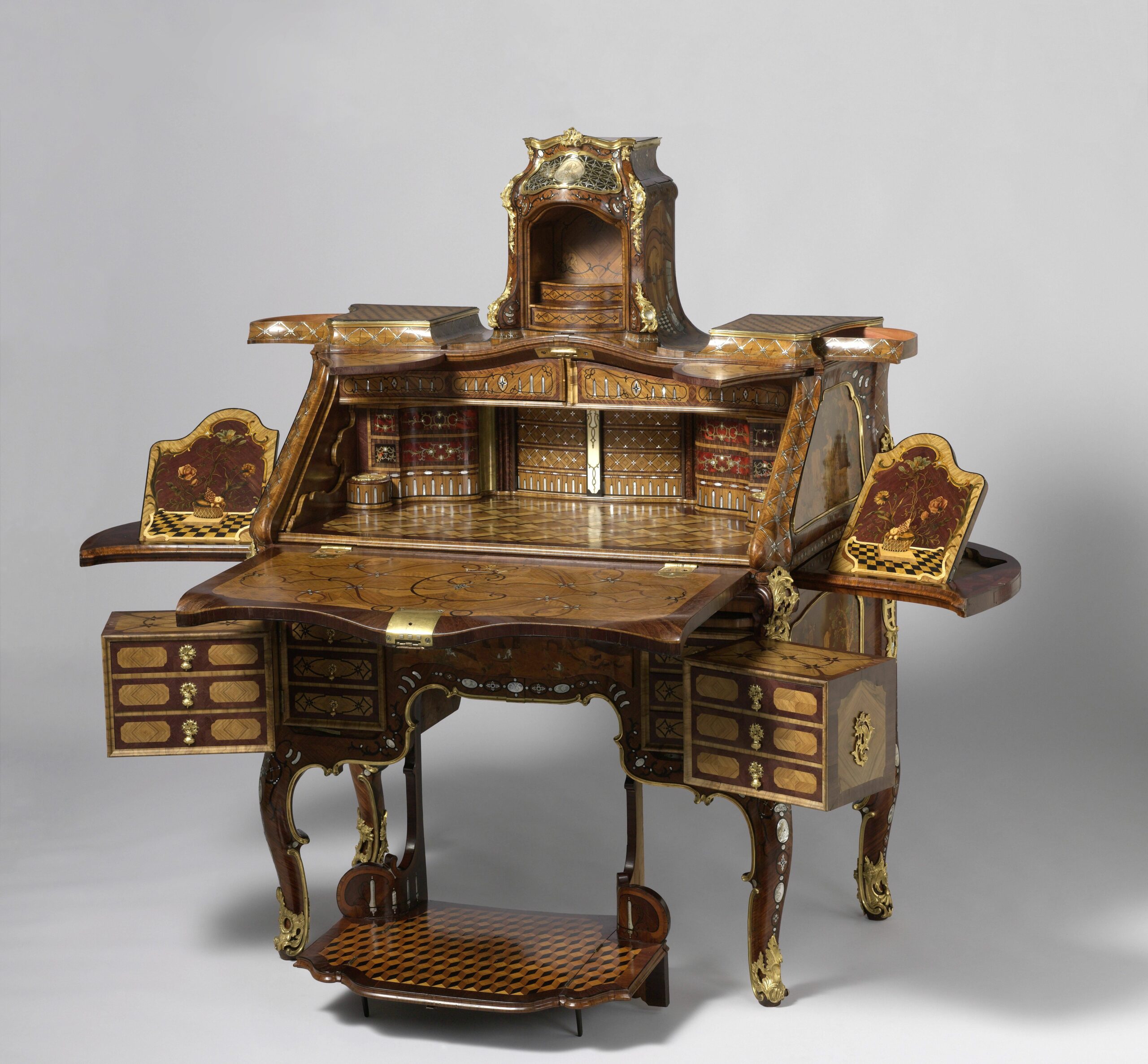
Sitting or standing before an esteemed writer’s desk can make us feel closer to their process. Virginia Woolf’s desks — plywood boards she held on her lap and sloped standing desks — show a kind of austere rigor in her posture. “Throughout her life as a writer,” James Barrett points out, Woolf “paid attention to the physical act of writing,” just as she paid attention to the creative act of walking. The bareness of her implements tells us a lot about her as an artist, but it tells us nothing about the state of writing desk technology available in her time.
20th century modernist Woolf preferred the 16th-century rustic simplicity of Monk’s house. Had she been an 18th century aristocrat and a follower of fashion, she might have availed herself of a desk designed by the Roentgens, the “principal cabinetmakers of the ancien régime,” notes the Metropolitan Museum of Art.
“From about 1742 to its closing in the early 1800s, the Roentgens’ innovative designs were combined with intriguing mechanical devices to revolutionize traditional French and English furniture types.”
The German workshop was founded by Abraham Roentgen and continued by his son David, whose creations Goethe called “palaces in fairyland” and who took first place in a furniture making contest with his entry: “a desk with cabinet, decorated with chinoiserie figures in superb marquetry and featuring a clock with a carillon (musical mechanism) and a hidden clavichord.”
Roentgen writing desks were as functional as they were beautiful. But they were not made for just anyone. The Roentgens made the Berlin Secretary Cabinet, for example — which you can see demonstrated in the Met video at the top — for King Frederick William II of Prussia.
Other Roentgen desks may have been somewhat less outwardly ostentatious, but their inner workings were just as ingenious, as you can see in the rolltop desk further up and the mechanical desk above. Each of these magnificent creations features hidden drawers and compartments, a mainstay of luxury desk design throughout the 1700s, as the Rijksmuseum video below demonstrates. Called “Neuwied furniture,” this style was all the rage and anyone who was anyone, including, of course, Marie Antoinette, had the Roentgens or their competitors make elaborate cabinets, desks, and bureaus that concealed complex inner workings like wooden clocks.
“Roentgen’s perfectly executed inventions became a status symbol for princely interiors all over Germany and Central Europe,” writes the Met. Whether their meticulously engineered writing desks really solved the problem of office clutter or physically improved the experience of writing in any way, however, seems debatable at best.
If you want to hear the music of Johann Sebastian Bach played on the instruments that actually existed during the stretch of the 17th and 18th centuries in which he lived, there are ensembles specializing in just that. But a full musical revival isn’t quite as simple as that: while there are baroque cellos, oboes, and violas around, not every instrument that Bach knew, played, and composed for has survived. Take the lautenwerck, a category of “gut-stringed instruments that resemble the harpsichord and imitate the delicate soft timbre of the lute,” according to Baroquemusic.org. Of the “lute-harpsichord” craftsmen in 18th-century Germany remembered by history, one name stands out: Johann Nicolaus Bach.
A second cousin of Johann Sebastian, he “built several types of lute-harpsichord. The basic type closely resembled a small wing-shaped, one-manual harpsichord of the usual kind. It only had a single (gut-stringed) stop, but this sounded a pair of strings tuned an octave apart in the lower third of the compass and in unison in the middle third, to approximate as far as possible the impression given by a lute. The instrument had no metal strings at all.”
This gave the lautenwerck a distinctive sound, quite unlike the harpsichord as we know it today. You can hear it — or rather, a reconstructed example — played in the video above, a short performance of Bach’s Prelude, Fugue, and Allegro in E‑flat, BWV 998 by early-music specialist Dongsok Shin.
“If he owned two of them, they couldn’t have been that off the wall,” Shin says of the composer and his relationship to this now little-known instrument in a recent NPR segment. “The gut has a different kind of ring. It’s not as bright. The lautenwerck can pull certain heartstrings.” Just as the sound of each lautenwerck must have had its own distinctive characteristics in Bach’s day, so does each attempt to recreate it today. “The small handful of artisans currently making lautenwerks are basically forensic musicologists,” notes NPR correspondent Neda Ulaby, “reconstructing instruments based on research and what they think lautenwercks probably sounded like.” As for the one man we can be sure knew them intimately enough to tell the difference, he’d be turning 336 years old right about now.
Based in Seoul, Colin Marshall writes and broadcasts on cities, language, and culture. His projects include the Substack newsletterBooks on Cities, the book The Stateless City: a Walk through 21st-Century Los Angeles and the video series The City in Cinema. Follow him on Twitter at @colinmarshall or on Facebook.
Did World War II help create the French New Wave? In a roundabout way, yes, according to this video essay by Nerdwriter. Although Jean-Luc Godard’s A Bout de Souffle (aka Breathless) was not technically the first Nouvelle Vague film, it was the film’s revolutionary look and feel, and Godard’s exquisite sense of how to work the promotional machine, that caused it to reverberate around the world. A few years later, many other countries would be launching their own New Waves: Britain, Germany, Eastern Europe, Australia, Japan, Brazil, Iran, and America. Each were particular to their own countries, but all sought to create an alternative to the dominant film culture, either Hollywood or their own country’s Hollywood-influenced film industries.
That decision did not come about in a vacuum, as the video points out. After the war, France was left with $2 billion in debt. Former Interim Prime Minister and then Ambassador Leon Blum signed an agreement with America’s Secretary of State James F. Byrnes to cancel debt and to start a new line of credit. One of the provisions of the 1946 Blum-Byrnes agreement was opening France up to American cultural product, in particular Hollywood films.
In French cinemas, four weeks out of every thirteen weeks would be devoted to French films. The other nine were reserved for foreign (i.e. mostly American) films. But the trade off included a tax on movie tickets, so the increased audience helped fund the French film industry.
Certain results came about that were not planned. A young cinephile generation was born, and its main journal was Cahiers du Cinema, edited by writer and theorist André Bazin. The French could not lay claim to an industry like Hollywood’s, but they could point to inventing movies as we now know them (Georges Méliès and the Lumière Brothers were French), and for treating film as an art form (by the Surrealists, by the Dadaists) before anybody else, and not just as entertainment.
The young critics who wrote for Cahiers du Cinema certainly loved the influx of American films, which they devoured daily in a city like Paris, especially at the Cinémathèque Française. Curated by Henri Langlois, this cinema/museum screened both new and old films, so much so that those critics began to see the artist behind the entertainment. The rise of the auteur theory, coined by Bazin among others, placed the director at the center of not just their one film, but demonstrated certain techniques and interests threading through all films that they directed.
Although there wasn’t a lot of money floating around, there was still enough to make short films and those critics—Jean-Luc Godard, Francois Truffaut, Claude Chabrol, Jacques Rivette, Eric Rohmer, and others—would start to put into practice the theory that they had been writing.
After a few shorts, Godard directed A Bout de Souffle, and the world wasn’t really the same after it.
The film was shot on a handheld camera, by Raoul Cotard, who had used such a camera in the war for newsreels. They used available light. And the two actors, Jean-Paul Belmondo and Jean Seberg, improvised around a script that Godard would write the night before. Godard turned his brain inside-out, like emptying a bag across a table: all his cultural obsessions, not just in cinema, but in writers, philosophers, music, and more, all came out. If Godard was going to be an auteur, then this was how to do it. And yes, the jump-cut editing, as Nerdwriter points out, was shocking for the time. But so was seeing the actors walking around the actual streets of Paris. And so was hearing two people talk (and talk and talk) just like they do in real life. Even if a lot of those things have become common place these days, when everybody carries a movie camera in their pocket, Breathless still brims with life.
Over the course of the ‘60s Godard and his contemporaries would both honor, indulge, and then break away from Hollywood influences. The dominance of Hollywood product began to feel like imperialism, and America’s involvement in Vietnam and its overwhelming influence on consumer culture would lead to the events of 1968, and Godard’s outright rejection of Hollywood. He would end up killing his masters, so to speak. But that was still to come. There’s still Breathless, and there’s still 1960 in Paris.
Ted Mills is a freelance writer on the arts who currently hosts the Notes from the Shed podcast and is the producer of KCRW’s Curious Coast. You can also follow him on Twitter at @tedmills, and/or watch his films here.
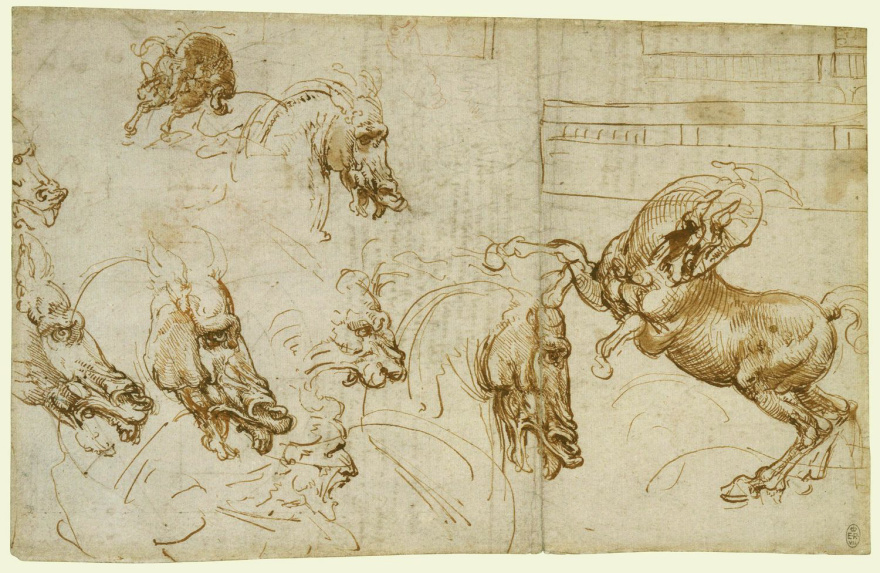
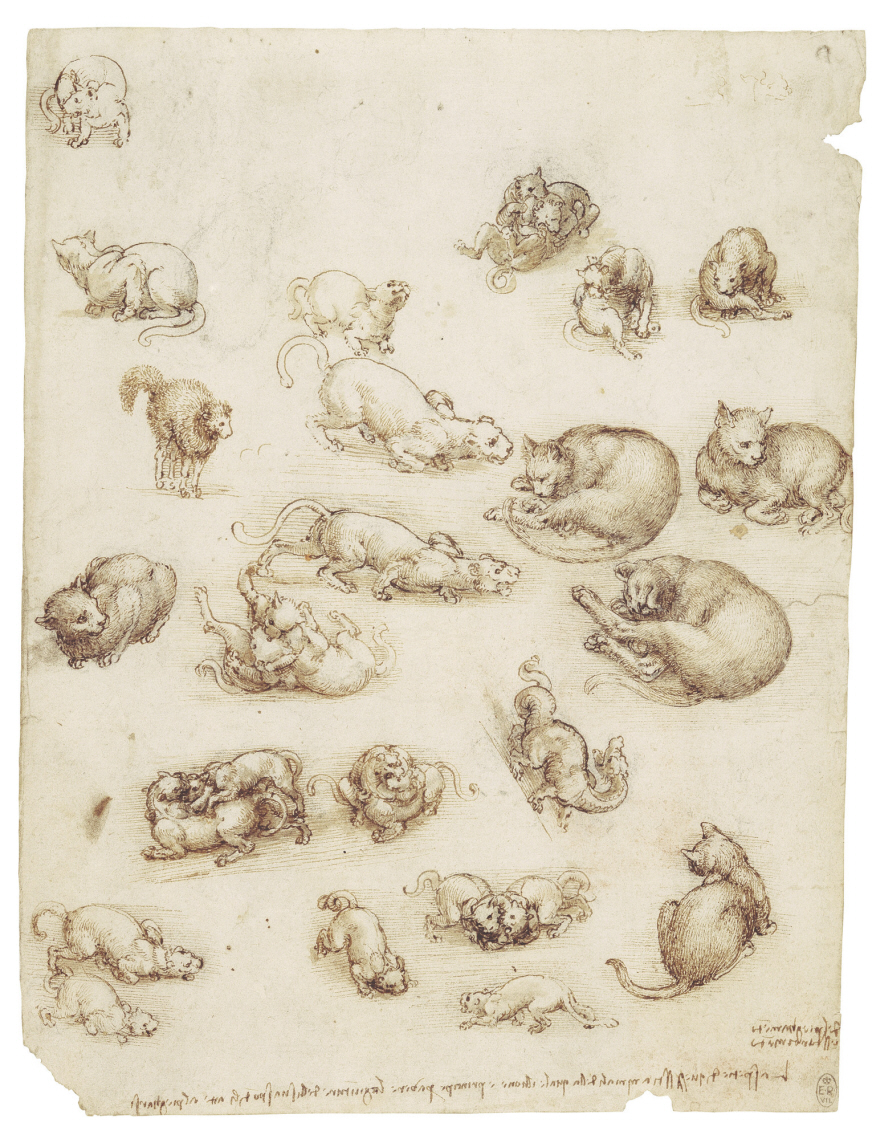
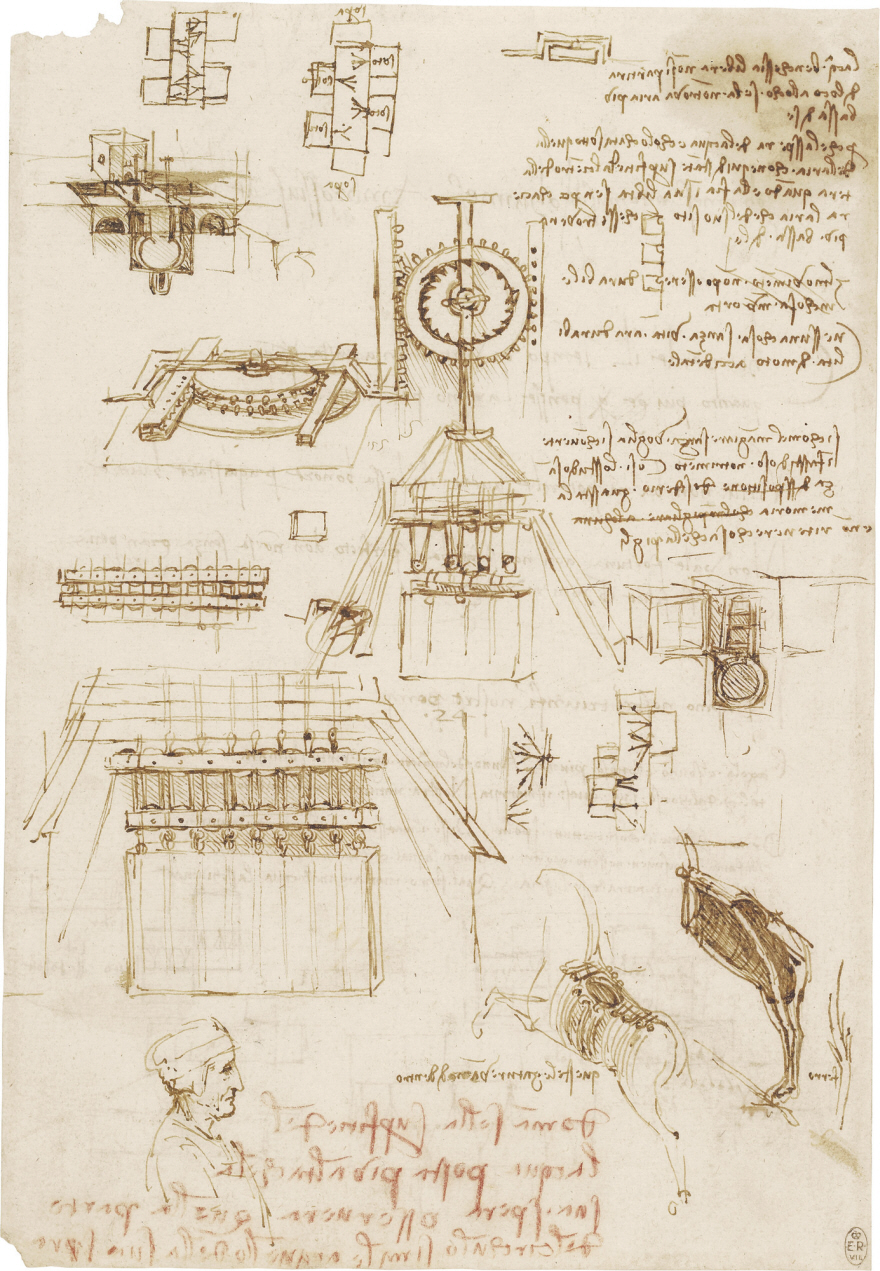
The modern artist has what can seem like an unlimited range of materials from which to choose, a variety completely unknown to great Renaissance masters like Leonardo da Vinci. Few, if any, can say, however, that they have anything like the raw talent, ingenuity, and discipline that drove Leonardo to draw incessantly, constantly honing his techniques and exploiting every use of the tools and techniques available to him.
What were those tools and techniques? Conservator Alan Donnithorne demonstrates Leonardo’s materials in the video above, with examples from the holdings of the Royal Collection at Windsor Castle. Leonardo “drew incessantly,” the Royal Collection Trust writes, “to devise his artistic projects, to explore the natural world, and to record the workings of his imagination.” He used metalpoint, a method of drawing on coated paper with a metal stylus; pen and ink, with pens made from a goose wing feather; and, after the 1490s, red and black chalks.
Leonardo produced thousands of drawings during his lifetime“many of them of extreme beauty and complexity,” says Donnithorne, “and it’s incredible to think that he produced them using these very simple ingredients.”
The Royal Collection owns around 550 of these drawings, “together as a group since the artist’s death in 1519,” when he bequeathed them to his student, Francesco Melzi. These works “provide unparalleled insight,” the Collection writes, “into the workings of Leonardo’s mind and reflect the full range of his interests, including painting, sculpture, architecture, anatomy, engineering, cartography, geology, and botany.”
The restlessness of Leonardo’s mind and hand also reflect the need to move quickly from project to project as he pursued some commissions and abandoned others. “Across all these themes,” however, Christopher Baker, director of European and Scottish Art and Portraiture at the National Galleries of Scotland, sees “a ravishing range of techniques and materials…. The precision required by metalpoint proved especially appropriate for some of his most incisive human or animal observations, while iron gall ink and red and black chalks allowed an exploratory freedom fitting for compositional trials, fictive works or capturing movement.”
The artist’s “prodigious skills” are evident among his many shifts in style and subject and we see even in utilitarian illustrations how “he overturned so many conventions and sometimes mixed his media to wonderful effect.” Leonardo’s choice of media was hardly expansive compared to the dizzyingly colorful aisles that greet the budding artist at art supply stores today. But what he could do with a stylus, goose-quill pen, and chalk has never been equalled. Learn more about how he used his materials in Donnithorne’s book, Leonardo da Vinci: A Closer Look, published on the 500th anniversary celebrations of Leonardo’s death.
By 1926, Benito Mussolini had become one of Europe’s most popular leaders after consolidating power through violence, turning Italy into a police state, and providing a model for budding dictator Adolf Hitler. Mussolini’s received positive recognition from the press, celebrities, and governments around the world, as well as the imprimatur of the Roman Catholic church. None of this mattered to onetime Irish socialite and fervent Catholic convert Violet Gibson. She knew he must be stopped, and she almost did it, getting close enough to graze his nose with a bullet in 1926 before she was taken into custody, handed over to British authorities, and “consigned to an asylum” for the next 29 years, “her story… all but forgotten,” Nora McGreevy writes at Smithsonian.
Gibson grew up between Dublin and London, hailing “from a wealthy family headed by her father, Lord Ashbourne, a senior judicial figure in Ireland.” She “served as a debutante in the court of Queen Victoria” and was raised among European aristocracy. A sickly child, she also suffered from mental health issues and was diagnosed with “hysteria.” Perhaps the most defining moment in Gibson’s life — before her assassination attempt on the Italian fascist dictator — came when she converted to Catholicism in 1902. It was an event, argues Siobhan Lynam in the 2014 RTÉ radio documentary below, that would lead to “a sort mutilation” in her relationship with her family. “There’s a sort of severing that happens,” says Frances Stonor Saunders, author of The Woman Who Shot Mussolini.
Throughout the 1920s, Gibson suffered attacks of mental illness and was hospitalized after her brother’s death, “overwhelmed by grief and loss and the sheer exhaustion of physical illness.” She also followed current events closely, and she was appalled by Mussolini’s rise to power. “Italy for her,” Stonor Saunders says, “is a place of… idealized values.” Gibson traveled to Italy in 1925 with a revolver, which she first used to shoot herself in the chest. She survived, then formed a plan to kill Mussolini instead, despairing of the world he was bringing about. She was able to get close to him, perhaps, because she fit the caricature to which she has been reduced as a historical footnote.
“This is a woman whom history has stripped of all her dignity,” says Stonor Saunders. “She exists as a series of really dreadful cliches in a number of texts, books that refuse her any kind of humanity. She’s just a stereotype of crazy Irish spinster.” As Lynam’s documentary, Stonor Saunders’ book, and a new documentary film currently screening at film festivals (see trailer at then top) show, there was much more to Violet Gibson; she was a committed Catholic and anti-fascist and she nearly changed history in the most successful of the four attempts on Mussolini’s life. She was fifty years old at the time and she lived another 30 years in an institution, dying in 1956. She became known among the staff as the delusional old woman who believed she’d tried to kill Il Duce. No one remembered the event, her own recollections had been silenced, and she had virtually faded from the historical record.
Now, in addition to the media attention, attempts to erect a plaque in Dublin in Gibson’s honor are continuing apace. But why was she ignored for so long? Dublin city councillor Mannix Flynn tells the BBC that while women are rarely given their due for their role in historical events, “for some strange reasons, Violet Gibson became some sort of an embarrassment, she got shunned, they tried to say she was insane to hide the shame.” Gibson’s family had a hand in this, immediately using their power to bargain for her release from Italy and her commitment in Britain. But she also became an embarrassment to the powers in Britain and the world at large who had happily embraced a fascist dictator.
We're hoping to rely on loyal readers, rather than erratic ads. Please click the Donate button and support Open Culture. You can use Paypal, Venmo, Patreon, even Crypto! We thank you!
Open Culture scours the web for the best educational media. We find the free courses and audio books you need, the language lessons & educational videos you want, and plenty of enlightenment in between.