From a port settlement on the banks of the Thames that the Romans called Londinium came a thriving city of “roughly 100,000 people” in Shakespeare’s time, “a cross-section of early modern English culture,” the British Library notes, including “royalty, nobility, merchants, artisans, laborers, actors, beggars, thieves, and spies, as well as refugees from political and religious persecution on the continent.” The city thrived economically and merchants from the known world passed through its ports. “As a result, Londoners would hear a variety of accents and languages as they strolled about the city — a chorus of voices from across Europe and from all walks of life.”
The chorus of voices became a cacophony for many Londoners in the following century who resurrected a pastoral ideal and/or retired to the countryside in the 1600s. The city swelled to a population of around half a million. “It is also a period during which a high proportion of London’s inhabitants were migrants,” writes the Proceedings of the Old Bailey. “It was only by maintaining this constant influx that the capital could possibly maintain its population growth,” slow as it was. “London’s population in this period was also characterized by its diversity,” and by stagnation as plague and fire devastated the city throughout the century.
The city’s cosmopolitan communities grew as England became a colonial world power. Neoclassical art and architecture beautified the city’s new wealth, and along with wealth came poverty, overcrowding, immiseration, and crime. “Here malice, rapine, accident, conspire; and now a rabble, now a fire,” wrote Samuel Johnson in “London,” (1738), a poem written in imitation of Juvenal’s satire on Imperial Rome. In his “London” over half a century later, William Blake saw “marks of weakness, marks of woe” on every face he met in the city — beginning a protest tradition that reached its zenith during the massive population growth in Dickens’ time, and found new voice in glam, punk, grime, etc.
People have come from all over the world to make their home in London for centuries. Each wave of migrants has had to navigate the city’s class hierarchies — through plagues, fires, the Blitz, strikes, riots, protests, more fires, Brexit.… London has burned, “London is drowning,” sang Joe Strummer. But London remains, a megacity of nearly 9 million. In the video above, you can see the city’s growth mapped over a period of 2,000 years, from the Romans to the Saxons; from Tudor to Stuart, early and late Georgian, early and late Victorian, and into the wartorn 20th century.
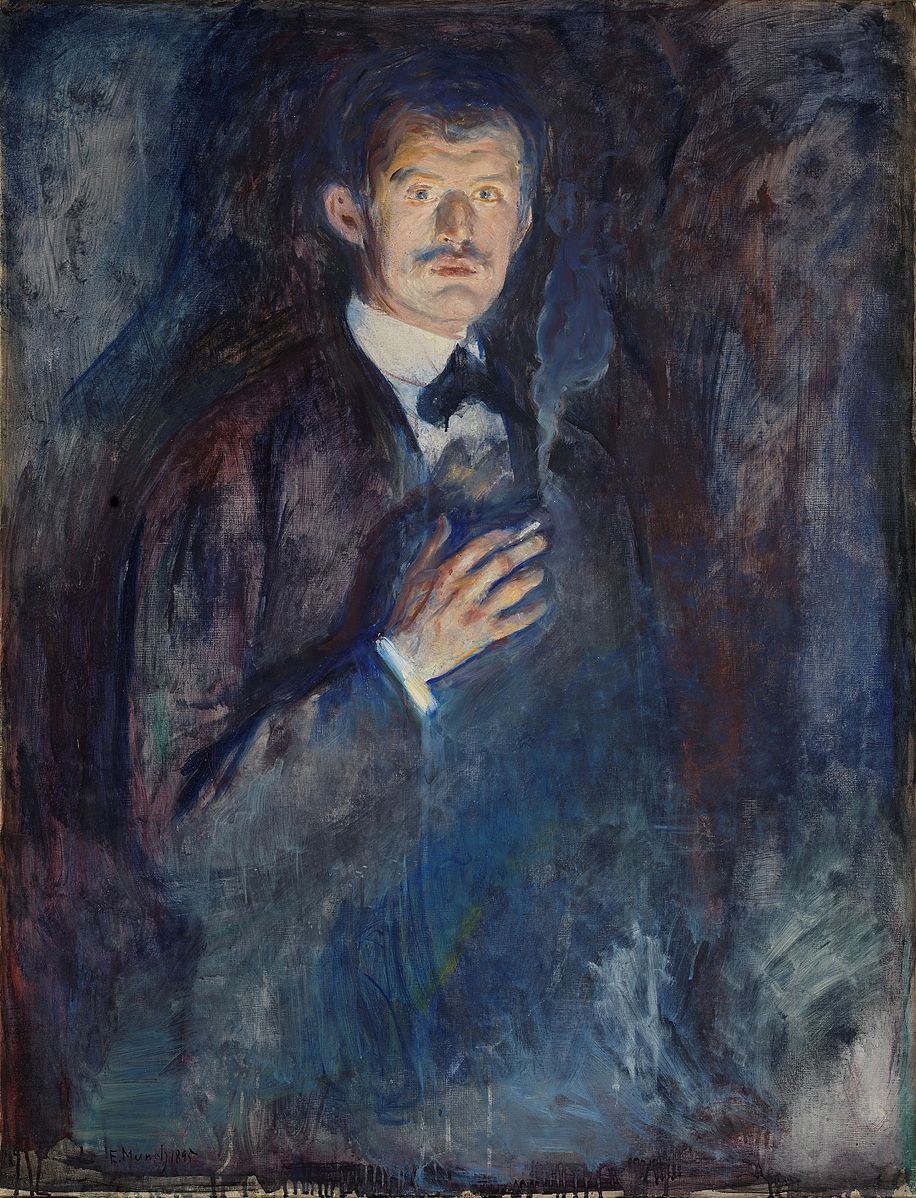
When we think of Edvard Munch, we think of The Scream. Though not explicitly a self-portrait, that iconic 1893 canvas does, to anyone who’s read up on the painter’s life, look like a plausible expression of his troubled internal state. But “Self-Portrait with Cigarette made two years later, though less jarring, is just as concerned with Munch’s personal psychology and the dark underside of his identity as The Scream is.” So argues Evan Puschak, better known as the Nerdwriter, in his video essay “Edvard Munch: What A Cigarette Means.” Through the artist’s smoke of choice, it seems, we can approach and understand the different time in which he lived.
“At the end of the 19th century,” Puschak explains, “the cigarette existed at the center of a lot of different cultural forces.” In fact it hadn’t quite caught on, having yet to overcome its lower-class image compared to cigars and pipes. But as with so much that eventually goes mainstream, the cigarette was first widely adopted by bohemians.
Among them Munch and his contemporaries “found their alternative to the suffocating middle-class value system. They traded in drawing rooms for late-night cafés, dinner parties for nightclubs, and cigars for cigarettes.” Puschak pulls up a painting by Munch’s mentor Christian Krohg showing a 21-year-old Munch “lighting up with his friends and fellow painters in his studio.”
Even as he inhabited it, Munch himself also captured this floating world in his art. In one of his etchings, “smoke snakes and fills up the atmosphere of a café, where bohemian intellectuals of both genders drink and debate art and ideas.” To the social reformers of late 19th-century Norway such scenes were anathema, and “the cigarette was symptomatic of society’s degeneration.” These figures thought little more of Munch’s art, whether the work in question was a relatively naturalistic image like Self-Portrait with Cigarette or a violently expressionist one like The Scream. Regarded today as examples of high, refined culture, his paintings have in some sense lost their edge; but then so has the cigarette, a onetime liberating symbol of social and artistic revolution now reduced to a squalid public-health hazard.
Based in Seoul, Colin Marshall writes and broadcasts on cities, language, and culture. His projects include the Substack newsletterBooks on Cities, the book The Stateless City: a Walk through 21st-Century Los Angeles and the video series The City in Cinema. Follow him on Twitter at @colinmarshall or on Facebook.
What’s the world’s oldest computer? If you answered the 5‑ton, room-sized IBM Mark I, it’s a good guess, but you’d be off by a couple thousand years or so. The first known computer may have been a handheld device, a little larger than the average tablet. It was also hand-powered and had a limited, but nonetheless remarkable, function: it followed the Metonic cycle, “the 235-month pattern that ancient astronomers used to predict eclipses,” writes Robby Berman at Big Think.
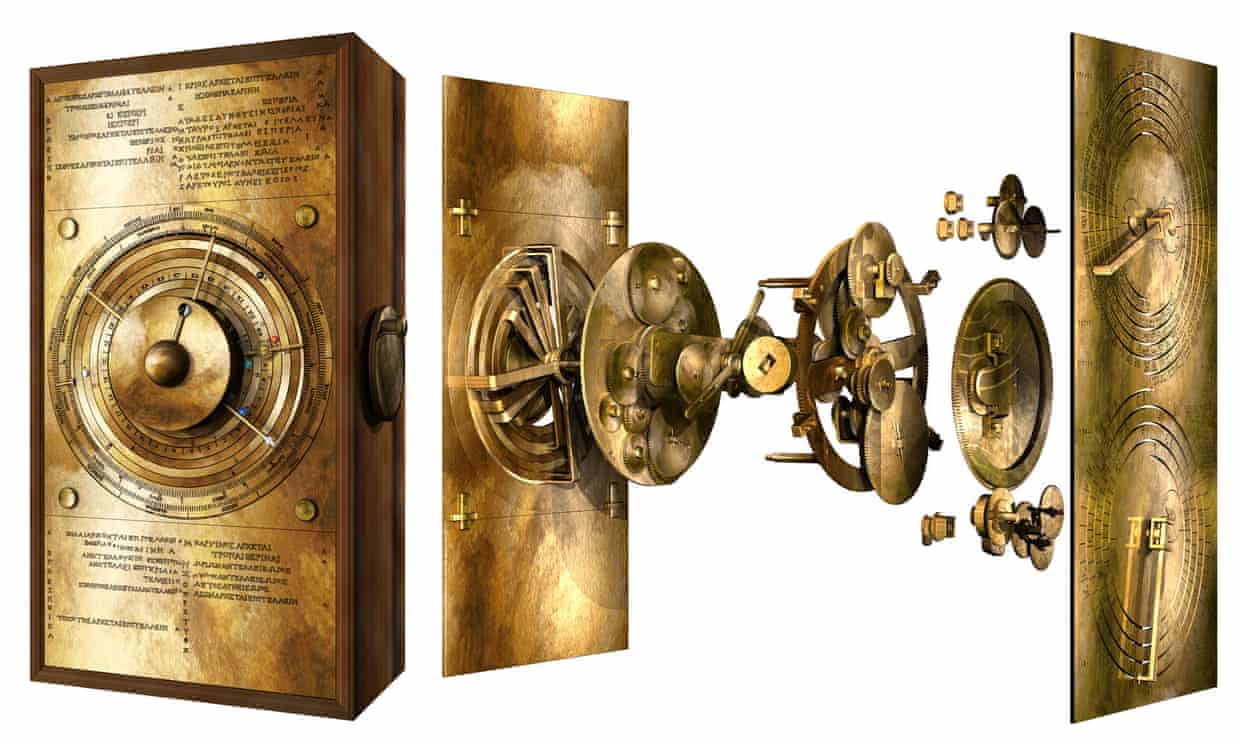
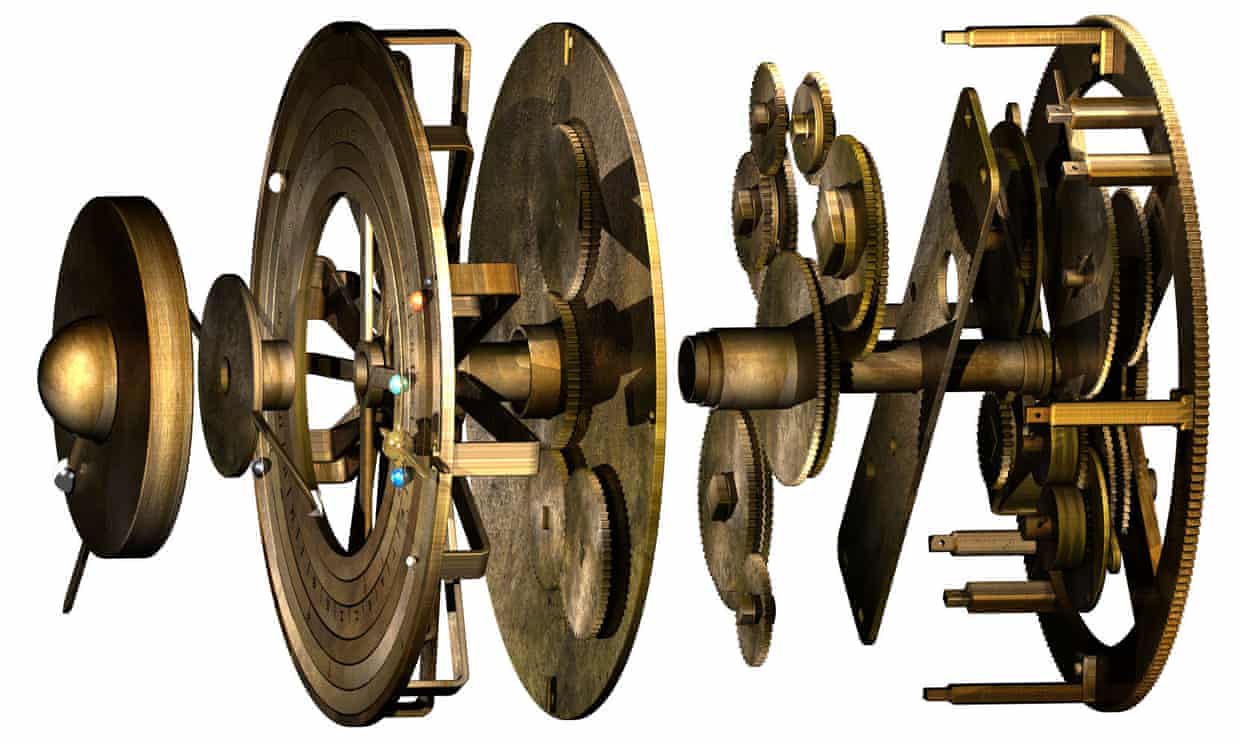
The ancient artifact known as the Antikythera mechanism — named for the Greek Island under which it was discovered — turned up in 1900. It took another three-quarters of a century before the secrets of what first appeared as a “corroded lump” revealed a device of some kind dating from 150 to 100 BC. “By 2009, modern imaging technology had identified all 30 of the Antikythera mechanism’s gears, and a virtual model of it was released,” as we noted in an earlier post.
The device could predict the positions of the planets (or at least those the Greeks knew of: Mercury, Venus, Mars, Jupiter, and Saturn), as well as the sun, moon, and eclipses. It placed Earth at the center of the universe. Researchers studying the Antikythera mechanism understood that much. But they couldn’t quite understand exactly how it worked, since only about a third of the complex mechanism has survived.
Image by University College London
Now, it appears that researchers from the University College of London have figured it out, debuting a new computational model in Scientific Reports. “Ours is the first model that conforms to all the physical evidence and matches the scientific inscriptions engraved on the mechanism itself,” lead author Tony Freeth tells The Engineer. In the video above, you can learn about the history of the mechanism and its rediscovery in the 20th century, and see a detailed explanation of Freeth and his team’s discoveries.
“About the size of a large dictionary,” the artifact has proven to be the “most complex piece of engineering from the ancient world” the video informs us. Having built a 3D model, the researchers next intend to build a replica of the device. If they can do so with “modern machinery,” writes Guardian science editor Ian Sample, “they aim to do the same with techniques from antiquity” — no small task considering that it’s “unclear how the ancient Greeks would have manufactured such components” without the use of a lathe, a tool they probably did not possess.
Image by University College London
The mechanism will still hold its secrets even if the UCL team’s model works. Why was it made, what was it used for? Were there other such devices? Hopefully, we won’t have to wait another several decades to learn the answers. Read the team’s Scientific Reports article here.
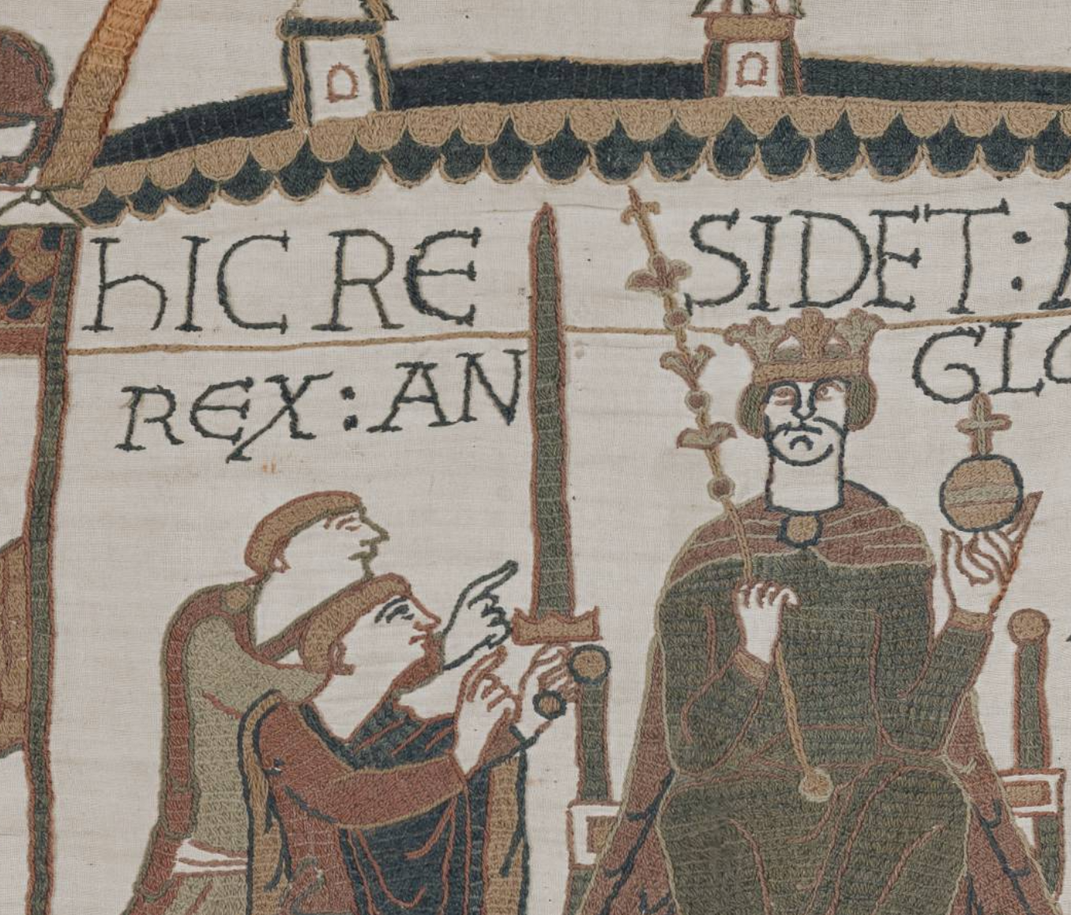
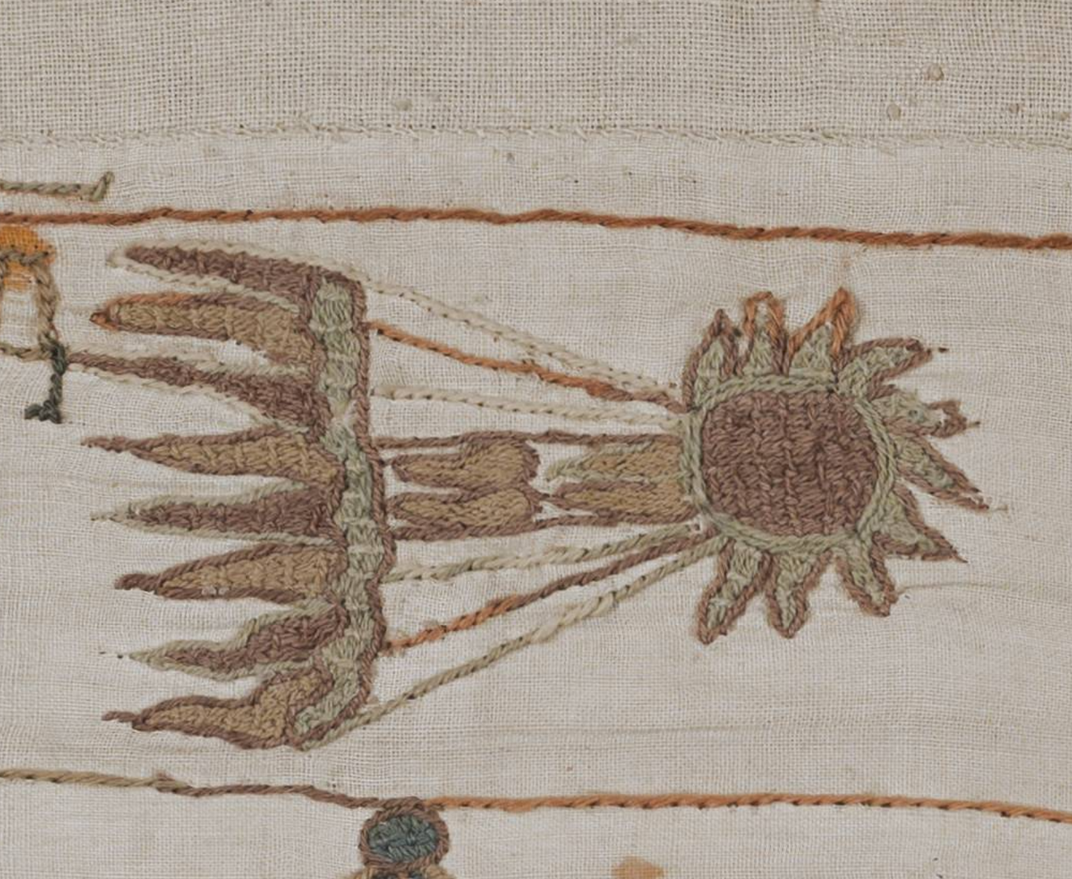
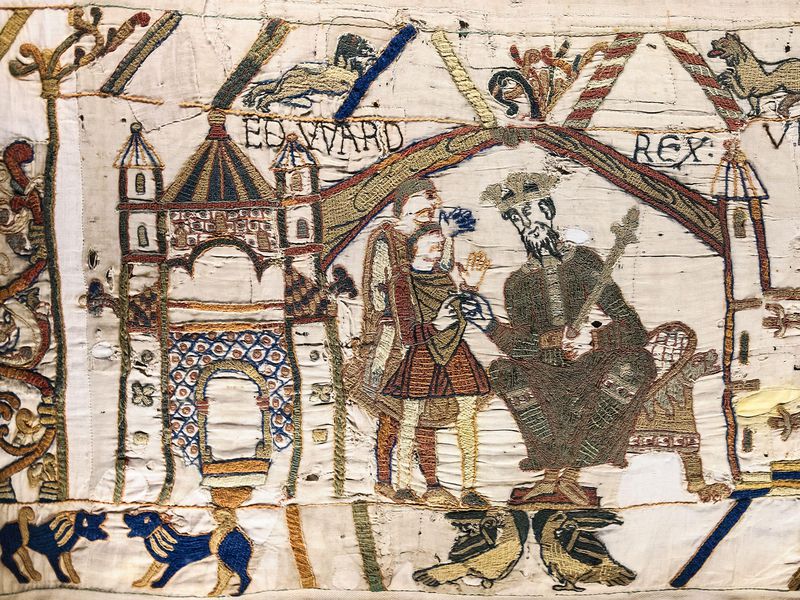
The Bayeux Tapestry, one of the most famous artifacts of its kind, isn’t actually a tapestry. Technically, because the images it bears are embroidered onto the cloth rather than woven into it, we should call it the Bayeux Embroidery. To quibble over a matter like this rather misses the point — but then, so does taking too literally the story it tells in colored yarn over its 224-foot length. Commissioned, historians believe, as an apologia for the Norman conquest of England in 1066, this elaborate work of narrative visual art conveys events with a certain slant. But in so doing, the Bayeux’s 75 dramatic, bloody, ribald, and sometimes mysterious episodes also capture how people and things (and even Halley’s Comet) looked in medieval Europe.
It does this in great, if stylized detail, at which you can get a closer look than has ever before been available to the public at the Bayeux Museum’s web site. The museum “worked with teams from the University of Caen Normandie to digitize high-resolution images of the tapestry, which were taken in 2017,” says Medievalists.net.
“A simple interface was created to access the digital version, which allows users to zoom in and explore it in great detail with access to Latin translations in French and English.” Made of 2.6 billion pixels (which brings it to eight gigabytes in size), the online Bayeux Tapestry lets us zoom in so far as to examine its individual threads — the same level at which it was inspected in real life earlier last year in anticipation of its next restoration.
“A team of eight restorers, all specialists in antique textiles, carried out the detailed inspection in January 2020, a period when the museum was closed to visitors,” says Medievalists.net. “Among their findings were that the tapestry has 24,204 stains, 16,445 wrinkles, 9,646 gaps in the cloth or the embroidery, 30 non-stabilized tears, and significant weakening in the first few metres of the work.” (Notably, the colors applied in a 19th-century restoration have faded much more than the vegetable dyes used in the original.) Though currently a bit rough around the edges, the Bayeux Tapestry looks pretty good for its 950 or so years, as any of us can now look more than closely enough to see for ourselves. This is a credit to its makers — whose identities, for all the scrutiny performed on the work itself, may remain forever unknown. Explore the high-resolution scan of the Tapestry here.
Based in Seoul, Colin Marshall writes and broadcasts on cities, language, and culture. His projects include the Substack newsletterBooks on Cities, the book The Stateless City: a Walk through 21st-Century Los Angeles and the video series The City in Cinema. Follow him on Twitter at @colinmarshall or on Facebook.
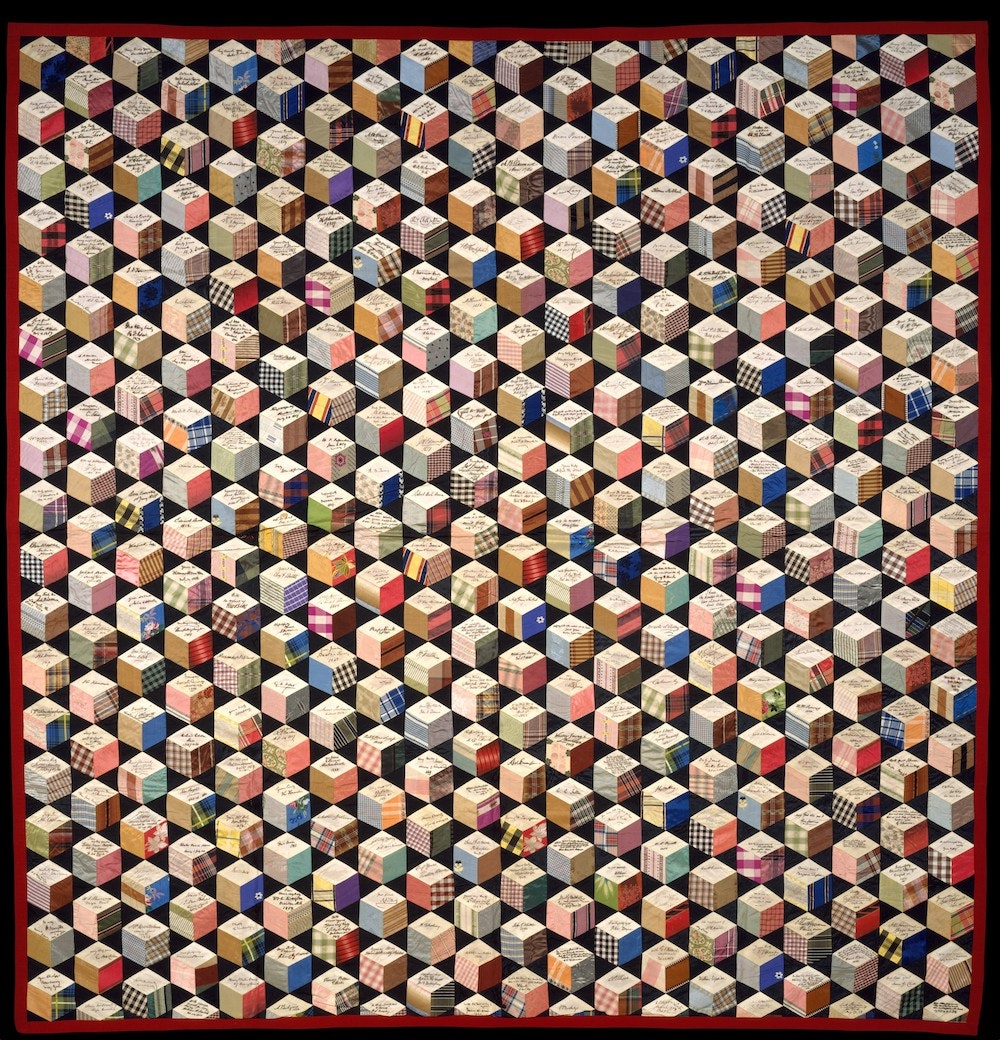
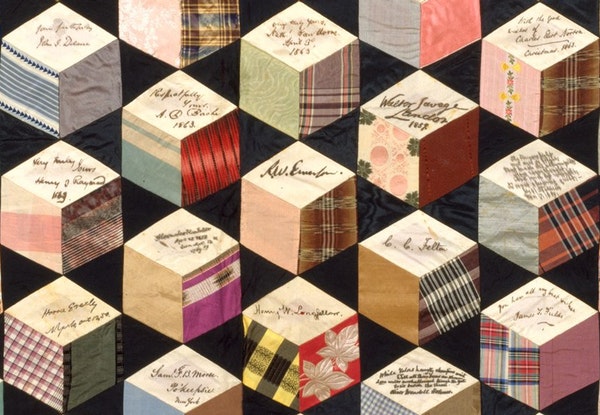
These days, anyone can reach out to hundreds of celebrities, artists, writers, major heads of state, etc., on social media (or to the interns and assistants who run their accounts). Instantaneous connection also means hundreds of near-instantaneous comments in near-real time. It can occasionally mean near-instantaneous influencer fame. For 17-year-old Adeline Harris, it would take seven years or so to get in touch with 360 of the biggest names in literature, politics, philosophy, science, and other fields of her time. Given that she started in 1856, that’s a somewhat extraordinary feat. It’s only one impressive feature of her Tumbling Block with Signatures Quilt, mostly completed sometime in 1863.
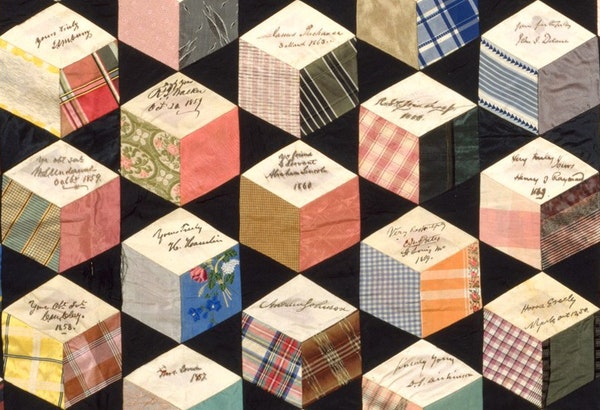
Harris’ quiltmaking project uses a “tumbling blocks pattern,” notes The History Blog, “characterized by a trompe l’oeil that gives it 3D cube effect. [She] showcased exceptional skill and mastery in her needlework and fabric choice, emphasizing the 3D effect with her arrangement of the varied patterns of silk pieces.”
The signatures on the white diamonds atop each “tumbling block” were mailed to Harris by request from a “who’s who” of mid-19th century luminaries, including “an astonishing eight presidents of the United States (Martin Van Buren, John Tyler, Millard Fillmore, Franklin Pierce, James Buchanan, Abraham Lincoln, Andrew Johnson, Ulysses S. Grant).”
The quilt also contains the signatures of Union generals, congressmen, journalists, academics, clergymen. Famous names include Samuel Morse, Horace Greeley, Washington Irving, Nathaniel Hawthorne, Ralph Waldo Emerson, Jacob Grimm, Alexander von Humboldt, Henry Wadsworth Longfellow, Julia Ward Howe, Harriet Beecher Stowe, William Cullen Bryant, Alexandre Dumas, Oliver Wendell Holmes, William Makepeace Thackeray, and Charles Dickens. She placed the names in categories dividing the signatories by profession.
The full list “is nothing short of phenomenal,” the Public Domain Review writes, adding that “according to her grand-daughter the Lincoln signature was, due to a family connection, actually acquired in person, and Adeline was meant to have even danced with Lincoln at his inauguration ball.” Harris — later Adeline Harris Sears — came from a wealthy Rhode Island textile mill family and married a prominent clergyman. She spent most of her life in the state, and mailed most of her signature requests rather than delivering them firsthand.
Signature quilts were not new; they had been sewn for years to mark family occasions and other events. But never had they been a means of celebrity autograph-hunting, nor been created by a single individual. Collecting autographs, however, was quite popular. “Adeline’s taste for autographs… betrays her romantic nature,” writes Metropolitan Museum of Art curator Amelia Peck. “Among a certain segment of the population, it was believed that a person’s signature revealed significant aspects of his or her personality.”
It’s hard not to see the seeds of our contemporary culture in the consumption of celebrity autographs Peck describes: “By owning a signature of an illustrious person, one could learn about the characteristics that made him or her great and emulate those traits.” This mania for autographs “paralleled the nineteenth-century fascination with other types of pseudoscientific personality discovery, such as phrenology.” There were deep, mystical meanings in Adeline’s quilt, wrote editor Sarah Hale, who also donated a signature. In her 1868 book Manners, Happy Homes and Good Society All the Year Round, Hale explained what made the quilt a masterpiece:
In short, we think this autograph bedquilt may be called a very wonderful invention in the way of needlework. The mere mechanical part, the number of small pieces, stitches neatly taken and accurately ordered; the arranging properly and joining nicely 2780 delicate bits of various beautiful and costly fabrics, is a task that would require no small share of resolution, patience, firmness, and perseverance. Then comes the intellectual part, the taste to assort colors and to make the appearance what it ought to be, where so many hundreds of shades are to be matched and suited to each other. After that we rise to the moral, when human deeds are to live in names, the consideration of the celebrities, who are to be placed each, the centre of his or her own circle! To do this well requires a knowledge of books and life, and an instinctive sense of the fitness of things, so as to assign each name its suitable place in this galaxy of stars or diamonds.
See more close-ups of the quilt at the Metropolitan Museum of Art, who hold this one-of-a-kind work of signatory fabric art in their collections.
Maybe you’ve sung the Christmas carol “Good King Wenceslas” and wondered who this good king was. The carol wasn’t written until the 19th century, but “Wenceslas was a real person,” writes NPR’s Tom Manoff, the patron saint of the Czechs and “the Duke of Bohemia, a 10th-century Christian prince in a land where many practiced a more ancient religion. In one version of his legend, Wenceslas was murdered in a plot by his brother,” Boleslav, “under the sway of their so-called pagan mother,” Drahomíra.
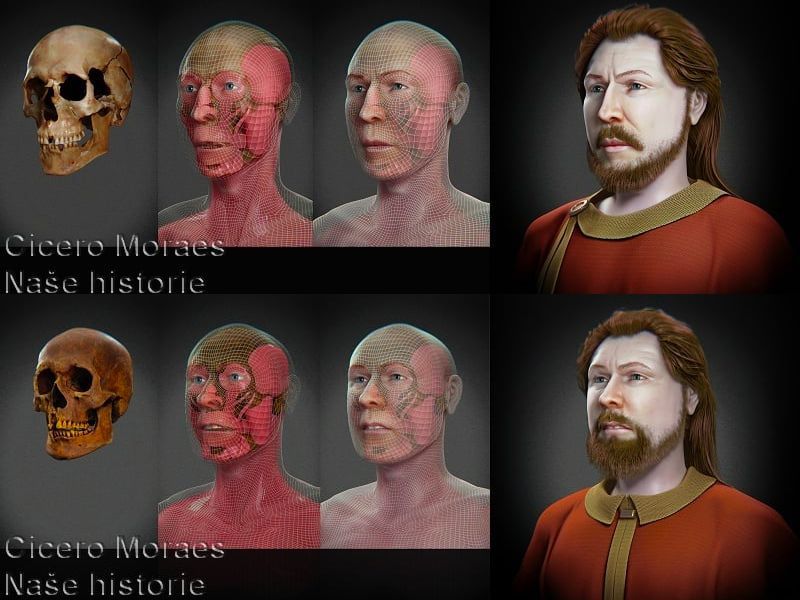
Wenceslas’ grandmother Ludmilla died a Christian martyr in 921 A.D. Her husband, Bořivoj, ruled as the first documented member of the Přemyslid Dynasty (late 800s-1306), and her two sons Spytihnĕv I (circa 875–915) and Vratislav I (circa 888–921), Wenceslas’ father, ruled after their father’s death. The skeletal remains of these royal Bohemian brothers were identified at Prague Castle in the 1980s by anthropologist Emanuel Vlček. Due to advances in DNA analysis and imaging, we can now see an approximation of what they looked like. (See Spytihnĕv at the top and Vratislav at the bottom in the image below.)
A Czech-Brazillian research team created the reconstructions, making “educated guesses” about the brothers’ hairstyles, beards, and clothing. “The team, which included archaeologists Jiří Šindelář and Jan Frolík, photographer Martin Frouz, and 3‑D technician Cicero André da Costa Moraes,” Isis Davis-Marks writes at Smithsonian, “has previously reconstructed the faces of Zdislava of Lemberk (circa 1220–1252), patron saint of families, and Czech monarch Judita of Thuringia (circa 1135–1174), among others.”
The project proceeded in several stages, with different experts involved along the way. “First,” notes Archaeology, “detailed images of the bones were assembled using photogrammetry to form virtual 3‑D models” of the skulls. Then, facial reconstruction expert Moraes added muscle, tissue, skin, etc., relying on “multiple three-dimensional reconstruction techniques,” Davis-Marks writes, “including anatomical and soft tissue depth methods, to ensure the highest possible level of accuracy.” DNA analysis showed that the brothers likely had blue eyes and reddish-brown hair.
Spytihnĕv and Vratislav’s other features come from the best guess of the researchers based on “miniatures or manuscripts,” says Frolík, “but we don’t really know.” Do they look a bit like video game characters? They look very much, in their digital sheen, like characters in a medieval video game. But perhaps we can anticipate a day when real people from the distant past return as fully animated 3D reconstructions to replay, for our education and amusement, the battles, court intrigues, and fratricides of history as we know it.
The cassette tape is so ubiquitous, so much a part of my life since I can even remember music as a thing, that it was a shock to find out that the man who invented it, Lou Ottens, passed away at the age of 94. Of course, somebody did have to invent the cassette tape, but in all these years I never thought to look the person up. Such an invention first makes you think of the world before it: records (dearly beloved, still around), and reel-to-reel tape (not so dearly beloved). The former was a fixed object, an art object, immutable (until turntablists came along). The latter was a way to record ourselves, but so much more was involved in the act. People had to wind the spindle, to thread the tape through the capstan and heads, and record usually in mono. You can see an overview of a model from the 1950s here.
Ottens was a Dutch engineer working at Philips who became head of new product development in Hasselt, Belgium. His assignment was to shrink the reel-to-reel and, like the radio, make it more portable. And here is the most important decision: Ottens wanted the format to be licensed to other manufacturers for free, so everybody could partake. Considering the endless format battles that we fight every day, this decision was as monumental as it was humanist.
He designed his prototype out of wood and sized it to fit into a pocket for true portability. (This prototype, by the way, disappeared from history after he used it to prop up a jack when fixing a flat tire.) The actual compact cassette, promoted as a cheaper and smaller format for major label releases, immediately gained a second life as an artistic tool: a way for regular folk to record whatever they wanted. Keith Richards reportedly recorded the riff for “Satisfaction” on the portable cassette player near his bed. People recorded lectures, the television, the radio, their relatives, their friends, the random sound of life. People started to curate: their favorite music, their favorite people, their favorite sounds. People pretended to be DJs, pretended to be artists, pretended to be television hosts, pretended to be authors, pretended to be critics. And some through pretending became the things they wanted to be.
People made mixtapes for friends and for lovers. They looked at the remaining tape on the spindle and wondered if the song they had to end side two would fit. People realized that cassette tape could be a collage of sounds, cut up by the pause button.
Ottens may not have realized it, but he had created a completely democratic format. In the 1980s, the back pages of music magazines flourished with the catalogs of cassette-only album releases. If you had a Walkman and a friend with a halfway decent tape recorder, you could carry around your favorite music and listen to it whenever you wanted.
The record industry rebelled (for a while). They wanted you to know that “home taping is killing music” but did so with a skull and bones graphic that made it that much cooler. In the end it didn’t really matter. The music fans repurchased everything on CD anyway. (Apart from the people who taped CDs and even then after that *those* people downloaded the mp3s.)
And here’s the thing. Ottens wasn’t precious about any of it. He was part of the development of the Compact Disc. The cassette was just another stepping stone.
But despite the numerous articles that cassettes were a dead medium, they kept coming back. Mixtapes, the lifeblood of hip hop culture continued to thrive, even if by the end of the century the idea was more of a concept. And then in the middle of the 2010s cassettes came roaring back after the vinyl resurgence. For bands it was a cheap way to provide a physical product, what with vinyl still being very expensive to produce. Bandcamp, the place to go for cassette-only releases, offers artistic tapes for the same price as a digital download. So why not get both and start your library again?
Ottens never foresaw any of this happening, but it speaks to something very human: we want control of our music, and digital music, especially in the cloud, ain’t cutting it. We want to hold something in our hands and claim it as our own.
So pour one out for Lou Ottens, who started a revolution that hasn’t finished. Do *not* press pause.
Ted Mills is a freelance writer on the arts who currently hosts the Notes from the Shed podcast and is the producer of KCRW’s Curious Coast. You can also follow him on Twitter at @tedmills, and/or watch his films here.
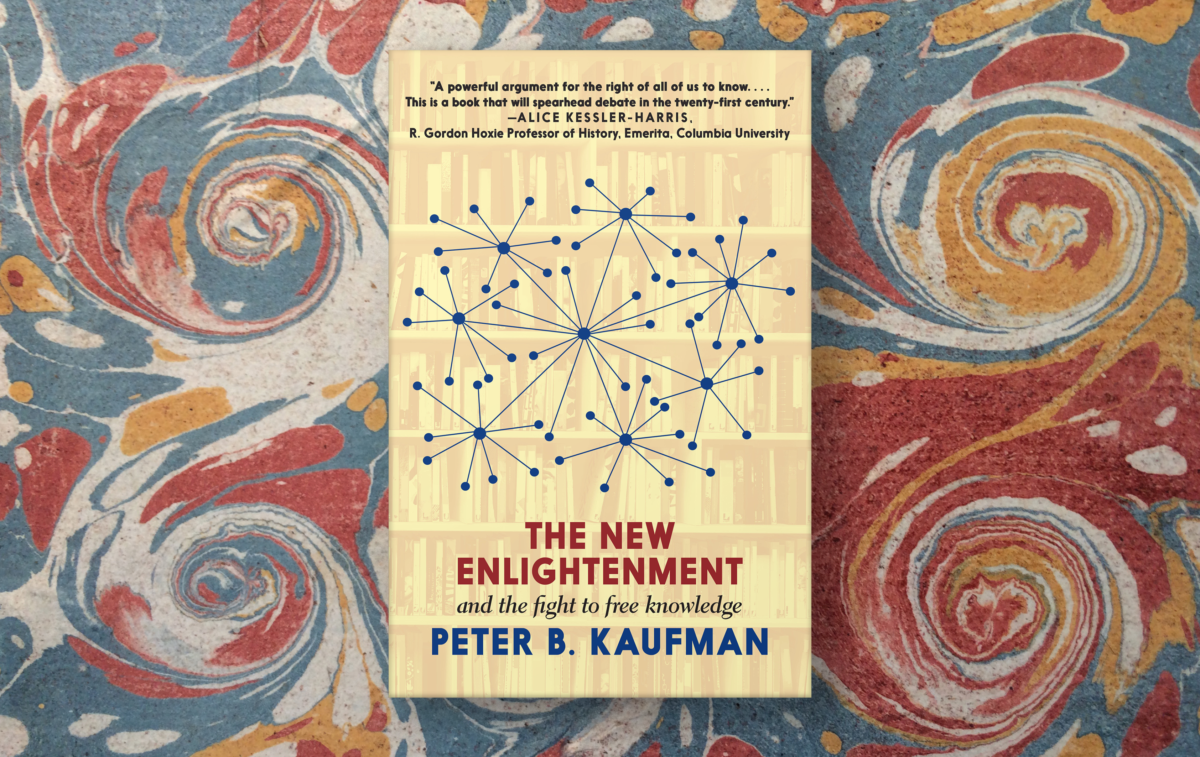
Editor’s Note: This month, MIT Open Learning’s Peter B. Kaufman has published The New Enlightenment and the Fight to Free Knowledge, a book that takes a historical look at the powerful forces that have purposely crippled our efforts to share knowledge widely and freely. His new work also maps out what we can do about it. In the coming days, Peter will be making his book available through Open Culture by publishing three short essays along with links to corresponding sections of his book. Today, you can read his second essay “On Wikipedia, the Encyclopédie, and the Verifiability of Information” (below), plus download the second chapter of his book here. Read his first essay, “The Monsterverse” here, and purchase the entire book online.
When the ideas that matter most to us – liberals, democrats, progressives, republicans, all in the original sense of the words – were first put forward in society in order to change society, they were advanced foremost in print. The new rules, new definitions, and new codicils of human and civil rights that undergird many of the freedoms we value today had as their heart text and its main delivery mechanism, the printing press.
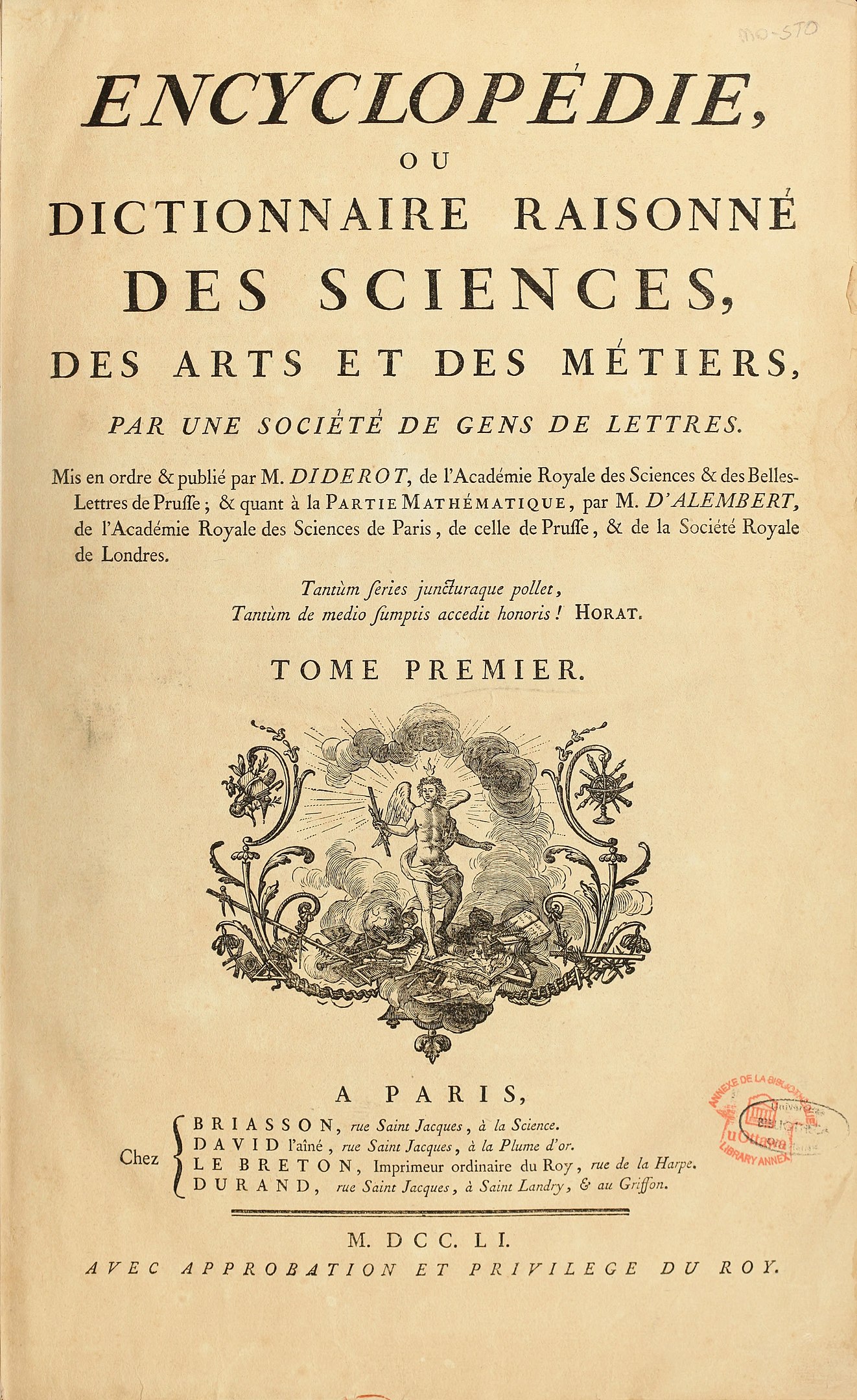
In that sense the first Enlightenment was based upon the foundation of the printed word. And of the 18th century’s contributions to knowledge and society – Newton’s physics, Montesquieu’s laws, Linnaeus’s taxonomies, Rousseau’s political philosophy, the Declaration of Independence, the Declaration of the Rights of Man – there was perhaps no greater printed offering than the 22-million-word Encyclopédie that the French Enlightenment philosophers starting writing, compiling, and offering to the public in 1750.
The Encyclopédie was monumental. Not just from a content-assembly perspective – an effort to gather all the world’s knowledge and to print and publish it – but also from a sociopolitical one, given the powerful forces suppressing knowledge that such an effort would provoke. The Encyclopédie found the state and the church banning at one time or another almost every one of its 72,000 articles, 18,000 pages, and 28 volumes and invoking a hundred ways to forbid its distribution.
The encyclopedia’s entire approach to collecting and presenting knowledge was radical. The articles presented truths – some heretical, some blasphemous – that astonished contemporary readers. And its innovative approach to the verification its own content, to proving what could be proved, which was really its nuclear core, rocked the Western world.
The Encyclopédie smote 18th-century orthodoxy with ink-and-paper sledgehammers. The article on “RAISON,” or “REASON,” for example, told every reader who for centuries had been steeped in church doctrine and the divine rights of royals that:
No proposition can be accepted as divine revelation if it contradicts what is known to us, either by immediate intuition, as in the case of self-evident propositions, or by obvious deductions of reason, as in demonstrations. It would be ridiculous to give preference to such revelations, because the evidence that causes us to adopt them cannot surpass the certainty of our intuitive or demonstrative knowledge…
Clerics and kings, needless to say, were not fans. Articles on religion, philosophy, and politics and society challenged the government and the church even as the censors watched. Direct swipes at the monarchy and the church appeared even where you might not expect – in articles on CONSCIENCE, LIBERTÉ DE; CROISADES; FANATISME; TOLÉRANCE; etc. The entry for FORTUNE spotlighted the gross inequalities of wealth already evident in 18th-century Europe. And a zinging condemnation of slavery in the article on the SLAVE TRADE made few friends among any who had a hand anywhere in the business.
Slave trade is the purchase of Negroes made by Europeans on the coasts of Africa, who then employ these unfortunate men as slaves in their colonies. This purchase of Negroes to reduce them into slavery […] violates all religion, morals, natural law, and human rights.
The Encyclopédistes announced from day one that this new work would be, as we would say today, fact-based. There would be an underlying and overarching commitment on the part of all contributors and the work as a whole to the verification of all of its source materials. Verification is potentially “a long and painful process,” Diderot wrote in his introduction to the whole enterprise – the famous “Preliminary Discourse” that these philosophers used to sell in the whole project:
We have tried as much as possible to avoid this inconvenience by citing directly, in the body of the articles, the authors on whose evidence we have relied and by quoting their own text when it is necessary.
We have everywhere compared opinions, weighed reasons, and proposed means of doubting or of escaping from doubt; at times we have even settled contested matters.… Facts are cited, experiments compared, and methods elaborated … in order to excite genius to open unknown routes, and to advance onward to new discoveries, using the place where great men have ended their careers as the first step.
What this meant in practice was revolutionary. There would be no accepted truths but for those that could be proven and cited. Fact-based versus faith- and belief-based: the start and spark of the Enlightenment. One of Diderot’s biographers explains that approximately 23,000 articles had at least one cross-reference to another article in one of the encyclopedia’s 28 volumes. “The total number of links – some articles had five or six – reached almost 62,000.” And all while retaining a sly sense of humor. The article on CANNIBALS ended with “the mischievous cross-reference,” as another historian would later describe it: “See Eucharist, Communion, Altar, etc.”
That commitment to reference citation continues in the Enlightenment’s most important successor project – Wikipedia, founded by Jimmy Wales and colleagues 20 years ago this year. It’s the foundation of what today’s Wikipedia terms verifiability, and in many key ways it’s the foundation for truth in knowledge and society today:
“Verifiability” … mean[s] that material added to Wikipedia must have been published previously by a reliable source. Editors may not add their own views to articles simply because they believe them to be correct, and may not remove sources’ views from articles simply because they disagree with them.
[V]erifiability is a necessary condition (a minimum requirement) for the inclusion of material, though it is not a sufficient condition (it may not be enough).
In 1999, free-software activist Richard M. Stallman called for this universal online encyclopedia covering all areas of knowledge, along with a complete library of instructional courses – and, equally important, a movement to develop it, “much as the Free Software Movement gave us the free operating system GNU/Linux.” That call (reproduced in full as the appendix in my book) is credited by Wikipedia as the origins of the work that is now the largest knowledge resource in history.
The free encyclopedia will provide an alternative to the restricted ones that media corporations will write.
Stallman published a list of what that the encyclopedia would need to do, what sort of freedoms it would need to give to the public, and how it could get started.
An encyclopedia located everywhere.
An encyclopedia open to anyone—but, most promisingly, to teachers and students.
An encyclopedia built of small steps.
An encyclopedia built on the long view: “If it takes twenty years to complete the free encyclopedia, that will be but an instant in the history of literature and civilization.”
An encyclopedia containing one or more articles for any topic you would expect to find in another encyclopedia – “for example, bird watchers might eventually contribute an article on each species of bird, along with pictures and recordings of its calls” – and “courses for all academic subjects.”
1999, and it sounds familiar. Wikipedia, of course, is one of the world’s most popular websites (the world’s most popular noncommercial one) now and an irreplaceable source of verifiable information – open to any and all. Its processes are transparent, and thanks to hackers affiliated with the project, you now can watch and listen to its edits live online:
Communities that work with Wikipedia are likely to benefit from this commitment to citation, and new collaborations that take effect around it are likely to benefit society. The Internet Archive is working with Wikipedia now, digitizing books so that links to sources in Wikipedia link all the way through to the books themselves – and render images and text on the cited pages. The reference link to a biography by Taylor Branch at the bottom of a Wikipedia article on Martin Luther King, Jr., for example, now hotlinks to the readable book online at Archive.org. That work is essential. “Only the use of footnotes and the research techniques associated with them” – as Princeton historian Anthony Grafton writes – “makes it possible to resist the efforts of modern governments, tyrannical and democratic alike, to conceal the compromises they have made, the deaths they have caused, the tortures they or their allies have inflicted.… Only the use of footnotes enables historians to make their texts not monologues but conversations, in which modern scholars, their predecessors, and their subjects all take part.”
Can we take verifiability further now, especially as our epistemic crisis deepens? Can we improve citation for the medium that’s beginning to overtake us all, which is video? Can we make resources on the web – also a new thing – verifiable? What is a citation like in a … podcast?
The great historian of the Encyclopédie, Robert Darnton, tells us in his new book, “When the printed word appeared in France in 1470, the state did not know what to make of it.” So, 700 years from now, what will tomorrow’s historians say about us? Further thoughts about how we can start more consciously collaborating with one another and producing – but immediately – for our burgeoning knowledge networks: next week.
We're hoping to rely on loyal readers, rather than erratic ads. Please click the Donate button and support Open Culture. You can use Paypal, Venmo, Patreon, even Crypto! We thank you!
Open Culture scours the web for the best educational media. We find the free courses and audio books you need, the language lessons & educational videos you want, and plenty of enlightenment in between.