A recent wax cylinder experiment by Metropolitan Opera soprano Susanna Phillips and tenor Piotr Beczala, above, suggests no. This early 20th-century technology is no more due for a comeback than the zoetrope or the steam powered vibrator.
Beczala initiated the project, curious to know how his voice would sound when captured by a Thomas Edison-era device. If it yielded a faithful reproduction, we can assume that the voice modern listeners accept as that of a great such as Enrico Caruso, whose output predated the advent of the electrical recording process, is fairly identical to the one experienced by his live audiences.
The result is not without a certain ghostly appeal, but the facsimile is far from reasonable.
As Beczala toldThe New York Times, the technological limitations undermined his intonation, diction, or performance of the quieter passages of his selection from Verdi’s Luisa Miller. In a field where craft and technique are under constant scrutiny, the existence of such a recording could be a liability, were it not intended as a curiosity from the get go.
Phillips, ear turned to the horn for playback, insisted that she wouldn’t have recognized this recording of “Per Pieta” from Mozart’s Così fan tutte as her own.
Learn more about wax cylinder recording technology and preservation here.
Imagine trying to reconstruct the music of the Beatles 2,500 years from now, if nothing survived but a few fragments of the lyrics. Or the operas of Mozart and Verdi if all we had were pieces of the librettos. In a 2013 BBC article, musician and classics professor at Oxford Armand D’Angour used these comparisons to illustrate the difficulty of reconstructing ancient Greek song, a task to which he has set himself for the past five years.
The comparison is not entirely apt. Scholars have long had clues to help them interpret the ancient songs that served as vehicles for Homeric and Sapphic verse or the later drama of Aeschylus, almost all of which was sung with musical accompaniment. In a recent article at The Conversation, D’Angour points out that many literary texts of antiquity “provide abundant and highly specific details about the notes, scales, effects, and instruments used,” the latter including the lyre and the aulos, “two double-reed pipes played simultaneously by a single performer.”
But these musical instructions have proved elusive; “the terms and notations found in ancient sources—mode, enharmonic, diesis, and so on—are complicated and unfamiliar,” D’Angour writes. Nonetheless, using recreations of ancient instruments, close analysis of poetic meter, and careful interpretation of ancient texts that discuss melody and harmony, he claims to have accurately deciphered the sound of ancient Greek music.
D’Angour has worked to turn the “new revelations about ancient Greek music” that he wrote of five years ago into performances that reconstruct the sound of Euripides and other ancient literary artists. In the video at the top, see a choral and aulos performance of Athanaeus’ “Paean” from 127 BC and Euripides Orestes chorus from 408 BC. D’Angour and his colleagues break in periodically to talk about their methodology.
In the 2017 interview above from the Greek television channel ERT1, D’Angour discusses his research into the music of ancient Greek verse, from epic, to lyric, to tragedy, to comedy, “all of which,” he says, “was sung music, either entirely or partly.” Central to the insights scholars have gained in the past five years are “some very well preserved auloi,” he notes, that “have been reconstructed by expert technicians” and which “provide a faithful guide to the pitch range of ancient music, as well as to the instruments’ own pitches, timbres, and tunings.”
Determining tempo can be tricky, as it can with any music composed before “the invention of mechanical chronometers,” when “tempo was in any case not fixed, and was bound to vary between performances.” Here, he relies on poetic meter, which gives indications through the patterns of long and short syllables. “It remains for me to realize,” D’Angour writes, “in the next few years, the other few dozen ancient scores that exist, many extremely fragmentary, and to stage a complete drama with historically informed music in an ancient theater such as that of Epidaurus.” We’ll be sure to bring you video of that extraordinary event.
“Now when I was a little chap I had a passion for maps. I would look for hours at South America, or Africa, or Australia, and lose myself in the all the glories of exploration. At that time there were many blank spaces on the earth, and when I saw one that looked particularly inviting on a map (but they all look that) I would put my finger on it and say, ‘When I grow up I will go there.’”
—Joseph Conrad, Heart of Darkness
In his post-WWII historical survey, The Story of Maps, Lloyd A. Brown observes that “the very material used in the making of maps, charts and globes contributed to their destruction.” Paper burns, rots, succumbs to water-damage and insects. Maps and globes made from solid silver, brass, copper, and other metals made too-tempting targets for looters and thieves. In this way, maps serve doubly as symbolic indices of what they represent—lands that, in the very act of mapping them, were often despoiled, overrun, and stolen from their inhabitants.
Moreover, in mapping history, it often happened that “if a map were old and obsolete and parchment was scarce, the old ink and rubrication could be scraped off and the skin used over again. This practice, accounting for the loss of many codices as well as valuable maps and charts, at one time became so pernicious” that the Catholic Church issued decrees to forbid it. What better allegory for conquest, the wiping away of civilizations in order to write new names and borders over them?
The old imperial tropes of “blank spaces” on the map and “dark places of the earth” (like “darkest Africa”), used with such effectiveness in Joseph Conrad’s Heart of Darkness, hide the plain truth, in the words of Conrad’s Marlow:
The conquest of the earth, which mostly means the taking it away from those who have a different complexion or slightly flatter noses than ourselves, is not a pretty thing when you look into it too much. What redeems it is the idea only. An idea at the back of it; not a sentimental pretence but an idea; and an unselfish belief in the idea—something you can set up, and bow down before, and offer a sacrifice to.…
Blank spaces represent those areas that had not yet been forcibly brought into the European economy of property, the sine qua non of Enlightenment humanity. “Once discovered by Europeans,” writes historian Michel-Rolph Trouillot—once classified, mapped, and made subject, “the Other finally enters the human world.” For several decades now, postcolonial projects have engaged in the progressive disenchantment of “the idea,” in the recognition of messy relationships between naming, mapping, and power, and the recovery, to the extent possible, of the names, borders, and identities beneath palimpsest histories.
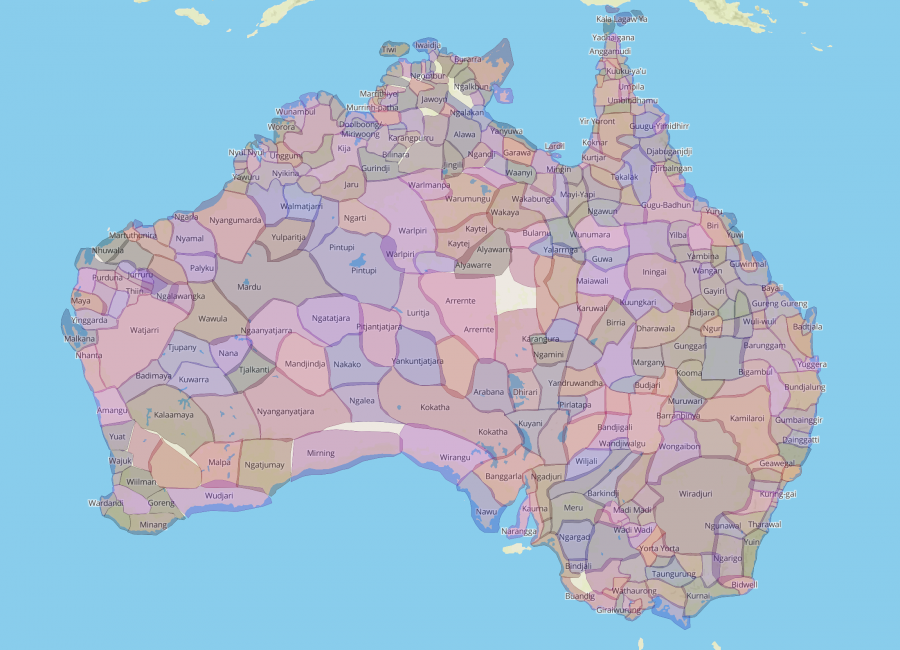
Such projects proliferate outside academia as technology amplifies previously unheard dissenting voices and perspectives and as, to use an old postcolonial phrase, “the empire writes back”—or, in this case, “maps back.” Such is the intent of the online project Native Land, an interactive website that “does the opposite” of centuries of colonial mapping, writes Atlas Obscura, “by stripping out country and state borders in order to highlight the complex patchwork of historic and present-day Indigenous territories, treaties, and languages that stretch across the United States, Canada,” the Canadian Arctic, Greenland, and Australia.
Also a mobile app for Apple and Android, the map allows visitors to enter street addresses or ZIP codes in the search bar, “to discover whose traditional territory their home was built on.”
White House officials will discover that 1600 Pennsylvania Avenue is found on the overlapping traditional territories of the Pamunkey and Piscataway tribes. Tourists will learn that the Statue of Liberty was erected on Lenape land, and aspiring lawyers that Harvard was erected in a place first inhabited by the Wamponoag and Massachusett peoples.
The map was created by Canadian activist and programmer Victor Temprano, founder of the company Mapster, which funds the project. Temprano prefaces the Native Land “About” page with a disclaimer: “This is not an academic or professional survey,” he writes, and is “constantly being refined from user input.” He defines his purpose as “helping people get interested and engaged” by asking questions like “who has the right to define where a particular territory ends, and another begins?”
As neo-colonial projects like oil pipelines once again threaten the survival of Indigenous communities, and indigenous people find themselves and their children caged in prisons for crossing militarized national borders, such questions could not be more relevant. Temprano does not make any claims to definitive historical accuracy and points to other, similar projects that supplement the “blank spaces” in his own online map, such as huge areas of South America being re-mapped on the ground by Amazonian tribes entering field data into smart phones, and Aaron Capella’s Tribal Nations Maps, which offers attractive printed products, perfect for use in classrooms.
Temprano quotes Capella in order to illuminate his work: “This map is in honor of all the Indigenous Nations [of colonial states]. It seeks to encourage people—Native and non-Native—to remember that these were once a vast land of autonomous Native peoples, who called the land by many different names according to their languages and geography. The hope is that it instills pride in the descendants of these People, brings an awareness of Indigenous history and remembers the Nations that fought and continue to fight valiantly to preserve their way of life.”
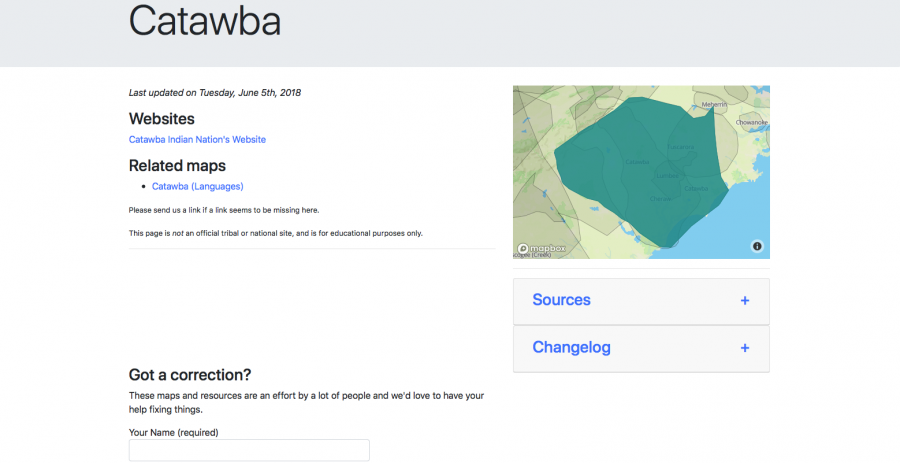
Visit Native Land here and enter an address in North or South America or Australia to learn about previous or concurrent Native inhabitants, their languages, and the historical treaties signed and broken over the centuries. Clicking on the territory of each Indigenous nation brings up links to other informative sites and allows users to submit corrections to help guide this inclusive project toward greater accuracy.
The site also features a Teacher’s Guide, Blog by Temprano, and a page on the importance of Territory Acknowledgement, a way for us to “insert an awareness of indigenous presence and land rights in everyday life,” and one of many “transformative acts,” as Chelsea Vowel, a Métis woman from the Plains Cree writes, “that to some extent undo Indigenous erasure.”
On March 28, 1941, Virginia Woolf took her final walk, into the River Ouse near her home in Sussex. She did it with her trusty cane in hand, the very cane you can see laid out alongside other Woolf-related artifacts in the New Yorkervideo above. Its five minutes provide a short introduction to the “weird objects” of the New York Public Library’s Berg Collection, an archive containing, in the words of the New Yorker’s Gareth Smit, “roughly two thousand linear feet of manuscripts and archival materials” donated in 1940 by the brothers Henry W. and Albert A. Berg, doctors who were also “avid collectors of English and American literature — and of literary paraphernalia.”
The NYPL labels as “realia” such non-paper items as Woolf’s cane as well as “Charlotte Brontë’s writing desk, with a lock of her hair inside; trinkets belonging to Jack Kerouac, including his harmonicas, and a card upon which he wrote ‘blood’ in his own blood; typewriters belonging to S. J. Perelman and Paul Metcalf; Mark Twain’s pen and wire-rimmed glasses; Vladimir Nabokov’s butterfly drawings; and the death masks of the poets James Merrill and E. E. Cummings.” We’ve previously featured Nabokov-drawn butterflies here on Open Culture, as well the letter opener seen in the video that Charles Dickens had made from the foot of his beloved cat Bob.
All this may sound on the grim side, but these objects bring their beholders that much closer to the long-passed literary figures who once possessed them. “If you are looking at, say, Jack Kerouac’s lighter or his boots, you’re seeing the man, in a sense,” the NYPL’s director of exhibitions Declan Kiely says in the video. “What you’re trying to get closest to is the creative spirit at work, and I think that’s why these objects are so evocative.” Though visitors to the Berg Collection can only do so by appointment, the library, as Kiely told Smit, “does intend to have an exhibition to present these and other treasures in the Gottesman Hall by 2020.” Something to look forward to for anyone who yearns to approach the creative spirit — and who among us doesn’t?
Based in Seoul, Colin Marshall writes and broadcasts on cities and culture. His projects include the book The Stateless City: a Walk through 21st-Century Los Angeles and the video series The City in Cinema. Follow him on Twitter at @colinmarshall or on Facebook.
Rock Gong. It sounds like a B‑52s song. But a rock gong is not a New Wave surf-rock party groove. It’s not a neo-synthpop act, hip hop group, or indie band (not yet). It’s a prehistoric instrument—as far away in time as one can get from synthesizers and electric guitars. Rock gongs are ancient, maybe as old as humankind. But they’re still groovy, in their way. As they say, the groove is in the player, not the instrument.
Rock gongs, or “lithophones,” if you want to get technical, have been found all over the African continent, in South America, Australia, Azerbaijan, England, Hawaii, Iceland, India, and everywhere else prehistoric people lived. Not the cultural property of any one group, the rock gong came, rather, from a universal human insight into the natural sonic properties of stone. (One theory even speculates that Stonehenge might have been a massive collection of rock gongs.)
Though some scholars have suggested that the term “rock gong” should be reserved for stationary, rather than portable, rocks that were used as instruments, the British Museum seems untroubled by the distinction. In the video above, archaeologist Cornelia Kleinitz explains the principles of rock gongs found in Sudan to modern rock drummer Liam Williamson of the band Cats on the Beach.
You can hear one of those Nubian rock gongs in its natural habitat, before it was moved to the British Museum, in the clip just above. The rock, the narrator tells us, has been “worn smooth by the action of people playing it more than 7,000 years ago. Long before the Romans, long before the Pharaohs.” Early humans would have searched long and hard for rocks that resonated at particular frequencies, for ringing rocks that could be combined into scales for early xylophones or produce a variety of tones like a steel drum.
Despite their antiquity, the study of rock gongs is a rather recent phenomenon, part of the emerging field of archaeoacoustics. “Methodologically,” write the authors of a 2016 paper on the subject, “this field of research is still in its infancy,” and there is much researchers do not know about the uses and varieties of rock gongs around the world. As Kleinitz explains to Williamson in the video at the top, archaeologists are trying to understand the context in which the Nubian gongs at the British Museum would have been played, whether as instruments for rituals, signaling, fun, or all of the above.
As for the techniques involved in rock gong playing, we can only guess, but Williamson does his best to adapt his drum chops to the ancient stone kit. One critical difference between our modern human musical instruments and this ancient kind, Kleinitz notes, is that the latter were integrated into the landscape; their distinctive sound depended not only on the rock itself, but on its interaction with the wild and unpredictable environment around it.
It’s unusual to encounter a pop-up book for sale in a thrift store.
Their enthusiastic child owners tend to work them so hard, that eventually even sentimental value is trashed.
Stuck slider bars and torn flaps scotch the element of surprise.
Scenes that once sprang to crisp attention can barely manage a flaccid 45° angle.
One good yank and Cinderella’s coach gives way forever, leaving an unsightly crust of dried glue.
Their natural tendency toward obsolescence only serves to make author Ellen G. K. Rubin’s international collection of more than 9000 pop-up and moveable books all the more astonishing.
The Popuplady—an honorific she sports with pride—would like to correct three commonly held beliefs about the objects of her highly specialized expertise:
They are not a recent phenomenon. One item in her collection dates back to 1547.
They were not originally designed for use by children (as a 1933 flip book with photo illustrations on how women can become better sexual partners would seem to indicate.)
They were once conceived of as excellent educational tools in such weighty subjects as mathematics, astronomy, medicine… and, as mentioned above, the boudoir.
A Yale trained physician’s assistant, she found that her hobby generated much warmer interest at social events than her daily toil in the area of bone marrow transplants.
And while paper engineering may not be not brain surgery, it does require high levels of artistry and technical prowess. It galls Rubin that until recently, paper engineers went uncredited on the books they had animated:
Paper engineers are the artists who take the illustrations and make them move. They are puppetmasters, but they hand the strings to us, the reader.
As seen in Atlas Obscura’s video, above, Rubin’s collection includes a moving postage stamp, a number of wheel-shaped volvelles, and a one-of-a-kind elephant-themed mini-book her friend, paper engineer, Edward H. Hutchins, created from elephant dung paper she found on safari.
She has curated or served as consultant for a number of pop-up exhibitions at venues including the Brooklyn Public Library, the Biennes Center of the Literary Arts and the Smithsonian’s National Museum of American History. See a few more examples from her collection, which were displayed as part of the latter’s Paper Engineering: Fold, Pull, Pop & Turn exhibition here.
Nearly everyone born within the past fifteen years naturally thinks of screens as both touchable and responsive to touch. But smartphones, tablets, and the other devices those kids have never known a world without will always look like technological marvels to their grandparents’ generation. Growing up in the 1950s as part of one of television’s most enthusiastic viewerships, they experienced the rise of that then-marvelous medium and the various concepts it tried out before settling into convention. Some may even remember happy Saturday mornings with CBS’Winky Dink and You, the show that they didn’t just watch but actually “interacted” with by breaking out their crayons and drawing on the screen.
First aired in 1953, Winky Dink and You came hosted by Jack Barry, a famous television personality since the beginning of television broadcasting. (He would remain so until his death in the mid-1980s, having bounced back from the quiz show scandals of the later 1950s.) His animated sidekick, the titular Winky Dink, was voiced by Mae Questel, best known as the voice of Betty Boop and Olive Oyl. “Winky Dink said he wanted the children to mail away for a ‘Magic Window,’ which was actually a cheaply produced, thin sheet of plastic that adhered to the TV screen by static electricity,” writes Winky Dink-generation columnist Bob Greene. “Along with the plastic sheet that arrived in the mail were ‘magic crayons.’ Children were encouraged to place the sheet on their TV screen and watch the show each Saturday, so that Winky Dink could tell them what to do.”
Winky Dink, and Barry, often told them to draw in the missing parts of a picture, or to connect dots that would reveal a coded message. In the episode above, writes Paleofuture’s Matt Novak, Barry invites kids to “draw things on Winky Dink’s family members, like flowers on the button hole of Uncle Slim’s jacket, or an entirely new nose on the old guy. Uncle Slim sneezes in reaction to getting a nose drawn on his face, as you might expect” — by the standards of 1950s children’s programming, “comedy gold.” Dull though it may sound today, Winky Dink and You dates from an era when television “was still seen as an education force for good,” when “Americans weren’t quite jaded enough to believe TV was a passive technology that didn’t actually stimulate the mind.”
And though the show managed to move two million magic screens, concerns about X‑rays emanating from picture tubes (as well as the likelihood of impatient kids drawing right on the glass) ended its run in 1957. But in a sense, its legacylives on: a much-circulated quote attributed to Bill Gates describes Winky Dink and You “the first interactive TV show,” and it does indeed seem to have pioneered a kind of content that has only in recent years reached full technological possibility. Anyone who has watched young children of the 21st century play on smartphones and tablets will notice a striking resemblance to the activities led by Winky Dink and Barry. Different reboots have been attempted in different eras, but has the time come for a Winky Dink and You app?
Based in Seoul, Colin Marshall writes and broadcasts on cities and culture. His projects include the book The Stateless City: a Walk through 21st-Century Los Angeles and the video series The City in Cinema. Follow him on Twitter at @colinmarshall or on Facebook.
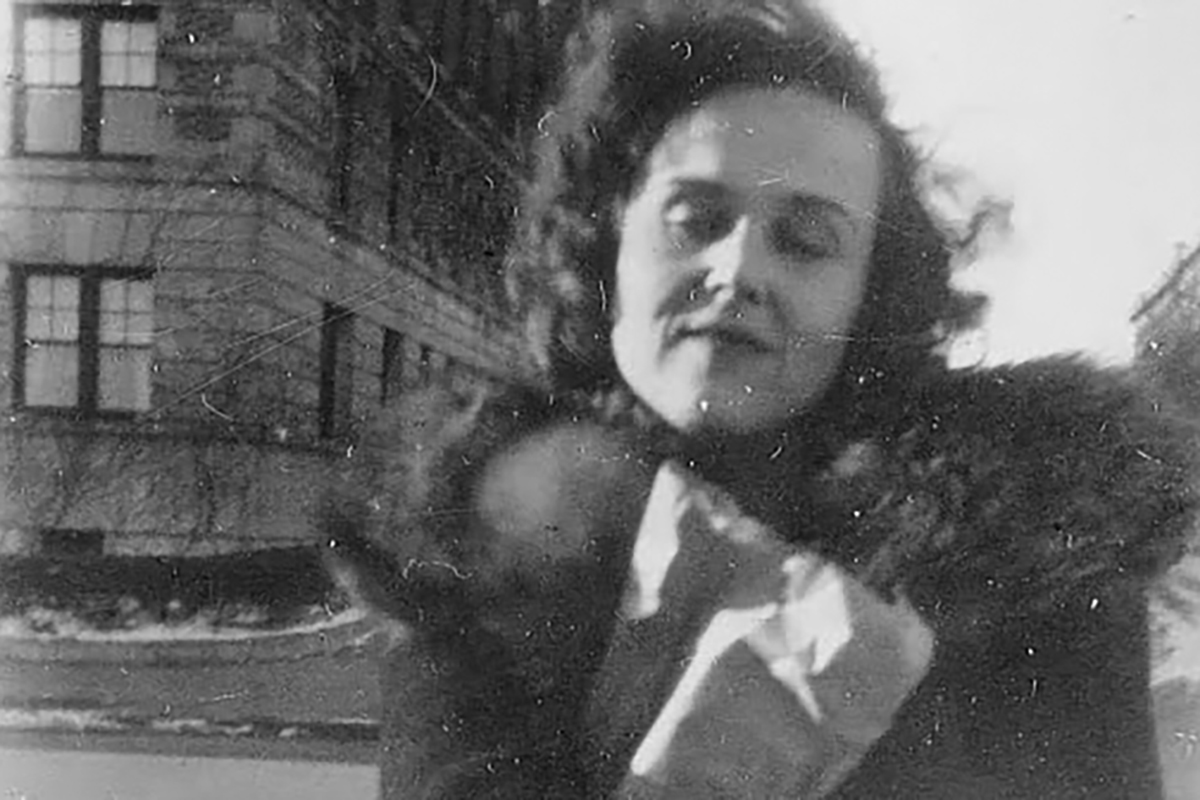
Popular culture knows William S. Burroughs primarily for three of the things he did in life: using drugs, writing Naked Lunch, and killing his wife. If popular culture remembers that wife, Joan Vollmer, it mostly remembers her for the manner of her death: shot, they say, as a result of Burroughs’ drunken imitation of William Tell. But in life she played an important role in the intellectual development of not just Burroughs but other major Beat writers as well, including Allen Ginsberg and Jack Kerouac. As Brenda Knight writes in Women of the Beat Generation, Vollmer “was seminal in the creation of the Beat revolution; indeed the fires that stoked the Beat engine were started with Joan as patron and muse.”
When her first husband Paul Adams was drafted into World War II, Vollmer moved in with her fellow future woman of the Beat Generation, and future wife of Jack Kerouac, Edie Parker. Into their series of Upper West Side apartments came a wide variety of substance-abusing artists, Burroughs, Kerouac, and Ginsberg included. Vollmer’s new coterie, as well as her own amphetamine addiction, so appalled Adams that he left her upon his return from the military. She took up with Burroughs in 1946, later becoming his common-law wife and the mother of their child, William Burroughs, Jr.. In seemingly constant flight from the law, they moved from New York to Texas to New Orleans to Mexico City, where the fateful game of William Tell would happen in 1951.
But did that game of William Tell happen? History has recorded that Vollmer did indeed die by gunshot, but as to exactly how or why it happened, nobody quite knows. Hence the investigations that academics, Beat Generation enthusiasts, and others have conducted since. The Burroughs-themed site RealityStudio has one page on Burroughs and the William Tell Legend and another gathering documents on the death of Joan Vollmer. You can get further in depth by reading “The Death of Joan Vollmer Burroughs: What Really Happened?”, a 70-page research paper by James Grauerholz, Burroughs’ biographer and the executor of his literary estate.
Despite his considerable interest in Burroughs, Grauerholz doesn’t show an outsized interest in absolving the writer of his crime. But he does know more than enough to cast doubt on, or at least add nuance to, the simple story everyone “knows.” Burroughs himself, though he gave contradictory accounts of the event at different times, never denied shooting Vollmer. He did, however, blame a kind of demonic possession for it: “I am forced to the appalling conclusion that I would have never become a writer but for Joan’s death,” he wrote in the introduction to a 1985 edition of his novel Queer. “I live with the constant threat of possession, and a constant need to escape from possession, from Control.”
Vollmer’s death, in Burroughs’ view, “brought me in contact with the invader, the Ugly Spirit, and maneuvered me into a life long struggle, in which I have had no choice except to write my way out.” Sound like self-justification though that may, the fact remains that Burroughs’ life freighted him with plenty of conditions to write his way out of. It also went on for 46 years after the end of Vollmer’s which, though short, saw her become, as Knight writes, “the whetstone against which the main Beat writers — Allen, Jack, and Bill — sharpened their intellect. Widely considered one of the most perceptive people in the group, her strong mind and independent nature helped bulldoze the Beats toward a new sensibility.”
Based in Seoul, Colin Marshall writes and broadcasts on cities and culture. His projects include the book The Stateless City: a Walk through 21st-Century Los Angeles and the video series The City in Cinema. Follow him on Twitter at @colinmarshall or on Facebook.
We're hoping to rely on loyal readers, rather than erratic ads. Please click the Donate button and support Open Culture. You can use Paypal, Venmo, Patreon, even Crypto! We thank you!
Open Culture scours the web for the best educational media. We find the free courses and audio books you need, the language lessons & educational videos you want, and plenty of enlightenment in between.