Last month, Lawrence Livermore National Laboratory put on YouTube 200 now-declassified videos documenting American nuclear tests conducted between 1945 and 1962. According the Lab, “around 10,000 of these films sat idle, scattered across the country in high-security vaults. Not only were they gathering dust, the film material itself was slowly decomposing, bringing the data they contained to the brink of being lost forever.”
In the first video above, weapon physicist Greg Spriggs discusses how a team of experts salvaged these decomposing films, with the hope that they can “provide better data to the post-testing-era scientists who use computer codes to help certify that the aging U.S. nuclear deterrent remains safe, secure and effective.”
If you click the forward button, the playlist will skip to the next video, the first of 63 nuclear tests. Several of those clips you can watch below:
Operation Hardtack
Operation Plumbbob
Operation Teapot
If you would like to support the mission of Open Culture, consider making a donation to our site. It’s hard to rely 100% on ads, and your contributions will help us continue providing the best free cultural and educational materials to learners everywhere. You can contribute through PayPal, Patreon, and Venmo (@openculture). Thanks!
Almost all movies tell stories, even the ones that don’t intend to. Put every movie ever made together, and they collectively tell another story: the story of cinema. Of course, not just one “story of cinema” exists to tell: critic Mark Cousins told one to great acclaim a few years ago in the form of his book and documentary series The Story of Film, as Jean-Luc Godard had done earlier in his Histoire(s) du cinéma, whose very title acknowledges the multiplicity of possible narratives in the history of the moving image. Now, with a lighter but no doubt equally strong perspective, comes the latest multipart video journey through it: Crash Course Film History.
“Movies haven’t always looked like they do now,” says host Craig Benzine (better known as the Youtuber WheezyWaiter) in the trailer above. “There was a real long process to figure out what they… were. Were they spectacles? Documentaries? Short films? If so, how short? Long films?
If so, how long? Is black and white better than color? Should sound be the industry standard? And where should we make them?” And even though we’ve now seen over a century of development in cinema, those issues still seem up for grabs — some of them more than ever.
In the first episode, Benzine dives right into his search for the source of the power of movies, “one of the most influential forms of mass communication the world has ever known,” a “universal language that lets us tell stories about our collective hopes and fears, to make sense of the world around us and the people around us.” To do so, he must begin with the invention of film — the actual image-capturing celluloid substance that made cinema possible — and then goes even farther back in time to the very first moving images, “illusions” in their day, and the surprising qualities of human visual perception they exploited.
All this might seem a far cry from the spectacles you’d see at the multiplex today, but Crash Course Film History (which comes from the same folks who gave us A Crash Course in English Literature and A Crash Course in World History) assures us that both of them exist on the same spectrum — the ride along that spectrum being the story of movies. It will last sixteen weeks, after which Crash Course and PBS Digital Studios will continue their collaborative exploration of film with a course on production followed by a course on criticism. Take all three and you’ll no doubt come out impressed not just by the size of the creative space into which film has expanded, but also by how much it has yet to touch.
One of the greatest challenges for writers and greatest joys for readers of fantasy and science fiction is what we call “world building,” the art of creating cities, countries, continents, planets, galaxies, and whole universes to people with warring factions and nomadic truth seekers. Such writing is the natural offspring of the Medieval travelogue, a genre once taken not as fantasy but fact, when sailors, crusaders, pilgrims, merchants, and mercenaries set out to chart, trade for, and convert, and conquer the world, and returned home with outlandish tales of glittering empires and people with faces in their chests or hopping around on a single foot so big they could use it to shade themselves.
One of the most famous of such chroniclers, Sir John Mandeville, may now be mostly forgotten, but for centuries his Travels was so popular with aspiring navigators and literary men like Shakespeare, Milton, and Keats that “until the Victorian era,” writes Giles Milton, it was he, “not Chaucer, who was known as ‘the father of English prose.’”
Mandeville, like Marco Polo half a century before him, may have been part adventurer, part charlatan, but in any case, both drew their itineraries, as did later navigators like Columbus and Walter Raleigh, from a very long tradition: the making of speculative world maps, which far predates the early Middle Ages of pilgrimage and thirst for Eastern spices and gold.
In the Western tradition, we can trace world mapmaking all the way back to 6th century B.C.E., Pre-Socratic thinker Anaximander, student of Thales, whom Aristotle regarded as the first Greek philosopher. We have no copy of the map, but we have some idea what it might have looked since Herodotus described it in detail, a circular known world sitting atop an earth the shape of a drum. (Anaximander was also an original speculative astronomer.) His map contained two continents, or halves, “Europe” and “Asia”—which included the known countries of North Africa. “Two relatively small strips of land north and south of the Mediterranean Sea,” with ten inhabited regions in total, that illustrate the very early dichotomizing of the world—in this case divided top to bottom rather than west and east.
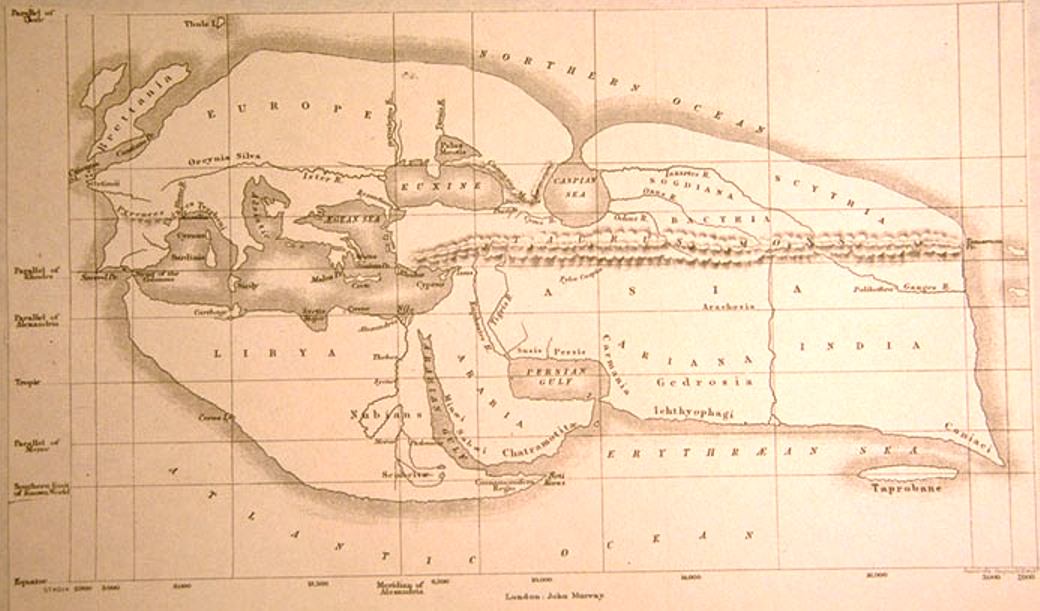
Anaximander may have been the first Greek geographer, but it is the 2nd century B.C.E. that Libyan-Greek scientist and philosopher Eratosthenes who has historically been given the title “Father of Geography” for his three-volume Geography, his discovery that the earth is round, and his accurate calculation of its circumference. Lost to history, Eratosthenes’ Geography has been pieced together from descriptions by Roman authors, as has his map of the world—at the top in a 19th-century reconstruction—showing a contiguous inhabited landmass resembling a lobster claw.
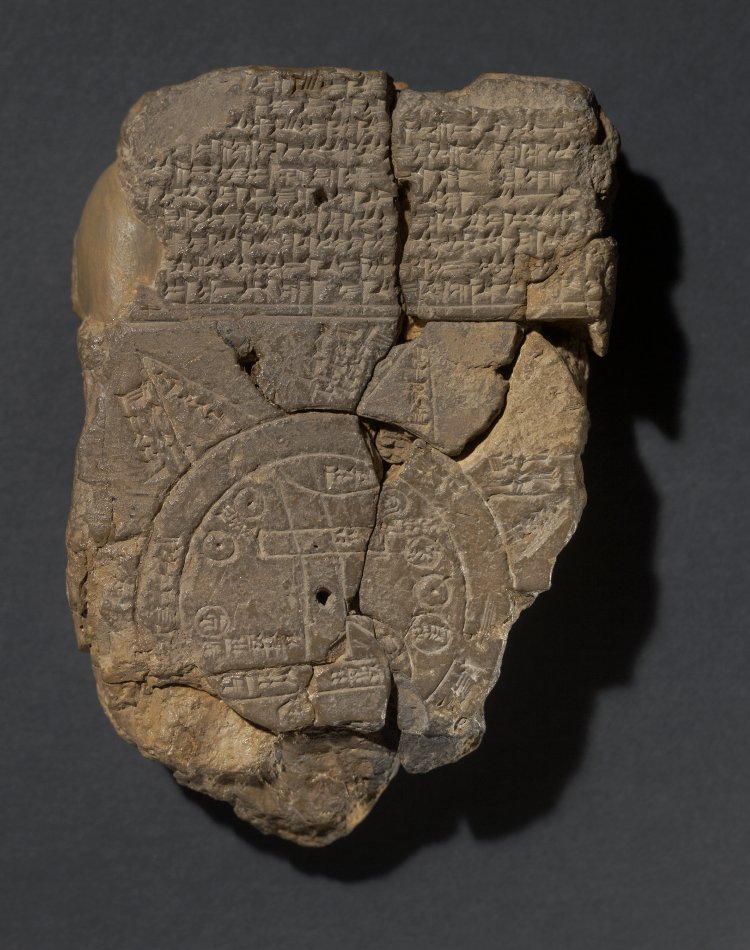
You’ll note that Eratosthenes drew primarily on Anaximander’s description of the world. In turn, his map had a significant influence on later Medieval geographers. A Babylonian world map, inscribed on a clay tablet around the time Anaximander imagined the world (and thought to be the earliest extant example of such a thing), may have influenced European map-making in the age of discovery as well. It depicts a flat, round world, with Babylon at the center (see the British Museum for a detailed translation and commentary of the map’s legend).
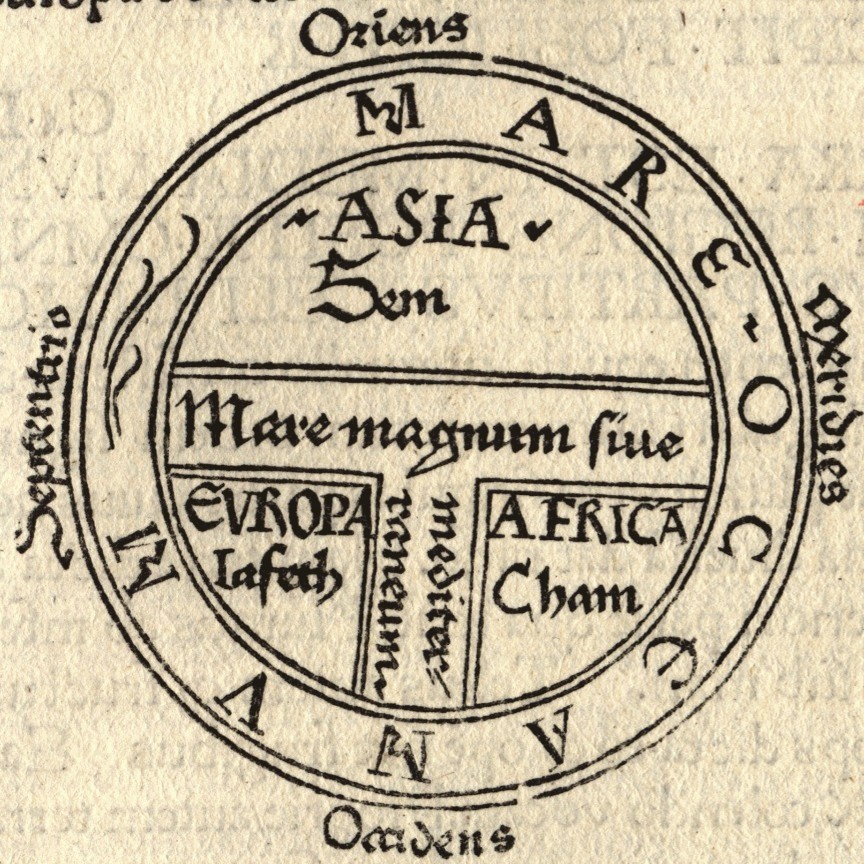
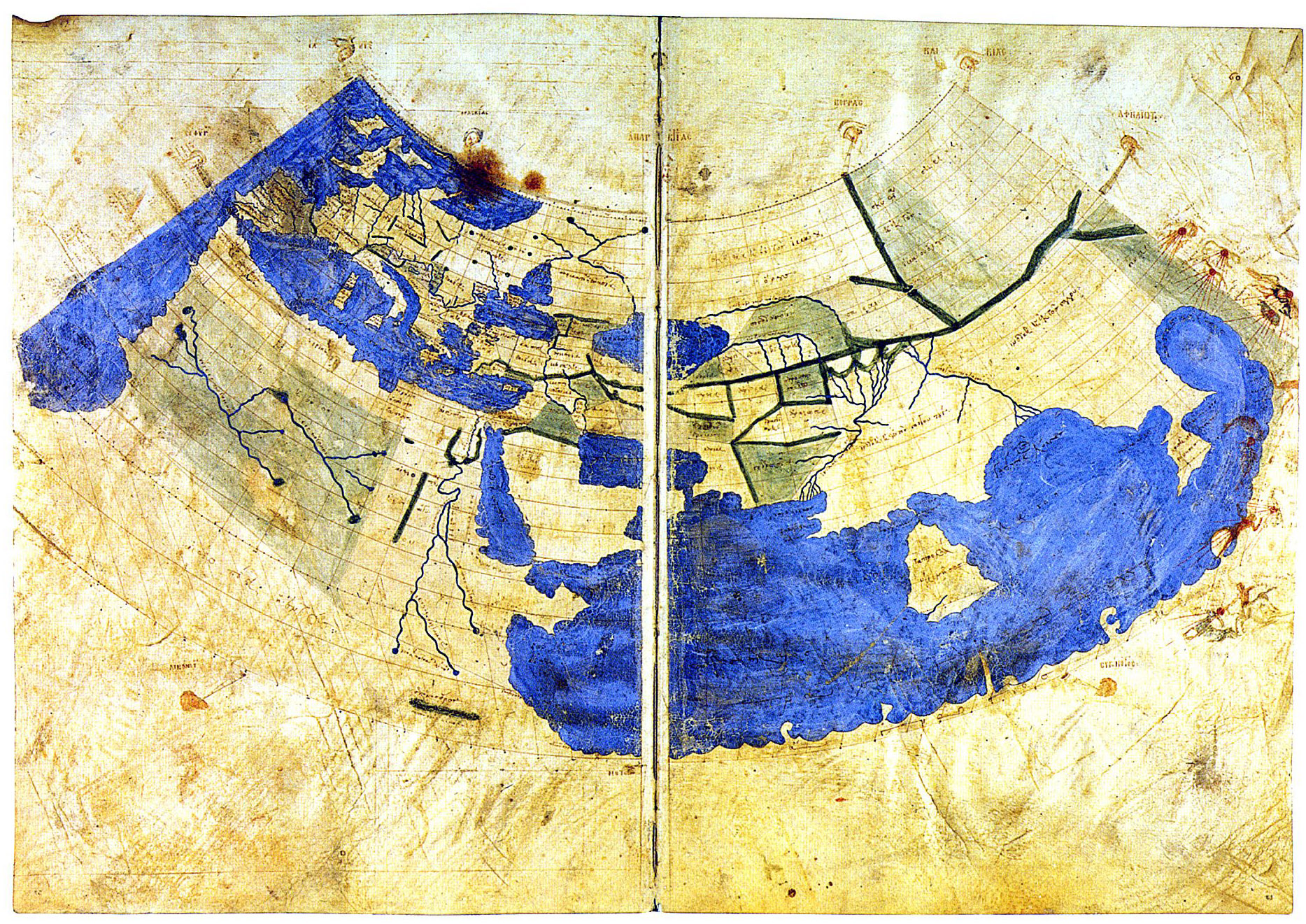
The Babylonian map is said to survive in the similar-looking “T and O map” (third image from top), representing the words orbis terrarium and originating from descriptions in 7th century C.E. Spanish scholar Isadora of Seville’s Etymologiae. The “T” is the Mediterranean and the “O” the ocean. In the version above, a recreation of an 8th century drawing, and every derivation thereafter, we see the three known continents, Asia, Europe, and Africa, with the holy city, Jerusalem, at the center. This map greatly informed early Medieval conceptions of the world, from crusaders to garrulous knights errant like Mandeville, and raconteur merchants like Polo, both of whom made quite an impression on Columbus and Raleigh, as did the circa 1300 map from Constantinople above, the oldest of many drawn from the thousands of coordinates in Roman geographer and astronomer Ptolemy’s Geographia.
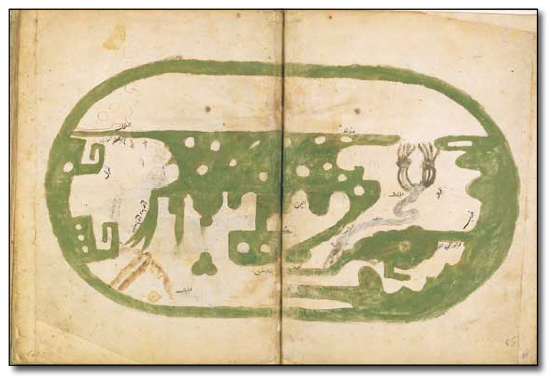
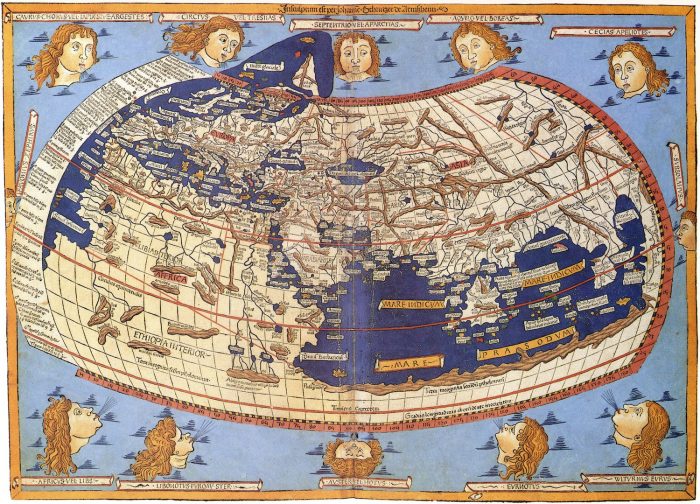
It wouldn’t be until 100 years after the translation of Ptolemy’s text from Greek to Latin in 1407 that his geographical precision became widely known. Until this, “all knowledge of these co-ordinates had been lost in the West,” writes the British Library. This would not be so in the East, however, where world maps like Ibn Hawqal’s, above from 980 C.E., show the influence of Ptolemy, already so long dominant in geography in the Islamic world that it was beginning to wane. Many more world maps survive from 11–12th century Britain, Turkey, and Sicily, from 16th century Korea, and from that wandering age of Columbus and Raleigh, beginning to increasingly resemble the world maps we’re familiar with today. (See a 15th century reconstruction of Ptolemy’s geography below.)
For most of recorded history, knowledge of the world from any one place in it was almost wholly or partly speculative and imaginative, often peopled with monsters and wonders. “All cultures have always believed that the map they valorize is real and true and objective and transparent,” as Jerry Brotton Professor at Queen Mary University of London tells Uri Friedman at The Atlantic. Columbus believed in his speculative maps, even when he ran into islands off the coast of continents charted on none of them. We are still conceptual prisoners—or consumers, users, readers, viewers, audiences—of maps, though we’ve physically plotted every corner of the globe. Perspectives cannot be rendered objective. No gods-eye views exist.
Nonetheless, several culturally formative projections of the world since Ptolemy’s Geography and well before it have changed the whole world, pointing to the power of human imagination and the legendarily imaginative, as well as legendarily brutal, acts of “world building” in real life.
The Open Culture audience, by my estimation, divides into two basic groups: those who’ve read the collected works of the likes of Simone de Beauvoir, Michel Foucault, and Plato, and those who’d like to. Whichever body of oft-referenced ideas you’ve been wanting to dig deep into yourself, getting a brief, concept-distilling primer beforehand can make the task easier, improving your understanding and ability to contextualize the original texts when you get around to them. Online education company Macat has produced 138 such primers in the form of animated videos freely available on YouTube which can put you in the right frame of mind to study a variety of ideas in literature, economics, sociology, politics, history, and philosophy.
De Beauvoir, in Macat’s analysis, argued in The Second Sex that “the views of individuals are socially and culturally produced. Femininity is not inherent,” but a societal mechanism long used “to keep men dominant.”
According to their video on Foucault’s Discipline and Punish, that famous book “explores the evolution of power since the Middle Ages,” culminating in the argument that “modern states have moved away from exploring their authority physically to enforcing it psychologically,” a phenomenon exemplified as much by late 18th- and early 19th-century philosopher Jeremy Bentham’s Panopticon as by modern closed-circuit television urban omni-surveillance (a technology now spread far beyond the infamously CCTV-zealous London all the way to Seoul, where I live). In The Republic, Plato asks more basic questions about society: “What would an ideal state look like, and how would it work?”
For that ancient Greek, says the video’s narrator, “the ideal society offered the guarantee of justice and would be ruled over not by a tyrant, but by an all-powerful philosopher-king.” Whether or not that strikes you as an appealing prospect, or indeed whether you agree with de Beauvoir and Foucault’s bold propositions, you stand to sharpen your mind by engaging with these and other influential ideas, including (as covered in Macat’s other three- to four-minute analyses) those of Machiavelli, David Hume, Edward Said, and Thomas Piketty. “Critical thinking is about to become one of the most in-demand set of skills in the global jobs market,” insists Macat’s marketing. “Are you ready?” Whether or not you’ll ever reference these thinkers on the job, preparing yourself to read them with an active mind will put you on the fast track to the examined life.
A couple days ago, a visually compelling thread on Twitter exploded with thousands of shares and likes and dozens of users submitting their own contributions. The thread (a series of connected tweets for the Twitter uninitiated) has become an evolving photo essay of women activists standing up to walls of militarized riot police and mobs of angry bigots. The photos feature subjects like Tess Asplund, Leshia Evans, and Saffiyah Khan, and historical inspirations like Gloria Richardson and Bernadette Devlin. Many of the subjects are unknown or unnamed, but no less iconic. These images, from all over the world, of women standing defiantly and often alone, against heavily armed and armored, mostly male power structures inspire and, in the case of children like Ruby Bridges, can break your heart.
Photos like these serve as powerful and necessary testaments to the fact that in social movements throughout history, women have held the front lines. And photographers have captured their activist spirit since the early days of the medium. In the 19th century, long exposures and fragile, finicky equipment made action shots difficult-to-impossible, and for a variety of cultural reasons, many women were far less likely to confront armed men on the streets. Therefore, the portraits of women activists from the time tend toward traditional seated poses. But as famous photographs of Harriet Tubman and Sojourner Truth demonstrate, these images do not show us passive observers of history.
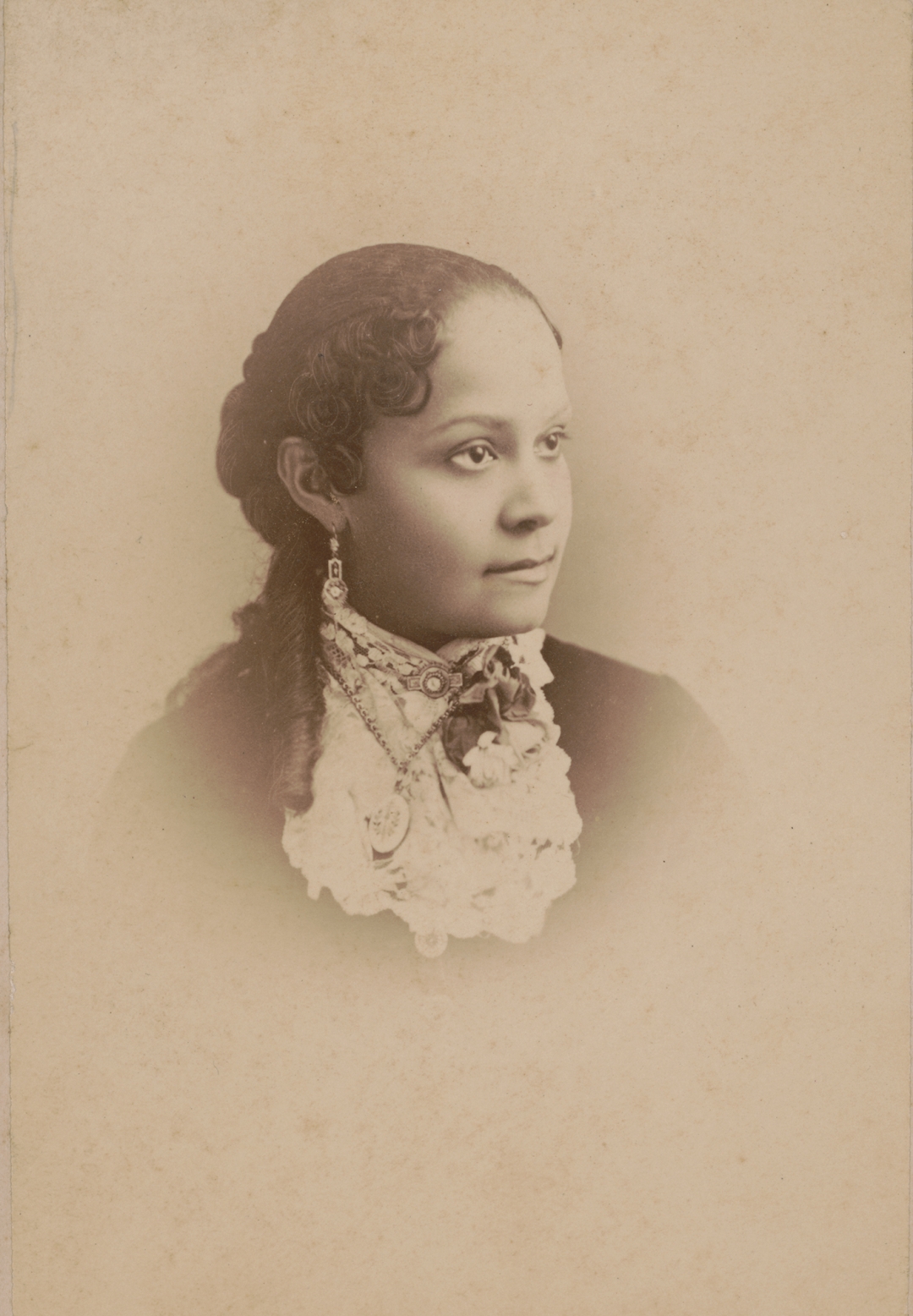
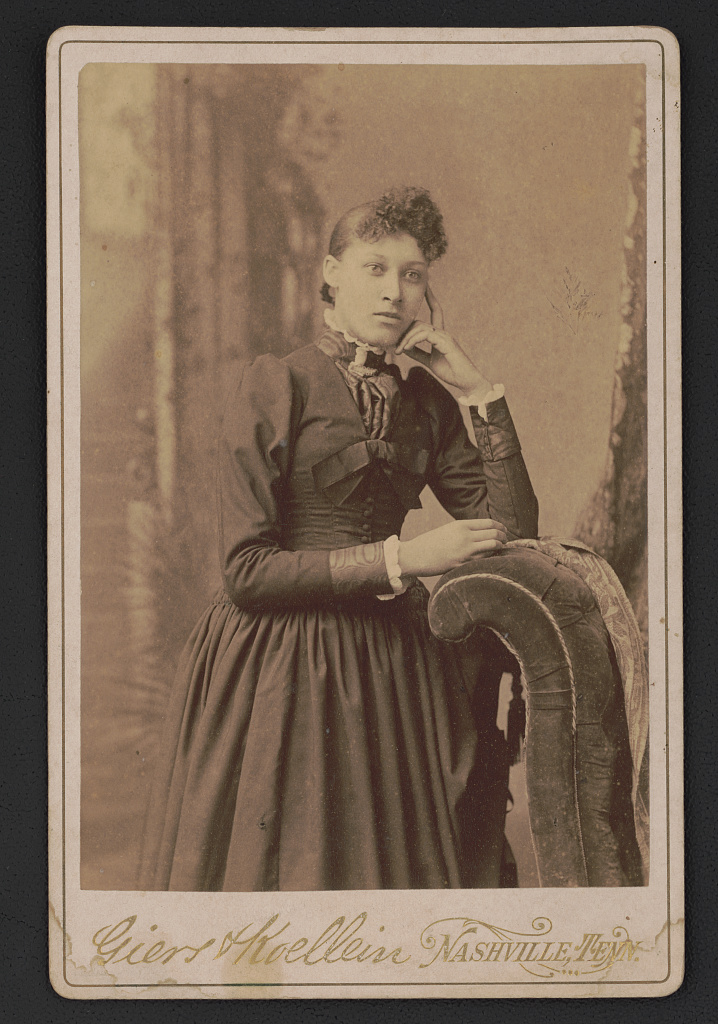
Pictures of Tubman and Truth have made their way into every elementary school history textbook. Far less well-known are the many other African-American women activists of the late-nineteenth and early twentieth centuries who fought for the rights of black Americans in education, at the voting booth, and everywhere else. During Reconstruction especially, many such activists rose to prominence in academia, journalism, and civic leadership. Women like Fannie Barrier Williams, at the top, whose wise, direct gaze illustrates her fearlessness as an educational reformer and suffragist, who, despite her maiden name, broke several barriers for black women in higher education and prominent public events like the 1893 Columbian Exposition. Against paternalistic claims that former slaves weren’t ready for citizenship, writes the Rochester Regional Library Council, Williams “called on all women to unite and claim their inalienable rights.”
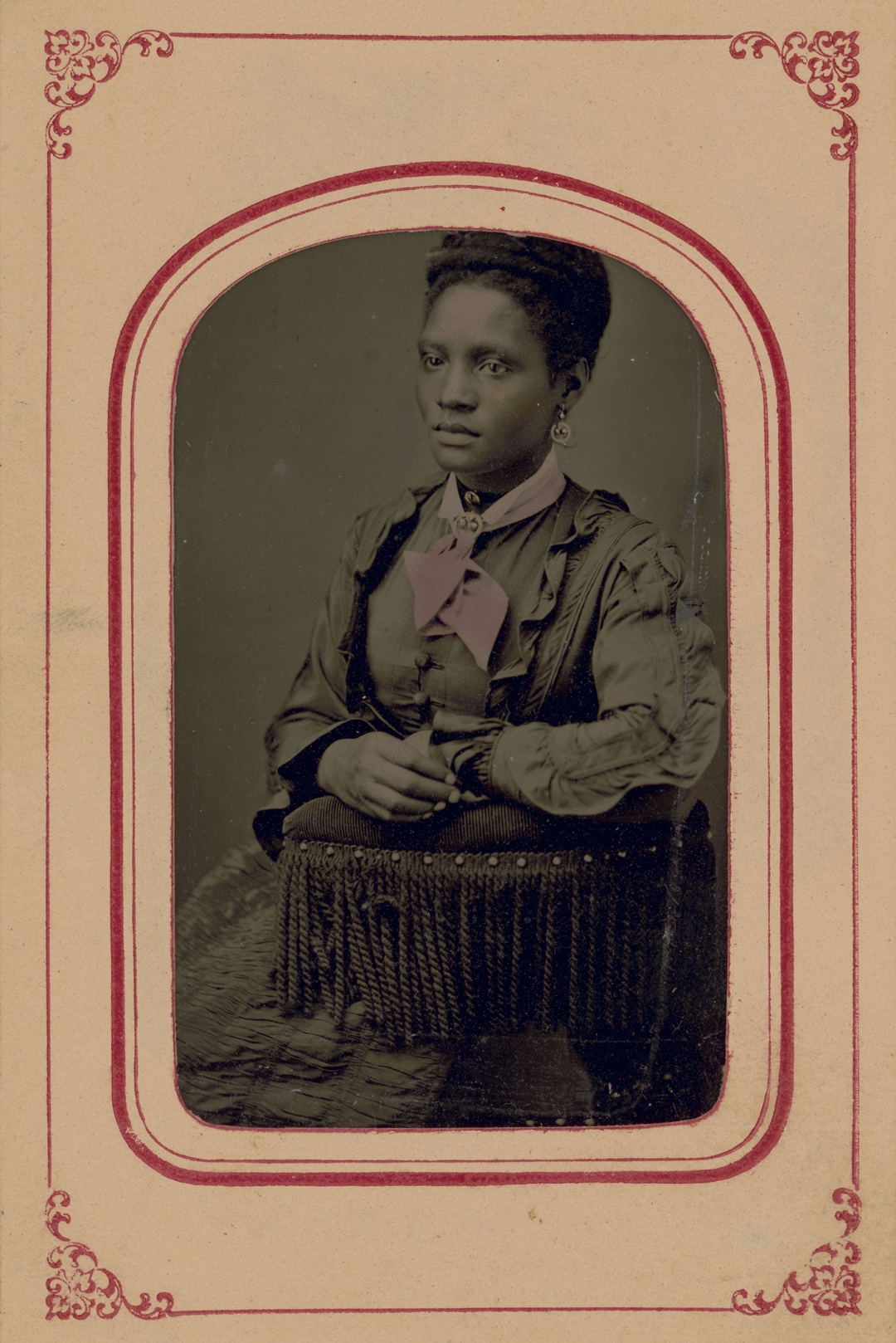
Above, we see Laura A. Moore Westbrook. Of the first generation to grow up after slavery, Westbrook received a master’s degree in 1880, the only woman in a class of four. She went on to teach and fight fiercely for formerly enslaved students in Texas, earning admiration, as Monroe Alphus Majors wrote in 1893, “in conspicuous instances and under very flattering circumstances” from contemporaries like Frederick Douglass. Majors’ characterization will sound patronizing to our ears, but in the rigid terms of the time, it offers nearly as vivid a portrait as her photograph: “Her motive to do good far surpasses her vanity, except when her race is attacked, then, manlike, she with the pen strikes back, and even goes beyond her loyalty to serve, but makes lasting impressions upon those who are so unfortunate to get within her range.”
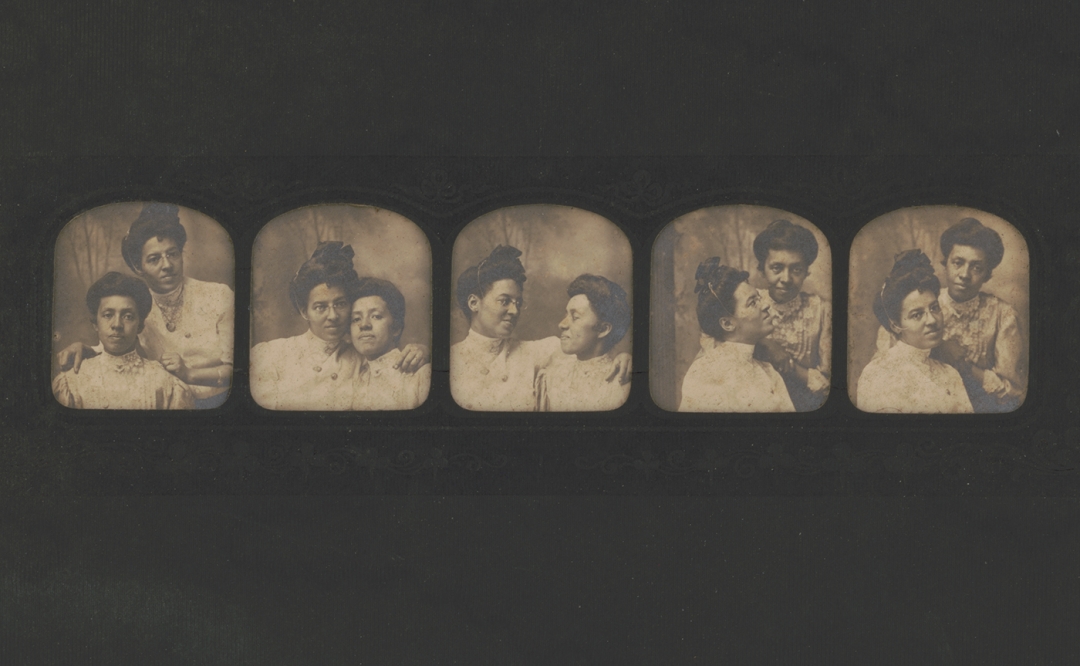
These images come from a Library of Congress archive of nineteenth-century African American activists from the collection of William Henry Richards, a professor at Howard University Law School from 1890 to 1928 and a staunch campaigner for civil rights and liberties. Most of the portraits are of the formal, staged variety, but we also have the more relaxed, even playful series of poses from activists Elizabeth Brooks and Emma Hackley, above. Richards’ collection, writes curator Beverly Brannon at the LoC site, includes many “people who joined him and others working in the suffrage and temperance movements and in education, journalism and the arts.” The photographs “show the women at earlier ages than most portraits previously available of them online.”
These portraits date from a time, notes Allison Meier at Hyperallergic, when “rights and opportunities for African Americans, especially women, remained severely limited.” Many “obscure black women writers,” journalists, and teachers “await their biographers,” argues Jonathan Daniel Wells, and perhaps the rediscovery of these photographs will prompt historians to reconsider their prominence. While they did not physically stand up to armed mobs or police battalions, these activists, writes Meier, “spoke out boldly against gender inequality, while at the same time remaining cognizant that especially in the so-called New South, racism, violence and murder were ever-present dangers for African American women and men.”
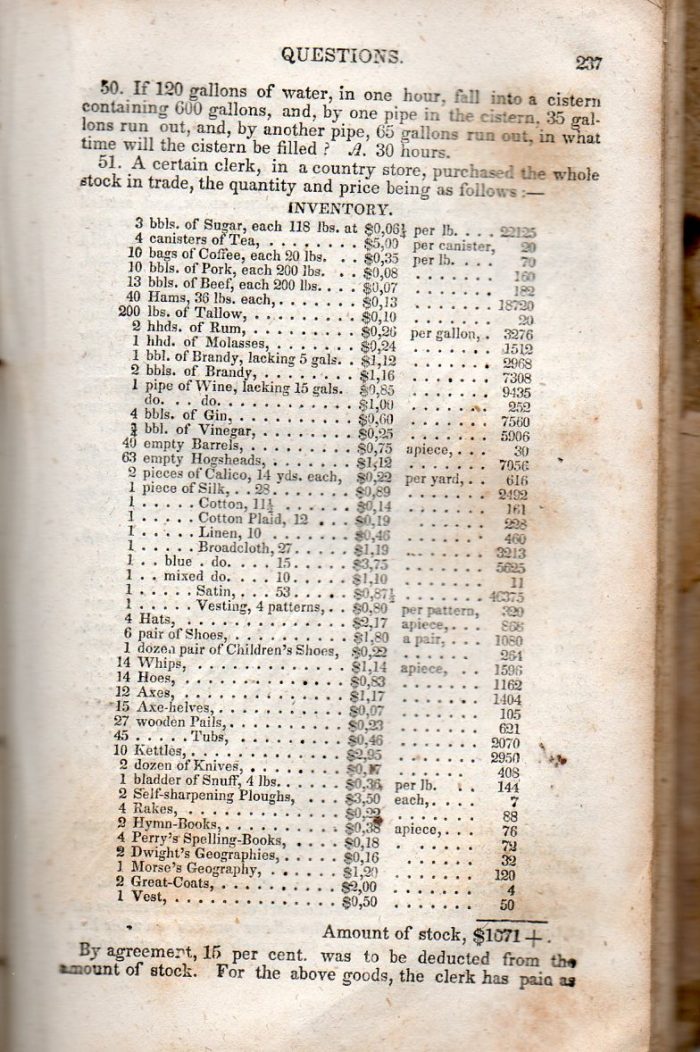
Coffee, 35 cents per pound. A self-sharpening plough, $3.50. A whip, a buck fourteen. And a gallon of gin, 60 cents, which was “about two-thirds of a day’s wages for the average non-farm white male worker.” (View the prices in a larger format here.)
But I’m less intrigued by the wholesale price of the various items Smith’s hypothetical country storekeeper would pay to stock his shelves in 1836, though I do love a bargain.
It’s more the type of goods listed on that inventory. They’re exactly the sort of items that figure in one of the most memorable chapters of Little House on the Prairie—“Mr Edwards Meets Santa Claus.”
Okay, so maybe not exactly the same. Author Laura Ingalls Wilder was pretty explicit about the simple pleasures of her 1870s and 80s childhood. Her family’s bachelor neighbor, Mr. Edwards, risked life and limb fording a near-impassable, late-December creek, a bundle containing his clothes, a couple of tin cups, some peppermint sticks, and two heart-shaped cakes, tied to his head. Without his kindly initiative, their stockings would have been empty that year.
Presumably, the Independence, Kansas general store where Neighbor Edwards did his Christmas shopping would’ve stocked a lot of the same merch’ that Smith alludes to in the above fragment of a bookkeeping-related story problem. Online bookseller John Ptak, on whose blog the page was originally reproduced, is keeping page 238 close to the vest (coincidentally the last item to be mentioned on the inventory, almost as an afterthought, just one, priced at 50¢.)
Childhood recollections aside, perhaps there was something else in Mr. Edward’s bundle, something the adult Laura chose not to mention. The sort of hostess gift that could’ve warmed Pa and Ma on those long, cold frontier nights…
Some gin, perhaps…or wine? Rum? Brandy?
Smith’s shopkeeper would’ve been well provisioned, laying the stuff in by the barrel, hogshead, and pipe-full.
As for that “bladder” of snuff, a post on the Snuffhouse forum suggests that it wasn’t a euphemism, but the actual bladder of a hog, paced with 4 pounds of snortin’ tobacco.
Of course, Smith’s shopkeeper would’ve also carried a healthy assortment of wholesome goods- hymnals, children’s shoes, calico, satin, whips…
The robots, as we all know, are coming for our jobs. We might regard that particular anxiety as distinctive of the digital age, but the idea of machines that perform what we’ve long considered specifically human tasks has a long history — as does the reality of those machines. The BBC video above offers a look at “The Writer,” which the New York Times’ Sonia Kolesnikov-Jessop describes as an “early humanoid robot of carved wood” who, “seated at a small mahogany table, could write on paper using a goosefeather quill.” The date of this impressive curiosity’s creation? The decidedly pre-digital year of 1768. The Writer has at his core a system of intricate clockwork, and so it stands to reason that its inventor Pierre Jaquet-Droz spent his career as a Swiss watchmaker.
“In the following years, working with the help of his son, Henri-Louis Jaquet-Droz, and his fellow clockmaker Jean-Frédéric Leschot,” writes Kolesnikov-Jessop, “he also created The Musician, a mechanical young woman who could play five tunes on an organ, and The Draughtsman, a ‘child’ able to draw four separate images including that of a dog and a portrait of a man.”
But The Writer, with its ability to dip its quill in ink, its moving eyes, and the wheel that makes it “programmable” to write any short message, remains both Jaquet-Droz’s most intricate and most important mechanical achievement. You can see more pieces of his work, automatons and otherwise, put into context in the short film just above, a production of the Jaquet Droz luxury watch brand still in existence today.
Upon hearing word of such “automatons,” other inventors followed suit. Artificial writing remained a goal: more than forty years after The Writer, for instance, Henri Maillardet built one capable of “hand”-reproducing four drawings and three poems stored in its “brass memory.” But other automaton-builders had chosen to widen the field of mechanical capabilities: in 1784, the famed German cabinetmaker David Roentgen presented to King Louis XVI a dulcimer-playing automaton modeled after Queen Marie Antoinette. While the Queen thrilled to musical performances from her own miniature likeness, automata made another kind of progress on the other side of the world in Japan, a land that had almost no contact with the West until the mid-18th century but whose traditions of craft stretch even deeper into history than Europe’s.
You can witness in the video just above an unboxing, operation, and internal examination of the best-known such Japanese karakuri, a spring-powered archer that can load arrows into its bow and fire away. Its creator Tanaka Hisashige, also known as “the Thomas Edison of Japan,” built a fair few of these clockwork amusements that still impress today, but also many more useful things, including a pneumatic fire pump, a universal clock, and the first Japanese steam locomotive and warship. His company Tanaka Engineering Works, founded in 1875, would later evolve into the electronics firm called Toshiba — developers of Aiko Chihira, who in 2015 became the world’s first robotic department-store employee. Retail is one thing, but will her even more advanced descendants find it in themselves to pick up the quill, the dulcimer hammers, or the bow and arrow?
This year’s Women’s History Month theme is “Honoring Trailblazing Women in Labor and Business.” Before these lionesses are hustled offstage in order for us to refocus our attentions on Asian/Pacific Americans, Jewish-Americans, Autism Awareness, Multiple Births, Sexually Transmitted Disease Education, pecans and the myriad other calendar girls and boys that April brings, let’s join video essayist Catherine Stratton in celebrating the achievements of filmmaker Alice Guy-Blaché, above.
While not an officially recognized honoree, Guy-Blaché, who made over 1,000 films over two decades, definitely qualifies as a trailblazing woman.
At age 21, she became the first female director in cinema history with The Cabbage Fairy, below, a whimsical, if not particularly accurate vision of where babies come from. (It was shot in 1896, long before rules limiting the amount of time a newborn actor can spend on set, but only a handful of years before nurse Margaret Sanger took up the cause of women’s reproductive health.)
She tackled the Life of Christ with a passel of animals, special effects, and 300 extras.
She popped viewers eyes with candy-colored hand tinting.
She built a state-of-the-art film studio in Fort Lee, New Jersey, pruning the terrain to serve as a variety of landscapes.
Viewed from the lens of 2017, one of her most startling achievements is 1912’s A Fool and His Money, an excerpt of which is below. The tale itself is an unremarkable crowdpleaser: a poor guy falls in love with a wealthy young woman. He goes to great lengths to woo her, outfitting himself with fancy duds and throwing a huge party, only to be bested by a flashy rival.
What is remarkable is that Guy-Blaché was white and the film’s cast is entirely African-American. According to essayist Stratton, the characters are portrayed with none of the explicit racism DW Griffith brought to The Birth of a Nationthree years later.
As Amy Poehler’s Smart Girls site reports, Guy-Blaché passed from the public view after an expensive divorce from her philandering husband forced her to sell her studio. She struggled to gain public recognition for her pioneering contributions to film history with little success. A Fool and His Money was rediscovered when a flea market shopper bought a musty chest of old, unmarked reels.
Like that film, her reputation is slowly being restored to its former glory. She was awarded France’s Legion of Honor in 1955 and a Director’s Guild of America Lifetime Achievement Award in 2012.
We're hoping to rely on loyal readers, rather than erratic ads. Please click the Donate button and support Open Culture. You can use Paypal, Venmo, Patreon, even Crypto! We thank you!
Open Culture scours the web for the best educational media. We find the free courses and audio books you need, the language lessons & educational videos you want, and plenty of enlightenment in between.