If you want to study another language, by all means feel free to study such widely spoken ones as English, Spanish, and Chinese. But obscurity, as we all learn at one point or another growing up, also has an appeal, though we often need someone cool to give us a hint as to which obscurities to pursue. One “cowboy professor” has, since the videos he posts to Youtube have begun to gain popularity, emerged as the cool guy who may well turn a generation of scholars-to-be on to the study of Old Norse. Though he holds an academic position at the University of California, Berkeley, “Wyoming’s Dr. Jackson Crawford,” as he refers to himself, seems to spend at least part of his time in what he describes as “the Wilderness of the American West.”
He also shoots his videos out there, an appropriately sublime backdrop for the discussion of the mechanics of the Old Norse language, originally spoken by the Scandinavians of the 9th through the 13h centuries, and the myth and poetry composed in it.
Here we have three of Crawford’s videos meant to address questions of general curiosity about Old Norse: what the language sounded like, and, in twoparts, how best to pronounce the names of the various gods, places, and other elements of its mythology, from Óðinn (whom you might have seen referred to as Odin) to Valhǫll (Valhalla) to Ásgarðr (Asgard).
Jackson also gives readings from the 13th-century Poetic Edda, arguably the most influential piece of Scandinavian literature ever written, and one which he recently translated into modern English. Perhaps a sample:
Þagalt ok hugalt
skyli þjóðans barn,
ok vígdjarft vera.
Glaðr ok reifr
skyli gumna hverr,
unz sinn bíðr bana.
A noble man should
be silent, thoughtful,
and bold in battle.
But every man should also
be cheerful and happy,
till the inevitable day of death.
On Friday, a person who has insulted, demeaned, and threatened tens of millions of the country’s citizens will take the oath of office for the presidency of the United States. That’s an extraordinary thing, and the reaction will also be extraordinary—a Women’s March the following day in Washington, DC expected to draw hundreds of thousands of every gender, race, creed, and orientation. Sister marches and protests will take place in every major city on the East and West Coast and everywhere in-between, as well as internationally in cities like London, Sydney, Buenos Aires, Calgary, Barcelona, Dar es Salaam… the list goes on and on and on.
Why Women’s Marches if these events are all-inclusive? In addition to responding to the public displays of contempt for women we’ve witnessed over and over in the past year, the events intend to reaffirm the rights of all people. The organizers succinctly state that “women’s rights are human rights. We stand together, recognizing that defending the most marginalized among us is defending all of us.”
A Rawlsian progressive notion, and also a “Kingian” one, a description the march applies to its nonviolent principles. What they don’t say is that there is also significant historical precedent for the action. Over 100 years ago, another women’s march coincided with a presidential swearing-in, this time of Woodrow Wilson in March of 1913.
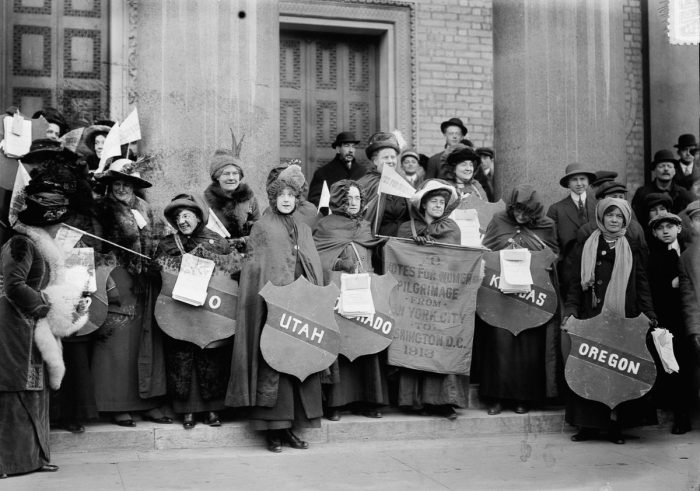
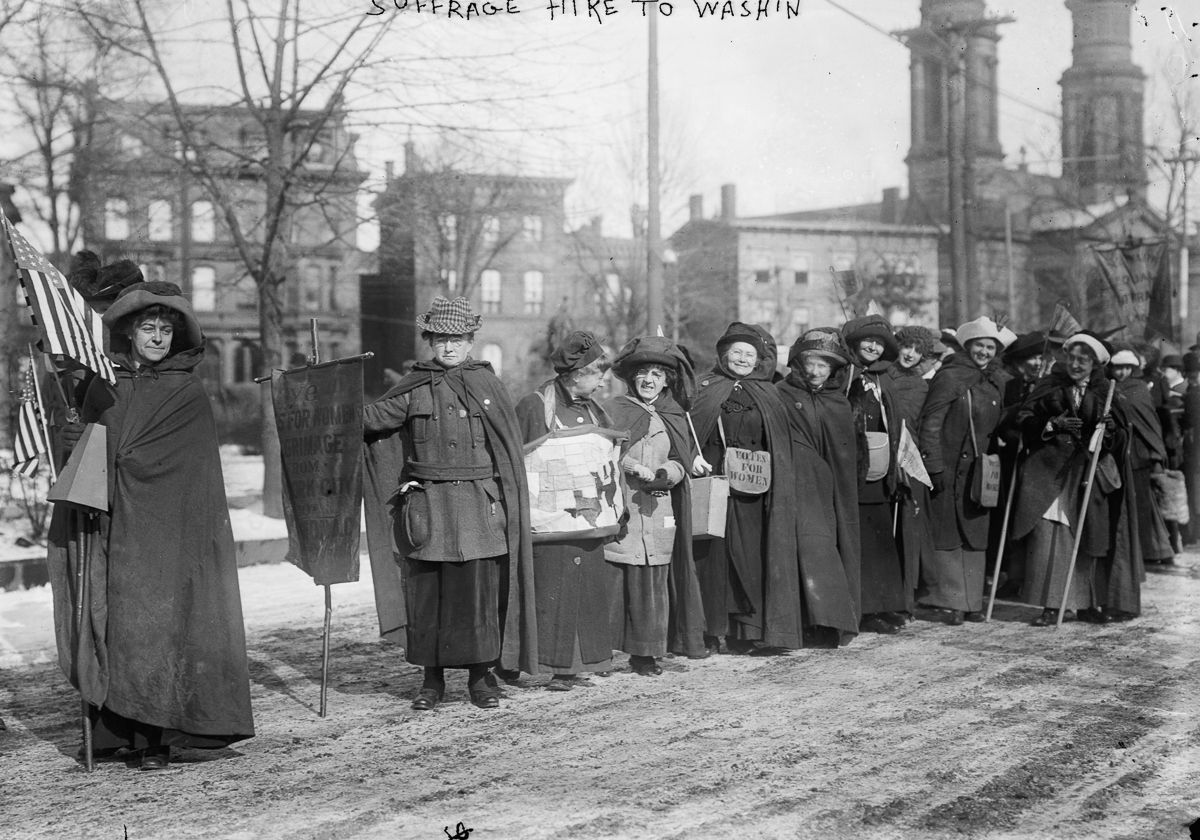
Marching for the cause of suffrage, women from around the country and the world arrived in DC on March 3rd, the day before Wilson’s inauguration. Many of those marchers had hiked 234 miles from New York in 17 days, bearing a letter to the President-elect, writes Mashable, “demanding that he make suffrage a priority of his administration and warning that the women of the nation would be watching ‘with an intense interest such as has never before been focused upon the administration of any of your predecessors.’” Organized by Alice Paul and Lucy Burns of the National American Woman Suffrage Association, the march promised, in their words, “the most conspicuous and important demonstration that has ever been attempted by suffragists in this country.”
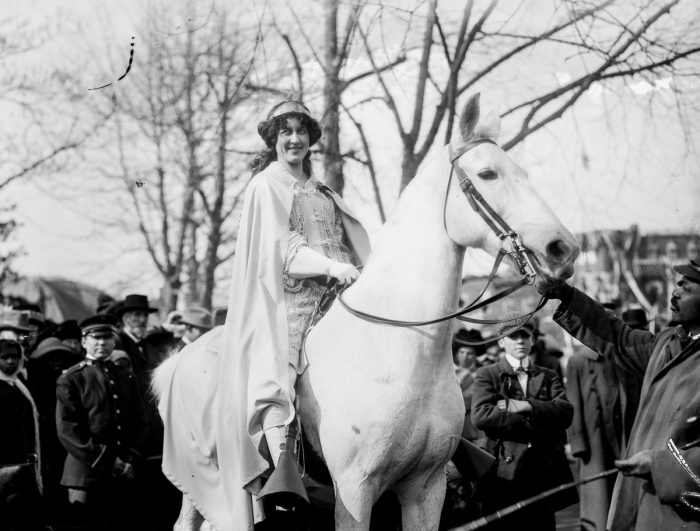
The parade was filled with pageantry. “Clad in a white cape astride a white horse,” writes the Library of Congress, “lawyer Inez Milholland led the great woman suffrage parade down Pennsylvania Avenue in the nation’s capital. Behind her stretched a long line with nine bands, four mounted brigades, three heralds, about twenty-four floats, and more than 5,000 marchers.”
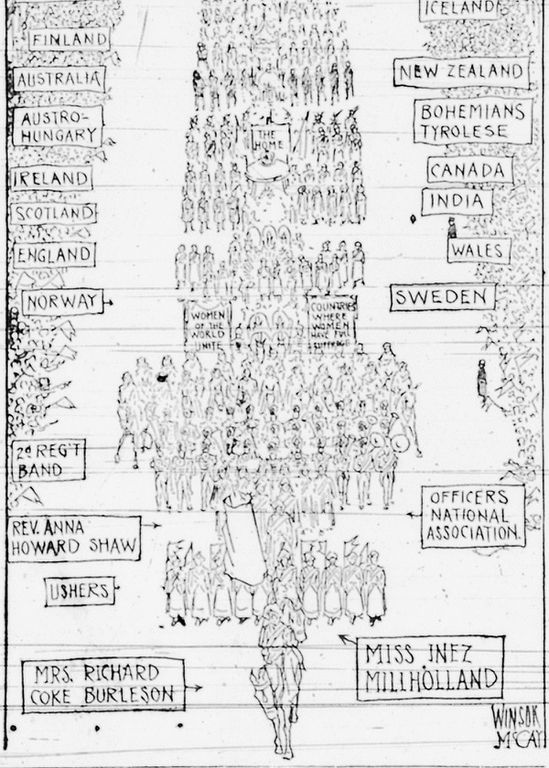
As you can see in the images here from the LoC—including the drawing of the parade route above by Little Nemo cartoonist Winsor McKay—the parade drew a huge global coalition. It also drew ridicule, harassment, and violence from groups in DC for the following day’s festivities. As the LoC writes:
[A]ll went well for the first few blocks. Soon, however, the crowds, mostly men in town for the following day’s inauguration of Woodrow Wilson, surged into the street making it almost impossible for the marchers to pass. Occasionally only a single file could move forward. Women were jeered, tripped, grabbed, shoved, and many heard “indecent epithets” and “barnyard conversation.” Instead of protecting the parade, the police “seemed to enjoy all the ribald jokes and laughter and in part participated in them.” One policeman explained that they should stay at home where they belonged.
Many marchers were injured; “two ambulances ‘came and went constantly for six hours, always impeded and at times actually opposed, so that doctor and driver literally had to fight their way to give succor.’” The event included several prominent figures, including Helen Keller, “who was unnerved by the experience.” Also present was Jeannette Rankin, who, writes Mashable, “would become the first woman elected to the House of Representatives four years later.” Nelly Bly marched, as did journalist and anti-lynching activist Ida B. Wells, “who marched with the Illinois delegation despite the complaints of some segregationist marchers.”
In fact, though the selective images suggest otherwise, the march was more inclusive than the suffragist movement is generally given credit for. Over the objections of mostly Southern delegates, many black women joined the ranks. After “telegrams and protests poured in” protesting segregation, members of the National Association of Colored Women “marched according to their State and occupation without let or hindrance,” noted the NAACP journal Crisis. And yet, when the women’s vote was finally achieved in 1920, that general category still did not include black women. The misogyny on display that day was vicious, but still perhaps not as endemic as the country’s racism, which existed in large degree within suffragist groups as well.
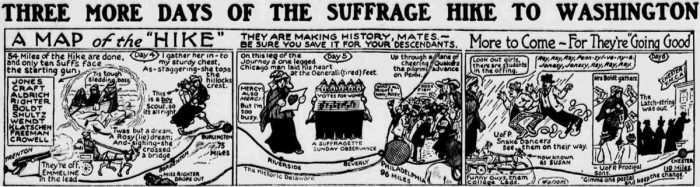
Once the press broadcast news of the marchers’ mistreatment, there was a massive public outcry that helped reinvigorate the suffrage movement. Several other artists than McKay found inspiration in the march; Cleveland Plain Dealer cartoonist James Donahey, for example, “substituted women for men in a cartoon based on the famous painting ‘Washington Crossing the Delaware,’” writes the Library of Congress. Another cartoonist, George Folsom, documented the stages of the hike from New York, with captions addressed to male readers. The strip above says, “they are making history mates—be sure you save it for your descendants.” Another strip reads “Brave women all, none braver mates. Put this away and look at it when they win.”
Materials like carbon fiber and Lucite have been making their way into classical stringed instrument design for many years, and we’ve recently seen the 3‑D printed electric violin come into being. It’s an impressive-sounding instrument, one must admit. But trained classical violinists, luthiers, music historians, and collectors all agree: the violin has never really been improved upon since around the turn of the 18th century, when two its finest makers—the Amati and Stradivari families—were at their peak. A few studies have tried to poke holes in the argument that such violins are superior in sound to modern makes. There are many reasons to view these claims with skepticism.
By the time the most expert Italian luthiers began making violins, the instrument had already more or less assumed its final shape, after the long evolution of its f‑holes into the perfect sonic conduit. However, Amati and Stradivari not only refined the violin’s curves, edges, and neck design, they also introduced new chemical processes meant to protect the wood from worms and insects.
One biochemistry professor discovered that these chemicals “had the unintended result of producing the unique sounds that have been almost impossible to duplicate in the past 400 years.”
Knowing they had hit upon a winning formula, the top makers passed their techniques down for several generations, making hundreds of violins and other instruments. A great many of these instruments survive, though a market for fakes thrives alongside them. The instruments you see in the videos here are the real thing, four of the world’s oldest and most priceless violins, all of them residing at The Metropolitan Museum of Art. These date from the late 1600s to early 1700s, and were all made in Cremona, the Northern Italian home of the great masters. At the top of the post, you can see Sean Avram Carpenter play Bach’s Sonata No. 1 in G minor on a 1669 violin made by Nicolò Amati.
The next three videos are of violins made by Antonio Stradivari, perhaps once an apprentice of Amati. Each instrument has its own nickname: “The Gould” dates from 1693 and is, writes the Met, “the only [Stradivari] in existence that has been restored to its original Baroque form.” We can see Carpenter play Bach’s Sonata in C major on this instrument further up. Both “The Gould” and the Amati violin were made before modifications to the angle of the neck created “a louder, more brilliant tone.” Above you can hear “The Francesca,” from 1694. Carpenter plays from “Liebesleid” by Fritz Kreisler with the pianist Gabriela Martinez. See if you can tell the difference in tone between this instrument and the first two, less modern designs.
The last violin featured here, “The Antonius,” made by Stradivari in 1717, gets a demonstration in front of a live audience by Eric Grossman, who plays the chaconne from Bach’s Partita No. 2 in D minor. This instrument comes from what is called Stradivari’s “Golden Period,” the years between 1700 and 1720. Some of the most highly valued of Stradivarii in private hands date from around this time. And some of these instruments have histories that may justify their staggering price tags. The Molitor Stradivarius, for example, was supposedly owned by Napoleon. But no matter the previous owner or number of millions paid, every violin created by one of these makers carries with it tremendous prestige. Is it deserved? Hearing them might make you a believer. Joseph Nagyvary, the Texas A&M professor emeritus who is discovering their secrets, tells us, “the great violin masters were making violins with more humanlike voices than any others of the time.” Or any since, most experts would agree.
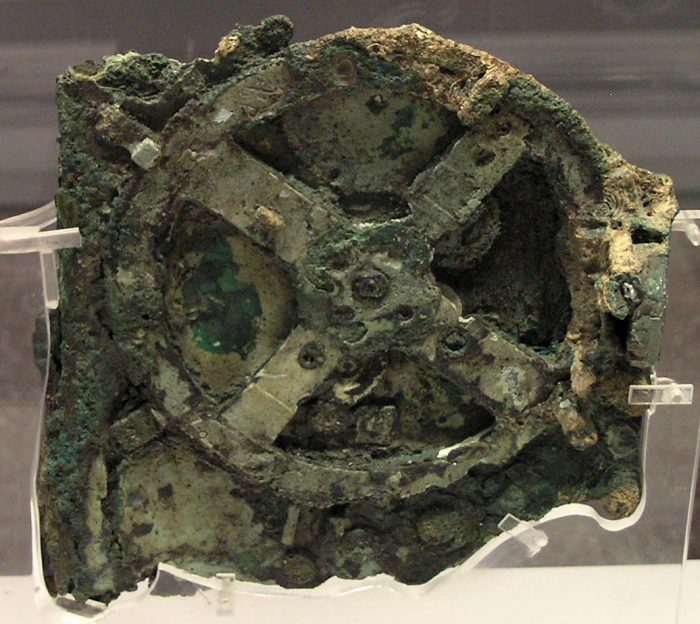
In 1900, Greek sponge divers discovered a shipwreck off the Greek island of Antikythera. The artifacts they came back up with included money, statues, pottery, and various other works of art and craft, as well as a curious lump of bronze and wood that turned out to be by far the most important item onboard. When an archaeologist named Valerios Stais took a look at it two years later, he noticed that the lump had a gear in it. Almost a half-century later, the science historian Derek J. de Solla Price thought this apparently mechanical object might merit further examination, and almost a quarter-century after that, he and the nuclear physicist Charalambos Karakalos published their discovery–made by using X‑ray and gamma-ray images of the interior–that those divers had found a kind of ancient computer.
“Understanding how the pieces fit together confirmed that the Antikythera mechanism was capable of predicting the positions of the planets with which the Greeks were familiar — Mercury, Venus, Mars, Jupiter and Saturn — as well as the sun and moon, and eclipses,” writes Big Think’s Robby Berman. “It even has a black and white stone that turns to show the phases of the moon.”
Determining how it really worked has required the building of various different models of various different kinds, one of which you can see assembled, operated, and disassembled before your very eyes in the CGI rendering at the top of the post. Its design comes from the work of historian of mechanism Michael T. Wright, who also put together the physical recreation of the Antikythera mechanism you can see him explain just above.
By its very nature, an artifact as fascinating and as incomplete as this draws all sorts of theories about the specifics of its design, purpose, and even its age. (It dates back to somewhere between 205 and 100 BC.) In 2012, Tony Freeth and Alexander Jones published their own model, different from Wright’s, of this “machine designed to predict celestial phenomena according to the sophisticated astronomical theories current in its day, the sole witness to a lost history of brilliant engineering, a conception of pure genius, one of the great wonders of the ancient world,” — but one which “didn’t really work very well.” Some of the problems has to do with the limitations of ancient Greek astronomical theory, and some with the unreliability of its layers of handmade gears.
More recent research, adds Berman, has discovered that “the device was built by more than one person on the island of Rhodes, and that it probably wasn’t the only one of its kind,” indicating that the ancient Greeks, despite the apparent deficiencies of the Antikythera mechanism itself, “were apparently even further ahead in their astronomical understanding and mechanical know-how than we’d imagined.” Now watch the video just above, in which the Apple engineer makes his own Antikythera mechanism with an entirely more modern set of components, and just imagine what the ancient Greeks could have accomplished had they developed Lego.
“Should we allow celebrities to discuss politics?” goes one variation on an evergreen headline and supposedly legitimate public debate. No amount of public disapproval could have stopped some of the most outspoken public figures, and we’d be the worse off for it in many cases. Muhammad Ali, John Lennon, Nina Simone, George Carlin, Roger Waters, Margaret Cho, and, yes, Meryl Streep—millions of people have been very grateful (and many not) for these artists’ political commentary. When it comes to scientists, however, we tend to see more baseless accusations of political speech than overwhelming evidence of it.
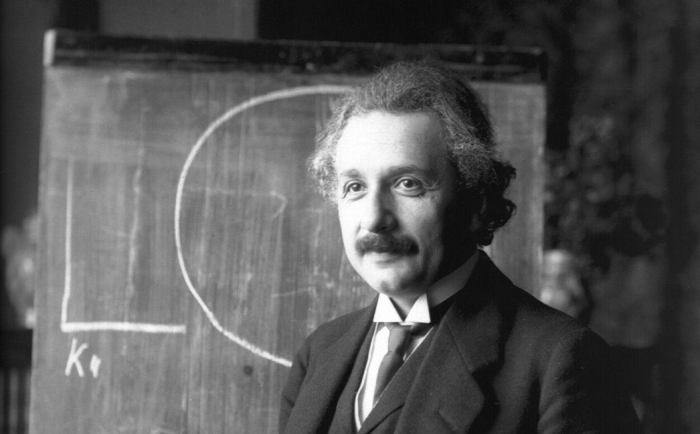
But there have been those few scientists and philosophers who were also celebrities, and who made their political views well-known without reservation. Bertrand Russell was such a person, as was Albert Einstein, who took up the causes of world peace and of racial justice in the post-war years. As we’ve previously noted, Einstein’s commitments were both philanthropic and activist, and he formed close friendships with Paul Robeson, W.E.B. Du Bois, Marian Anderson, and other prominent black leaders.
Einstein also co-chaired an anti-lynching campaign and issued a scathing condemnation of racism during a speech he gave in 1946 at the alma mater of Langston Hughes and Thurgood Marshall in which he called racism “a disease of white people.” That same year, notes On Being’s executive editor Trent Gilliss, Einstein “penned one of his most articulate and eloquent essays advocating for the civil rights of black people in America.” Titled “The Negro Question” and published in the January 1946 edition of Pageant magazine, the essay, writes Gilliss, “was intended to address a primarily white readership.”
Einstein begins by answering the inevitable objection, “What right has he to speak about things which concern us alone, and which no newcomer should touch?” To this, the famed physicist answers, “I do not think such a standpoint is justified.” Einstein believed he had a unique perspective: “One who has grown up in an environment takes much for granted. On the other hand, one who has come to this country as a mature person may have a keen eye for everything peculiar and characteristic.” Speaking freely about his observations, Einstein felt “he may perhaps prove himself useful.”
Then, after praising the country’s “democratic trait” and its citizens’ “healthy self-confidence and natural respect for the dignity of one’s fellow-man,” he plainly observes that this “sense of equality and human dignity is mainly limited to men of white skins.” Anticipating a casually racist defense of “natural” differences, Einstein replies:
I am firmly convinced that whoever believes this suffers from a fatal misconception. Your ancestors dragged these black people from their homes by force; and in the white man’s quest for wealth and an easy life they have been ruthlessly suppressed and exploited, degraded into slavery. The modern prejudice against Negroes is the result of the desire to maintain this unworthy condition.
The ancient Greeks also had slaves. They were not Negroes but white men who had been taken captive in war. There could be no talk of racial differences. And yet Aristotle, one of the great Greek philosophers, declared slaves inferior beings who were justly subdued and deprived of their liberty. It is clear that he was enmeshed in a traditional prejudice from which, despite his extraordinary intellect, he could not free himself.
Like the ancient Greeks, Americans’ prejudices are “conditioned by opinions and emotions which we unconsciously absorb as children from our environment.” And racist attitudes are both causes and effects of economic exploitation, learned behaviors that emerge from historical circumstances, yet we “rarely reflect” how powerful the influence of tradition is “upon our conduct and convictions.” The situation can be remedied, Einstein believed, though not “quickly healed.” The “man of good will,” he wrote, “must have the courage to set an example by word and deed, and must watch lest his children become influenced by this racial bias.”
Classical music enthusiasts seem to agree that the renewal of interest in period instruments made for a noticeable change in the sound of most, if not all, orchestral performances. But doesn’t the replication and use of viols, ophicleides, and fortepianos from the times of Bach, Beethoven, and Mozart raise a curiosity about what people used to make music generations before them, and generations before that? How early can we get into early music and still find tools to use in the 21st century? Since the end of the 20th, we’ve had the same answer: about nine millennia.
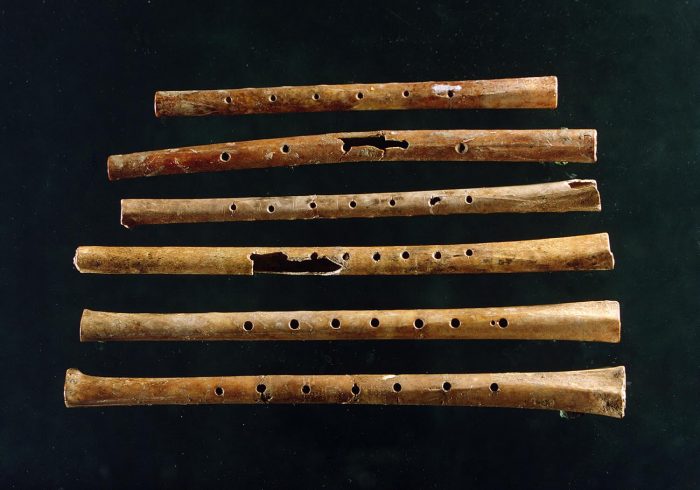
“Chinese archeologists have unearthed what is believed to be the oldest known playable musical instrument,” wrote Henry Fountain in a 1999 New York Times article on the discovery of “a seven-holed flute fashioned 9,000 years ago from the hollow wing bone of a large bird.”
Those holes “produced a rough scale covering a modern octave, beginning close to the second A above middle C,” and the fact of this “carefully selected tone scale indicates that the Neolithic musicians may have been able to play more than single notes, but actual music.”
You can hear the haunting sounds of this oldest playable musical instrument known to man in the clip above. When would those prehistoric humans have heard it themselves? Fountain quotes ethnomusicologist Frederick Lau as saying that these flutes “almost certainly were used in rituals,” perhaps “at temple fairs, burials and other ritualistic events,” and possibly even for “for personal entertainment.” 9,000 years ago, one surely took one’s entertainment where one could find it.
If this listening experience has given you a taste for the real oldies — not just the AM-radio but the history-of-mankind sense — you can also hear in our archive the 43,000-year-old “Neanderthal flute” (found only in fragments, but reconstructed) as well as such ancient songs as 100 BC’s “Seikilos Epitaph,” a composition by Euripides from a century before that, and a 3,400-year-old Sumerian hymn known as the oldest song in the world, all of which raises an important question: what will the people of the year 11000 think when they unearth our DJ rigs, those artifacts of so many of our own ritualistic events, and give them a spin?
In 1968, both Robert F. Kennedy and Martin Luther King, Jr. were assassinated, and U.S. cities erupted in riots; anti-war demonstrators chanted “the whole world is watching” as police beat and tear-gassed them in Chicago outside the Democratic convention. George Wallace led a popular political movement of Klan sympathizers and White Citizens Councils in a vicious backlash against the gains of the Civil Rights movement; and the vengeful, paranoid Richard Nixon was elected president and began to intensify the war in Vietnam and pursue his program of harassment and imprisonment of black Americans and anti-war activists through Hoover’s FBI (and later the bogus “war on drugs”).
Good times, and given several pertinent similarities to our current moment, it seems like a year to revisit if we want to see recent examples of organized, determined resistance by a very beleaguered Left. We might look to the Black Panthers, the Yippies, or Students for a Democratic Society, to name a few prominent and occasionally affiliated groups. But we can also revisit a near-revolution across the ocean, when French students and workers took to the Paris streets and almost provoked a civil war against the government of authoritarian president Charles de Gaulle. The events often referred to simply as Mai 68 have haunted French conservatives ever since, such that president Nicolas Sarkozy forty years later claimed their memory “must be liquidated.”
May 1968, wrote Steven Erlanger on the 40th anniversary, was “a holy moment of liberation for many, when youth coalesced, the workers listened and the semi-royal French government of de Gaulle took fright.” As loose coalitions in the U.S. pushed back against their government on multiple fronts, the Paris uprising (“revolution” or “riot,” depending on who writes the history) brought together several groups in common purpose who would have otherwise never have broken bread: “a crazy array of leftist groups,” students, and ordinary working people, writes Peter Steinfels, including “revisionist socialists, Trotskyists, Maoists, anarchists, surrealists and Marxists. They were anticommunist as much as anticapitalist. Some appeared anti-industrial, anti-institutional, even anti-rational.”
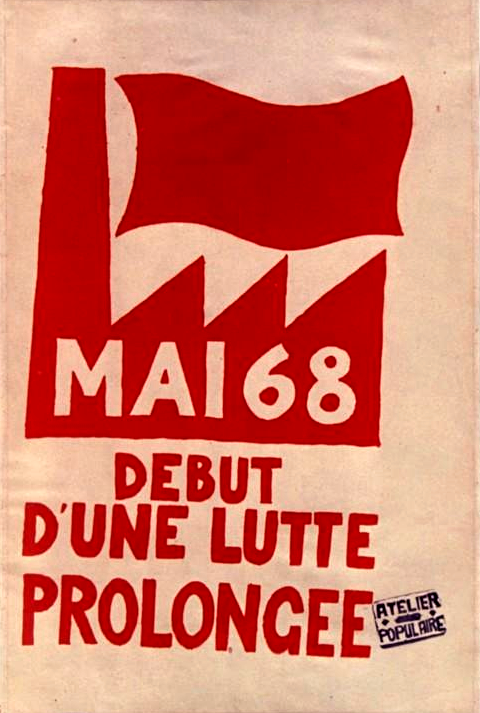
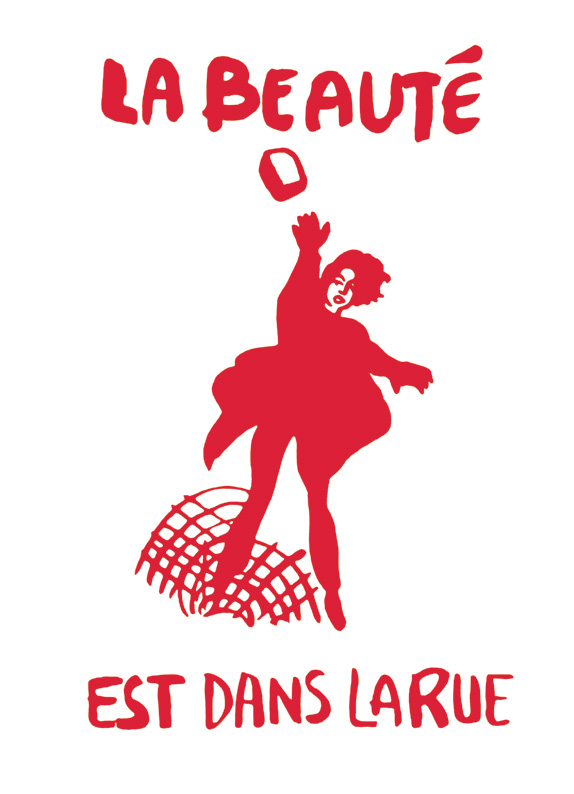
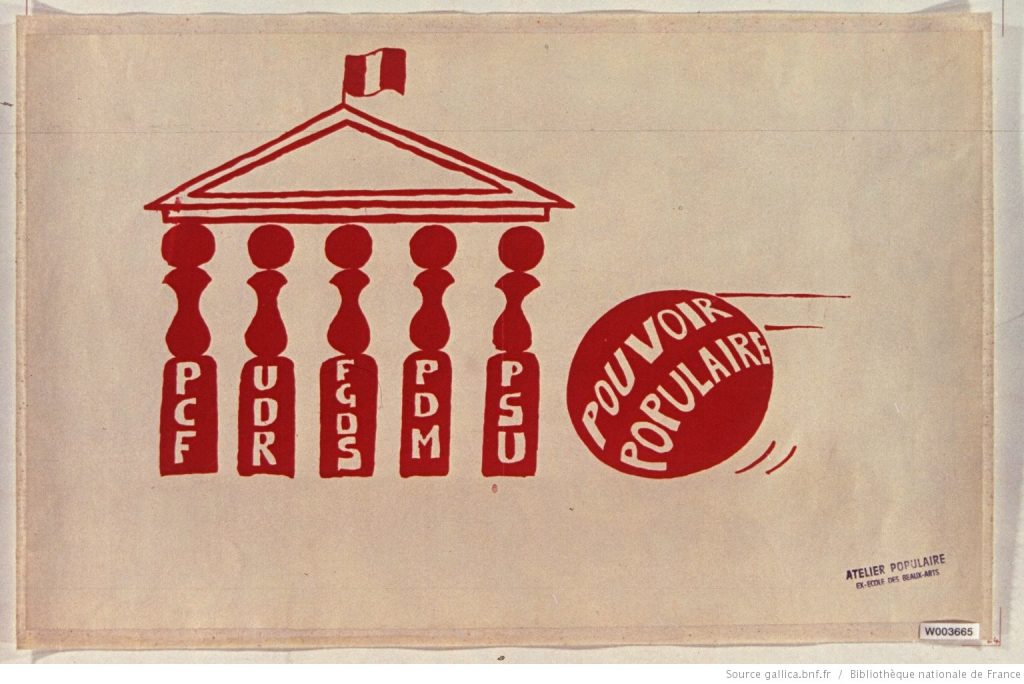
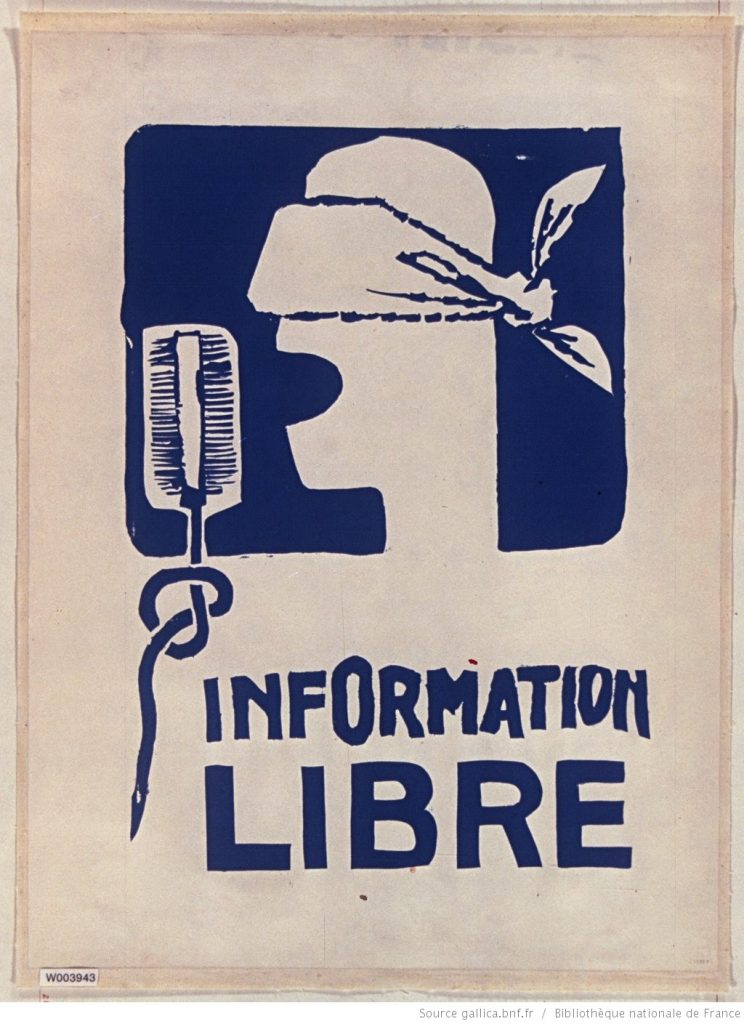
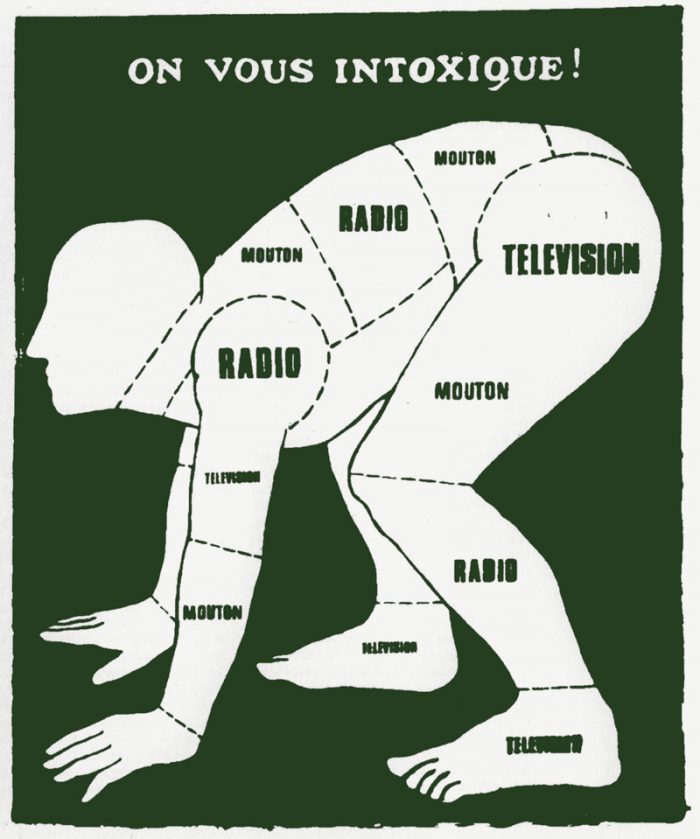
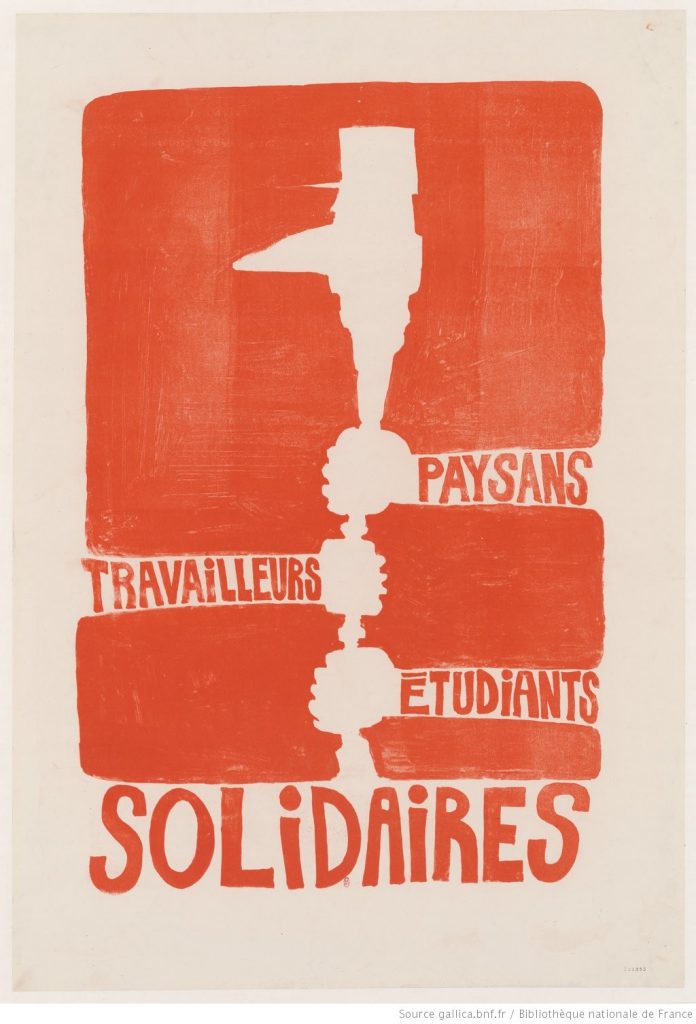
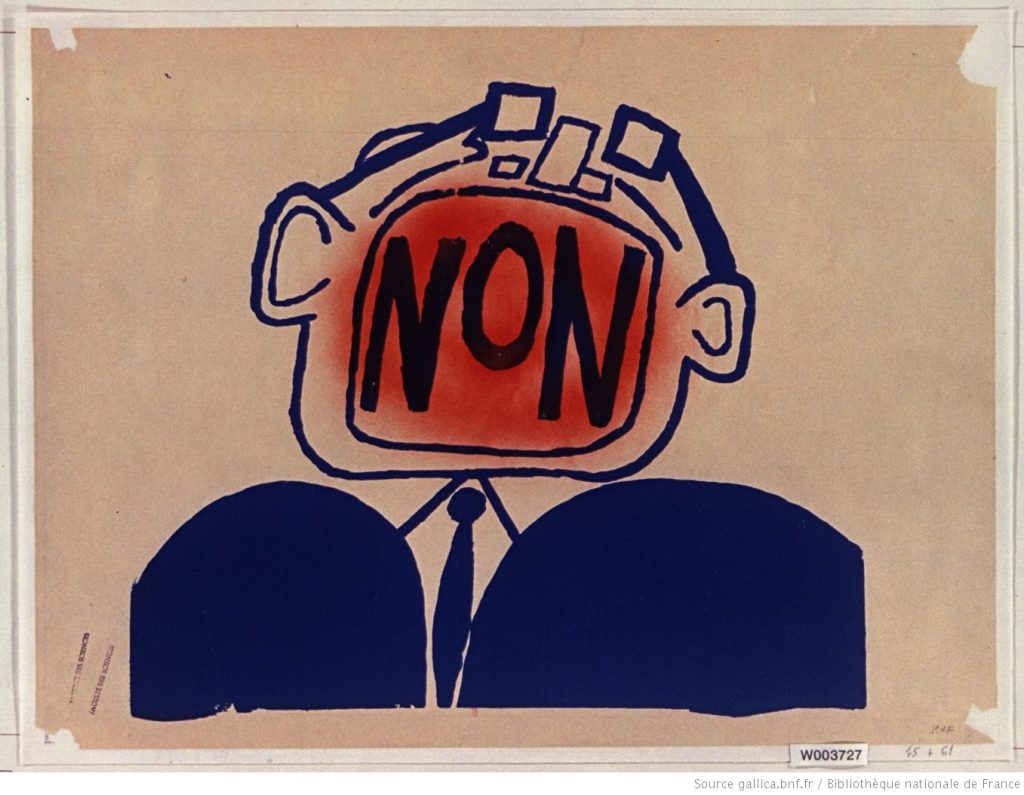
“Be realistic: Demand the impossible!” was one of the May movement’s slogans. A great many more slogans and icons appeared on “extremely fine examples of polemical poster art” like those you see here. These come to us via Dangerous Minds, who explain:
The Atelier Populaire, run by Marxist artists and art students, occupied the École des Beaux-Arts and dedicated its efforts to producing thousands of silk-screened posters using bold, iconic imagery and slogans as well as explicitly collective/anonymous authorship. Most of the posters were printed on newssheet using a single color with basic icons such as the factory to represent labor and a fist to stand for resistance.
The Paris uprisings began with university students, protesting same-sex dorms and demanding educational reform, “the release of arrested students and the reopening of the Nanterre campus of the University of Paris,” notes the Global Nonviolent Action Database. But in the following weeks the “protests escalated and gained more popular support, because of continuing police brutality.” Among the accumulating democratic demands and labor protests, writes Steinfels, was “one great fear… that contemporary capitalism was capable of absorbing any and all critical ideas or movements and bending them to its own advantage. Hence, the need for provocative shock tactics.”
This fear was dramatized by Situationists, who—like Yippies in the States—generally preferred absurdist street theater to earnest political action. And it provided the thesis of one of the most radical texts to come out of the tumultuous times, Guy Debord’s The Society of the Spectacle. In a historical irony that would have Debord “spinning in his grave,” the Situationist theorist has himself been co-opted, recognized as a “national treasure” by the French government, writes Andrew Gallix, and yet, “no one—not even his sworn ideological enemies—can deny Debord’s importance.”
The same could be said for Michel Foucault, who found the events of May ’68 transformational. Foucault pronounced himself “tremendously impressed” with students willing to be beaten and jailed, and his “turn to political militancy within a post-1968 horizon was the chief catalyst for halting and then redirecting his theoretical work,” argues professor of philosophy Bernard Gendron, eventually “leading to the publication of Discipline and Punish,” his groundbreaking “genealogy” of imprisonment and surveillance.
Many more prominent theorists and intellectuals took part and found inspiration in the movement, including André Glucksmann, who recalled May 1968 as “a moment, either sublime or detested, that we want to commemorate or bury.… a ‘cadaver,’ from which everyone wants to rob a piece.” His comments sum up the general cynicism and ambivalence of many on the French left when it comes to May ’68: “The hope was to change the world,” he says, “but it was inevitably incomplete, and the institutions of the state are untouched.” Both student and labor groups still managed to push through several significant reforms and win many government concessions before police and de Gaulle supporters rose up in the thousands and quelled the uprising (further evidence, Anne-Elisabeth Moutet argued this month, that “authoritarianism is the norm in France”).
The iconic posters here represent what Steinfels calls the movement’s “utopian impulse,” one however that “did not aim at human perfectibility but only at imagining that life could really be different and a whole lot better.” These images were collected in 2008 for a London exhibition titled “May 68: street Posters from the Paris Rebellion,” and they’ve been published in book form in Beauty is in the Street: A Visual Record of the May ’68 Paris Uprising. (You can also find and download many posters in the digital collection hosted by the Bibliotheque nationale de France.)
Perhaps the co-option Debord predicted was as inevitable as he feared. But like many radical U.S. movements in the sixties, the coordinated mobilization of huge numbers of people from every strata of French society during those exhilarating and dangerous few weeks opened a window on the possible. Despite its short-lived nature, May 1968 irrevocably altered French civil society and intellectual culture. As Jean-Paul Sartre said of the movement, “What’s important is that the action took place, when everybody believed it to be unthinkable. If it took place this time, it can happen again.”
Imagine your favorite works for the piano—the delicate and haunting, the thundering and powerful. The minimalism of Erik Satie, the Romanticism of Claude Debussy or Modest Mussorgsky, the rapturous swooning of Beethoven’s concertos. Maybe it’s Jerry Lee Lewis or Little Richard; Thelonious Monk or Duke Ellington. Tom Waits, Tori Amos, Rufus Wainwright, Prince… you get the idea.
Now imagine all of it never existing. A giant hole opens up in world culture. Catastrophic! Or maybe, I suppose, we’d never know the difference. But I’m certain we’d be worse off for it, somehow. The piano seems inevitable when we look back into music history. Its immediate predecessors, the clavichord and harpsichord, so resemble the modern piano that they must have evolved in just such a way, we think. But it needn’t have been so.
The harpsichord, writes Georgia State University’s Hyperphysics, “has a shape similar to a grand piano,” but its operation prevents one critical musical property: dynamics—“the player has no control over the loudness and quality of the tone.” On the whole, every innovation of the harpsichord’s design aimed to solve this problem. Over the instrument’s 400-year history, none of them did so as elegantly as the piano, invented around 1700 by Bartolomeo Cristofori. In the video above, you can hear a slightly later version of his instrument from 1720 played by pianist Dongsok Shin—an excerpt from one of the first pieces of music ever written for the instrument.
Cristofori called his design the gravecembalo col piano et forte, “keyboard instrument with soft and loud” sounds. This soon shortened to simply pianoforte. It’s interesting that the word for “soft” eventually became its sole name. For all its grandeur and thunderous capability, it’s the piano’s softness that so often captures our attention—the ability of this lumbering beast of an instrument to pull its punches and move with quiet grace. As you’ll probably note in Shin’s demonstration, the earliest pianos still retained a bit of the harpsichord’s twang, but we can also clearly discern the woody thumps, rumbles, and tinkling highs of modern pianos. (Compare it to this, for example.)
True to its name, the “quiet nature of the piano’s birth around 1700,” writes the Metropolitan Museum of Art, “comes as something of a surprise.” It was invented “almost entirely by one man,” Cristofori, whose expertise had made him steward of Florentine Prince Ferdinando d’Medici’s entire collection of harpsichords and other musical instruments. The first mention comes from a 1700 Medici inventory describing a harpsichord-like instrument “newly invented by Bartolomeo Cristofori with hammers and dampers, two keyboards, and a range of four octaves, C‑c.” The first pianos had 54 keys rather than 88, and used “small wooden hammers covered with deerskin.”
Other makers tried different mechanisms, but “Cristofori was an artful inventor,” the Met remarks, “creating such a sophisticated action for his pianos that, at the instrument’s inception, he solved many of the technical problems that continued to puzzle other piano designers for the next seventy-five years of its evolution.” These designers made shortcuts, since Cristofori’s “action was highly complex and thus expensive.” But nothing matched his design, and those features were “gradually reinvented and reincorporated in later decades.”
Cristofori’s ingenious innovations included an “escapement” mechanism that enabled the hammer to fall away from the string instantly after striking it, so as not to dampen the string, and allowing the string to be struck harder than on a clavichord; a “check” that kept the fast-moving hammer from bouncing back to re-hit the string; a dampening mechanism on a jack to silence the string when not in use; isolating the soundboard from the tension-bearing parts of the case, so that it could vibrate more freely; and employing thicker strings at higher tensions than on a harpsichord.
The piano Shin plays above is the oldest surviving instrument of Cristofori’s design, and it resides at the Metropolitan Museum of Art. Only “two other Cristofori pianos survive today,” notes CMuse, “in Rome and another at Leipzi University.” This instrument might have represented an elegant dead end in musical evolution. Though Baroque composers at the time, including Johann Sebastian Bach, “were aware of it,” most, like Bach, harbored doubts. “It was only with the compositions of Haydn and Mozart” decades later “that the piano found a firm place in music.” A place so firm, it’s nearly impossible to imagine the last 250 years of music without it.
We're hoping to rely on loyal readers, rather than erratic ads. Please click the Donate button and support Open Culture. You can use Paypal, Venmo, Patreon, even Crypto! We thank you!
Open Culture scours the web for the best educational media. We find the free courses and audio books you need, the language lessons & educational videos you want, and plenty of enlightenment in between.