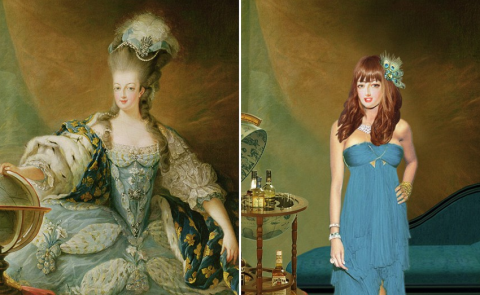
What would a modern Marie Antoinette look like? Her hair would hang down; her once crooked teeth would be straightened; she’d continue to wear designer clothes; and, yes, she’d sadly have some surgical enhancements too. A far cry from how the more stately Queen Elizabeth I might look today. These images come out of a Telegraph gallery that gives historical figures a modern makeover. Other figures re-imagined here include Shakespeare (who goes a little hipster doofus), Henry VIII, and Admiral Lord Nelson.
In 1941, England found itself in an all-out-war with Nazi Germany. It had sustained severe damage when the Nazis unleashed the Blitz on 16 English cities between September 1940 and May 1941. Despite the heavy toll, there was only one thing for most Brits to do — to keep calm and carry on and preserve small moments of normalcy when possible. Of course, that meant drinking tea and not just any tea, but good tea. Above we present Tea Making Tips, a short 1941 film created by the Empire Tea Bureau, that outlines the golden rules for making tea worthy of its name. The narrator reminds the viewers, “Tea is not a manufactured article which can be made, bottled up and served at will. It must be prepared every time it is acquired, and it’s success or failure depends entirely upon the attention you pay to the six golden rules.” If you watch the 10-minute film, you’ll actually count 10 rules (if not more), many of which are still presumably relevant to a tea drinker today. They are as follows:
1) In general, store tea leaves in an airtight container, preferably away from cheese, soap, spices and other items with strong aromas.
2) Also keep the tea off of the ground and away from walls.
3) Always use a good quality tea. You’ll spend a little more money, but you’ll actually get more bang for your pound.
4) Use fresh water. Stale water makes stale tea, which no one needs, especially in wartime.
5) Make sure you warm your teapot before adding hot water and tea leaves.
6) Use the right ratio of tea leaves to water.
7) Steep the tea in water that’s neither under-boiled nor over-boiled.
8) Let the tea infuse for the right amount of time. 3–5 minutes should cover most kinds of tea. Other kinds will need more time.
9) Use tea pots made of china, earthenware, and stainless steel. Avoid ones made of enamel or tin.
10) Don’t add milk to the tea too soon. Wait for the last possible minute.
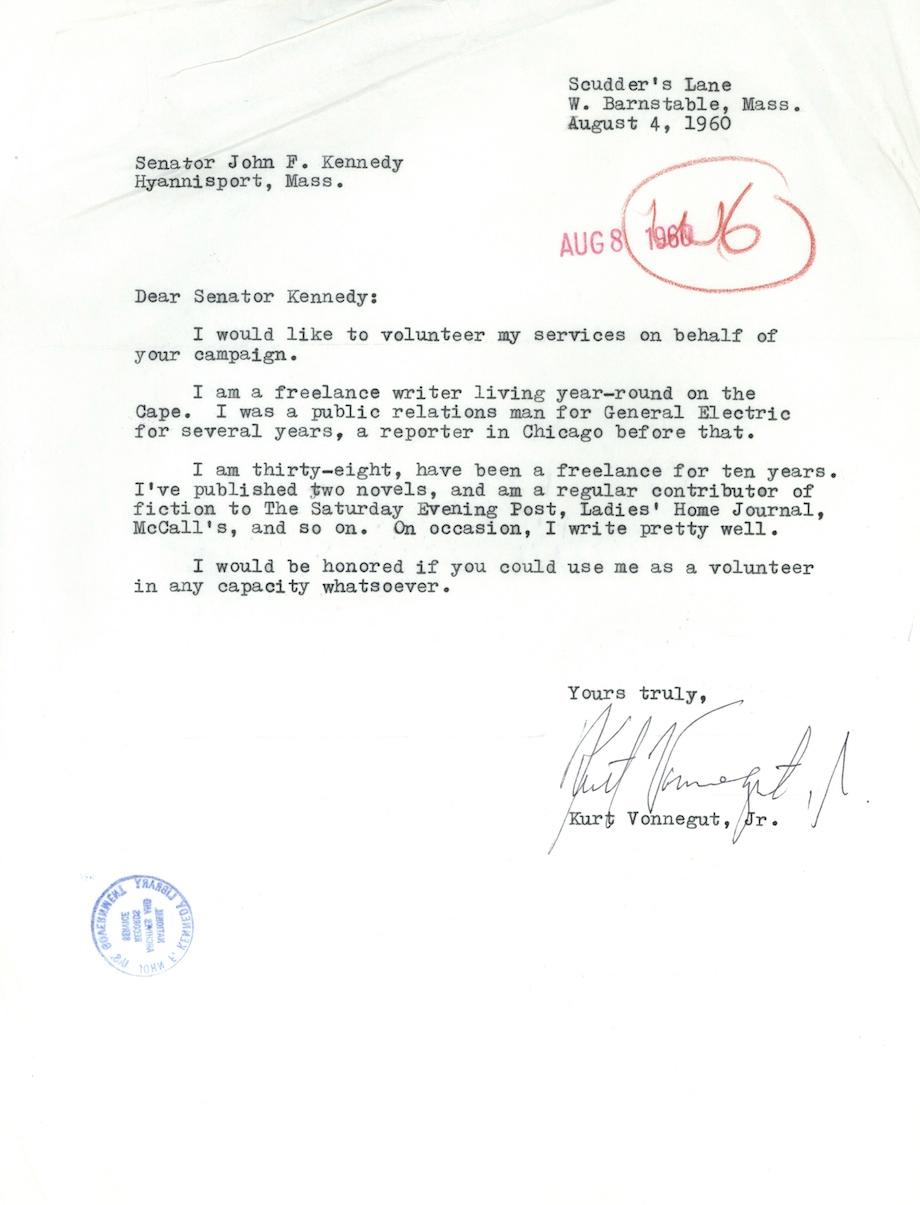
When archivist Stacey Chandler was combing through one of the “Massachusetts” files recently at the John F. Kennedy Presidential Library and Museum in Boston, she stumbled on something unexpected: a letter to Kennedy from an obscure writer named Kurt Vonnegut, volunteering his services on Kennedy’s presidential campaign.
The letter (click the image above to see it larger) was written on August 4, 1960, when Vonnegut was a struggling fiction writer and a failed Saab dealer living on Cape Cod, in the town of West Barnstable, Massachusetts. He had written two novels: Player Piano (1952) and The Sirens of Titan (1959). In a few declarative sentences, Vonnegut outlines his writing experience and offers his help. There is no record at the JFK Library of a reply from Kennedy and, according to Rebecca Onion at Slate, no mention of the subject in two Vonnegut biographies.
“I am thirty-eight,” writes Vonnegut, “have been a freelance for ten years. I’ve published two novels, and am a regular contributor of fiction to The Saturday Evening Post, Ladies’ Home Journal, McCall’s, and so on. On occasion, I write pretty well.”
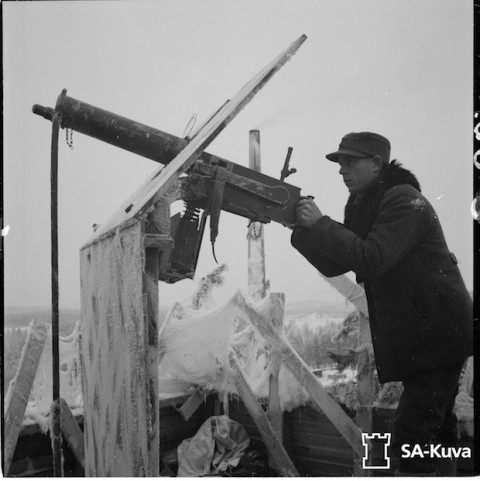
From the The Finnish Defence Forces comes the Finnish Wartime Photograph Archive, a collection of 160,000 photographs taken during World War II when Finland fought to free itself from Nazi Germany and the Soviet Union. Preserved in their original state, the pictures “portray life on the home front, ruins from bombings, the war industry and events that happened behind the front lines.” As you can imagine, some of the photos can be disturbing.
On a brighter note, let me add this. You can download each and every photo, and use them for educational purposes. The archive only asks that you give proper attribution by mentioning “SA-kuva” as the source. And, indeed, “SA-kuva” should be given credit for the image above.
In the early ’90s, the so-called “Iron Archives” of Russian political documents from the Cold War era opened up to historians, shedding light on the earliest days of Mao Zedong and Joseph Stalin’s diplomatic alliance.
But not all of the Russian documents were declassified at that time. The Woodrow Wilson International Center for Scholars has launched a new digital archive containing recently declassified materials from some 100 different international collections, including a cable Mao sent to Commander Filippov (Stalin’s alias) eagerly detailing his plans to study Russia and complaining about his poor health.
The subsequent exchange between the two world leaders is as banal as their later correspondence would be ideological. Mao suggests, once his health improves, that they use the aerodrome in Weixian for his departure and he includes the exact dimensions of the landing strip. One wonders whether Obama and Israeli President Shimon Peres worked so closely together on travel details for their meetings in March.
The details contained in the thousands of cables, telegrams and memos are part of the fun. Other documents exchanged between the KGB chairman and East German Minister in July, 1981 include blunt language about the difficulties of reading the Reagan Administration’s intentions and the importance of quashing the Polish Solidarity Movement.
Because the world’s biggest issues tend to have long roots, there is a lot of material here that echoes today’s headlines. Here, the Soviet Minister of Foreign Affairs records a 1958 memo about his assessment of North Korea’s plans for a nuclear program.
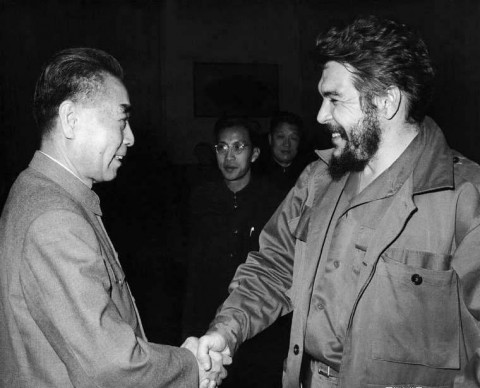
During a 1960 global communist delegation meeting, Mao Zedong spoke at length with Che Guevara about sugar sales, American influence and counter-revolutionaries.
As a side note, the Wilson Center is a one of the more intellectual memorials to an American president. Woodrow Wilson was, after all, the only President of the United States to hold a Ph.D. The Center is one of the world’s top think tanks, with research and projects focused on U.S.-Russia relations, the Middle East, North Korea and, oddly, emerging nanotechnologies. But, of course, the Wilson Center is more known for its centrist analysis of international diplomacy issues.
The new digital archive (whose tagline is “International History Declassified”) offers several ways to search: by place, year (beginning with1938) or subject. For scholars or history buffs, this is a trove worth browsing.
Kate Rix writes about education and digital media. Visit her website: .
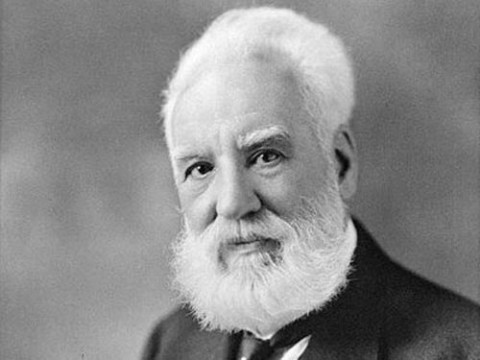
In the past, we’ve brought you sound recordings from the 19th century — recordings that recapture the long lost voices of figures likes Walt Whitman, Alfred Lord Tennyson, William Gladstone,Tchaikovsky, and Thomas Edison. Now, thanks to the “dramatic application of digital technology,” the Smithsonian brings you (quite fittingly) the lost voice of the telephone’s inventor, Alexander Graham Bell. According to biographer Charlotte Gray, Bell recorded his voice onto discs while conducting sound experiments between 1880 and 1886. Although the discs remained in the Smithsonian’s possession for decades, researchers lacked the technical ability to play them back, and Bell’s voice went “mute” until Carl Haber, a scientist at the Lawrence Berkeley National Laboratory, figured out how to take high resolutions scans of the discs and convert them into playable audio files. That’s what you can hear below. In the short recording dated April 15, 1885, the inventor declares: “Hear my voice — Alexander Graham Bell.”
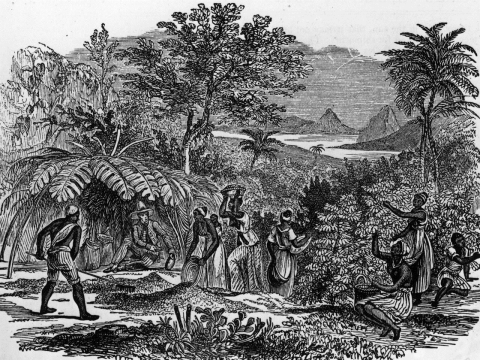
Like so many daily comestibles we completely take for granted—salt, sugar, and (far fewer of us) tobacco—coffee has a long and often brutal history. And like many of these substances, it tends to be addictive. But coffee has also inspired a longstanding social tradition that shows no signs of ever going out of fashion. It’s a drug that makes us thinky and chatty and sociable (I for one don’t speak a human language until I’ve had my first cup). It’s these contradictions of coffee history—its complicity in slave economies and the Enlightenment public square—that Mark Pendergrast takes on in his new book Uncommon Grounds: The History of Coffee and How It Transformed Our World. Pendergrast puts it this way:
One of the ironies about coffee is it makes people think. It sort of creates egalitarian places — coffeehouses where people can come together — and so the French Revolution and the American Revolution were planned in coffeehouses. On the other hand, that same coffee that was fueling the French Revolution was also being produced by African slaves who had been taken to Santo Domingo, which we now know as Haiti.
In the interview above with NPR’s “Morning Edition,” Pendergrast explains his interest in coffee history as a way to look at the “relationship between the have-nots and the haves.” His investigation is another foray into the hundreds of years of European colonial history that gave us both massive global inequality and Starbucks on every corner. Listen to the short interview, read Pendergrast’s book, and the next time you get thinky over coffee, you may just think a lot about how coffee shaped the world.
When Field Marshal Wilhelm Keitel signed Nazi Germany’s unconditional surrender on May 8, 1945 in Berlin (footage here), the Second World War may have been over for Europe, but the war on the Pacific front waged on as Japan refused to surrender. Only after the fateful decision to drop atomic bombs on Hiroshima and Nagasaki, and after the Soviets invaded Japanese-held Manchuria, did Emperor Hirohito accept the hopelessness of the situation and agree to surrender on August 15. When the official radio announcement (recording here) was broadcast — due to time zone differences on August 14 in the U.S. — the news spread like wildfire and the day became known as “Victory over Japan Day”, or simply as “VJ Day.” Spontaneous celebrations erupted all over the United States, but especially on Hawaii, where the Japanese attacked Pearl Harbor on December 7, 1941 leading the US to officially enter World War II.
One of these spontaneous celebrations in Honolulu was captured on Kodachrome 16mm film and has been digitally restored. One commenter on Vimeo has identified all of the exact locations here.
By profession, Matthias Rascher teaches English and History at a High School in northern Bavaria, Germany. In his free time he scours the web for good links and posts the best finds on Twitter.
We're hoping to rely on loyal readers, rather than erratic ads. Please click the Donate button and support Open Culture. You can use Paypal, Venmo, Patreon, even Crypto! We thank you!
Open Culture scours the web for the best educational media. We find the free courses and audio books you need, the language lessons & educational videos you want, and plenty of enlightenment in between.
 What would a modern Marie Antoinette look like? Her hair would hang down; her once crooked teeth would be straightened; she’d continue to wear designer clothes; and, yes, she’d sadly have some surgical enhancements too. A far cry from how the more stately Queen Elizabeth I might look today. These images come out of a Telegraph gallery that gives historical figures a modern makeover. Other figures re-imagined here include Shakespeare (who goes a little hipster doofus), Henry VIII, and Admiral Lord Nelson.