When you write history, you’re always confronted with the question: what facts and events will make it into your historical account, and which ones will be left out? When it comes to this viral video produced by Donolinio Studio, what makes the cut? Europe. America. Men. And a long list of downers: war, depravation, natural disaster, a‑bombs, social crisis, financial crisis, genocide and assassination, all set to a dramatic soundtrack by Hans Zimmer. What gets left out? Anything that seemingly makes life worth living and, with some minor exceptions, human achievement. And, yes, Africa and Latin America too — except for the first World Cup tournament played in Uruguay. (Note: we’re pretty sure that English isn’t the first language of the filmmakers. Hence the spelling errors in the captions.)
Speaking of human achievement and historical omissions, we’d like to pay tribute to Martin Luther King Jr. on his birthday by highlighting two of MLK’s memorable speeches — his soaring “I Have a Dream” speech presented in August 1963, and then fast forward to his prescient “I’ve Been to the Mountaintop” speech, delivered just the day before he was assassinated in April 1968.
Harry Houdini (né Erik Weisz) emigrated from Hungary to the United States as a youngster, settling first in Wisconsin, then later in New York City. Captivated by magic from an early age, Houdini (1874–1926) began performing small-time magic shows and experimenting with escape acts, eventually honing his ability to escape from handcuffs. Then he never looked back:
Arriving in a new town, Houdini would claim the ability to escape from any handcuffs provided by the local police. His easy escapes provided excellent publicity for his shows. Houdini offered $100 to anyone who provided handcuffs from which he could not escape, but he never had to pay. Through his increasingly complex escapes and his shrewd use of publicity, Houdini became a headliner on the vaudeville circuit, playing in cities across the country. Not satisfied with that low level of fame, however, Houdini decided to gamble by taking his act to Europe.
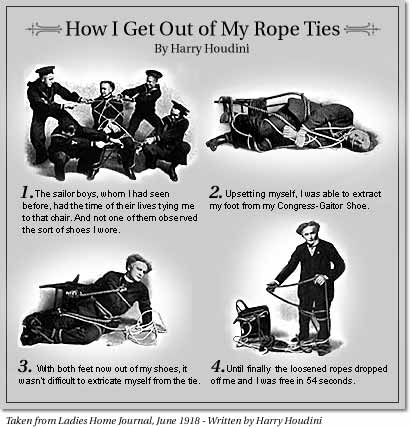
When he returned from Europe, Houdini performed increasingly high-profile stunts — e.g., freeing himself from chains after jumping into Boston’s Charles River, escaping from a strait jacket while hanging upside down in Times Square, breaking out of a prison cell that held the assassin of President James Garfield. Today, we have Houdini performing a more straightforward escape — from a simple chair and rope. Below, in an image appearing in Ladies’ Home Journal (1918), Houdini tells you a little about how he made his great rope escape. He offers more details here. The video above was shot circa 1920.
If you would like to support the mission of Open Culture, consider making a donation to our site. It’s hard to rely 100% on ads, and your contributions will help us continue providing the best free cultural and educational materials to learners everywhere. You can contribute through PayPal, Patreon, and Venmo (@openculture). Thanks!
This fall, the world’s population reached seven billion. A sobering thought. How did we get to this point? Producer Adam Cole and photographer Maggie Starbard of National Public Radio have put the world’s accelerating population growth in perspective in a two-and-a-half minute video, above.
In those two and a half minutes, 638 babies will be born worldwide, according to statistics from the United States Census Bureau, and 265 people will die. That’s a net gain of 373 people, just while you watch the film. The biggest growth, according to NPR, is happening in sub-Saharan Africa, where access to family planning is low and infant mortality rates are high.
It may seem counter-intuitive that population growth rates are high where infant survival rates are low, but as Swedish global health expert Hans Rosling put it during a recent TED talk, “Only by child survival can we control population growth.” Because population growth and infant mortality rates are both correlated to poverty rates, he argues, eliminating poverty is the key to achieving a sustainable world population. You can learn more in our November 1 feature, “Hans Rosling Uses IKEA Props to Explain World of 7 Billion People.”
In June 1937 Pablo Picasso painted Guernica, a mural that memorialized the events of April 27, 1937, the date when Germany supported its fascist ally Francisco Franco and bombed Guernica, a rather remote town in the Basque region of northern Spain. For the Nazis, the military strike was an excuse to try out their latest military hardware, establish a blueprint for terror bombings of civilian populations, and pull Spain into the fascist fold. After the bombing, the republican government on the other side of the Spanish Civil War commissioned Picasso to create the mural for display at the 1937 World’s Fair in Paris.
You can learn more about the famous anti-war painting, now housed at the Museo Reina Sofía in Madrid, by checking out the Smarthistory primer posted below. In the meantime, we’re highlighting today a digitally-rendered 3D tour of Picasso’s landmark work. It’s the creation of Lena Gieseke, a visual effects artist who, once upon a time, was married to the filmmaker Tim Burton. Some will consider the idea of putting Guernica in 3D downright blasphemous. Others will find it instructive, a chance to see parts of the mural from a new perspective. The video above runs three minutes.
If you would like to support the mission of Open Culture, consider making a donation to our site. It’s hard to rely 100% on ads, and your contributions will help us continue providing the best free cultural and educational materials to learners everywhere. You can contribute through PayPal, Patreon, and Venmo (@openculture). Thanks!
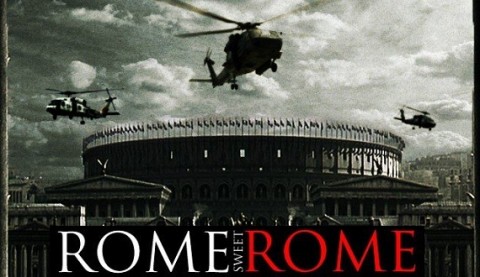
It all started as a thought experiment on Reddit.com when a user posed the question: “Could I destroy the entire Roman Empire during the reign of Augustus if I traveled back in time with a modern U.S. Marine infantry battalion or MEU?”
Then the Reddit user offered a more precise scenario:
We’d be up against nearly 330,000 men since each legion was comprised of 11,000 men. These men are typically equipped with limb and torso armor made of metal, and for weaponry they carry swords, spears, bows and other stabbing implements. We’d also encounter siege weapons like catapults and crude incendiary weapons.
We’d be made up of about 2000 members, of which about half would be participating in ground attack operations. We can use our mechanized vehicles (60 Humvees, 16 armored vehicles, etc), but we cannot use our attack air support, only our transport aircraft.
We also have medics with us, modern medical equipment and drugs, and engineers, but we no longer have a magical time-traveling supply line (we did have but the timelords frowned upon it, sadly!) that provides us with all the ammunition, equipment and sustenance we need to survive. We’ll have to succeed with the stuff we brought with us.
And now professional historians are weighing in. Interviewed in Popular Mechanics, historian Adrian Goldsworthy, an expert on the Roman army, offered these thoughts:
Obviously, there is a massive difference in firepower. Not only would Roman armor be useless against a rifle round—let alone a grenade launcher or a .50 caliber machine gun—it would probably distort the bullet’s shape and make the wound worse.
But here comes the difficulty:
In the short term and in the open, modern infantry could massacre any ancient soldiers at little risk to themselves. But you could not support modern infantry. So all of these weapons and vehicles could make a brief, dramatic, and even devastating appearance, but would very quickly become useless. Probably in a matter of days.… Marines are the best warriors ever trained. But they can’t fight an endless wave of soldiers. No one can.
You can find the rest of Goldsworthy’s thoughts here, and several good Roman history courses in our big collection of Free Online Courses.
Follow Open Culture on Facebook and Twitter and share intelligent media with your friends. Or better yet, sign up for our daily email and get a daily dose of Open Culture in your inbox. And if you want to make sure that our posts definitely appear in your Facebook newsfeed, just follow these simple steps.
As the French like to say, plus ça change, plus c’est la même chose. The more things change, the more they stay the same. Before there was Twitter, Facebook and Google+ (click to follow us), Europeans living in the seventeenth and eighteenth centuries had to deal with their own version of information overload. Emerging postal systems, the proliferation of short letters called billets, and the birth of newspapers and pamphlets all pumped unprecedented amounts of information — valuable information, gossip, chatter and the rest — through newly-emerging social networks, which eventually played a critical role in the French Revolution, much like Twitter and Facebook proved instrumental in organizing the Arab Spring.
These historical social networks are being carefully mapped out by scholars at Stanford. Above, we have Anaïs Saint-Jude painting the historical picture for us. Below Dan Edelstein gives you a closer look at Stanford’s Mapping the Republic of Letters project.
In September 1976, Jimmy Carter and Gerald Ford squared off in a presidential debate, and the following day, the legendary communication theorist Marshall McLuhan appeared on the TODAY show, then hosted by Tom Brokaw, to offer some almost real-time analysis of the debate. The first televised presidential debate was famously held in 1960, and it pitted John F. Kennedy against Richard Nixon. Sixteen years later, pundits and citizens were still trying to make sense of the format. Was the televised debate a new and vital part of American democracy? Or was it a carefully controlled act of political performance? For McLuhan, there was still some idealistic sense that televised debates could enhance our democracy, assuming the message was suited to the medium. But McLuhan came away disillusioned, calling the Carter/Ford spectacle “the most stupid arrangement of any debate in the history of debating” and chalking up technical difficulties (watch them here) to the medium raging against the message.
If you would like to support the mission of Open Culture, consider making a donation to our site. It’s hard to rely 100% on ads, and your contributions will help us continue providing the best free cultural and educational materials to learners everywhere. You can contribute through PayPal, Patreon, and Venmo (@openculture). Thanks!
This year marks the 400th anniversary of the King James Bible, a translation that influenced the development of the English language as much as it did the Christian faith. Right alongside many other anniversary celebrations taking place this year, Glen Scrivener, a minister in the Church of England, has started a blog about the linguistic impact of the text, focusing on 365 phrases that have passed in common parlance. A lot of this gets artfully distilled by Scrivener’s short video, The King’s English — 100 phrases in 3 Minutes (above).
We're hoping to rely on loyal readers, rather than erratic ads. Please click the Donate button and support Open Culture. You can use Paypal, Venmo, Patreon, even Crypto! We thank you!
Open Culture scours the web for the best educational media. We find the free courses and audio books you need, the language lessons & educational videos you want, and plenty of enlightenment in between.