This new video from Cambridge University, featuring archaeologist John Robb, gives you a quick and visually appealing introduction to how humans have understood something we take for granted – our own bodies. Covering 10,000 years in six minutes, Robb takes us from the “Animal Body” and “Sexualized Body” of the Mesolithic and Neolithic Ages, to the “Politicized Body” of the Classical Age, “God’s Body” of the Middle Ages, and finally “The Body as Machine,” the metaphor we have been living with since 1500. And we wrap up with the “Body Digital,” the body of the future, and “Multiple Bodies.” This video comes from the Cambridge Ideas series available on Cambridge’s YouTube channel.
Leon Trotsky: Love, Death and Exile in Mexico
Leon Trotsky, one of the fathers of the Russian Revolution, second only to to Lenin, was assassinated in Mexico 70 years ago today (August 21, 1940). During the early years of the Revolution, Trotsky headed up foreign affairs for Russia and founded the Red Army. Following Lenin’s death (1924), he looked primed to take control of the revolutionary state. But Stalin had other thoughts about the matter, and, before too long, Trotsky found himself in exile again. Previous exiles took him to Siberia, Kazakhstan, Austria, Switzerland, Spain and the United States. This time, he went to France, Norway, Turkey (see the film Vanessa Redgrave narrates on his stint in Istanbul) and later Mexico (1936), where he lived with painter Diego Rivera and his wife/fellow painter, Frida Kahlo. Eventually, Kahlo and Trotsky would have a famous affair.
Above, we have some grainy footage of Trotsky from his Mexico years. The footage dates back to 1937, and it shows Trotsky, speaking in broken English, giving thanks to Mexico for providing sanctuary and defending himself against the show trials that Stalin orchestrated back in Russia. Trotsky was sentenced to death in absentia. Three years later, he would be assassinated by an undercover agent while still living in Mexico. YouTube has more on the assassination here. A big thanks goes to Mike S. for unearthing this great little cluster of videos.
If you would like to support the mission of Open Culture, consider making a donation to our site. It’s hard to rely 100% on ads, and your contributions will help us continue providing the best free cultural and educational materials to learners everywhere. You can contribute through PayPal, Patreon, and Venmo (@openculture). Thanks!
Visit 890 UNESCO World Heritage Sites with Free iPhone/iPad App
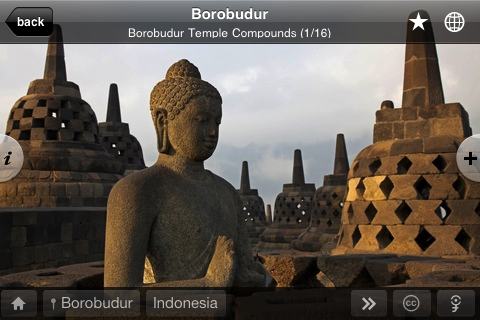
The new Fotopedia Heritage app for the iPhone and iPad lets the world come to you. (Download here.) Drawing on 20,000 curated photos taken by thousands of photographers from the Fotopedia community, this FREE app lets you visit (at least virtually) 890 UNESCO World Heritage sites. In a matter of minutes, you can move from Notre Dame in Paris, to the Dome of the Rock in Jerusalem, to Machu Picchu in Peru, to the Great Pyramid of Giza in Egypt. You get the picture. And speaking of pictures, it’s worth noting that all photos are released under a Creative Commons license. A very nice touch. Let me finally mention that the app has some smart mashup features, including maps showing the location of each site, plus Wikipedia entries offering background information on each location. You can start downloading the app right here. (Many thanks to Jane for calling this out.)
Related Content:
Visit Pompeii (also Stonehenge & Versailles) with Google Street View
Nelson Mandela’s First-Ever TV Interview (1961)
Note: This post was originally featured on our site in 2010. In light of the news that Nelson Mandela has passed away at age 95, we’re bringing this vintage clip back to the fore. Here you can see a young Mandela making history, and without perhaps realizing it, building the remarkable legacy that remains with us today.
In 1962, Nelson Mandela was arrested on allegations of sabotage and other charges and sentenced to life in prison, where he spent 27 years before becoming South Africa’s first president elected in a fully democratic election. His story, among modern history’s most profoundly inspirational, is beautifully and poetically captured in Clint Eastwood’s 2009 gem, Invictus. But what Eastwood’s account leaves out are the events that preceded and led to Mandela’s arrest.
In May of 1961, a 42-year-old Mandela gave his first-ever interview to ITN reporter Brian Widlake as part of a longer ITN Roving Report program about Apartheid. At that point, the police are already hunting for Mandela, but Widlake pulls some strings and arranges to meet him in his hideout. When the reporter asks Mandela what Africans want, he promptly responds:
“The Africans require, want the franchise, the basis of One Man One Vote – they want political independence.”
But perhaps more interesting is the dialogue towards the end of the interview, where Mandela explores the complex relationship between peace and violence as protest and negotiation tactics. We’re left wondering whether his seemingly sudden shift from a completely peaceful campaign strategy up to that point towards considering violence as a possibility may be the product of South African police going after him with full force that week. Violence, it seems, does breed violence even in the best and noblest of us.
Related Content:
Nelson Mandela Archive Goes Online (With Help From Google)
The Nelson Mandela Digital Archive Goes Online
U2 Releases a Nelson Mandela-Inspired Song, “Ordinary Love”
Maria Popova is the founder and editor in chief of Brain Pickings, a curated inventory of eclectic interestingness and indiscriminate curiosity. She writes for Wired UK, GOOD Magazine, BigThink and Huffington Post, and spends a disturbing amount of time curating interestingness on Twitter.
Oppenheimer: The Man Behind the Bomb
In July 1945, J. Robert Oppenheimer, a theoretical physicist from UC Berkeley, saw his work on the Manhattan Project culminate with the test of the first nuclear bomb. The genie was let out of the bottle, and, ever since then, world leaders have been trying to put the genie back in … with great difficulty. The new documentary Countdown to Zero, which premiered at Sundance earlier this year, traces the history of the atomic bomb and makes the case for worldwide nuclear disarmament – a timely issue given that the US Senate has been debating the New Strategic Arms Reduction Treaty (aka New START). The “featurette” above, excerpted from the film, gives you a quick and somewhat haunting introduction to Oppenheimer, the man behind the bomb.
If you would like to support the mission of Open Culture, consider making a donation to our site. It’s hard to rely 100% on ads, and your contributions will help us continue providing the best free cultural and educational materials to learners everywhere. You can contribute through PayPal, Patreon, and Venmo (@openculture). Thanks!
The Civil War & Reconstruction: A Free Course from Yale University
The Civil War was a watershed moment in US history, and it figures centrally in any American history curriculum. If you missed this course during high school or college, not to worry. Now, thanks to Yale University, you can revisit this historical moment with Prof. David Blight, one of the nation’s leading Civil War scholars. The Civil War and Reconstruction “explores the causes, course, and consequences of the American Civil War, from the 1840s to 1877,” looking at how the United States was transformed on multiple levels: racially, socially, politically, constitutionally and morally. You can access the 27 free lectures, presented in audio and video, via YouTube, iTunes, and the Yale web site (plus a syllabus). We also have it on the list of our Free History Courses, a subset of our collection 1,700 Free Online Courses from Top Universities.
If you would like to support the mission of Open Culture, consider making a donation to our site. It’s hard to rely 100% on ads, and your contributions will help us continue providing the best free cultural and educational materials to learners everywhere. You can contribute through PayPal, Patreon, and Venmo (@openculture). Thanks!
A Brief, Artistic Introduction to Nikola Tesla
This weekend marked the 154th birthday of Nikola Tesla, the Serbian/Croatian emigre whose work on electromagnetism and electromechanical engineering contributed to the birth of commercial electricity. Especially during the past year, his name has regained a fair amount of currency, not least because there’s a very sporty electric roadster now named after him. In honor of his birthday, the clip above gives a very quick and artistic introduction to Tesla’s life and work …
5,000 Years in 90 Seconds
Great empires rise and fall, mostly in the Middle East. Watch history play itself out on dynamic maps and timeline.
Thanks Bob. (Got a great find for readers? Send it our way.)
Support Us
We're hoping to rely on loyal readers, rather than erratic ads. Please click the Donate button and support Open Culture. You can use Paypal, Venmo, Patreon, even Crypto! We thank you!

About Us

Open Culture scours the web for the best educational media. We find the free courses and audio books you need, the language lessons & educational videos you want, and plenty of enlightenment in between.
Advertise With Us

