“Nothing Good Gets Away”: John Steinbeck Offers Love Advice in a Letter to His Son (1958)

steinbeck

Cer­tain read­ers may turn, for gen­er­al solace, to the nov­els of John Stein­beck. But how many, in par­tic­u­lar need of roman­tic advice, open up Of Mice and Men, East of Eden, or The Grapes of Wrath? Yet on mat­ters of the heart, Stein­beck knew of what he spoke, as his son Thom found out after men­tion­ing a new school sweet­heart in a note home. In what must sure­ly count as the most elo­quent, rel­e­vant piece of unso­licit­ed parental love advice ever given—not, admit­ted­ly, a high bar to cross—the for­mi­da­ble man of Amer­i­can let­ters explained how best to nav­i­gate this rich­est of all expe­ri­ences:

First—if you are in love—that’s a good thing—that’s about the best thing that can hap­pen to any­one. Don’t let any­one make it small or light to you.

Second—There are sev­er­al kinds of love. One is a self­ish, mean, grasp­ing, ego­tis­ti­cal thing which uses love for self-impor­tance. This is the ugly and crip­pling kind. The oth­er is an out­pour­ing of every­thing good in you—of kind­ness and con­sid­er­a­tion and respect—not only the social respect of man­ners but the greater respect which is recog­ni­tion of anoth­er per­son as unique and valu­able. The first kind can make you sick and small and weak but the sec­ond can release in you strength, and courage and good­ness and even wis­dom you didn’t know you had.

This excerpt comes from a full text avail­able at a favorite site of ours, Let­ters of Note. One of the inter­net’s finest repos­i­to­ries of man’s wis­dom and fol­ly, Let­ters of Note has offered William Faulkn­er’s take-this-job-and-shove-it, a young Kurt Von­negut’s wartime report home after his release from a Dres­den work camp, the first Amer­i­can fan let­ter sent to David Bowie, and Aldous Hux­ley’s death as described by his wid­ow. My per­son­al favorite remains the simul­ta­ne­ous­ly astute and unhinged lament Ted Turn­er received from his father after chang­ing his col­lege major to clas­sics. Turn­er père wrote, in his askew fash­ion, in the same spir­it of father­ly sup­port as Stein­beck. But Ted did­n’t get to read any lines half as reas­sur­ing as those Thom Stein­beck did: “Don’t wor­ry about los­ing,” his father advised. “If it is right, it happens—The main thing is not to hur­ry. Noth­ing good gets away.”

Relat­ed con­tent:

John Steinbeck’s Six Tips for the Aspir­ing Writer and His Nobel Prize Speech

This is Your Brain in Love: Scenes from the Stan­ford Love Com­pe­ti­tion

Face to Face with Bertrand Rus­sell: ‘Love is Wise, Hatred is Fool­ish’

Col­in Mar­shall hosts and pro­duces Note­book on Cities and Cul­ture and writes essays on lit­er­a­ture, film, cities, Asia, and aes­thet­ics. He’s at work on a book about Los Ange­les, A Los Ange­les Primer. Fol­low him on Twit­ter at @colinmarshall.

Woody Guthrie’s Fan Letter To John Cage and Alan Hovhaness (1947)

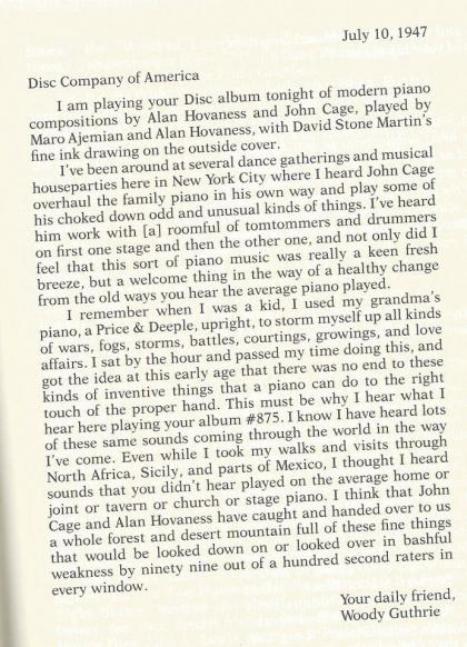
I’ve always felt a cer­tain close affin­i­ty with Woody Guthrie. Could be my admi­ra­tion for his unstint­ing working-man’s pol­i­tics or that he hails from my mother’s home state of Okla­homa. Those are strong appeals, and I sup­pose it’s all of that and more: Guthrie could carve out com­pact gran­ite sen­tences even Robert Frost would envy. If the let­ter above doesn’t con­vince you, read the man’s auto­bi­og­ra­phy. In the let­ter, the unapolo­getic work­ing-class folksing­ing Okie who embod­ied depres­sion-era authen­tic­i­ty writes to “Disc Com­pa­ny of Amer­i­ca” to enthuse over John Cage for his “over­haul of the fam­i­ly piano” and his “choked down odd and unusu­al kinds of things.”

Odd and unusu­al are two words that spring to mind when imag­in­ing Guthrie writ­ing a let­ter in praise of Cage. (He also prais­es Armen­ian com­pos­er Alan Hov­haness—Guthrie spells it “Hov­aness”). Writ­ten in 1947, it is the kind of text one wants to quote in its entire­ty. For­tu­nate­ly, we have the repro­duc­tion above, and you can read it for your­self. What isn’t repro­duced is the post­script, in which Guthrie wrote: “I need some­thing like this odd­strik­ing music to match the things I feel in my soul tonight.” He also wrote that that morn­ing, his wife, Mar­jorie, had “giv­en birth to a big 7‑pound boy”—Arlo.

Guthrie’s let­ter ref­er­ences a (now extreme­ly rare) two-disc set enti­tled Piano Com­po­si­tions by Alan Hov­haness and John Cage played by Maro Ajemi­an and Alan Hov­hanes, fea­tur­ing a hand-drawn cov­er by acclaimed jazz-record illus­tra­tor David Stone Mar­tinAccord­ing to LA Times music crit­ic Mark Swed, the Cage com­po­si­tion on Guthrie’s 78-rpm record was the pre­pared piano solos from Cage’s Amores, com­posed in 1943. Below, watch a per­for­mance of the “odd­strik­ing” Amores by Span­ish ensem­ble Neop­er­cusión.

Thanks to Tris­tan for point­ing us to this let­ter orig­i­nal­ly blogged over at Stool Pigeon.

Josh Jones is a doc­tor­al can­di­date in Eng­lish at Ford­ham Uni­ver­si­ty and a co-founder and for­mer man­ag­ing edi­tor of Guer­ni­ca / A Mag­a­zine of Arts and Pol­i­tics.

« Go Back
Quantcast

