Professional Pickpocket Apollo Robbins Explains the Art of Misdirection

You’ve got to pick-a-pock­et or two, boys 

You’ve got to pick-a-pock­et or two. 

Unlike the Art­ful Dodger and oth­er light-fin­gered urchins brought to life by Charles Dick­ens and, more recent­ly, com­pos­er Lionel Bartpro­fes­sion­al pick­pock­et Apol­lo Rob­bins con­fines his prac­tice to the stage.

Past exploits include reliev­ing actress Jen­nifer Gar­ner of her engage­ment ring and bas­ket­ball Hall-of-Famer Charles Barkley of a thick bankroll. In 2001, he vir­tu­al­ly picked for­mer U.S. pres­i­dent Jim­my Carter’s Secret Ser­vice detail clean, net­ting badges, a watch, Carter’s itin­er­ary, and the keys to his motor­cade. (Rob­bins wise­ly steered clear of their guns.)

How does he does he do it? Prac­tice, prac­tice, prac­tice… and remain­ing hyper vig­i­lant as to the things com­mand­ing each indi­vid­ual vic­tim­s’s atten­tion, in order to momen­tar­i­ly redi­rect it at the most con­ve­nient moment.

Clear­ly, he’s a put lot of thought into the emo­tion­al and cog­ni­tive com­po­nents. In a TED talk on the art of mis­di­rec­tion, above, he cites psy­chol­o­gist Michael Posner’s “Trin­i­ty Mod­el” of atten­tion­al net­works. He has deep­ened his under­stand­ing through the study of aiki­do, crim­i­nal his­to­ry, and the psy­chol­o­gy of per­sua­sion. He under­stands that get­ting his vic­tims to tap into their mem­o­ries is the best way to tem­porar­i­ly dis­arm their exter­nal alarm bells. His easy­go­ing, seem­ing­ly spon­ta­neous ban­ter is but one of the ways he gains marks’ trust, even as he pen­e­trates their spheres with a preda­to­ry grace.

Watch his hands, and you won’t see much, even after he explains sev­er­al tricks of his trade, such as secur­ing an already depock­et­ed wal­let with his index fin­ger to reas­sure a jack­et-pat­ting vic­tim that it’s right where it belongs. (Half a sec­ond lat­er, it’s drop­ping below the hem of that jack­et into Rob­bins’ wait­ing hand.) Those paws are fast!

I do won­der how he would fare on the street. His act depends on a fair amount of chum­my touch­ing, a phys­i­cal inti­ma­cy that could quick­ly cause your aver­age straphang­er to cry foul. I guess in such an instance, he’d lim­it the take to one pre­cious item, a cell phone, say, and leave the wal­let and watch to a non-the­o­ret­i­cal “whiz mob” or street pick­pock­et team.

Though he him­self has always been scrupu­lous about return­ing the items he lib­er­ates, Rob­bins does not with­hold pro­fes­sion­al respect for his crim­i­nal broth­ers’ moves. One real-life whiz mob­ber so impressed him dur­ing a tele­vi­sion inter­view that he drove over four hours to pick the perp’s brains in a min­i­mum secu­ri­ty prison, a con­fab New York­er reporter Adam Green described in col­or­ful detail as part of a lengthy pro­file on Rob­bins and his craft.

One small detail does seem to have escaped Rob­bins’ atten­tion in the sec­ond demon­stra­tion video below, in which reporter Green will­ing­ly steps into the role of vic’. Per­haps Rob­bins doesn’t care, though his mark cer­tain­ly should. The sit­u­a­tion is less QED than XYZPDQ.

While you’re tak­ing notice, don’t for­get to remain alert to what a poten­tial pick­pock­et is wear­ing. Such atten­tion to detail may serve you down at the sta­tion, if not onstage.

Relat­ed Con­tent:

Watch Björk’s 6 Favorite TED Talks, From the Mush­room Death Suit to the Vir­tu­al Choir

The Sci­ence of Willpow­er: 15 Tips for Mak­ing Your New Year’s Res­o­lu­tions Last from Dr. Kel­ly McGo­ni­gal

The Kit­ty Gen­ovese Myth and the Pop­u­lar Imag­i­na­tion

Ayun Hal­l­i­day is an author, illus­tra­tor, and Chief Pri­ma­tol­o­gist of the East Vil­lage Inky zine. The sleep­ing bag-like insu­lat­ing prop­er­ties of her ankle-length faux leop­ard coat make her very pop­u­lar with the pick­pock­ets of New York. Fol­low her @AyunHalliday

John Cleese on The Importance of Making and Embracing Mistakes

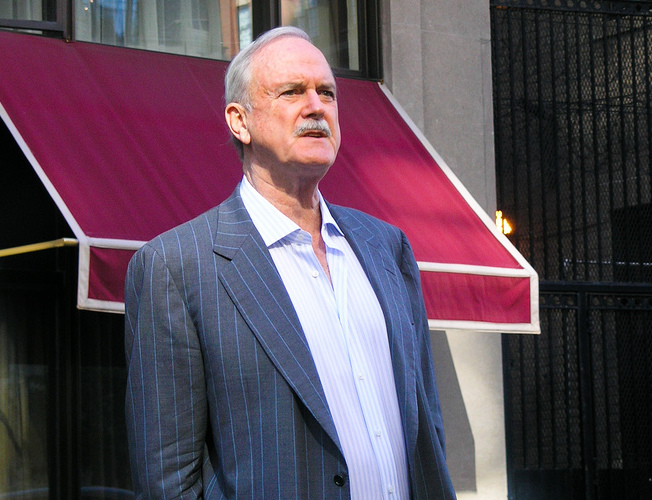
John_Cleese_2008

Cre­ative Com­mons image by Paul Box­ley

In his essay “The Rel­a­tiv­i­ty of Wrong,” Isaac Asi­mov argues per­sua­sive­ly against the com­mon belief that “’right’ and ‘wrong’ are absolute; that every­thing that isn’t per­fect­ly and com­plete­ly right is total­ly and equal­ly wrong.” Instead, he says, “it seems to me that right and wrong are fuzzy con­cepts,” and that cer­tain ideas can be true in a sense, but still in need of fur­ther cor­rec­tion with new infor­ma­tion. I can’t tes­ti­fy as to the strength of his argu­ment when it comes to the­o­ret­i­cal physics, but as far as basic induc­tive rea­son­ing goes it seems per­fect­ly sound to me, and a point worth mak­ing fre­quent­ly. We don’t expe­ri­ence a world of bina­ries, but one full of “fuzzi­ness” and near miss­es of all kinds.

As in science—argues for­mer Mon­ty Python mem­ber, com­e­dy writer, and intel­lec­tu­al gad­fly John Cleese—so in busi­ness. Cleese gave a moti­va­tion­al speech called “The Impor­tance of Mis­takes” in 1988 to an audi­ence of 500 busi­ness­man at the British-Amer­i­can Cham­ber of Com­merce, a demo­graph­ic he has addressed remote­ly since 1972 with a series of busi­ness train­ing videos made by his com­pa­ny, Video Arts. (“Bet­ter job train­ing through enter­tain­ment,” as Kate Callen at UPI describes the com­pa­ny’s mis­sion. Videos have titles like “Meet­ings, Bloody Meet­ings,” and “If Looks Could Kill.”)

In “The Impor­tance of Mis­takes,” Cleese explains that we do not veer wild­ly off course into total wrong­ness every time we make an error. Instead, our mis­takes pro­vide us with oppor­tu­ni­ties for feed­back, which enables us to make course cor­rec­tions, where we will inevitably make anoth­er mis­take, receive more feed­back, etc., until we hit the mark. These metaphors are not mine; Cleese uses a sto­ry called Gor­don the Guid­ed Mis­sile as his pri­ma­ry example—which he dubi­ous­ly claims was “the first nurs­ery sto­ry I ever remem­ber my moth­er read­ing to me”:

Gor­don the guid­ed mis­sile sets off in pur­suit of its tar­get. It imme­di­ate­ly sends out sig­nals to dis­cov­er if it is on the right course to hit that tar­get. Sig­nals come back: “No, you are not on course. So change it. Up a bit and slight­ly to the left.” And Gor­don changes course as instruct­ed and then, ratio­nal lit­tle fel­low that he is, sends out anoth­er sig­nal. “Am I on course now?” Back comes the answer, “No, but if you adjust your present course a bit fur­ther up and a bit fur­ther to the left, you will be.” He adjusts his course again and sends out anoth­er request for infor­ma­tion. Back comes the answer, “No, Gor­don, you’ve still got it wrong. Now you must come down a bit and a foot to the right.” And the guid­ed mis­sile goes on and on mak­ing mis­takes, and on and on lis­ten­ing to feed­back and on and on cor­rect­ing its behav­ior until it blows up the nasty ene­my thing. And we applaud the mis­sile for its skill. If, how­ev­er some crit­ic says, “Well, it cer­tain­ly made a lot of mis­takes on the way”, we reply, “Yes, but that didn’t mat­ter, did it? It got there in the end.” All its mis­takes were lit­tle ones, in the sense that they could be imme­di­ate­ly cor­rect­ed. And as a results of mak­ing many hun­dreds of mis­takes, even­tu­al­ly the mis­sile suc­ceed­ed in avoid­ing the one mis­take which real­ly would have mat­tered: miss­ing the tar­get.

The sto­ry illus­trates, Cleese says, the impor­tance of a “tol­er­ant atti­tude towards mistakes”—even, a “pos­i­tive atti­tude.” To take any oth­er view would be to behave “irra­tional­ly, unsci­en­tif­i­cal­ly, and unsuc­cess­ful­ly.” Cleese more or less rec­om­mends his audi­ence adopt Asimov’s sci­en­tif­ic per­spec­tive on error: mis­takes are not dis­as­trous­ly irrecov­er­able mis­steps, but ways of learn­ing how to get things “less wrong.”

Some clar­i­fi­ca­tion: Cleese means to val­i­date only “those mis­takes which, at the time they were com­mit­ted, did have a chance.” A rea­son­ably good try, in oth­er words. There are some absolutes in the world, after all, and there are “true cop­per bot­tomed mis­takes, like spelling the word ‘rab­bit with three m’s or … start­ing a land war in Asia.” But the point stands. We’re usu­al­ly in the realm of in-between, and instead of let­ting the anx­i­ety of inde­ter­mi­na­cy over­whelm us, Cleese rec­om­mends we take risks and “gain the con­fi­dence to con­tribute spon­ta­neous­ly to what’s hap­pen­ing,” thus over­com­ing inhi­bi­tions and the fear of look­ing ridicu­lous.

Cleese deliv­ered this speech to a body of peo­ple not typ­i­cal­ly known for act­ing spon­ta­neous­ly. And while it seems to me that these days top exec­u­tives can make egre­gious errors (or com­mit egre­gious fraud) and land square­ly on their feet, I won­der if those on the tiers below have the priv­i­lege of dar­ing to make errors in most indus­tries. In any case, whether an assem­bly of cor­po­rate man­agers can afford to loosen up, the rest of us prob­a­bly can, if we’re will­ing to adopt a “pos­i­tive atti­tude” toward mis­takes and consistently—scientifically, even—view them as oppor­tu­ni­ties to learn.

All of this requires a fine bal­ance of the con­fi­dence to screw up and the humil­i­ty to take con­struc­tive feed­back when you do. “Healthy behav­ior actu­al­ly aris­es out of con­fi­dence,” Cleese observed in an inter­view after his speech, and yet, “the worst prob­lem in management—in fact, the worst prob­lem in life—is the ego.”

Read many more excerpts from Cleese’s speech here.

Relat­ed Con­tent:

John Cleese on How “Stu­pid Peo­ple Have No Idea How Stu­pid They Are” (a.k.a. the Dun­ning-Kruger Effect)

John Cleese Explores the Health Ben­e­fits of Laugh­ter

John Cleese’s Phi­los­o­phy of Cre­ativ­i­ty: Cre­at­ing Oases for Child­like Play

Josh Jones is a writer and musi­cian based in Durham, NC. Fol­low him at @jdmagness

The Negro Travelers’ Green Book, the Pre-Civil Rights Guide to Traveling Safely in the U.S. (1936–66)

Green Book Cover

Pop­u­lar enter­tain­ment has roman­ti­cized the idea of the road trip as a whol­ly spon­ta­neous adven­ture, but for mid-cen­tu­ry African Amer­i­can motorists, plan­ning was essen­tial. The lodg­ings, restau­rants, and tourist attrac­tions where they could be assured of a warm wel­come were often few and far between in the era of seg­re­ga­tion.

The Negro Trav­el­ers’ Green Book, first print­ed in 1936, was an invalu­able resource for trav­el­ers of col­or, par­tic­u­lar­ly when their route took them out­side of urban areas. In the pre-Inter­net age, pub­lish­er Vic­tor Green, a Harlem-dwelling mail­man, relied on read­ers to sup­ply feed­back and new loca­tions for sub­se­quent edi­tions:

There are thou­sands of first class busi­ness places that we don’t know about and can’t list, which would be glad to serve the trav­el­er, but it is hard to secure list­ings of these places since we can’t secure enough agents to send us the infor­ma­tion. Each year before we go to press the new infor­ma­tion is includ­ed in the new edi­tion. When you are trav­el­ing please men­tion the Green Book, in order that they might know how you found their place of busi­ness, as they can see that you are strangers. If they haven’t heard about this guide, ask them to get in touch with us so that we might list their place. If this guide has proved use­ful to you on your trips, let us know. If not, tell us also as we appre­ci­ate your crit­i­cisms and ideas in the improve­ment of this guide from which you ben­e­fit. There will be a day some­time in the near future when this guide will not have to be pub­lished. That is when we as a race will have equal oppor­tu­ni­ties and priv­i­leges in the Unit­ed States. It will be a great day for us to sus­pend this pub­li­ca­tion for then we can go wher­ev­er we please, and with­out embar­rass­ment. But until that time comes we shall con­tin­ue to pub­lish this infor­ma­tion for your con­ve­nience each year.

- from the intro­duc­tion to the 1949 edi­tion

The New York Pub­lic Library’s Schom­burg Cen­ter for Research in Black Cul­ture has dig­i­tized 21 vol­umes of its Green Book col­lec­tion for your brows­ing plea­sure. It’s a trip back in time.

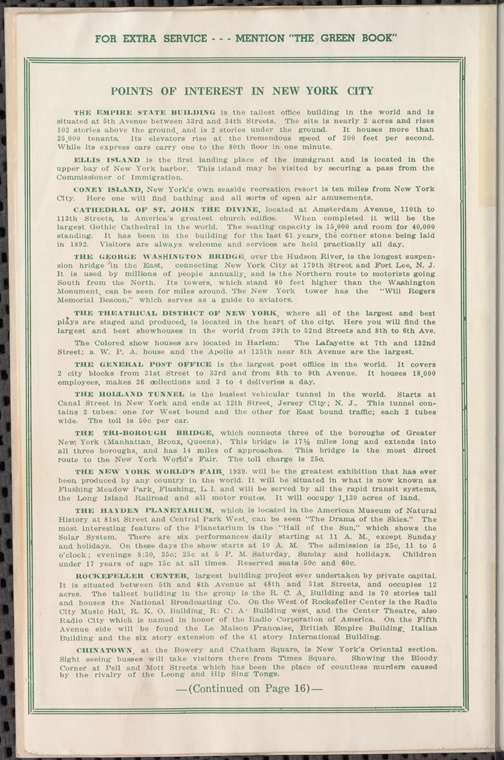
Green Book Points of Interest NYC

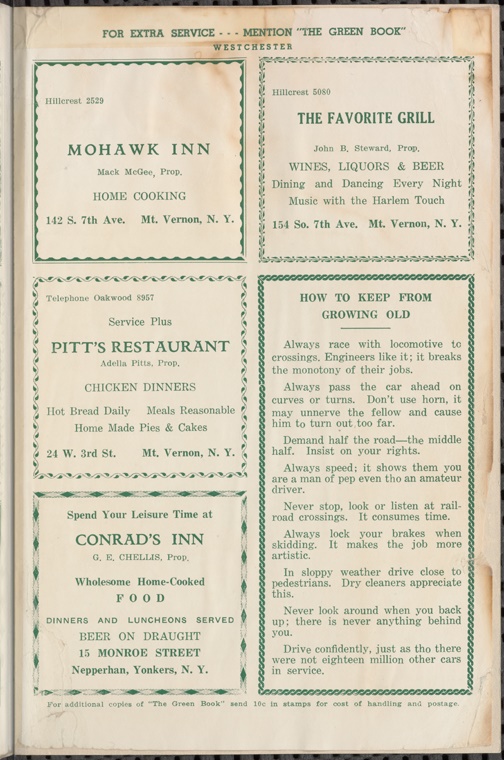
1936’s pre­mier edi­tion is geared toward vis­i­tors spend­ing time in and around New York City. In appear­ance, it resem­bles a church bul­letin or com­mu­ni­ty the­ater pro­gram, with busi­ness card ads for beau­ty salons spe­cial­iz­ing in mar­cel wav­ing and restau­rants serv­ing South­ern home cook­ing. Pub­lish­er Green extols the won­ders of Coney Island, Chi­na­town, and the The­atri­cal Dis­trict, even as he notes that “the col­ored show hous­es are in Harlem.” He also seeks to give read­ers a laugh with “How to Keep From Grow­ing Old,” a dri­ver-spe­cif­ic list that could be read aloud from the pas­sen­ger seat for the mer­ri­ment of every­one in the car. (“In slop­py weath­er, dri­ve close to pedes­tri­ans. Dry clean­ers appre­ci­ate this.”)

Green Book Westchester

The Green Book soon swelled to include nation­al list­ings, as tourists and busi­ness trav­el­ers heed­ed Green’s call to beef up the info.

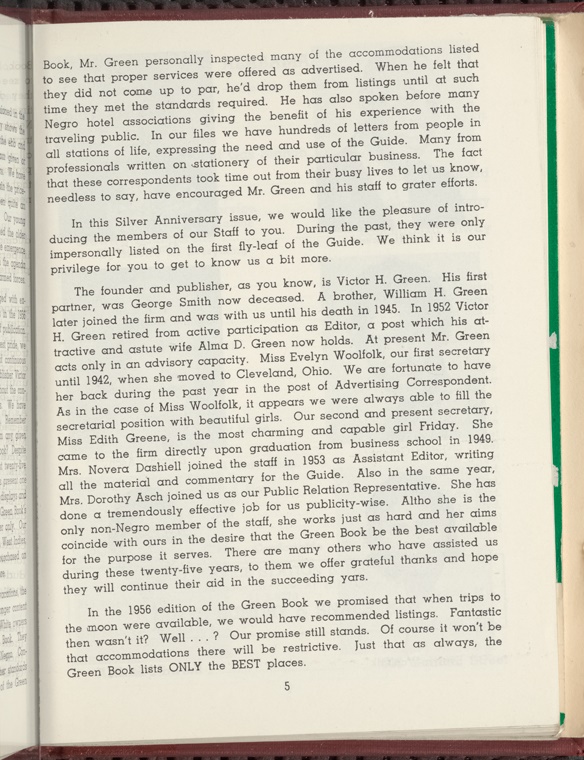
1961’s 25th anniver­sary edi­tion includes a his­to­ry of the enter­prise, a fair amount of typos, newsy updates on the staff, and a renewed promise to list the best places on the moon, should lunar trav­el become an option.

Green Book Pg 5

Green Book 25th Anniversary

Arm­chair trav­el­ers can take the NYPL’s dig­i­tized col­lec­tion out for a spin by enter­ing coor­di­nates into a map­ping fea­ture for 1947 or 1956.

Start­ing in my Indi­ana home­town with sights set on Man­hat­tan took me to the Cot­tage Restau­rant in Colum­bus, Ohio, the Jones Restau­rant in Grafton, West Vir­ginia, and the beau­ti­ful­ly named Trott Inn in Philadel­phia, before I final­ly lay my vir­tu­al head at the Amer­i­ca Hotel. (These days, it would be the Mil­len­ni­um Broad­way.)

Green Book 1956

Enjoy your trip. In the words of Vic­tor Green, “let’s all get togeth­er and make motor­ing bet­ter.”

Relat­ed Con­tent:

Read Mar­tin Luther King and The Mont­gomery Sto­ry: The Influ­en­tial 1957 Civ­il Rights Com­ic Book

Robert Penn War­ren Archive Brings Ear­ly Civ­il Rights to Life

Vin­tage 1930s Japan­ese Posters Artis­ti­cal­ly Mar­ket the Won­ders of Trav­el

Ayun Hal­l­i­day is an author, illus­tra­tor, and Chief Pri­ma­tol­o­gist of the East Vil­lage Inky zine. She doc­u­ment­ed her mis­ad­ven­tures on the road in No Touch Mon­key! And Oth­er Trav­el Lessons Learned Too Late Fol­low her @AyunHalliday

Artist Julie Green Paints the Last Suppers of 600+ Death Row Inmates on Ceramic Plates

What would you choose for your last meal?

The com­fort food of your child­hood?

Or some lav­ish dish you nev­er had a chance to taste?

What might your choice reveal about your race, region­al ori­gins, or eco­nom­ic cir­cum­stances?

Artist Julie Green devel­oped a fas­ci­na­tion with death row inmates’ final meals while teach­ing in Okla­homa, where the per capi­ta exe­cu­tion rate exceeds Texas’ and con­demned pris­on­ers’ spe­cial menu requests are a mat­ter of pub­lic record:

Fried fish fil­lets with red cock­tail sauce from Long John Silver’s

Large pep­per­oni piz­za with sausage and extra mush­rooms and a large grape soda.

Chateaubriand steak, medi­um rare with A‑1 steak sauce, fried shrimp entree with cock­tail sauce, large baked pota­to with but­ter, sour cream, chopped scal­lions, bacon bits, salt and pep­per, six pieces of gar­lic but­ter toast, whole Ken­tucky Bour­bon pecan pie, one liter of Coca Cola Clas­sic, and bag of ice

Last Meal Plate

The lat­ter order, from April 29, 2014, was denied on the grounds that it would have exceed­ed the $15-per-cus­tomer max. The pris­on­er who’d made the request skipped his last meal in protest.

Green recre­ates these, and hun­dreds of oth­er death row pris­on­ers’ last sup­pers in cobalt blue min­er­al paint on care­ful­ly select­ed sec­ond-hand plates. The influ­ence of Dutch Delft­ware and Span­ish still life paint­ing are evi­dent in her depic­tion of burg­ers, Ken­tucky Fried Chick­en, and pie.

Many of the requests betray a child­like poignan­cy:

A sin­gle hon­ey bun (North Car­oli­na, Jan­u­ary 30, 1998) 

Shrimp and ice cream  (New Mex­i­co, Novem­ber 6, 2001)

 A peanut but­ter and jel­ly sand­wich (Flori­da, Feb­ru­ary 26, 2014)

One man got per­mis­sion for his moth­er to pre­pare his last meal in the prison kitchen. Anoth­er was sur­prised with a birth­day cake after prison staff learned he had nev­er had one before.

Some refrain from exer­cis­ing their right to a spe­cial request, a choice Green doc­u­ments in text. She resorts to sim­i­lar tac­tics when a pris­on­er requests that his final meal be kept con­fi­den­tial.

Final Meal Not Made Public

Each meal Green paints is accom­pa­nied by a menu, the date, and the state in which it was served, but the pris­on­ers and their crimes go unnamed. She has com­mit­ted to pro­duc­ing fifty plates a year until cap­i­tal pun­ish­ment is abol­ished.

Green nar­rates a Last Sup­per slideshow above, or you can browse all the plates in the project, orga­nized by state here.

Relat­ed Con­tent:

What Pris­on­ers Ate at Alca­traz in 1946: A Vin­tage Prison Menu

The Odd Col­lec­tion of Books in the Guan­tanamo Prison Library

Mod­ern Art Was Used As a Tor­ture Tech­nique in Prison Cells Dur­ing the Span­ish Civ­il War

Ayun Hal­l­i­day is an author, illus­tra­tor, and Chief Pri­ma­tol­o­gist of the East Vil­lage Inky zine. Fol­low her @AyunHalliday

David Bowie Gives Graduation Speech At Berklee College of Music: “Music Has Been My Doorway of Perception” (1999)

I have lit­tle to add to the tidal wave of remem­brances and trib­utes in the wake of David Bowie’s death. Seems near­ly every­one has a sto­ry about how his music, his per­sis­tence, his gen­eros­i­ty, his genius, his unabashed weird­ness changed their lives. What he taught me as a young teenag­er was that the phrase “just be your­self” can just as well mean “be who­ev­er you can dream up,” and damn the pre­de­ter­mined roles and mean­ing­less stig­ma. Hard­er than it sounds, but Bowie pulled it off like no one before or since.

Bowie was, writes Sara Ben­in­casa, the “patron saint of… weirdos of all stripes, and that most dan­ger­ous crea­ture of all: the artist.” He did not shy away from pre­tense; he embraced it as his spe­cial méti­er. In 1999, Bowie deliv­ered the com­mence­ment address at Boston’s Berklee Col­lege of Music, where he received an hon­orary doc­tor­ate along with Wayne Short­er. In his speech, he says, he learned ear­ly on that “authen­tic­i­ty and the nat­ur­al form of expres­sion wasn’t going to be my forte.”

In fact, what I found that I was good at doing, and what I real­ly enjoyed the most, was the game of “what if?” What if you com­bined Brecht-Weill musi­cal dra­ma with rhythm and blues? What hap­pens if you trans­plant the French chan­son with the Philly sound? Will Schoen­berg lie com­fort­ably with Lit­tle Richard? Can you put hag­gis and snails on the same plate? Well, no, but some of the ideas did work out very well.

Thus began his exper­i­ments with iden­ti­ty that first took shape in the fan­tas­tic crea­ture, Zig­gy Star­dust, his “cru­sade,” as he calls it, “to change the kind of infor­ma­tion that rock music con­tained.” Speak­ing of Zig­gy, Bowie tells a sto­ry about play­ing “grot­ty… workingman’s clubs” in “full, bat­tle fin­ery of Tokyo-space­boy and a pair of shoes high enough that it induced nose bleeds.”

Informed by the pro­mot­er at one such bar that the only bath­room was a filthy sink at the end of the hall, Bowie balked. “Lis­ten son,” said the pro­mot­er, “If its good enough for Shirley Bassey, it’s good enough for you.” From this expe­ri­ence, he says, he learned that “mix­ing ele­ments of bad taste with good would often pro­duce the most inter­est­ing results.”

The speech is packed with wit­ty anec­dotes like this and self-dep­re­cat­ing asides. Most of the sto­ries, as you can hear in the video excerpt at the top of the post, are about Bowie’s “great­est men­tor,” John Lennon. Lennon, says Bowie, “defined for me, at any rate, how one could twist and turn the fab­ric of pop and imbue it with ele­ments from oth­er art­forms, often pro­duc­ing some­thing extreme­ly beau­ti­ful, very pow­er­ful and imbued with strange­ness.” Indulging his love for high and low cul­ture, Bowie under­cuts his ele­vat­ed talk of art-pop by describ­ing his and Lennon’s con­ver­sa­tions as “Beav­is and Butthead on ‘Cross­fire.’”

Bowie ends his speech with a heart­felt, and dare I say, authen­tic sum­ma­ry of his life in music. His only piece of advice, writes Boston.com: he urges the Berklee grad­u­ates to “pur­sue their musi­cal pas­sion as if it were a sick­ness.”

Music has giv­en me over 40 years of extra­or­di­nary expe­ri­ences. I can’t say that life’s pains or more trag­ic episodes have been dimin­ished because of it. But it’s allowed me so many moments of com­pan­ion­ship when I’ve been lone­ly and a sub­lime means of com­mu­ni­ca­tion when I want­ed to touch peo­ple. It’s been both my door­way of per­cep­tion and the house that I live in.

I only hope that it embraces you with the same lusty life force that it gra­cious­ly offered me. Thank you very much and remem­ber, if it itch­es, play it.

Read the full tran­script of the speech here, or below the jump:

(more…)

Björk Takes Us Inside Her Creative Process and Explains How She Writes a Song

Some songs are so straight­for­ward there’s no need to debate their mean­ings with friends and Red­dit users. Oth­ers remain opaque, despite fans’ best attempts to crack lyri­cal codes.

“Stone­milk­er,” the first track on Björk’s self-described “com­plete heart­break album” Vul­ni­cu­ra, seems to fall into the for­mer cat­e­go­ry:

Show me emo­tion­al respect, oh respect, oh respect

And I have emo­tion­al needs, oh needs, oh ooh

I wish to syn­chro­nize our feel­ings, our feel­ings, oh ooh

“Prob­a­bly the most obvi­ous lyrics I’ve ever writ­ten” she remarks in her above appear­ance on Hrishikesh Hir­way’s Song Exploder, a pod­cast where­in musi­cians decon­struct a song’s mean­ing, ori­gin, and record­ing process.

Björk was walk­ing on a beach when the sim­ple lyrics of “Stone­milk­er” popped into her head. She quick­ly real­ized that she should steer clear of the impulse to make them more clever, and chose the pri­mal over the poet­ic.

As to its inspi­ra­tion, she diplo­mat­i­cal­ly refrains from nam­ing her ex-hus­band, film­mak­er Matthew Bar­ney, on the pod­cast, say­ing only that “Stonemilker”’s nar­ra­tor has achieved emo­tion­al clar­i­ty, unlike “the per­son” to whom she is singing, some­one who prefers for things to stay fog­gy and com­plex.

She strove for arrange­ments that would sup­port that feel­ing of clar­i­ty, wait­ing for the right micro­phone, ham­mer­ing out every beat with pro­duc­er Ale­jan­dro “Arca” Gher­si, and releas­ing a sec­ond, strings only ver­sion.

“I decid­ed to become a vio­lin nerd,” she told Pitch­fork:

 I had like twen­ty tech­no­log­i­cal threads of things I could have done, but the album couldn’t be futur­is­tic. It had to be singer/songwriter. Old-school. It had to be blunt. I was sort of going into the Bergman movies with Liv Ull­mann when it gets real­ly self-pity­ing and psy­cho­log­i­cal, where you’re kind of per­form­ing surgery on your­self, like, What went wrong? 

The accom­pa­ny­ing 360-degree vir­tu­al real­i­ty music video, above, can now be viewed online as well as with Ocu­lus Rift. Every instru­ment was miked and if you can’t get clear on an Ice­landic beach, well then…

As for those plain­tive, crys­talline vocals, Björk inten­tion­al­ly held off, wait­ing for the sort of day when impul­sive­ness reigns. (I know she’s a clas­si­cal­ly trained musi­cian, but isn’t that pret­ty much every day when you’re Björk?)

Hav­ing some insights into what the artist was aim­ing for can guide lis­ten­ers toward deep­er appre­ci­a­tion. Björk oblig­ing­ly offers Song Exploder lis­ten­ers a vast buf­fet. Sure­ly some­thing will res­onate:

A tow­er of equi­lib­ri­um…

Smooth cream-like per­fec­tion…

A net…

A cra­dle…

Com­pare those sim­ple goals to Fla­vor­wires Moze Halperin’s analy­sis of  what he calls “Vulnicura’s most trag­ic track — and per­haps the sad­dest Björk has ever writ­ten”:

“Stone­milk­er” has the grandiose sound of hav­ing been sung in a cathe­dral, but like one tiny per­son con­front­ed by the large­ness of ideas of God or the archi­tec­tur­al com­plex­i­ty of one such struc­ture, Björk’s voice sounds dis­tant, echo­ing, fight­ing not to get sucked in by the threat of a vast abyss. When, in the com­ing songs, she actu­al­ly con­fronts the abyss, her voice becomes stronger. The crush­ing sad­ness of this song is that it’s the begin­ning of the end, and in lis­ten­ing to it, we feel at once clos­est to the love that was recent­ly lost, while also being aware of the tur­moil ahead.

The song’s near-non­cha­lant melan­choly — its false impres­sion that it can afford non­cha­lance because the lovers’ dis­con­nect is just a bump in the road — makes it more unbear­ably sad than the rest of the album. In this song, she car­ries all of her pre­vi­ous work on her back like arrows in a quiver, pulling ref­er­ences out one by one and shoot­ing them at lis­ten­ers to remind them of the man­i­fold ways she once doc­u­ment­ed the com­plex­i­ties of her love. For now, she’s about to doc­u­ment the com­plex­i­ties of its dis­ap­pear­ance. 

Basi­cal­ly, if you wind up feel­ing like you’re “lying at home in the moss look­ing at the sky,” Björk’s mis­sion has been accom­plished.

Want more? You can unpack oth­er artists’ defin­i­tive mean­ings and song mid­wifery by sub­scrib­ing to Song Exploder.

Relat­ed Con­tent:

Hear the Album Björk Record­ed as an 11-Year-Old: Fea­tures Cov­er Art Pro­vid­ed By Her Mom (1977)

A Young Björk Decon­structs (Phys­i­cal­ly & The­o­ret­i­cal­ly) a Tele­vi­sion in a Delight­ful Retro Video

Watch Björk’s 6 Favorite TED Talks, From the Mush­room Death Suit to the Vir­tu­al Choir

Ayun Hal­l­i­day is an author, illus­tra­tor, and Chief Pri­ma­tol­o­gist of the East Vil­lage Inky zine. Fol­low her @AyunHalliday

David Bowie Sings “Changes” in His Last Live Performance, 2006

Note: This post was pub­lished on our site less than two weeks ago–December 29, 2015–when we had no idea that David Bowie was in the final days of an 18 month bat­tle with can­cer. In the post, Josh Jones won­dered whether the video fea­tured above would be Bowie’s last live per­for­mance. And, alas, tonight we dis­cov­er that it’s appar­ent­ly so. David Bowie’s offi­cial Twit­ter and Face­book accounts, not to men­tion major news­pa­pers, have just report­ed that David Bowie has died, only two days after his 69th birth­day and the release of his new album Black­star. We’ll have more to say about Bowie, a hero of ours, in the com­ing days. But, for now, we leave you with the sad news and this now his­toric per­for­mance caught on lam­en­ta­bly grainy video. –D.C

The man of a thou­sand hair­cuts, David Bowie has been the van­guard for cre­ative rein­ven­tion for longer than many of his fans have been alive. As soon as he’s made us think he’s exhaust­ed his imag­i­na­tion, he reap­pears with yet anoth­er album, anoth­er look, anoth­er the­atri­cal tour. Except that last bit isn’t like­ly to hap­pen again. We may have seen the end of Bowie the per­former some time ago, accord­ing to such sources as long­time Bowie pro­duc­er Tony Vis­con­ti (who worked with him on 2013’s The Next Day) and British con­cert pro­mot­er John Gid­dings.

“David is one of the best artists I’ve ever worked with,” said Gid­dings in Octo­ber, ”but every time I see him now, before I even speak to him, he goes, ‘I’m not tour­ing.’” Does this rule out the odd one-off appear­ance? Who knows. Noth­ing is for cer­tain with Bowie. But it may well be that the per­for­mance above, a duet of “Changes” with Ali­cia Keys from 2006, rep­re­sents the leg­endary shape shifter’s last gig. (And if so, we hope some bet­ter-qual­i­ty video of it sur­faces.)

Bowie appeared with Keys, Dami­an Mar­ley, and come­di­an Wan­da Sykes at New York’s Ham­mer­stein Ball­room for a fundrais­er and sang Sta­tion to Sta­tion’s “Wild is the Wind” and Lodger’s “Fan­tas­tic Voy­age” in addi­tion to “Changes,” all fit­ting notes to end on, if this is indeed the end of his live per­form­ing career. He had rarely tak­en the stage since his 2004 heart attack dur­ing the Real­i­ty tour, but, Rolling Stone points out, “that didn’t stop him from play­ing with Arcade Fire twice in 2005 and David Gilmour the fol­low­ing year.”

But that was ten years ago. Dur­ing the record­ing of The Next Day, Vis­con­ti report­ed that Bowie insist­ed there would be no live shows, and there weren’t. Now, Bowie’s sur­prised us again with a new album, Black­star, and a ten-minute video, above, that looks like all the para­noid dystopi­an visions in 90s albums like Out­side, Earth­ling, and Hea­then come ter­ri­fy­ing­ly true. I can imag­ine this most recent, per­haps final, entry in the Bowie canon would make for a hell of a stage show, but it looks like he will pass that torch to the younger artists who con­tin­ue to inspire him as he ages grace­ful­ly. Black­star will be released on Jan­u­ary 8th, Bowie’s 69th birth­day.

Relat­ed Con­tent:

Lis­ten to Fred­die Mer­cury and David Bowie on the Iso­lat­ed Vocal Track for the Queen Hit ‘Under Pres­sure,’ 1981

50 Years of Chang­ing David Bowie Hair Styles in One Ani­mat­ed GIF

David Bowie’s Top 100 Books

David Bowie Becomes a DJ on BBC Radio in 1979; Intro­duces Lis­ten­ers to The Vel­vet Under­ground, Talk­ing Heads, Blondie & More

A 17-Year-Old David Bowie Defends “Long-Haired Men” in His First TV Inter­view (1964)

David Bowie and Cher Sing Duet of “Young Amer­i­cans” and Oth­er Songs on 1975 Vari­ety Show

David Bowie Sings ‘I Got You Babe’ with Mar­i­anne Faith­full in His Last Per­for­mance As Zig­gy Star­dust

Ricky Ger­vais Cre­ates Out­landish Com­e­dy with David Bowie

Josh Jones is a writer and musi­cian based in Durham, NC. Fol­low him at @jdmagness

Brazil Gives Out Books That Double as Subway Tickets, Promoting Literacy & Mass Transit at Once

One of the things I miss about liv­ing in a city with a sub­way sys­tem is the myr­i­ad thought­ful design ele­ments that go into man­ag­ing a per­pet­u­al flow of tourists and com­muters. New York’s sub­way map presents us with an icon­ic tan­gle of inter­lock­ing trib­u­taries resem­bling dia­grams of a cir­cu­la­to­ry sys­tem. The NYC system’s inge­nious­ly sim­ple graph­ic pre­sen­ta­tion of let­tered and num­bered trains, encir­cled in their cor­re­spond­ing col­ors, can be read by most any­one with a rudi­men­ta­ry grasp on the Eng­lish alphabet—from a new lan­guage learn­er to a small child. The Wash­ing­ton, DC sub­way sys­tem, though a much more pro­sa­ic affair over­all, whisks rid­ers through impres­sive­ly cav­ernous, cat­a­comb-like sta­tions, with bru­tal­ist tile and con­crete hon­ey­combs that seem to go on for­ev­er. The squig­gly lines of its col­or-cod­ed map like­wise promise ease of use and leg­i­bil­i­ty.

Ticket-Books_LPM-1-957x644

And then there are the hours of read­ing time grant­ed by a sub­way com­mute, a leisure I’ve relin­quished now that I rely on car and bike. So you can imag­ine my envi­ous delight in learn­ing about Brazil’s Tick­et Books, which are exact­ly what they sound like—books that work as sub­way tick­ets, designed with the min­i­mal­ist care that major tran­sit sys­tems do so well. And what’s more, they’re free: “To cel­e­brate World Book Day last April 23rd,” writes “future-for­ward online resource” PSFK, “[Brazil­lian pub­lish­er] L&PM gave away 10,000 books for free at sub­way sta­tions across São Paulo. Each book came with ten free trips.” Rid­ers could then recharge them and use the books again or pass them on to oth­ers to encour­age more read­ing, an impor­tant pub­lic ser­vice giv­en that Brazil­ians only read two books per year on aver­age.

Ticket-Books_LPM-3-968x516

With sub­way map-inspired cov­ers designed by firm Agên­cia Africa, the books include The Great Gats­by, The Art of War, Ham­let, Mur­der Alley by Agatha Christie, Hun­dred Love Son­nets by Pablo Neru­da, and more (includ­ing com­ic col­lec­tions from Charles Schulz and Garfield’s Jim Davis). Watch an explain­er video at the top of the post and see some love­ly images of the book cov­ers above. The cam­paign won three tro­phies at the Cannes Lions Fes­ti­val in the cat­e­gories “Pro­mo,” “Out­door,” and “Design,” and has proved so pop­u­lar that pub­lish­er L&PM has expand­ed the project to oth­er Brazil­ian cities, giv­ing me yet more rea­son to vis­it Brazil. And if Tick­et Books makes its way to a sub­way-enabled city near me, I may con­sid­er mov­ing.

via PSFK

Relat­ed Con­tent:

Design­er Mas­si­mo Vignel­li Revis­its and Defends His Icon­ic 1972 New York City Sub­way Map

Com­muters Can Down­load Free eBooks of Russ­ian Clas­sics While Rid­ing the Moscow Metro

55 Cov­ers of Vin­tage Phi­los­o­phy, Psy­chol­o­gy & Sci­ence Books Come to Life in a Short Ani­ma­tion

Artist Ani­mates Famous Book Cov­ers in an Ele­gant, Under­stat­ed Way

Josh Jones is a writer and musi­cian based in Durham, NC. Fol­low him at @jdmagness

« Go BackMore in this category... »
Quantcast