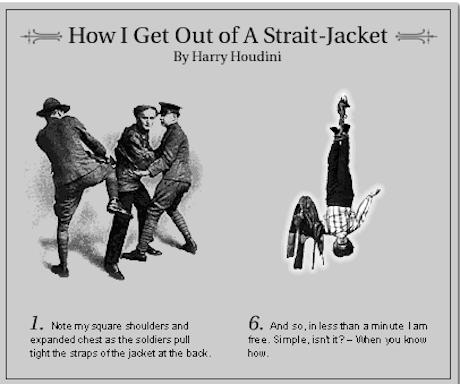
Claustrophobes, take caution, and for pity’s sake, don’t try this at home!
Should such warnings leave you undeterred, PBS has step-by-step instructions for performing Houdini’s strait jacket escape. Well, almost step-by-step. Derived from the master’s own 1909 Handcuff Secrets, the directions are both vague and horrifying in their specificity, falling somewhere between assembling an Ikea bookshelf and 127 Hours.
In need of more guidance? Have a look below at the how-to Houdini shared with Ladies Home Journal in 1918. (He also gave advice to genteel, post-WWI female readers on how to escape rope bondage.)
For a more manageable trick, imagine yourself a face in the crowd, gazing upward at the struggling magician, without texting, tweeting, or Instagramming. Sheer open-mouthed amazement is a trick we see precious little of these days.
Our best guess is that the video above was shot around 1917.
In 2006, a profile of Christopher Hitchens in The New Yorker noted how its subject had the tendency to drink “like a Hemingway character: continually and to no apparent effect.” Although Ernest Hemingway’s approach to alcohol informed the habits of his literary personages, it differed significantly from that of the late journalist. Hemingway, counter to his image, stood firmly against mixing writing and drinking, and when asked about combining the two exclaimed:
“Jeezus Christ! Have you ever heard of anyone who drank while he worked? You’re thinking of Faulkner. He does sometimes—and I can tell right in the middle of a page when he’s had his first one. Besides, who in hell would mix more than one martini at a time, anyway?”
Whereas Hemingway’s approach to writing and imbibing was often marked by a cautious and professional wall of separation, Hitchens had no such compunctions. The contrarian willingly admitted to drinking a fortifying mixture of wine and spirit throughout the day:
“I work at home, where there is indeed a bar-room, and can suit myself.… At about half past midday, a decent slug of Mr. Walker’s amber restorative, cut with Perrier water (an ideal delivery system) and no ice. At luncheon, perhaps half a bottle of red wine: not always more but never less. Then back to the desk, and ready to repeat the treatment at the evening meal. No “after dinner drinks”—most especially nothing sweet and never, ever any brandy. “Nightcaps” depend on how well the day went, but always the mixture as before. No mixing: no messing around with a gin here and a vodka there.”
Despite this hale and hearty routine, Hitchens claimed to be invigorated rather than impaired by his consumption:
“… on average I produce at least a thousand words of printable copy every day, and sometimes more. I have never missed a deadline. I give a class or a lecture or a seminar perhaps four times a month and have never been late for an engagement or shown up the worse for wear. My boyish visage and my mellifluous tones are fairly regularly to be seen and heard on TV and radio, and nothing will amplify the slightest slur more than the studio microphone.”
As with fishing and amorous exploits, so with drinking—one should be skeptical of bold claims. Nevertheless, Graydon Carter, the longstanding editor of Vanity Fair magazine, corroborated the robustness of Hitchens’ constitution in a fond and respectful obituary following the journalist’s death in 2011.
“He was a man of insatiable appetites—for cigarettes, for scotch, for company, for great writing, and, above all, for conversation… Pre-lunch canisters of scotch were followed by a couple of glasses of wine during the meal and a similar quantity of post-meal cognac. That was just his intake. After stumbling back to the office, we set him up at a rickety table and with an old Olivetti, and in a symphony of clacking he produced a 1,000-word column of near perfection in under half an hour.”
In the clip above, Hitchens makes his well-researched pronouncements on the world’s best Scotch whisky. Below, the former Asylum.com producer Anthony Layser sits down with Hitchens for a drink following the release of his memoir, Hitch-22. Over Hitchens’ beloved spirit, the duo discusses everything from writing, to Brazilian waxes, to waterboarding. The conversation, lasting some 14 minutes, is part of an Asylum.com series titled Drinks with Writers, which includes Layser’s interviews with Gary Shteyngart, Simon Rich, and Nick Hornby.
Pshaw! As she’s very likely aware, there’s not a thing wrong with her dancing. If there were, I doubt she’d be sporting saucy hot pants in the above video for the first single off of the Plastic Ono Band’s Take Me to the Land of Hell.
Her 80-year-old stems are in fantastic shape. Mayhaps this youthful vibe is a reflection of the company she keeps. A bunch of nifty pals from Generations X and Y showed up to shake their tail feathers on camera—the surviving Beastie Boys (who also produced), Reggie Watts, Cibo Matto’s Yuka Honda and Miho Hatori, gender-bending performer Justin Vivian Bond, and public radio star Ira Glass, to name but a few.
Apparently, she’s not quite as tight with all her dance partners as the video would imply. Glass describes his involvement thusly:
She’s gracious, has to be reminded by a handler who in the world I am. Then totally acts nice, says something along the lines of “I appreciate the work you do” which either means she’s heard my work or she hasn’t…. The song is called “Bad Dancer” so I’m the perfect participant because—though I love to dance, I have no illusions. I’m a spaz. I stand in front of the camera and 20 handlers and hipsters and publicists and crew and Yoko Ono and I think a reporter from Rolling Stone and I tell myself to pretend I can do this and I dance.
Perhaps declaring herself a Bad Dancer is Ono’s way of encouraging self-conscious wall huggers to drop their inhibitions and join in the fun. It’s an approach to life, and aging, that made a cult classic of Harold and Maude.
The Smithsonian’s 19 museums, 9 research centers, and 140-plus affiliates boast the world’s largest collection—137 million items, in addition to a staggering array of photos, documents, films, and recordings. Choosing which to include in The Smithsonian’s History of America in 101 Objects (published on October 29)from such a wealth of options was no easy task. (On the other hand, the Director of the British Museum Neil MacGregor did manage to encapsulate two million years of world history in one object less…)
Anthropologist Richard Kurin, the Smithsonian Institution’s Under Secretary for History, Art, and Culture, prioritized objects with vivid biographies. There may be no way for a museum to recreate the Civil War, as he notes, but a “hand-drawn battle map of the time, a bullet or gunnery shelf, a uniform bearing evidence of wounds, and broken metal shackles are all objects that, having been present at the event depicted, can speak to the larger story. The parts stand for the whole.”
Celebrity may have factored into the selection process, too. Not every entry is bespangled with a famous name, but one can’t overlook the vicarious thrill inherent in Cesar Chavez’s union jacket, Abraham Lincoln’s top hat, Helen Keller’s watch, or Marian Anderson’s mink coat. Who can say whether these resonances will lose their luster in the future. In his introduction, Kurin uses the steering wheel of the U.S.S. Maine, once an object of keen national interest due to its role in the Spanish-American War, to exemplify the descent into obscurity.
To celebrate the publication of The Smithsonian’s History of America in 101 Objects, the Smithsonian Channel will be profiling some of the items in a four-part series, Seriously Amazing™ Objects (love the trademark, guys).
Or enjoy these three samples, selected by yours truly for their unifying roundness. (I could never accomplish anything on the order of Kurin’s feat, but encourage the Smithsonian to get in touch whenever they’re in the market for someone who could repackage their collection as board books for infants…)
Negro League Baseball
1937, American History Museum
Sportswriter Frank Deford fulfills Kurin’s biographic requirements with an essay on the larger social implications behind this artifact, which scored a home run for Buck Leonard and the East lineup in the ’37 Comiskey All-Star game.
USS Oklahoma Stamp
1941, Postal Museum
“To record when a piece of mail was processed aboard ship, the Navy used wooden postmark stamps. This one bears an ominous date: Dec 6, 1941 PM. It was recovered from the battleship Oklahoma after it was hit by several torpedoes, listed to a 45-degree angle, capsized and sank in the attack on Pearl Harbor on December 7, 1941. The Oklahoma lost 429 sailors and Marines, a third of its crew.”
Wow.
The Pill
c. 1965 American History Museum
As Natalie Angier, author of Woman: An Intimate Geography pointed out in a recent article in Smithsonian magazine, “when people speak of the Pill, you know they don’t mean aspirin or Prozac but rather that mother of all blockbuster drugs, the birth control pill.” A pinnacle of both medical and feminist history, its significance extends well beyond the national borders.
How about you, readers? What item from a museum collection would you include in a book on American History?
Philosophers are quirky creatures. Some become household names, in certain well-educated households, without anyone knowing a thing about their lives, their loves, their apartments. The life of the mind, after all, rarely makes for good theater (or TV). And prior to the creation of whole academic departments devoted to contemplation and regional conferences, a philosopher’s life could be a very lonely one. Or so it would seem to those who shun solitude. But for the bookish among us, the glimpses we have here into the well-kept homes and studies of several famous dead male European thinkers may elicit sighs of wonder, or envy even. It was so much easier to keep a room of one’s own neat before computer paraphernalia and tiny sheaves of Post-it notes cluttered everything up, no?
At the top of the post, we have an austere space for a severely austere thinker, Ludwig Wittgenstein. His desk in Cambridge faces a vaulted triptych of sunlit windows, but the bookshelf has clearly been emptied since his stay, unless Herr Wittgenstein preferred to work free of the distraction of other people’s published work. Above, another angle reveals comfortable seating near the fireplace, since blocked up with what appears to be an electric heater, an appliance the ultra-minimalist Wittgenstein may have found superfluous.
In addition to his philosophy, the German scion of a wealthy and eccentric family had an interest in photography and architecture, and he built his sister Margaret a house (above) that became known for “for its clarity, precision, and austerity—and served as a foil for his written work.” Wittgenstein’s eldest sister Hermione pronounced the house unlivable, as it “seemed indeed to be much more a dwelling for the gods than for a small mortal like me.”
Another polymath, credited along with Goethe for a phase of German thought called Weimar Classicism, poet and philosopher Friedrich Schiller’s studio in his Weimar house above presents us with a light, airy space, a standing desk, and some surprisingly well-tended furnishings. Whether they are original or not I do not know, but the space befits the man who wrote Letters Upon the Aesthetic Education of Man, in which (Fordham University informs us) he “gives the philosophic basis for his doctrine of art, and indicates clearly and persuasively his view of the place of beauty in human life.” The entire house is a study in beauty. A much gloomier character, whose view of humankind’s capacity for rational development was far less optimistic than Schiller’s, Arthur Schopenhauer lived a solitary existence, surrounded by books—a life much more like the caricature of philosophy. Below, see Schopenhauer’s book collection lined up neatly and catalogued.
The façade of Schopenhauer’s birth house in Gdansk, below, doesn’t stand out much from its neighbors, none of whom could have guessed that the strange child inside would prepare the way for Nietzsche and other scourges of the good Christian bourgeoisie. No doubt little Arthur received his portion of ridicule as he shuffled in and out, an odd boy with an odd haircut. And if Schopenhauer didn’t actually write the words attributed to him about the “three stages of truth”—ridicule, violent opposition, and acceptance—he may have fully agreed with the sentiment.
Finally, speaking of Nietzsche, we have below the Nietzsche-Haus in Sils-Maria, Switzerland, where the lover of mountainous climes and hater of the vulgar rabble’s noise holed away to work in the summers of 1881, 1883, and 1888. The house now contains an open library, one of the world’s largest collections of books on Nietzsche. Trip Advisor gives the site four-and-a-half stars, a crowd-sourced score, of course, of which Nietzsche, I’m sure, would be proud.
The 80s saw a number of hits by mostly UK synth-pop and new wave bands with prominent gay members (whether their fans knew it or not) like Culture Club, Soft Cell, Frankie Goes to Hollywood, and Wham!. One of the most impressively talented singers on this burgeoning 80s dance scene was Scottish musician Jimmy Somerville who defined the tremulous falsetto disco sound of bands like Bronski Beat and the Communards. Somerville’s first hit, 1984’s “Smalltown Boy,” was something of an early “It Gets Better” message coupled with a hard-edged dance-pop sound and a very autobiographical video (below). The song, writes Allmusic, dealt openly with Somerville’s sexuality, “a recurring theme [in his work] that met with surprisingly little commercial resistance.”
Today, Somerville lives in Berlin with his dog, and he’s still got that tremendous set of pipes. A Berlin street musician found this out recently while busking “Smalltown Boy” on an acoustic guitar, and bystanders happened to catch it on video (at top). As the young street performer hits the chorus, up walks Somerville to casually join in. The singer starts over and they finish the song in harmony. The more cynical corners of the internet swear the whole thing’s staged, perhaps for a Somerville comeback, but I like to think it’s genuine serendipity, especially at the end as the German busker suddenly has a flash of recognition: “it’s you?” he asks. “It’s me,” says Somerville, “it’s a hit.”
Although Joseph Brodsky was one of the most celebrated Soviet dissidents of the 20th century, the Nobel Prize-winning poet had been unerringly hounded by the repressive Soviet government, which had labeled his poetry as “pornographic and anti-Soviet.” Refusing to abandon his writing, Brodsky was repeatedly brought to court, and once sentenced to 18 months of labor in the Arctic region of Arkhangelsk. During one of his courtroom appearances, the young poet displayed an admirable level of testicular fortitude when the judge asked him, “Who has recognized you as a poet? Who has enrolled you in the ranks of poets?” Brodsky, defiant, replied “No one. Who enrolled me in the ranks of the human race?”
Brodsky’s remarks are far from the galvanizing dose of inspiration that many commencement addresses impart, and certainly not what Michigan graduates were expecting. Rather than uplift, the poet’s words soberly ground the audience; instead of wrapping them in a warm self-assuredness, the life tips are jarring, like an ice bath. Brodsky’s address is a mix of wry humour, acknowledgement of our absurdist existential dilemma, and bold, honest compassion. Reading Brodsky’s advice, one can’t help but feel that the poet valued his flawed humanity even more than his art; likely, they were inseparable.
Here’s a boiled-down version of the poet’s remarks:
1) “Treat your vocabulary the way you would your checking account.” Expression often lags behind experience, and one should learn to articulate what would otherwise get pent up psychologically. Learn to express yourself. Get a dictionary.
2) “Parents are too close a target… The range is such that you can’t miss.” Be generous with your family. Even if your convictions clash with theirs, don’t reject them—your skepticism of your infallibility can only benefit you. It will also save you a good deal of grief when they are gone.
3) “You ought to rely on your own home cooking.” Do not expect society to arrange itself to your benefit—there are too many people whose desires conflict for that to happen. Learn to rely on yourself, and help those who cannot.
4) “Try to not to stand out.” Do not covet money or fame for their own sake. It is best to be modest. There is comfort joining the ranks of those who follow their own discreet paths.
5) “A paralyzed will is no dainty for angels.” Do not indulge in victimhood. By blaming others, you undermine your determination to change your circumstances. When life confronts you with hardships, remember that they are no less an intrinsic part of existence. If you must struggle, do so with dignity.
6) “To be social is to be forgiving.” Do not let those who have hurt you live on in your complaints. Forget them.
The full text—irrevocably more pithy and eloquent—may be found here.
Israeli musician and video artist Ophir Kutiel, akaKutiman, gained notice culling and remixing unrelated performers’ Youtube videos for his extremely collaborative-feeling Thru You project.
With 2011’s Thru Jerusalem, the urge to connect fellow musicians went live, as he left his computer to film local instrumentalists performing tunes of their choice in various city settings. Back in Tel Aviv, he edited the results into one of his signature mashups, not to mention a virtuoso musical travelogue.
Now he’s traveled even further afield to Tokyo, capturing forms both traditional and ultra-modern, for the first in a new series of original shorts from PBS Digital Studios.
Mayuko Kobayashi plucks serenely at the strings of a koto. Turntablist KEIZOmachine!, half of the breakbeat duo Hifana, scratches in his studio. The diminutive Ishii Chizuru pounds a taiko drum. Inventor Maywa Denki (aka Novumichi Tosa) demonstrates his adorable Otama-Tone. (Currently marked down in the Museum of Modern Art’s gift shop, for those looking ahead to their holiday shopping lists.)
The desire to integrate the ancient and the new is best embodied by kimono-clad Makoto Takei, who closes his eyes on a high-rise balcony as he plays a shakuhachi flute, the vertical city serving as backdrop.
Add a pink haired Harajuku girl, a string of red lanterns, innumerable cell phones, some pixellated video game characters, an aged temple or two, and several teeming intersections, then blend at top speed!
The product may be a bit earsplitting at times, but that in itself is fitting given the location. Thru Tokyo is a marvelous audio-visual postcard from 21st-century Edo, Japan.
We're hoping to rely on loyal readers, rather than erratic ads. Please click the Donate button and support Open Culture. You can use Paypal, Venmo, Patreon, even Crypto! We thank you!
Open Culture scours the web for the best educational media. We find the free courses and audio books you need, the language lessons & educational videos you want, and plenty of enlightenment in between.