Patrick Stewart came to Comicpalooza (aka The Texas International Comic Convention) as a special guest. It’s not hard to imagine why, especially given his roles on Star Trek: The Next Generation and the X‑Men film series.
During a Q&A session with convention attendees, Stewart fielded a question that asked everyone to leave behind the fantasy world and confront some cold realities. Since 2006, Stewart has worked with Amnesty International and Refuge, a UK charity for abused women, to make a meaningful dent in the levels of domestic violence experienced in our societies. Still haunted, Stewart personally witnessed domestic violence in his own home as a child. As a youngster, he felt powerless to stop it. But, as an adult, he can now put his celebrity on the line and ask men to be part of the solution, not the problem. The video, which gets more moving as it goes along, also makes the case for improving treatment of PTSD — a problem unto itself, and also something that contributes to domestic violence, especially during times of prolonged war.
Note: the influential speech referenced in the conversation appears below.
If you watch enough commencement speeches, if you gather the collective wisdom of people who “have made it” in life, you start to see a trend. The key to life isn’t being smarter than the rest, though that doesn’t hurt. The key is resilience — your ability to deal with inevitable failures, learn from your mistakes, dust yourself off emotionally, physically or financially, and then move forward. It’s easier said than done, but essential. J.K. Rowling, who went from homelessness to writing Harry Potter, delivered that message at Harvard several years ago. Now Oprah Winfrey, who emerged from the Jim Crow South to become America’s most enduring TV personality, returns to Harvard to tell students her version of that story:
There is no such thing as failure. Failure is just life trying to move us in another direction. Now, when you’re down there in the hole, it looks like failure. … Give yourself time to mourn what you think you may have lost, but then here’s the key: Learn from every mistake because every experience, encounter and particularly your mistakes are there to teach you and force you into being more who you are. And then figure out what is the next right move. And the key to life is to develop an internal moral, emotional GPS that can tell you which way to go.
For more insights into constructively managing failure, you can visit these talks below:
Her appetite for digital dialogue with admirers and accusers alike calls to mind fellow shrinking violet Courtney Love. Her refusal to let anyone but Amanda Palmer speak for Amanda Fucking Palmer has given rise to an army of trolls, who gleefully find proof of monstrous ego in her most innocuous of moves. It’s the price of allowing the public complete access to “Do It With a Rockstar,” if you will.
As noted in her keynote speech (above) at the recent Muse and the Marketplace literary conference, “with the internet you do not get to choose.” This applies whether one is generating content or leaving nasty comments. Her remarks touch upon her most recent firestorm, a direct trail leading back to “A Poem for Dzhokar,” a hastily composed and posted attempt to put herself in the shoes of the suspected Boston Marathon bomber as he lay in a boat, awaiting capture.
Clearly, someone with her experience does not slap such a hot potato online innocent of the consequences. She got plenty of lumps, and whether or not the majority of them were deserved is a matter of personal opinion. More than 2300 people quickly logged on to voice these aforementioned opinions, some supportive, some taking the form of mocking haikus, which Palmer appreciated, especially since it was, at the time, National Poetry Month.
It seems to me that any time her ass is hanging out her giant heart’s not far behind. Listen to her speech, and see if you don’t find her attitude ultimately inspiring, especially for those artists interested in connecting with a larger audience. (The presentation’s so restrained, you can turn your back on the screen, turn your attention to some pedestrian task, and enjoy her thoughts podcast-style. )
It turns out that the fleeting pronouncements we post on Twitter are catnip for academics and others eager to find the elusive pulse of American society. Since Twitter launched in 2006, researchers have been hard at work figuring out how to turn those 140-character musings into tea leaves with something meaningful to say about us all.
Here come three new projects that claim to provide a window into the American soul through Twitter. Whether they succeed or not, well, that’s still unclear. (And, by the way, you can start following Open Culture on Twitter here.)
They looked at two things: Hurricane Sandy (top) and the 2012 Presidential Election (above). Using Twitter’s “garden hose feed”—a random sampling of 10 percent of the roughly 500 million tweets sent every day—researchers color-coded tweets red for negative tone and blue for positive and showed the shifting concentrations of Twitter activity across the country. It looks like a map of a talking weather system as occasional dialogue boxes open up to show representative tweets. Researcher Kalev Leetaru argues that tracking Twitter activity gives us the potential to track the heartbeat of society.
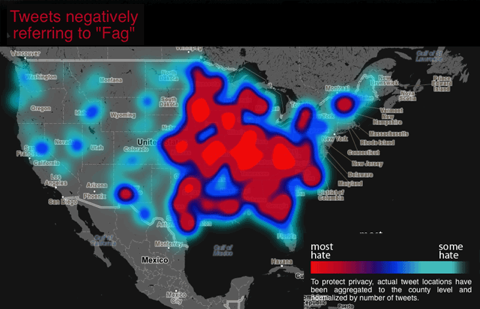
Two other projects look in an on-going way at tweet “tone,” or the negativity/positivity of messages. One spin on this research is the Geographic Hate Map (sample map above), a project by Dr. Monica Stephens of Humboldt State University in Northern California. To begin their work, Stephens and her team accessed a massive database of geographically tagged tweets sent between June, 2012 and April, 2013.
They used only tweets that contained any of ten “hate words.” They read each tweet to be sure the words were used in a negative way and built a map based on where the tweets came from. Then they aggregated to the county level and normalized for the amount of twitter traffic in that area so that densely populated areas don’t look more racist or homophobic by default.
Then there’s the glass half full. The Hedonometer measures happiness, or lack thereof, as expressed by tweets, calculating averages based on what the researchers call “word shifts” (watch an explanation above). This research project, put together by the University of Vermont Complex Systems Center, uses the same garden hose feed as the Global Twitter Heartbeat. This project searches for frequently used words to measure how good a day Twitter users are having. Since 2008 the Hedonometer has kept track of how often words like “happy,” “yes,” and “love” pop up in tweets, as opposed to “hate,” “no,” and “unhappy.” The saddest day on Hedonometer record so far is April 15, 2013, the day bombs exploded at the Boston Marathon finish line. Christmas Day tends to rank as the happiest day of the year.
To be sure, any tool that uses tweets for data is measuring a very young and specific subgroup of people. Tweets are not a reliable measure of anything, really, but maybe with some tweaking, these research models will come up with something interesting.
In sixth grade, my friend Amy Osborn’s parents took us to a screening of Annie Hall. The bedroom scenes with Carol Kane, Janet Margolin and Diane Keaton were chaste by today’s standards. The repartee was so beyond my frame of reference, it caused but little discomfort. What did me in was the two-line exchange between a cartoon Woody Allen and Snow White’s Wicked Queen concerning her period (or lack thereof). Are You There God? It’s Me, Margaret was our sacred text, but its most sensational subject matter—menstruation—was deeply taboo outside of my 1970’s Indiana tribe. I could have died, knowing Mr. Osborn was sitting right there. The one consolation was that my own parents weren’t.
These awkward encounters can be defining, which explains why the Tribeca Film Festival sought to ferret them out as part of its One Question series. It’s impressive that the four directors and one producer featured above decided to pursue careers in film after inadvertently sharing with their parents such tender moments as a masturbating Philip Seymour Hoffman in Todd Solondz’s seminal (pardon the pun) Happiness or the relentless defloration scene at the top of Larry Clark’s Kids.
Perhaps you can relate. If so, please spill the gory details below. Provided you’re strong enough to revisit the trauma, what was your most cringe-inducing moment at the movies with your mom or dad, or—let’s not be ageist here—your kids?
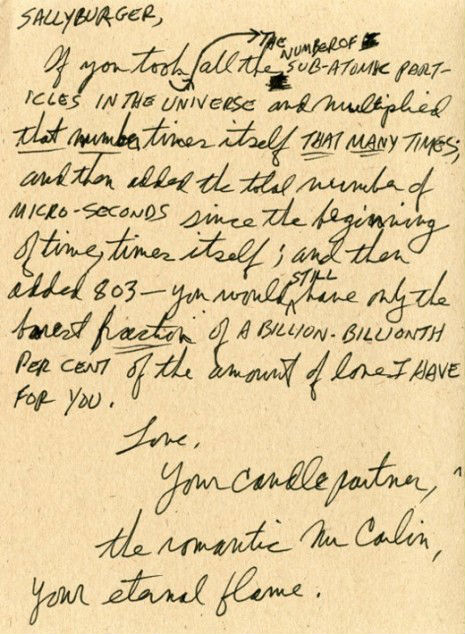
Given such a prodigious output, he wisely turned to science to quantify his ardor in the reproduction above. (His physician’s scrawl can be difficult to decipher — a transcription is supplied below.)
SALLYBURGER,
If you took THE NUMBER OF SUB-ATOMIC PARTICLES IN THE UNIVERSE and multiplied that number times itself THAT MANY TIMES; and then added the total number of MICRO-SECONDS since the beginning of time, times itself; and then added 803—you would STILL have only the tiniest fraction of A BILLION-BILLIONTH PER CENT of the amount of love I HAVE FOR YOU.
Love,
your candle partner,
the romantic Mr Carlin,
your eternal flame
A portion of these sweet nothings were collected in The George Carlin Letters. Its subtitle, The Permanent Courtship of Sally Wade, was taken from the note he left on her computer the day he died, two days shy of their 10th anniversary.
David Foster Wallace was a hyper-anxious chronicler of the minute details of a certain kind of upper-middle-class American life. In his hands, it took on sometimes luminous, sometimes jaundiced qualities. Wallace was also something of a metaphysician: reflective teacher, wise-beyond-his-years thinker, and (tragically in hindsight) quite self-deprecating literary superstar. In the latter capacity, he was often called on to perform the duties of a docent, administering commencement speeches, for example, which he did for the graduating class of Kenyon in 2005.
He began with a story: two young fish meet an older fish, who asks them “How’s the water?” The younger fish look at each other and say, “What the hell is water?” Foster Wallace explains the story this way:
The point of the fish story is merely that the most obvious, important realities are often the ones that are hardest to see and talk about. Stated as an English sentence, of course, this is just a banal platitude, but the fact is that in the day to day trenches of adult existence, banal platitudes can have a life or death importance, or so I wish to suggest to you on this dry and lovely morning.
Foster Wallace acknowledges that the anecdote is a cliché of the genre of commencement speeches. He follows it up by challenging, then re-affirming, another cliché: that the purpose of a liberal arts education is to “teach you how to think.” The whole speech is well worth hearing.
In the video above, “This is Water,” The Glossary—“fine purveyors of stimulating videograms”—take an abridged version of the original audio recording and set it to a series of provocative images. In their interpretation, Foster Wallace’s speech takes on the kind of middle-class neurosis of David Fincher’s realization of Chuck Palahniuk’s Fight Club.
It’s a dystopian vision of post-grad life that brings vivid clarity to one of my mentors’ pieces of advice: “There are two worst things: One, you don’t get a job. Two, you get a job.” Or one could always quote Morrissey: “I was looking for a job, and then I found a job. And heaven knows I’m miserable now.” I still haven’t figured out what’s worse. I hope some of those Kenyon grads have.
If you would like to support the mission of Open Culture, consider making a donation to our site. It’s hard to rely 100% on ads, and your contributions will help us continue providing the best free cultural and educational materials to learners everywhere. You can contribute through PayPal, Patreon, and Venmo (@openculture). Thanks!
Andy Stewart builds boats with his own hands for life-affirming reasons. It’s a way to make inanimate objects come alive, to breathe new life into our world. But Stewart also enjoys the challenge of it all. The sea, he tells us, is the “final arbitrator” of your work. Quite decisively, it tells you whether a boat has been crafted with precision, whether every piece of wood contributes to the larger hull/whole. If your boat can stand the rigorous tests of nature and time, you know you’ve mastered your craft. The short documentary above, Shaped on all Six Sides, was directed by Kat Gardiner.
If you would like to support the mission of Open Culture, consider making a donation to our site. It’s hard to rely 100% on ads, and your contributions will help us continue providing the best free cultural and educational materials to learners everywhere. You can contribute through PayPal, Patreon, and Venmo (@openculture). Thanks!
We're hoping to rely on loyal readers, rather than erratic ads. Please click the Donate button and support Open Culture. You can use Paypal, Venmo, Patreon, even Crypto! We thank you!
Open Culture scours the web for the best educational media. We find the free courses and audio books you need, the language lessons & educational videos you want, and plenty of enlightenment in between.