“Gorging on the man’s image and voice is a reminder of his strength as a writer that’s easiest to overlook: an awareness of his own limitations. This is a quality that his acting lacks.” This Christine Smallwood writes of the novelist Norman Mailer after having watched the late-sixties/early-seventies trilogy of films he directed and starred in: Wild 90, Beyond the Law, and Maidstone. Her post on theNew Yorker’s blog Page-Turner considers these pictures, recently released as a box set in the Criterion Collection’s Eclipse Series, ultimately finding them hugely flawed but not uninterestingly so. They have cinematography by a young D.A. Pennebaker, they foreshadow reality television in their own skewed way, and they capture the spectacle of Norman Mailer reveling in, essentially, the role of himself. Not that this counts as an acting technique: “Mailer lurches, lumbers, rants, reels,” writes Smallwood. “He doesn’t bother with a story that would drum up interest or fix attention, because he knows, and you know, that you’re watching because he’s Norman Mailer.”
But a force fiercer than Mailer’s will to impose his own reality rips into the very end of Maidstone, and the result has become a popular clip on the internet. That force’s name is Rip Torn. He plays the brother-in-law and would-be assassin of Mailer’s character, an iconoclastic auteur running for President of the United States. On camera, Torn suddenly attacks Mailer, and the two launch into what looks like an actual brawl, involving techniques up to and including a hammer to the ear. “The intrusion of bald ‘real life’ means that Mailer has to reckon with another person,” writes Smallwood. “This, I think, is what motivated his interest in violence more generally: it interrupted the constant preoccupation of being Norman Mailer, forcing him out of himself. In his writing, he could sometimes discipline himself into achieving those moments, as when he imagined the mind-set of a policeman in ‘Armies of the Night,’ but onscreen he needed to get hit.”
When F. Scott Fitzgerald died in 1940, his New York Times obituary claimed, “the promise of his brilliant career was never fulfilled.” This is a sentence that may puzzle modern-day lovers of Fitzgerald’s enduringly-relevant fiction, but it was the judgment of the time on the exhausted, alcoholic writer’s career. And it was a judgment he often applied to himself, as he demonstrated publicly in his 1936 essay “The Crack-Up,” about his depression. Reduced at the end of his life to writing film scripts for money, a task he found degrading for a “successful literary man” such as himself, Fitzgerald also, at some time near his final year, made recordings of himself reading the work of Shakespeare, Keats, and others, presumably also for money, though it’s not exactly clear who produced the recordings or why.
In the first video (above), listen to Fitzgerald deliver a dignified reading of Othello’s speech to the Venetian Senators from Act 1, Scene 3 of Othello. Fitzgerald stumbles and slurs occasionally, and the speech may in fact be composed of several different takes edited together, suggesting that he may have had difficulty making it through. Nonetheless, his voice is seductive and sonorous; he reads the speech as a literary monologue, rather than a declaration. Hear more of him below, reading an edited version of John Masefield’s “On Growing Old,” a poem which may have had particular poignancy to the man who wrote in 1936, “of course all life is in a process of breaking down.” But even in decline, Fitzgerald was worth listening to. You can find major works by F. Scott Fitzgerald in our Free eBooks and Free Audio Books collections.
Josh Jones is a doctoral candidate in English at Fordham University and a co-founder and former managing editor of Guernica / A Magazine of Arts and Politics.
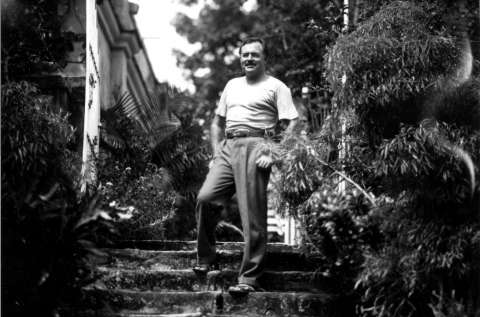
We associate Ernest Hemingway with foreign locales: Spain, Italy, Paris, Africa and Cuba. He may be the definitive peripatetic writer, famously hauling his manuscripts-in-progress around the world while soaking in enough material for the next book.
Lucky for us Hemingway may also be one of the most photographed writers of his generation. The photographs in the Ernest Hemingway Collection take us into a mid-century world where writers, actors, political leaders and beautiful jet-setters mingled on patios and yachts at ease before the camera. These were the days before paparazzi started hiding in bushes.
The collection is available to us with a typical Hermingway-esque story attached. When he died in 1961 in Idaho, most of his personal effects were still in Cuba. Heminway lived for 20 years in the Finca Vigia, a home he bought with the royalties from For Whom the Bell Tolls. It was at Finca Vigia that he wrote The Old Man and the Sea. Rather than writing in the workshop that his wife Mary had built for him there, he used the bedroom, leaving the new room for his numerous pet cats to use.
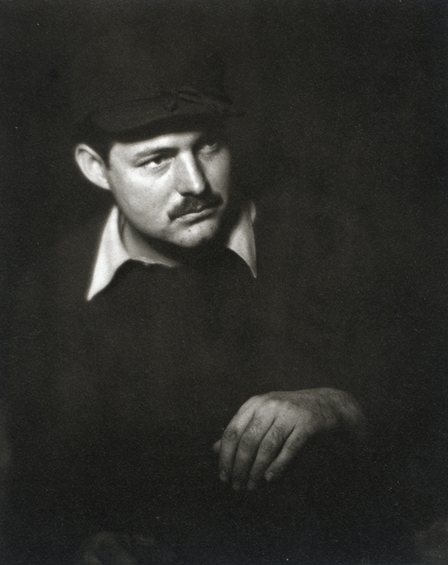
Hemingway was in Paris when he sat for this portrait in March, 1928. The photographer, Helen Pierce Breaker, was a friend and had been a bridesmaid in Hemingway’s wedding to his first wife, Hadley.
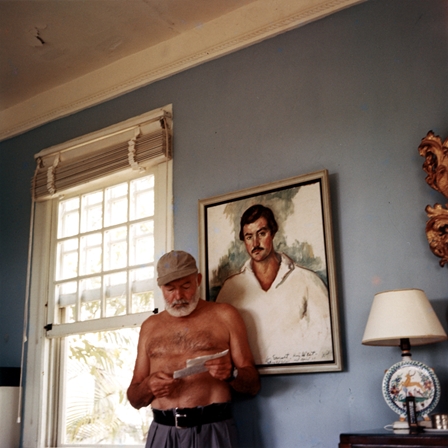
By the early 1950s, Hemingway was living in Cuba. The painting behind him here at Finca Vigia is a portrait of himself by Waldo Peirce titled Kid Balzac.
Kate Rix is an Oakland-based freelance writer. Find more of her work at .
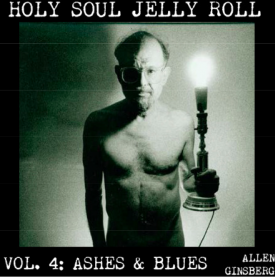
Today marks the release of the final volume in the Allen Ginsberg box set Holy Soul Jelly Roll: Poems & Songs 1949–1993, a collection of previously released and unreleased recordings. For whatever reason, Ginsberg Recordings decided to stagger the digital release of the set over the month of September, beginning with Volume Four (Ashes & Blues), followed by Three (Ah!), Two (Caw! Caw!), and finally, today, Volume One (Moloch!). The last volume “contains the stunning 1956 Berkeley Town Hall reading of Ginsberg’s seminal poem ‘Howl,’ as well as other important historic early poems.” You can preview and buy all four volumes on iTunes, but you needn’t pay to hear some full tracks: Ginsberg Recordings made the “8 song sampler” available on Soundcloud for us. Here is the track listing:
1. A Supermarket In California
2. Green Valentine Blues
3. Kral Majales (King Of May)
4. CIA Dope Calypso
5. Laughing Song
6. First Party at Ken Kesey’s With Hell’s Angels
7. Vomit Express
Listening to these poems brings a couple things to mind. One, the realization, too often lost, that “There was a time when not every moment of our lives was recorded, photographed, tweeted, facebooked, or otherwise made instantly available to the global billions of the connected,” in the words of Ginsberg friend and archivist Stephen Taylor. In those ancient days, recordings mattered and the things people chose to put on tape or film or whatever medium they chose were precious because of their rarity and their fragile physicality. Two, these recordings underscore the perfect pitch of the collection’s title, which takes in all at once the complementary natures of Ginsberg the holy fool—mystic, trickster, and sensual “white Negro” (to take Norman Mailer’s snide 50s term for hipster bohemians). Ginsberg was all these things, usually in the same poem. His voice can slide in subtle or startling turns from bathos to pathos, from the fantastic imaginary to keenly-observed social critique.
In the first recorded poem above, “A Supermarket in California,” Ginsberg imagines himself shopping for groceries at night with Walt Whitman, an elaborate extended excursion into the poet’s process. In an intro, he calls this a “coming down” poem after writing “a lot of great poetry.” Reminiscent of Wallace Stevens’ “The Man on the Dump,” Ginsberg describes “shopping for images” in a “hungry fatigue… dreaming of your enumerations.” The “you” here is Whitman, and in the poem the two stroll down store aisles, sampling the “neon fruit” without paying. In a funny image, Ginsberg asks his muse, “which way are we going? Which way does your beard point tonight?” Maybe Ginsberg thought it a minor poem, but I’d call it a tiny delicacy next to the sprawling monster “Howl.”
Another short autobiographical poem above—well-stocked with images as precise, but not so neon, as “Supermarket”—is “First Party at Ken Kesey’s with Hell’s Angels.” I can only imagine this is an accurate account of events not much embellished but perceptively edited to give us an elliptical succession of loosely connected vignettes. None of the images surprise so much as confirm exactly what one expects to find at Ken Kesey’s (with Hell’s Angels): “Cool black night through the red woods,” “a few tired souls hunched over in black leather jackets,” “a yellow chandelier at three a.m.,” “twenty youths dancing through the vibration in the floor,” “a little marijuana in the bathroom,” and, of course, “four police cars parked outside the painted gate.” It’s not a masterpiece, but it’s a little showcase of Ginsberg’s talent for compression and, to use the word he applies to his hero Walt Whitman, “enumerations” of jazz-inflected lines that pop into focus with pleasing immediacy.
“CIA Dope Calypso” is also true to its title, an upbeat island-style ditty with congas, guitar and maracas–a song about the Southeast Asian heroin trade (allegedly!), Ginsberg sings, “supported by the C‑I-A.” Never afraid to hurl verbal Molotovs at his imperialist foes, Ginsberg does so here with strained and silly rhymes and a good deal of tongue-in-cheek in-joking. It’s a “jelly roll” performance—wickedly subversive.
All of these recordings are great fun, but Ginsberg seems best known for the “Holy Soul” part of his persona, the thundering prophet mystic warrior of “Howl,” and that’s here in the box set too, with “Howl” and other poems. We’ve previously featured Ginsberg’s riveting 1955 reading of the epic “Howl” at San Francisco’s Six Gallery, dramatized in Rob Epstein and Jeffrey Friedman’s semi-biopic Howl, with James Franco as Ginsberg. Below, see the poem’s apocalyptic “Moloch” section set to some terrifying animated images from the 2010 film:
If Holy Soul Jelly Roll doesn’t fully sate your taste for Ginsberg’s voice, never fear: there is much more to come from Ginsberg Recordings.
Josh Jones is a doctoral candidate in English at Fordham University and a co-founder and former managing editor of Guernica / A Magazine of Arts and Politics.
When his telephone rang on February 14, 1989, Christopher Hitchens was thunderstruck. A newspaper reporter was on the line, asking for his reaction to a radio speech from Tehran earlier that day in which the theocratic ruler of Iran, Ayatollah Ruhollah Khomeini, called on Muslims around the world to murder his friend the novelist Salman Rushdie because of something Rushdie had written in his book The Satanic Verses. As Hitchens later wrote in his memoir, Hitch-22:
I felt at once that here was something that completely committed me. It was, if I can phrase it like this, a matter of everything I hated versus everything I loved. In the hate column: dictatorship, religion, stupidity, demagogy, censorship, bullying, and intimidation. In the love column: literature, irony, humor, the individual, and the defense of free expression. Plus, of course, friendship–though I like to think that my reaction would have been the same if I hadn’t known Salman at all. To re-state the premise of the argument again: the theocratic head of a foreign despotism offers money in his own name in order to suborn the murder of a civilian citizen of another country, for the offense of writing a work of fiction. No more root-and-branch challenge to the values of the Enlightenment (on the bicentennial of the fall of the Bastille) or to the First Amendment to the Constitution, could be imagined.
Rushdie went into hiding, but his Japanese translator, Hitoshi Igarashi, was murdered, and attempts were made against the lives of several other translators and a publisher. Bookstores in England and California were firebombed, and many more received threats of violence. The public reaction to all of this was a bitter disappointment to Hitchens. In his book, God is Not Great: How Religion Poisons Everything, he wrote:
One might have thought that such arrogant state-sponsored homicide, directed at a lonely and peaceful individual who pursued a life devoted to language, would have called forth a general condemnation. But such was not the case. In considered statements, the Vatican, the archbishop of Canterbury, the chief sephardic rabbi of Israel all took a stand in sympathy with–the ayatollah. So did the cardinal archbishop of New York and many other lesser religious figures. While they usually managed a few words in which to deplore the resort to violence, all these men stated that the main problem raised by the publication of The Satanic Verses was not murder by mercenaries, but blasphemy. Some public figures not in holy orders, such as the Marxist writer John Berger, the Tory historian Hugh Trevor-Roper, and the doyen of espionage authors John Le Carré, also pronounced that Rushdie was the author of his own troubles, and had brought them on himself by “offending” a great monotheistic religion. There seemed nothing fantastic, to these people, in the British police having to defend an Indian-born ex-Muslim citizen from a concerted campaign to take his life in the name of god.
This month Rushdie published Joseph Anton: A Memoir, describing his nine-years of life in hiding under the Ayotollah’s death order. The new book’s relevance could not be more obvious, given the Anti-American rioting that broke out in much of the Muslim world this month in reaction to a YouTube video called Innocence of Muslims. Hitchens died last December, and his voice in the matter is sorely missed. But it isn’t hard to imagine what he might have said. In a 2009 Vanity Fair essay, “Assassins of the Mind,” Hitchens wrote: “For our time and generation, the great conflict between the ironic mind and the literal mind, the experimental and the dogmatic, the tolerant and the fanatical, is the argument that was kindled by The Satanic Verses.”
For a recent discussion with Rushdie, listen to his September 21 interview with Studio360:
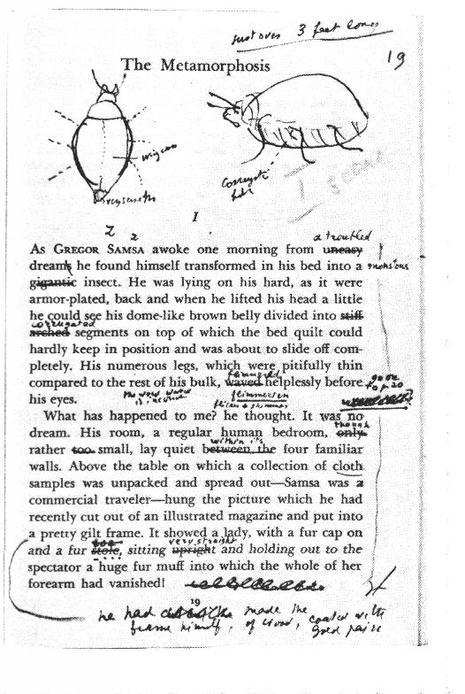
Vladimir Nabokov admired Franz Kafka’s novella, The Metamorphosis. Hence the lecture that Nabokov dedicated to the work here. But he also saw some small ways to wordsmith the story, or at least the English translation of it. Above, we have some edits — the nips and tucks — that Nabokov scribbled on his personal copy of Kafka’s most famous work.
In 1989, Nabokov’s lecture on The Metamorphosis was actually turned into a television production starring Christopher Plummer. You can watch The Metamorphosis — A Study: Nabokov on Kafka online. It runs 30 minutes. Of course, you can also download your own copy of Kafka’s near perfect work of poetic imagination, to borrow a phrase from Elias Canetti. Visit our collections of Free eBooks and Free Audio Books.
If you would like to support the mission of Open Culture, consider making a donation to our site. It’s hard to rely 100% on ads, and your contributions will help us continue providing the best free cultural and educational materials to learners everywhere. You can contribute through PayPal, Patreon, and Venmo (@openculture). Thanks!
The story behind the writing of Frankenstein is famous. In 1816, Mary Shelley and Percy Bysshe Shelley, summering near Lake Geneva in Switzerland, were challenged by Lord Byron to take part in a competition to write a frightening tale. Mary, only 18 years old, later had a waking dream of sorts where she imagined the premise of her book:
When I placed my head on my pillow, I did not sleep, nor could I be said to think. My imagination, unbidden, possessed and guided me, gifting the successive images that arose in my mind with a vividness far beyond the usual bounds of reverie. I saw — with shut eyes, but acute mental vision, — I saw the pale student of unhallowed arts kneeling beside the thing he had put together. I saw the hideous phantasm of a man stretched out, and then, on the working of some powerful engine, show signs of life, and stir with an uneasy, half vital motion.
This became the kernel of Frankenstein; or, The Modern Prometheus, the novel first published in London in 1818, with only 500 copies put in circulation.
Nearly two centuries later, a first edition signed by Shelley has turned up in the vestiges of Lord Byron’s library. The grandson of Lord Jay notes, “I saw the book lying at an angle in the corner of the top shelf. On opening it, I saw the title page, recognised what it was at once and leafed hungrily through the text — it was only when I flicked idly back to the first blank that I saw the inscription in cursive black ink, “To Lord Byron, from the author.”
Today this inscribed copy is on display at Peter Harrington’s, a London specialist in rare books. And there it will be put on auction, likely fetching north of £350,000, or $575,000. The video above gives you more of the backstory on the writing and gifting of the book.
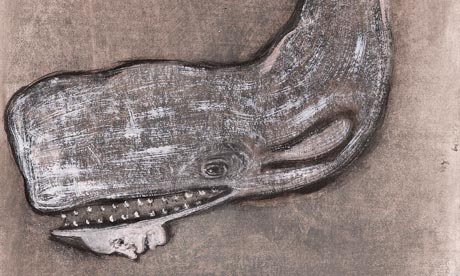
“Moby-Dick is the great American novel. But it is also the great unread American novel. Sprawling, magnificent, deliriously digressive, it stands over and above all other works of fiction, since it is barely a work of fiction itself. Rather, it is an explosive exposition of one man’s investigation into the world of the whale, and the way humans have related to it. Yet it is so much more than that.”
That’s how Plymouth University introduces Herman Melville’s classic tale from 1851. And it’s what sets the stage for their web project launched earlier this week. It’s called The Moby Dick Big Read, and it features celebrities and lesser known figures reading all 135 chapters from Moby Dick — chapters that you can start downloading (as free audio files) on a rolling, daily basis. Find them on iTunes, Soundcloud, RSS Feed, or the Big Read web site itself.
The project started with the first chapters being read by Tilda Swinton (Chapter 1), Captain R.N. Hone (Chapter 2), Nigel Williams (Chapter 3), Caleb Crain (Chapter 4), Musa Okwonga (Chapter 5), and Mary Norris (Chapter 6). John Waters, Stephen Fry, Simon Callow and even Prime Minister David Cameron will read future chapters, which often find themselves accompanied by contemporary artwork inspired by the novel.
If you want to read the novel as you go along, find the text in our collection of Free eBooks. We also have versions read by one narrator in our Free Audio Books collection. Tilda Swinton’s narration of Chapter 1 appears right below:
We're hoping to rely on loyal readers, rather than erratic ads. Please click the Donate button and support Open Culture. You can use Paypal, Venmo, Patreon, even Crypto! We thank you!
Open Culture scours the web for the best educational media. We find the free courses and audio books you need, the language lessons & educational videos you want, and plenty of enlightenment in between.