The Paris Review blog, which just gets better and better each week, posted Andrew David Watson’s lovely video yesterday about Michael Seidenberg, who moved his shop, Brazenhead Books, into his New York City apartment after his bookshop rent skyrocketed. “It’s a continuation of just me being a bookseller in the way that I want to be… If it’s all about money, there’s just better things to sell. Just sell crack. That’s a much better business.” As for where he’s located, he says “My name is in the phonebook, and anyone can call me… I’m hiding in plain sight. Come find me, visit me, and I’m yours.”
A special h/t to Rachel Rosenfelt and The New Inquiry for first introducing Watson (and us) to Brazenwood Books.
Sheerly Avni is a San Francisco-based arts and culture writer. Her work has appeared in Salon, LA Weekly, Mother Jones, and many other publications. You can follow her on twitter at @sheerly.
You’ve heard him read Lady Gaga, you’ve seen him reminisce with his fellow lov-ahs on Saturday Night Live, and you’ve heard him sub in for Leonard Lopate on the radio. But we’re not sure if any of Christopher Walken’s appearances can beat his demented spin on “The Three Little Pigs.” Mr. Walken’s reading of the potentially terrifying story is uncharacteristically jolly (he’s going for laughs, not chills), and we freely recommend it for children. Especially children from Brooklyn.
Sheerly Avni is a San Francisco-based arts and culture writer. Her work has appeared in Salon, LA Weekly, Mother Jones, and many other publications. You can follow her on twitter at @sheerly.
In 1932, as America slipped deeper into the Great Depression, Raymond Chandler lost his job as an oil company executive. Drinking and absenteeism didn’t help. So it was time to improvise. Soon enough, the 45 year old reinvented himself, becoming America’s foremost writer of hard-boiled detective fiction. During the 30s, he wrote 20 stories for pulp magazines and published his first novel, The Big Sleep(1939). Then, it was off to Hollywood, where Chandler co-wrote Double Indemnity (1944) with Billy Wilder and collaborated on Hitchcock’s Strangers on a Train(1951).
Hollywood may have buttered Chandler’s bread, but he never felt much affection for the film industry, and didn’t hesitate to say so. Writing for The Atlantic in November, 1945, he lamented how the Hollywood system bled anything you’d call “art” from the screenwriting process:
Hollywood is a showman’s paradise. But showmen make nothing; they exploit what someone else has made. The publisher and the play producer are showmen too; but they exploit what is already made. The showmen of Hollywood control the making – and thereby degrade it. For the basic art of motion pictures is the screenplay; it is fundamental, without it there is nothing. Everything derives from the screenplay, and most of that which derives is an applied skill which, however adept, is artistically not in the same class with the creation of a screenplay. But in Hollywood the screenplay in written by a salaried writer under the supervision of a producer — that is to say, by an employee without power or decision over the uses of his own craft, without ownership of it, and, however extravagantly paid, almost without honor for it.
Hot on the heels of Independence Day, here’s a chance to listen to one of America’s best writers declaring his own form of Independence — a freedom from some of the more troubling assumptions embedded in the English language. Starting with a dry, mild questioning of phrases like “black as night,” “black-hearted,” and “black as sin,” Baldwin turns quickly to a critique of the name of the civil rights movement itself, which he suggests would be more accurately described as a slave rebellion.
The logic and eloquence with which Baldwin makes his case is much better savored than explained. Enjoy the clip, and especially make sure not to miss his remarks on Huck Finn at minute 3:00, or the lovely description of Malcolm X at about minute 5:00. And, to be sure, we’ll add this to our collection of Cultural Icons.
Sheerly Avni is a San Francisco-based arts and culture writer. Her work has appeared in Salon, LA Weekly, Mother Jones, and many other publications. You can follow her on twitter at @sheerly.
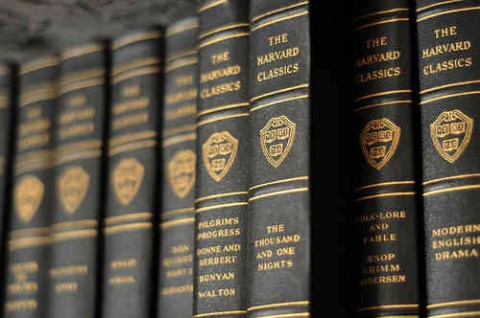
During his days as Harvard’s influential president, Charles W. Eliot made a frequent assertion: If you were to spend just 15 minutes a day reading the right books, a quantity that could fit on a five foot shelf, you could give yourself a proper liberal education. The publisher P. F. Collier and Son loved the idea and asked Eliot to assemble the right collection of works. The result wasa 51-volume series published in 1909 called Dr. Eliot’s Five Foot Shelf. Later it would simply be called The Harvard Classics.
Texts in the Harvard Classics collection (courtesy of Wikipedia):
Vol. 1: FRANKLIN, WOOLMAN, PENN
His Autobiography, by Benjamin Franklin
The Journal of John Woolman, by John Woolman (1774 and subsequent editions)
Fruits of Solitude, by William Penn
Vol. 2. PLATO, EPICTETUS, MARCUS AURELIUS
The Apology, Phaedo, and Crito, by Plato
The Golden Sayings, by Epictetus
The Meditations, by Marcus Aurelius
Vol. 3. BACON, MILTON’S PROSE, THOS. BROWNE
Essays, Civil and Moral, and New Atlantis, by Francis Bacon
Areopagitica and Tractate of Education, by John Milton
Religio Medici, by Sir Thomas Browne
Vol. 4. COMPLETE POEMS IN ENGLISH, MILTON
Complete poems written in English, by John Milton
Vol. 5. ESSAYS AND ENGLISH TRAITS, EMERSON
Essays and English Traits, by Ralph Waldo Emerson
Vol. 6. POEMS AND SONGS, BURNS
Poems and songs, by Robert Burns
Vol. 7. CONFESSIONS OF ST. AUGUSTINE, IMITATIONS OF CHRIST
The Confessions, by Saint Augustine
The Imitation of Christ, by Thomas á Kempis
Vol. 8. NINE GREEK DRAMAS
Agamemnon, The Libation Bearers, The Furies, and Prometheus Bound, by Aeschylus
Oedipus the King and Antigone, by Sophocles
Hippolytus and The Bacchae, by Euripides
The Frogs, by Aristophanes
Vol. 9. LETTERS AND TREATISES OF CICERO AND PLINY
On Friendship, On Old Age, and letters, by Cicero
Letters, by Pliny the Younger
Vol. 10. WEALTH OF NATIONS, ADAM SMITH
The Wealth of Nations, by Adam Smith
Vol. 11. ORIGIN OF SPECIES, DARWIN
The Origin of Species, by Charles Darwin
Vol. 12. PLUTARCH’S LIVES
Lives, by Plutarch
Vol. 13. AENEID, VIRGIL
Aeneid, by Virgil
Vol. 14. DON QUIXOTE, PART 1, CERVANTES
Don Quixote, part 1, by Cervantes
Vol. 15. PILGRIM’S PROGRESS, DONNE & HERBERT, BUNYAN, WALTON
The Pilgrim’s Progress, by John Bunyan
The Lives of Donne and Herbert, by Izaak Walton
Vol. 16. THE THOUSAND AND ONE NIGHTS
Stories from the Thousand and One Nights
Vol. 17. FOLKLORE AND FABLE, AESOP, GRIMM, ANDERSON
Fables, by Aesop
Children’s and Household Tales, by Jacob and Wilhelm Grimm
Tales, by Hans Christian Andersen
Vol. 18. MODERN ENGLISH DRAMA
All for Love, by John Dryden
The School for Scandal, by Richard Brinsley Sheridan
She Stoops to Conquer, by Oliver Goldsmith
The Cenci, by Percy Bysshe Shelley
A Blot in the ‘Scutcheon, by Robert Browning
Manfred, by Lord Byron
Vol. 19. FAUST, EGMONT, ETC. DOCTOR FAUSTUS, GOETHE, MARLOWE
Faust, part 1, Egmont, and Hermann and Dorothea, by Johann Wolfgang von Goethe
Dr. Faustus, by Christopher Marlowe
Vol. 20. THE DIVINE COMEDY, DANTE
The Divine Comedy, by Dante Alighieri
Vol. 21. I PROMESSI SPOSI, MANZONI
I Promessi Sposi, by Alessandro Manzoni
Vol. 22. THE ODYSSEY, HOMER
The Odyssey, by Homer
Vol. 23. TWO YEARS BEFORE THE MAST, DANA
Two Years Before the Mast, by Richard Henry Dana, Jr.
Vol. 24. ON THE SUBLIME, FRENCH REVOLUTION, ETC., BURKE
On Taste, On the Sublime and Beautiful, Reflections on the French Revolution, and A Letter to a Noble Lord, by Edmund Burke
Vol. 25. AUTOBIOGRAPHY, ETC., ESSAYS AND ADDRESSES, J.S. MILL, T. CARLYLE
Autobiography and On Liberty, by John Stuart Mill
Characteristics, Inaugural Address at Edinburgh, and Sir Walter Scott, by Thomas Carlyle
Vol. 26. CONTINENTAL DRAMA
Life is a Dream, by Pedro Calderón de la Barca
Polyeucte, by Pierre Corneille
Phèdre, by Jean Racine
Tartuffe, by Molière
Minna von Barnhelm, by Gotthold Ephraim Lessing
William Tell, by Friedrich von Schiller
Vol. 27. ENGLISH ESSAYS: SIDNEY TO MACAULAY
Vol. 28. ESSAYS: ENGLISH AND AMERICAN
Vol. 29. VOYAGE OF THE BEAGLE, DARWIN
The Voyage of the Beagle, by Charles Darwin
Vol. 30. FARADAY, HELMHOLTZ, KELVIN, NEWCOMB, ETC
The Forces of Matter and The Chemical History of a Candle, by Michael Faraday
On the Conservation of Force and Ice and Glaciers, by Hermann von Helmholtz
The Wave Theory of Light and The Tides, by Lord Kelvin
The Extent of the Universe, by Simon Newcomb
Geographical Evolution, by Sir Archibald Geikie
Vol. 31. AUTOBIOGRAPHY, BENVENUTO CELLINI
The Autobiography of Benvenuto Cellini
Vol. 32. LITERARY AND PHILOSOPHICAL ESSAYS
Essays, by Michel Eyquem de Montaigne
Montaigne and What is a Classic?, by Charles Augustin Sainte-Beuve
The Poetry of the Celtic Races, by Ernest Renan
The Education of the Human Race, by Gotthold Ephraim Lessing
Letters upon the Aesthetic Education of Man, by Friedrich von Schiller
Fundamental Principles of the Metaphysic of Morals, by Immanuel Kant
Byron and Goethe, by Giuseppe Mazzini
Vol. 33. VOYAGES AND TRAVELS
An account of Egypt from The Histories, by Herodotus
Germany, by Tacitus
Sir Francis Drake Revived, by Philip Nichols
Sir Francis Drake’s Famous Voyage Round the World, by Francis Pretty
Drake’s Great Armada, by Captain Walter Bigges
Sir Humphrey Gilbert’s Voyage to Newfoundland, by Edward Haies
The Discovery of Guiana, by Sir Walter Raleigh
Vol. 34. FRENCH AND ENGLISH PHILOSOPHERS, DESCARTES, VOLTAIRE, ROUSSEAU, HOBBES
Discourse on Method, by René Descartes
Letters on the English, by Voltaire
On the Inequality among Mankind and Profession of Faith of a Savoyard Vicar, by Jean Jacques Rousseau
Of Man, Being the First Part of Leviathan, by Thomas Hobbes
Vol. 35. CHRONICLE AND ROMANCE, FROISSART, MALORY, HOLINSHEAD
Chronicles, by Jean Froissart
The Holy Grail, by Sir Thomas Malory
A Description of Elizabethan England, by William Harrison
Vol. 36. MACHIAVELLI, MORE, LUTHER
The Prince, by Niccolò Machiavelli
The Life of Sir Thomas More, by William Roper
Utopia, by Sir Thomas More
The Ninety-Five Theses, To the Christian Nobility of the German Nation, and On the Freedom of a Christian, by Martin Luther
Vol. 37. LOCKE, BERKELEY, HUME
Some Thoughts Concerning Education, by John Locke
Three Dialogues Between Hylas and Philonous in Opposition to Sceptics and Atheists, by George Berkeley
An Enquiry Concerning Human Understanding, by David Hume
Vol. 38. HARVEY, JENNER, LISTER, PASTEUR
The Oath of Hippocrates
Journeys in Diverse Places, by Ambroise Paré
On the Motion of the Heart and Blood in Animals, by William Harvey
The Three Original Publications on Vaccination Against Smallpox, by Edward Jenner
The Contagiousness of Puerperal Fever, by Oliver Wendell Holmes
On the Antiseptic Principle of the Practice of Surgery, by Joseph Lister
Scientific papers, by Louis Pasteur
Scientific papers, by Charles Lyell
Vol. 39. FAMOUS PREFACES
Vol. 40. ENGLISH POETRY 1: CHAUCER TO GRAY
Vol. 41. ENGLISH POETRY 2: COLLINS TO FITZGERALD
Vol. 42. ENGLISH POETRY 3: TENNYSON TO WHITMAN
Vol. 43. AMERICAN HISTORICAL DOCUMENTS
Vol. 44. SACRED WRITINGS 1
Confucian: The sayings of Confucius
Hebrew: Job, Psalms, and Ecclesiastes
Christian I: Luke and Acts
Vol. 45. SACRED WRITINGS 2
Christian II: Corinthians I and II and hymns
Buddhist: Writings
Hindu: The Bhagavad-Gita
Mohammedan: Chapters from the Koran
Vol. 46. ELIZABETHAN DRAMA 1
Edward the Second, by Christopher Marlowe
Hamlet, King Lear, Macbeth, and The Tempest, by William Shakespeare
Vol. 47. ELIZABETHAN DRAMA 2
The Shoemaker’s Holiday, by Thomas Dekker
The Alchemist, by Ben Jonson
Philaster, by Beaumont and Fletcher
The Duchess of Malfi, by John Webster
A New Way to Pay Old Debts, by Philip Massinger
Vol. 48. THOUGHTS AND MINOR WORKS, PASCAL
Thoughts, letters, and minor works, by Blaise Pascal
Vol. 49. EPIC AND SAGA
Beowulf
The Song of Roland
The Destruction of Dá Derga’s Hostel
The Story of the Volsungs and Niblungs
Vol. 50. INTRODUCTION, READER’S GUIDE, INDEXES
Vol. 51. LECTURES
The last volume contains sixty lectures introducing and summarizing the covered fields: history, poetry, natural science, philosophy, biography, prose fiction, criticism and the essay, education, political science, drama, travelogues, and religion.
Today is the 50th anniversary of the death of Ernest Hemingway. In remembrance, we bring you the writer’s own voice from 1954, reading his Nobel Prize acceptance speech at a radio station in Havana, Cuba. Hemingway’s influence on Twentieth Century literature was profound, both for the originality of his prose and the tragic alienation of his heroes. One of the most beautiful and frequently quoted examples of Hemingway’s style is the opening paragraph of A Farewell to Arms:
In the late summer of that year we lived in a house in a village that looked across the river and the plain to the mountains. In the bed of the river there were pebbles and boulders, dry and white in the sun, and the water was clear and swiftly moving and blue in the channels. Troops went by the house and down the road and the dust they raised powdered the leaves of the trees. The trunks of the trees too were dusty and the leaves fell early that year and we saw the troops marching along the road and the dust rising and leaves, stirred by the breeze, falling and the soldiers marching and afterward the road bare and white except for the leaves.
“Hemingway’s appreciation of the aesthetic qualities of the physical world is important,” wrote Robert Penn Warren in 1949, “but a peculiar poignancy is implicit in the rendering of those qualities; the beauty of the physical world is a background for the human predicament, and the very relishing of the beauty is merely a kind of desperate and momentary compensation possible in the midst of the predicament.” That predicament, wrote Warren, “in a world without supernatural sanctions, in the God-abandoned world of modernity,” is man’s full consciousness of his own impending annihilation. Here is a stark passage from “A Clean, Well-Lighted Place”:
What did he fear? It was not fear or dread. It was a nothing he knew too well. It was all a nothing and a man was nothing too. It was only that and light was all it needed and a certain cleanliness and order. Some lived in it and never felt it but he knew it was all nada y pues nada y nada y pues nada. Our nada who art in nada, nada be thy name thy kingdom nada thy will be nada in nada as it is in nada. Give us this nada our daily nada and nada us our nada as we nada our nadas and nada us not into nada but deliver us from nada; pues nada. Hail nothing full of nothing, nothing is with thee. He smiled and stood before a bar with a shining steam pressure coffee machine. “What’s yours?” asked the barman. “Nada.”
Caught in an existential cul-de-sac, Hemingway’s characters find meaning through adherence to what Warren called the Hemingway Code: “His heroes are not defeated except upon their own terms. They are not squealers, welchers, compromisers, or cowards, and when they confront defeat they realize that the stance they take, the stoic endurance, the stiff upper lip mean a kind of victory. Defeated upon their own terms, some of them have even courted their defeat; and certainly they have maintained, even in the practical defeat, an ideal of themselves.”
Fifty years ago today, after enduring years of declining health, Ernest Hemingway met death upon his own terms. Looking back on it in 1999, Joyce Carol Oates wrote: “Hemingway’s death by suicide in 1961, in a beautiful and isolated Ketchum, Idaho, would seem to have brought him full circle: back to the America he had repudiated as a young man, and to the method of suicide his father had chosen, a gun. To know the circumstances of the last years of Hemingway’s life, however, his physical and mental suffering, is to wonder that the beleaguered man endured as long as he did. His legacy to literature, apart from the distinct works of art attached to his name, is a pristine and immediately recognizable prose style and a vision of mankind in which life and art are affirmed despite all odds.”
It’s with some discomfort that the author names Gone with the Wind, published exactly 75 years ago today, her favorite childhood book: It was thick, it was romantic — and perhaps most crucially for any awkward, bespectacled preteen girl — it featured a headstrong heroine whose appeal to the opposite sex derived more from her charm than her physical beauty.
Nonetheless, there’s no way around the profound failings of both the book and the MGM epic film based on it: Novel and film treated slavery as an incidental backdrop to the war; they glorified and misrepresented the actions of the Ku Klux Klan; and most egregiously, they portrayed the master-slave relationship as one which neither master nor slave should ever dream of altering. In the words of historian and sociologist Jim Loewen, author of Lies My Teacher Told Me: Everything Your High School History Textbook Got Wrong:
[Gone With The Wind] laments the passing of the slave era as “gone with the wind.” In the novel, Mitchell states openly that African Americans are “creatures of small intelligence.” And this book is by far the most popular book in the U.S. and has been for 60 years. The book is also profoundly wrong in its history. What it tells us about slavery, and especially reconstruction, did not happen…it is profoundly racist and profoundly wrong. Should we teach it? Of course. Should we teach against it? Of course.
Meanwhile, Hattie McDaniel took home a best supporting actress Oscar for her role as Scarlett O’Hara’s loyal house slave, Mammy. She was the first African-American woman to win an Academy Award. The fact that she was not allowed to attend the film’s premiere in Atlanta makes her acceptance speech (1940) even more poignant. It appears above.
Sheerly Avni is a San Francisco-based arts and culture writer. Her work has appeared in Salon, LA Weekly, Mother Jones, and many other publications. You can follow her on twitter at @sheerly.
The high points of this documentary on the great J.R.R. Tolkien, from the BBC Series In Their Own Words: British Novelists, are the moments that fulfill the promise of the series’ title. Skip over the distracting “man on the street” interviews and long pans of the landscape, meant perhaps to invoke Middle Earth. In fact, you can skip over every scene that isn’t just the author’s magnificent talking head.
Start at minute 2:49, where he describes first writing the immortal words “In a hole in the ground there lived a hobbit.” The anecdote should inspire beleaguered graduate students and teachers everywhere: He came up with the line while grading exams.
We also loved Tolkien’s confession about trees, starting at the 7:00 minute mark: “I should have liked to make contact with a tree and find out how it feels about things.”
You can watch the documentary on YouTube in two parts. The first part is above, the second here. The material also appears in our collection of 250 Cultural Icons.
Sheerly Avni is a San Francisco-based arts and culture writer. Her work has appeared in Salon, LA Weekly, Mother Jones, and many other publications. You can follow her on twitter at @sheerly.
We're hoping to rely on loyal readers, rather than erratic ads. Please click the Donate button and support Open Culture. You can use Paypal, Venmo, Patreon, even Crypto! We thank you!
Open Culture scours the web for the best educational media. We find the free courses and audio books you need, the language lessons & educational videos you want, and plenty of enlightenment in between.