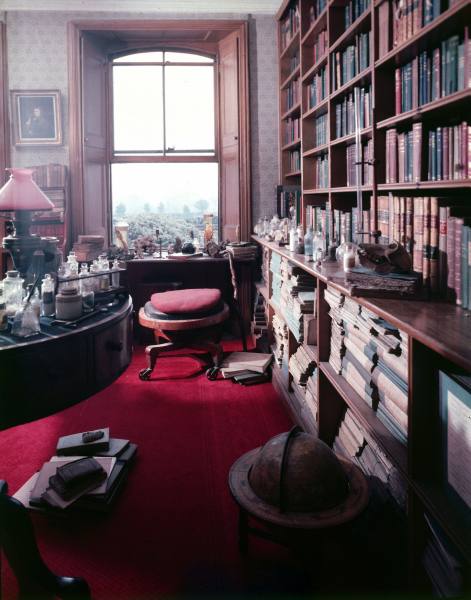
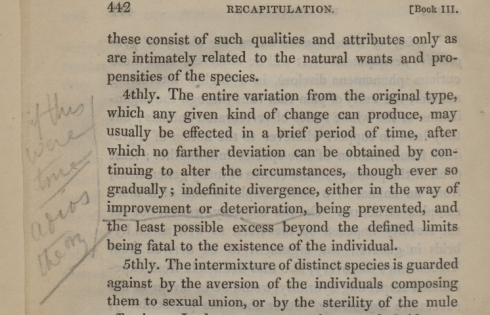
When Charles Darwin finished reading Charles Lyell’s Principles of Geology, a book suggesting that there are clear limits to the variation of species, he wrote in the margins: “If this were true adios theory.” It’s a great piece of marginalia. And it’s just one of many comments that adorn books in Darwin’s personal library, and help illuminate his intellectual path to writing On The Origin Of Species(1859).
A few days ago, we asked you to send us your favorite non-fiction titles. We’ll be posting your many excellent suggestions soon, and, in the meantime, we thought we should offer something in return — more specifically, yet another list of excellent non-fiction compiled by someone other than ourselves.
Kevin Kelly, web-pioneer, co-founder of Wired Magazine, former editor of the Whole Earth Catalog, and one of the best all-around living arguments for ditching college and traveling the world instead, has put together a crowdsourced list of the best magazine articles from the 60s, 70s, 80s, 90s, 00s and 10s, almost all of them available on the web. He’s also gathered the top 25 of all time (based on the number of votes received) on one thrilling page.
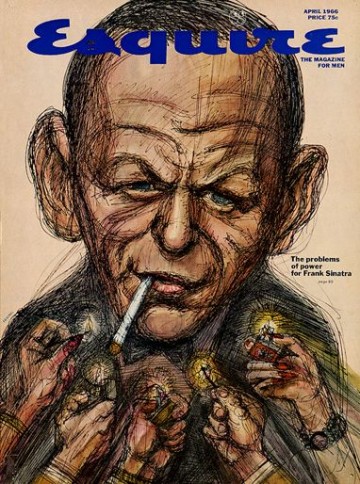
The list includes pieces like Fear and Loathing in Las Vegas by Hunter S. Thompson, David Foster Wallace’s Consider the Lobster, and Gay Talese’s legendary 1966 Esquire cover story, Frank Sinatra Has a Cold. It’s an invaluable resource, whether you’re an aspiring journalist or novelist, a history buff, or just a person who wants to enjoy the evolution of the past 60 years of the English language.
You may already be familiar with the sites Instapaper, Longreads, and Longform. All three can help you find great reading material on the web, organize it, and download it to your Kindle, iPad, or tablet. Enjoy.
Get more classics from our collection of Free eBooks.
Sheerly Avni is a San Francisco-based arts and culture writer. Her work has appeared in Salon, LA Weekly, Mother Jones, and many other publications. You can follow her on twitter at @sheerly.
Bestselling writer Jonathan Lethem — author of one of my favorite contemporary novels Motherless Brooklyn — has a new short story featured in the summer edition of the Paris Review. The story is called “The Empty Room,” and, once again, the background, childhood, moves to the foreground. It begins:
Earliest memory: father tripping on strewn toys, hopping with toe outraged, mother’s rolling eyes. For my father had toys himself. He once brought a traffic light home to our apartment on the thirty-somethingth floor of the tower on Columbus Avenue. The light, its taxi yellow gone matte from pendulum-years above some polluted intersection and crackled like a Ming vase’s glaze where bolts had been overtightened and then eased, sat to one side of the coffee table it was meant to replace as soon as my father found an appropriate top. In fact, the traffic light would follow us up the Hudson, to Darby, to the house with the empty room. There it never escaped the garage.
Another memory: my playmate Max’s parents had borrowed, from mine, a spare set of china plates. I spent a lot of time visiting with Max and, when he let us inside his room, Max’s older brother. So I was present the afternoon my father destroyed the china set. Max’s family lived in a duplex, the basement and parlor floor of a brownstone, a palace of abundance . . . Max and his brother had separate rooms, and a backyard. All this would pale beside the spaciousness of our Darby farmhouse. That was the point.
You can read the full text here. And please note: the Paris Review has just launched its first digital edition, letting you read the famous literary journal on your computer, iPad or mobile device. More on that here. H/T Biblioklept
As for Amis, he has never worked hard to make friends, staking out controversial positions on Muslims and euthanasia and then, earlier this year, going out of his way to mock writing for children: “People ask me if I ever thought of writing a children’s book. I say, if I had a serious brain injury I might well write a children’s book, but otherwise the idea of being conscious of who you’re directing the story to is anathema to me, because, in my view, fiction is freedom and any restraints on that are intolerable.” You get the drift.
But good writers rarely win popularity contests. And few will deny that Mailer and Amis have put their stamp on the Anglo-American literary scene. So here you have it — Martin Amis interviewing Norman Mailer in 1991, upon the release of Mailer’s sprawling 1400-page CIA epic, Harlot’s Ghost. The first clip (above) starts with the novel, the remaining parts move in many different directions. The writing life, writing about homosexuality, the state of capitalism, America after the Cold War, Mailer’s legacy — it’s part of the 40 minute conversation. Find Part 2, Part 3, and Part 4.
You can find this video permanently listed in our new collection of 235 Cultural Icons.
A few days ago, The Guardian published its list of the 100 Greatest Non-Fiction Books of all time. The collection spans biography, art, philosophy, history and several other hefty categories, and, for the most part, there’s not much for anyone seeking light summer reading, unless you’re the sort who regularly brings Kant, Hume, Herodotus, and Pepys down to the seaside. (Note: The Guardian published Friday The Best Holiday Reads, which goes heavy on vacation-worthy fiction.)
Several years ago we asked you to tell us about the books that changed your life, and you delivered. (Your first choice by a wide margin was George Orwell’s 1984.) This time around, we want to hear your favorite non-fiction books, and we’ll both post your choices and — of course — let you know if they’re available for free online.
We’ll kick it off with a few personal favorites:
The Possessed, by Elif Batuman. A delightful reminiscence by a recovering graduate student, in which she treats, among other things, Russian novelists, doomed love affairs, academic conferences, Turkic poetry, and mostly, the pleasures and perils of loving books just a little bit too much.
The Best American Sports Writing of the Century, edited by David Halberstam and Glenn Stout. You don’t even need to know or care about sports, because like all great literature, these essays aren’t really just about what they’re about. The subject may be sports, but the stories are America.
Your turn! Feel free to add your favorites to the comments section below…
Sheerly Avni is a San Francisco-based arts and culture writer. Her work has appeared in Salon, LA Weekly, Mother Jones, and many other publications. You can follow her on twitter at @sheerly.
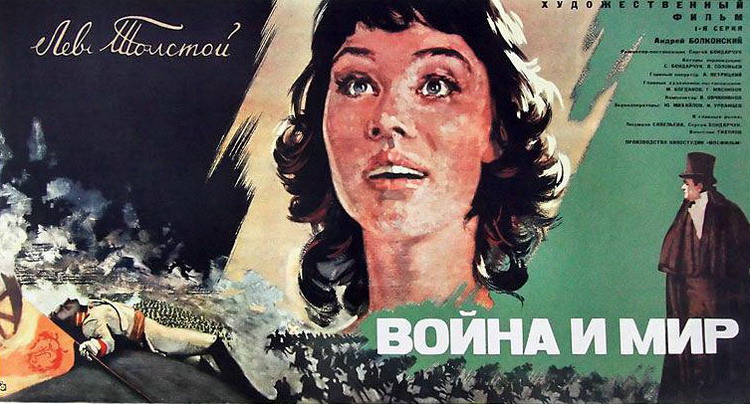
It’s hard to do cinematic justice to any good novel, let alone the greatest of Russia’s many great novels, Leo Tolstoy’s War & Peace. But Soviet director Sergei Bondarchuk somehow managed to pull it off. Reviewing Bondarchuk’s film back in 1969, a young Roger Ebert wrote:
“War and Peace” is the definitive epic of all time. It is hard to imagine that circumstances will ever again combine to make a more spectacular, expensive, and — yes — splendid movie. Perhaps that’s just as well; epics seem to be going out of favor, replaced instead by smaller, more personal films. Perhaps this greatest of the epics will be one of the last, bringing the epic form to its ultimate statement and at the same time supplying the epitaph.
No corners were cut, and no expenses spared, in making the film. Indeed, the film (available on DVD here) was made “at a cost of $100,000,000, with a cast of 120,000, all clothed in authentic uniforms, and the Red Army was mobilized to recreate Napoleon’s battles exactly (it is claimed) as they happened.” What’s more, 35,000 costumes were made for the production, and many Soviet museums contributed artifacts for the production design. That’s staggering, even by today’s standards.
Released in four parts between 1965 and 1967, the Academy Award-winning film runs more than seven hours and you can now find it playing on YouTube. You can watch Part 1 here, and here you have Part 2, Part 3 and Part 4. And if you need subtitles, click CC at the bottom of the videos. The film is, of course, listed in our collection of Free Movies Online.
Several weeks back, Go the F**k to Sleep, the irreverent new children’s book, gained national attention when pirated PDF copies went viral on the internet. But don’t feel sorry for the author and illustrator. The book is now #1 on the Amazon bestseller list; Samuel Jackson has narrated the official audio book (you can probably snag a free copy through this Audible.com deal); and Werner Herzog delighted fans when he read the (not safe for work) bookat the New York Public Library book party held earlier this week. And, yes, this is the real Werner Herzog — not the impersonator who passed around popular readings of Curious Georgeand Twas the Night Before Christmas on YouTube …
The narrator of this rare clip describes James Joyce — arguably the greatest novelist of the 20th century — as a “small, thin, unathletic man with very bad eyes.” Ouch. And it gets worse. According to the voiceover, when Joyce and drinking buddy Ernest Hemingway faced a potential brawl, Joyce would hide behind his more imposing comrade and shout “Deal with him, Hemingway, deal with him!!!’
But we bet they were both just hiding behind Gertrude Stein.
If you would like to support the mission of Open Culture, consider making a donation to our site. It’s hard to rely 100% on ads, and your contributions will help us continue providing the best free cultural and educational materials to learners everywhere. You can contribute through PayPal, Patreon, and Venmo (@openculture). Thanks!
Sheerly Avni is a San Francisco-based arts and culture writer. Her work has appeared in Salon, LA Weekly, Mother Jones, and many other publications. You can follow her on twitter at @sheerly.
We're hoping to rely on loyal readers, rather than erratic ads. Please click the Donate button and support Open Culture. You can use Paypal, Venmo, Patreon, even Crypto! We thank you!
Open Culture scours the web for the best educational media. We find the free courses and audio books you need, the language lessons & educational videos you want, and plenty of enlightenment in between.