It’s quite profound, isn’t it? — Helen Fagin, aged 100
Every time I open my laptop to discover a friend posting a vintage photo of their parent as a beaming bride or saucy sailor boy in lush black and white or gold-tinged Kodachrome, I know the deal.
Another elder has left the building.
With luck, I’ll have at least two or three decades before my kids start sniffing around in my shoe boxes of old snapshots.
In the meantime, I’ll wonder how much of the emotion that’s packed into those memorial postings gets expressed to the subject in the days leading up to their final exit.
Seems like most of us pussyfoot around the obvious until it’s too late.
There are, of course, medical situations that force us to acknowledge in a loved one’s presence the abyss in their immediate future, but otherwise, Western tradition has positioned us to shy away from those sorts of discussions.
In celebration of Helen’s centenary, Palmer asked Brain Picking’s Maria Popova to recommend a poem that Gaiman could read aloud during another in-person birthday visit.
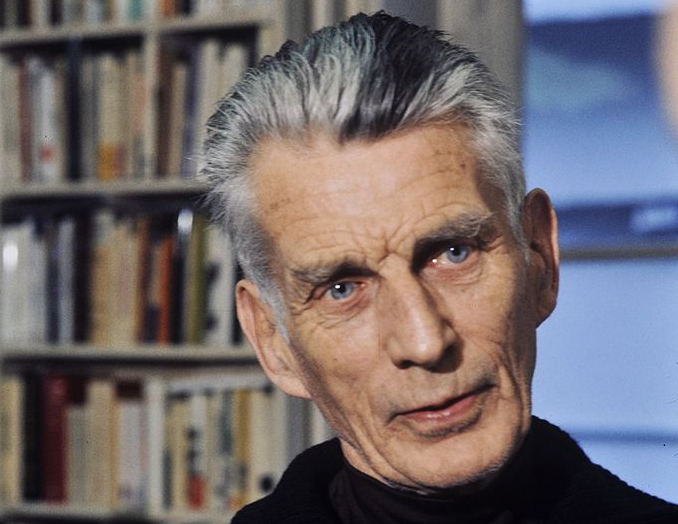
Samuel Beckett, Pic, 1″ by Roger Pic. Via Wikimedia Commons
Clad in a black turtleneck and with a shock of white hair, Samuel Beckett was a gaunt, gloomy high priest of modernism. After the 1955 premiere of Samuel Beckett’s play Waiting for Godot(watch him stage a performance here), Kenneth Tynan quipped, ”It has no plot, no climax, no denouement; no beginning, no middle and no end.” From there, Beckett’s work only got more austere, bleak and despairing. His 1969 play Breath, for instance, runs just a minute long and features just the sound of breathing.
An intensely private man, he managed to mesmerize the public even as he turned away from the limelight. When he won the Nobel Prize in 1969 (after being rejected in 1968), his wife Suzanne, fearing the onslaught of fame that the award would bring, decried it as a “catastrophe.”
A recently published collection of his letters from 1941–1956, the period leading up to his international success with his play Waiting for Godot, casts some light on at least one corner of the man’s private life – what books were piling up on his bed stand. Below is an annotated list of what he was reading during that time. Not surprisingly, he really dug Albert Camus’s The Stranger. “Try and read it,” he writes. “I think it is important.” He dismisses Agatha Christie’s Crooked Houseas “very tired Christie” but praises Around the World in 80 Days: “It is lively stuff.” But the book he reserves the most praise for is J.D. Salinger’s Catcher in the Rye. “I liked it very much indeed, more than anything for a long time.”
You can see the full list below. It was originally published online by Cambridge University Press in 2011. Books with an asterisk next to the title can be found in our collection of 700 Free eBooks.
Andromaque* by Jean Racine: “I read Andromaque again with greater admiration than ever and I think more understanding, at least more understanding of the chances of the theatre today.”
Lautreamont and Sade by Maurice Blanchot: “Some excellent ideas, or rather starting-points for ideas, and a fair bit of verbiage, to be read quickly, not as a translator does. What emerges from it though is a truly gigantic Sade, jealous of Satan and of his eternal torments, and confronting nature more than with humankind.”
Jonathan Crow is a Los Angeles-based writer and filmmaker whose work has appeared in Yahoo!, The Hollywood Reporter, and other publications. You can follow him at @jonccrow. And check out his blog Veeptopus, featuring lots of pictures of badgers and even more pictures of vice presidents with octopuses on their heads. The Veeptopus store is here.
Remember Lucy, aka Xena the Warrior Princess, perhaps better known to younger folks as Ron Swanson’s (eventual) wife on Parks and Recreation? Before her career re-launched via major roles on Spartacus, Salem, and Ash vs. Evil Dead, she took some time off to study philosophy and so got involved with The Partially Examined Life Philosophy Podcast, which is coming up on its 10th birthday and has now been downloaded more than 25 million times.
She has now joined the gang for cold-read on-air performances with discussions of Sartre’s No Exit, Sophocles’s Antigone, and most recently Aristophanes’s still-funny proto-feminist comedy Lysistrata. For the discussion of this last, she was joined by fellow cast member Emily Perkins (she played the little girl on the 1990 TV version of Stephen King’s “IT”) to hash through whether this story of stopping war through a sex-strike is actually feminist or not, and how it relates to modern politics. (For another take on this, see Spike Lee’s 2015 adaptation of the story for the film Chi-Raq.)
And as a present to bring you into the New Year, she provided lead vocals on a new song by PEL host Mark Linsenmayer about the funky ways women can be put on a pedestal, projected upon, unloaded upon, and otherwise not treated as quite human despite the intention to provide affection. Stream it right below. And read the lyrics and get more information on bandcamp.com.
What do you see when you read the work of Edgar Allan Poe? The great age of the illustrated book is far behind us. Aside from cover designs, most modern editions of Poe’s work circulate in text-only form. That’s just fine, of course. Readers should be trusted to use their imaginations, and who can forget indelible descriptions like “The Tell-Tale Heart”’s “eye of a vulture—a pale, blue eye, with a film over it”? We need no picture book to make that image come alive.
Yet, when we first discover the many illustrated editions of Poe published in the late 19th and early 20th centuries, we might wonder how we ever did without them. A copy of Tales of Mystery and Imaginationillustrated by Arthur Rackham in 1935 (above) served as my first introduction to this rich body of work.
Known also for his editions of Peter Pan, The Wind in the Willows, Grimm’s Fairy Tales, and Alice in Wonderland, Rackham’s “signature watercolor technique” was “always in high demand,” Sadie Stein writes at The Paris Review.
Sometime later, I came across the 1894 Symbolist illustrations of Aubrey Beardsley, and for a while, when Poe came to mind so too did Beardsley’s sensually creepy prints, influenced by Japanese woodcuts and Art Nouveau posters. His stylized take on Poe, notes Print magazine, offers “a very different aesthetic from the works of his predecessors.” Most prominent among those earlier illustrators was the hugely prolific Gustave Doré, whose classical renderings of the Divine Comedyand Don Quixotemay have few equals in a field crowded with illustrated editions of those books.
But for me, there’s something lacking, in the 26 steel engravings Doré made for an 1884 edition of Poe’s “The Raven.” They are, like all of his work, classically accomplished works of art. But unlike Beardsley, Doré seems to miss the strain of absurdism and dark humor that runs through all of Poe’s work (or at least the way I’ve read him), though it’s true that “The Raven” relies on atmosphere and suggestion for its effect, rather than torture, murder, and plague. In the later, 1923 edition of Tales of Mystery and Imagination illustrated by Irish artist Harry Clarke, we find the best qualities of Beardsley and Doré combined: finely-detailed, fully-realized scenes, suffused with gothic sensuality, symbolism, grotesque weirdness, and an almost comically exaggerated sense of dread.
Poe significantly influenced the poetry of Charles Baudelaire and Stéphane Mallarmé, and Clarke foregrounds in his work many of the qualities those poets did—the tangling up of sex and death in images that attract and repulse at the same time. Early Impressionist master Édouard Manet also illustrated an 1875 edition of “The Raven,” translated into French by Mallarmé. Manet draws the French poet/translator as the speaker of the poem (recognizable by his pushbroom mustache).
Manet’s minimal drawings of the poem contrast starkly with Doré’s elaborate engravings. Just as readers might imagine Poe’s macabre stories in innumerable ways, so too the artists who have illustrated his work. See contemporary illustrations for “The Tell-Tale Heart,” for example, by South African artist Pencilheart Art and Brooklyn-based illustrator Daniel Horowitz, and recommend your favorite Poe artist in the comments below.
Medieval conceptions of hell may have little effect on the laws and social mores of our secular age. But they sure as hell did in the late 15th century, when the first illustrated editions of Dante’s Inferno appeared. A 1481 edition contained art based on a series of unfinished illustrations by Renaissance master Sandro Botticelli. In 1491, the first fully-illustrated edition of the Inferno arrived. As were most printed works at the time, these books were elaborate and expensive, reflecting the very serious treatment the subject of Dante’s work received.
Centuries later, Dante’s work has not lost its effect on our imaginations. Though most people are far less likely to entertain belief in a giant corkscrew pit beneath the earth full of tortured souls, it remains a vivid, chilling (so to speak) metaphor. The epic poem’s language moves and entrances us; its psychological insights dazzle; its formal innovations continue to awe; and its images still shock, amuse, and terrify.
This is daunting company, and the online, interactive companion to the Infernoyou see screen-shotted here does not attempt to join their ranks. Its charming, children’s‑book-graphic visual presentation takes a G‑rated approach, ditching accurate human anatomy and horrific violence for a cartoonish video game romp through hell that makes it seem like a super fun, if super weird, place to visit. Created by Alpaca, an Italian design cooperative, and design studio Molotro, the tool aims to be “a synsemic access point to Dante’s literature, aiding its study.”
What it lacks in visual high seriousness, it makes up for in utility. In this brilliantly simple design you can leap from Canto to Canto, learn the circle each one covers, the kind of sinners who inhabit it, and the main characters in each. Click on selected figures in the graphic to see character names and quoted excerpts from the poem. A much longer list of characters serves as an index, quickly linking each name to a Canto, quotation, circle, and sin. The Italian site links to the original poem on Wikipedia. The English version’s annotations link to Henry Wadsworth Longfellow’s 1867 translation.
Access Cantos and Characters in menus at the top of the main page or use the zoom button to move closer into any point in the topographical map and begin clicking on cartoon figures in various stages of tortured distress. See Behance for an illustrated guide through the online Inferno, a comical-looking tool with very serious applications for students of Dante’s poem. If you’re new to the Inferno, dive right in here. Hell awaits, as it has for millions of fascinated readers for 800 years.
Earlier this year we informed readers that thousands of works of art and entertainment would soon enter the public domain—to be followed every year by thousands more. That day is nigh upon us: Public Domain Day, January 1, 2019. At the stroke of midnight, such beloved classics as Robert Frost’s “Stopping by Woods on a Snowy Evening” and “Yes! We Have No Bananas” will become the common property of the people, to be quoted at length or in full anywhere when the copyright expires on work produced in 1923. Then, 1924 will expire in 2020, 1925 in 2021, and so on and so forth.
It means that “hundreds of thousands of books, musical compositions, paintings, poems, photographs and films” will become freely available to distribute, remix, and remake, as Glenn Fleishman writes at Smithsonian. “Any middle school can produce Theodore Pratt’s stage adaptation of The Picture of Dorian Gray, and any historian can publish Winston Churchill’s The World Crisis with her own extensive annotations… and any filmmaker can remake Cecil B. DeMille’s original The Ten Commandments.”
Those are just a few ideas. See more extensive lists of hits and obscurities from 1923 at our previous post and come up with your own creative adaptations. The possibilities are vast and possibly world changing, in ways both decidedly good and arguably quite bad. Teachers may photocopy thousands of pages without fear of prosecution; scholars may quote freely, artists may find deep wells of inspiration. And we may also see “Frost’s immortal ode to winter used in an ad for snow tires.”
Such crassness aside, this huge release from copyright heralds a cultural sea change—the first time such a thing has happened in 21 years due to a 20-year extension of the copyright term in 1998, in a bill sponsored by Sonny Bono at the urging of the Walt Disney company. The legislation, aimed at protecting Mickey Mouse, created a “bizarre 20-year hiatus between the release of works from 1922 and 1923.” It is fascinating to consider how a government-mandated marketing decision has affected our understanding of history and culture.
The novelist Willa Cather called 1922 the year “the world broke in two,” the start of a great literary, artistic and cultural upheaval. In 1922, Ulysses by James Joyce and T.S. Eliot’s “The Waste Land” were published, and the Harlem Renaissance blossomed with the arrival of Claude McKay’s poetry in Harlem Shadows. For two decades those works have been in the public domain, enabling artists, critics and others to burnish that notable year to a high gloss in our historical memory. In comparison, 1923 can feel dull.
That year, however, marked the film debut of Marlene Dietrich, the publication of modernist landmarks like Virginia Woolf’s Mrs. Dalloway and Jean Toomer’s Cane and far too many more influential works to name here. Find several more at Duke University’s Center for the Study of the Public Domain, Lifehacker, Indiewire, and The Atlanticand have a very happy Public Domain Day.
Public domain films and books will be added to ever-growing collections:
“It’s difficult to make predictions,” they say, “especially about the future.” The witticism has been variously attributed. If Yogi Berra said it, it’s adorable nonsense, if Mark Twain, dry plainspoken irony. If Niels Bohr, however, we have a statement that makes us wonder what exactly “the future” could mean in a radically uncertain universe.
If scientists can’t predict the future, who can? Science fiction writers, of course. They may be spectacularly wrong at times, but few professionals seem better equipped to imaginatively extrapolate from current conditions—cultural, technological, social, and political—and show us things to come. J.G. Ballard, Octavia Butler, Arthur C. Clarke, Kurt Vonnegut… all have foreseen many of the marvels and dystopian nightmares that have arrived since their time.
In 1964, Asimov used the occasion of the New York World’s Fair to offer his vision of fifty years hence. “What will the World’s Fair of 2014 be like?” he asked in The New York Times, the question itself containing an erroneous assumption about the durability of that event. As a scientist himself, his ideas are both technologically farseeing and conservative, containing advances we can imagine not far off in our future, and some that may seem quaint now, though reasonable by the standards of the time (“fission-power plants… supplying well over half the power needs of humanity”).
Nineteen years later, Asimov ventured again to predict the future—this time of 2019 for The Star. Assuming the world has not been destroyed by nuclear war, he sees every facet of human society transformed by computerization. This will, as in the Industrial Revolution, lead to massive job losses in “clerical and assembly-line jobs” as such fields are automated. “This means that a vast change in the nature of education must take place, and entire populations must be made ‘computer-literate’ and must be taught to deal with a ‘high-tech’ world,” he writes.
The transition to a computerized world will be difficult, he grants, but we should have things pretty much wrapped up by now.
By the year 2019, however, we should find that the transition is about over. Those who can be retrained and re-educated will have been: those who can’t be will have been put to work at something useful, or where ruling groups are less wise, will have been supported by some sort of grudging welfare arrangement.
In any case, the generation of the transition will be dying out, and there will be a new generation growing up who will have been educated into the new world. It is quite likely that society, then, will have entered a phase that may be more or less permanently improved over the situation as it now exists for a variety of reasons.
Asimov foresees the climate crisis, though he doesn’t phrase it that way. “The consequences of human irresponsibility in terms of waste and pollution will become more apparent and unbearable with time and again, attempts to deal with this will become more strenuous.” A “world effort” must be applied, necessitating “increasing co-operation among nations and among groups within nations” out of a “cold-blooded realization that anything less than that will mean destruction for all.”
He is confident, however, in such “negative advances” as the “defeat of overpopulation, pollution and militarism.” These will be accompanied by “positive advances” like improvements in education, such that “education will become fun because it will bubble up from within and not be forced in from without.” Likewise, technology will enable increased quality of life for many.
… more and more human beings will find themselves living a life rich in leisure.
This does not mean leisure to do nothing, but leisure to do something one wants to do; to be free to engage in scientific research. in literature and the arts, to pursue out-of-the-way interests and fascinating hobbies of all kinds.
If this seems “impossibly optimistic,” he writes, just wait until you hear his thoughts on space colonization and moon mining.
The Asimov of 1983 sounds as confident in his predictions as the Asimov of 1964, though he imagines a very different world each time. His future scenarios tell us as much or more about the time in which he wrote as they do about the time in which we live. Read his full essay at The Star and be the judge of how accurate his predictions are, and how likely any of his optimistic solutions for our seemingly intractable problems might be in the coming year.
It’s that time of year when certain songs conspire with certain moods to hit you right in the ol’ brisket.
Thefeeling is voluptuous, and not necessarily unpleasant, provided there’s a bathroom stall or spare bedroom should you need to flee a party like Cinderella, as some old chestnut threatens to turn you into a blubbering mess.
Let the kiddies deck the halls, jingle bells, and prance about with Rudolph and Frosty. The best secular songs for grown ups are the ones with a thick current of longing just under the surface, a yearning for those who aren’t here with us, for a better future, for the way we were…
There’s got to be some hope in the balance though, some sweetness to savor as we muddle through.
(Judy Garland famously stonewalled on the first version of “Have Yourself a Merry Little Christmas” until lyricist Hugh Martin agreed to lighten things up a bit. In the end, both got what they wanted. She got her update:
Have yourself a merry little Christmas
Let your heart be light
Next year all our troubles will be out of sight
But the tension between the promise of a better tomorrow and her emotional delivery holds a place for Hughes’ appealingly dark sentiment:
As a rule, the oldies are the goodies in this department.
More recent bids by Coldplay and Taylor Swift have failed to achieve the proper mix of hope and hopelessness.
It’s a difficult balance, but singer-songwriter Ellia Bisker pulls it off beautifully, above, by turning to O. Henry’s enduring short story, “The Gift of the Magi.”
I want to give you something that I can’t afford,
Let you believe with me we’re really not so poor.
You see that package waiting underneath the tree?
It’s just a token of how much you mean to me.
(Spoiler for the handful of people unfamiliar with this tale: he does the same, thus negating the utility of both costly presents.)
In an interview with Open Culture, Bisker praised the O. Henry story’s ironic symmetry:
It’s a little like the death scene in Romeo & Juliet, but without the tragedy. The story itself still feels surprisingly fresh, despite the period details. It has more humor and sympathy to it than sentiment. It surprises you with real emotion.
The Romeo and Juliet comparison is apt. The story covers a time period so brief that the newlyweds’ feelings for each other never stray from purest wonder and admiration.
Bisker’s song starts, as it ends, with a pair of young, broke lovers who only have eyes for each other.
Let’s not forget O. Henry’s parting words:
The magi, as you know, were wise men—wonderfully wise men—who brought gifts to the Babe in the manger. They invented the art of giving Christmas presents. Being wise, their gifts were no doubt wise ones, possibly bearing the privilege of exchange in case of duplication. And here I have lamely related to you the uneventful chronicle of two foolish children in a flat who most unwisely sacrificed for each other the greatest treasures of their house. But in a last word to the wise of these days let it be said that of all who give gifts these two were the wisest. Of all who give and receive gifts, such as they are wisest. Everywhere they are wisest. They are the magi.
Enjoy this musical gift, readers. The artist has made the track free for downloading, though perhaps you could scratch up a few coins in thanks, without pawning your watch or cutting your hair.
Read O. Henry’s short story “The Gift of the Magi” here.
We're hoping to rely on loyal readers, rather than erratic ads. Please click the Donate button and support Open Culture. You can use Paypal, Venmo, Patreon, even Crypto! We thank you!
Open Culture scours the web for the best educational media. We find the free courses and audio books you need, the language lessons & educational videos you want, and plenty of enlightenment in between.