“You know how earlier we were talking about Dostoyevsky?” asks David Brent, Ricky Gervais’ iconically insecure paper-company middle-manager central to the BBC’s original The Office. “Oh, yeah?” replies Ricky, the junior employee who had earlier that day demonstrated a knowledge of the influential Russian novelist apparently intimidating to his boss. “Fyodor Mikhailovich Dostoyevsky. Born 1821. Died 1881,” recites Brent. “Just interested in him being exiled in Siberia for four years.” Ricky admits to not knowing much about that period of the writer’s life. “All it is is that he was a member of a secret political party,” Brent continues, drawing upon research clearly performed moments previous, “and they put him in a Siberian labour camp for four years, so, you know…”
We here at Open Culture know that you wouldn’t stoop to such tactics in an attempt to establish intellectual supremacy over your co-workers — nor would you feel any shame in not having yet plunged into the work of that same Fyodor Mikhailovich Dostoyevsky, born 1821, died 1881, and the author of such much-taught novels as Crime and Punishment, The Idiot, and The Brothers Karamazov (as well as a prolific doodler). “His first major work,” in the posturing words of David Brent, “was Notes from the Underground, which he wrote in St Petersburg in 1859. Of course, my favorite is The Raw Youth. It’s basically where Dostoyevsky goes on to explain how science can’t really find answers for the deeper human need.”
An intriguing position! To hear it explained with deeper comprehension (but just as entertainingly, and also in an English-accented voice), watch this 14-minute, Monty Python-style animated primer from Alain de Botton’s School of Life and read the accompanying article from The Book of Life. Even apart from those years in Siberia, the man “had a very hard life, but he succeeded in conveying an idea which perhaps he understood more clearly than anyone: in a world that’s very keen on upbeat stories, we will always run up against our limitations as deeply flawed and profoundly muddled creatures,” an attitude “needed more than ever in our naive and sentimental age that so fervently clings to the idea – which this great Russian loathed – that science can save us all and that we may yet be made perfect through technology.”
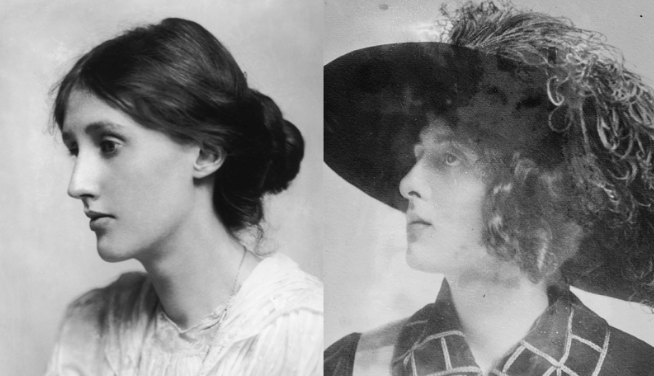
After The School of Life gets you up to speed on Dostoyevsky, you’ll no doubt find yourself able to more than hold your own in any water-cooler discussion of the man whom James Joyce credited with shattering the Victorian novel, “with its simpering maidens and ordered commonplaces,” whom Virginia Woolf regarded as the most exciting writer other that Shakespeare, and whose work Hermann Hesse tantalizingly described as “a glimpse into the havoc.” You may well also find yourself moved even to open one of Dostoyevsky’s intimidatingly important books themselves, whose assessments of the human condition remain as devastatingly clear-eyed as, well, The Office’s.
It is widely accepted among scholars that the first few books of the Bible—including, of course, Genesis, with its creation myths and flood story—are a patchwork of several different sources, pieced together by so-called redactors. This “documentary hypothesis” identifies the literary characteristics of each source, and attempts to reconstruct their different theological and political contexts. Primarily refined by German scholars in the late nineteenth century, the theory is very persuasive, but can also seem pretty schematic and dry, robbing the original texts of much of their liveliness, rhetorical power, and ancient strangeness.
Another German scholar, Hermann Gunkel, approached Genesis a little differently. “Everyone knows”—write the editors of a scholarly collection on the foundational Biblical text—Gunkel’s “motto”: “Genesis ist eine Sammlung von Sagen”—“Genesis is a collection of popular tales.” Rather than reading the various stories contained within as historical narratives or theological treatises, Gunkel saw them as redacted legends, myths, and folk tales—as ancient literature. “Legends are not lies,” he writes in The Legends of Genesis, “on the contrary, they are a particular form of poetry.”
Such was the approach of cartoonist and illustrator Robert Crumb, who took on illustrating the entire book of Genesis, “a text so great and so strange,” he says, “that it lends itself readily to graphic depictions.” In the short video above, Crumb describes the creation narrative in the ancient Hebrew book as “an archetypal story of our culture, such a strong story with all kinds of metaphorical meaning.” He also talks about his genuine respect and admiration for the stories of Genesis and their origins. “You study ancient Mesopotamian writings,” says Crumb, “and there’s all of these references in the oldest Sumerian legends about the tree of knowledge” and other elements that appear in Genesis, mixed up and redacted: “That’s how folk legends and all that shit evolve over centuries.”
The Biblical book first struck Crumb as “something to satirize,” and his initial approach leans on the irreverent, scatological tropes we know so well in his work. But he instead decided to produce a faithful visual interpretation of the text just as it is, illustrating each chapter, all 50, word for word. The result, writes Colin Smith at Sequart, is “idiosyncratic, tender-hearted and ultimately inspiring.” It is also a critical visual commentary on the text’s central character: Crumb’s God “is regularly, if not exclusively, portrayed as an unambiguously self-obsessed and bloodthirsty despot, terrifying in his demands, terrifying in his brutality.” Arguably, these traits emerge from the stories unaided, yet when we’re told, for example, that “The Lord regretted having made man on Earth and it grieved him in his heart,” Crumb “shows us nothing of regret and grief, but rather a furious old dictator apparently tottering on the edge of madness.”
“It’s not the evil of men that Crumb’s concerned with,” writes Smith, “so much as the psychology of a creature who’d slaughter an entire world.” In that interpretation, he echoes critics of the Bible’s theology since the Enlightenment, from Voltaire to Christopher Hitchens. But he doesn’t shy away from graphic depictions of human brutality, either. Crumb’s move away from satire and decision to “do it straight,” as he told NPR, came from his sense that the sweeping, violent mythology and “soap opera” relationships already lend themselves “to lurid illustration”—his forté. Originally intending to do just the first couple chapters “as a comic story,” he soon found he had a market for all 50 and “stupidly said, ‘okay, I’ll do it.’” The work—undertaken over four years—proved so exhausting, he says he “earned every penny.”
Does Crumb himself identify with the religious traditions in Genesis? Raised a Catholic, he left the church at 16: “I have my own little spiritual quest,” Crumb says, “but I don’t associate it with any particular traditional religion. I think that the traditional Western religions all are very problematic in my view.” That said, like many nonreligious people who read and respect religious texts, he knows the Bible well—better, it turned out, than his editor, a self-described expert. “I just illustrate it as it’s written,” said Crumb, “and the contradictions stand.”
When I first illustrated that part, the creation, where there’s basically two different creation stories that do contradict each other, and I sent it to the editor at Norton, the publisher, who told me he was a Bible scholar. And he read it, and he said wait a minute, this doesn’t make sense. This contradicts itself. Can we rewrite this so it makes sense? And I said that’s the way it’s written. He said, that’s the way it’s written? I said, yeah, you’re a Bible scholar. Check it out.
Online archives, galleries, and libraries offer Vegas-sized buffets for the senses (well two of them, anyway). All the art and photography your eyes can take in, all the music and spoken word recordings your ears can handle. But perhaps you’re still missing something? “Geordies banging spoons” maybe? Or “Tawang lamas blowing conch shell trumpets… Tongan tribesmen playing nose flutes…,” the sound of “the Assamese woodworm feasting on a window frame in the dead of night”?
No worries, the British Library’s got you covered and then some. In 2009, it “made its vast archive of world and traditional music available to everyone, free of charge, on the internet,” amounting to roughly 28,000 recordings and, The Guardian estimates “about 2,000 hours of singing, speaking, yelling, chanting, blowing, banging, tinkling and many other verbs associated with what is a uniquely rich sound archive.”
The 80,000 recordings available to stream online represent just a selection of the British Library’s “extensive collections of unique sound recordings,” but what a selection it is. In the short video at the top of the post, The Wire Magazine takes us on a mini-tour of the physical archive’s meticulous digitization methods. As with all such wide-ranging collections, it’s difficult to know where to begin.
One might browse the range of unusual folk sounds on aural display in the World & Traditional music section, covering every continent and a daunting metacategory called “Worldwide.” For a more specific entry point, Electronic Beats recommends a collection of “around 8,000 Afropop tracks” from Guinea, recorded on “the state-supported Syliphone label” and “released between 1958 and 1984.”
The category called “Sound Maps” organizes a diversity of recordings—including regional accents, interviews with Holocaust survivors, wildlife sounds, and Ugandan folk music—by reference to their locations on Google maps.
Not all of the material in “Sounds” is sound-based. Recording and audio geeks and historians will appreciate the large collection of “Playback & Recording Equipment” photographs (such as the 1912 Edison Disc Phonograph, above ), spanning the years 1877 to 1992. Also, many of the recordings—such as the wonderful first version of “Dirty Old Town” by Alan Lomax and the Ramblers, with Ewan MacColl and Peggy Seeger (below)—feature album covers, front and back, as well as disc labels.
The recordings in the Archive are unfortunately not downloadable (unless you are a licensed member of a UK HE/FE institution), but you can stream them all online and share any of them on your favorite social media platform. Perhaps the British Library will extend download privileges to all users in the future. For now, browsing through the sheer volume and variety of sounds in the archive should be enough to keep you busy.
What does Kafka mean to you? To me he has always represented the triumph of smallness, which is no slight; the exemplary figure of what Gilles Deleuze and Felix Guattari called “a minor literature.” Kafka made minutiae and triviality compelling, invested the petty struggles of everyday life with a dramatic intensity and metaphysical aura that linger for days after reading him. Kafka’s letters show him caught in the grip of a crippling, yet deeply funny, intellectual ambivalence; his stories and novels equally trade in absurdist humor and philosophical seriousness. Kafka haunts the small domestic spaces and tedium of office life, imbuing secular modernity with a tragicomic strangeness. He trembles at the continued power of a dethroned religious authority, perplexed by its emptiness, rewriting the inwardness and self-negation of religious asceticism in parables absent of any god.
Seeking the source of authority, Kafka’s heroes find instead unsolvable riddles and mysterious vacancies. Which is why it seems odd to me that Kafka should himself be memorialized as a gigantic head in statuary—an 11 meter, 45 ton stainless steel head, with 42 motorized layers that move independently, rearranging and “metamorphosing” the author’s face.
Called “K on Sun” and created by Czech artist David Černý, the shimmering, monumental work, installed in 2014, sits near the office building where Kafka worked as a clerk at an insurance company and across from the Prague City Hall. The “enormous mirrored bust” writes Christopher Jobson at This is Colossal, “brilliantly reveals Kafka’s tortured personality and unrelenting self-doubt.” Perhaps. Jacob Shamsian at Business Insider has another interpretation: “It’s meant to distract people from the frustrations of dealing with government employees.”
Maybe the key to understanding “K on Sun” is by comparison with an earlier piece by Černý called Metalmorphosis, which as you can see above, uses the same monumental, stainless steel design to create an enormous, gleaming, constantly rearranging head. This one sits at the Whitehall Technology Park in Charlotte, North Carolina, the kind of bland, homogenized corporate office campus that might have driven Kafka mad. “Černý,” writes Atlas Obscura, “notes the Metalmorphosis as something of a self-portrait of his own psyche,” saying “This is how I feel; it is a mental self-portrait.” Can we regard “Kafka in Sun” as also something of a portrait of Černý as well, imagining himself as Kafka? Perhaps.
The artist is a trickster character, known for frustrating and infuriating patrons and audiences, “a rebellious mix of Antony Gormley and Damien Hirst,” The Guardian opines, “as controversial as he is amusing.” One work, “Piss,” features just that, “two gyrating, mechanical men urinating on a map of the Czech Republic.” Their urine spells out famous sayings from Prague residents. Located right next to the Franz Kafka museum, the sculpture mocks the idea of art as a cultural enterprise devoted to the national interest. “Kafka in Sun” presents us with a much more imposingly serious piece than so many of Černý’s other, more whimsical, works. But it’s hard to imagine the satirical artist had a more serious, straightforward intention. In imagining Kafka as a huge, shiny sunlit head, he inverts the author’s small, private, self-contained world, turning Kafka into a strangely looming, public, authoritative presence resembling an enormous metal god.
Ta-Nehisi Coates has been riding a wave so high these past few years that most honest writers would confess to at least some small degree of envy. And yet anyone—writer or reader—who appreciates Coates’ rigorous scholarship, stylistic mastery, and enthralling personal voice must also admit that the accolades are well-earned. Winner of the National Book Award for his second autobiographical work, Between the World and Me and recipient of a MacArthur “Genius Grant,” Coates is frequently called on to discuss the seemingly intractable racism in the U.S., both its long, gritty history and continuation into the present. (On top of these credentials, Coates, an unabashed comic book nerd, is now penning the revived Black Panther title for Marvel, currently the year’s best-selling comic.)
As a senior editor at The Atlantic, Coates became a national voice for black America with articles on the paradoxes of Barack Obama’s presidency and the bootstraps conservatism of Bill Cosby (published before the comedian’s prosecution). His article “The Case for Reparations,” a lengthy, historical examination of Redlining, brought him further into national prominence. So high was Coates’ profile after his second book that Toni Morrison declared him the heir to James Baldwin’s legacy, a mantle that has weighed heavily and sparked some backlash, though Coates courted the comparison himself by styling Between the World and Me after Baldwin’s The Fire Next Time. In doing so, writes Michael Eric Dyson, “Coates did a daring thing… waged a bet that the American public could absorb even more of the epistolary device, and wrote a book-length essay to his son.”
Not only did America “absorb” the device; the nation’s readers marveled at Coates’ deft mixture of existential toughness and emotional vulnerability; his intense, unsentimental take on U.S. racist animus and his moving, loving portraits of his close friends and family. As a letter from a father to his son, the book also works as a teaching tool, and Coates liberally salts his personal narrative with the sources of his own education in African American history and politics from his father and his years at Howard University. In the wake of the fame the book has brought him, he has continued what he seems to view as a public mission to educate, and interviews and discussions with the writer frequently involve digressions on his sources of information, as well as the books that move and motivate him.
So it was when Coates sat down with New York Times Magazine and ProPublica reporter Nikole Hannah-Jones at New York’s Schomburg Center for Research in Black Culture last year. You can watch the full interview at the top of the post. During the course of the hour-long talk, Coates mentioned the books below, in the hopes, he says, that “folks who read” Between the World and Me “will read this book, and then go read a ton of other books.” He both began and ended his recommendations with Baldwin.
Finally, Coates references the famous debate between James Baldwin and William F. Buckley at Cambridge University in 1965, which you can read about and watch in full here.
I’m sure I speak for many when I say that Ursula K. Le Guin’s novels and stories changed what I thought science fiction could be and do. Raised on H.G. Wells, Isaac Asimov, Robert Heinlein, and other mostly-white-male-centered classic sci-fi, I found Le Guin’s literary thought experiments startling and refreshing. Now it seems like almost a matter of course that science fiction and fantasy narratives come from a diversity of peoples and perspectives. But Le Guin remains the first to wake me from a dogmatic slumber about the potential of speculative fiction to imagine not only future technologies, but also expansive future identities.
Novels like The Left Hand of Darkness,The Dispossessed, and The Lathe of Heaven reflect Le Guin’s very broad range of interests in politics and the humanities and social sciences. She began her career as an academic studying Renaissance French and Italian literature, and her fiction synthesizes years of careful reading in anthropology, psychology, sociology, history, and Eastern and Western philosophy. Likewise, though she has been much influenced by traditional hard science fiction, Le Guin’s literary loves are wide and deep. All that’s to say she’s as admirable and interesting a reader as she is a writer. When she praises a book, I pay attention. Thanks to her genial, loquacious online presence for many years, her fans have had ample opportunity to find out what she’s reading and why.
Le Guin recently made a few lists of books she likes, and made sure to preface each one with a disclaimer: “This list is not ‘my favorite books.’ It’s just a list of books I’ve read or re-read, recently, that I liked and wanted to tell people about.” She leaps from genre to genre, writing mini-reviews of each book and linking each one to Powell’s, the independent bookstore in her beloved city of Portland, Oregon. Below, we’ve excerpted some of Le Guin’s “Books I’ve Liked” from each list, along with her commentary. Click on each date heading to see her complete lists of recommendations.
Seeing, by José Saramago. A sequel to his amazing novel Blindness. Saramago is not easy to read. He punctuates mostly with commas, doesn’t pararaph often, doesn’t set off conversation in quotes —; mannerisms I wouldn’t endure in a lesser writer; but Saramago is worth it. More than worth it. Transcendently worth it. Blindness scared me to death when I started it, but it rises wonderfully out of darkness into the light. Seeing goes the other way and is a very frightening book.
Changing Ones, by Will Roscoe. An examination of how gender has been constructed in Native American societies. Responsibly researched, very well written, generous in spirit, never oversimplifying a complex subject, this is a wonderfully enlightening book.
Age of Bronze: The Story of the Trojan War.I: A Thousand Ships, and II: Sacrifice by Eric Shanower. A graphic novel —; the first two volumes of a projected series. The drawing is excellent, the language lively, and the research awesome. Shanower goes back to the very origins of the war to follow the early careers of the various heroes —; Agamemnon and Menelaus, Achilles, Odysseus, Hector, Paris, Aeneas, and their families, parents, wives, lovers, children… Thus, by the end of Book Two, the actual siege of Troy, which the Iliad tells one part of, is yet to begin. I see a looming problem: the battles (of which there have been a good many already) are visually all alike, and there’s endlessly more to come —; battle scenes in Homer are brutally monotonous and interminable (as war is). But these two volumes are visually and narratively varied, and give a fascinating backgrounding and interpretation to the great stories.
Some young adult books I like — I had to read a lot of them this spring, and these stood out:
The Higher Power of Lucky by Susan Patron. This one has already won the Newbery Award and gone to Kiddilit Booksellers Heaven forever, so it doesn’t need my endorsement… but it’s a lovely, funny, sweet book, set in a truly godforsaken desert town in California.
Weedflower by Cynthia Kadohata. A novel that goes with its young heroine to one of the prison camps where our government sent all our citizens of Japanese ancestry in 1942 after Pearl Harbor. It’s a beautiful book, understated and strong and tender. If you read it you won’t forget it.
Charles Mann, 1491. A brilliant survey of what we know about the human populations of the Americas before the arrival of the Europeans, and a brief, often scathing history of how we’ve handled our knowledge. The author is not an archeologist or anthropologist, but he has done his homework, and is a fine reporter and summarizer, writing with clarity and flair, easy to read but never talking down. Discussing intensely controversial subjects such as dates of settlement and population sizes, he lets you know where he stands, but presents both sides fairly. A fascinating, mind-expanding book.
Michael Pollan, The Omnivore’s Dilemma. I have never eaten an Idaho potato since I read Pollan’s article about what potato fields are “treated” with, in his earlier book The Botany of Desire. This one is scary in a different way. It probably won’t stop you from eating anything, indeed it is a real celebration of (real) food; but the first section is as fine a description of the blind, incalculable power of Growth Capitalism as I ever read. (Did you know that cattle can’t digest corn, and have to be chemically poisoned in order to produce “cornfed beef”? So, there being lots and lots of grass, why feed them corn? Read the book!) There are some depressing bits in the section on “organic” food, too, but the last section, where he hunts and gathers his dinner, is funny and often touching.
Barbara Ehrenreich, Nickel and Dimed. Ehrenreich tries to get by on minimum wage, in three different towns, working as a waitress, a house cleaner, in a Wal-Mart… Yes, it came out eight years ago, and yes, it’s just as true now, if not truer. (I just read in my hometown paper that 47% of working people in Portland have to rely on food stamps. Not “welfare queens” — people with jobs, working people.) She writes her story with tremendous verve and exactness. It reads like a novel, and leaves you all shook up.
[Le Guin devoted this list to “Some Graphic Novels,” and wrote about her difficulty finding good “grown-up stuff.” Though most of it was not to her taste (“gross-out violence, or horror, or twee, or sexist, or otherwise not down my alley”), she kept “hoping, because the form seems to me such a hugely promising and adventurous one.” Below are two graphic novels she did like. Another, Age of Bronze, she mentioned above in her 2006 list.]
Marjane Satrapi’s Persepolis I and II, and her other books. (The movie of Persepolis was charming but it really didn’t add much to the book.) I admire her drawing, which is deceptively simple but very subtly designed, using the pure contrast-power of black-and-white. The drawings and the text combine so seamlessly that I’m not aware of looking back and forth between them, I’m just taking it all in at once — Which I think is pretty much my ideal for a graphic narrative?
Joann Sfar’s The Rabbi’s Cat I and II. Three connected stories in each volume. The first two stories in the first volume are pure delight. They are funny and wise and show you a world you almost certainly never knew existed. The rabbi is a dear, the rabbi’s daughter is a dear, and the rabbi’s cat is all cat, all through, all the way down. (I wondered why Sfar drew him so strangely, until I looked at the photograph of Sfar’s cat on the cover.) The second volume isn’t quite as great, but the first story in it is awfully funny and well drawn, with the most irresistible lion, and it’s all enjoyable. Sfar’s imagination and color are wonderful. His publisher should be pilloried in Times Square for printing the art in Vol II so small that you literally need a magnifying glass to read some of the continuity. — I gather that Sfar and Satrapi are friends. Are we on the way to having a great school of graphic novels by Foreigners Living in Paris?
But no one has solved the mystery of 1900’s Sherlock Holmes Baffled, above, the very first filmed entertainment to feature the character. The director and cinematographer was Arthur W. Marvin, who went on to serve as cameraman for D. W. Griffith’s early silent films. The identity of his starring actor has unfortunately been lost to the ages.
The film itself was believed lost, too, until Michael Pointer, a historian specializing in Sherlock Holmesiana, unearthed a paper copy in a Library of Congress archive. A series of individual cards, it was intended to be viewed by Mutoscope, a single viewer, crank-operated peep show device, common in turn-of-the-century arcades.
No doubt audiences who paid a penny to watch this fairly plotless 30-second adventure were more impressed by the special effects than the anonymous actor playing the iconic detective.
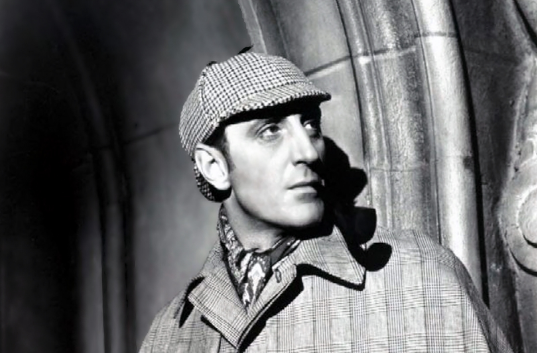
• The Adventures of Sherlock Holmes – Free – The film is adapted from the 1899 play “Sherlock Holmes” by William Gillette, and stars Basil Rathbone, Nigel Bruce, Ida Lupino, George Zucco and Alan Marshal. (1939)
• Dressed to Kill– Free – The last of 14 films starring Basil Rathbone as Sherlock Holmes and Nigel Bruce as Doctor Watson. (1941)
• Sherlock Holmes and the Secret Weapon – Free – Sherlock Holmes rescues an inventor of a new bomb site before the Nazis can get him. (1943)
• The Woman in Green – Free – Sherlock Holmes investigates when young women around London turn up murdered, each with a finger severed off. Scotland Yard suspects a madman, but Holmes believes the killings to be part of a diabolical plot. Stars Basil Rathbone as Holmes and Nigel Bruce as Dr. Watson. (1945)
• Terror by Night – Free – Sherlock Holmes film, the thirteenth to star Basil Rathbone and Nigel Bruce and was directed by Roy William Neill. The story revolves around the theft of a famous diamond aboard a train. (1946)
In the years after World War II, the CIA made use of jazz musicians, abstract expressionist painters, and experimental writers to promote avant-garde American culture as a Cold War weapon. At the time, downward cultural comparisons with Soviet art were highly credible.
Many years of repressive Stalinism and what Isaiah Berlin called “the new orthodoxy” had reduced so much Russian art and literature to didactic, homogenized social realism. But in the years following the first World War and the Russian Revolution, it would not have been possible to accuse the Soviets of cultural backwardness.
The first three decades of the twentieth century produced some of the most innovative art, film, dance, drama, and poetry in Russian history, much of it under the banner of Futurism, the movement begun in Italy in 1909 by F.T. Marinetti. Like the Italian Futurists, these avant-garde Russian artists and poets were, writes Poets.org, “preoccupied with urban imagery, eccentric words, neologisms, and experimental rhymes.” One of the movement’s most inventive members, Velimir Khlebnikov, wrote poetry that ranged from “dense and private neologisms to exotic verseforms written in palindromes.” Most of his poetry “was too impenetrable to reach a popular audience,” and his work included not only experiments with language on the page, but also avant-garde industrial sound recording.
Khlebnikov’s experiments in linguistic sound and form became known as “Zaum,” a word that can be translated as “transreason,” or “beyond sense.” He pioneered his techniques with another major Futurist poet, Aleksei Kruchenykh, who may have been, writes Monoskop, “the most radical poet of Russian Futurism.” The most famous name to emerge from the movement, Vladimir Mayakovsky, embodied Futurism’s confident individualism, his poetics “a mixture of extravagant exaggerations and self-centered and arduous imagery.” Mayakovsky made a name for himself as an actor, painter, poet, filmmaker, and playwright. Even Stalin, who would soon preside over the suppression of the Russian avant-garde, called Mayakovsky after his death in 1930 “the best and most talented poet of the Soviet epoch.”
You can also download full pages in high-resolution. Many of the texts include strong visual elements, such as the cover at the top from a multi-author collection titled Radio, featuring Mayakovsky, whose own books include photo montages like the two further up. Just above, see the cover of Khlebnikov and Kruchenykh’s Vintage Love, which includes many more such sketches. And below, the cover of a 1926 book by Kruchenykh called On the Fight Against Hooliganism in Literature.
Although “state control was absolute throughout” Soviet history, these artists flourished before Trotsky’s fall in 1928, wrote Isaiah Berlin in his 1945 profile of Russian art; there was “a vast ferment in Soviet thought, which during those early years was genuinely animated by the spirit of revolt against, and challenge to, the arts of the West.” The Party came to view this period as “the last desperate struggle of capitalism” and the Futurists would soon be overthrown, “by the strong, young, materialist, earthbound, proletarian culture”—a culture imposed from above in the mid-30s by the Writers’ Union and the Central Committee.
Thus began the regrettable persecutions and purges of artists and dissidents of all kinds, and the movement toward the Stalinist personality cult and “collective work on Soviet themes by squads of proletarian writers.” But during the first quarter of the century, “a time of storm and stress,” Russian literature and art, Berlin adjudged, “attained its greatest height since its classical age of Pushkin, Lermontov, and Gogol.”
We're hoping to rely on loyal readers, rather than erratic ads. Please click the Donate button and support Open Culture. You can use Paypal, Venmo, Patreon, even Crypto! We thank you!
Open Culture scours the web for the best educational media. We find the free courses and audio books you need, the language lessons & educational videos you want, and plenty of enlightenment in between.