The New York Times featured yesterday a piece that raises serious questions about the art world. According to the article, some major museums are now allowing art galleries to financially underwrite their exhibitions. And, of course, the galleries often have a direct financial stake in the work on display. This trend, which seems to be growing, naturally prompts questions of influence: are some of the most well-regarded museums letting financing — something that’s always in short supply — determine what exhibitions they will put on display? Are the lines between church and state getting crossed? (The museums insist that the answer is no.) Then, there are questions of commerce: are non-profit museums helping for-profit galleries, whether intentionally or not, bump up the prestige and financial value of their artists — something which almost always redounds to the financial benefit of the galleries?
I had a chance to catch up with Jori Finkel, the author of the article. She’s an arts journalist based in LA where she covers contemporary art for The Times, among other places. I asked her a few questions and here’s what she had to say:
DC: What’s essentially driving the museums to work so closely, perhaps too closely, with galleries? In short, how did we get here?
JF: One thing I discovered in reporting this story is just how common it is for galleries to help out museums behind the scenes—with research, with loans, and with things galleries do in the normal course of business like framing works of art. But it’s much more unusual to find galleries writing checks for museum shows. People I interviewed see this as a sign of the art world spinning out of control or out of balance because of all the money chasing contemporary art lately. The imbalance being that galleries are richer than ever before, while museums, which are not supposed to be part of the market, can find themselves struggling or even begging for funding. A museum director once told me he felt his job was a lot like being a beggar—a glamorous, well-connected beggar, but a beggar.
DC: As I recall, some museums have gotten into trouble when seeking out sponsors for exhibitions in the past — for example, from some corporations. Is what’s happening now any different, and does it raise particularly new ethical concerns?
JF: We saw a number of controversies in the late 1990s over corporate sponsorship—like Armani reportedly gifting the Guggenheim $15 million and getting a show in return, and BMW underwriting a motorcyle show, also at the Guggenheim. Then there was the scandal over the “Sensation” show at the Brooklyn Museum of Art, which featured works from Charles Saatchi’s personal collection and was funded in part by Saatchi. Several of my sources mentioned these cases because they think gallery sponsorship raises roughly the same set of ethical questions. The only difference they pointed out is that gallery conflicts might have the potential to be more pervasive. (more…)
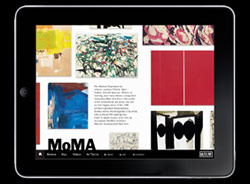 Through next April, you can visit “Abstract Expressionist New York,” – an exhibit at the Museum of Modern Art (NYC) that looks back at the work of Jackson Pollock, Mark Rothko, David Smith, Willem de Kooning and many others. If you can’t make the trip, then you can do the next best thing. Fire up your iPad, download the free app created by MoMA, and start watching a slideshow of 60 paintings currently on display in “AB EX NY.” All images are presented in high resolution, and the app also features 20 videos created by the curators, each of which concentrates on individual painters and their techniques. And did I mention that the app is free? (via Arts Beat)


