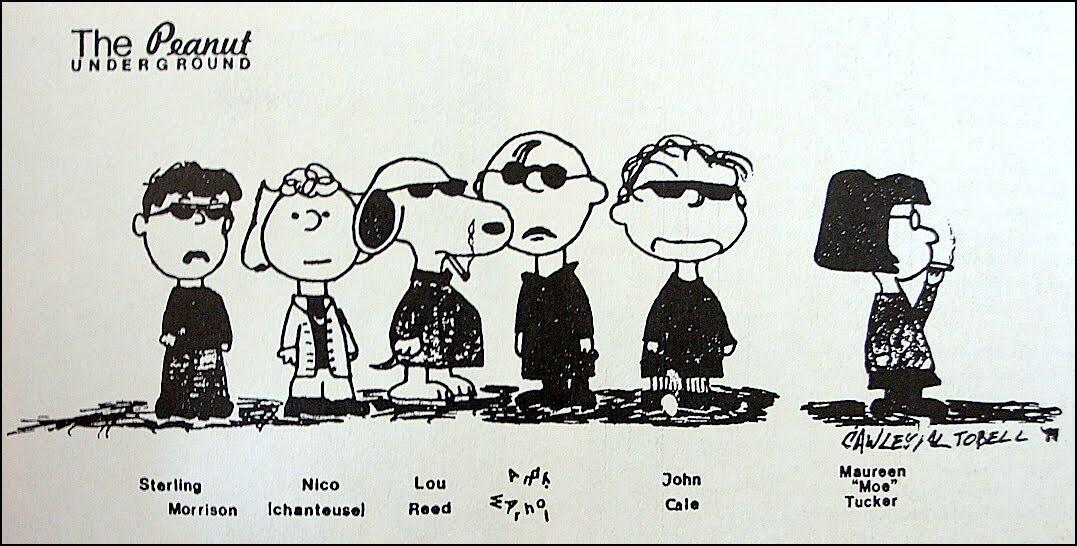
The fun cartoon above was apparently found in a “Guide to the Velvet Underground and Andy Warhol’s Factory” published by the French magazine, Les Inrockuptibles in 1990. It came around the same time the Fondation Cartier pour l’art contemporain (located in Paris) held an exhibition dedicated to Andy Warhol. Of course, Warhol famously took a break from painting in the mid-1960s and, among other things, threw his influence behind the up-and-coming NYC band, The Velvet Underground. Serving as the band’s manager, he “produced” VU’s first album, which meant designing the album cover and giving the band members — Lou Reed, John Cale, Sterling Morrison, Maureen Tucker and Nico — the freedom to make whatever album they pleased, up to a certain point. Above, you can see these same musicians reimagined as Peanuts characters.
If you would like to support the mission of Open Culture, consider making a donation to our site. It’s hard to rely 100% on ads, and your contributions will help us continue providing the best free cultural and educational materials to learners everywhere. You can contribute through PayPal, Patreon, and Venmo (@openculture). Thanks!
For decades we’ve been hearing promises about how communication technology will one day eliminate distance itself, making everyone around the globe feel as if they might as well be in the same room. Such a future would have its downside as well as its upside, but even now, approaching the third decade of the 21st century, it hasn’t quite arrived yet. Nevertheless, we’ve already grown so used to the idea of real-time global collaboration that it takes an extraordinarily ambitious project to let us step back and appreciate the technological reality that makes it possible. Take, for example, conductor Eric Whitacre’s Virtual Choir, whose performance of Whitacre’s own piece “Lux Arumque” appears above.
“Virtual,” here, is a bit of a misnomer, encouraging as it does Gibsonian visions of the 100-percent digital voices of synthetic singers resonating purely in cyberspace. And while Whitacre’s project wouldn’t have been possible without streaming digital audio and video technology — as well as the infrastructure of what we may as well still call cyberspace — it begins with the real voices of 100-percent analog humans.
185 such humans, to be precise, based in twelve countries, and all of them visible on their separate screens as Whitacre plays the role of conductor on his own. The much larger-scale performance of “Water Night,” a piece composed for the poetry of Octavio Paz, brings together 3,746 videos from 73 countries, necessitating a credits sequence longer than the piece itself.
The Virtual Choir grew, as many such immense works do, from a small seed: “It all started with this one young girl who sent me this video of herself singing one of my choral pieces,” says Whitacre in this video on the preparation for the Virtual Choir’s “Sleep” video. “I was struck so hard by the beauty, the intimacy of it, the sweetness of it, and I thought, ‘Boy, it would be amazing if we could get 100 people to do this and cut it all together.” The experience of assembling this virtual choir, or even hearing it, shows that “singing together and making music together is a fundamental human experience,” and on a scale hardly imaginable a generation or two ago. But on the most basic level, even this new way of making music is merely an expansion of the oldest way of making music: with one human voice, then another, and another.
Based in Seoul, Colin Marshall writes and broadcasts on cities, language, and culture. His projects include the book The Stateless City: a Walk through 21st-Century Los Angeles and the video series The City in Cinema. Follow him on Twitter at @colinmarshall or Facebook.
Leonard Cohen had an intimate relationship with despair. “I’ve seen the future,” he deadpanned, “Brother, it is murder.” But for many people, there is no one from whom we’d rather hear the news. In her harrowing essay “Facing Extinction,” meditation teacher and former climate journalist Catherine Ingram frames the catastrophe of climate change with Cohen’s lyrics and the many conversations she had with him before his death in 2016.
Cohen “understood human nature and assumed we would do ourselves in,” Ingram writes. Yet, with his razor-sharp gallows wit, he delivered his grim prophecies with deep love and concern. Confronting her own despair, Ingram asked the ailing poet for advice on how to wake up people who’d rather tune it all out. “There are things,” he said, “we don’t tell the children.”
Coming from someone else, this might sound supremely patronizing. From Cohen, it reminds me of what Japanese Zen master Dogen called “grandmother mind”—protective, unconditional compassion for others who may not, and may never, be ready to take in the facts. It also speaks of someone living with clinical depression, carrying the weight of the world. Cohen once called the condition a lifelong “background of anguish and anxiety.”
He met his suffering with meditation, practicing Rinzai Zen for decades and living as a monk for five years at the Mount Baldy monastery in Los Angeles. This period provides the inspiration for the new video above, directed by Daniel Askill, that dramatizes Cohen’s transformation from grief to “ordinary silence,” the meaning of his Japanese ordination name, Jikan.
Askill calls the video a “quiet, symbolic narrative that charts the letting go of ego and the trappings of fame.” The interpretation is “straightforward—almost pious,” says Matthew Gindin at Tricycle, and also “an intelligent update and homage” to imagery from Cohen’s first album.
The song, “Happens to the Heart” is the first on “an unexpected harvest of new songs” released on the posthumous album Thanks for the Dance, coming November 22. “Happens to the Heart,” is a distillation of classic Cohen themes: the weariness of pleasure, cosmic absurdity, compassion, and despair.
I had no trouble betting On the flood against the ark You see I knew about the ending What happens to the heart
Its title refrain turns each stanza into a case for how and why to care, investigating the mind’s lifetime of turnings from “the heart”—the constant splitting in two that Zen sees as the source of suffering. “I fought for something final,” Cohen intones at the song’s end, “not the right to disagree.”
Cohen talks about his journey into the monastery in the interview further up. “Maybe this whole activity,” the formal practice of Zen, “is a response to a sense of despair that I’ve always had.… By and large, I didn’t have what it took to really enjoy my success, or my celebrity. I was never able to locate it. I was never able to use it.” He learned how to disassociate and quarantine himself.
In the prison of the gifted I was friendly with the guards So I never had to witness What happens to the heart
In the austerities of the monastery, Cohen discovered “a voluptuous sense of economy that you can’t find anywhere else,” a daily practice “necessary to open the heart to the fact that you’re not alone,” even if, as he says wryly in “The Goal,” above—the first release fromThanks for the Dance—you “can’t stop the rain, can’t stop the snow.”
“Fame is a prison,” tweeted Lady Gaga, and many Twitter wars ensued. She was only echoing an old sentiment passed down through the entertainment ages, from Greta Garbo (“I detest crowds”) to Don Johnson. The emotional toll of celebrity is so well-known as to have become a standard, almost cliché, theme in storytelling, and no recent artist has exemplified the tortured, reluctant celebrity more prominently than Kurt Cobain.
Cobain may have wanted to be famous when Nirvana broke out of Washington State and signed with major label Geffen, but he did not want the kind of thing he got. At the end 1993, when the band recorded their MTV Unplugged in New Yorkspecial, he seemed positively suffocated by stardom. “We knew Cobain didn’t seem all that happy being a rock star,” recalls music journalist David Browne, who sat in the audience for that legendary performance, “and that Nirvana was essentially acquiescing to industry dictates by taping one of these shows.”
Cobain’s rare talent was to take his bitterness, despair, and rage and turn them back into deftly arranged melodic songs, stripped down in “one of the greatest live albums ever,” writes Andrew Wallace Chamings at The Atlantic. “An unforgettable document of raw tension and artistic genius. While intimacy was an intended part of the [Unplugged] concept… parts of the Nirvana set at Sony’s Hells Kitchen studio feel so personal it’s awkward.”
The performance reveals “a singer uncomfortable in his own skin, through addiction and depression” and the continued demands that he make nice for the crowds. The clipped interactions between Cobain and his bandmates, especially Dave Grohl, have become as much a part of the Nirvana Unplugged mythology as that frumpy green thrift-store cardigan (which recently sold at auction for $137,500).
Kurt’s disheveled crankiness may have been part of Nirvana’s act, but he also never seemed more authentically himself than in these performances, and it’s riveting, if painful, to see and hear. Five months later, he was dead, and. Unplugged would become Nirvana’s first posthumous release in November 1994. In the quarter century since, “accounts have emerged,” writes Browne, that show exactly “what was taking place in the days leading up to that taping.”
“The rehearsals were tense,” Browne continues, “MTV brass weren’t thrilled when the promised guests turned out to be the Meat Puppets and not, say, anyone from Pearl Jam. Cobain was going through withdrawal that morning.” And yet every song came together in one take—only one of three Unplugged specials in which that had ever happened. “The entire performance made you feel as if Cobain would perhaps survive…. The quiet seemed to be his salvation, until it wasn’t.”
Marking the album’s 25th anniversary this month, Geffen has rereleased Unplugged in New York both digitally and as a 2 LP set, announcing the event with more behind-the-scenes glimpses in the rehearsal footage here, previously only available on DVD. At the top, see the band practice “Polly,” and see a frustrated Grohl, whom Cobain considered leaving out of the show entirely, smoke and joke behind the scowling singer.
Further up, see Cobain strain at the vocals in “Come as You Are,” while Grohl shows off his newfound restraint and the band makes the song sound as watery and wobbly as it does fully electrified. Above, Cobain and guitarist Pat Smear work out their dynamic on Bowie’s “The Man Whole Sold the World,” while cellist Lori Goldston helps them create “the prettiest noise the band has ever made,” writes Chamings. Even 25 years on, “there is no way of listening to Unplugged in New York without invoking death; it’s in every note.” Somehow, this grim intensity made these performances the most vital of Nirvana’s career.
When people hear Anna-Maria Hefele sing, they wonder how she does it, and not just because of her impressive traditional chops. “While most of us struggle to voice one clear, distinct note,” writes the Independent’s Christopher Hooton, the polyphonic overtone singer Hefele “can sing two at once, and move them around in separate scales.” Also known as “throat singing,” this technique “allows her to establish a fundamental note and then move the overtone above it through different notes, creating an astounding, ethereal effect.” With nothing more than what nature gave her, in other words, Hefele manages to achieve a vocal effect more striking than most anything heard as a result of even today’s most complicated digital processes.
But what, exactly, is going on when she sings? These two videos, recorded with Hefele performing inside a magnetic resonance imaging machine at the Institute for Musician’s Medicine at the University Medical Center Freiburg, shed light on the mechanics of polyphonic overdone singing. “What you see in this dynamic MRI-recording is the tongue movement in the vocal tract while doing overtone singing and normal singing,” says the description.
“The positions of the tongue forms the resonance cavities which delete all not-wanted overtones in the sound of the voice at a certain point in time, and then amplify a single overtone that is left, which can be heard as a separate note above the fundamental.” It has, in other words, as much to do with suppressing all the tones you don’t want to sing as with emphasizing the ones you do. Hardly the easiest musical trick to pull off, much less inside an environment as unforgivingly noisy as an MRI machine.
But you can still learn the basic techniques, and from Hefele herself at that: previously here on Open Culture we’ve featured Hefele’s own demonstration of and how-to lessons on overtone singing. No matter how well we ourselves learn to sing two notes at once, though, we’d nevertheless have little idea what’s going on to let us make such sounds without these revealing MRI videos. (Others have similarly exposed the inner workings of beatboxing and opera singing.) The footage also underscores the respectable musical taste of Hefele herself or her collaborators in this research project, selecting as they have the musical examples of “Sehnsucht nach dem Frühlinge” by Hefele’s countryman Wolfgang Amadeus Mozart and “By This River” from singing advocate Brian Eno’s classic LP Before and After Science — though you might call this an example of music made during science.
Based in Seoul, Colin Marshall writes and broadcasts on cities, language, and culture. His projects include the book The Stateless City: a Walk through 21st-Century Los Angeles and the video series The City in Cinema. Follow him on Twitter at @colinmarshall or Facebook.
There seems to be widespread agreement—something special was lost in the rushed-to-market move from physical media to digital streaming. We have come to admit that some older musical technologies cannot be improved upon. Musicians, producers, engineers spend thousands to replicate the sound of older analog recording technology, with all its quirky, inconsistent operation. And fans buy record players and vinyl records in surprisingly increasing numbers to hear the warm and fuzzy character of their sound.
Neil Young, who has relentlessly criticized every aspect of digital recording, has dismissed the resurgence of the LP as a “fashion statement” given that most new albums released on vinyl are digital masters. But buyers come to vinyl with a range of expectations, writes Ari Herstand at Digital Music News: “Vinyl is an entire experience. Wonderfully tactile…. When we stare at our screens for the majority of our days, it’s nice to look at art that doesn’t glow and isn’t the size of my hand.” Vinyl can feel and look as good as it sounds (when properly engineered).
While shiny, digitally mastered vinyl releases pop up in big box stores everywhere, the real musical wealth lies in the past—in thousands upon thousands of LPs, 45s, 78s—relics of “the only consumer playback format we have that’s fully analog and fully lossless,” says vinyl mastering engineer Adam Gonsalves. Few institutions can afford to store thousands of physical albums, and many rarities and oddities exist in vanishingly fewer copies. Their crackle and hiss may be forever lost without the intervention of digital preservationists like the Internet Archive.
The Archive is “now expanding its digitization project to include LPs,” reports Faye Lessler on the organization’s blog. This will come as welcome news to cultural historians, analog conservationists, and vinyl enthusiasts of all kinds, who will mostly agree that digitization is far better than extinction, though the tactile and visual pleasures may be irreplaceable. The Archive has focused its efforts on the over 100,000 audio recordings from the Boston Public Library’s collection, “in order to prevent them from disappearing forever when the vinyl is broken, warped, or lost.”
“These recordings exist in a variety of historical formats, including wax cylinders, 78 rpms, and LPs,” though the project is currently focused on the latter. “They span musical genres including classical, pop, rock, and jazz, and contain obscure recordings like this album of music for baton twirlers, and this record of radio’s all-time greatest bloopers.” The method of rapidly converting the artifacts at the rate of ten LPs per hour (which you can read more about at the Archive blog) serves as a testament to what digital technology does best—using machine learning and metadata to automate the archival process and create extensive, searchable databases of catalogue information.
Currently, the project has uploaded 1,180 recordings to its site, “but some of the albums are only available in 30 second snippets due to rights issues,” Lessler points out. Browse the “Unlocked Recordings” category to hear 750 digitized LPs available in full: these include a recording of Gian Carlo Menotti’s ballet The Unicorn, the Gorgon, and the Manticore, further up; The Begetting of the President, above, a satire of Nixon’s rise to power as Biblical epic, read by Orson Welles in his King of Kings’ voice; and Tchaikovsky’s Piano Concerto no. 1 in B‑flat minor, played by Van Cliburn, below.
The range and variety captured in this collection—from fireworks sound effects to Elton John’s second, self-titled album to classic Pearl Baily to 80s new wave band The Communards to Andres Segovia playing Bach to the Smokey and the Bandit 2 soundtrack—will outlast copyright restrictions. And they will leave behind an extensive record, no pun intended, of the LP: “our primary musical medium for over a generation,” says the Archive’s special projects director CR Saikley, “witness to the birth of both Rock & Roll and Punk Rock… integral to our culture from the 1950s to the 1980s.” Vinyl remains the most revered of musical formats for good reason—reasons future generations will discover, at least virtually, for themselves someday.
A month before Leonard Cohen died in November, 2016, The New Yorker’s editor David Remnick traveled to the songwriter’s Los Angeles home for a lengthy interview in which Cohen looked both forward and back.
As a former Zen monk, he was also adept at inhabiting the present, one in which the shadow of death crept ever closer.
His former lover and muse, Marianne Ihlen, had succumbed to cancer earlier in the summer, two days after receiving a frank and loving email from Cohen:
Well, Marianne, it’s come to this time when we are really so old and our bodies are falling apart and I think I will follow you very soon. Know that I am so close behind you that if you stretch out your hand, I think you can reach mine. And you know that I’ve always loved you for your beauty and your wisdom, but I don’t need to say anything more about that because you know all about that. But now, I just want to wish you a very good journey. Goodbye old friend. Endless love, see you down the road.
The New Yorker has never shied from over-the-top physical descriptions. The courteous, highly verbal young poet, who’d evinced “a kind of Michael Corleone Before the Fall look, sloe-eyed, dark, a little hunched” was now very thin, but still handsome, with the handshake of “a courtly retired capo.”
In addition to an album, You Want It Darker, to promote, Cohen had a massive backlog of unpublished poems and unfinished lyrics to tend to before the sands of time ran out.
At 82, he seemed glad to have all his mental faculties and the support of a devoted personal assistant, several close friends and his two adult children, all of which allowed him to maintain his music and language-based workaholic habits.
Time, as he noted, provides a powerful incentive for finishing up, despite the challenges posed by the weakening flesh:
At a certain point, if you still have your marbles and are not faced with serious financial challenges, you have a chance to put your house in order. It’s a cliché, but it’s underestimated as an analgesic on all levels. Putting your house in order, if you can do it, is one of the most comforting activities, and the benefits of it are incalculable.
He had clearly made peace with the idea that some of his projects would go unfinished.
You can hear his fondness for one of them, a “sweet little song” that he recited from memory, eyes closed, in the animated interview excerpt, above:
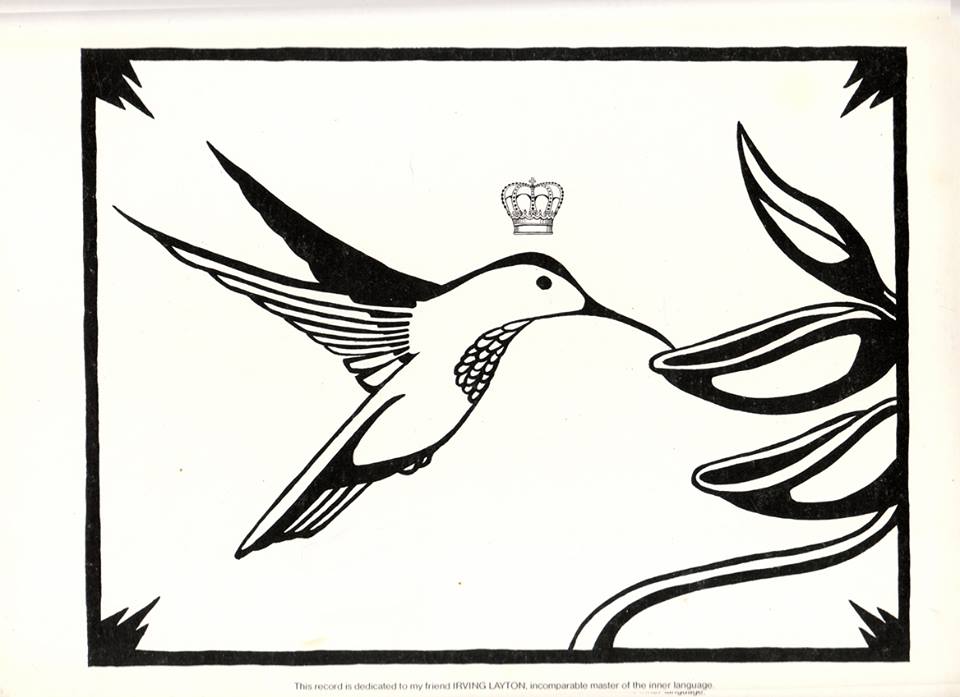
Listen to the hummingbird
Whose wings you cannot see
Listen to the hummingbird
Don’t listen to me.
Listen to the butterfly
Whose days but number three
Listen to the butterfly
Don’t listen to me.
Listen to the mind of God
Which doesn’t need to be
Listen to the mind of God
Don’t listen to me.
These unfinished thoughts close out Cohen’s beautifully named posthumous album, Thanks for the Dance, scheduled for release later this month.
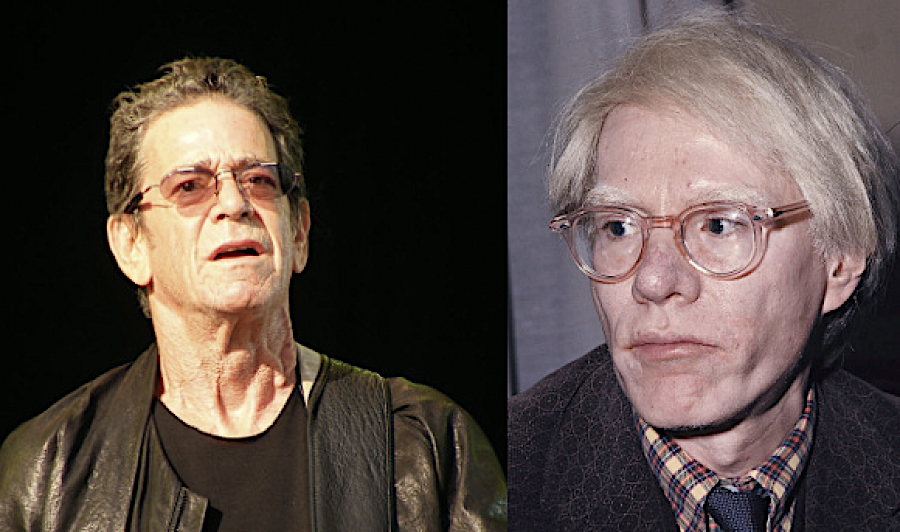
It’s every researcher’s dream: that somewhere among the pile of materials lies gold, an undiscovered masterpiece, or an unknown piece to a puzzle that complicates conventional knowledge. That’s what Cornell University’s Judith Peraino discovered while going through some of the 3,500 cassettes in the Andy Warhol archive. Here she found a mix-tape cassette that Lou Reed had made for Andy in the mid-seventies, with one side a selection of songs from recent live gigs, the other side containing 12 unknown and unreleased songs by Reed, accompanied by only his guitar, recorded at home in New York City.
Labeled “The Philosophy Songs (From A to B and Back),” the songs are Reed’s response to Warhol’s 1975 book The Philosophy of Andy Warhol: From A to B and Back Again, which his mentor had sent to Reed in galley proof. Their relationship was always difficult. After an unpleasant breakup after the Velvet Underground came out from under Warhol’s shadow, the two never worked together again. But they kept in touch in the way that certain bitter exes do: keeping it cordial, possibly considering working together again, then realizing why they broke up in the first place.
Prof. Peraino surmised that the tape is related to a musical Warhol wanted to create with Reed based on Warhol’s book. And in fact Reed uses passages from the book as jumping off points for the lyrics, she found. There’s a song each about “fame, sex, and the business of art,” and two about drag queens. But Reed used other songs to criticize Warhol for his seeming indifference to the deaths of Factory stars Candy Darling and Eric Emerson, adding that he should have died after being shot in 1968. Reed then apologies to Warhol at the end of the song.
Because her research was about the beginnings of mixtape culture, queerness, and Warhol’s endless boxes of cassettes, she is excited about both sides of the tape. Mixtapes, she explains, were a way for people to communicate complex emotions without having to simply write them down. Songs strike emotional chords in so many ways.
The tape “is an example of Lou Reed curating himself, putting together an ideal set list for Andy Warhol,” Peraino says in Cornell’s video interview. “I see the message of the tape as being both courtship and breakup in a sense. The one side is saying, look at me, what I’ve able to do this year…and now look at you.”
Apart from a 30-second excerpt, found on Variety’s web page, there are no current plans to release something so rough, and with so many rights issues at stake.
Lou Reed did go on to make something similar however, when in 1990 he wrote Songs for Drella with fellow Velvet John Cale.
Ted Mills is a freelance writer on the arts who currently hosts the artist interview-based FunkZone Podcast and is the producer of KCRW’s Curious Coast. You can also follow him on Twitter at @tedmills, read his other arts writing at tedmills.com and/or watch his films here.
We're hoping to rely on loyal readers, rather than erratic ads. Please click the Donate button and support Open Culture. You can use Paypal, Venmo, Patreon, even Crypto! We thank you!
Open Culture scours the web for the best educational media. We find the free courses and audio books you need, the language lessons & educational videos you want, and plenty of enlightenment in between.