The American folk revival of the 1950s and 60s paid dividends in the 1970s, a decade we usually associate with prog rock, disco, funk, and punk. These were the years of some of Crosby, Stills & Nash and Neil Young’s best acoustic folk, and the finest work of Joni Mitchell and James Taylor, both of whom had such unique takes on folk guitar that they redefined the instrument for generations. Mitchell drew from her teenage appreciation for jazz guitar, which she taught herself to play while still in high school. Taylor picked up his unusual voicings and arrangements from a number of American sources.
His influences, he told Adam Gopnik on The New Yorker Radio Hour, came from his early study of the cello (he played “badly, reluctantly,” he says); early exposure to Broadway show tunes and “light classics”, thanks to parents who shuttled him by train from North Carolina to New York City, and his admiration for Elvis, the Beatles, and Ray Charles.
Through a mix of childhood training, adolescent obsessions, and a mature fingerstyle honed by hours and hours of patient practice, Taylor came to dominate the charts with songs like 1970’s “Fire and Rain” and “Country Road,” bringing his acoustic folk and country sensibilities to soft rock stations everywhere.
Taylor’s songwriting, for all its lyrical drama and melancholy, begins with the guitar. Through pure technique, he makes the instrument sing, pulling his melodies from chord patterns and picking styles. As befits such a thoughtful player, he is also a teacher of the instrument, offering a free series of lessons for playing his most beloved songs. Here you can see his “Fire and Rain” lesson further up, “Country Road” above, and at the top, a brief intro to the series from Taylor himself.
Note that these lessons are for intermediate players, at least, and assume prior familiarity with the chord changes in the songs. The videos were originally available on Taylor’s website, and required a sign-in, he says, somewhat apologetically. Since 2011, they are all—8 lessons total—available on his official YouTube channel. See lesson number 6, “Carolina in My Mind,” just below, and watch all the rest for free here.
Neil Young has worked with Rick James in the Mynah Birds and David Crosby, Steven Stills, and Graham Nash in CSNY. He’s recorded everything from tearjerking piano ballads to brilliantly meandering psych rock to folk, country, and early 80s electronic. He perfected the spontaneous sound of albums recorded live and loose in a barn, but he is meticulous about technology and sound quality. He’s a superstar and self-described “rich hippie” who has near-universal credibility with indie artists. He is both “a hippie icon but also the godfather of grunge,” says the Polyphonic video above.
Young’s many seeming contradictions only strengthen his musical integrity. The shaggy Canadian singer, songwriter, guitarist, and leader of Buffalo Springfield and Crazy Horse has made films under the pseudonym “Bernard Shakey,” recorded soundtracks for acclaimed films, and inspired far more than the signature Seattle sound, though Pearl Jam and Nirvana both acknowledged their debt.
The Velvet Underground may get much of the credit for the sonic qualities of indie and alternative rock, but Young deserves more than a little recognition for influencing not only Kurt Cobain but also the likes of Radiohead’s Thom Yorke, Sonic Youth’s Kim Gordon, and Pavement’s Stephen Malkmus.
It’s a hell of a rock and roll resume, to have achieved lasting, significant influence on modern folk, country, and indie rock, just to name the most obvious genres Young has touched, in a career showcasing some of the most emotionally honest music ever captured on record. Despite the shambling, seemingly out-of-control nature of much of his output, it’s a very carefully crafted showcase. The 1979 live album Rust Never Sleeps, for example, functions as both a summation of his musical output up to that point and a metacommentary on the many—or well, the two—sides of Neil Young.
On one side, mellow, moody, solo acoustic folk, on the other, raucous, distorted rock and roll, courtesy of Crazy Horse. Bookending the record, the mirror image songs “My My, Hey Hey (Out of the Blue)” and “Hey Hey, My My (Into the Black),” tracks that apply the two different treatments to similar lyrics and arrangements, integrating the two sides of Young, which Polyphonic roughly divides into his acoustic Canadian pastoral side—warbling homesick ballads full of references to Ontario and other points north—and his American side: raw, edgy, full of righteous political indignation in songs like “Ohio, “Southern Man,” “Alabama,” and “Rockin’ in the Free World.”
Those who love Neil Young need no further inducement to embrace his contradictions, even when his work is uneven. The tension between them keeps fans hanging on, knowing full well that his less successful efforts are paths on the way to yet more brilliant restatements of his major themes and minor chords. Those less familiar, or less appreciative, of Neil Young’s formidable legacy may find they’ve underestimated him after watching this whirlwind tour through his tireless crusade against musical complacency, war, racism, and environment destruction, and the rust that has crept over so many of his contemporaries.
When Led Zeppelin appeared in late 1968, they already had the makings of a supergroup, so to speak, though only founding member Jimmy Page was a famous rock star. Four equally talented and seasoned musicians, each integral to the band’s sound. But it might have been otherwise. Page first intended to create a literal supergroup, joining his fellow former Yardbird Jeff Beck and The Who’s Keith Moon and John Entwistle.
Who knows what might have come of it? Moon supposedly quipped that it would go down like a lead balloon, inspiring the name of the band that was to come. This history makes all the more poignant the fact that Moon’s last onstage performance before his death was with Led Zeppelin.
Moon joined the band during the L.A. stop of their 1977 tour to ramble drunkenly into the microphone and sit in on a drum and tambourine with John Bonham during a nearly 20-minute drum solo on “Moby Dick.”
Moon also joined the band during the two-song encore of “Whole Lotta Love” and “Rock & Roll.” See parts of those performances at the top in audience footage. His brief moments behind John Bonham’s drums cannot be considered representative of what a hypothetical Keith Moon-backed Led Zeppelin might sound like. Not only was he playing another drummer’s kit—a significant handicap for Moon—but also, the Keith Moon of 1977 was not the Keith Moon of 1968. These documents of rock history can’t tell us what might have been, only, for a brief moment, what was.
Moon has been regarded as one of the greatest drummers in rock for his huge musical personality. “No drummer in a true rock & roll band has ever been given—has ever seized, perhaps—so much space and presence,” wrote Greil Marcus in tribute when Moon died the year after his Led Zeppelin cameo. Moon, “as Jon Landau pointed out years ago… played the parts conventionally given over to the lead guitar.” Moon called himself, with typical sarcasm, “the best Keith Moon-type drummer,” an insight into just how singular his playing was. His total lack of restraint fit The Who perfectly.
But history would decree that Bonham become the ideal Led Zeppelin-type drummer. He played lead parts as well, but never at the expense of rhythm. The pitfall of a supergroup—or a group of equally superb musicians—is that everyone can tend to overplay. Bonham was a superb musician, but also a drummer who knew exactly how to accommodate others’ virtuosity—building spacious rhythmic structures that held together the bombast of Plant and Page in a coherent whole. Bonham could follow Page’s riffs just as often as he could deploy his own thundering hooks.
Keith Moon was at his best playing Keith Moon, sounding “as if he came out of nowhere to take over the world,” wrote Marcus. The Who’s “best singles and album tracks not only featured Moon, they were built around him,” Entwistle and Townshend providing structure while Moon supplied the fiery core. Hear him at his incandescent best in the isolated drum track for “Wont’ Get Fooled Again” above and read more about what made him so indelibly unique in Marcus’ eulogy for “the best drummer in the history of rock ‘n roll.” Listen to a full audience audio recording of that 1977 concert just below.
Harp guitars have been around since at least the 19th century, and if you want a good, enthusiastic, intellectual argument on the exact date of its birth, you’ll find many an organologist ready to do that. (Here’s a page filled with information about the subject.) But it was only recently, in 2014, that the Grove Dictionary of Musical Instruments finally recognized the harp guitar as its own thing. New- or old-fangled as it might be, the harp guitar contains both the usual six strings and fretted neck and a neighboring series of unstopped open strings. Well known musicians who have played them include John McLaughlin, David Lindley, and Robbie Robertson.
But look up the instrument on the ‘net and there’s one name that will pop up before anybody else: 29 year old Canadian Jamie Dupuis. He’s earned millions of views on his YouTube channel for arranging and performing covers of rock and metal classics.
He’s certainly a fan of Pink Floyd, as you can see above in his cover of “Comfortably Numb.” The ringing, echoing quality of the harp guitar’s body suit the song well, as it starts to resemble a sort of synth-string wash.
The acoustic-based Floyd songs work as well as you might expect. “Wish You Were Here” for example.
Dupuis shows his skill with the more experimental electronics of Dark Side of the Moon. He adds a slide guitar and effects to “Time”:
…which works even better on “Breathe”:
And he brings out the very strange looking Dyer Electric Guitar Harp for “Welcome to the Machine,” using some double-tracking to give him some soloing space.
Ted Mills is a freelance writer on the arts who currently hosts the artist interview-based FunkZone Podcast and is the producer of KCRW’s Curious Coast. You can also follow him on Twitter at @tedmills, read his other arts writing at tedmills.com and/or watch his films here.
What if everything you thought you knew about grunge was a lie? Maybe you’ve suspected all along! But even if you were there, or somewhere, in that time of abysmally low internet literacy and connectivity, when every traditional media outlet was flannel, floppy hair, mopey half-protests, festivals, Seattle.… When you could save $6-$13 on “women’s grunge” and “$5 on kids’ grunge too!” at major department store chains…
But we may still remember grunge as a movement—with charismatic leaders and tragic heroes. A movement to reclaim serious, heavy, emotional hair rock from the profoundly unserious hair bands of the 80s. The first wave of Pacific Northwest bands to emerge with Nirvana, Soundgarden, and Pearl Jam were earnest and well-meaning and “primal,” says Bruce Pavitt, co-founder of the legendary Seattle record label Sub Pop.
Sub Pop midwifed the scene by signing so many of the bands that made it big, cultivating the sound and look of dirty, angry backwoodsmen with guitars. “Grunge Made Blue-Collar Culture Cool,” wrote Steven Kurutz in The New York Times Style Section just a few days ago, an implicit acknowledgment that the mostly-white and largely male scene sold a particular image of blue-collar that resonated, says Pavitt, because it represented an “ ‘American archetype.”
Pavitt and co-founder Jonathan Poneman were diehard fans of the music but they were no starry-eyed idealists—they understood exactly how to sell the region’s quirks to a national and international media. “It could have happened anywhere,” Poneman has said, “but there was a lucky set of coincidences. [Photographer] Charles Peterson was here to document the scene, [producer] Jack Endino was here to record the scene. Bruce and I were here to exploit the scene.”
But what was the scene? Was it “Grunge”? What is “Grunge”? How do you pronounce “Grunge”? What do “Grunge” people eat? After being peppered with one too many questions when the shockwave of Nirvana’s major label debut Nevermindhit in 1992, Poneman referred a reporter to a former Sub Pop employee, Megan Jasper, then working as a sales rep for Caroline records. The reporter, Rick Marin, was calling from The New York Times’ Style Section, asking for help compiling a grunge lexicon. What kinds of things do “Grunge” people say?
“By then,” writes Alan Siegel at The Ringer, “only outsiders earnestly used the term ‘grunge’ as a noun.” It was, says Charles Cross, former editor of alternative paper The Rocket, “an overhyped, inflated word that doesn’t have actual meaning in Seattle.” As for grunge slang, such a thing “didn’t exist.” The only thing to do, Jasper decided, was “react by trying to make fun of it,” she says. She had done the very same thing months earlier, when British magazine Sky made the same request. “I gave them a bunch of fake shit.”
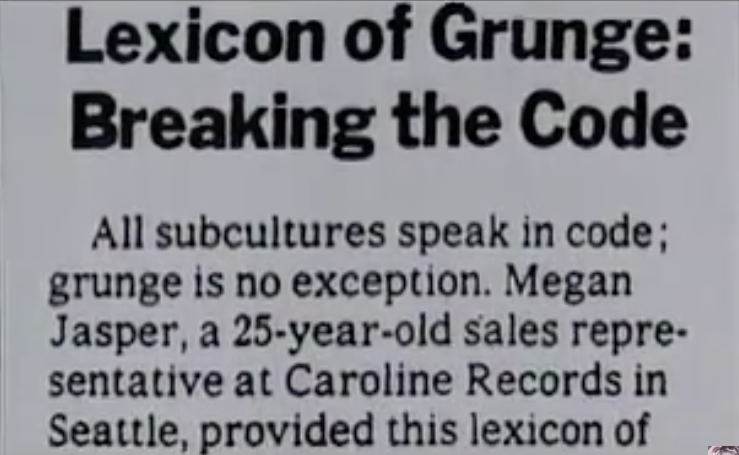
As she says in the interview clip at the top, she asked Marin to toss out normal words and she would give him “grunge” equivalents. “I kept escalating the craziness of the translations because anyone in their right mind would go, ‘Oh, come on, this is bullshit.’… but it never happened because he was concentrating so hard on getting the information right.” Thus, the grunge lexicon below, published in The New York Times in 1992. (“All subcultures speak in code,” goes the caption. This one would be appearing in malls nationwide.)
bloated, big bag of bloatation – drunk
bound-and-hagged – staying home on Friday or Saturday night
cob nobbler – loser
dish – desirable guy
fuzz – heavy wool sweaters
harsh realm – bummer
kickers – heavy boots
lamestain – uncool person
plats – platform shoes
rock on – a happy goodbye
score – great
swingin’ on the flippity-flop – hanging out
tom-tom club – uncool outsiders
wack slacks – old ripped jeans
It’s unlikely Marin ever traveled to Seattle and tried to bond with fellow kids, or he would not have published Jasper’s hoax glossary in an article otherwise critical of the mainstreaming of grunge. Marin compared the phenomenon to “the mass-marketing of disco, punk and hip-hop. Now with the grunging of America, it’s happening again. Pop will eat itself, the axiom goes.” It’s a thorough, well-sourced piece that quotes many of the scene’s founders, including Poneman, never suspecting they might be having a laugh.
The fake news grunge lexicon was a huge hit in Seattle, where Jasper was celebrated by her friends and family. “I got a very nice pat on the back,” she says. People clipped the lexicon to their shirts at shows. Indie label C/Z records then printed t‑shirts. “Lamestain” appeared on one. “Harsh Realm” on another. Mudhoney spread around Jasper’s slang in a Melody Maker interview with straight faces. It should have been debunked immediately “but this was 1992,” writes Siegel, “Snopes wasn’t around yet. Hell, The New York Times was still four years away from launching a website.”
Then, writer and reporter Thomas Frank called Jasper and asked, “there’s no way this is real, right?” Immediately, she responded, “Of course it’s not real.” Frank published the scoop in 1993; the Times smeared him as a hoaxer to discredit the revelation. The Baffler faxed the Times this note: “When The Newspaper of Record goes searching for the Next Big Thing and the Next Big Thing piddles on its leg, we think that’s funny.” These days, we might expect a Twitter war.
No one Siegel interviews seems to have been particularly upset about the whole thing. Marin’s “eyebrow is totally raised” throughout his piece, says his former editor Penelope Green. (Marin himself declined to be interviewed.) But the story has far less to do with one credulous reporter working a deadline and more to do with his argument—grunge had been rapidly packaged and sold, and by The Times, no less! But maybe its image was sort of a joke to begin with, one that now gets such straight-faced, reverent, sealed-behind-glass-cases treatment that you have to laugh.
Dylan’s “Tangled Up in Blue” strikes a middle point between his more surreal lyrics of the ‘60s and his more straightforward love songs, and as Polyphonic’s recent video taking a deep dive into this “musical masterpiece” shows, that combination is why so many count it as one of his best songs.
It is the opening track of Blood on the Tracks, the 1975 album that critics hailed as a return to form after four middling-at-best albums. (One of them, Self-Portrait, earned Dylan one of critic Greil Marcus’ best known opening lines: “What is this shit?”–in the pages of Rolling Stone no less.)
Blood on the Tracks is one of the best grumpy, middle-age albums, post-relationship, post-fame, all reckoning and accountability, a survey of the damage done to oneself and others, and “Tangled” is the entry point. Dylan’s marriage to Sara Lowndes Dylan was floundering after eight years–affairs, drink, and drugs had estranged the couple. Dylan would later say that “Tangled” “took me ten years to live and two years to write.”
It would also take him two studios, two cities, and two band line-ups to get working. A version recorded in New York City is slower, lower (in key), and more like one of his guitar-only folk tunes. In December of 1974, Dylan returned home to Minnesota and played the songs to his brother, who wasn’t impressed and suggested he rerecord. The version we know is faster, brighter, janglier, and as Polyphonic explains, sung at a key nearly too high for Dylan. But it’s that wild, near exasperation of reaching those notes that gives the song its lifeblood.
And he also reworked the lyrics, removing whole verses and changing others, until the finished version is, indeed, tangled. It jumps back and forth from present to past to wishful future, verse to verse, and even line to line.
The pronouns change too–the “she” is sometimes the lost love, sometimes a woman who reminds the singer of the former. The further he goes to get away from his first love, the more he meets visions of her elsewhere.
Then there’s the details of the travels and the jobs the narrator takes on, leaving fans to parse which are true and which are not (Sara Lowndes, for example, was working at a Playboy club–the “topless place”–when he met her). And even if we could know who the man is in verse six who “started into dealing with slaves”…would it make any difference?
In the end the song feels universal because it is both so specific and so intentionally confounding. “Tangled Up in Blue” affects so many of its listeners, yours truly included, because it recreates the way memories nestle in our minds, not as a linear sequence but as a kaleidoscope of images and feelings.
Ted Mills is a freelance writer on the arts who currently hosts the artist interview-based FunkZone Podcast and is the producer of KCRW’s Curious Coast. You can also follow him on Twitter at @tedmills, read his other arts writing at tedmills.com and/or watch his films here.
Why do David Bowie’s songs sounds like no one else’s, right down to the words that turn up in their lyrics? Novelist Rick Moody, who has been privy more than once to details of Bowie’s songwriting process, wrote about it in his column on Bowie’s 2013 album The Next Day: “David Bowie misdirects autobiographical interpretation, often, by laying claim to reportage and fiction as songwriting methodologies, and he cloaks himself, further, in the cut-up.” Anyone acquainted with the work of William S. Burroughs will recognize that term, which refers to the process of literally cutting up existing texts in order to generate new meanings with their rearranged pieces.
You can see how Bowie performed his cut-up composition in the 1970s in the clip above, in which he demonstrates and explains his version of the method. “What I’ve used it for, more than anything else, is igniting anything that might be in my imagination,” he says. “It can often come up with very interesting attitudes to look into. I tried doing it with diaries and things, and I was finding out amazing things about me and what I’d done and where I was going.”
Given what he sees as its ability to shed light on both the future and the past, he describes the cut-up method as “a very Western tarot” — and one that can provide just the right unexpected combination of sentences, phrases, or words to inspire a song.
As dramatically as Bowie’s self-presentation and musical style would change over the subsequent decades, the cut-up method would only become more fruitful for him. When Moody interviewed Bowie in 1995, Bowie “observed that he worked somewhere near to half the time as a lyricist in the cut-up tradition, and he even had, in those days, a computer program that would eat the words and spit them back in some less referential form.” Bowie describes how he uses that computer program in the 1997 BBC clip above: “I’ll take articles out of newspapers, poems that I’ve written, pieces of other people’s books, and put them all into this little warehouse, this container of information, and then hit the random button and it will randomize everything.”
Amid that randomness, Bowie says, “if you put three or four dissociated ideas together and create awkward relationships with them, the unconscious intelligence that comes from those pairings is really quite startling sometimes, quite provocative.” Sixteen years later, Moody received a startling and provocative set of seemingly dissociated words in response to a long-shot e‑mail he sent to Bowie in search of a deeper understanding of The Next Day. It ran as follows, with no further comment from the artist:
Effigies
Indulgences
Anarchist
Violence
Chthonic
Intimidation
Vampyric
Pantheon
Succubus
Hostage
Transference
Identity
Mauer
Interface
Flitting
Isolation
Revenge
Osmosis
Crusade
Tyrant
Domination
Indifference
Miasma
Pressgang
Displaced
Flight
Resettlement
Funereal
Glide
Trace
Balkan
Burial
Reverse
Manipulate
Origin
Text
Traitor
Urban
Comeuppance
Tragic
Nerve
Mystification
“Chthonic is a great word,” Moody writes, “and all art that is chthonic is excellent art.” He adds that “when Bowie says chthonic, it’s obvious he’s not just aspiring to chthonic, the album has death in nearly every song” — a theme that would wax on Bowie’s next and final album, though The Next Day came after an emergency heart surgery ended his live-performance career. “Chthonic has personal heft behind it, as does isolation, which is a word a lot like Isolar, the name of David Bowie’s management enterprise.” Moody scrutinizes each and every one of the words on the list in his column, finding meanings in them that, whatever their involvement in the creation of the album, very much enrich its listening experience. By using techniques like the cut-up method, Bowie ensured that his songs can never truly be interpreted — not that it will keep generation after generation of intrigued listeners from trying.
Based in Seoul, Colin Marshall writes and broadcasts on cities, language, and culture. His projects include the book The Stateless City: a Walk through 21st-Century Los Angeles and the video series The City in Cinema. Follow him on Twitter at @colinmarshall or on Facebook.
Could the return of marble-based madness be a reaction to our digital age? That we must construct real fantastical machines that perform humble amusements in the face of CGI-filled blockbusters? Do we need to know that if society collapses we can look to members of the Swedish folktronic band Wintergatan to help rebuild it? After watching the above video, friends, I say yes to all those (rhetorical) questions.
The Marble Conveyer Belt does what its name implies in a loving series of cranks, gears, “fish stairs,” ratchets, pistons, curved tracks, and springs, and no real amount of florid description will do justice to the visual poetry of watching Wintergatan’s Martin Molin operate/play what they have dubbed Marble Machine X.
This is not Molin or the band’s first machine. According to Wikipedia, between December 2014 and March 2016, Molin built the first Marble Machine, that played instruments like a vibraphone, bass guitar, cymbals, and a contact-microphone’d mini drum kit following a programmed wheel that triggered marble release armatures.
When that was a success, they disassembled the machine and set about working on Machine X.
Each step of the process was documented on YouTube, which is perfect for this sort of thing. The 79 videos can be watched over at this massive playlist. (Watch it below.) This time, Molin worked with a team of designers and engineers, along with fan input, to build something bigger and better.
Molin provided some specs over at the finished video’s YouTube page:
The Marble Conveyer Belt is Completed and it delivers Perfectly.
— lifts 8 marbles per crank turn.
— thanks to it being driven by ratchets and pistons, it makes a short halt to load and unload the marbles, on exactly the same spot every time.
— The pistons are connected to the crank shaft with a 2:1 gear reduction which means that the conveyer belt go in time with the music, and in half time. I can even use the mechanical sounds from the ratchets and the marbles climbing the fish stair to create parts of the beats.
— I only had one kick drum channel up and running so the kick drum plays on 2–4 like a snare normally would. Sounds a little strange but I just made this piece of music to demonstrate the concepts are working. (no music you hear in the videos are going to be used for the album, its quick and dirty functional pieces for the videos only)
— Its been a journey but we are now on our way. Again.
— the throw of the pistons s 40mm, the pitch of the chain is 15,875x2 mm, an imperial value, and it happens to be exactly twice the marble diameter. All this makes it possible to lift exactly one row of marbles per crank turn. The ratchets move 40 mm but only grabs onto the chain to move it exactly 31,75mm per crank turn.
The carriers are flame polished cnc:ed acrylic
— The chain was custom made in Japan and I waited 5 months for it to be delivered. haha. Of all the time consuming darlings on the MMX I love the conveyer belt /fish stair combo the most.
the marbles looks like they are stuck over the demagnetiser wheel, this is by design, as soon new marbles come into the pipes from below, the marbles are slowly pushed over the demag wheel which ensures perfect demagnetisation.
Molin has some kind of madness, the good kind. Where he goes after this achievement is anybody’s guess.
Ted Mills is a freelance writer on the arts who currently hosts the artist interview-based FunkZone Podcast and is the producer of KCRW’s Curious Coast. You can also follow him on Twitter at @tedmills, read his other arts writing at tedmills.com and/or watch his films here.
We're hoping to rely on loyal readers, rather than erratic ads. Please click the Donate button and support Open Culture. You can use Paypal, Venmo, Patreon, even Crypto! We thank you!
Open Culture scours the web for the best educational media. We find the free courses and audio books you need, the language lessons & educational videos you want, and plenty of enlightenment in between.