It’s not a subtle effect, by any means, which is precisely what makes it so effective. Gated reverb, the sound of an airbag deploying or weather balloon suddenly blowing out, an airy thud that pervades eighties pop, and the work of every musician thereafter who has referenced eighties pop, including CHVRCHES, Tegan and Sara, M83, Beyoncé, and Lorde, to name but a very few.
Before them came the pummeling gated drums of Kate Bush, Bruce Springsteen, Prince, Depeche Mode, New Order, Cocteau Twins, David Bowie, and Grace Jones, who turned Roxy Music’s “Love is the Drug” into a strict machine with the gated reverb of her 1980 cover.
Roxy Music caught up quickly with songs like the lovely “More Than This” on 1982’s Avalon, but Jones was an early adopter of the effect, which—like many a legendary piece of studio wizardry—came about entirely by accident, during a 1979 recording session for Peter Gabriel’s eerie solo track “Intruder.”
On the drums—Vox’s Estelle Caswell tells us in the explainer video at the top—was Gabriel’s former Genesis bandmate Phil Collins, and in the control room, recording engineer Hugh Padgham, who had inadvertently left a talkback mic on in the studio.
The mic happened to be running through a heavy compressor, which squashed the sound, and a noise gate that clamped down on the reverberating drums, cutting off the natural decay and creating a short, sharp echo that cut right through any mix. After hearing the sound, Gabriel arranged “Intruder” around it, and the following year, Collins and Padgham created the most iconic use of gated reverb in pop music history on “In the Air Tonight.” “Thanks to a happy accident,” says Caswell, “the sound of the 80s was born.” Also the sound of the oughties and beyond, as you’ll hear in the 38-s0ng playlist above, featuring many of the pioneers of gated reverb and the many earnest revivalists who made it hip, and ubiquitous, again.
FYI. Björk has just released a new track, “The Gate,” from her forthcoming album. And, with it, comes a hypnotic new video, the product of a collaboration between Björk, artist Andrew Thomas Huang, and Gucci’s Alessandro Michele.
About the video, Andrew Thomas Huang has this to say:
The Gate picks up where 2015’s Vulnicuraleft off. It is the first glimpse into Björk’s utopia. The doorway lies within the wound from Vulnicura, which now appears transformed into a prismatic portal channeled between the chests of two lovers. Not lovers in the quotidian romantic sense, but in a broader cosmological way. As a throughway into Bjork’s new album, The Gate is a declaration of hope sung by a woman refracted and re-formed into a luminous whole.
If you would like to support the mission of Open Culture, consider making a donation to our site. It’s hard to rely 100% on ads, and your contributions will help us continue providing the best free cultural and educational materials to learners everywhere. You can contribute through PayPal, Patreon, and Venmo (@openculture). Thanks!
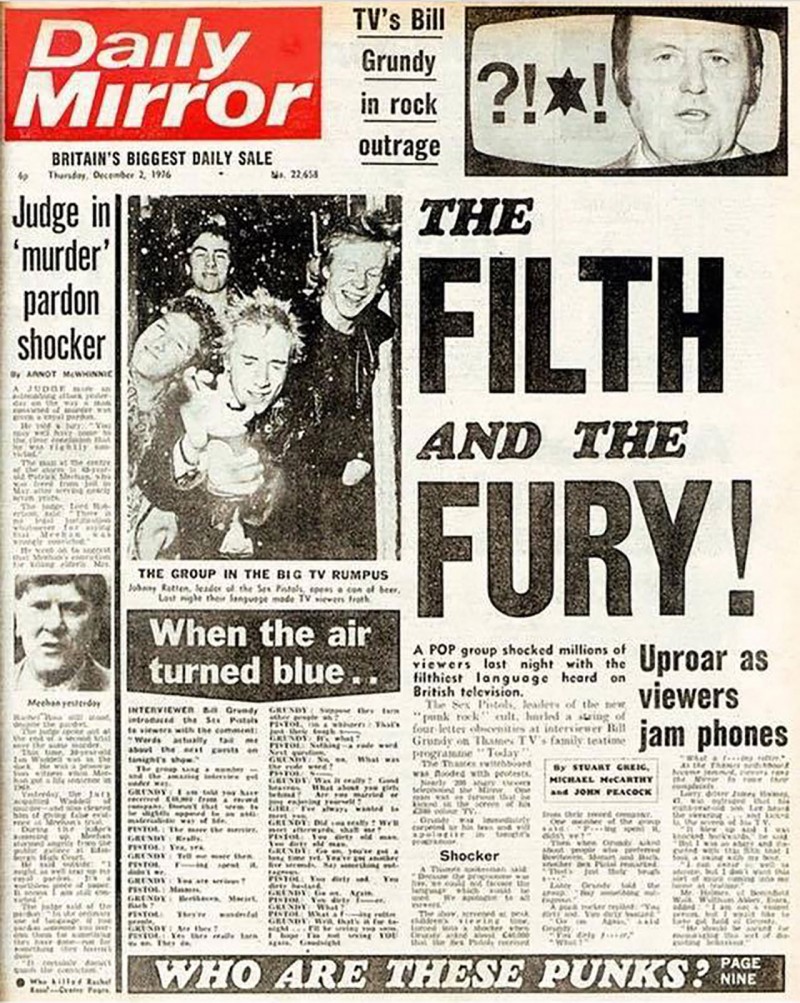
The brainlessness and hypocrisy of television has long been a source of fun and social commentary in punk rock—from Black Flag’s “TV Party” (“I don’t even bother to use my brain anymore”) to the Dead Kennedys’ “M.T.V. –Get Off the Air” (“… feeding you endless doses / of sugar-coated mindless garbage”). It’s fitting then that one of the seminal moments in punk history happened on television, orchestrated by Sex Pistols manager and arch provocateur Malcolm McLaren, who knew as well as anyone how to manipulate the media. The notorious Bill Grundy interview, which you can watch—likely not for the first or even second time—above, rocketed the Sex Pistols to national infamy overnight, simply because of a few swear words and some slightly rude behavior.
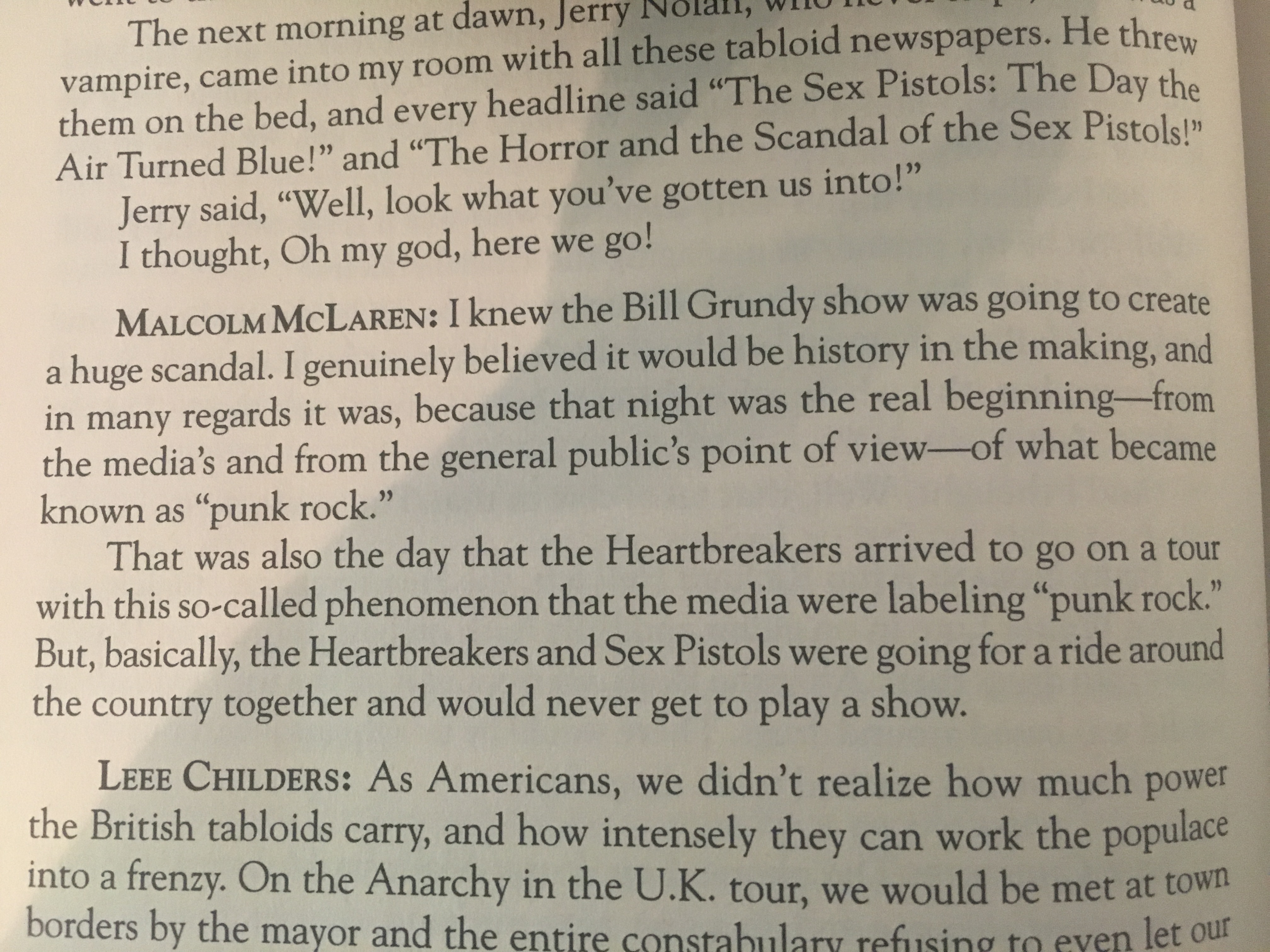
Though the U.S. does its damndest to keep up these days, no one in 1976 could match the outrage machinery of the UK press. As rock photographer and manager Leee Black Childers put it in the oral history of punk, Please Kill Me, thetabloids “can work the populace into a frenzy.” McLaren goes on record to say, “I knew the Bill Grundy show was going to create a huge scandal. I genuinely believed it would be history in the making.” We might expect him to take credit after the fact, but in any case, it worked: the day after the band’s appearance on the Grundy-hosted Today show on Thames Television, every tabloid paper featured them on the front page. The Daily Mirror provided the title of Julien Temple’s 2000 documentary with their clever headline, “The Filth and the Fury.”
Even in 2008, a survey showed the Grundy interview as the most requested clip in UK television history. With all this hype, you might be disappointed if you’re one of the few who hasn’t seen it. Though f‑bombs on TV can still cause a minor stir, a few mumbled curse words will hardly garner the kind of publicity they did forty years ago. McLaren claims punk rock began that day on the Today show, and that’s true, at least, for the viewing public who would have been treated to an appearance from Queen if Freddie Mercury hadn’t developed a crippling toothache. Instead, they were introduced to Paul Cook in a Vivienne Westwood naked breasts t‑shirt, and Glen Matlock, Steve Jones, and Johnny Rotten tossing insults at Grundy, who egged them on, hit on the teenage Siouxsie Sioux, part of the band’s entourage, and may have been drunk, though he denied it.
It may be one of the least witty exchanges in television history, and that’s saying a lot. But for all the pearl-clutching over the band’s crudity, it’s maybe Grundy who comes off looking the worse. More interesting than the interview itself is the hyperbolic fallout, as well as what happened immediately afterward. The station was flooded with complaints, and for some reason, its telephone system rerouted unanswered calls to the green room, where the band and their followers had decamped. “A producer on the programme ignored instructions to remain in the room,” notes Jon Bennett at Team Rock. “The result? The group started answering the phones and dishing out even more abuse. How this evaded the press at the time remains a mystery.” Indeed. It’s doubtful McLaren could have planned it, but the image evokes the sneer of every punk who has ever spit on the pious insistence that TV spoonfeed its viewers middle-class decorum with their advertising, sports, wish-fulfilling fantasies, and infotainment.
The composer Mussorgsky’s most famous work, Pictures at an Exhibition(listen here), had a tremendous influence on some of the most famous composers of the day when it debuted, which happened to be after its author’s death. Written in 1874 as a solo piano piece, it didn’t see publication until 1886, when it quickly became a virtuoso challenge for pianists and a popular choice for arrangements most notably by Maurice Ravel and Nikolai Rimsky-Korsakov, who, along with Igor Stravinsky and others, interpreted and expanded on many of Mussorgsky’s ideas into the early 20th century.
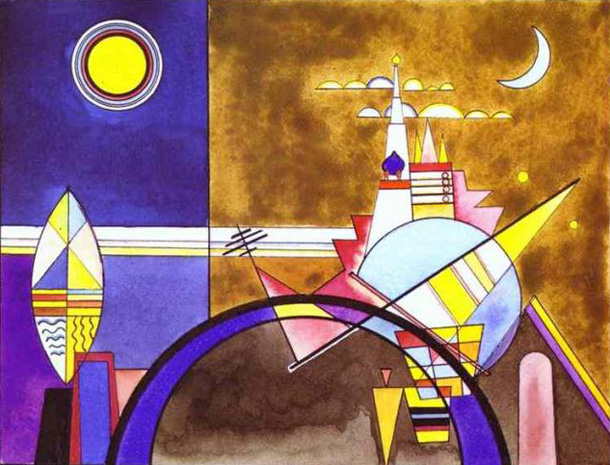
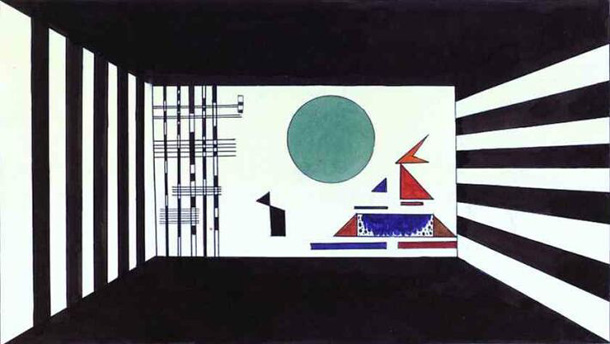
Mussorgsky’s early death in 1881 prevented any living collaboration between the painter and composer, but it’s only natural that his minimalist musical piece should have inspired Kandinsky’s only successful stage production. In Kandinsky’s theory, musical ideas operate like primary colors. His paintings explicitly illustrate sound. In his stage adaptation of Pictures at an Exhibition, he had the opportunity to paint sound in motion.
Kandinsky was first inspired to paint, at the age of 30, after hearing a performance of Wagner’s Lohengrin. “I saw all my colors in spirit,” he remarked afterward, “Wild, almost crazy lines were sketched in front of me.” The Denver Art Museum’s Renée Miller writes of Kandinsky’s experience as an example of synesthesia. He drew from the work of Arnold Schoenberg in his abstract expressionist canvases, and “gave many of his paintings musical titles, such as Composition and Improvisation.”
For his part, Mussorgsky found inspiration for his nonrepresentational work in the strangely uncanny representational visual art of Russian architect and painter Viktor Hartmann, his closest friend and member of a circle of artists attempting a nationalist Russian cultural revival. Mussorgsky’s Pictures at an Exhibition sets music to a collection of Hartmann’s paintings and drawings exhibited after the artist’s death, including sketches of opera costumes and a monumental architectural design.
The creation of several highly distinctive musical motifs is of a piece with Mussorgsky’s opera compositions. Both he and Kandinsky were drawn to opera for its dramatic conjunction of visual art, performance, and music, or what Wagner called Gesamtkunstwerk, the “total work of art.” And yet, despite their mutual admiration for classical forms and traditional Russian folklore, both artists illustrated the title of Wagner’s essay on the subject, “The Artwork of the Future,” more fully than Wagner himself.
Mussorgsky’s piece, as composed solo on the piano, is willfully odd, ugly and piercingly beautiful by turns, and always unsettling, like the Hartmann paintings that inspired it. So visually descriptive is its musical language that it might be said to induce a virtual form of synesthesia. In illustrating Pictures at an Exhibition, Kandinsky “took another step towards translating the idea of ‘monumental art’ into life,” notes the site Modern Art Consulting, “with his own sets and light, color and geometrical shapes for characters.”
On April 4, 1928, the première at the Friedrich Theater, Dessau, was a tremendous success. The music was played on the piano. The production was rather cumbersome as the sets were supposed to move and the hall lighting was to change constantly in keeping with Kandinsky’s scrupulous instructions. According to one of them, “bottomless depths of black” against a black backdrop were to transform into violet, while dimmers (rheostats) were yet to be invented.
Rather than translating Mussorgsky’s piece back into Hartmann’s representational idiom, Kandinsky creates an operatic movement of geometrical figures from the lexicon of the Bauhaus school. (Only “The Great Gate of Kiev,” at the top, resembles the original painting.) Rather than create narrative, “Kandinsky’s task was to turn the music into paintings,” says Harald Wetzel, curator of a recent exhibit in Dessau featuring many of the set designs. Those static elements “give just a limited impression of the stage production,” which was “constantly in motion.”
We may not have film of that original production, but we do have a very good sense of what it might have looked like through its many re-stagings over the past few years, including the production further up with pianist Mikhaïl Rudy at the théâtre de Brive in 2011 and the animated video remake above, which brings it even further into the future. See a selection of photos from the Kandinsky exhibit at Deutsche Welleand compare these paintings with the original pictures by Viktor Hartmann that inspired Mussorgsky’s piece.
The worlds of the Velvet Underground and Lawrence Welk are pretty far apart. On the one side, you have a gritty New York band city writing lyrics about shooting up heroin. On the other, a bandleader whose “champagne music” charmed TV viewers across Middle America for 27 straight years. And yet. And yet.
In this 2007 YouTube classic, director/producer Darren Hacker found a way to cross the chasm, mashing up VU’s 1968 song “Sister Ray” with footage from the Lawrence Welk Show. As he explained to Dangerous Minds, “I rigged up 2 ancient VCRs and a CD player across my living room floor, layed down on my stomach, cued everything up and then manually activated all 3 devices at precise intervals, live…in real time. One take, no edits…” Everything lined up, just like that.
Enjoy “Lawrence Welk Meets Velvet Underground” and imagine a moment when, circa 1968, VU went mainstream on the milquetoast Lawrence Welk Show.
Last year we featured the Wintergatan Music Machine, a lovingly handcrafted in wood automated instrument created by artist/musician Martin Mollin. Over 2,000 marbles travel through a complex series of gears, cranks, and tubes, eventually striking notes on a xylophone and creating beats on two closely mic’d pads to make bass and snare drum sounds. There’s more layers to follow in the video, and it’s all been programed by Mollin.
Even before digital they made fantastic, programmable music instruments. In bell towers and church towers that play a melody they always have a programming wheel exactly like the one that is on the marble machine.
Which leads to today’s video, where Mollin gets to improvise on the machine that inspired him to make his own: a 500-year-old carillon. This carillon uses a programmable wheel (or “repinnable musical drum” as it is officially called), which allowed melodies to be played on church bells.
Those patterns are set on the drum by a series of movable stops, but this carillon also has a second set of keys that are arranged like a piano, and must be played with a fist. Mollin has a go, and improvises a melody near the end.
Mollin also hosts “Music Machine Mondays” on his YouTube channel, where he explores more of the museum’s collection of automata, like this insane Self-Playing Orchestra with 17 Instruments (above). If you are into some pre-transistor coolness, before steam or punk was even a thing, do check it out.
Ted Mills is a freelance writer on the arts who currently hosts the FunkZone Podcast. You can also follow him on Twitter at @tedmills, read his other arts writing at tedmills.com and/or watch his films here.
Was Frank Zappa a musical genius? A modernist, avant-garde composer who just happened to work in an idiomatic pastiche of jazz, classical, progressive rock and juvenile shock tactics? The question can be a deeply divisive one. Zappa tends to inspire either intense devotion or intense dislike. But whatever one’s opinion of the man or his music, it’s safe to say that when he wasn’t working alone, Zappa worked in the company of some incredibly talented musicians. And he attracted, as John Rockwell wrote in 1984 at The New York Times, “a tiny following among classical avant-gardists.”
That year, one of his more genteel fans, Pierre Boulez—former music director of the New York Philharmonic and “widely regarded,” notes Rockwell, “as one of the great composers of the [20th] century”—decided to conduct a suite of Zappa songs. Zappa hoped the resulting album, The Perfect Stranger, would help him realize his ambition of having his music taken seriously in classical circles. (“A brief collaboration in 1970 with Zubin Mehta,” writes April Peavey at PRI, “went nowhere.”)
Boulez conducts his own ensemble for three tracks on the album, “The Perfect Stranger,” “Naval Aviation in Art?” and “Dupree’s Paradise.” The remaining four songs are performed by “The Barking Pumpkin Digital Gratification Consort,” a Zappaism for the Synclavier, Zappa’s favorite electronic instrument. For all the high seriousness the collaboration implies, Zappa couldn’t help inserting his surreally sardonic sense of humor; always “a compulsive musical comedian,” wrote Rockwell, he wears here “the defensive mask of irony, again.”
Each of the songs has an accompanying scenario. “The Perfect Stranger” imagines that “a door-to-door salesman, accompanied by his faithful gypsy-mutant industrial vacuum cleaner, cavorts licentiously with a slovenly housewife.” In “Love Story,” Zappa wants us to picture “an elderly Republican couple attempting sex while breakdancing.” Many people have had trouble getting past the sophomoric posturing and seeing Zappa’s music as serious art. He often seemed intent on alienating exactly such people.
But perhaps Zappa did not need the pedigree Boulez lent to his work. When listening, for example, to the Mothers of Invention play Zappa’s original arrangement of “Dupree’s Paradise” (top), one has to admit, he created brilliantly complex, rhythmically exciting music and, in the final analysis, represented “a particularly appealing type of quintessentially American composer—genuinely defiant of established categories and divisions that others routinely accept.” Listen to the Boulez/Zappa collaboration The Perfect Stranger in the Spotify playlist above, or access it directly on Spotify here.
Few filmmakers have ever figured out how to make a motion picture about an already larger-than-life personality, and personalities haven’t come much larger in recent history than Freddie Mercury’s. Talk of a movie about the Queen frontman, who died in 1991, has gone on for years: Dexter Fletcher came up as a potential director, and for the role of Mercury both Ben Wishaw and Sacha Baron Cohen have at different times been attached. But now the film has entered production, having found a director in Bryan Singer, he of the X‑Men franchise, and a star in Rami Malek, best known as the lead in the television series Mr. Robot.
But can Malek — or indeed anyone currently living — convince as Mercury? The first piece of evidence has surfaced in the form of the clip at the top of the post, shot on set as the cast recreates Queen’s 1985 comeback performance at Live Aid. The band “seemed to intuit right from the start the importance of the day, though they were very nervous backstage.
But once onstage they completely own it, even more so Freddie Mercury who rises to the occasion as a front man and as a singer, giving one of his best performances,” writes Ted Mills of the real concert video, which we featured just this past May here on Open Culture. The show opens by going straight into“Bohemian Rhapsody,” Queen’s signature eight-minute rock opera, which gives the new movie its working title.
Even going by just a minute and a half of footage, shot shakily, in low resolution, and at a distance, it must be said that Malek does look to make an uncanny Mercury, right down to that distinctive jog onto the stage at Wembley Stadium. In the Late Show with Stephen Colbert clip just above, Malek talks about his experience watching the surviving members of Queen watch his performance as Mercury for the first time — and at the iconic Abbey Road Studios, no less. “How did they take you?” Colbert asks. “They took me,” Malek responds, leaving us to wait until December of next year to judge for ourselves how he brings their beloved lead singer back to life — and whether, by whatever combination of training and technological wizardry, the film gets it right down to that one-of-a-kind voice.
We're hoping to rely on loyal readers, rather than erratic ads. Please click the Donate button and support Open Culture. You can use Paypal, Venmo, Patreon, even Crypto! We thank you!
Open Culture scours the web for the best educational media. We find the free courses and audio books you need, the language lessons & educational videos you want, and plenty of enlightenment in between.