Note: There are a few not-safe-for-work scenes in the film.
The world of music video was in its infancy in the late 1970s. MTV had yet to exist, and promotional films for singles were seen as useful for the times when a show couldn’t book a band to play live, or the band just didn’t play live any more. Into this world fell many a commercial director, used to the promotion side of the promo film business. But there were also directors like Derek Jarman, the punkest of UK directors at that time. This new format paid the bills in between features, and let him experiment.
Though he would go on to work with the Pet Shop Boys and The Smiths, Jarman’s first promo video is above, for three songs from Marianne Faithfull’s masterpiece of a new wave album, Broken English(1979).
Faithfull had been out of the public eye for years, having spent a lot of the ’70 trying to kick her drug habit. The anger and cynicism of this album, her cracked but commanding voice, and the electronic sounds were such that many forget she released two other “comeback albums” before this one. On Broken English she forcefully rewrites her own history as an artist, not content to be seen as a drug casualty or Mick Jagger’s ex-girlfriend.
Jarman was known at the time as the controversial filmmaker of both the homoerotic Sebastiane and the anti-Royal Jubilee, which more than any film at the time encapsulated the UK punk scene. It’s both brutal and romantic and charmingly D.I.Y.
The Broken English promo film features three songs, bracketed by black and white footage of Faithfull wandering around London and playing Space Invaders in a local arcade. The first, “Witch’s Song,” is the closest to Jarman’s short films during that period: languid, ambiguously gendered young people, apocalyptic dockside ruins, reflected mirrors, occultism and debauchery. The second, “The Ballad of Lucy Jordan,” features scenes of domesticity double exposed and/or projected over footage of Faithfull. The final one, for the title track, is a short collage of 20th century fascism and carnage, featuring Hitler, Mussolini, Oswald Mosley, British strikes, and self-immolated monks.
The two artists got along so well that she recorded the theme song for his film The Last of England, featuring a very young Tilda Swinton.
Both Jarman and Faithfull went on to successfully reinvent themselves, but for the 21st century viewer, they are also both worth rediscovering.
Ted Mills is a freelance writer on the arts who currently hosts the artist interview-based FunkZone Podcast and is the producer of KCRW’s Curious Coast. You can also follow him on Twitter at @tedmills, read his other arts writing at tedmills.com and/or watch his films here.
Smack in the middle of Pink Floyd’s classic Dark Side of the Moon sits a song many listeners may hear as an extended bridge between the two true centerpieces, “Time” and “Money.” But I’ve always thought of “The Great Gig in the Sky” as the album’s true center, a swirling, swinging, soulful prog-rock masterpiece, carried to stratospheric heights by British singer Clare Torry. The song’s wordless gospel vocal makes it an ecstatic, even hopeful, tent pole supporting Dark Side’s brilliantly cynical songs about the banality and injustice of modern life.
“The Great Gig in the Sky,” that is to say, provides much-needed emotional release in an album that can sound, writes Alexis Petridis, “like one long sigh.” Yet if you know the story of Dark Side of the Moon and of Clare Torry’s defining contribution, you’ll know that her incredible soaring vocal was sheer happenstance, an improvisation by a young unknown singer brought in at the last minute by producer Alan Parsons—and one who wasn’t a particular fan of the band. (“If it had been The Kinks,” she remembered, “I’d have been over the moon.”)
Torry reluctantly stepped into the studio and asked the band, “’Well, what do you want?’” Basically, she says, “they had no idea.” An early instrumental mix of the song from 1972 (top), foregrounds Nick Mason’s propulsive drums, Richard Wright’s Hammond organ, and samples from Apollo 17 transmissions. (These were replaced in the final version with a snippet from conservative writer Malcolm Muggeridge.)
When Torry went into the vocal booth and put on the headphones, she would have heard an even more stripped-down mix. Given no other instruction than “we don’t want any words,” she decided, “I have to pretend to be an instrument.”
Torry’s vocal is so distinctive that she eventually won a settlement in 2004 for a co-songwriting credit with Wright—an outcome some songwriting experts agree was fully justified since she essentially created a new melody for the song. In the interview above, hear Torry describe how she “had a little go” and, after some guidance from David Gilmour and a can of Heineken, casually knocked out one of the most thrilling vocal performances in rock history.
It’s graced the soundtracks of dozens of films, and provided the title for at least two more: the recent Edith Piaf bio-pic and an award winning French feature about a pre-adolescent transgender girl…
And now the above love story, set on the Pont des Art, starring an anthropomorphic rose and a long tall stick of beef jerky bearing a suspicious resemblance to Iggy Pop.
The animated Iggy stalks across toward his lady love with the stiffness of a White Walker, but it’s undeniably moving when this biologically ill-matched couple begins to dance in a swirl of green and red leaves signifying… what?
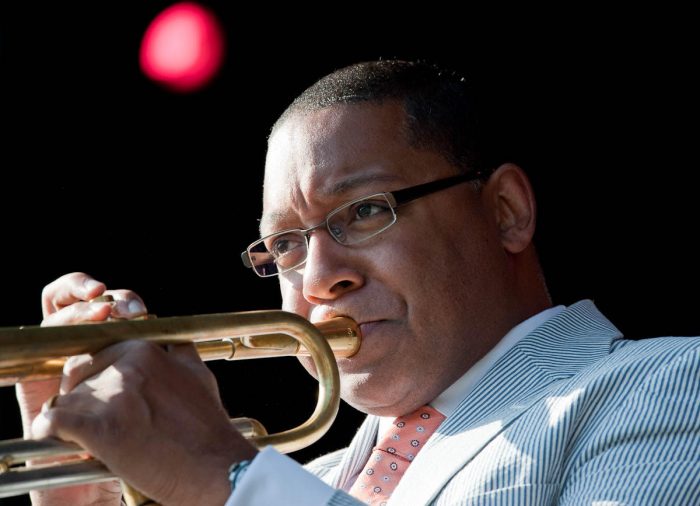
Practicing for countless hours before we can be good at something seems burdensome and boring. Maybe that’s why we’re drawn to stories of instant achievement. The monk realizes satori (and Neo learns kung fu); the superhero acquires great power out of the blue; Robert Johnson trades for genius at the crossroads. At the same time, we teach children they can’t master a skill without discipline and diligence. We repeat pop psych theories that specify the exact number hours required for excellence. The number may be arbitrary, but it comforts us to believe that practice might, eventually, make perfect. Because in truth we know there is no way around it. As Wynton Marsalis writes in “Wynton’s Twelve Ways to Practice: From Music to Schoolwork,” “practice is essential to learning music—and anything else, for that matter.”
For jazz musicians, the time spent learning theory and refining technique finds eloquent expression in the concept of woodshedding, a “humbling but necessary chore,” writes Paul Klemperer at Big Apple Jazz, “like chopping wood before you can start the fire.”
Yet retiring to the woodshed “means more than just practicing…. You have to dig deep into yourself, discipline yourself, become focused on the music and your instrument.” As beginners, we tend to look at practice only as a chore. The best jazz musicians know there’s also “something philosophical, almost religious” about it. John Coltrane, for example, practiced ceaselessly, consciously defining his music as a spiritual and contemplative discipline.
Marsalis also implies a religious aspect in his short article: “when you practice, it means you are willing to sacrifice to sound good… I like to say that the time spent practicing is the true sign of virtue in a musician.” Maybe this piety is intended to dispel the myth of quick and easy deals with infernal entities. But most of Marsalis’ “twelve ways to practice” are as pragmatic as they come, and “will work,” he promises “for almost every activity—from music to schoolwork to sports.” Find his abridged list below, and read his full commentary at “the trumpeter’s bible,” Arban’s Method.
Seek out instruction: A good teacher will help you understand the purpose of practicing and can teach you ways to make practicing easier and more productive.
Write out a schedule: A schedule helps you organize your time. Be sure to allow time to review the fundamentals because they are the foundation of all the complicated things that come later.
Set goals: Like a schedule, goals help you organize your time and chart your progress…. If a certain task turns out to be really difficult, relax your goals: practice doesn’t have to be painful to achieve results.
Concentrate: You can do more in 10 minutes of focused practice than in an hour of sighing and moaning. This means no video games, no television, no radio, just sitting still and working…. Concentrated effort takes practice too, especially for young people.
Relax and practice slowly: Take your time; don’t rush through things. Whenever you set out to learn something new – practicing scales, multiplication tables, verb tenses in Spanish – you need to start slowly and build up speed.
Practice hard things longer: Don’t be afraid of confronting your inadequacies; spend more time practicing what you can’t do…. Successful practice means coming face to face with your shortcomings. Don’t be discouraged; you’ll get it eventually.
Practice with expression: Every day you walk around making yourself into “you,” so do everything with the proper attitude…. Express your “style” through how you do what you do.
Learn from your mistakes: None of us are perfect, but don’t be too hard on yourself. If you drop a touchdown pass, or strike out to end the game, it’s not the end of the world. Pick yourself up, analyze what went wrong and keep going….
Donʼt show off: It’s hard to resist showing off when you can do something well…. But my father told me, “Son, those who play for applause, that’s all they get.” When you get caught up in doing the tricky stuff, you’re just cheating yourself and your audience.
Think for yourself: Your success or failure at anything ultimately depends on your ability to solve problems, so don’t become a robot…. Thinking for yourself helps develop your powers of judgment.
Be optimistic: Optimism helps you get over your mistakes and go on to do better. It also gives you endurance because having a positive attitude makes you feel that something great is always about to happen.
Look for connections: If you develop the discipline it takes to become good at something, that discipline will help you in whatever else you do…. The more you discover the relationships between things that at first seem different, the larger your world becomes. In other words, the woodshed can open up a whole world of possibilities.
You’ll note in even a cursory scan of Marsalis’ prescriptions that they begin with the imminently practical—the “chores” we can find tedious—and move further into the intangibles: developing creativity, humility, optimism, and, eventually, maybe, a gradual kind of enlightenment. You’ll notice on a closer read that the consciousness-raising and the mundane daily tasks go hand-in-hand.
While this may be all well and good for jazz musicians, students, athletes, or chess players, we may have reason for skepticism about success through practice more generally. Researchers at Princeton have found, for example, that the effectiveness of practice is “domain dependent.” In games, music, and sports, practice accounts for a good deal of improvement. In certain other “less stable” fields driven by celebrity and networking, for example, success can seem more dependent on personality or privileged access.
But it’s probably safe to assume that if you’re reading this post, you’re interested in mastering a skill, not cultivating a brand. Whether you want to play Carnegie Hall or “learn a language, cook good meals or get along well with people,” practice is essential, Marsalis argues, and practicing well is just as important as practicing often. For a look at how practice changes our brains, creating what we colloquially call “muscle memory,” see the TED-Ed video just above.
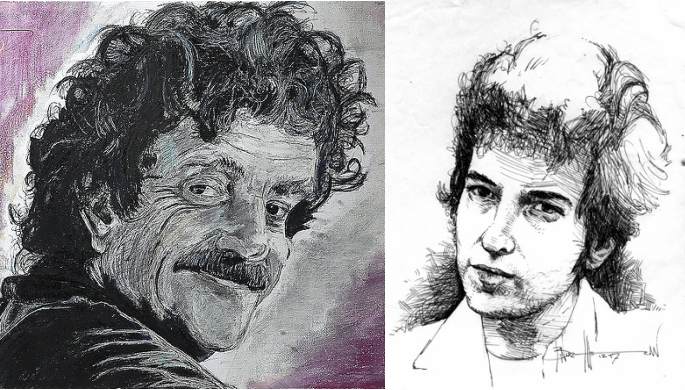
As if life weren’t fraught enough, we’re barreling toward the 10th anniversary of author Kurt Vonnegut’s death.
So it goes.
Several years before he died, Vonnegut penned an essay called “Knowing What’s Nice,” in which he stated:
If I should ever die, God forbid, let this be my epitaph: ‘The only proof he needed for the existence of God was music.’
“If I should ever…God forbid…”
Bless his cranky humanist heart, if that isn’t nice, I don’t know what is.
Those outside the inner circle can only speculate as to whether his remains rest eternally beneath his preferred epitaph. Their whereabouts are not a matter of public record. As one Internet wag surmised, he “probably didn’t want some vandal sonofabitch writing Everything was Beautiful and Nothing Hurt on it.”
What else is sacred? Oh, Romeo and Juliet, for instance. And all music is.
In reality, the amateur clarinet player’s ear was a bit more discerning:
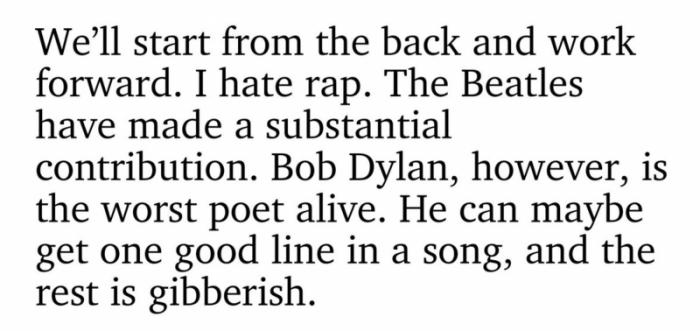
I hate rap. The Beatles have made a substantial contribution. Bob Dylan, however, is the worst poet alive. He can maybe get one good line in a song, and the rest is gibberish.
So he told Hustler in 1991, in response to a question about his musical tastes. Never did get around to telling the interviewer what he actually liked. According to his daughter, Nannette, the list would’ve included Dave Brubeck, the Statler Brothers, and The Music Man soundtrack.
Meanwhile, Dylan’s fans are not waiting for him to die to talk about the ways in which his music has helped them navigate through life, much as the jazzmen Vonnegut saw playing live in Depression-era Indianapolis transported him to a better place:
…what music is, I don’t know. But it helps me so.
Fans have created eleven playlists inspired by Vonnegut on the music sharing site 8tracks, including one that features Dylan’s A Hard Rain’s A‑Gonna Fall. (“Perfect for capturing Vonnegut’s vibe” enthused one innocent young commenter.)
Even in the early years of Pink Floyd’s career, the band was experimenting with the possibilities of the live experience. Already dazzling audiences with booming sound, colorful light shows, and bubbling translucent oil projections, the group called in Abbey Road engineers to design a quadrophonic sound system in 1967 to send Rick Wright’s keyboards around the concert hall, along with nature sounds, footsteps, or maniacal laughter.
By the time of Dark Side of the Moon, the band had even more of a budget, and began to screen short films, some animated, during their world tour concerts. Not really promotional videos, these films haven’t been seen outside their live context since. But the Internet has a way of finding these things.
Earlier this month, several YouTube users uploaded the film reels used on Pink Floyd’s 1974 North American Tour, with music from Dark Side of the Moon added back in to give an indication of how it was used in the show. (The mixes are also quite different from the album–maybe a fan can tell us from where these come?)
We get some very Kubrick-like traveling shots down both an empty hospital corridor and of Heathrow’s arrival lounge, and later a fist punching a bowl of eggs, Zabriskie Point-like exploding televisions, shots of Nixon and Idi Amin, and finally back to opening shots of the moon for the finale.
But there’s also moments of animation created then-unknown filmmaker Ian Emes.
The up-and-coming and self-taught artist had already made an animation “French Windows” set to the Floyd song “One of these Days,” filled with trippy landscapes and rotoscoped dancers. It won awards at animation festivals and was shown on British TV. According to Emes:
“Having seen my film French Windows on BBC’s The Old Grey Whistle Test, the band commissioned me to make their first-ever animated film, which they subsequently toured the world with. The Time sequence is used to this day. It was a breathtaking experience to see my film projected live at Wembley Arena before a huge crowd of tripped out fans.”
The concert films differed from country to country, sharing 75 percent of their footage, which means if you are a true fan, you’ll have to watch the British Tour version and the French Tour to know what you’re missing. The British version features more information, but it’s not clear if it’s also by Emes.
After Dark Side of the Moon, Pink Floyd continued to bring visuals into their live shows, most notably another animation for “Welcome to the Machine,” seen below. This time they used another up-and-coming illustrator and animator called Gerald Scarfe to create the harrowing graphics. Scarfe, of course, would later create many more works for Pink Floyd’s The Wall, and those animations would be used in concert and later in the Alan Parker film, The Wall.
Ted Mills is a freelance writer on the arts who currently hosts the artist interview-based FunkZone Podcast and is the producer of KCRW’s Curious Coast. You can also follow him on Twitter at @tedmills, read his other arts writing at tedmills.com and/or watch his films here.
Since the 1950s at least, Americans have embraced science fiction of all kinds—from the high concepts of 2001 to the high kitsch of Barbarella—even if sometimes only among devoted cult fans. The Queen-scored Flash Gordon, for example, did not do well in U.S. theaters on its release in 1980, though it was a hit in the UK. But not long after, its iconic, pulsing theme song, with its operatic blasts, became an unmistakable callback to the final days of 70s rock opera’s glorious excesses.
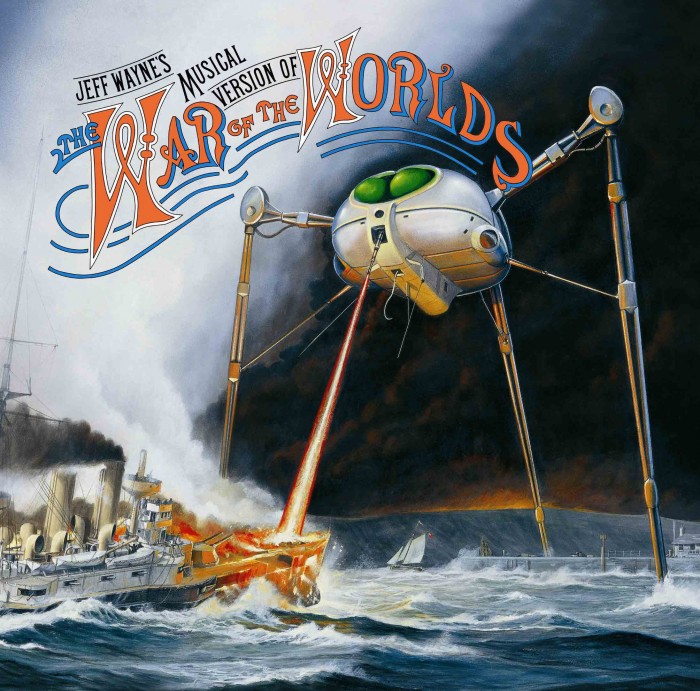
And yet somehow, another equally bombastic sci-fi rock opera produced in 1978, Jeff Wayne’s musical adaptation of H.G. Wells’ War of the Worlds, has been denied proper cult status in the States. At the time of its release, U.S. audiences, primed by the previous year’s colossal hit, Star Wars, perhaps sought more swashbuckling fare, not prog-rock double concept albums based on classic novels. American indifference, however, in no way hindered the album’s popularity abroad.
According to its clunky website, Wayne’s adaptation, “is one of the best known and best-selling musical works of all time.” This is no empty boast; it had “sold approximately 15 million records around the world” by 2013 and in 2009 was named the 40th best-selling album ever. And for good reason! While you may never have heard of Wayne—he wrote music for TV commercials for much of his career, and once struck it big by producing David Essex’s 1973 hit “Rock On”—you know the “cast” of his War of the Worlds.
Richard Burton narrates, lending the proceedings the gravitas Orson Welles gave The Alan Parsons Project’s adaptation of Edgar Allan Poe (and, many years earlier, brought to his own infamous War of the Worldsadaptation). The songs prominently feature Thin Lizzy’s Phil Lynott and The Moody Blues’ Justin Hayward, both huge stars at the time, as well as David Essex, “musical theater vet Julie Covington,” writes Dangerous Minds’ Ron Kretsch, and “guitar ace and Sex Pistols demo producer Chris Spedding.”
Supplementing the album’s musical charms, and they are many, the original LP also came “packaged in a gatefold with a book containing the complete script and some awesome paintings, mostly by noted Lord of the Rings cover artist Geoff Taylor.” For many of us, Jeff Wayne’s War of the Worlds will seem like a lost masterpiece, a brilliantly kitschy sci-fi, prog-disco classic that never got its due. For fans, however, in “no less than 22 countries,” as the album’s site proclaims, where it charted, reaching number one in half of them, the strangely inspired rock opera may well be very familiar.
You can hear the complete double LP at the playlist above (or click here), along with two more “sides” of alternates, outtakes, and demos. (If you need Spotify, download it here.) One of the songs, Hayward’s “Forever Autumn,” above, was originally written for a “late-‘60s LEGO commercial,” but warranted inclusion because “Wayne simply wanted a ballad to be included.” The move is typical of his more is more production approach to War of the Worlds, and yet, somehow, it all comes together into an engrossing experience. For some reason, in 2012, Wayne decided to remake the album, with Liam Neeson taking on the narration duties. Judging by its Amazon reviews, the new version is just as beloved by many fans as the old.
In times past, happening upon just the right radio station, record store, or tape trading community were some of the few serendipitous ways of discovering new music. And in those days, one faithful curator of innovative new sounds, BBC DJ John Peel, never disappointed. Because of a law limiting the amount of recorded music radio could play, his name became synonymous with the hundreds of intimate performances punk, new wave, reggae, and other bands recorded live in his studio. While the “Peel Sessions” will forever live in legend (stream some here), the man himself passed away in 2004, and the musical landscape he helped create has changed irrevocably.
And yet, Peel’s animating spirit lives on, most especially in NPR’s Tiny Desk Concerts, live in-studio performances recorded “at the desk of All Songs Considered host Bob Boilen.” Since 2008, Boilen has invited established and up-and-coming artists alike to his desk, capturing loose, unguarded, stripped-down, performances that sound like they’re happening in your living room.
Guitarists unplug, drummers trade their sticks for brushes, and we not only get to listen to old and new favorites; we get to watch them—like the Pixies at the top—up close as well. This performance, from 2014, garnered “the largest crowd we’d ever assembled for a Tiny Desk Concert,” writes Boilen, and featured newest member Paz Lenchantin trading her bass for violin.
Where the Pixies usually fill arenas with their eerily-quiet-to-deafeningly-loud songs, the group further up, Dirty Dozen Band, can easily fill public squares, football fields, and parade routes without stacks of overdriven amps. Hearing them explode in Boilen’s office with their rambunctious funk is a real treat, as is the larger-than-life voice of Adele, above, scaled down to college coffeehouse levels of closeness.
Though Tiny Desk Concerts often showcase pop, hip-hop, folk, country, and indie stars—like Wilco, below—and even classical stars like Yo-Yo Ma, above, it just as often introduces us to musicians we’ve never heard, or seen, before, and gives us the chance to get to know them without the usual trappings of marketing and boilerplate PR, or loud, crowded clubs with bad acoustics and no visibility.
The current homepage features a handful of incredibly talented musicians you’re unlikely to run across in most major venues. At least for now. Had he lived to see Tiny Desk Concerts, and its preservation of a radio curatorial tradition, John Peel, I think, would have been proud. See more performances from The National, Susan Vega, Yusuf Islam/Cat Stevens, Steve Earle, and many, many more—450 concerts in all—at NPR Music on Youtube.
We're hoping to rely on loyal readers, rather than erratic ads. Please click the Donate button and support Open Culture. You can use Paypal, Venmo, Patreon, even Crypto! We thank you!
Open Culture scours the web for the best educational media. We find the free courses and audio books you need, the language lessons & educational videos you want, and plenty of enlightenment in between.