One of our favorite curiosities is the The Charles Mingus CAT-alogue for Toilet Training Your Cat–a pamphlet written by the mercurial jazz musician that offers step-by-step advice on how to get your cat to use the loo. The one thing Mingus didn’t provide is video proof that it could actually be done.
That’s where another musician steps in. Above, we have video of Thomas Dolby’s cat, “Mozart,” in action. Dolby, best known for his 1982 hit “She Blinded Me with Science,” is a teacher at heart. The son of an Oxford and Cambridge don, he’s now the Professor of the Arts at Johns Hopkins University. And, on his Youtube channel, he explains how he pulled off the seemingly impossible:
This is my cat Mozart, a Cornish Rex, peeing on the toilet. Many believed this was not possible, but it’s 100% real. When he was a kitten we tried to teach him to use the toilet, using a DVD. We thought it was a no go. But then aged about 3 he suddenly started to do it. Now sometimes when I get up in the night to pee Mo nips in ahead of me and I have to wait till he’s done. Next we need to teach him to flush! ~TD
If anyone is familiar with the DVD he’s referencing, please identify it in the comments below.
The Beatles played their last stadium gig in August, 1966 at Candlestick Park, then stopped touring altogether. At least publicly, they claimed that their new songs, coming off of intricately-produced albums like Revolver and Sgt. Pepper, were just too hard to perform live.
Enter The Fab Faux, the greatest of all Beatles cover bands.
Featuring Will Lee (bassist for the Late Show with David Letterman), Jimmy Vivino (bandleader for Conan), Rich Pagano, Frank Agnello, and Jack Petruzzelli, The Fab Faux is all about one thing– performing live the most accurate reproduction of The Beatles’ repertoire. That includes songs that The Beatles never played live, and particularly songs off of the intricate later albums.
Above, you can watch them in action, playing the extended medley (16 minutes) that graces the second side of Abbey Road. Before you watch it, here are a couple things you need to know:
This Fab Faux recording of most of side two of ‘Abbey Road’ is a live, in-the-studio performance for a two-camera video shoot.… In the end, there were only three minor guitar fixes and each section was recorded in no more than three takes (most were two). There are NO added overdubs within this performance. The audio is pure — and mixed by Joe Chinnici.
The video was originally recorded for The Howard Stern Show. If you want to get a feel for how well The Fab Faux nailed it, watch their version played alongside the original below:
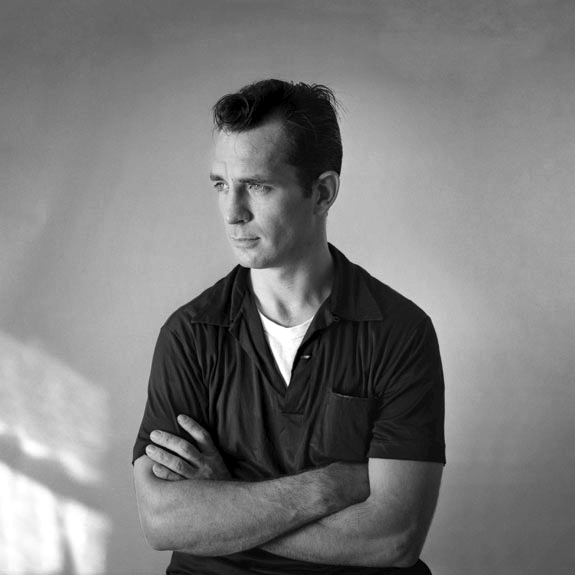
Last year, we featured a few readings and performances of the work of Jack Kerouac by musicians like Patti Smith, John Cale, Thurston Moore, and Joe Strummer. Those tracks got laid down for 1997’s Kerouac: Kicks Joy Darkness, a tribute to the author of On the Roadand The Dharma Bumsand an American cultural presence as resonant as they come. Now, you can listen to the whole thing on Spotify (whose free software you can download here) and revel in renditions of Kerouac’s poetry and prose by an even wider selection of beloved alternative musicians: Warren Zevon, Pearl Jam’s Eddie Vedder, REM’s Michael Stipe, Sonic Youth’s Lee Ranaldo show up on the roster, to name but a few.
It also features contributions from a great many subculture-defining non-musicians, including writers like Hunter S. Thompson and William S. Burroughs, comedian Richard Lewis, actor Matt Dillon, poet Maggie Estep, and a genuine Beat eminence like Lawrence Ferlinghetti. It even brings in cultural figures who, though known for other pursuits, also established enough of a side career in music to hold their own in the recording studio, like Johnny Depp and The Basketball Diariesauthor Jim Carroll. We even hear Kerouac as interpreted with the help of no less a lifelong musician — and no less unexpected a musician on an album like this — than Aerosmith’s Steven Tyler.
“Fourteen of the 25 tracks on this 79½-minute disc are drawn from Kerouac’s poetry book Pomes All Sizes,” writes All Music Guide’s William Ruhlmann. “The rest come from his novels (nothing from On the Road, though) and letters, with some unpublished work also included.” Ruhlmann points out Kerouac’s own lack of enthusiasm for rock and preference for jazz, highlighting Ranaldo, Zevon, Dillon, and Lewis’ contributions as closest to the man’s own sensibility. But altogether, he writes, they “present a good sampling of Kerouac’s literary concerns, and, whether appropriate or not, the recordings demonstrate his extensive influence” — a perfect demonstration of how the cool of one era can inspire the cool of another.
As a sometime musician, it’s only natural that I want my four-year-old daughter to take an interest in music. Sure, it’s a fun bonding activity, and sure, there may be a bit of a stage dad lurking inside me at times. But I’m also convinced of the tangible benefits playing a musical instrument can have on one’s personal development. New science, it seems, backs up this intuition. The Washington Post reported last year on a recent study from Northwestern University which found that “Music training not only helps children develop fine motor skills, but aids emotional and behavioral maturation as well.”
This may not come as a surprise. And yet, the details of the study provide insights our intuitions about the power of musical education may lack. For one thing, as you can see in the CNN report above, the benefits of learning to play music as a child can last for decades, even if someone hasn’t picked up an instrument since those early lessons. As Dr. Nina Kraus, director of Northwestern’s Auditory Neuroscience Laboratory, explains, good musical timing is strongly correlated with reading skills and general mental acuity. According to a co-author of the study, James Hudziak, professor of psychiatry at the University of Vermont, early musical training was shown to have “accelerated cortical organization in attention skill, anxiety management and emotional control.” These brain changes can accompany us well into old age.
Another, Canadian study, published in February in the The Journal of Neuroscience, found that childhood music lessons boost the ability of older adults to hear speech, a skill that begins to weaken later in life. The study found “robust” evidence that “starting formal lessons on a musical instrument prior to age 14 and continuing intense training for up to a decade appears to enhance key areas in the brain that support speech recognition.” Even music lessons taken later life can help rehabilitate the brains of older adults. “The findings,” writes Science Daily, “underscore the importance of music instruction in schools and in rehabilitative programs for older adults.”
Music teachers certainly need this kind of evidence to bolster support for ailing programs in schools, and musically-inclined parents will cheer these findings as well. But before the stage parent in you begins enrolling your kid in every music lesson you can fit into the schedule, take heed. As Dr. Kraus discovered in the Northwestern study, forcing kids to show up and participate under duress won’t exercise their brains. Real, active engagement is key. “We like to say that ‘making music matters,’” says Kraus, “because it is only through the active generation and manipulation of sound that music can rewire the brain.” While musical training may be one particularly enjoyable way to strengthen cognition, it isn’t the only way. But even if they don’t stick with it, the kids willing to put in the hours (and yes, the longer the better) will experience positive change that lasts a lifetime.
Last month, we featured poet, professor, and WFMU radio host Kenneth Goldsmith singing the theory of Theodor Adorno, Sigmund Freud, and Ludwig Wittgenstein — heavy reading, to be sure, but therein lay the appeal. How differently do we approach these formidable theoretical texts, Goldsmith’s project implicitly asks, if we receive them not just aurally rather than textually, but also in a light — not to say goofy — musical arrangement? But if it should drain you to think about questions like that, even as you absorb the thought of the likes of Adorno, Freud, and Wittgenstein, might we suggest Kenneth Goldsmith singing Harry Potter?
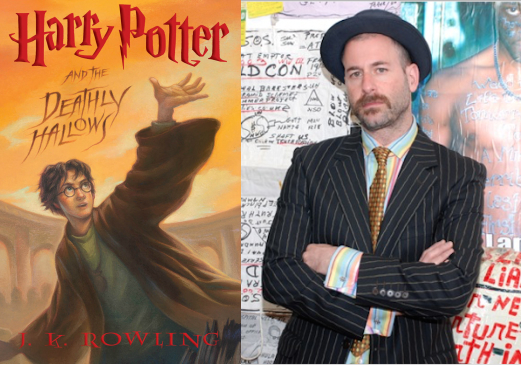
Perhaps the best-known modern exemplar of “light reading” we have, J.K. Rowling’s Harry Potter books present themselves as ripe for adaptation, most notably in the form of those eight big-budget films released between 2001 and 2011. On the other end of the spectrum, with evidently no budget at all, comes Goldsmith’s 30-minute adaptation, which you can hear just above, or along with his various other sung texts at Pennsound. Here he sings, with ever-shifting musical accompaniment and through some otherworldly voice processing, what sounds like the final novel in the Harry Potter series, Harry Potter and the Deathly Hallows.
“She tells a good story” — thus has every adult Harry Potter-reader I know explained the appeal of Rowling’s children’s novels even outside of the children’s demographic, especially as they awaited Deathly Hallows’ release in 2007. Having never dipped into the well myself, I couldn’t say for sure, but to my mind, if she tells a good enough story, that story will survive no matter the form into which you transpose it. The Potter faithful hold a variety of opinions about the degree of justice each movie does to their favorite novels, and even about the voice that reads them aloud in audiobook form, but what on Earth will they think of Goldsmith’s idiosyncratic rendition?
Update: Kenneth shot us an email a few minutes ago and filled out the backstory on this recording. Turns out the story is even more colorful than we first thought. He writes: “I was a DJ on WFMU from 1995–2010. In 2007, J.K. Rowling released the seventh and final Harry Potter and the Deathly Hallows. Prior to the book’s release the day I went on the air at WFMU, someone had leaked a copy to the internet, enraging Scholastic Books, who threatened anybody distributing it with a heavy lawsuit. I printed out and sang in my horrible voice the very last chapter of the book on the air, thereby spoiling the finale of the series for anyone listening. During my show, the station received an angry call from Scholastic Books. It appears that their whole office was listening to WFMU that afternoon. Nothing ever came of it.”
Sooo…. Let’s talk Bernie Sanders. No, I don’t want to talk about Bernie vs. Hillary, or vs. an increasingly worrisome grandstanding demagogue whose name I need not mention. I don’t want to talk Bernie vs. a younger civil rights activist groundswell… No!
Let’s talk about Bernie Sanders the recording artist.
Yeah, that’s right, Bernie made a record in 1987, a spoken-word album of classic hippy folk songs like “This Land is Your Land,” “Where Have All the Flowers Gone,” and—fittingly given his roots as a civil rights campaigner—“We Shall Overcome,” also the title of the album. Sanders, a passionate democratic socialist and stalwart advocate for economic justice, was also so passionate about this music that he wanted to add his voice to the choir. “Apparently,” writes Dan Joseph at MRCTV, “everyone in Sanders’ inner circle thought the recording was a pretty good idea. That was until they realized that Sanders had no musical talent, whatsoever.”
This is no exaggeration. Gawker quotes Todd Lockwood, a Burlington musician who helped produce the record: “As talented of a guy as he is, he has absolutely not one musical bone in his body, and that became painfully obvious from the get-go.” Hell, it never stopped William Shatner, and Shatner is the go-to comparison for the Sanders’ awkward “singing.” (It’s “positively Shatneresque,” writes Dangerous Minds.) Hear for yourself above in the Sander-ization of Woody Guthrie’s “This Land is Your Land.”
Bernie earnestly reads the lyrics in his native Brooklyn accent over a backing track that sounds like an outtake from the frustratingly great/terrible Leonard Cohen/Phil Spector collaboration Death of a Ladies Man. The contrast between the overproduced music and Sanders’ heartfelt and completely unmusical delivery is pretty weird, to say the least. Hear several more samples above, from Todd Lockwood’s Soundcloud. And if for some reason you want to listen to the whole album, and pay for the pleasure, buy Sanders’ We Shall Overcome at Amazon.
There may be no more critical interplay between two musicians in modern music than that between bassists and drummers. As jazz bassist Christian McBride put it in a recent NPR interview, “the bass and drums should work as one instrument. It determines whether it’s funk or jazz or country or rock ‘n’ roll. It all depends on what rhythms are coming from the bass and the drums that make a particular music what it is.” In funk and jazz, these rhythm players tend to get a lot more credit. Most people—even die hard fans—would be hard pressed to name one country bassist or drummer. In rock and roll, we’re used to lauding lead singers and guitarists. And certainly classic duos from Jagger and Richards, to Page and Plant, Roth and Van Halen, Morrissey and Marr and a lengthy list of others each have earned their vaunted places in music history.
Yet as a fan, I’ve always been drawn to unsung bass and drum combos—like The Smiths’ Mike Joyce and Andy Rourke, Jane’s Addiction’s Eric Avery and Stephen Perkins, and many others in bands whose flamboyant leaders tended to overshadow their rock solid supports. This is not the case in many other groups of superstars. McBride gives us the examples of Bootsy Collins and John Starks in James Brown’s band, and bassist Sam Jones and drummer Louis Hayes from Cannonball Adderley’s ensemble. Today we look specifically at some famed rock rhythm duos, and listen in on isolated tracks from some of their bands’ most well-known tunes. We begin with the absolutely classic powerhouse rhythm section of John Paul Jones (top) and John Bonham, whose grooves anchored the riff machine that was Led Zeppelin. Just above, hear their push and pull on “Ramble On.”
As it turns out, Zeppelin were big James Brown fans, and Jones has specifically mentioned the funk influence on his playing. Jones and Bonham, in turn, have influenced thousands of rhythm players, including perhaps one of the most famous of bass and drum duos, Rush’s Geddy Lee and Neil Peart. Just above, hear Lee’s fuzzed-out bass work in tandem with Peart’s expert time changes and breakdowns in isolated tracks from “Vital Signs,” a song from their early-eighties new wave-inspired album Moving Pictures. Rush is certainly not everyone’s cup of tea, but more rock and roll drummers than not probably cite them as an influence at some point in their careers. Though it wasn’t apparent to me in their heyday, even such a minimalist band as the Pixies had a Rush influence, specifically by way of drummer David Lovering. His locked grooves with bassist Kim Deal more or less defined the sound of the 90s through their influence on Nirvana, Weezer, Radiohead, Smashing Pumpkins and countless others. Hear their isolated rhythm tracks from Doolittle’s “Wave of Mutilation” below.
It’s hardly necessary to point out that perhaps the most famed rhythm section in rock history comes from its most celebrated band. But Paul McCartney and Ringo Starr often get remembered more for their songwriting and personalities than for their rhythm playing. Ringo’s taken his share of undeserved flak for his no-frills style. I’ve always found him to be an especially tasteful player who knows when to add the perfect fill or accent, when to lay back and let the song dominate, and when to get out of the way entirely. Starr’s thoughtful drumming perfectly complements McCartney’s highly melodic walking basslines—captured as well on the George Harrison-penned “Something,” below, as on anything else the band recorded.
Again, it’s hardly necessary to cite the number of bands influenced by the Beatles, though it’s harder to name rhythm sections directly inspired by McCartney and Starr’s dynamic. Nonetheless, their DNA runs through decades of pop music in all its forms. The other three duos above have directly inspired a more specific phenomenon of bands made up solely of bass and drums. One such band, the UK’s Royal Blood, has won numerous awards (and praise from Jimmy Page). See them perform a live version of “Figure It Out” below.
Other bands like Death From Above 1979 and Om have hugely devoted followings. (See a discussion of more bass-and-drum-only combos here.) With the success of these bands—along with the rise of electronic dance music as a dominant form—it’s safe to say that killer rhythm sections, so often overshadowed in rock and pop history, have pushed past traditional lead players and, in many cases, taken their place. I’d say it’s about time.
“A beautiful way to perform one of the world’s great musical treasures.” The video above, and the accompanying 58-character sentence, make up the last tweet from Oliver Sacks, the influential neurologist who passed away earlier today. The clip (originally highlighted on our site back in 2012) features 100 musicians and singers from the Orchestra Simfonica del Valles, Amics de l’Opera de Sabadell, Coral Belles Arts, and Cor Lieder Camera performing what’s now the anthem of the European Union — Beethoven’s “Ode to Joy” from his Symphony No. 9. It’s a pretty stirring performance, and certainly a worthwhile way to punctuate a Twitter stream. (Side note: Dr. Sacks started following our Twitter stream several years ago, and we still consider it a great honor, a high point in OC history.)
If you would like to support the mission of Open Culture, consider making a donation to our site. It’s hard to rely 100% on ads, and your contributions will help us continue providing the best free cultural and educational materials to learners everywhere. You can contribute through PayPal, Patreon, and Venmo (@openculture). Thanks!
We're hoping to rely on loyal readers, rather than erratic ads. Please click the Donate button and support Open Culture. You can use Paypal, Venmo, Patreon, even Crypto! We thank you!
Open Culture scours the web for the best educational media. We find the free courses and audio books you need, the language lessons & educational videos you want, and plenty of enlightenment in between.

 author Jim Carroll. We even hear Kerouac as interpreted with the help of no less a lifelong musician — and no less unexpected a musician on an album like this — than Aerosmith’s Steven Tyler.
 ,”
,” 
 . Rush is certainly not everyone’s cup of tea, but more rock and roll drummers than not probably cite them as an influence at some point in their careers. Though it wasn’t apparent to me in their heyday, even such a minimalist band as the Pixies had a Rush influence, specifically by way of drummer David Lovering. His locked grooves with bassist Kim Deal more or less defined the sound of the 90s through their influence on Nirvana, Weezer, Radiohead, Smashing Pumpkins and countless others. Hear their isolated rhythm tracks from Doolittle’s “Wave of Mutilation” below.



