Herbie Hancock Explains the Big Lesson He Learned From Miles Davis: Every Mistake in Music, as in Life, Is an Opportunity

One thing they don’t teach you in par­ent­ing school is how to guide a young child into mak­ing few­er mis­takes in her home­work, while also com­mu­ni­cat­ing to her that mis­takes are not “bad” but often “good” in that they can be con­duits for cre­ative think­ing and intu­itive path­ways to progress. This les­son presents even more prob­lems if your child has per­fec­tion­ist ten­den­cies. (If you have sound ped­a­gog­i­cal meth­ods, I’m all ears.)

The prob­lem isn’t just that adults con­stant­ly tele­graph bina­ry “yes/no,” “good/bad” mes­sages to every­one and every­thing around them, but that most adults are deeply uncom­fort­able with ambi­gu­i­ty, and thus deeply afraid of mis­takes, as a result of imbib­ing so many bina­ry mes­sages them­selves. Impro­vi­sa­tion fright­ens trained and untrained musi­cians alike, for exam­ple, for this very rea­son. Who wants to screw up pub­licly and look like… well, a screw up?

We think that doing some­thing well, and even “per­fect­ly,” will win us the pat on the head/gold star/good report card we have been taught to crave all our lives. Sure­ly there are excel­lent rea­sons to strive for excel­lence. But accord­ing to one who should know—the most excel­lent Miles Davis—excellence by nature obvi­ates the idea of mis­takes. How’s that, you ask? Let us attend to one of Davis’ for­mer side­men, Her­bie Han­cock, who tells one of his favorite sto­ries about the man above.

Loose impro­vi­sa­tion is inte­gral to jazz, but we all know Miles Davis as a very exact­ing char­ac­ter. He could be mean, demand­ing, abra­sive, cranky, hyper­crit­i­cal, and we might con­clude, giv­en these per­son­al qual­i­ties, and the con­sis­tent excel­lence of his play­ing, that he was a per­fec­tion­ist who couldn’t tol­er­ate screw ups. Han­cock gives us a very dif­fer­ent impres­sion, telling the tale of a “hot night” in Stuttgart, when the music was “tight, it was pow­er­ful, it was inno­v­a­tive, and fun.”

Mak­ing what any­one would rea­son­ably call a mis­take in the mid­dle of one of Davis’ solos—hitting a notice­ably wrong chord—Hancock react­ed as most of us would, with dis­may. “Miles paused for a sec­ond,” he says, “and then he played some notes that made my chord right… Miles was able to turn some­thing that was wrong into some­thing that was right.” Still, Han­cock was so upset, he couldn’t play for about a minute, par­a­lyzed by his own ideas about “right” and “wrong” notes.

What I real­ize now is that Miles didn’t hear it as a mis­take. He heard it as some­thing that hap­pened. As an event. And so that was part of the real­i­ty of what was hap­pen­ing at that moment. And he dealt with it…. Since he didn’t hear it as a mis­take, he thought it was his respon­si­bil­i­ty to find some­thing that fit.

Han­cock drew a musi­cal les­son from the moment, yes, and he also drew a larg­er life les­son about growth, which requires, he says, “a mind that’s open enough… to be able to expe­ri­ence sit­u­a­tions as they are and turn them into med­i­cine… take what­ev­er sit­u­a­tion you have and make some­thing con­struc­tive hap­pen with it.”

This bit of wis­dom reminds me not only of my favorite Radio­head lyric (“Be con­struc­tive with your blues”), but also of a sto­ry about a Japan­ese monk who vis­it­ed a monastery in the U.S. and promised to give a demon­stra­tion in the fine art of Zen archery. After much solemn prepa­ra­tion and breath­less antic­i­pa­tion, the monk led his hosts on a hike up the moun­tain, where he then blind­ly fired an arrow off a cliff and walked away, leav­ing the stunned spec­ta­tors to con­clude the tar­get must be wher­ev­er the arrow hap­pened to land.

What mat­ters, Davis is quot­ed as say­ing, is how we respond to what’s hap­pen­ing around us: “When you hit a wrong note, it’s the next note that you play that deter­mines if it’s good or bad.” Or, as he put it more sim­ply and non-dual­is­ti­cal­ly, “Do not fear mis­takes. There are none.”

Note: An ear­li­er ver­sion of this post appeared on our site in 2018.

Relat­ed Con­tent:

Miles Davis Opens for Neil Young and “That Sor­ry-Ass Cat” Steve Miller at The Fill­more East (1970)

How to Respond to the Chal­lenges of Our Time?: Jazz Leg­ends Her­bie Han­cock & Wayne Short­er Give 10 Pieces of Advice to Young Artists, and Every­one Else

The Only Time Prince & Miles Davis Jammed Togeth­er Onstage: Watch the New Year’s Eve, 1987 Con­cert

How Music Unites Us All: Her­bie Han­cock & Kamasi Wash­ing­ton in Con­ver­sa­tion

Her­bie Hancock’s Joy­ous Sound­track for the Orig­i­nal Fat Albert TV Spe­cial (1969)

Her­bie Han­cock Presents the Pres­ti­gious Nor­ton Lec­tures at Har­vard Uni­ver­si­ty: Watch Online

Josh Jones is a writer and musi­cian based in Durham, NC. 

Watch All of Vivaldi’s Four Seasons Performed on Original Baroque Instruments

Anto­nio Vivaldi’s The Four Sea­sons reigns as one of the world’s most rec­og­niz­able ear­ly 18th-cen­tu­ry pieces, thanks to its fre­quent appear­ances in films and tele­vi­sion com­mer­cials.

Upon its debut in 1725, The Four Sea­sons stunned lis­ten­ers by telling a sto­ry with­out the help of a human voice. Vival­di drew on four exist­ing son­nets (pos­si­bly of his own prove­nance), using strings to paint a nar­ra­tive filled with spring thun­der­storms, summer’s swel­ter, autum­nal hunts and har­vests, and the icy winds of win­ter.

The com­pos­er stud­ded his score with pre­cise­ly placed lines from the son­nets, to con­vey his expec­ta­tions that the musi­cians would use their instru­ments to son­i­cal­ly embody the expe­ri­ences being described.

For two hun­dred years, musi­cians cleaved close­ly to Vivaldi’s orig­i­nal orches­tra­tion.

The last hun­dred years, how­ev­er, have seen a wide range of instru­ments and inter­pre­ta­tions. Drumssynths, an elec­tric gui­tar, a Chi­nese pipa, an Indi­an saran­gi, a pair of Inu­it throat singers, a Japan­ese a cap­pel­la women’s cho­rus, a Theremin and a musi­cal saw are among those to have tak­en a stab at The Four Sea­sons’ drows­ing goatherd, bark­ing dog, and twit­ter­ing birdies.

Remem­ber­ing that Vival­di him­self was a great inno­va­tor, we sug­gest that there’s noth­ing wrong with tak­ing a break from all that to revis­it the orig­i­nal fla­vor.

The San Fran­cis­co-based ear­ly music ensem­ble, Voic­es of Music does so beau­ti­ful­ly, above, with a video playlist of live per­for­mances giv­en between 2015 and 2018, with the four con­cer­tos edit­ed to be pre­sent­ed in their tra­di­tion­al order.

Voic­es of Music co-direc­tors David Tayler and Han­neke van Proos­dij were adamant that these high qual­i­ty audio record­ings would leave lis­ten­ers feel­ing as if they are in the same room with the musi­cians and their baroque instru­ments. As Tayler told Ear­ly Music Amer­i­ca:

We did tests where we sat in the audi­ence lis­ten­ing to the mix. We stopped when we got to the point that it sound­ed like sit­ting in the audi­ence. We didn’t want some­thing that looked like a con­cert, with a CD play­ing in the back­ground.

Mul­ti­ple sta­tionery cam­eras ensured that the most­ly stand­ing per­form­ers’ spon­ta­neous phys­i­cal respons­es to the music and each oth­er would not pass unre­marked. As tempt­ing as it is to savor these joy­ful sounds with ears alone, we rec­om­mend tak­ing it in with your eyes, too. The plea­sure these vir­tu­osos take in Vival­di and each oth­er is a delight.

You also won’t want to miss the Eng­lish trans­la­tions of the son­net, bro­ken into sub­ti­tles and timed to appear at the exact place where they appear in Vivaldi’s 300 year-old score.

Spring:

Alle­gro — 0:00

Largo — 3:32

Alle­gro — 6:13

Sum­mer:

Alle­gro non molto — 10:09

Ada­gio — 15:31

Presto — 17:46

Autumn:

Alle­gro — 20:42

Ada­gio molto — 26:14

Alle­gro — 28:25

Win­ter:

Alle­gro non molto — 31:56

Largo — 35:29

Alle­gro — 37:25

While the audi­ence reac­tions were edit­ed from the pre­sen­ta­tion above, we’d be remiss if we didn’t direct you to a playlist where­in these vir­tu­oso play­ers are seen gra­cious­ly accept­ing the applause of the crowds who were lucky enough to catch these per­for­mances in per­son.

Note: An ear­li­er ver­sion of this post appeared on our site in 2021.

If you would like to sign up for Open Culture’s free email newslet­ter, please find it here. It’s a great way to see our new posts, all bun­dled in one email, each day.

If you would like to sup­port the mis­sion of Open Cul­ture, con­sid­er mak­ing a dona­tion to our site. It’s hard to rely 100% on ads, and your con­tri­bu­tions will help us con­tin­ue pro­vid­ing the best free cul­tur­al and edu­ca­tion­al mate­ri­als to learn­ers every­where. You can con­tribute through Pay­Pal, Patre­on, and Ven­mo (@openculture). Thanks!

Relat­ed Con­tent:

See Vivaldi’s Four Sea­sons Visu­al­ized in Col­or­ful­ly Ani­mat­ed Scores

The Authen­tic Vivaldi’s The Four Sea­sons: Watch a Per­for­mance Based on Orig­i­nal Man­u­scripts & Played with 18th-Cen­tu­ry Instru­ments

Why We Love Vivaldi’s “Four Sea­sons”: An Ani­mat­ed Music Les­son

Ayun Hal­l­i­day is an author, the­ater­mak­er, and the Chief Pri­ma­tol­o­gist in NYC.


Rare Video: Vince Guaraldi’s First Televised Performance of “Linus and Lucy” (1964)

In 1964—a year before the release of A Char­lie Brown Christ­masVince Guaral­di gave the first tele­vised per­for­mance of “Linus and Lucy.” Filmed for pub­lic tele­vi­sion, the per­for­mance fea­tured Guaral­di on piano, Tom Bee­son on bass, and John Rae on drums. Long unseen, this 1964 per­for­mance cap­tures the piece in its ear­li­est tele­vised form, well before A Char­lie Brown Christ­mas became the sec­ond-best-sell­ing jazz album in his­to­ry. Sit back, take a deep breath, and enjoy this groovy, his­toric per­for­mance.

If you would like to sign up for Open Culture’s free email newslet­ter, please find it here. It’s a great way to see our new posts, all bun­dled in one email, each day.

If you would like to sup­port the mis­sion of Open Cul­ture, con­sid­er mak­ing a dona­tion to our site. It’s hard to rely 100% on ads, and your con­tri­bu­tions will help us con­tin­ue pro­vid­ing the best free cul­tur­al and edu­ca­tion­al mate­ri­als to learn­ers every­where. You can con­tribute through Pay­Pal, Patre­on, and Ven­mo (@openculture). Thanks!

Relat­ed Con­tent 

How Inno­v­a­tive Jazz Pianist Vince Guaral­di Became the Com­pos­er of Beloved Char­lie Brown Music

The Vel­vet Under­ground as Peanuts Char­ac­ters: Snoopy Morphs Into Lou Reed, Char­lie Brown Into Andy Warhol

An Intro­duc­tion to Vince Guaral­di, the Jazz Com­pos­er Who Cre­at­ed the Best Christ­mas Album Ever, A Char­lie Brown Christ­mas

How the Beatles Wrote Their Songs: From Early Demos to Final Recordings

More than a few of us can claim, with some con­fi­dence, to know every Bea­t­les song. And indeed it may be true, in that we’ve heard every track of all their stu­dio albums. But as decade after decade of Bea­t­les schol­ar­ship has demon­strat­ed, there’s know­ing their songs, and then there’s know­ing their songs. Musi­cian and YouTu­ber David Ben­nett has made it his project to attain the sec­ond kind of knowl­edge, and on his ded­i­cat­ed series UnBea­t­led, to share it with the pub­lic. In each UnBea­t­led video he ana­lyzes just one song — “Help!,” “Here Comes the Sun,” “Pen­ny Lane,” and so on — at a lev­el of detail fine enough to neces­si­tate not just break­ing it down to its com­po­nent tracks, but also exam­in­ing the demos and unre­leased takes record­ed in the stu­dio.

This process can reveal a great deal about the Bea­t­les’ song­writ­ing process, as Ben­nett explains in the video at the top of the post. In the course of twen­ty min­utes, he cov­ers eleven songs, a selec­tion not nec­es­sar­i­ly lim­it­ed to the group’s uni­ver­sal­ly praised com­po­si­tions.

Take the first, “Yel­low Sub­ma­rine,” whose ear­ly record­ings dif­fer both lyri­cal­ly, melod­i­cal­ly, and in time sig­na­ture from the ver­sion we know (and may or may not love), begin­ning with an idea of John’s and being fur­ther shaped by Paul through its iter­a­tions. Anoth­er of John’s musi­cal seeds is “Every­body Had a Hard Year,” whose fin­ger­pick­ing pat­tern (orig­i­nal­ly learned from Dono­van in India) is also heard in “Julia” and “Dear Pru­dence,”  and which evolved, with dif­fer­ent chords, into the mid­dle sec­tion of “I’ve Got a Feel­ing.”

Such inter­con­nec­tions come as rewards of close and deep lis­ten­ing to the Bea­t­les canon. And cer­tain songs turn out to be worlds of their own: “Straw­ber­ry Fields For­ev­er,” for instance, was assem­bled out of two com­plete­ly dif­fer­ent record­ings, then adjust­ed in tem­po and pitch to match in the mid­dle. One of those takes includes the voice of pro­duc­er George Mar­tin count­ing in the orches­tra, the pitch of which sug­gests that its mem­bers had orig­i­nal­ly played in a dif­fer­ent key than the one we hear. As Ben­nett notes, using the then rel­a­tive­ly nov­el tech­nol­o­gy of “vari-speed” had become prac­ti­cal­ly stan­dard in the Bea­t­les’ stu­dio process, as such tech­no­log­i­cal lay­er­ing and adjust­ment itself became a key part of their song­writ­ing process. It con­tributed much to their sig­na­ture “vibey, psy­che­del­ic, uncan­ny sound”: sought after by many bands over the past six decades, but nev­er tru­ly repli­cat­ed.

Relat­ed Con­tent:

How John Lennon Wrote the Bea­t­les’ Best Song, “A Day in the Life”

“Tomor­row Nev­er Knows”: How The Bea­t­les Invent­ed the Future With Stu­dio Mag­ic, Tape Loops & LSD

Is “Rain” the Per­fect Bea­t­les Song?: A New Video Explores the Rad­i­cal Inno­va­tions of the 1966 B‑Side

The “Straw­ber­ry Fields For­ev­er” Demos: The Mak­ing of a Bea­t­les Clas­sic (1966)

How the Bea­t­les Exper­i­ment­ed with Indi­an Music & Pio­neered a New Rock and Roll Sound

How George Mar­tin Defined the Sound of the Bea­t­les: From String Quar­tets to Back­wards Gui­tar Solos

Based in Seoul, Col­in Marshall writes and broad­casts on cities, lan­guage, and cul­ture. He’s the author of the newslet­ter Books on Cities as well as the books 한국 요약 금지 (No Sum­ma­riz­ing Korea) and Kore­an Newtro. Fol­low him on the social net­work for­mer­ly known as Twit­ter at @colinmarshall.

The Powerful Messages That Woody Guthrie & Pete Seeger Inscribed on Their Guitar & Banjo: “This Machine Kills Fascists” and “This Machine Surrounds Hate and Forces it to Surrender”

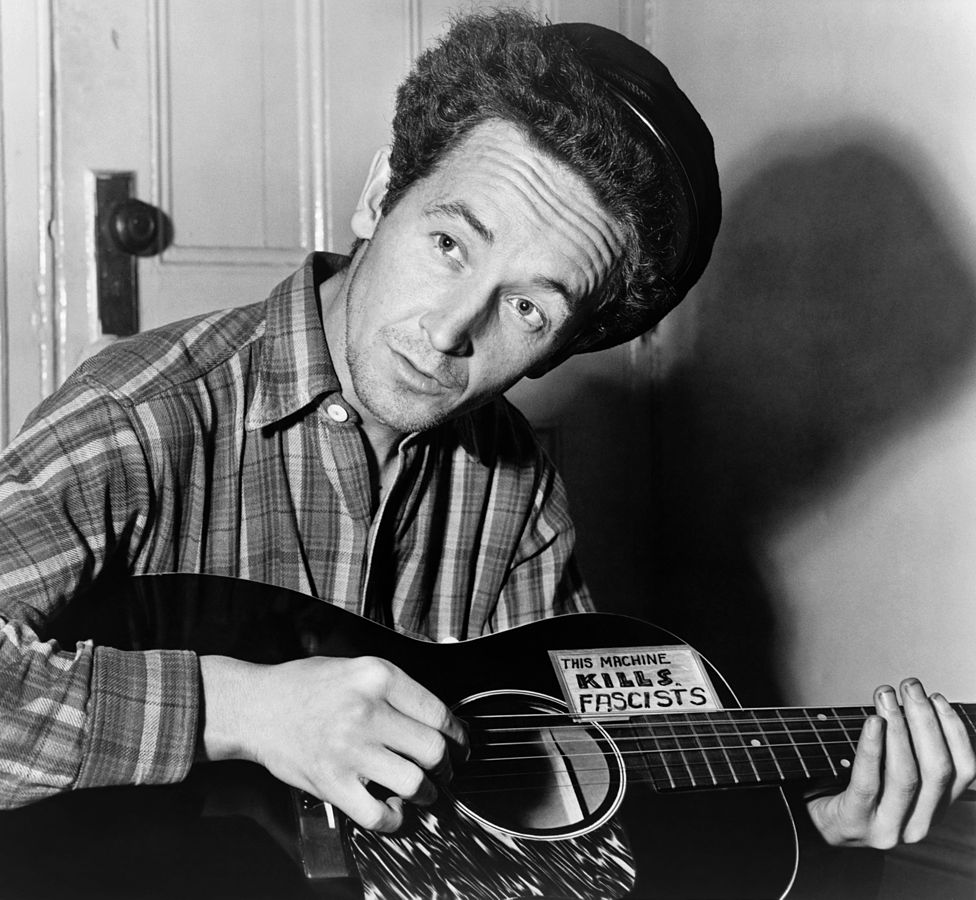
Pho­to by Al Aumuller, via Wiki­me­dia Com­mons

Like anoth­er famous Okie from Musko­gee, Woody Guthrie came from a part of Okla­homa that the U.S. gov­ern­ment sold dur­ing the 1889 land rush away from the Qua­paw and Osage nations, as well as the Musco­gee, a peo­ple who had been forcibly relo­cat­ed from the South­east under Andrew Jackson’s Indi­an Removal Act. By the time of Guthrie’s birth in 1912 in Okfus­kee Coun­ty, next to Musko­gee, the region was in the hands of con­ser­v­a­tive Democ­rats like Guthrie’s father Charles, a landown­er and mem­ber of the revived KKK who par­tic­i­pat­ed in a bru­tal lynch­ing the year before Guthrie was born.

Guthrie was named after pres­i­dent Woodrow Wil­son, who was high­ly sym­pa­thet­ic to Jim Crow (but per­haps not, as has been alleged, an admir­er of the Klan). While he inher­it­ed many of his father’s atti­tudes, he recon­sid­ered them to such a degree lat­er in life that he wrote a song denounc­ing the noto­ri­ous­ly racist New York land­lord Fred Trump, father of the cur­rent pres­i­dent. “By the time he moved into his new apart­ment” in Brook­lyn in 1950, writes Will Kauf­man at The Guardian, Guthrie “had trav­eled a long road from the casu­al racism of his Okla­homa youth.”

Guthrie was deeply embed­ded in the for­ma­tive racial pol­i­tics of the coun­try. While some peo­ple may con­vince them­selves that a time in the U.S. past was “great”—unmarred by class con­flict and racist vio­lence and exploita­tion, secure in the hands of a benev­o­lent white majority—Guthrie’s life tells a much more com­plex sto­ry. Many Indige­nous peo­ple feel with good rea­son that Guthrie’s most famous song, “The Land is Your Land,” has con­tributed to nation­al­ist mythol­o­gy. Oth­ers have viewed the song as a Marx­ist anthem. Like much else about Guthrie, and the coun­try, it’s com­pli­cat­ed.

Con­sid­ered by many, Stephen Petrus writes, “to be the alter­na­tive nation­al anthem,” the song “to many peo­ple… rep­re­sents America’s best pro­gres­sive and demo­c­ra­t­ic tra­di­tions.” Guthrie turned the song into a hymn for the strug­gle against fas­cism and for the nascent Civ­il Rights move­ment. Writ­ten in New York in 1940 and first record­ed for Moe Asch’s Folk­ways Records in 1944, “This Land is Your Land” evolved over time, drop­ping vers­es protest­ing pri­vate prop­er­ty and pover­ty after the war in favor of a far more patri­ot­ic tone. It was a long evo­lu­tion from embit­tered par­o­dy of “God Bless Amer­i­ca” to “This land was made for you and me.”

But whether social­ist or pop­ulist in nature, Guthrie’s patri­o­tism was always sub­ver­sive. “By 1940,” writes John Pietaro, he had “joined forces with Pete Seeger in the Almanac Singers,” who “as a group, joined the Com­mu­nist Par­ty. Woody’s gui­tar had, by then, been adorned with the hand-paint­ed epi­taph, THIS MACHINE KILLS FASCISTS.” (Guthrie had at least two gui­tars with the slo­gan scrawled on them, one on a stick­er and one with ragged hand-let­ter­ing.) The phrase, claims music crit­ic Jon­ny White­side, was orig­i­nal­ly “a morale-boost­ing WWII gov­ern­ment slo­gan print­ed on stick­ers that were hand­ed out to defense plant work­ers.” Guthrie reclaimed the pro­pa­gan­da for folk music’s role in the cul­ture. As Pietaro tells it:

In this time he also found­ed an inter-racial quar­tet with Lead­bel­ly, Son­ny Ter­ry and Cis­co Hous­ton, a ver­i­ta­ble super-group he named the Head­line Singers. This group, sad­ly, nev­er record­ed. The mate­r­i­al must have stood as the height of protest song—he’d named it in oppo­si­tion to a pro­duc­er who advised Woody to “stop try­ing to sing the head­lines.” Woody told us that all you can write is what you see.

You can hear The Head­line Singers above, minus Lead Bel­ly and fea­tur­ing Pete Seeger, in the ear­ly 1940’s radio broad­cast of “All You Fas­cists Bound to Lose.” “I’m gonna tell you fas­cists,” sings Woody, “you may be sur­prised, peo­ple in this world are get­ting orga­nized.” Upon join­ing the Mer­chant Marines, Guthrie fought against seg­re­ga­tion in the mil­i­tary. After the war, he “stood shoul­der to shoul­der with Paul Robe­son, Howard Fast, and Pete Seeger” against vio­lent racist mobs in Peek­skill, New York. Both of Guthrie’s anti-fas­cist gui­tars have seem­ing­ly dis­ap­peared. As Robert San­tel­li writes, “Guthrie didn’t care for his instru­ments with much love.” But dur­ing the decade of the 1940’s he was nev­er seen with­out the slo­gan on his pri­ma­ry instru­ment.

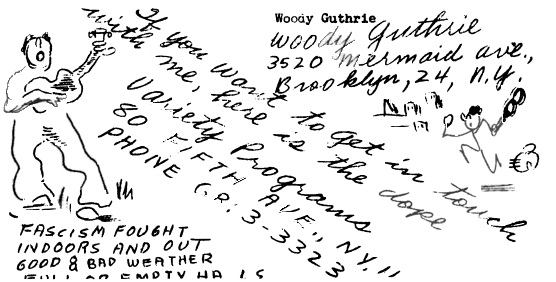
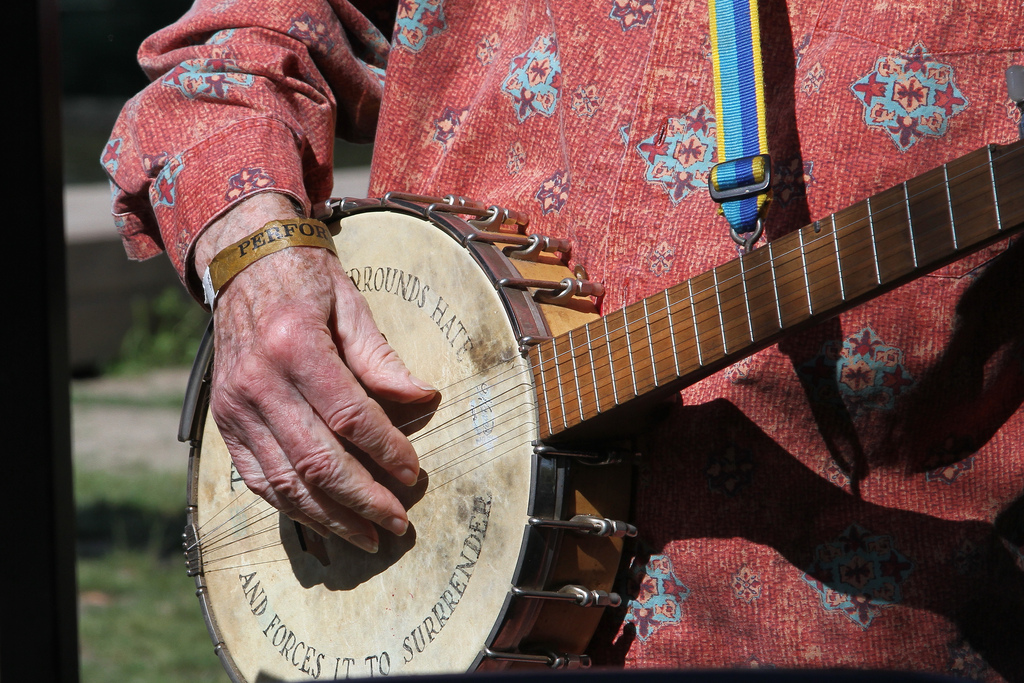
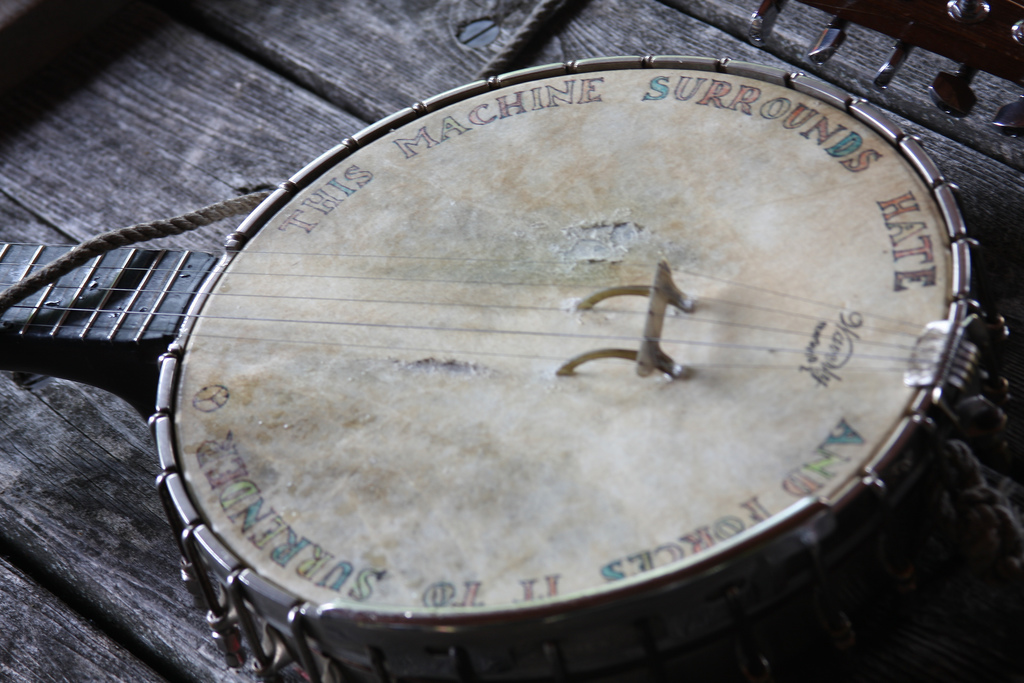
“This Machine Kills Fas­cists” has since, writes Moth­er­board, become Guthrie’s “trade­mark slo­gan… still ref­er­enced in pop cul­ture and beyond” and pro­vid­ing an impor­tant point of ref­er­ence for the anti-fas­cist punk move­ment. You can see anoth­er of Guthrie’s anti-fas­cist slo­gans above, which he scrawled on a col­lec­tion of his sheet music: “Fas­cism fought indoors and out, good & bad weath­er.” Guthrie’s long-lived broth­er-in-arms Pete Seeger, car­ried on in the tra­di­tion of anti-fas­cism and anti-racism after Woody suc­cumbed in the last two decades of his life to Huntington’s dis­ease. Like Guthrie, Seeger paint­ed a slo­gan around the rim of his instru­ment of choice, the ban­jo, a mes­sage both play­ful and mil­i­tant: “This machine sur­rounds hate and forces it to sur­ren­der.”

Pho­to by “Jim, the Pho­tog­ra­ph­er

Seeger car­ried the mes­sage from his days play­ing and singing with Guthrie, to his Civ­il Rights and anti-war orga­niz­ing and protest in the 50s and 60s, and all the way into the 21st cen­tu­ry at Occu­py Wall Street in Man­hat­tan in 2011. At the 2009 inau­gu­ra­tion of Barack Oba­ma, Seeger sang “This Land is Your Land” onstage with Bruce Spring­steen and his son, Tao-Rodriquez Singer. In rehearsals, he insist­ed on singing the two vers­es Guthrie had omit­ted from the song after the war. “So it was,” writes John Nichols at The Nation, “that the new­ly elect­ed pres­i­dent of the Unit­ed States began his inau­gur­al cel­e­bra­tion by singing and clap­ping along with an old lefty who remem­bered the Depres­sion-era ref­er­ences of a song that took a class-con­scious swipe at those whose ‘Pri­vate Prop­er­ty’ signs turned away union orga­niz­ers, hobos and ban­jo pick­ers.”

Both Guthrie and Seeger drew direct con­nec­tions between the fas­cism and racism they fought and cap­i­tal­is­m’s out­sized, destruc­tive obses­sion with land and mon­ey. They felt so strong­ly about the bat­tle that they wore their mes­sages fig­u­ra­tive­ly on their sleeves and lit­er­al­ly on their instru­ments. Pete Seeger’s famous ban­jo has out­lived its own­er, and the col­or­ful leg­end around it has been mass-pro­duced by Deer­ing Ban­jos. Where Guthrie’s anti-fas­cist gui­tars went off to is any­one’s guess, but if one of them were ever dis­cov­ered, Robert San­tel­li writes, “it sure­ly would become one of Amer­i­ca’s most val­ued folk instru­ments.” Or one of its most val­ued instru­ments in gen­er­al.

Pho­to by “Jim, the Pho­tog­ra­ph­er

Note: An ear­li­er ver­sion of this post appeared on our site in 2017.

Relat­ed Con­tent:

Bruce Spring­steen Won’t Back Down: Per­forms “Streets of Min­neapo­lis” Live in Min­neapo­lis

Hear Two Leg­ends, Lead Bel­ly & Woody Guthrie, Per­form­ing on the Same Radio Show (1940)

The Nazis’ 10 Con­trol-Freak Rules for Jazz Per­form­ers: A Strange List from World War II

Josh Jones is a writer and musi­cian based in Durham, NC. 

by | Permalink | Make a Comment ( 1 ) |

David Lynch Remembers Attending the Beatles’ First American Concert in 1964

Though his movies may have ben­e­fit­ed great­ly from for­eign audi­ences and back­ers, David Lynch was one of the most thor­ough­ly Amer­i­can of all film­mak­ers. “Born Mis­soula, MT,” declared his Twit­ter bio, yet one nev­er real­ly asso­ciates him with a par­tic­u­lar place in the Unit­ed States (at least no extant one). From Mon­tana, the Lynch fam­i­ly moved to Ida­ho, then Wash­ing­ton, then North Car­oli­na, then Vir­ginia. The tim­ing of that last stint proved cul­tur­al­ly for­tu­itous indeed: liv­ing in the city of Alexan­dria, the eigh­teen-year-old Lynch was close enough to the nation’s cap­i­tal to attend the very first con­cert the Bea­t­les played in North Amer­i­ca, at the Wash­ing­ton Col­i­se­um on Feb­ru­ary 11, 1964.

“I was into rock and roll music, main­ly Elvis Pres­ley.” Lynch recalls this unsur­pris­ing fact in the clip above (which would have been among the last inter­views he gave before his death a year ago) from Bea­t­les ’64, the Mar­tin Scors­ese-pro­duced doc­u­men­tary on the Fab Four’s first U.S. tour.

“I didn’t have any idea how big this event was. And it was in a gigan­tic place where they had box­ing match­es. The Bea­t­les were in the box­ing ring. It was so loud, you can’t believe. Girls shud­der­ing, cry­ing, scream­ing their heart out. It was phe­nom­e­nal.” That deaf­en­ing crowd noise fig­ures into most every account of the group’s Beat­le­ma­nia-era shows — and played a deci­sive role in their per­ma­nent retreat into the stu­dio a cou­ple of years lat­er.

Lynch sure­ly would have under­stood the desire for artis­tic explo­ration and con­trol that drove the Bea­t­les’ con­cen­tra­tion on mak­ing records. Even the sen­si­bil­i­ties of his work and theirs had some­thing in com­mon, exhibit­ing as they both did the unlike­ly com­bi­na­tion of pop­u­lar­i­ty and exper­i­men­ta­tion.  Some­how, David Lynch’s films and the Bea­t­les’ albums could ven­ture into bewil­der­ing obscu­ri­ty and sen­ti­men­tal kitsch with­out los­ing coher­ence or crit­i­cal respect. And dare one imag­ine that the expe­ri­ence of wit­ness­ing the Amer­i­can debut of what would become the most influ­en­tial rock band of all time has giv­en Lynch his appre­ci­a­tion — evi­dent in his movies, but also his own record­ings — for the pow­er of music, which he calls “one of the most fan­tas­tic things”? Even if not, it must have been, well… sur­re­al.

via Wel­come to Twin Peaks

Relat­ed con­tent:

Ange­lo Badala­men­ti Reveals How He and David Lynch Com­posed the Twin Peaks’ “Love Theme”

When the Bea­t­les Refused to Play Before Seg­re­gat­ed Audi­ences on Their First U.S. Tour (1964)

David Lynch Directs a New Music Video for Dono­van

Watch the Bea­t­les Per­form Their Famous Rooftop Con­cert: It Hap­pened 50 Years Ago Today (Jan­u­ary 30, 1969)

David Lynch Talks Med­i­ta­tion with Paul McCart­ney

The Wide-Rang­ing Cre­ative Genius of David Lynch (RIP): Dis­cov­er His Films, Music Videos, Car­toons, Com­mer­cials, Paint­ings, Pho­tog­ra­phy & More

Based in Seoul, Col­in Marshall writes and broad­casts on cities, lan­guage, and cul­ture. He’s the author of the newslet­ter Books on Cities as well as the books 한국 요약 금지 (No Sum­ma­riz­ing Korea) and Kore­an Newtro. Fol­low him on the social net­work for­mer­ly known as Twit­ter at @colinmarshall.

Bruce Springsteen Won’t Back Down: Performs “Streets of Minneapolis” Live in Minneapolis

When the his­to­ry books are writ­ten, we’ll remem­ber the politi­cians, law firms, and CEOs who quick­ly bent the knee to Don­ald Trump. We’ll also remem­ber the scant few Amer­i­can fig­ures who refused to back down. Bruce Spring­steen will be high on that short list.

Tour­ing in Europe last sum­mer, Spring­steen warned his audi­ence: “The Amer­i­ca that I love, the Amer­i­ca I have writ­ten about, that has been a bea­con of hope and lib­er­ty for 250 years, is cur­rent­ly in the hands of a cor­rupt, incom­pe­tent and trea­so­nous admin­is­tra­tion.” Those words seem par­tic­u­lar­ly pre­scient giv­en the chaos and vio­lence now unfold­ing in Min­neso­ta.

Fol­low­ing the shoot­ings of Renee Good and Alex Pret­ti, Spring­steen made his voice heard again—this time through music. Last week, he released the protest song “Streets of Min­neapo­lis” and soon after­ward trav­eled to Min­neso­ta to per­form the song live at a ben­e­fit con­cert arranged by Tom Morel­lo. Speak­ing to the crowd, Spring­steen said, “I wrote Streets of Min­neapo­lis and record­ed it the next day.” When he won­dered if the song sound­ed too ‘soap­boxy,’ he turned to Morel­lo, and the Rage Against the Machine gui­tarist replied, “Bruce, nuance is won­der­ful, but some­times you need to kick them in the teeth.” We’ll say amen to that.

After “Streets of Min­neapo­lis,” Spring­steen and Morel­lo per­formed “The Ghost of Tom Joad.” Watch it above. The start of the show began with “Killing In The Name Of.” Catch it below.

Relat­ed Con­tent 

Bruce Spring­steen Revives the Protest Song, Con­demns ICE Vio­lence in “Streets of Min­neapo­lis”

Scott Gal­loway Unveils “Resist and Unsub­scribe,” an Action Plan for Con­sumers to Push Back Against Gov­ern­ment Over­reach

Tom Morel­lo Responds to Angry Fans Who Sud­den­ly Real­ize That Rage Against the Machine’s Music Is Polit­i­cal: “What Music of Mine DIDN’T Con­tain Polit­i­cal BS?”

by | Permalink | Make a Comment ( 1 ) |

Bruce Springsteen Revives the Protest Song, Condemns ICE Violence in “Streets of Minneapolis”

If there’s a sil­ver lin­ing to our tumul­tuous times, it’s that musi­cians are reviv­ing the protest song, a tra­di­tion that has with­ered since the end of the Viet­nam War. Cre­dence Clear­wa­ter Revival’s “For­tu­nate Son,” Arlo Guthrie’s “Alice’s Restau­rant,” Jimi Hen­drix’s “Machine Gun”—these songs all took aim at the John­son and Nixon admin­is­tra­tions’ increas­ing­ly mis­guid­ed war effort. But it was Neil Young who wrote the most damn­ing protest song. When the Ohio Nation­al Guard shot and killed four stu­dents at Kent State in 1970, Young dis­ap­peared for a few hours and returned with the haunt­ing lyrics of “Ohio.”

Tin sol­diers and Nixon com­ing,
We’re final­ly on our own.
This sum­mer I hear the drum­ming,
Four dead in Ohio.

Got­ta get down to it
Sol­diers are cut­ting us down
Should have been done long ago.
What if you knew her
And found her dead on the ground
How can you run when you know?

With his new song released this week, Bruce Spring­steen picks up this thread. “Streets Of Min­neapo­lis” doc­u­ments the mur­der of civil­ians in Min­neso­ta’s largest city. On Jan­u­ary 7, ICE agent Jonathan Ross shot Renee Good repeat­ed­ly in the head, leav­ing the moth­er of three dead. On Jan­u­ary 24, two fed­er­al agents fired at least 10 shots at Alex Pret­ti, killing the ICU nurse instant­ly. Days lat­er, the iden­ti­ty of these mur­der­ers remains hidden—something that news orga­ni­za­tions odd­ly don’t seem trou­bled by, almost as if we’re qui­et­ly accept­ing that we’re liv­ing in a police state. When was the last time Amer­i­can agents could wear masks before killing civil­ians, and then hide behind a veil of anonymi­ty after? Yeah, that’s nor­mal.

On social media, Spring­steen wrote: “I wrote this song on Sat­ur­day, record­ed it yes­ter­day and released it to you today in response to the state ter­ror being vis­it­ed on the city of Min­neapo­lis. It’s ded­i­cat­ed to the peo­ple of Min­neapo­lis, our inno­cent immi­grant neigh­bors and in mem­o­ry of Alex Pret­ti and Renee Good.” You can read the lyrics below.

Through the winter’s ice and cold
Down Nicol­let Avenue
A city aflame fought fire and ice
‘Neath an occupier’s boots
King Trump’s pri­vate army from the DHS
Guns belt­ed to their coats
Came to Min­neapo­lis to enforce the law
Or so their sto­ry goes
Against smoke and rub­ber bul­lets
By the dawn’s ear­ly light
Cit­i­zens stood for jus­tice
Their voic­es ring­ing through the night
And there were bloody foot­prints
Where mer­cy should have stood
And two dead left to die on snow-filled streets
Alex Pret­ti and Renee Good

Oh our Min­neapo­lis, I hear your voice
Singing through the bloody mist
We’ll take our stand for this land
And the stranger in our midst
Here in our home they killed and roamed
In the win­ter of ’26
We’ll remem­ber the names of those who died
On the streets of Min­neapo­lis

Trump’s fed­er­al thugs beat up on
His face and his chest
Then we heard the gun­shots
And Alex Pret­ti lay in the snow, dead
Their claim was self defense, sir
Just don’t believe your eyes
It’s our blood and bones
And these whis­tles and phones
Against Miller and Noem’s dirty lies

Oh our Min­neapo­lis, I hear your voice
Cry­ing through the bloody mist
We’ll remem­ber the names of those who died
On the streets of Min­neapo­lis

Now they say they’re here to uphold the law
But they tram­ple on our rights
If your skin is black or brown my friend
You can be ques­tioned or deport­ed on sight

In chants of ICE out now
Our city’s heart and soul per­sists
Through bro­ken glass and bloody tears
On the streets of Min­neapo­lis

Oh our Min­neapo­lis, I hear your voice
Singing through the bloody mist
Here in our home they killed and roamed
In the win­ter of ’26
We’ll take our stand for this land
And the stranger in our midst
We’ll remem­ber the names of those who died
On the streets of Min­neapo­lis
We’ll remem­ber the names of those who died
On the streets of Min­neapo­lis

Relat­ed Con­tent 

Leg­endary Protest Songs from Wood­stock: Hen­drix, Jef­fer­son Air­plane, Coun­try Joe & More Per­form Protest Songs Dur­ing the Music Fes­ti­val That Launched 50 Years Ago This Week

David Byrne Curates a Playlist of Great Protest Songs Writ­ten Over the Past 60 Years: Stream Them Online

The Pow­er­ful Mes­sages That Woody Guthrie & Pete Seeger Inscribed on Their Gui­tar & Ban­jo: “This Machine Kills Fas­cists” and “This Machine Sur­rounds Hate and Forces it to Sur­ren­der”

Nina Simone’s Live Per­for­mances of Her Poignant Civ­il Rights Protest Songs

by | Permalink | Make a Comment ( 4 ) |

« Go BackMore in this category... »
Quantcast