Hey, hoarders, think you’re the only ones who see potential in a single crutch, an empty Scotch bottle, the jagged remains of a skateboard? Not so. Musician, artist, and all-around visionary Ken Butler has been turning such trash into treasure since 1978, when he fitted an ax with a tail piece, fingerboard and contact mic and snuggled it inside a 3/4 size violin case. Chop a cherry tree with it, or play it just like Buddy Guy plays his ax. Like most of the hybrids Butler creates in his Brooklyn studio, it’s a functioning musical instrument, though he’s quick to point out that for him, the sound is immaterial. What really counts is the poetic coupling of unlikely materials.
Things really get cookin’ at the 4:20 mark, when Butler plays a few licks on a three-stringed shovel before moving on to a bowable, electrified tennis racket. The results are far lovelier than the master would lead you to believe.
- Ayun Halliday can stumble her way through the Entertainer if there’s a piano handy.
Having seen Radiohead a few times since their post-2000 Kid A transformation, I can tell you firsthand that while their last several records have trended toward bedroom rock, the live show is still a full-on experience. No twiddling behind laptops and drum machines. And if you haven’t had the pleasure of seeing them perform since their break with noisy alt-rock, now you can, thanks to the fans who produced the above film, shot at NYC’s Roseland Ballroom and the second of only three shows the band played in 2011 in support of The King of Limbs.
Edited together from the YouTube footage of ten different fans, the video is a remarkable example of crowdsourced dedication. Radiohead generously donated the audio straight from the soundboard, providing stellar sound, and the fan-editors obtained at least two camera angles for every song, giving this production the look of a professional concert film. It’s quite an achievement overall (and not the first time this has been done).
Finally, in the spirit of fan collaboration, YouTube user MountainMan1092 helpfully typed up and posted the tracklist below:
0:00:58 Bloom 0:07:23 Little By Little 0:12:07 Staircase 0:17:02 The National Anthem 0:22:03 Feral 0:26:20 Subterranean Homesick Alien 0:31:24 Like Spinning Plates 0:34:50 All I Need 0:39:06 True Love Waits/ Everything In Its Right Place 0:44:49 15 Step 0:49:04 Weird Fishes/ Arpeggi 0:55:08 Lotus Flower 1:00:55 Codex 1:06:43 The Daily Mail 1:10:33 Good Morning Mr. Magpie 1:16:22 Reckoner 1:24:00 Give Up The Ghost 1:29:19 Myxomatosis 01:33:24 Bodysnatchers 1:41:28 Supercollider 1:47:17 Nude
Josh Jones is a doctoral candidate in English at Fordham University and a co-founder and former managing editor of Guernica / A Magazine of Arts and Politics.
Back in the mid-to-late 1980s, some of the figures we consider Rock and Roll icons were near or at the nadir of their popularity. With Duran Duran, The Police and Michael Jackson at the top of the charts, artists like George Harrison, Bob Dylan and even David Bowie had put out their last great records and were waiting for the nostalgia wheel to turn.
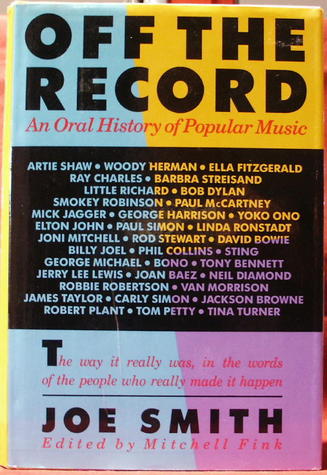
Enter Joe Smith, recording industry executive and former disc jockey. Over two years in the late 80s, while president of Capitol Records/EMI, Smith recorded nearly 240 hours of interviews with a catalog of major musical artists from Mick Jagger, Bowie and Paul McCartney to Yoko Ono, George Harrison and Linda Ronstadt.
Smith used excerpts of the interviews for the book Off the Record, published in 1988. Now retired, he has donated the archive of unedited audio interviews to the Library of Congress. The Joe Smith Collection will feature talks with more than 200 artists. As an industry insider Smith had extraordinary access. It’s not that these artists aren’t already heavily interviewed and documented. It’s the intimate tone of the conversations that pleases and surprises.
In a leisurely conversation with Smith, David Bowie (above) talks about taking classes from Peter Frampton’s father in art school. Yoko Ono, interviewed in late 1987, comes across as still living in the shadow of her late husband. By now, Ono has a bigger reputation as an artist in her own right. Linda Ronstadt, who Smith signed to a recording contract, reflects on her years performing at L.A.’s Troubadour nightclub during the rise of country rock.
By now each of these superstars has written his or her memoir and the golden era of major labels has been dissected by musical diggers. So listening to these interviews from the 1980s takes on a nostalgic feel of its own. Smith’s questions sound naive now. Isn’t it amazing, he remarks to the legendary producer George Martin, that the Beatles were so heavily influenced by African-American blues?! It’s sweet to hear legendary artists and an industry insider stumble upon observations like that one, which have now been so thoroughly digested.
Smith transitioned from broadcast radio to record promotions, eventually rising to executive ranks as president of Warner Brothers, Elektra/Asylum and Capitol Records/EMI. He signed the Grateful Dead, Jimi Hendrix and Van Morrison, so it’s no surprise that Mickey Hart is interviewed, sharing an intimate story about his father.
So far, audio for only 25 interviews is available on the library’s site. More interviews will be uploaded over time, including one with Smith himself in which he talks dirt about his relationship with former business partner Frank Sinatra.
Kate Rix writes about digital media and education. Read more of her work at and thenifty.blogspot.com.
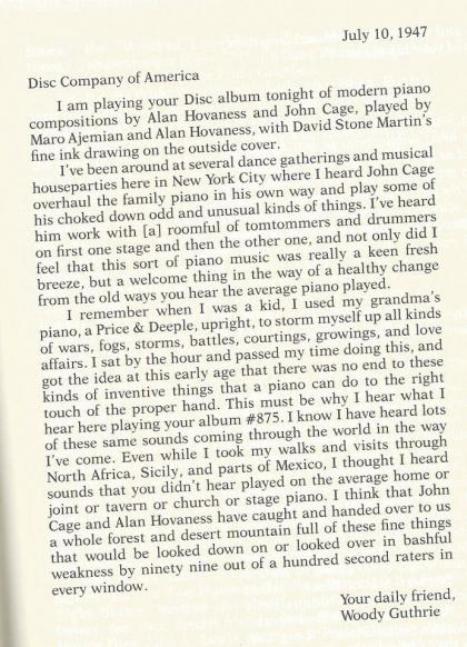
I’ve always felt a certain close affinity with Woody Guthrie. Could be my admiration for his unstinting working-man’s politics or that he hails from my mother’s home state of Oklahoma. Those are strong appeals, and I suppose it’s all of that and more: Guthrie could carve out compact granite sentences even Robert Frost would envy. If the letter above doesn’t convince you, read the man’s autobiography. In the letter, the unapologetic working-class folksinging Okie who embodied depression-era authenticity writes to “Disc Company of America” to enthuse over John Cage for his “overhaul of the family piano” and his “choked down odd and unusual kinds of things.”
Odd and unusual are two words that spring to mind when imagining Guthrie writing a letter in praise of Cage. (He also praises Armenian composer Alan Hovhaness—Guthrie spells it “Hovaness”). Written in 1947, it is the kind of text one wants to quote in its entirety. Fortunately, we have the reproduction above, and you can read it for yourself. What isn’t reproduced is the postscript, in which Guthrie wrote: “I need something like this oddstriking music to match the things I feel in my soul tonight.” He also wrote that that morning, his wife, Marjorie, had “given birth to a big 7‑pound boy”—Arlo.
Thanks to Tristan for pointing us to this letter originally blogged over at Stool Pigeon.
Josh Jones is a doctoral candidate in English at Fordham University and a co-founder and former managing editor of Guernica / A Magazine of Arts and Politics.
We’ve written before about the public service Leonard Bernstein rendered the American public as an ambassador of classical music. Bernstein made some appearances on an arts and culture program called Omnibus in the 50s, and in 1972, as the Charles Eliot Norton Professor of Poetry at Harvard, he delivered a masterful series of public lectures. Through his various appearances on radio and television programs, he succeeded brilliantly in making high art accessible to the average person. In January of 1958, just two weeks after taking over duties as the director of the New York Philharmonic, Bernstein took up a tradition in American orchestras called “young people’s concerts.” He would lead a total of 53 such concerts, even after his tenure at the Philharmonic ended in 1969, continuing as conductor emeritus until 1972. The concerts were first broadcast on Saturday mornings, but for a few years, CBS—probably in reaction to FCC director Newton Minow’s 1961 “vast wasteland” speech about the state of television—moved the program to prime time. Bernstein made the concerts central to his work at the Philharmonic, describing them in hindsight as “among my favorite, most highly prized activities of my life.”
The first concert (above), entitled “What Music Means,” begins with Rossini’s “William Tell Overture.” While the orchestra works away with precision, the camera cuts to the faces of astonished kids reacting to what they knew at the time as the theme to The Lone Ranger TV show. Bernstein then stops the piece, the kids cry out “Lone Ranger!” and he deftly pivots from this disarming moment to a fascinating discussion of why music isn’t about “stories,” isn’t about “anything, it just is.” He communicates his formalist theory without dumbing-down or condescension, but with clarity and passion. Stripping away the popular notion that every work of art has some inherent “meaning” (or “hidden,” or “deep” meaning), Bernstein shows his young audience instead how all art–“high” or “low”–is first and foremost about aesthetic pleasure, and appreciation begins with an understanding of how any given work can only appeal to our emotions through the senses. Music, Bernstein insists, is just “made of notes.”
This concert, at Carnegie Hall, was the first of its kind to be televised. Later episodes marked the first concerts to be televised from New York’s Lincoln Center. The remaining three parts of “What Music Means” are available here (Part 2, Part 3, Part 4), and a full version (with Spanish subtitles) can be found here.
Josh Jones is a doctoral candidate in English at Fordham University and a co-founder and former managing editor of Guernica / A Magazine of Arts and Politics.
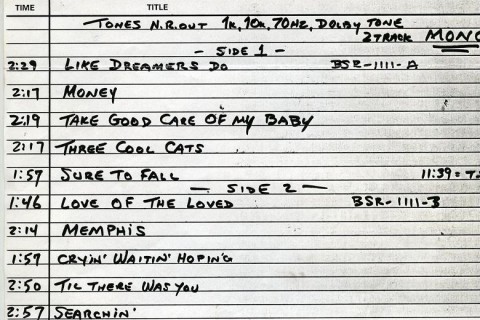
It’s been called the biggest mistake in music history. On New Year’s Day 1962, Decca Records had the opportunity to hear two new bands. One was Brian Poole and the Tremeloes. The other was an obscure group from Liverpool called the Beatles. Of course, Decca chose the Tremeloes. “Guitar groups are on their way out, Mr. Epstein,” was what the label’s senior A&R man, Dick Rowe, reportedly said to Beatles manager Brian Epstein. The Beatles, who at that time included Pete Best on drums, recorded 15 songs on New Year’s Day at the Decca Studios in London and selected 10 for their demo tape. The original 10-song tape (see the hand-written list of tracks below) will be auctioned today in London. Organizers expect it to sell for around $30,000. Despite all the pre-auction hype, the demo tracks themselves have been around for decades on bootleg and “grey market” records. And they’re online. You can listen below and decide for yourself: If you were a record company executive, would you have signed the Beatles?
“Like Dreamers Do” (Lennon-McCartney)
“Money (That’s What I Want)” (Gordy/Bradford)
“Till There Was You” (Meredith Willson)
“The Sheik of Araby” (Smith/Wheeler/Snyder)
“To Know Her is to Love Her” (Phil Spector)
“Take Good Care of My Baby” (King/Goffin)
“Memphis, Tennessee” (Chuck Berry)
“Sure to Fall (In Love with You)” (Cantrell/Claunch/Perkins)
It’s from a special called “Johnny Cash on Campus” which aired on February 17, 1971. The performance was taped in front of an all-student audience at the Ryman Auditorium in downtown Nashville. A few days earlier Cash had traveled across town to visit students on the campus of Vanderbilt University and, as he explains here in the introduction, an idea began brewing.
1971 was a time of widespread student protests over the Vietnam War and other issues. The Kent State shootings had happened the year before. As a protest song, “Man in Black” shows Cash’s ability to reach across generations and appeal to audiences much wider than those usually afforded to country music.
When Cash first played the song at Ryman Auditorium it was so new he needed cue cards to follow the words. The video offers a rare glimpse of an artist trying out a major work when the paint was still wet.
With all the current debate over the real world worthiness of expensive college educations, it’s reassuring to see recent Julliard grads helping themselves to the crown once sported by Mr. Jaws and Dr. Demento.
And now, readers, it’s your turn to shake it like a polar bear ninja. Was your favorite aural fail acknowledged above? Or will you be using the space below to demand its inclusion in a follow up?
We're hoping to rely on loyal readers, rather than erratic ads. Please click the Donate button and support Open Culture. You can use Paypal, Venmo, Patreon, even Crypto! We thank you!
Open Culture scours the web for the best educational media. We find the free courses and audio books you need, the language lessons & educational videos you want, and plenty of enlightenment in between.