“When I’m singing blues,” Etta James once said, “I’m singing life.”
Hers was a difficult life. The legendary singer, who died this morning at the age of 73 after a long struggle with leukemia, was born Jamesetta Hawkins on January 25, 1938, to an unwed 14-year-old girl, and her life was marked by drug addiction and emotional volatility. Through it all, James rose to become one of the most influential and admired singers of the second half of the 20th century.
“There’s a lot going on in Etta James’ voice,” Bonnie Raitt told Rolling Stone in 2008. “A lot of pain, a lot of life but, most of all, a lot of strength. She can be so raucous and down one song, and then break your heart with her subtlety and finesse the next.”
Her greatest hit came in 1961, with the soulful ballad “At Last.” For another side of James’s versatile style, listen and watch above, as she performs the gospel-influenced “Something’s Got a Hold on Me” in 1962. To learn more about James, and to watch video highlights from her career, see today’s article by Ben Greenman on The New Yorker’s “Culture Desk” blog. And over at the Guardian, see Richard Williams selection of 10 Classic Etta James Performances.
In 1997, James summed things up in an interview with Rolling Stone: “Life’s been rough,” she said, “but life’s been good. If I had to go back and do it all over again, I would live it the exact same way.”
One of the catchiest grooves from the rhythm and blues of the late 1950s is “Willie and the Hand Jive,” by Johnny Otis. In this lively scene from his early TV show, Otis performs the song as Marie Adams and the Three Tons of Joy demonstrate the hand jive. Lionel Hampton joins in on the vibraphone.
Otis, known as “the godfather of rhythm and blues,” died Tuesday at the age of 90. The son of Greek immigrants, he grew up in a predominantly black neighborhood of Berkeley, California, and developed an early affinity for African American culture. “Genetically, I’m pure Greek,” Otis said in 1994. “Psychologically, environmentally, culturally, by choice, I’m a member of the black community.”
As a bandleader in the 1950s, Otis helped bring rhythm and blues to a mainstream audience. He discovered a number of important artists, including Big Mama Thornton (Otis produced her original 1952 recording of “Hound Dog”) and the great Etta James, who died this morning.
“Willie and the Hand Jive,” with its infectious Bo Diddley beat, was a top 10 pop hit for Otis in 1958, and was covered by a variety of well-known artists, including Eric Clapton. Otis continued to perform into his 80s, and worked at various times as a disc jockey, an ordained minister and an organic farmer. You can read more about his remarkable life in the New York Times obituary.
You can also watch the complete half-hour episode of The Johnny Otis Show (below) from which the clip above was taken. The Johnny Otis Show was broadcast on KTLA in Los Angeles from 1954 to 1961. This episode features great performances by Lionel Hampton (with the multi-instrumentalist Otis joining in on drums) and other artists, including more from Marie Adams and the Three Tons of Joy.
Music and comic book art are the two passions of Robert Crumb’s creative life. In this video from W.W. Norton, Crumb talks about his obsessive interest in the old-time blues, folk and country music of the 1920s and 1930s. “I think it’s neurological,” he says. “Some quirky types of nervous systems are just attracted to that old music.”
As one of the pioneers of the underground comix movement in the late 1960s, Crumb’s work often related in some way to his love of music. His famous “Keep on Truckin’ ” comic of 1968 was inspired by the lyrics of Blind Boy Fuller’s song, “Truckin’ My Blues Away.” That same year Janis Joplin, who was singing with Big Brother & the Holding Company, asked Crumb to design the cover of the band’s album Cheap Thrills.
Since then, Crumb has designed hundreds of album covers and music posters. His new book, R. Crumb: The Complete Record Cover Collection, brings together all the covers and many related works. The book contains portraits of famous artists like Robert Johnson and Woody Guthrie, along with works featuring obscure artists with names like “Ukelele Ike” and “Big John Wrencher and his Maxwell Street Blues Boys.” There are also covers and posters made for Crumb’s own band, the Cheap Suit Serenaders.
Crumb is a banjo and mandolin player. One group he has sat in with in recent years is Eden & John’s East River String Band. This video was directed by the group’s co-leader, John Heneghan, and includes appearances by himself and his partner Eden Brower. The video features the following songs:
“Sing Song Girl” by Leroy Sheild (1930)
“Some of these Days” by Cab Calloway (1930)
“Lindberg Hop” by the Memphis Jug Band (1928)
“Down On Me” by Eddie Head and His Family (1930)
“Chasin’ Rainbows” by R. Crumb and his Cheap Suit Serenaders (1976)
“Singing in the Bathtub” by R. Crumb and his Cheap Suit Serenaders (1978)
“So Sorry Dear” by Eden & John’s East River String Band, featuring R. Crumb
December 2, 1997. Exactly ten years after his first visit to Moscow, jazz legend Dave Brubeck returned to perform before the faculty and students of the Moscow Conservatory. During his concert, an audience member asked him to improvise on the old Russian sea shanty “Ej, Uhnem.” About two minutes into the improvisation, a young violinist rose from his seat and started to play along. You just have to love Dave’s surprised look at 2:09.
This young man turned out to be a student at the conservatory. His name is Denis Kolobov and he is now a violinist of international renown. Denis must have mustered up all of his courage to cut into the performance of one of the great jazz pianists. But the day before, French jazz violinist Stéphane Grappelli had died in Paris and Denis decided to honor Grappelli’s memory in this way. What a great idea!
By profession, Matthias Rascher teaches English and History at a High School in northern Bavaria, Germany. In his free time he scours the web for good links and posts the best finds on Twitter.
The video above gives you mostly the prelude to the actual music. Then, in the first video below, Zappa gives a demo of the instruments. Next comes the Concerto for Two Bicycles, which features the show’s house orchestra joining the cacophonous fun. The clips run a good 15 minutes.
If you would like to support the mission of Open Culture, consider making a donation to our site. It’s hard to rely 100% on ads, and your contributions will help us continue providing the best free cultural and educational materials to learners everywhere. You can contribute through PayPal, Patreon, and Venmo (@openculture). Thanks!
Before we rush headlong into a new year, it’s worth pausing, ever so briefly, to consider the ground we covered in 2011. What topics resonated with you … and jazzed us? Today, we’re highlighting 10 thematic areas (and 46 posts) that captured the imagination. Chances are you missed a few gems here. So please join us on our brief journey back into time. Tomorrow, we start looking forward again.
1) Universities Offer More Free Courses, Then Start Pushing Toward Certificates: The year started well enough. Yale released another 10 stellar open courses. (Find them on our list of 400 Free Courses). Then other universities started pushing the envelope on the open course format. This fall, Stanford launched a series of free courses that combined video lectures with more dynamic resources — short quizzes; the ability to pose questions to Stanford instructors; feedback on your overall performance; a statement of accomplishment from the instructor, etc. A new round of free courses will start in January and February. (Get the full list and enroll here.) Finally, keep your eyes peeled for this: In 2012, MIT will offer similar courses, but with one big difference. Students will get an official certificate at the end of the course, all at a very minimal charge. More details here.
3) Books Intelligent People Should Read: Neil deGrasse Tyson’s list “8 (Free) Books Every Intelligent Person Should Read” ended up generating far more conversation and controversy than we would have expected. (Users have left 83 comments at last count.) No matter what you think of his rationale for choosing these texts, the books make for essential reading, and they’re freely available online.
4) Christopher Hitchens and Stephen Fry: Christopher Hitchens left us this past month. And, until his last day, Hitchens was the same old Hitch — prolific, incisive, surly and defiant, especially when asked about whether he’d change his position on religion, spirituality and the afterlife. All of this was on display when he spoke at the American Jewish University in Los Angeles last February. We covered his comments in a post called, No Deathbed Conversion for Me, Thanks, But it was Good of You to Ask. And even from the grave, Hitchens did more of the same, forcing us to question the whole modern meaning of Christmas.
In 1952, John Cage composed his most controversial piece, 4′33,″ a four-and-a-half minute reflection on the sound of silence. Now fast forward eight years. It’s February, 1960, and we find the composer teaching his famous Experimental Composition courses at The New School in NYC, and paying a visit to the CBS game show “I’ve Got a Secret.” The TV show offered Cage something of a teachable moment, a chance to introduce the broader public to his brand of avant-garde music. Cage’s piece is called Water Walk (1959), and it’s all performed with unconventional instruments, save a grand piano. A water pitcher, iron pipe, goose call, bathtub, rubber duckie, and five unplugged radios — they all make the music. And the audience doesn’t quite know how to react, except with nervous laughter. It wasn’t particularly courteous. But, as one scholar has noted, it’s equally remarkable that prime time TV gave ten minutes of uninterrupted airtime to avant-garde music. You take the good with the bad.
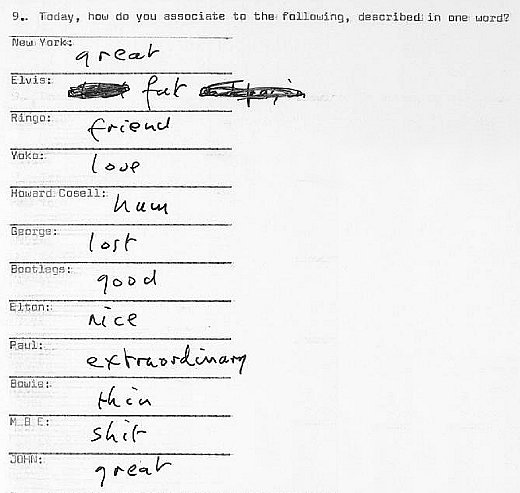
In 1976 a youthful fan named Stuart sent John Lennon a six-page list of questions. The former Beatle responded with answers, along with a child-like drawing of a lamb standing on a cloud, saying, “Hi Stuart.”
Stuart wanted to know a few things, like what sort of album Lennon was working on. “Until it’s been on tape,” Lennon replied, “I never know what it will be.” He also wondered if the famous musician was writing anything, like perhaps an autobiography. “Yes, I have been writing, but not an autobiography. I’ve noticed that people tend to DIE after writing their life story.”
The young fan included a list of words and names, along with the question: How would you characterize the following figures in one word?
John: “Great”
Paul: “Extraordinary”
George: “Lost”
Ringo: “Friend”
Elvis: “Fat”
Yoko: “Love”
Howard Cosell: “Hum”
Lennon signed off with, “It was a pleasure, hope ya dig it/John Lennon.”
We're hoping to rely on loyal readers, rather than erratic ads. Please click the Donate button and support Open Culture. You can use Paypal, Venmo, Patreon, even Crypto! We thank you!
Open Culture scours the web for the best educational media. We find the free courses and audio books you need, the language lessons & educational videos you want, and plenty of enlightenment in between.