The refinements of medical imaging technologies like fMRI have given neuroscientists, psychologists, and philosophers better tools with which to study how the brain responds to all sorts of stimuli. We’ve seen studies of the brain on Jane Austen, the brain on LSD, the brain on jazz improv…. Music, it seems, offers an especially rich field for brain research, what with its connection to language, bodily coordination, mathematics, and virtually every other area of human intelligence. Scientists at MIT have even discovered which specific regions of the brain respond to music.
And yet, though we might think of music as a discrete phenomenon that stimulates isolated parts of the brain, Brownell professor of philosophy Dan Lloyd has a much more radical hypothesis, “that brain dynamics resemble the dynamics of music.”
He restates the idea in more poetic terms in an article for Trinity College: “All brains are musical—you and I are symphonies.” Plenty of people who can barely whistle on key or clap to a beat might disagree. But Lloyd doesn’t mean to suggest that we all have musical talent, but that—as he says in his talk below—“everything that goes on in the brain can be interpreted as having musical form.”
To demonstrate his theory, Lloyd chose not a musician or composer as a test subject, but another philosopher—and one whose brain he particularly admires—Daniel Dennett. And instead of giving us yet more colorful but baffling brain images to look at, he chose to convert fMRI scans of Dennett’s brain—“12 gigabytes of 3‑d snapshots of his cranium”—into music, turning data into sound through a process called “sonification.” You can hear the result at the top of the post—the music of Dennett’s brain, which is apparently, writes Daily Nous, “a huge Eno fan.”
In his paper “Mind as Music,” Lloyd argues that the so-called “language of thought” is, in fact, music. As he puts it, “the lingua franca of cognition is not a lingua at all,” an idea that has “aftershocks for semantics, method, and more.” Several questions arise: I, for one, am wondering if all our brains sound like Dennett’s abstract ambient score, or if some play waltzes, some operas, some psychedelic blues.…
You can learn much more about Lloyd’s fascinating research in his talk, which simplifies the technical language of his paper. Lloyd’s work goes much further, as he says, than studying “the brain on music”; instead he makes a sweepingly bold case for “the brain as music.”
Talk to nearly any veteran of sixties counterculture, and you’re bound to hear a story or three about an acid trip. Some of those trips were bad, man, full of nightmare hallucinations and severe anxiety. In other accounts, however, LSD gets credit for opening up the mind, releasing old patterns of thought, and freeing up latent creative energy. From Ken Kesey to R. Crumb, these stories abound. Are they credible? Now that scientists have once again begun to study the drug—first synthesized in 1938 and used in experiments in the 50s and 60s until it was banned nearly everywhere—they are finding concrete answers using the latest in brain imaging technology.
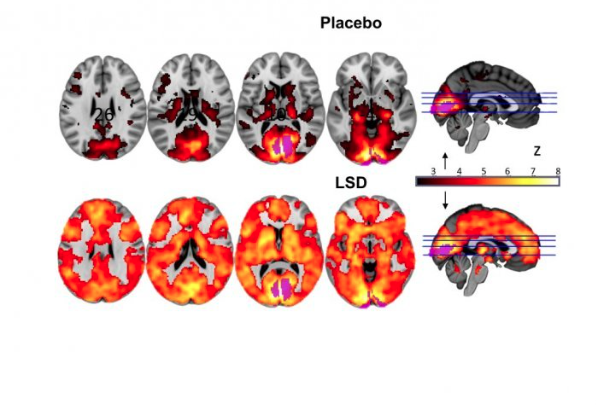
And it appears that LSD—-in a controlled laboratory setting at least—“can be seen as reversing the more restricted thinking we develop from infancy to adulthood.” So reports The Guardian in regard to experiments recently conducted by neuropharmacologist David Nutt, former “drugs advisor” for the British government. Nutt gave volunteer subjects an injection of LSD, then captured the first images ever recorded of the brain on acid. You can see dramatic animations of those scans in the video at the top of the post, comparing the brains of test subjects on the drug and those on placebo, and see some static images above. The study, says Nutt, “is to neuroscience what the Higgs boson was to particle physics.” In an interview with Nature, he describes LSD research as a “way to study the biological phenomenon that is consciousness.”
What the subjects experienced won’t necessarily surprise anyone who has been on one of those legendary, mind-altering trips: researchers found, writes The Guardian, that “under the drug, regions [of the brain] once segregated spoke to one another,” producing hallucinations, “feelings of oneness with the world,” and “a loss of personal identity called ‘ego dissolution.’” However, prior to this study, Nutt says, “we didn’t know how these profound effects were produced.” There has been precious little data, because “scientists were either scared or couldn’t be bothered to overcome the enormous hurdles to get this done.”
Working with the Beckley Foundation, which studies psychoactive drugs and promotes policy reform, Nutt and his colleague Robert Carhart-Harris crowdfunded their study; in the video above, you can hear them both describe the goals and rationale of their research. What they eventually found, The Guardian reports, was that “under the influence, brain networks that deal with vision, attention, movement and hearing became far more connected, leading to what looked like a ‘more unified brain.’”
But at the same time, other networks broke down. Scans revealed a loss of connections between part of the brain called the parahippocampus and another region known as the retrosplenial cortex.
Nutt and his colleagues have more specific experiments planned, he tells Nature, “to look at how LSD can influence creativity, and how the LSD state mimics the dream state.” And just as the drug was tested decades ago as a therapy for addictions and psychiatric disorders, Nutt hopes he can conduct similar trials. But his research has an even larger scope: As Amanda Feilding, director of the Beckley Foundation, puts it, “We are finally unveiling the brain mechanisms underlying the potential of LSD, not only to heal, but also to deepen our understanding of consciousness itself.” We look forward to Nutt’s further research findings. Perhaps someday, LSD will be available with a prescription. Until then, it’s probably wise not to try these experiments at home.
The late neurologist and writer Oliver Sacks had a big hit back in 2007 with his book Musicophilia: Tales of Music and the Brain, addressing as it did from Sacks’ unquenchably brain- and music-curious perspective a connection almost all of us feel instinctively. We know we love music, and we know that love must have something to do with how our brains work, but for most of human history we haven’t had many credible explanations for what’s going on. But science has discovered more about the relationship between music and the brain, and we’ve posted about some of those fascinating discoveries as they come out. (Have a look at all the related posts below.)
But now, a study from MIT’s McGovern Institute for Brain Research has revealed exactly which parts of our brains respond specifically to music. They’ve put out a brief video of this research, which you can watch above, explaining their process, which involved putting subjects into an MRI and playing them various sounds, then studying how their brains responded differently to music than to, say, the spoken word or a flushing toilet. Not looking to test any hypothesis in particular, the research team found “striking selectivity” in which regions of the brain lit up, in their specially designed analytical model, in response to music.
“Why do we have music?” asks the McGovern Institute’s Dr. Nancy Kanwisher in a New York Times article on the research by Natalie Angier. “Why do we enjoy it so much and want to dance when we hear it? How early in development can we see this sensitivity to music, and is it tunable with experience? These are the really cool first-order questions we can begin to address.” The piece also quotes Josef Rauschecker, director of the Laboratory of Integrative Neuroscience and Cognition at Georgetown University, citing “theories that music is older than speech or language,” and that “some even argue that speech evolved from music,” which “works as a group cohesive. Music-making with other people in your tribe is a very ancient, human thing to do.” Which all, of course, goes to support the bold hypothesis put forth by the late Tower Records: No Music, No Life.
We hear it so often it’s almost a cliché, one I’m sure I’ve repeated without giving it much thought: You can’t measure love in a laboratory. But we probably can, in fact. Or at least neuroscientists can. Last year, one joint Chinese and American team of neuroscientists did just that, defining the feeling we call love as “a motivational state associated with a desire to enter or maintain a close relationship with a specific other person.” This doesn’t cover the love of pets, food, or sunsets, but it gets at what we celebrate with candy and red tchotchkes every year around this time, as well as the love we have for friends or family.
Using fMRI scans of three groups of 100 men and women, the researchers found that an “in-love group had more increased activity across several brain regions involved in reward, motivation, emotion, and social functioning,” reports Medical Daily. The longer people had been “in love,” the greater the brain activity in these regions. Whether the brain states cause the emotion, or the emotion causes the brain states, or they are one in the same, I can’t say, but the fact remains: love can be quantifiably measured.
Meanwhile, Brent Hoff separately decided to exploit this fact for what he calls a “Love Competition.” With the help of Stanford’s Center for Cognitive Neurobiological Imaging (CNI), Hoff enlisted seven contestants of varying ages—from 10 to 75—and genders to enter an fMRI machine and “love someone as hard as they can” for five minutes. Whoever generates the most activity in regions “producing the neurochemical experience of love” wins. Gives you the warm fuzzies, right?
While “the idea that love can be measured may seem deeply unromantic,” writes Aeon magazine, “the results were anything but.” The contestants were not restricted to romantic love. Ten-year-old Milo gives his love to a new baby cousin, because “she’s very cute.” Dr. Bob Dougherty of CNI predicts early on that an “older guy” like himself might win because experience would better help him control the emotion. But at the beginning, it’s anyone’s game. Watch the competition above and find out who wins.
Given that this is billed as the “1st Annual Love Competition,” might we expect another this year?
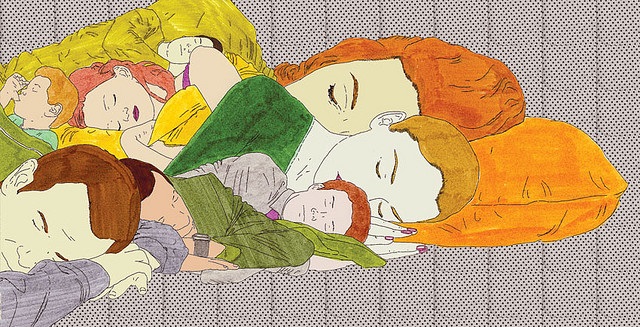
You decide you need some medical advice, so you take to the internet. Whoops! There’s your first mistake. Now you are bombarded with contradictory opinions from questionable sources and you begin to develop symptoms you never knew existed. It’s all downhill from there. So I’ll say this upfront: I have no medical qualifications authorizing me to dispense information about sleep disorders. The only advice I’d venture, should you have such a problem, is to go see a doctor. It might help, or not. I can certainly sympathize. I am a chronic insomniac.
The downside to this condition is obvious. I never get enough sleep. Whenever I consult the internet about this, I learn that it’s probably very dire and that I may lose my mind or die young(ish). The upside—which I learned to master after years of trying and failing to sleep like normal people—is that the nights are quiet and peaceful, and thus a fertile time creatively.
Medical issues aside, what do we know about sleep, insomnia, and creativity? Let us wade into the fray, with the proviso that we will likely reach few conclusions and may have to fall back on our own experience to guide us. In surveying this subject, I was pleased to have my experience validated by an article in Fast Company. Well, not pleased, exactly, as the author, Jane Porter, cites a study in Science that links a lack of sleep to Alzheimer’s and the accumulation of “potentially neurotoxic waste products.”
And yet, in praise of sleeplessness, Porter also recommends turning insomnia into a “productivity tool,” naming famous insomniacs like Margaret Thatcher, Bill Clinton, Charles Dickens, Marcel Proust, and Madonna (not all of whom I’d like to emulate). She then quotes psychologist Tomas Chamorro-Premuzic of University College London, who made the dubious-sounding claim in Psychology Today that “insomnia is to exceptional achievement what mental illness is to creativity.” Everything about this analogy sounds suspect to me.
But there are more substantive views on the matter. Another study, published in Creativity Research Journal, suggests insomnia may be a symptom of “notable creative potential,” though the authors only go as far as saying the two phenomenon are “associated.” The arrow of causality may point in either direction. Perhaps the most pragmatic view on the subject comes from Michael Perlis, psychology professor at the University of Pennsylvania, who says, “What is insomnia, but the gift of more time?”
Dennis Drabelle at The Washington Post, also an insomniac, refers to a recent study (as of 2007) from the University of Canterbury that suggests “insomnia and originality may go hand in hand.” He also points out that the notion of sleeplessness as productive, though “counterintuitive,” has plenty of precedent. Drabelle mentions many more famous cases, from W.C. Fields to Theodore Roosevelt to Franz Kafka. The list could go on and on.
Actor and musician Matt Berry tells The Guardian how, after years of tossing and turning, he finally harnessed his sleepless hours to write and record an album, Music for Insomniacs. “I knew that this was dead time,” says Berry, “and I could be doing something instead of sitting worrying about not being asleep.” Another musician, Dave Bayley of band Glass Animals, “owes his career in music to insomnia,” The Guardian writes, then notes a phenomenon sleep researchers call—with some skepticism—“creative insomnia.” Other musicians like Chris Martin, Moby, Tricky, and King Krule have all suffered the condition and turned it to good account.
The Guardian also notes that each of these poor souls has found “sleepless nights inspiring as well as tormenting.” Insomnia is not, in fact a gift or talent, but a painful condition that Porter and Drabelle both acknowledge can be associated with depression, addiction, and other serious medical conditions. One might make good use of the time—but perhaps only for a time. A site called Sleepdex—-which offers “resources for better sleep”—puts it this way:
Occasional insomnia appears to help some people produce new art and work, but is a detriment to others. It is perhaps true that more people find it a detriment than find it useful. Long-term insomnia and the accompanying sleep debt are almost surely negative for creativity.
This brings us to the subject of sleep—good, restful sleep—and its relationship to creativity. Sleepdex cites several research studies from Swiss and Italian universities, UC San Diego, and UC Davis. The general conclusion is that REM sleep—that period during which dreams “are the most narratively coherent of any during the night”—is also an important stimulus for creativity. There are the numerous anecdotes from artists like Salvador Dali, Paul McCartney, and countless others about famous works of art taking shape in dream states (Keith Richards says he heard the riff from “Satisfaction” in a dream).
And there are the experimental data, purportedly confirming that REM sleep enhances “creative problem solving.” European scientists have found that people were more likely to have creative insights after a long period of restful sleep, when the right brain gets a boost. Likewise, Tom Stafford at the BBC describes the “post-sleep, dreamlike mental state—known as sleep inertia or the hypnopompic state” that infuses our “waking, directed thoughts with a dusting of dreamworld magic.” It isn’t that insomniacs don’t experience this, of course, but we have less of it, as periods of REM sleep can be shorter and often interrupted by the need to scramble out of bed and get to work or get the kids to school not long after hitting the pillow.
Stafford points us toward a UC Berkeley study (apparently the University of California has some sort of monopoly on sleep research) “that helps illustrate the power of sleep to foster unusual connections, or ‘remote associates’ as psychologists call them.” Like nearly all of the scientific literature on sleep, this study expresses little doubt about the importance of sleep to memory function and problem solving. Big Think collects several more studies that confirm the findings.
On the whole, when it comes to the links between sleep—or sleeplessness—and creativity, the data and the stories point in different directions. This is hardly surprising given the slipperiness of that thing we call “creativity.” Like “love” it’s an abstract quality everyone wants and no one knows how to make in a laboratory. If it’s extra time you’re after—and very quiet time at that—I can’t recommend insomnia enough, though I wouldn’t recommend it at all as a voluntary exercise. If it’s the special creative insights only available in dream states, well, you’d best get lots of sleep. If you can, that is. Creative insomniacs—like those wandering in the confines of a dream world—know all too well they don’t have much choice in the matter.
Physicist Stephen Hawking may trump them all, though his famously recognizable voice is not organic. The one we all associate with him has been computer generated since worsening Amyotrophic lateral sclerosis, aka Lou Gehrig’s disease, led to a tracheotomy in 1985.
Without the use of his hands, Hawking controls the Assistive Context-Aware Toolkit software with a sensor attached to one of his cheek muscles.
Recently, Intel has made the software and its user guide available for free download on the code sharing site, Github. It requires a computer running Windows XP or above to use, and also a webcam that will track the visual cues of the user’s facial expressions.
The multi-user program allows users to type in MS Word and browse the Internet, in addition to assisting them to “speak” aloud in English.
The software release is intended to help researchers aiding sufferers of motor neuron diseases, not pranksters seeking to borrow the famed physicist’s voice for their doorbells and cookie jar lids. To that end, the free version comes with a default voice, not Professor Hawking’s.
Ayun Halliday is an author, illustrator, and Chief Primatologist of the East Village Inky zine. Her play, Fawnbook, is currently playing in New York City. Follow her @AyunHalliday
In the United States and the UK, we’ve seen the emergence of a multibillion-dollar brain training industry, premised on the idea that you can improve your memory, attention and powers of reasoning through the right mental exercises. You’ve likely seen software companies and web sites that market games designed to increase your cognitive abilities. And if you’re part of an older demographic, worried about your aging brain, you’ve perhaps been inclined to give those brain training programs a try. Whether these programs can deliver on their promises remains an open question–especially seeing that a 2010 scientific study from Cambridge University and the BBC concluded that there’s “no evidence to support the widely held belief that the regular use of computerised brain trainers improves general cognitive functioning in healthy participants…”
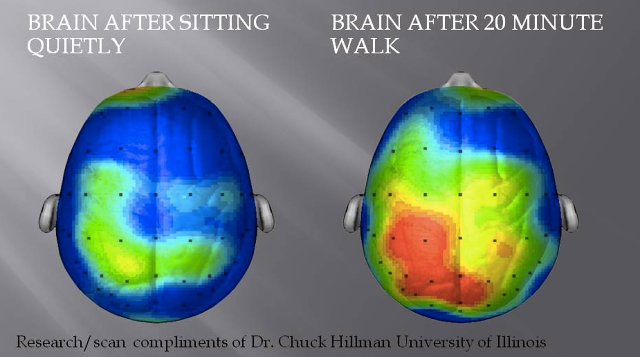
And yet we shouldn’t lose hope. A number of other scientific studies suggest that physical exercise–as opposed to mental exercise–can meaningfully improve our cognitive abilities, from childhood through old age. One study led by Charles Hillman, a professor of kinesiology and community health at the University of Illinois, found that children who regularly exercise, writes The New York Times:
displayed substantial improvements in … executive function. They were better at “attentional inhibition,” which is the ability to block out irrelevant information and concentrate on the task at hand … and had heightened abilities to toggle between cognitive tasks. Tellingly, the children who had attended the most exercise sessions showed the greatest improvements in their cognitive scores.
And, hearteningly, exercise seems to confer benefits on adults too. A study focusing on older adults already experiencing a mild degree of cognitive impairment found that resistance and aerobic training improved their spatial memory and verbal memory. Another study found that weight training can decrease brain shrinkage, a process that occurs naturally with age.
If you’re looking to get the gist of how exercise promotes brain health, it comes down to this:
Exercise triggers the production of a protein called brain-derived neurotrophic factor, or BDNF, which helps support the growth of existing brain cells and the development of new ones.
With age, BDNF levels fall; this decline is one reason brain function deteriorates in the elderly. Certain types of exercise, namely aerobic, are thought to counteract these age-related drops in BDNF and can restore young levels of BDNF in the age brain.
You’re perhaps left wondering what’s the right dose of exercise for the brain? And guess what, Gretchen Reynolds, the phys ed columnist for The Times’Well blog, wrote a column on just that this summer. Although the science is still far from conclusive, a new study conducted by The University of Kansas Alzheimer’s Disease Center found that small doses of exercise could lead to cognitive improvements. Writes Reynolds, “the encouraging takeaway from the new study … is that briskly walking for 20 or 25 minutes several times a week — a dose of exercise achievable by almost all of us — may help to keep our brains sharp as the years pass.”
If you would like to support the mission of Open Culture, consider making a donation to our site. It’s hard to rely 100% on ads, and your contributions will help us continue providing the best free cultural and educational materials to learners everywhere. You can contribute through PayPal, Patreon, and Venmo (@openculture). Thanks!
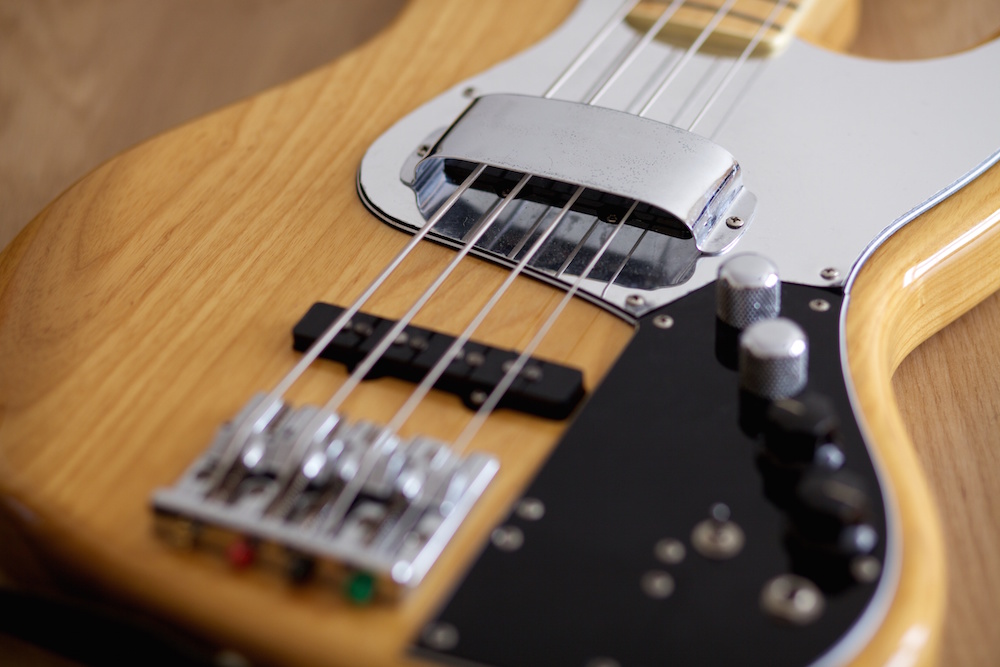
At the lower range of hearing, it’s said humans can hear sound down to about 20 Hz, beneath which we encounter a murky sonic realm called “infrasound,” the world of elephant and mole hearing. But while we may not hear those lowest frequencies, we feel them in our bodies, as we do many sounds in the lower frequency ranges—those that tend to disappear when pumped through tinny earbuds or shopping mall speakers. Since bass sounds don’t reach our ears with the same excited energy as the high frequency sounds of, say, trumpets or wailing guitars, we’ve tended to dismiss the instruments—and players—who hold down the low end (know any famous tuba players?).
In most popular music, bass players don’t get nearly enough credit—even when the bass provides a song’s essential hook. As Led Zeppelin’s John Paul Jones joked at his Rock and Roll Hall of Fame induction ceremony in 1995, “thank you to my friends for remembering my phone number.” And yet, writes Tom Barnes at Mic, “there’s scientific proof that bassists are actually one of the most vital members of any band…. It’s time we started treating bassists with the respect they deserve.” Research into the critical importance of low frequency sound explains why bass instruments mostly play rhythm parts and leave the fancy melodic noodling to instruments in the upper range. The phenomenon is not specific to rock, funk, jazz, dance, or hip hop. “Music in diverse cultures is composed this way,” says psychologist Laurel Trainor, director of the McMaster University Institute for Music and the Mind, “from classical East Indian music to Gamelan music of Java and Bali, suggesting an innate origin.”
Trainor and her colleagues have recently published a study in the Proceedings of the National Academy of Sciences suggesting that perceptions of time are much more acute at lower registers, while our ability to distinguish changes in pitch gets much better in the upper ranges, which is why, writes Nature, “saxophonists and lead guitarists often have solos at a squealing register,” and why bassists tend to play fewer notes. (These findings seem consistent with the physics of sound waves.) To reach their conclusions, Trainer and her team “played people high and low pitched notes at the same time.” Participants were hooked up to an electroencephalogram that measured brain activity in response to the sounds. The psychologists “found that the brain was better at detecting when the lower tone occurred 50 MS too soon compared to when the higher tone occurred 50 MS too soon.”
The study’s title perfectly summarizes the team’s findings: “Superior time perception for lower musical pitch explains why bass-ranged instruments lay down musical rhythms.” In other words, “there is a psychological basis,” says Trainor, “for why we create music the way we do. Virtually all people will respond more to the beat when it is carried by lower-pitched instruments.” University of Vienna cognitive scientist Tecumseh Fitch has pronounced Trainor and her co-authors’ study a “plausible hypothesis for why bass parts play such a crucial role in rhythm perception.” He also adds, writes Nature:
For louder, deeper bass notes than those used in these tests, people might also feel the resonance in their bodies, not just hear it in their ears, helping us to keep rhythm. For example, when deaf people dance they might turn up the bass and play it very loud, he says, so that “they can literally ‘feel the beat’ via torso-based resonance.”
Painfully awkward revelers at weddings, on cruise ships, at high school reunions—they just can’t help it. Maybe even this dancing owl can’t help it. Some of us keep time better than others, but most of us feel and respond physically to low-frequency rhythms.
Bass instruments don’t only keep time; they also play a key role in a song’s harmonic and melodic structure. In 1880, an academic music textbook informed its readers that “the bass part… is, in fact, the foundation upon which the melody rests and without which there could be no melody.” As true as this was at the time—-when acoustic precursors to electric bass, synthesizers, and sub-bass amplification provided the low end—it’s just as true now. And bass parts often define the root note of a chord, regardless of what other instruments are doing. As a bass player, notes Sting, “you control the harmony,” as well as anchoring the melody. It seems the importance of rhythm players, though overlooked in much popular appreciation of music, cannot be overstated.
We're hoping to rely on loyal readers, rather than erratic ads. Please click the Donate button and support Open Culture. You can use Paypal, Venmo, Patreon, even Crypto! We thank you!
Open Culture scours the web for the best educational media. We find the free courses and audio books you need, the language lessons & educational videos you want, and plenty of enlightenment in between.