The Cringe-Inducing Humor of The Office Explained with Philosophical Theories of Mind

“I’m a friend first and a boss sec­ond,” says David Brent, mid­dle man­ag­er at the Slough branch of paper com­pa­ny Wern­ham-Hogg. “Prob­a­bly an enter­tain­er third.” Those of us who’ve watched the orig­i­nal British run of The Office — and espe­cial­ly those of us who still watch it reg­u­lar­ly — will remem­ber that and many oth­er of Bren­t’s pitiable dec­la­ra­tions besides. As por­trayed by the show’s co-cre­ator Ricky Ger­vais, Brent con­sti­tutes both The Office’s comedic and emo­tion­al core, at once a ful­ly real­ized char­ac­ter and some­one we’ve all known in real life. His dis­tinc­tive com­bi­na­tion of social incom­pe­tence and an aggres­sive des­per­a­tion to be liked pro­vokes in us not just laugh­ter but a more com­plex set of emo­tions as well, result­ing in one expres­sion above all oth­ers: the cringe.

“In David Brent, we have a char­ac­ter so invest­ed in the per­for­mance of him­self that he’s blocked his own access to oth­ers’ feel­ings.” So goes the analy­sis of Evan Puschak, a.k.a. the Nerd­writer, in his video inter­pret­ing the humor of The Office through philo­soph­i­cal the­o­ries of mind.

The elab­o­rate friend-boss-enter­tain­er song-and-dance Brent con­stant­ly puts on for his co-work­ers so occu­pies him that he lacks the abil­i­ty or even the incli­na­tion to have any sense of what they’re think­ing. “The irony is that Brent can’t see that a weak the­o­ry of mind always makes for a weak self-per­for­mance. You can’t brute force your pre­ferred per­son­al­i­ty onto anoth­er’s con­scious­ness: it takes two to build an iden­ti­ty.”

Cen­tral though Brent is to The Office, we laugh not just at what he says and does, but how the oth­er char­ac­ters (which Puschak places across a spec­trum of abil­i­ty to under­stand the minds of oth­ers) react — or fail to react — to what he says and does, how he reacts to their reac­tions, and so on. Mas­tery of the comedic effects of all this has kept the orig­i­nal Office effec­tive more than fif­teen years lat­er, though its effect may not be entire­ly plea­sur­able: “A lot of peo­ple say that cringe humor like this is hard to watch,” says Puschak, “but in the same way that under our con­fi­dence, in the­o­ry of mind, lies an anx­i­ety, I think that under our cring­ing there’s actu­al­ly a deep feel­ing of relief.” When Brent and oth­ers fail to con­nect, their “body lan­guage speaks in a way that is total­ly trans­par­ent: in that moment the embar­rass­ment is not only pal­pa­ble, it’s pal­pa­bly hon­est.” And it reminds us that — if we’re being hon­est — none of us are exact­ly mind-read­ers our­selves.

You can get the com­plete British run of The Office on Ama­zon here.

Relat­ed Con­tent:

Ricky Ger­vais Presents “Learn Gui­tar with David Brent”

The Phi­los­o­phy of Bill Mur­ray: The Intel­lec­tu­al Foun­da­tions of His Comedic Per­sona

A Romp Through the Phi­los­o­phy of Mind: A Free Online Course from Oxford

Based in Seoul, Col­in Mar­shall writes and broad­casts on cities, lan­guage, and cul­ture. His projects include the book The State­less City: a Walk through 21st-Cen­tu­ry Los Ange­les and the video series The City in Cin­e­ma. Fol­low him on Twit­ter at @colinmarshall or on Face­book.

Sleep or Die: Neuroscientist Matthew Walker Explains How Sleep Can Restore or Imperil Our Health

Wouldn’t it be nice if we could fix the work/life thing by chuck­ing out the dif­fer­ence? At home, you’re in the office, at the office, you’re at home, always on and nev­er off—sleep, option­al. Two-four hours per 24-hour cycle should be enough, right? Wrong. We need prop­er sleep like we need good food, low stress, engag­ing pur­suits, etc.—to thrive and live a long and hap­py life. If you wait until you’re dead to sleep, you’ll be dead soon­er than you think. “Short sleep pre­dicts a short­er life,” explains sleep researcher Matthew Walk­er in the RSA ani­ma­tion Sleep or Die, above. “Sleep,” he says, “is a non-nego­tiable bio­log­i­cal neces­si­ty.“

The Nation­al Sleep Foun­da­tion rec­om­mends that adults sleep an aver­age of eight hours a night. That num­ber may vary from per­son to per­son, but few­er than six can be high­ly detri­men­tal. Walk­er is some­thing of a “sleep evan­ge­list,” notes Berke­ley News. Ask him about “the down­side of pulling an all-nighter, and he’ll rat­tle off a list of ill effects that range from mem­o­ry loss and a com­pro­mised immune sys­tem to junk food crav­ings and wild mood swings.” The neu­ro­sci­en­tist tells Ter­ry Gross on Fresh Air, “Every dis­ease that is killing us in devel­oped nations has causal and sig­nif­i­cant links to a lack of sleep.”

Walk­er has a lot more to say about sleep in the inter­view below, includ­ing tips for get­ting there, whether you can make up for lost sleep (you can’t), and why you shouldn’t yank teenagers out of bed on the week­ends. Why should we lis­ten to him? Well, he isn’t just any sleep sci­en­tist. “To be spe­cif­ic,” writes Rachel Cooke at The Guardian, “he is the direc­tor of the Cen­ter for Human Sleep Sci­ence at the Uni­ver­si­ty of Cal­i­for­nia, a research insti­tute whose goal—possibly unachievable—is to under­stand every­thing about sleep’s impact on us, from birth to death, in sick­ness and health.”


The ben­e­fits of sound sleep include enhanced cre­ativ­i­ty and con­cen­tra­tion, low­er blood pres­sure, bet­ter mood reg­u­la­tion, and high­er immu­ni­ty and fer­til­i­ty. Lack of sleep, how­ev­er, is “increas­ing our risk of can­cer, heart attack and Alzheimer’s,” notes Cooke. Indeed, “after just one night of only four or five hours’ sleep,” Walk­er tells The Guardian, “your nat­ur­al killer cells—the ones that attack the can­cer cells that appear in your body every day—drop by 70%.” Sleep depri­va­tion has such seri­ous out­comes that “the World Health Organ­i­sa­tion has classed any form of night-time shift work as a prob­a­ble car­cino­gen.”

Sleep holds many mys­ter­ies, but one thing sci­en­tists like Walk­er seem to know: poor sleep leaves us more in sick­ness than in health. And we are in the midst of a “cat­a­stroph­ic sleep-loss epi­dem­ic.” “No one would look at an infant baby asleep, and say ‘What a lazy baby!” Walk­er observes. Yet adults have “stig­ma­tized sleep with the label of lazi­ness. We want to seem busy, and one way we express that is by pro­claim­ing how lit­tle sleep we’re get­ting.” It’s a way to broad­cast that we aren’t falling behind or miss­ing out. But our bod­ies’ nat­ur­al cycles and rhythms don’t speed up along with tech­nol­o­gy and glob­al mar­kets.

“As bed­rooms every­where glow from the screens of round-the-clock tech­nol­o­gy con­sump­tion,” Berke­ley News writes, mil­lions of peo­ple suf­fer phys­i­cal, emo­tion­al, cog­ni­tive, and psy­cho­log­i­cal stress­es. Or, put more pos­i­tive­ly, “a grow­ing body of sci­en­tif­ic work” shows that “a sol­id sev­en to nine hours of sleep a night serves func­tions beyond our wildest imag­i­na­tions.” Learn more about not only what’s gone wrong with sleep, but how to start address­ing the prob­lem in Walker’s book Why We Sleep: Unlock­ing the Pow­er of Sleep and Dreams.

Relat­ed Con­tent:

Bertrand Russell’s Advice For How (Not) to Grow Old: “Make Your Inter­ests Grad­u­al­ly Wider and More Imper­son­al”

Bri­an Eno Lists the Ben­e­fits of Singing: A Long Life, Increased Intel­li­gence, and a Sound Civ­i­liza­tion

10 Longevi­ty Tips from Dr. Shigea­ki Hino­hara, Japan’s 105-Year-Old Longevi­ty Expert

Josh Jones is a writer and musi­cian based in Durham, NC. Fol­low him at @jdmagness

A Brief Animated Introduction to Noam Chomsky’s Linguistic Theory, Narrated by The X‑Files’ Gillian Anderson

How is it that chil­dren just enter­ing tod­dler­hood pick up the struc­ture of their respec­tive lan­guages with ease? They are not for­mal­ly taught to use speech; they have lim­it­ed cog­ni­tive abil­i­ties and a “pover­ty of stim­u­lus,” giv­en their high­ly cir­cum­scribed envi­ron­ments. And yet, they learn the func­tion and order of sub­jects, verbs, and objects, and learn to rec­og­nize improp­er usage. Chil­dren might make rou­tine mis­takes, but they under­stand and can be under­stood from a very ear­ly age, and for the most part with­out very much dif­fi­cul­ty. How?

These are the ques­tions that con­front­ed Noam Chom­sky in the ear­ly years of his career in lin­guis­tics. His answers pro­duced a the­o­ry of Uni­ver­sal Gram­mar in the 1960s, and for decades, it has been the reign­ing the­o­ry in the field to beat, ini­ti­at­ing what is often referred to as the “Chom­skyan Era,” a phrase the man him­self dis­likes but which nonethe­less sums up the kinds of issues that have been at stake in lin­guis­tics for over fifty years.

Ques­tions about lan­guage acqui­si­tion have always been the sub­ject of intense philo­soph­i­cal spec­u­la­tion. They were fold­ed into gen­er­al the­o­ries of epis­te­mol­o­gy, like Plato’s the­o­ry of forms or John Locke’s so-called “blank slate” hypoth­e­sis. Vari­a­tions on these posi­tions sur­face in dif­fer­ent forms through­out West­ern intel­lec­tu­al his­to­ry. Descartes picks up Plato’s dual­ism, argu­ing that humans speak and ani­mals don’t because of the exis­tence of an immor­tal “ratio­nal soul.” Behav­ior­ist B.F. Skin­ner sug­gests that oper­ant con­di­tion­ing writes lan­guage onto a total­ly impres­sion­able mind. (“Give me a child,” said Skin­ner, “and I will shape him into any­thing.”)

Chom­sky “gave a twist” to this age-old debate over the exis­tence of innate ideas, as Gillian Ander­son tells us in the ani­mat­ed video above from BBC 4’s His­to­ry of Ideas series. Chomsky’s the­o­ry is biolin­guis­tic: it sit­u­ates lan­guage acqui­si­tion in the struc­tures of the brain. Not being him­self a neu­ro­bi­ol­o­gist, he talks of those the­o­ret­i­cal struc­tures, respon­si­ble for repro­duc­ing accu­rate syn­tax, as a metaphor­i­cal “lan­guage acqui­si­tion device” (LAD), a hard­wired fac­ul­ty that sep­a­rates the human brain from that of a dog or cat.

Chomsky’s the­o­ry has lit­tle to do with the con­tent of lan­guage, but rather with its struc­ture, which he says is uni­ver­sal­ly encod­ed in our neur­al archi­tec­ture. Chil­dren, he writes, “devel­op lan­guage because they’re pre-pro­grammed to do this.” Syn­tax is pri­or to and inde­pen­dent of spe­cif­ic mean­ing, a point he demon­strat­ed with the poet­ic sen­tence “Col­or­less green ideas sleep furi­ous­ly.” Every Eng­lish speak­er can rec­og­nize the sen­tence as gram­mat­i­cal, even very small chil­dren, though it refers to no real objects and would nev­er occur in con­ver­sa­tion.

Con­verse­ly, we rec­og­nize “Furi­ous­ly sleep ideas green col­or­less” as ungram­mat­i­cal, though it means no more nor less than the first sen­tence. The region­al vari­a­tions on word order only under­line his point since, in every case, chil­dren quick­ly under­stand how to use the ver­sion they’re pre­sent­ed with at rough­ly the same devel­op­men­tal age and in the same way. The exis­tence of a the­o­ret­i­cal Lan­guage Acqui­si­tion Device solves the chick­en-egg prob­lem of how chil­dren with no under­stand­ing of and only a very lim­it­ed expo­sure to lan­guage, can learn to speak just by lis­ten­ing to lan­guage.

Chomsky’s the­o­ry was rev­o­lu­tion­ary in large part because it was testable, and researchers at the professor’s long­time employ­er, MIT, recent­ly pub­lished evi­dence of a “lan­guage uni­ver­sal” they dis­cov­ered in a com­par­a­tive study of 37 lan­guages. It’s com­pelling research that just might antic­i­pate the dis­cov­ery of a phys­i­cal Lan­guage Acqui­si­tion Device, or its neu­ro­bi­o­log­i­cal equiv­a­lent, in every human brain.

Relat­ed Con­tent:

Watch Michel Gondry Ani­mate Philoso­pher, Lin­guist & Activist Noam Chom­sky

The Ideas of Noam Chom­sky: An Intro­duc­tion to His The­o­ries on Lan­guage & Knowl­edge (1977)

Noam Chom­sky Defines What It Means to Be a Tru­ly Edu­cat­ed Per­son

5 Ani­ma­tions Intro­duce the Media The­o­ry of Noam Chom­sky, Roland Barthes, Mar­shall McLuhan, Edward Said & Stu­art Hall

Josh Jones is a writer and musi­cian based in Durham, NC. Fol­low him at @jdmagness

“Odyssey of the Ear”: A Beautiful Animation Shows How Sounds Travel Into Our Ears and Become Thoughts in Our Brain

As all school­child­ren know, we hear with our ears. And as all school­child­ren also prob­a­bly know, we hear with our brains — or if they don’t know it, at least they must sus­pect it, giv­en the way sounds around us seem to turn with­out effort into thoughts in our heads. But how? It’s the inter­face between ear and brain where things get more com­pli­cat­ed, but “Odyssey of the Ear,” the six-minute video above, makes it much clear­er just how sound gets through our ears and into our brains. Suit­able for view­ers of near­ly any age, it com­bines sil­hou­ette ani­ma­tion (of the kind pio­neered by Lotte Reiniger) with live action, pro­jec­tion, and even dance.

Accord­ing to the video, which was orig­i­nal­ly pro­duced as part of Har­vardX’s Fun­da­men­tals of Neu­ro­science course, the process works some­thing like this. Our out­er ear col­lects sounds from our envi­ron­ment when things vibrate in the phys­i­cal world, pro­duc­ing vari­a­tions in air pres­sure, or “sound waves” that pass through the air.

The sound waves enter the ear and pass down through the audi­to­ry canal, at the end of which they hit the ear drum. The ear drum trans­fers the vibra­tions of the sound waves to a “series of lit­tle bones,” three of them, called the ossi­cles, or “ham­mer, anvil, and stir­rup.” These trans­mit the sounds to the flu­id-filled inner ear through a mem­brane called the “oval win­dow.”

Inside the inner ear is the snail-shaped organ known as the cochlea, and inside the cochlea is the organ of cor­ti, and inside the organ of cor­ti are “thou­sands of audi­to­ry hair cells,” actu­al­ly recep­tor neu­rons called stere­ocil­ia, that “con­vert the motion ener­gy of sound waves into elec­tri­cal sig­nals that are com­mu­ni­cat­ed to the audi­to­ry nerve.” From there, “the sig­nal goes into struc­tures deep­er in the brain, until at last it reach­es the audi­to­ry cor­tex, where we con­scious­ly expe­ri­ence sound.” That con­scious expe­ri­ence of sound may make it feel as if we imme­di­ate­ly rec­og­nize and con­sid­er all the nois­es, voic­es, or music we hear, but as “Odyssey of the Ear” reveals, sound waves have to make quite an epic jour­ney before they reach our brains at all. At that point the waves them­selves may have dis­si­pat­ed, but they live on in our con­scious­ness. In oth­er words, “the brain has tak­en what was out­side and made it inside.”

via The Kids Should See This

Relat­ed Con­tent:

Eve­lyn Glen­nie (a Musi­cian Who Hap­pens to Be Deaf) Shows How We Can Lis­ten to Music with Our Entire Bod­ies

How Did Beethoven Com­pose His 9th Sym­pho­ny After He Went Com­plete­ly Deaf?

The Neu­ro­science of Bass: New Study Explains Why Bass Instru­ments Are Fun­da­men­tal to Music

The British Library’s “Sounds” Archive Presents 80,000 Free Audio Record­ings: World & Clas­si­cal Music, Inter­views, Nature Sounds & More

Feel Strange­ly Nos­tal­gic as You Hear Clas­sic Songs Reworked to Sound as If They’re Play­ing in an Emp­ty Shop­ping Mall: David Bowie, Toto, Ah-ha & More

The Vin­cent Van Gogh Action Fig­ure, Com­plete with Detach­able Ear

Based in Seoul, Col­in Mar­shall writes and broad­casts on cities, lan­guage, and cul­ture. His projects include the book The State­less City: a Walk through 21st-Cen­tu­ry Los Ange­les and the video series The City in Cin­e­ma. Fol­low him on Twit­ter at @colinmarshall or on Face­book.

Jazz Musician Plays Acoustic Guitar While Undergoing Brain Surgery, Helping Doctors Monitor Their Progress

Unlike many col­or­ful expres­sions in Eng­lish whose ori­gins are lost to us, the com­par­i­son of major­ly con­se­quen­tial tasks to brain surgery makes per­fect sense. One false move or mis­cal­cu­la­tion can result in instant death. The chances of irre­versible, life-alter­ing dam­age are high, should a scalpel slip or a sur­geon mis­take healthy brain tis­sue for dis­eased. This can hap­pen more read­i­ly than we might like to think. “It can be very dif­fi­cult to tell the dif­fer­ence between the tumor and nor­mal brain tis­sue,” admits Dr. Basil Enick­er, a spe­cial­ist neu­ro­sur­geon at Inkosi Albert Luthuli Cen­tral Hos­pi­tal in South Africa.

An oper­a­tion Enick­er led makes the pro­ce­dure seem like just as much an art as a sci­ence. Dur­ing an “awake cran­ioto­my,” the sur­geon and his team removed a tumor from the brain of Musa Manzi­ni, a South African jazz bassist.

To help them mon­i­tor the oper­a­tion as they went, they had him strum an acoustic gui­tar in the OR. “Pre­sum­ably, had he hit a wrong note,” writes Kimon de Greef at The New York Times, “it would have been an imme­di­ate sig­nal for the sur­geons to probe else­where.” He also car­ried on an extend­ed con­ver­sa­tion with one of the sur­geons, as you can see in the video above.

Such pro­ce­dures are not at all unusu­al. In a sim­i­lar case at the Uni­ver­si­ty of Texas’ MD Ander­son Can­cer Cen­ter, young musi­cian Robert Alvarez strummed his gui­tar while sur­geons removed a tumor near his speech and move­ment cen­ters. In 2014, de Greef reports, “a tenor in the Dutch Nation­al Opera, Ambroz Bajec-Lapa­jne, sang Schubert’s ‘Gute Nacht’ as doc­tors removed a tumor. In 2015, the sax­o­phon­ist Car­los Aguil­era read music and per­formed dur­ing an oper­a­tion in Spain.” That same year, a Brazil­ian man played the Bea­t­les while he under­went brain surgery.

Not all of them are musi­cal, but awake cran­iotomies are so com­mon that Manzi­ni “watched quite a lot of YouTube videos,” he says, “to pre­pare myself men­tal­ly.” As for the shock of being con­scious while sur­geons poke around in your most pre­cious of bod­i­ly organs, mil­lime­ters from pos­si­ble paral­y­sis, etc., well… it’s cer­tain­ly more com­fort­able now than in some of the ear­li­est brain surg­eries we have on fos­sil record—some 8,000 years ago. One won­ders how Neolith­ic patients passed their time under the knife.

Relat­ed Con­tent:

Oliv­er Sacks Explains the Biol­o­gy of Hal­lu­ci­na­tions: “We See with the Eyes, But with the Brain as Well”

This is Your Brain on Sex and Reli­gion: Exper­i­ments in Neu­ro­science

The Brains of Jazz and Clas­si­cal Musi­cians Work Dif­fer­ent­ly, New Research Shows

Josh Jones is a writer and musi­cian based in Durham, NC. Fol­low him at @jdmagness

How to Practice Effectively: Lessons from Neuroscience Can Help Us Master Skills in Music, Sports & Beyond

Prac­tice makes per­fect, so the cliché says, although like many clichés, it has also spawned cor­rec­tive vari­ants. “Prac­tice makes per­ma­nent,” a com­mon one of them goes, and what it lacks in catch­i­ness it may well make up for in neu­ro­sci­en­tif­ic truth. We’ve all rec­og­nized that, when we do things a cer­tain way, we tend to keep doing them in that cer­tain way; in fact, the more we’ve done them that way before, the more like­ly we’ll do them that way next time. What holds true for sim­ple habits, formed over long peri­ods of time and often inad­ver­tent­ly, also holds true for delib­er­ate­ly per­fect­ed — or any­way, per­ma­nent-ified — tasks. But what hap­pens in our brains to cause it?

“Prac­tice is the rep­e­ti­tion of an action with the goal of improve­ment, and it helps us per­form with more ease, speed, and con­fi­dence,” says the nar­ra­tor of “How to Prac­tice Effec­tive­ly… for Just About Any­thing,” edu­ca­tors Annie Bosler and Don Greene’s TED Ed video above. It then goes on to explain our two kinds of neur­al tis­sue, grey mat­ter and white mat­ter. The for­mer “process­es infor­ma­tion in the brain, direct­ing sig­nals and sen­so­ry stim­uli to nerve cells,” and the lat­ter “is most­ly made up of fat­ty tis­sue and nerve fibers.” When we move, “infor­ma­tion needs to trav­el from the brain’s grey mat­ter, down the spinal cord, through a chain of nerve fibers called axons to our mus­cles,” and those axons in the white mat­ter “are wrapped with a fat­ty sub­stance called myelin.”

Myelin, and the sheath it forms, is key: “sim­i­lar to insu­la­tion on elec­tri­cal cables,” it “pre­vents ener­gy loss from elec­tri­cal sig­nals that the brain uses, mov­ing them more effi­cient­ly along neur­al path­ways.” (You’ve prob­a­bly read about the weak­en­ing of myelin sheaths as a fac­tor in ALS and oth­er move­ment-relat­ed neu­ro­log­i­cal dis­or­ders.) Recent stud­ies per­formed on mice sug­gest that repeat­ing a motion builds up the lay­ers of those axon-insu­lat­ing myelin sheaths, “and the more lay­ers, the greater the insu­la­tion around the axon chains; form­ing a sort of super­high­way for infor­ma­tion con­nect­ing your brain to your mus­cles.” This, though it has no direct effect on our mus­cles, may be what we’re build­ing when we say we’re build­ing “mus­cle mem­o­ry.”

All inter­est­ing facts, to be sure, but how can they help us in or own prac­tice ses­sions, what­ev­er those ses­sions may find us prac­tic­ing? Bosler and Greene pro­vide a series of tips, each quite sim­ple but all in align­ment with cur­rent neu­ro­sci­en­tif­ic knowl­edge. They include:

  • Focus on the task at hand. “Min­i­mize poten­tial dis­trac­tions by turn­ing off the com­put­er or TV and putting your cell phone on air­plane mode.”
  • Go slow. “Coor­di­na­tion is built with rep­e­ti­tions, whether cor­rect or incor­rect. If you grad­u­al­ly increase the speed of the qual­i­ty rep­e­ti­tions, you have a bet­ter chance of doing them cor­rect­ly.”
  • Fre­quent rep­e­ti­tions with allot­ted breaks. “Stud­ies have shown that many top ath­letes, musi­cians, and dancers spend 50–60 hours per week on activ­i­ties relat­ed to their craft. Many divide their time used for effec­tive prac­tice into mul­ti­ple dai­ly prac­tice ses­sions of lim­it­ed dura­tion.”
  • Prac­tice in your imag­i­na­tion. “In one study, 144 bas­ket­ball play­ers were divid­ed into two groups. Group A phys­i­cal­ly prac­ticed one-hand­ed free throws while Group B only men­tal­ly prac­ticed them. When they were test­ed at the end of the two week exper­i­ment, the inter­me­di­ate and expe­ri­enced play­ers in both groups had improved by near­ly the same amount.”

If you’d like more sug­ges­tions on how to prac­tice effec­tive­ly, have a look at the list of twelve tips from Wyn­ton Marsalis we fea­tured here on Open Cul­ture last year. He takes a more expan­sive approach, encour­ag­ing those who prac­tice — not just music but sports, art, or any­thing else besides — to adopt strate­gies like writ­ing out a sched­ule, avoid­ing show­ing off, and stay­ing opti­mistic. We must also stay real­is­tic: opti­mism, even opti­mism backed by sci­ence, can’t make our skills per­fect. None of our skills are per­fect — not even Wyn­ton Marsalis’ — but with the right tech­niques, we can at least give them some degree of per­ma­nence.

Relat­ed Con­tent:

Play­ing an Instru­ment Is a Great Work­out For Your Brain: New Ani­ma­tion Explains Why

Wyn­ton Marsalis Gives 12 Tips on How to Prac­tice: For Musi­cians, Ath­letes, or Any­one Who Wants to Learn Some­thing New

What Are the Most Effec­tive Strate­gies for Learn­ing a For­eign Lan­guage?: Six TED Talks Pro­vide the Answers

How Bud­dhism & Neu­ro­science Can Help You Change How Your Mind Works: A New Course by Best­selling Author Robert Wright

Based in Seoul, Col­in Mar­shall writes and broad­casts on cities, lan­guage, and cul­ture. His projects include the book The State­less City: a Walk through 21st-Cen­tu­ry Los Ange­les and the video series The City in Cin­e­ma. Fol­low him on Twit­ter at @colinmarshall or on Face­book.

The Brains of Jazz and Classical Musicians Work Differently, New Research Shows

All of the musi­cians I’ve played with have been impro­vis­ers, whether they came from jazz, rock, folk, or what­ev­er. As a loose impro­vi­sor myself, I’ve found it dif­fi­cult to col­lab­o­rate with trained clas­si­cal play­ers. It’s not for lack of try­ing, but—while we like to think of music as a uni­ver­sal language—the means of com­mu­ni­ca­tion were strained at best. Clas­si­cal musi­cians have a hard time with spon­ta­neous com­po­si­tion; jazz play­ers are gen­er­al­ly com­fort­able with loose tech­nique and can adapt to exper­i­ments and unex­pect­ed shifts.

I’d always chalked this dif­fer­ence up to dif­fer­ent kinds of train­ing (or lack there­of in my case), but a new study by researchers in Leipzig sug­gests a deep­er neu­ro­log­i­cal basis, at least when it comes strict­ly to jazz ver­sus clas­si­cal musi­cians. Researchers at the Max Planck Insti­tute for Human Cog­ni­tive and Brain Sci­ences stud­ied the brains of thir­ty pianists—half jazz play­ers, half clas­si­cal. They found, the Insti­tute reports, that “dif­fer­ent process­es occur in jazz and clas­si­cal pianists’ brains, even when per­form­ing the same piece.”

It’s a con­clu­sion play­ers them­selves intu­itive­ly under­stand. As jazz pianist Kei­th Jar­rett once said, when asked if he would ever play both jazz and clas­si­cal in con­cert, “No… it’s [because of] the cir­cuit­ry. Your sys­tem demands dif­fer­ent cir­cuit­ry for either of those two things.” This isn’t due to hard-wired bio­log­i­cal dif­fer­ences, but to the way the brain cre­ates path­ways over time in response to dif­fer­ent musi­cal activ­i­ties. As neu­ro­sci­en­tist Daniela Samm­ler puts it:

The rea­son could be due to the dif­fer­ent demands these two styles pose on the musicians—be it to skill­ful­ly inter­pret a clas­si­cal piece or to cre­ative­ly impro­vise jazz. There­by, dif­fer­ent pro­ce­dures may have estab­lished in their brains while play­ing the piano which makes switch­ing between the styles more dif­fi­cult.

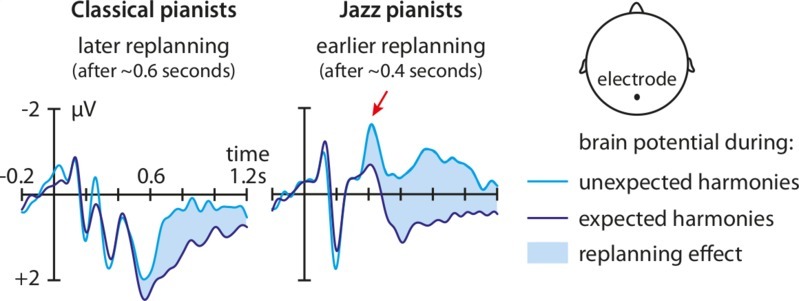
On its face, the study may hard­ly seem illu­mi­nat­ing. We have long known that repeat­ed actions change the struc­ture of the brain, so why should it be dif­fer­ent for musi­cians? Things get a lit­tle more inter­est­ing as we dig into the details. One find­ing, study author Robert Bian­co notes, shows that jazz pianists “replan… actions faster than clas­si­cal pianists” and were “bet­ter able to react and con­tin­ue their per­for­mance” when asked to play a har­mon­i­cal­ly unex­pect­ed chord with­in a stan­dard pro­gres­sion (see graph below).

On the oth­er hand, Sci­ence Dai­ly reports, clas­si­cal pianists’ brains showed, “a stronger aware­ness of fin­ger­ing, and con­se­quent­ly they made few­er errors while imi­tat­ing the chord sequence.” The crit­i­cal dis­tinc­tion between the two relates to how they plan move­ments, with clas­si­cal pianists focus­ing on the “How” of tech­nique and jazz play­ers on the “What” of adap­ta­tion to the unex­pect­ed.

Oth­er stud­ies sub­stan­ti­ate the find­ings. Researchers at Wes­leyan Uni­ver­si­ty focused on the role of what they call “expectan­cy” in three groups: jazz impro­vis­ers, “non-impro­vis­ing musi­cians,” and non-musi­cians. Jazz play­ers trained to impro­vise not only pre­ferred unex­pect­ed chords in a pro­gres­sion, but their brains react­ed and recov­ered more quick­ly to the unex­pect­ed, sug­gest­ing a high­er degree of cre­ative poten­tial than both clas­si­cal­ly trained musi­cians and non-musi­cians.

“The impro­visato­ry and exper­i­men­tal nature of jazz train­ing,” the study’s authors write, “can encour­age musi­cians to take notes and chords that are out of place, and use them as a piv­ot to tran­si­tion to new tonal and musi­cal ideas.” How­ev­er, the com­par­i­son between the two groups does not place val­ue on one over the oth­er.

While jazz impro­vi­sa­tion may bet­ter teach cre­ativ­i­ty, clas­si­cal train­ing, as neu­ro­sci­en­tist Ardon Shorr argues in his TEDx talk above, may bet­ter train the brain in infor­ma­tion pro­cess­ing. These stud­ies show that the effect of music on the brain can­not be stud­ied with­out regard for the dif­fer­ing neu­ro­log­i­cal demands of dif­fer­ent kinds of music, just as the study of lan­guage pro­cess­ing can­not be lim­it­ed to just one lan­guage.

Such stud­ies can also give us an even greater appre­ci­a­tion for the rare musi­cian who can eas­i­ly switch between jazz and clas­si­cal in the same per­for­mance, like the late, great Nina Simone. See her work a Bach-influ­enced fugue into “Love Me or Leave Me,” at the top.

Relat­ed Con­tent:

Music in the Brain: Sci­en­tists Final­ly Reveal the Parts of Our Brain That Are Ded­i­cat­ed to Music

New Research Shows How Music Lessons Dur­ing Child­hood Ben­e­fit the Brain for a Life­time

The Neu­ro­science of Bass: New Study Explains Why Bass Instru­ments Are Fun­da­men­tal to Music

Josh Jones is a writer and musi­cian based in Durham, NC. Fol­low him at @jdmagness

How Meditation Can Change Your Brain: The Neuroscience of Buddhist Practice

Nir­vana is a place on earth. Pop­u­lar­ly thought of a Bud­dhist “heav­en,” reli­gious schol­ars dis­cuss the con­cept not as an arrival at some­place oth­er than the phys­i­cal place we are, but as the extinc­tion of suf­fer­ing in the mind, achieved in large part through inten­sive med­i­ta­tion. If this state of enlight­en­ment exists in the here and now—the sci­en­tif­ic inquir­er is jus­ti­fied in asking—shouldn’t it be some­thing we can mea­sure?

Maybe it is. Psy­chol­o­gist Daniel Gole­man and neu­ro­sci­en­tist Richard David­son set out to do just that when they flew sev­er­al “Olympic lev­el med­i­ta­tors” from Nepal, India, and France to Davidson’s lab at the Uni­ver­si­ty of Wis­con­sin.

Once they put the med­i­ta­tors under David­son’s scan­ners, researchers found that “their brain waves are real­ly dif­fer­ent,” as Gole­man says in the Big Think video above.

Per­haps the most remark­able find­ings in the Olympic lev­el med­i­ta­tors has to do with what’s called a gam­ma wave. All of us get gam­ma for a very short peri­od when we solve a prob­lem we’ve been grap­pling with, even if it’s some­thing that’s vexed us for months. We get about half sec­ond of gam­ma; it’s the strongest wave in the EEG spec­trum….

What was stun­ning was that the Olympic lev­el med­i­ta­tors, these are peo­ple who have done up to 62,000 life­time hours of med­i­ta­tion, their brain­wave shows gam­ma very strong all the time as a last­ing trait just no mat­ter what they’re doing. It’s not a state effect, it’s not dur­ing their med­i­ta­tion alone, but it’s just their every day state of mind. We actu­al­ly have no idea what that means expe­ri­en­tial­ly. Sci­ence has nev­er seen it before.

The med­i­ta­tors them­selves describe the state of mind in terms con­sis­tent with thou­sands of years of lit­er­a­ture on the sub­ject; “it’s very spa­cious and you’re wide open, you’re pre­pared for what­ev­er may come.” Gole­man and David­son have elab­o­rat­ed their find­ings for the pub­lic in the book Altered Traits: Sci­ence Reveals How Med­i­ta­tion Changes Your Mind, Brain, and Body. For more on Davidson’s work on the sub­ject, see his talk at Google, “Trans­form Your Mind, Change Your Brain.”

The bar to enlight­en­ment seems high. Gole­man and Davidson’s “Olympic lev­el” test sub­jects spent a min­i­mum of 62,000 hours in med­i­ta­tion, which amounts to some­thing like 20 years of eight-hour days, sev­en days a week (and maybe explains why the path to enlight­en­ment is often spread out over sev­er­al life­times in the tra­di­tion). But that doesn’t mean med­i­ta­tion in less­er dos­es does not have sig­nif­i­cant effects on the brain as well.

As Gole­man explains in the video above, med­i­ta­tion induces a state of hyper-focus, or “flow,” that acts as a gym for your brain: low­er­ing stress, rais­ing the lev­el of resilience under stress, and increas­ing focus “in the midst of dis­trac­tions.” At some point, he says, these tem­po­rary “altered states” become per­ma­nent “altered traits.” Along the way, as with any con­sis­tent, long-term work­out pro­gram, med­i­ta­tors devel­op strength, sta­mi­na, and flex­i­bil­i­ty the longer they stick with the prac­tice. Find resources to get you start­ed in the Relat­eds below.

Relat­ed Con­tent:

How Bud­dhism & Neu­ro­science Can Help You Change How Your Mind Works: A New Course by Best­selling Author Robert Wright

Free Guid­ed Med­i­ta­tions From UCLA: Boost Your Aware­ness & Ease Your Stress

Med­i­ta­tion 101: A Short, Ani­mat­ed Beginner’s Guide

Josh Jones is a writer and musi­cian based in Durham, NC. Fol­low him at @jdmagness

« Go BackMore in this category... »
Quantcast