Mark Linsenmayer, Erica Spyres, and Brian Hirt discuss Michael Schur’s NBC TV show. Is it good? (Yes, or we wouldn’t be covering it?) Is it actually a sit-com? Does it effectively teach philosophy? What did having actual philosophers on the staff (after season one) contribute, and was that enough? We talk TV finales, the dramatic impact of the show’s convoluted structure, the puzzle of heaven being death, and more.
If you like the show, you should also check out The Official Good Place Podcast, especially the interviews with Schur himself. There are also supplementary educational videos with professor Todd May like this one on existentialism.
Boethius, Henry David Thoreau, Antonio Gramsci, Martin Luther King, Jr…. It’s possible, if one tried, to draw other comparisons between these disparate figures, but readers familiar with the work of all four will immediately recognize their most obvious literary commonality: all wrote some of their most impassioned and persuasive work while unjustly confined to a cell.
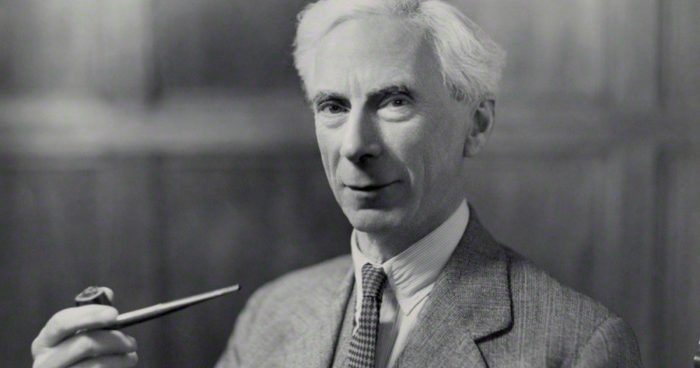
In the case of Bertrand Russell, however, perhaps one of the most famous figures in 20th century philosophy and intellectual life more generally, periods of incarceration in Brixton prison in 1918 and, forty-three years later, in 1961, play a minimal role in the larger drama of his writing life, despite the fact that he did a good deal of writing, including some significant philosophical work, behind bars.
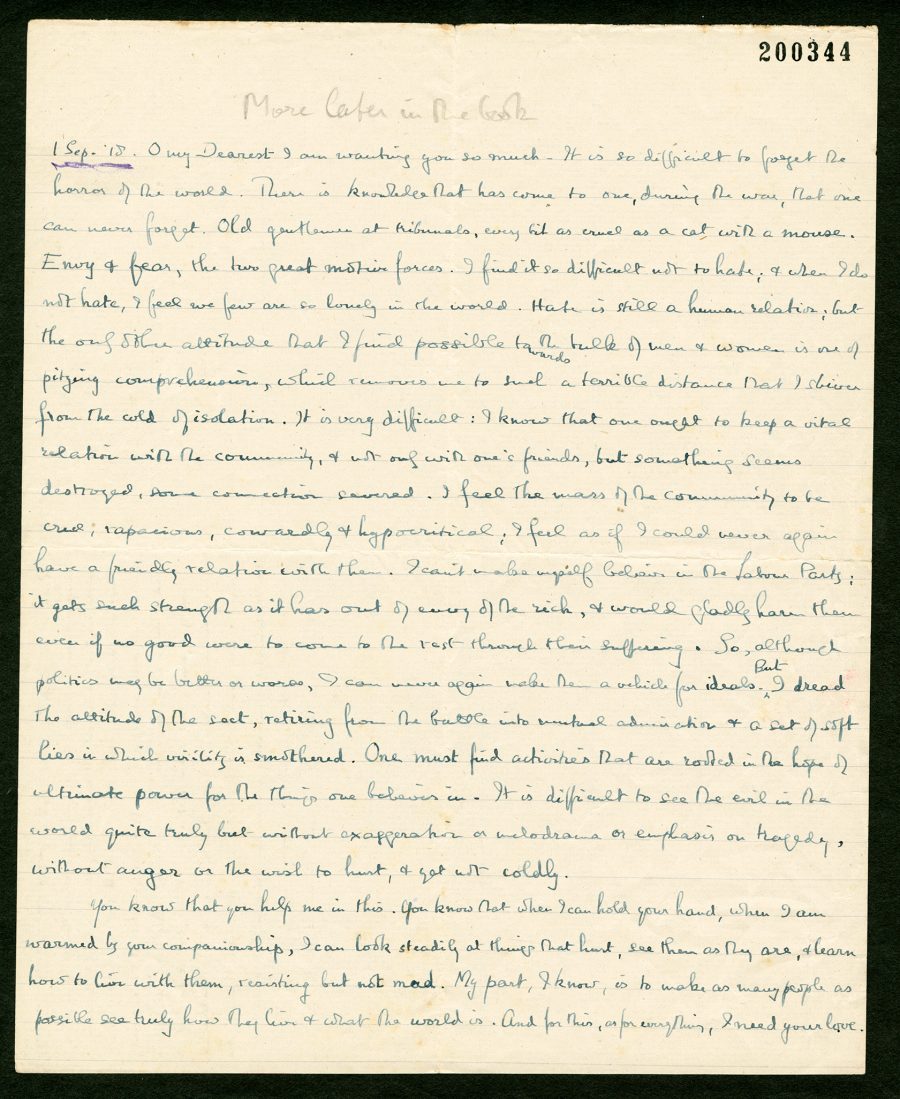
The contents of the letters reveal other reasons that Russell’s prison writing isn’t better known. He did plenty of impassioned and persuasive writing for the public outside of a prison cell—publishing fiery books, essays, and lectures against war and propaganda and in defense of free thought throughout his life. Behind bars, however, Russell’s writing turned almost solely professional and personal, in letters addressed primarily to “his then lover Lady Constance Malleson (known as ‘Colette’) and his former lover, aristocrat and socialite Lady Ottoline Morrell.”
The 105 letters “reveal the private thoughts of one of the 20th century’s most public figures and provide an interesting window on Russell’s inner life,” says Andrew Bone, Senior Research Associate at McMaster’s Bertrand Russell Research Centre. Most of the letters “were written in secret,” Balch notes, “and smuggled out of Brixton by Russell’s friends, concealed between the uncut pages of books.” Russell was only allowed one letter per week; officially sanctioned correspondence is written on prison stationary and bears the Brixton governor’s initials.
A lifelong pacifist, Russell was first jailed for six months in 1918 for a speech opposing U.S. entry into World War I. “I found prison in many ways quite agreeable,” he later wrote in his autobiography. “I had no engagements, no difficult decisions to make, no fear of callers, no interruptions to my work. I read enormously; I wrote a book, ‘Introduction to Mathematical Philosophy’… and began the work for ‘Analysis of Mind,’” a project that never reached fruition. In 1961, at age 89, he was jailed for seven days for participating in a London anti-nuclear demonstration.
During his first stay as a prisoner of Brixton’s “first division,” Russell was “allowed to furnish his cell, wear civilian clothes, purchase catered food, and most importantly, be exempted from prison work while he pursued his profession as an author,” as the Bertrand Russell Research Centre points out. It’s little wonder he looked forward to the experience as a “holiday from responsibility,” he wrote in a letter to his brother, Frank, four days after he began his sentence.
Russell may not have suffered—or acquired a heightened sense of political urgency—while behind bars (at one point he was heard laughing out loud and had to be reminded by the warden that “prison is a place of punishment”). But his prison letters offer significant insight into not only the deeply emotional relationships he had with Malleson and Morrell, but also his relationship with other members of the famous Bloomsbury group and “literary celebrities such as D.H. Lawrence, and T.S. Eliot,” writes Balch, “many of whom are referenced in the letters.”
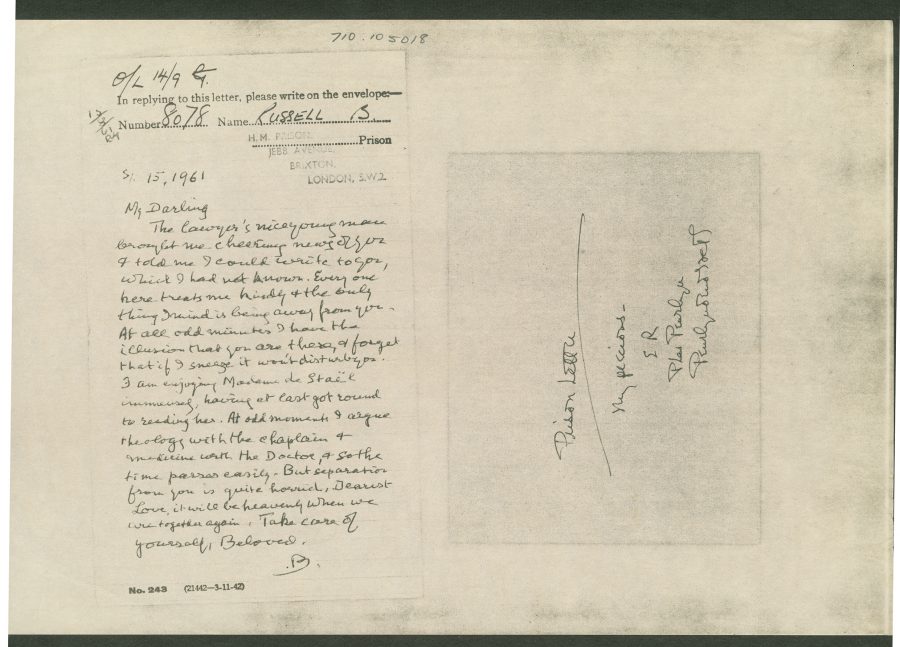
The 104 letters from 1918, including Russell’s correspondence with his brother, his publisher, The Nation magazine and others, are all available in original scans with transcriptions and annotations at the McMaster University Bertrand Russell Research Centre site. The final letter, number 105, the sole piece of correspondence from Russell’s weeklong stay in Brixton in 1961, is addressed to his wife Edith.
My Darling,
The lawyer’s nice young man brought me cheering news of you and told me I could write to you, which I had not known. Every one here treats me kindly and the only thing I mind is being away from you. At all odd minutes I have the illusion that you are there, and forget that if I sneeze it won’t disturb you. I am enjoying Madame de Staël immensely, having at last got round to reading her. At odd moments I argue theology with the chaplain and medicine with the Doctor, and so the time passes easily. But separation from you is quite horrid, Dearest Love, it will be heavenly when we are together again. Take care of yourself, Beloved.
B.
As in most of the earlier letters, Russell avoids politics and keeps things personal. But as in nearly all of his writing, the prose is lively, evocative, and poignant, revealing much about the personality behind it. While these letters may never achieve the status of great literature, by virtue of their private nature and their minor role in Russell’s major canon, that does not mean they aren’t a joy to read, for students of Bertrand Russell and anyone else who appreciates the workings of a brilliant philosophical and ethical mind. Enter the Brixton Letter archivehere.
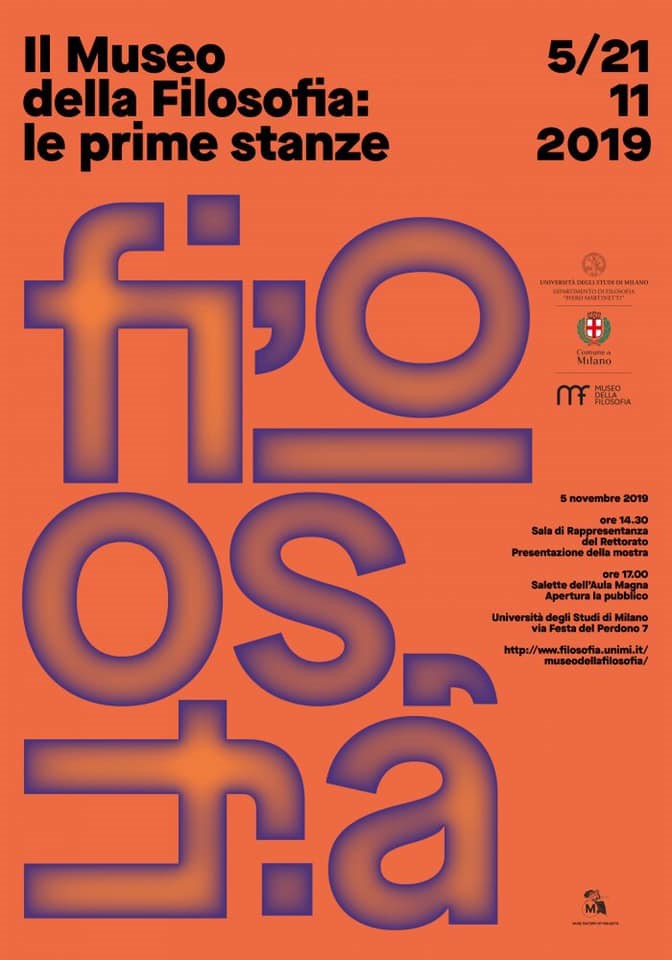
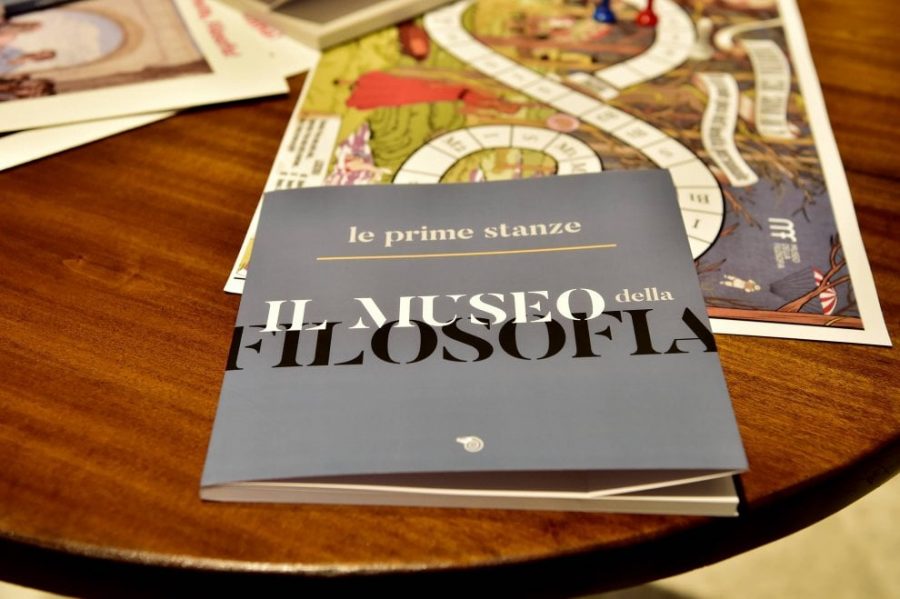
You’ve almost certainly been to more art museums than you can remember, and more than likely to a few museums of natural history, science, and technology as well. But think hard: have you ever set foot inside a museum of philosophy? Not just an exhibition dealing with philosophers or philosophical concepts, but a single institution dedicated wholly to putting the practice of philosophy itself on display. Your answer can approach a yes only if you spent time in Milan last November, and more specifically at the University of Milan, in whose halls the Museo della Filosofia set up shop and proved its surprisingly untested — and surprisingly successful — concept.
“What we had in mind was not an historically-minded museum collecting relics about the lives and works of important philosophers, but something more dynamic and interactive,” writes University of Milan postdoctoral research fellow Anna Ichino at Daily Nous, “where philosophical problems and theories become intuitively accessible through a variety of games, activities, experiments, aesthetic experiences, and other such things.”
In the first hall, “we used images like Mary Midgely’s ‘conceptual plumbing’ or Wittgenstein’s ‘fly bottle’ to convey the idea according to which philosophical problems are in important respects conceptual problems, which amount to analyzing concepts that we commonly use in unreflective ways.”
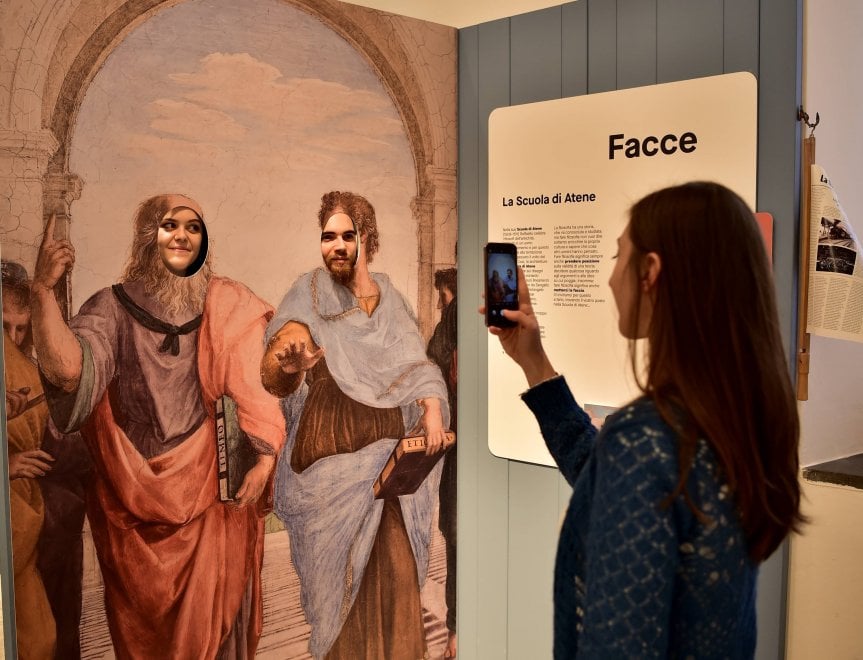
In the second hall, visitors to the Museo della Filosofia “could literally play with paradoxes and thought experiments in order to appreciate their heuristic role in philosophical inquiry.” The experiences available there ranged from using an oversized deck of cards to “solve” paradoxes, the perhaps inevitable demonstration of the well-known “trolley problem” using a model railroad set, and — most harrowing of all — the chance to “eat chocolates shaped as cat excrement” straight from the litter box. Then came the “School of Athens” game, “in which visitors had to decide whether to back Plato or Aristotle; then they could also take a souvenir picture portraying themselves in the shoes (and face!) of one or the other.”
In the third, “programmatic” hall, the museum’s organizers “presented the plan for what still needs to be done,” a to-do list that includes finding a permanent home. Before it does so, you can have a look at the project’s web site as well as its pages on Facebook and Instagram. At the top of the post appears a short video introducing the Museo della Filosofia which, like the rest of the materials, is for the moment in Italian only, but it nevertheless gets across even to non-Italian-speakers a certain idea of the experience a philosophical museum can deliver. Philosophical thinking, after all, occurs prior to language. Or maybe it’s inextricably tied up with language; different philosophers have approached the problem differently. And when the Museo della Filosofia opens for good, you’ll be able to visit and approach a few philosophical problems yourself. Read more about the museum at Daily Nous.
Based in Seoul, Colin Marshall writes and broadcasts on cities, language, and culture. His projects include the book The Stateless City: a Walk through 21st-Century Los Angeles and the video series The City in Cinema. Follow him on Twitter at @colinmarshall or on Facebook.
In 1956, the Pop artist Ed Ruscha left Oklahoma City for Los Angeles. “I could see I was just born for the job” of an artist, he would later say, “born to watch paint dry.” The comment encapsulates Ruscha’s ironic use of cliché as a centerpiece of his work. He called himself an “abstract artist… who deals with subject matter.” Much of his subject matter has been commonplace words and phrases—decontextualized and foregrounded in paintings and prints made with careful deliberation, against the trend toward Abstract Expressionism and its gestural freedom.
Another of Ruscha’s subjects comes with somewhat less conceptual baggage. His photographic books capture mid-century America gas stations and the city he has called home for over 50 years. In his 1966 book, Every Building on the Sunset Strip, Ruscha “photographed both sides of Sunset Boulevard from the back of a pickup truck,” writes filmmaker Matthew Miller. “He stitched the photos together to make one long book that folded out to 27 feet. That project turned into his larger Streets of Los Angeles series, which spanned decades.”
The connection between their style and their use of language feels really strong, but at the end of the day, I simply thought it’d be great to hear Ed Ruscha read On the Road. Something about Ed’s voice just feels right. Something about his work just feels right. It’s like the images, the words, and the forms he makes were always meant to be together.”
Miller describes the painstaking process of selecting the photos and “constructing a mini narrative that evoked Ed’s sensibilities” at Vimeo. The artist’s “perspective seemed to speak to the signage and architecture of the city, while Kerouac’s voice felt like it was pulling in all the lively characters of the street.” It’s easy to see why Ruscha would be so drawn to Kerouac. Both share a fascination with vernacular American speech and iconic American subjects of advertising, the automobile, and the freedoms of the road.
But where Ruscha turns to words for their visual impact, Kerouac relished them for their music. “For a while,” Miller writes of his project, “it felt like the footage wanted one thing and the voiceover wanted another.” But he and Leonard, who also did the sound design, were able to bring image and voice together in a short film that frames both artists as mid-century visionaries who turned the ordinary and seemingly unremarkable into an experience of the ecstatic.
We all know what to think of when we hear the term bonsai: dwarf trees. Or so Shinobu Nozaki titled his book, the very first major publication on the subject in English. Dwarf Trees came out in the 1930s, not long after the Japanese art of bonsai started drawing serious international attention. But the art itself goes back as far as the sixth century, when Japanese embassy employees and students of Buddhism returning from sojourns in China brought back all the latest things Chinese, including plants growing in containers. By six or seven centuries later, as scrolls show us today, Japan had taken that horticultural technique and refined it into a practice based on not just miniaturization but proportion, asymmetry, poignancy, and erasure of the artist’s traces, one that produces the kind of trees-in-miniature we recognize as artworks, and even masterworks, today.
It hardly needs saying that bonsai trees don’t take shape by themselves. As the name, which means “tray planting” (盆栽), suggests, a work of bonsai must begin by planting a specimen in a small container. From then on, it demands daily attention in not just the provision of the proper amounts of water and sunlight but also careful trimming and adjustment with trimmers, hooks, wire, and everything else in the bonsai cultivator’s surprisingly large suite of tools.
You can see a Japanese master of the art named Chiako Yamamoto in action in “Bonsai: The Endless Ritual,” the BBC Earth Unplugged video at the top of the post. “Shaping nature in this way demands everlasting devotion without the prospect of completion,” says its narrator, a point underscored by one bonsai under Yamamoto’s care, originally planted by her grandfather over a century ago.
You’ll find even older bonsai at the National Bonsai Museum at the U.S. National Arboretum in Washington D.C. In the video “Bonsai Will Make You a Better Person,” curator Jack Sustic — an American first exposed to bonsai in the military, while stationed in Korea — shows off a Japanese white pine “in training” since the year 1625. That unusual terminology reflects the fact that no work of bonsai even attains a state of completeness. “They’re always growing,” say Sustic. “They’re always changing. It’s never a finished artwork.” In National Geographic’s “American Shokunin” just above, the titular bonsai cultivator (shokunin has a meaning similar to “craftsman” or “artisan”), Japan-trained, Oregon-based Ryan Neil, expands on what bonsai teaches: not just how to artistically grow small trees that resemble big ones, but what it takes to commune with nature and attain mastery.
“A master is somebody who, every single day, tries to pursue perfection at their chosen endeavor,” says Neil. “A master doesn’t retire. A master doesn’t stop. They do it until they’re dead.” And as a work of bonsai literally outlives its creator, the pursuit continues long after they’re dead. The bonsai master must be aware of the aesthetic and philosophical values held by the generations who came before them as well as the generations that will come after. Wabi sabi, as bonsai practitioner Pam Woythal defines it, is “the Japanese art of finding beauty in imperfection and profundity in nature, of accepting the natural cycle of growth, decay, and death.” Shibumi (or in its adjectival form shibui) is, in the words of I Am Bonsai’s Jonathan Rodriguez, “the simple subtle details of the subject,” manifest for example in “the apparent simple texture that balances simplicity and complexity.” Looked at correctly, a bonsai tree — leaves, branches, pot, and all — reminds us of the important elements of life and the important elements of art, and of the fact that those elements aren’t as far apart as we assume.
Based in Seoul, Colin Marshall writes and broadcasts on cities, language, and culture. His projects include the book The Stateless City: a Walk through 21st-Century Los Angeles and the video series The City in Cinema. Follow him on Twitter at @colinmarshall or on Facebook.
Now, on its tenth anniversary, Singer has released an updated version of The Life You Can Save. And he’s made it available as a free ebook, and also as a free audiobook featuring narrations by Kristen Bell, Stephen Fry, Paul Simon and Natalia Vodianova, among others. You can get the downloads here.
The word “cynical,” like “stoic,” has come to have a very specific meaning in English, one that bears only a partial resemblance to the ancient Greek philosophy from which it came. “Cynics,” writes psychiatrist Neel Burton, “often come across as contemptuous, irritating, and dispiriting.” They are bitter, unhappy people, defined by thoroughgoing pessimism, summed up in the Oscar Wilde quote about those who “know the price of everything and the value of nothing.” This characterization is partly the result of ancient slander.
As with many movements of the past, the first Cynics were named by their enemies. Diogenes of Sinope, often credited as the first Cynic (though there were others before him), was “an individual well known for dog-like behavior,” notes Emory University professor Julie Piering at the Internet Encyclopedia of Philosophy. “As such, the term [Cynic, from kunikos, or “dog-like”] may have begun as an insult referring to Diogenes’ style of life, especially his proclivity to perform all of his activities in public.” His shamelessness and exile from Greek civil society for the crime of counterfeiting made him unwelcome in polite company.
But Diogenes turned his public humiliation into experimental philosophy. Like many who have insults hurled at them regularly, the early Cynics “embraced their title: they barked at those who displeased them, spurned Athenian etiquette, and lived from nature…. What may have originated as a disparaging label became the designation of a philosophical vocation.” Of what did their philosophy consist? In the TED-Ed video above, scripted by Maynooth University professor of Ancient Classics William Desmond, we learn the basics.
Like the Stoics who came after them, Cynics valued simplicity and self-sufficiency. But unlike many a famed Stoic philosopher—such as Nero’s advisor Seneca or the Emperor Marcus Aurelius—Diogenes and his disciples cared nothing for material comforts or political power. The Cynics were vagrant exhibitionists by choice. Diogenes “did not go about his new existence quietly but is said to have teased passersby and mocked the powerful, eating, urinating, and even masturbating in public.”
If the philosopher lived like a dog, this does not mean that he had abandoned all human values, only redefined them. Dogs aren’t bitter, angry pessimists. “They’re happy creatures,” Desmond’s lesson points out, “free from abstractions like wealth and reputation.” The “dog philosophers” were a serious irritation, living examples of a social alternative in which money, fame, and power meant nothing. Their contentment posed a challenge to the established order of things.
Cynics followed Diogenes’ example for almost a thousand years after his death—and even far longer, we might argue, if we consider them forerunners of hobos, hippies, and every intentionally homeless wanderer who decides to rid themselves of property and society and live fully on their own terms.
After his dismissal from Harvard for researching LSD with Timothy Leary, Richard Alpert left the U.S. for India in 1967. He devoted himself to the teachings of Hindu teacher Neem Karoli Baba and returned to the States a permanently changed man, with a new name and a message he first spread via the collaboratively-edited and illustrated 1971 classic Be Here Now.
In the “philosophically misty, stubbornly resonant Buddhist-Hindu-Christian mash-up,” writes David Marchese at The New York Times, Ram Dass “extolled the now-commonplace, then-novel (to Western hippies, at least) idea that paying deep attention to the present moment—that is, mindfulness—is the best path to a meaningful life.” We’ve grown so used to hearing this by now that we’ve likely become a little numb to it, even if we’ve bought into the premise and the practice of meditation.
Ram Dass discovered that mindful awareness was not part of any self-improvement project but a way of being ordinary and abandoning excess self-concern. “The more your awareness is expanded, the more it becomes just a natural part of your life, like eating or sleeping or going to the toilet” he says in the excerpt above from a talk he gave on “Conscious Aging” in 1992. “If you’re full of ego, if you’re full of yourself, you’re doing it out of righteousness to prove you’re a good person.”
To really open ourselves up to reality, we must be willing to put desire aside and become “irrelevant.” That’s a tough ask in a culture that values few things more highly than fame, youth, and beauty and fears nothing more than aging, loss, and death. Our culture “denigrates non-youth,” Ram Dass wrote in 2017, and thus stigmatizes and ignores a natural process everyone must all endure if they live long enough.
[W]hat I realized many years ago was I went into training to be a kind of elder, or social philosopher, or find a role that would be comfortable as I became irrelevant in the youth market. Now I’ve seen in interviewing old people that the minute you cling to something that was a moment ago, you suffer. You suffer when you have your face lifted to be who you wish you were then, for a little longer, because you know it’s temporary.
The minute you pit yourself against nature, the minute you pit yourself with your mind against change, you are asking for suffering.
Older adults are projected to outnumber children in the next decade or so, with a healthcare system designed to extract maximum profit for the minimal amount of care. The denial of aging and death creates “a very cruel culture,” Ram Dass writes, “and the bizarre situation is that as the demographic changes, and the baby boomers come along and get old, what you have is an aging society and a youth mythology”—a recipe for mass suffering if there ever was one.
We can and should, Ram Dass believed, advocate for better social policy. But to change our collective approach to aging and death, we must also, individually, confront our own fears of mortality, no matter how old we are at the moment. The spiritual teacher and writer, who passed away yesterday at age 88, confronted death for decades and helped students do the same with books like 2001’s Still Here: Embracing Aging, Changing, and Dying and his series of talks on “Conscious Aging,” which you can hear in full further up.
“Recorded at the Conscious Aging conference sponsored by the Omega Institute in 1992,” notes the Ram Dass Love Serve Remember Foundation, the conference “was the first of its kind on aging. Ram Dass had just turned sixty.” He begins his first talk with a joke about purchasing his first senior citizen ticket and says he felt like a teenager until he hit fifty. But joking aside, he learned early that really living in the present means facing aging and death in all its forms.
We're hoping to rely on loyal readers, rather than erratic ads. Please click the Donate button and support Open Culture. You can use Paypal, Venmo, Patreon, even Crypto! We thank you!
Open Culture scours the web for the best educational media. We find the free courses and audio books you need, the language lessons & educational videos you want, and plenty of enlightenment in between.