An 8‑Hour Marathon Reading of 500 Emily Dickinson Poems

It’s unlike­ly that reclu­sive poet Emi­ly Dick­in­son would have want­ed much fuss made over her birth­day while still alive to cel­e­brate it.

But with the lady safe­ly ensconced in Amherst’s West Cemetery’s plot 53 for more than a cen­tu­ry, fans can observe the day in the man­ner they see fit.

The Library of Con­gress’ Poet­ry and Lit­er­a­ture Cen­ter threw in with the Fol­ger Library in cel­e­bra­tion of her 184th, invit­ing poet­ry lovers to the free marathon read­ing of her work, above (and below).

Poet Eleanor Hegin­both­am cit­ed Dickinson’s let­ter to her edi­tor, abo­li­tion­ist Thomas Went­worth Hig­gin­son–“Are you too deeply occu­pied to say if my verse is alive?”–before prim­ing the break­fast crowd on what they should expect from the 8 hour marathon:

We’re just going to have a day with no dis­cus­sion beyond… And it will be frus­trat­ing that we can’t ask ques­tions, we can’t stop and say, “Oh, my good­ness.  Let’s do that one over again.”  We’re just going to read and read and read.  And from this moment on, the voice of Emi­ly Dick­in­son, through those of you in this room, that’s the only voice we’re going to hear, and won’t that be fun?

Yes, though you may want to pack a nutri­tious snack to keep your ener­gy up. The read­ing slots were secured by means of an online sign up sheet, and while such egal­i­tar­i­an­ism is laud­able, it does not nec­es­sar­i­ly con­fer per­for­mance chops on the inex­pe­ri­enced.

Nat­u­ral­ly, there are stand outs.

Mar­i­anne Noble, Asso­ciate Pro­fes­sor of Lit­er­a­ture at Amer­i­can Uni­ver­si­ty, is a high­light with Poem 75, (2:36:40, above). Her Emi­ly Rocks t‑shirt is pret­ty rad too.

Pro­fes­sor Hegin­both­am is anoth­er sort of treat with Poem 416, 30 min­utes and 40 sec­onds into the sec­ond video, below.

All told, the vol­un­teer read­ers held the podi­um for 8 hours, mak­ing it through 500 poems, slight­ly less than a third of the poet’s out­put.

A tran­script of the event, with the read­ers’ names record­ed before their cho­sen vers­es can be found here.

Sin­gle tick­ets for the Fol­ger’s 2017 Emi­ly Dick­in­son Birth­day Trib­ute, co-host­ed by poet and  fem­i­nist lit­er­ary crit­ic, San­dra M. Gilbert, go on sale August 1.

This marathon read­ing of Dick­in­son’s poems will be added to our col­lec­tion, 1,000 Free Audio Books: Down­load Great Books for Free.

Relat­ed Con­tent:

The Online Emi­ly Dick­in­son Archive Makes Thou­sands of the Poet’s Man­u­scripts Freely Avail­able

The Sec­ond Known Pho­to of Emi­ly Dick­in­son Emerges

Bill Mur­ray Reads Poet­ry at a Con­struc­tion Site: Emi­ly Dick­in­son, Bil­ly Collins & More

Ayun Hal­l­i­day is an author, illus­tra­tor, the­ater mak­er and Chief Pri­ma­tol­o­gist of the East Vil­lage Inky zine.  Dis­cuss Emi­ly Dick­in­son with her infor­mal­ly at Pete’s Mini Zine­fest in Brook­lyn this Sat­ur­day. Fol­low her @AyunHalliday.

Allen Ginsberg’s Howl Manuscripts Now Digitized & Put Online, Revealing the Beat Poet’s Creative Process

Some­how you have to imag­ine that, from its very open­ing — “I saw the best minds of my gen­er­a­tion destroyed by mad­ness, starv­ing hys­ter­i­cal naked, drag­ging them­selves through the negro streets at dawn look­ing for an angry fix” — Allen Gins­berg’s poem “Howl” sim­ply emerged ful­ly formed and launched itself per­ma­nent­ly into Amer­i­can cul­ture. But deep down we all know that no work, poet­ic or oth­er­wise, actu­al­ly does that, no mat­ter how wide­ly read it becomes, no mat­ter how vivid­ly it cap­tures a time and a place, no mat­ter how many gen­er­a­tions look to it as an exam­ple. Gins­berg had to work on “Howl,” and now, thanks to Stan­ford Libraries, we have an up-close way to see some of that work in progress.

“From its first pub­lic read­ing at the Six Gallery in San Fran­cis­co in Octo­ber 1955 to the noto­ri­ous obscen­i­ty tri­al that fol­lowed in the wake of its first pub­li­ca­tion in 1956,” writes Stan­ford Cura­tor for Amer­i­can and British Lit­er­a­ture Rebec­ca Wing­field, “the poem is indeli­bly tied to the Beat Gen­er­a­tion and their cri­tique of the staid morals and cus­toms of Eisen­how­er-era Amer­i­ca.”

Before all that, it began with a sev­en-page first draft writ­ten in Gins­berg’s North Beach apart­ment, gained a sec­ond sec­tion before that now-leg­endary Six Gallery read­ing, and final­ly, after Gins­berg tried out dif­fer­ent com­po­si­tion­al tech­niques and fol­lowed dif­fer­ent sug­ges­tions in search of a way to cap­ture Amer­i­ca as he saw it, evolved into a long poem com­pris­ing three sec­tions and a foot­note, pub­lished along­side oth­er works by City Lights Books as the paper­back that made him famous.

“The ‘Howl’ man­u­scripts and type­scripts in the Allen Gins­berg Papers,” which you can view online at Stan­ford Libraries, “doc­u­ment the for­mal devel­op­ment of the poem, trac­ing Ginsberg’s exper­i­ments with dif­fer­ent struc­tures and word­ing in each of the poem’s sec­tions.” These pre-“Howl” “Howl“s, man­u­scripts and type­scripts both, retain the cor­rec­tions and anno­ta­tions that reveal details about Gins­berg’s dis­tinc­tive cre­ative process. But giv­en the most well-known aspect of the poem’s con­struc­tion, that each line lasts as long as exact­ly one breath, a full under­stand­ing can only come from hear­ing it as well as read­ing it. You can hear Gins­berg’s ear­li­est record­ed per­for­mance of the poem, at Port­land’s Reed Col­lege (alma mater of Gins­berg’s Beat col­league Gary Sny­der) in 1956, at the top of the post, and a lat­er read­ing on record here. (The text of the com­plet­ed poem can be viewed here.) Look and lis­ten close­ly, and you’ll find that a cri de coeur, espe­cial­ly as Gins­berg cried it, demands delib­er­ate crafts­man­ship.

See the Howl man­u­scripts online here.

via Stan­ford News/Boing Boing

Relat­ed Con­tent:

The First Record­ing of Allen Gins­berg Read­ing “Howl” (1956)

Allen Gins­berg Reads His Famous­ly Cen­sored Beat Poem, “Howl” (1959)

James Fran­co Reads a Dream­i­ly Ani­mat­ed Ver­sion of Allen Ginsberg’s Epic Poem ‘Howl’

Allen Ginsberg’s “Celes­tial Home­work”: A Read­ing List for His Class “Lit­er­ary His­to­ry of the Beats

Allen Gins­berg Record­ings Brought to the Dig­i­tal Age. Lis­ten to Eight Full Tracks for Free

Allen Ginsberg’s Hand­writ­ten Poem For Bernie Sanders, “Burling­ton Snow” (1986)

Based in Seoul, Col­in Mar­shall writes and broad­casts on cities and cul­ture. He’s at work on a book about Los Ange­les, A Los Ange­les Primer, the video series The City in Cin­e­ma, the crowd­fund­ed jour­nal­ism project Where Is the City of the Future?, and the Los Ange­les Review of Books’ Korea Blog. Fol­low him on Twit­ter at @colinmarshall or on Face­book.

Every Poem in Baudelaire’s “Les Fleurs du Mal” Set to Music, Illustrated and Performed Live

Charles Baude­laire must be a joy­ful corpse indeed. His work has suc­ceed­ed as few oth­ers’ have, to be so pas­sion­ate­ly alive 150 years after his death.

The­ater Oobleck, a Chica­go artis­tic col­lec­tive ded­i­cat­ed to cre­at­ing orig­i­nal afford­able the­atri­cal works, has spent the last eleven years assem­bling Baude­laire in a Box, a can­tas­to­ria cycle based on Les Fleurs du Mal.

Why?

Because he would be so irri­tat­ed. Because he might be charmed

There is a touch of vaude­ville and cabaret in Baude­laire. He tend­ed to go big or go home. Home to his moth­er.

Because he invent­ed the term “moder­ni­ty” and even now no one quite knows what it means. Because he wrote a poet­ry of immer­sion per­fect­ly suit­ed to the tran­sience and Now-ness of song and of the Ever-Mov­ing scroll. Because we nev­er had a prop­er goth phase. Sex and death! For all these rea­sons, and for the true one that remains just out of our grasp.

Each new install­ment fea­tures a line-up of musi­cians per­form­ing live adap­ta­tions of anoth­er 10 to 15 poems, as artist Dave Buchen’s paint­ed illus­tra­tions slow­ly spool past on hand-turned “crankies.”

The result­ing “pro­to music videos” are volup­tuous­ly inti­mate affairs, with plen­ty of time to reflect upon the orig­i­nal texts’ explic­it sex­u­al­i­ty, the gor­geous urban decay that so pre­oc­cu­pied one of Roman­tic poetry’s naugh­ti­est boys.

The instru­ments and musi­cal palate—klezmer, alt-coun­try, antifolk—are befit­ting of the inter­preters’ well honed down­town sen­si­bil­i­ties. The lyrics are drunk on their dark imagery.

The entire project makes for the sort of extrav­a­gant­ly eccen­tric night out that might lead a young poet to lean close to his blind date, mid-show, to whis­per “Wouldn’t it be agree­able to take a bath with me?” No word on whether that line worked for the poéte mau­dit, who report­ed­ly issued such an invi­ta­tion to a friend mid-sen­tence.

This August, The­ater Oobleck intends to observe the sesqui­cen­ten­ni­al of Baudelaire’s death in grand style with a marathon per­for­mance of the com­plete Baude­laire in a Box, a three-day effort involv­ing 50 artists and over 130 poems.

Allow a few past exam­ples to set the mood:

The Offend­ed Moon From Episode 9 of Baude­laire In A Box, “Unquenched.” Com­posed and trans­lat­ed by David Costan­za. Emmy Bean: vocal, Ron­nie Kuller: accor­dion, T‑Roy Mar­tin trom­bone, David E. Smith: clar­inet, Chris Schoen: vocal, Joey Spilberg: bass.

The Denial of St. Peter Com­posed, trans­lat­ed and per­formed by Sad Brad Smith, with Emmy Bean (hand per­cus­sion), Ron­nie Kuller (accor­dion), T‑Roy Mar­tin (trom­bone), Chris Schoen (man­dolin), and Joey Spilberg (bass).

The Drag Music com­posed by Ron­nie Kuller, to Mick­le Maher’s trans­la­tion of “L’Aver­tis­seur” by Charles Baude­laire. Per­formed by: Emmy Bean (vocal, per­cus­sion), Angela James (vocal), Ron­nie Kuller (piano, per­cus­sion), T‑Roy Mar­tin (vocal), Chris Schoen (vocal), David E. Smith (sax­o­phone), and Joey Spilberg (bass).

The Hard(-est) Work­ing Skele­ton Music by Amy War­ren, Per­formed by Nora O’Con­nor, with Addie Horan, Amalea Tshilds, Kate Dou­glas, James Beck­er and Ted Day.

The Pos­sessed Writ­ten and per­formed by Jeff Dorchen.

You can lis­ten to and pur­chase songs from Episodes 7 (the King of Rain) and 9 (Unquenched) on Band­camp.

Some of the par­tic­i­pat­ing musi­cians have released their own albums fea­tur­ing tracks of their Baude­laire-based tunes.

The­ater Oobleck is rais­ing funds for the upcom­ing Closed Cas­ket: The Com­plete, Final, and Absolute­ly Last Baude­laire in a Box on Kick­starter, with music and prints and orig­i­nals of Buchen’s work among the pre­mi­ums at var­i­ous pledge lev­els.

All images used with per­mis­sion of artist Dave Buchen.

Relat­ed Con­tent:

Great 19 Cen­tu­ry Poems Read in French: Baude­laire, Rim­baud, Ver­laine & More

Baude­laire, Balzac, Dumas, Delacroix & Hugo Get a Lit­tle Baked at Their Hash Club (1844–1849)

Hen­ri Matisse Illus­trates Baudelaire’s Cen­sored Poet­ry Col­lec­tion, Les Fleurs du Mal

Ayun Hal­l­i­day is an author, illus­tra­tor, the­ater mak­er and the Chief Pri­ma­tol­o­gist of the East Vil­lage Inky zine.  She will be appear­ing in a live excerpt from CB Goodman’s How to Kill an Ele­phant this Fri­day at Dixon Place in New York City. Fol­low her @AyunHalliday.

John F. Kennedy Explains Why Artists & Poets Are Indispensable to American Democracy (October 26th, 1963)

The Greek word poe­sis did not con­fine itself to the lit­er­ary arts. Most broad­ly speak­ing, the word meant “to make”—as in, to cre­ate any­thing, god­like, out of the stuff of ideas. But the Eng­lish word “poet­ry” has always retained this grander sense, one very present for poets steeped in the clas­sics, like Per­cy Shel­ley, who famous­ly called poets the “unac­knowl­edged leg­is­la­tors of the world” in his essay “A Defence of Poet­ry.” Shel­ley argued, “If no new poets should arise to cre­ate afresh the asso­ci­a­tions which have been thus dis­or­ga­nized, lan­guage will be dead to all the nobler pur­pos­es of human inter­course.”

It can feel at times, watch­ing cer­tain of our lead­ers speak, that lan­guage may be dying for “nobler pur­pos­es.” But cer­tain poets would seek to con­vince us oth­er­wise. As Walt Whit­man wrote of his coun­try­men in an intro­duc­tion to Leaves of Grass, “pres­i­dents shall not be their com­mon ref­er­ee so much as their poets shall.”

Whit­man lived in a time that val­ued rhetor­i­cal skill in its lead­ers. So too did anoth­er of the country’s revered nation­al poets, Robert Frost, who accept­ed the request of John F. Kennedy to serve as the first inau­gur­al poet in 1961 with “his sig­na­ture ele­gance of wit,” com­ments Maria Popo­va. Frost, 86 years old at the time, read his poem “The Gift Out­right” from mem­o­ry and offered Kennedy some full-throat­ed advice on join­ing “poet­ry and pow­er.”

Kennedy, an “arts patron in chief,” as the L.A. Times’ Mark Swed describes him, was so moved that two years lat­er, after the poet’s death, he deliv­ered an elo­quent eulo­gy for Frost at Amherst Col­lege that picked up the poet’s theme, and acknowl­edged the pow­er of poet­ry as equal to, and per­haps sur­pass­ing, that of pol­i­tics. “Our nation­al strength mat­ters,” he began, “but the spir­it which informs and con­trols our strength mat­ters just as much.” That ani­mat­ing spir­it for Kennedy was not reli­gion, civ­il or super­nat­ur­al, but art. Frost’s poet­ry, he said, “brought an unspar­ing instinct for real­i­ty to bear on the plat­i­tudes and pieties of soci­ety.”

His sense of the human tragedy for­ti­fied him against self-decep­tion and easy con­so­la­tion… it is hard­ly an acci­dent that Robert Frost cou­pled poet­ry and pow­er, for he saw poet­ry as the means of sav­ing pow­er from itself. When pow­er leads men towards arro­gance, poet­ry reminds him of his lim­i­ta­tions. When pow­er nar­rows the areas of man’s con­cern, poet­ry reminds him of the rich­ness and diver­si­ty of his exis­tence. When pow­er cor­rupts, poet­ry cleans­es. For art estab­lish­es the basic human truth which must serve as the touch­stone of our judg­ment.

The tragedy of hubris and cel­e­bra­tion of diver­si­ty, how­ev­er, we can see not only in Frost, but in Shel­ley, Whit­man, and per­haps every oth­er great poet whose “per­son­al vision… becomes the last cham­pi­on of the indi­vid­ual mind and sen­si­bil­i­ty against an intru­sive soci­ety and an offi­cious state.” Kennedy’s short speech, with great clar­i­ty and con­ci­sion, makes the case for using the country’s resources to “reward achieve­ment in the arts as we reward achieve­ment in busi­ness or state­craft.” But just as impor­tant­ly, he argues against any kind of state impo­si­tion on an artist’s vision: “If art is to nour­ish the roots of our cul­ture, soci­ety must set the artist free to fol­low his vision wher­ev­er it takes him. We must nev­er for­get that art is not a form of pro­pa­gan­da; it is a form of truth.”

You can hear Kennedy deliv­er the speech in the audio above, read a full tran­script in Eng­lish here and in 12 oth­er lan­guages here. In the audi­ence at Amherst sat poet and crit­ic Archibald MacLeish, who, in his “Ars Poet­i­ca,” had sug­gest­ed that poet­ry should not be stripped of its sounds and images and turned into a didac­tic tool. Kennedy agrees. “In free soci­ety art is not a weapon and it does not belong to the spheres of polemic and ide­ol­o­gy.” Yet poet­ry is not a lux­u­ry, but a neces­si­ty if a body politic is to flour­ish. “The nation which dis­dains the mis­sion of art,” Kennedy warned, “invites the fate of Robert Frost’s hired man, the fate of hav­ing ‘noth­ing to look back­ward to with pride, and noth­ing to look for­ward to with hope.’”

Kennedy’s is a point of view, per­haps, that might get under a lot of peo­ple’s skin. It’s worth con­sid­er­ing, as a less opti­mistic crit­ic argued at the time, whether an over­abun­dance of didac­tic polit­i­cal state­ments in art may be as cul­tur­al­ly dam­ag­ing as the absence of art in pol­i­tics. Or whether art like Frost’s is ever “dis­in­ter­est­ed,” in Kennedy’s phras­ing, or apo­lit­i­cal, or can oper­ate inde­pen­dent­ly as a check to pow­er. Frost him­self may express ambiva­lence in his embrace of “human tragedy.” But in his doubt he ful­fills the poet­’s role, enter­ing into the kind of crit­i­cal dialec­tic Kennedy claims for poet­ry and democ­ra­cy.

Relat­ed Con­tent:

Lis­ten to Robert Frost Read ‘The Gift Out­right,’ the Poem He Recit­ed from Mem­o­ry at JFK’s Inau­gu­ra­tion

New Film Project Fea­tures Cit­i­zens of Alaba­ma Read­ing Walt Whitman’s “Song of Myself,” a Poet­ic Embod­i­ment of Demo­c­ra­t­ic Ideals

Theodor Adorno’s Rad­i­cal Cri­tique of Joan Baez and the Music of the Viet­nam War Protest Move­ment

Josh Jones is a writer and musi­cian based in Durham, NC. Fol­low him at @jdmagness

Inspiration from Charles Bukowski: You Might Be Old, Your Life May Be “Crappy,” But You Can Still Make Good Art

Now more than ever, there’s tremen­dous pres­sure to make it big while you’re young.

Pity the 31-year-old who fails to make it onto a 30-under-30 list…

The soon-to-grad­u­ate high school­er passed over for YouTube star­dom…

The great hordes who creep into mid­dle age with­out so much as a TED Talk to their names…

Social media def­i­nite­ly mag­ni­fies the sen­sa­tion that an unac­cept­able num­ber of our peers have been grant­ed first-class cab­ins aboard a ship that’s sailed with­out us. If we weren’t so demor­al­ized, we’d sue Insta­gram for cre­at­ing the impres­sion that every­one else’s #Van­Life is lead­ing to book deals and pro­files in The New York­er.

Don’t despair, dear read­er. Charles Bukows­ki is about to make your day from beyond the grave.

In 1993, at the age of 73, the late writer and self-described “spoiled old toad,” took a break from record­ing the audio­book of Run With the Hunt­ed to reflect upon his “crap­py” life.

Some of these thoughts made it into Drew Christie’s ani­ma­tion, above, a reminder that the smoothest road isn’t always nec­es­sar­i­ly the rich­est one.

In ser­vice of his ill-pay­ing muse, Bukows­ki logged decades in unglam­orous jobs —dish­wash­er, truck­driv­er and loader, gas sta­tion atten­dant, stock boy, ware­house­man, ship­ping clerk, park­ing lot atten­dant, Red Cross order­ly, ele­va­tor oper­a­tor, and most noto­ri­ous­ly, postal car­ri­er and clerk. These gigs gave him plen­ty of mate­r­i­al, the sort of real world expe­ri­ence that eludes those upon whom lit­er­ary fame and for­tune smiles ear­ly.

(His alco­holic mis­ad­ven­tures pro­vid­ed yet more mate­r­i­al, earn­ing him such hon­orifics as the ”poet lau­re­ate of L.A. lowlife” and “enfant ter­ri­ble of the Meat School poets.”)

One might also take com­fort in hear­ing a writer as prodi­gious as Bukows­ki reveal­ing that he didn’t hold him­self to the sort of dai­ly writ­ing reg­i­men that can be dif­fi­cult to achieve when one is jug­gling day jobs, stu­dent loans, and/or a fam­i­ly. Also appre­ci­at­ed is the far-from-cur­so­ry nod he accords the ther­a­peu­tic ben­e­fits that are avail­able to all those who write, regard­less of any pub­lic or finan­cial recog­ni­tion:

Three or four nights out of sev­en. If I don’t get those in, I don’t act right. I feel sick. I get very depressed. It’s a release. It’s my psy­chi­a­trist, let­ting this shit out. I’m lucky I get paid for it. I’d do it for noth­ing. In fact, I’d pay to do it. Here, I’ll give you ten thou­sand a year if you’ll let me write. 

Relat­ed Con­tent:

4 Hours of Charles Bukowski’s Riotous Read­ings and Rants

Hear 130 Min­utes of Charles Bukowski’s First-Ever Record­ed Read­ings (1968)

Rare Record­ings of Bur­roughs, Bukows­ki, Gins­berg & More Now Avail­able in a Dig­i­tal Archive Cre­at­ed by the Mary­land Insti­tute Col­lege of Art (MICA)

Ayun Hal­l­i­day is an author, illus­tra­tor, the­ater mak­er and Chief Pri­ma­tol­o­gist of the East Vil­lage Inky zine.  Fol­low her @AyunHalliday.

New Film Project Features Citizens of Alabama Reading Walt Whitman’s “Song of Myself,” a Poetic Embodiment of Democratic Ideals

In times of nation­al anx­i­ety, many of us take com­fort in the fact that the U.S. has endured polit­i­cal crises even more severe than those at hand. His­to­ry can be a teacher and a guide, and so too can poet­ry, as Walt Whit­man reminds us again and again. Whit­man wit­nessed some of the great­est upheavals and rev­o­lu­tion­ary changes the coun­try has ever expe­ri­enced: the Civ­il War and its after­math, the assas­si­na­tion of Abra­ham Lin­coln, the fail­ure of Recon­struc­tion, the mas­sive indus­tri­al­iza­tion of the coun­try at the end of the 19th cen­tu­ry.…

Per­haps this is why we return to Whit­man when we make what crit­ics call a “poet­ic turn.” His expan­sive, mul­ti­va­lent verse speaks for us when beau­ty, shock, or sad­ness exceed the lim­its of every­day lan­guage. Whit­man con­tained the nation’s war­ring voic­es, and some­how rec­on­ciled them with­out dilut­ing their unique­ness. This was, indeed, his lit­er­ary mis­sion, to “cre­ate a uni­fied whole out of dis­parate parts,” argues Karen Swal­low Pri­or at The Atlantic. “For Whit­man, poet­ry wasn’t just a vehi­cle for express­ing polit­i­cal lament; it was also a polit­i­cal force in itself.” Poetry’s impor­tance as a bind­ing agent in the frac­tious, frag­ile coali­tion of states, meant that for Whit­man, the country’s “Pres­i­dents shall not be their com­mon ref­er­ee so much as their poets shall.”

Whit­man wrote as a gay man who, by the time he pub­lished the first edi­tion of Leaves of Grass in 1855, had gone from being an “ardent Free-Soil­er” to ful­ly sup­port­ing abo­li­tion. His poet­ry pro­claimed a “rad­i­cal­ly egal­i­tar­i­an vision,” writes Mar­tin Klam­mer, “of an ide­al, mul­tira­cial repub­lic.” A coun­try that was, itself, a poem. “The Unit­ed States them­selves are essen­tial­ly the great­est poem,” wrote Whit­man in his pref­ace. The nation’s con­tra­dic­tions inhab­it us just as we inhab­it them. The only way to resolve our dif­fer­ences, he insist­ed, is to embody them ful­ly, with open­ness toward oth­er peo­ple and the nat­ur­al world. Under­stand­ing Whitman’s mis­sion makes film­mak­er Jen­nifer Crandall’s project Whit­man, Alaba­ma all the more poignant.

For two years, Cran­dall “criss­crossed this deep South­ern state, invit­ing peo­ple to look into a cam­era and share part of them­selves through the words of Walt Whit­man.” To the ques­tion “Who is Amer­i­can?,” Crandall—just as Whit­man before her—answers with a mul­ti­tude of voic­es, weav­ing in and out of a col­lab­o­ra­tive read­ing of the epic “Song of Myself,” begin­ning with 97-year-old Vir­ginia Mae Schmitt of Birm­ing­ham, at the top, who reads Whitman’s lines, “I, now thir­ty-sev­en years old in per­fect health begin / Hop­ing to cease not till death.” No one watch­ing the video, Cran­dall remarks, should ask, “Why isn’t’ a thir­ty-sev­en year old man read­ing this?” To do so is to ignore Whitman’s design for the uni­ver­sal in the par­tic­u­lar.

When Whit­man penned the first lines of “Song of Myself,” the coun­try had not yet “Unlimber’d” the can­nons “to begin the red busi­ness,” as he would lat­er write, but the 1850 Fugi­tive Slave Act had clear­ly lain the foun­da­tion for civ­il war. The poet­’s many revi­sions, addi­tions, and sub­se­quent edi­tions of Leaves of Grass after his first small run in 1855 con­tin­ued until his death in 1892. He was obsessed with the huge­ness and dynamism of the coun­try and its peo­ple, in their dark­est, blood­i­est moments and at their most flour­ish­ing. His vision lets every­one in, with­out qual­i­fi­ca­tion, con­stant­ly rewrit­ing itself to meet new faces in the ever-chang­ing nation.

As Mari­am Jal­loh, a 14-year old Mus­lim girl from Guinea, recites in her short por­tion of the read­ing fur­ther up, “every atom belong­ing to me as good belongs to you.” Jol­lah quite lit­er­al­ly makes Whitman’s lan­guage her own, trans­lat­ing into her native Fulani the line, “If they are not just as close as they are dis­tant, they are noth­ing.” Jal­loh “may seem like a sur­pris­ing con­duit for the writ­ing of Whit­man, a long-dead queer social­ist poet from Brook­lyn,” writes Chris­t­ian Kerr at Hyper­al­ler­gic, “but such incon­gruity is the active agent in Whit­man, Alaba­ma’s ther­a­peu­tic salve.” It is also, Whit­man sug­gest­ed, the matrix of Amer­i­can democ­ra­cy.

See more read­ings from the project above from Lau­ra and Bran­don Reed­er of Cull­man, the Sul­li­van fam­i­ly of Mobile, and by Demetrius Leslie and Fred­er­ick George, and Patri­cia Mar­shall and Tam­my Coop­er, inmates at mens’ and wom­ens’ pris­ons in Mont­gomery. Whitman’s voice winds through these bod­ies and voic­es, set­tling in, find­ing a home, then, rest­less, mov­ing on, invit­ing us all to join in the cho­rus, yet also—in its con­trar­i­an way—telling us to find our own paths. “You shall no longer take things at sec­ond or third hand.…,” wrote Whit­man, “nor look through the eyes of the dead, nor feed on the spec­tres in books, / You shall not look through my eyes either, nor take things from me, / You shall lis­ten to all sides and fil­ter them from your­self.”

Find many more read­ings at the Whit­man, Alaba­ma web­site. And stay tuned for new read­ings as they come online.

Also find works by Walt Whit­man on our lists of Free Audio Books and Free eBooks.

via Hyper­al­ler­gic

Relat­ed Con­tent:

Iggy Pop Reads Walt Whit­man in Col­lab­o­ra­tions With Elec­tron­ic Artists Alva Noto and Tar­wa­ter

Walt Whit­man Gives Advice to Aspir­ing Young Writ­ers: “Don’t Write Poet­ry” & Oth­er Prac­ti­cal Tips (1888)

Walt Whitman’s Unearthed Health Man­u­al, “Man­ly Health & Train­ing,” Urges Read­ers to Stand (Don’t Sit!) and Eat Plen­ty of Meat (1858)

The Civ­il War & Recon­struc­tion: A Free Course from Yale Uni­ver­si­ty

Josh Jones is a writer and musi­cian based in Durham, NC. Fol­low him at @jdmagness

Download Russian Futurist Book Art (1910–1915): The Aesthetic Revolution Before the Political Revolution

Giv­en the image of Com­mu­nist Rus­sia we’ve most­ly inher­it­ed from Cold War Hol­ly­wood pro­pa­gan­da and cher­ry-picked TV doc­u­men­taries, we tend to think of Com­mu­nist art as ster­ile, bru­tal­ist, devoid of expres­sive emo­tion and exper­i­ment. But this has nev­er been entire­ly so. While Par­ty-approved social real­ism dom­i­nat­ed in cer­tain decades, exper­i­men­tal Russ­ian ani­ma­tion, film, design, and lit­er­a­ture flour­ished, even under extreme­ly harsh con­di­tions one wouldn’t wish on any artist.

In the ear­ly days of the Rev­o­lu­tion, one of the most influ­en­tial forms of expres­sion, Russ­ian Futur­ism, brought its avant-gardism to the mass­es, and praised the Rev­o­lu­tion while for­mal­ly chal­leng­ing every received idea or doc­trine. Begin­ning in the ear­ly 20th cen­tu­ry and work­ing until the Sovi­et Union was formed and Trot­sky ban­ished, Futur­ist poets and artists like Vladimir Mayakovsky, Kaz­imir Male­vich, Nalia Gon­charo­va, and Velimir Khleb­nikov con­tributed to a style called “Zaum,” a word, as we not­ed in a pre­vi­ous post, that can mean “tran­srea­son” or “beyond sense.” (A very unsci­en­tif­ic, bour­geois approach, it would lat­er be alleged by the Cen­tral Com­mit­tee.)

Like mod­ernist move­ments all over Europe, Russ­ian Futur­ism took risks in every medi­um, but took a much more Dadaist approach than the Ital­ian Futur­ists who had part­ly inspired them. They pub­lished prolifically—creating hun­dreds of books and jour­nals between 1910 and 1930. A new book from Get­ty Research Insti­tute cura­tor Nan­cy Perloff, Explodi­ty: Sound, Image, and Word in Russ­ian Futur­ist Book Art, cov­ers the first five years of that period—pre-Revolutionary but no more nor less rad­i­cal. Her book is accom­pa­nied by an “inter­ac­tive com­pan­ion,” a site that allows users to see the pub­li­ca­tions and poems Perloff exam­ines. If you scroll down to the bot­tom of the page, you’ll find a link to “dig­i­tized Russ­ian avant-garde books from the Get­ty Research Insti­tute.”

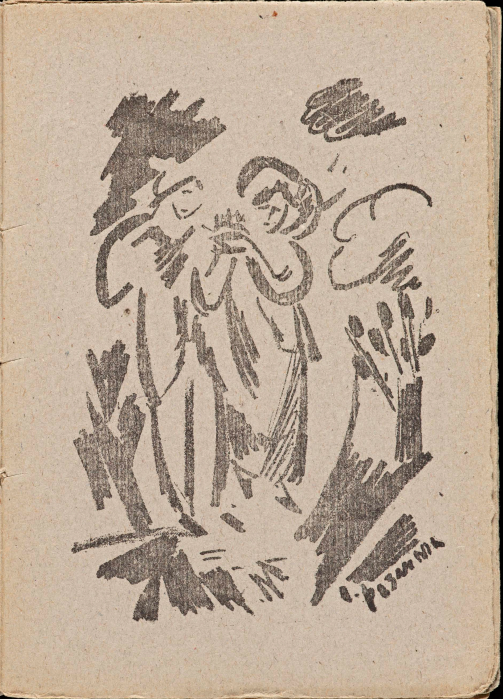
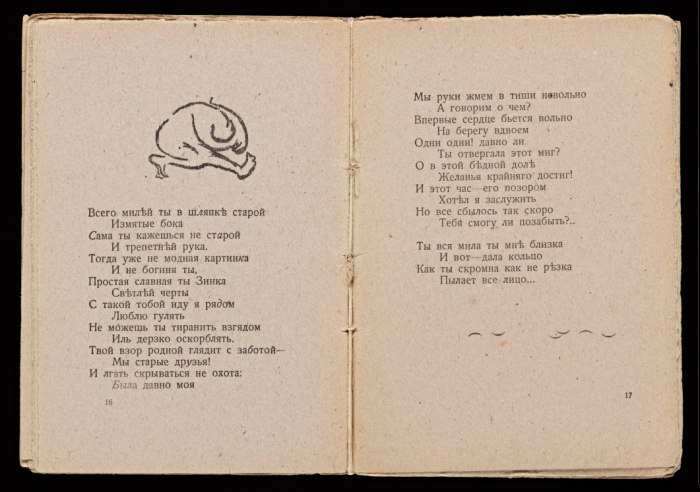
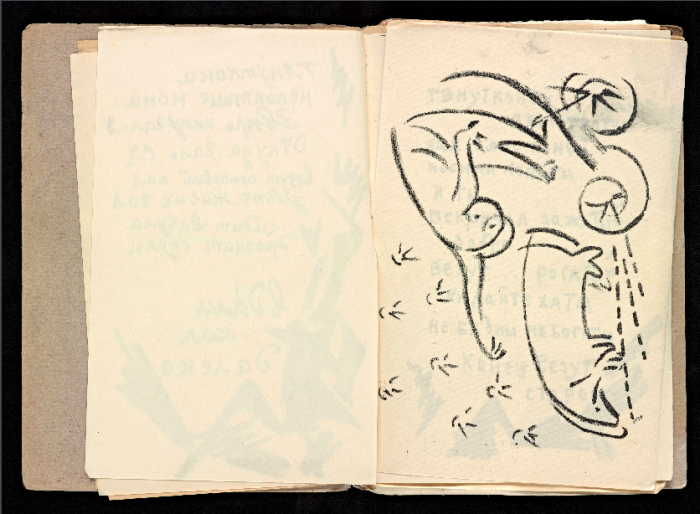
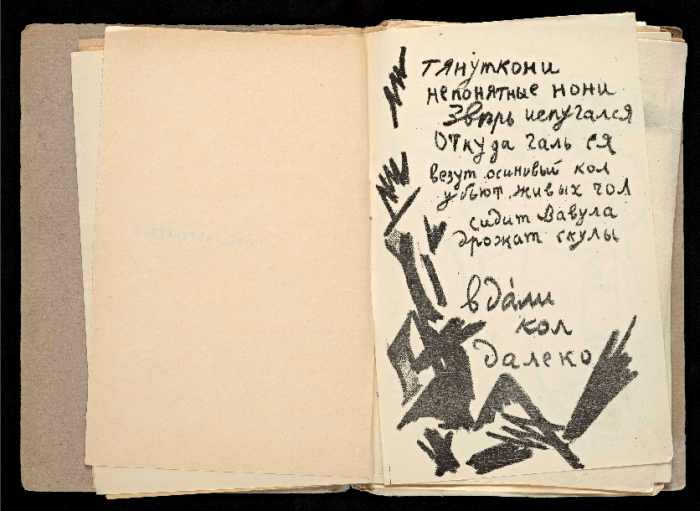
This archive con­tains about four dozen books by artist/poets like Khleb­nikov whose 1914 Old-Fash­ioned Love; Forest­ly Boom, you can see pages from at the top of the post. Fur­ther up and just above, we see excerpts from Alex­ei Kruchenykh’s 1913 Vzor­val’ (Explodi­ty), a most­ly hand-let­tered pub­li­ca­tion with whim­si­cal, dynam­ic draw­ings alter­nat­ing with and sur­round­ing the text. You’ll find over four dozen of these books at the Get­ty Research Insti­tute. As you browse or search their cat­a­logue, then click on an entry, you’ll want to click on the “View Online” but­ton to see scanned images.

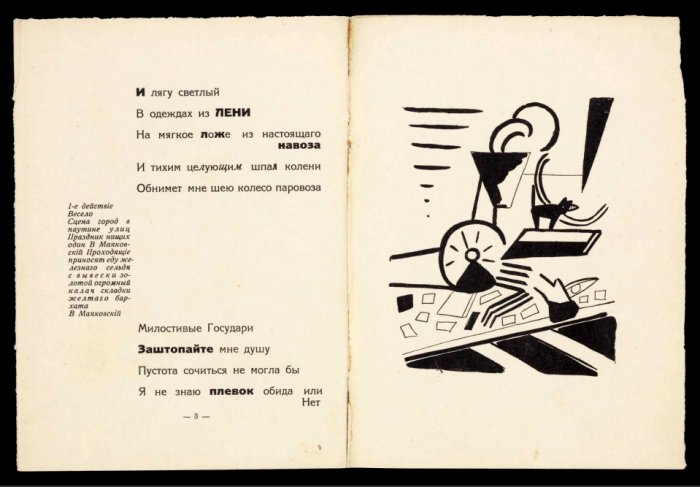
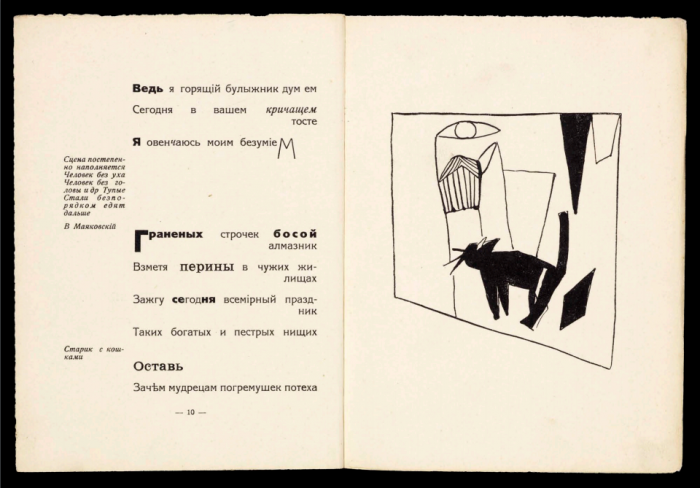
Each of these books—like Vladimir Mayakovsky’s 1913 play, Vladimir Mayakovsky: A Tragedy, above and below—makes a force­ful visu­al impres­sion even if we can­not under­stand the text. But in many ways, this is beside the point. Zaum poet­ry was meant to be heard as sound, not sense, and looked at as a phys­i­cal arti­fact. Perloff’s book, writes the Get­ty, “uncov­ers a wide-rang­ing lega­cy in the mid­cen­tu­ry glob­al move­ment of sound and con­crete poet­ry (the Brazil­ian Noigan­dres group, Ian Hamil­ton Fin­lay, and Hen­ri Chopin), con­tem­po­rary West­ern con­cep­tu­al art, and the artist’s book.” In many ways, these artists rep­re­sent a par­al­lel tra­di­tion in mod­ernism to the one we gen­er­al­ly learn of in West­ern Europe and the U.S., and one just as rich and fas­ci­nat­ing.

Relat­ed Con­tent:

Down­load 144 Beau­ti­ful Books of Russ­ian Futur­ism: Mayakovsky, Male­vich, Khleb­nikov & More (1910–30)

Hear Russ­ian Futur­ist Vladimir Mayakovsky Read His Strange & Vis­cer­al Poet­ry

Hear the Exper­i­men­tal Music of the Dada Move­ment: Avant-Garde Sounds from a Cen­tu­ry Ago

Josh Jones is a writer and musi­cian based in Durham, NC. Fol­low him at @jdmagness

Hear a Rare Poetry Reading by Captain Beefheart (1993)

When I find myself in times of musi­cal trou­ble, Cap­tain Beef­heart comes to me. His Mar­cel Duchamp-meets-James Brown shtick goes places no oth­er exper­i­men­tal prog-blues-jazz artist ever has—places of absur­dist vir­tu­os­i­ty where the gap between the artist and the mask dis­ap­pears, where words and music have rela­tion­ships that defy phys­i­cal laws. Many have tried, but few have so well suc­ceed­ed in the wild ambi­tion to make sur­re­al­ist verse cohere in songs that defy all tra­di­tion­al arrange­ments. For my exper­i­men­tal rock dime, no one has mas­tered the art so well as Beef­heart and his Mag­ic Band.

In fact, every musi­cian, I believe, should some­times ask them­selves, “what would Cap­tain Beef­heart do?” But what about Beefheart’s rela­tion­ship with the oth­er arts? We prob­a­bly know that the man also named Don Van Vli­et was a pro­lif­ic abstract painter through­out his career, the medi­um he chose for the last 28 years of his life after he hung up his sax­o­phone in 1982. But did his “strange uncle of post-punk” musi­cal sen­si­bil­i­ties trans­late into poet­ry, a relat­ed but quite dif­fer­ent art than that of even the most abstract song­writ­ing?

Well, if Bob Dylan can win a Nobel Prize—and why not?—I see no rea­son why we can’t con­sid­er the work of Cap­tain Beef­heart lit­er­ary art. And in addi­tion to his extra­or­di­nary Dadaist songs, Beef­heart penned restrained, mas­ter­ful­ly imag­is­tic poems with wry humor and crys­talline intel­li­gence. His work sure­ly belongs in Alan Kaufman’s Out­law Bible of Amer­i­can Poet­ry right next to that of Dylan, Tom Waits, Pat­ti Smith, Tupac Shakur, Gil Scott-Heron, Jim Mor­ri­son, the Beats, and dozens more non-musi­cal writ­ers. But it seems that Beefheart’s lit­er­ary genius has been most­ly over­looked.

That’s unfor­tu­nate. In tense, vivid­ly observed poems like “A Tin Peened Rein­deer,” he approach­es the ellip­ti­cal mys­tery of Wal­lace Stevens and the baroque lan­guage of John Ash­bery. Late songs like “The Thou­sandth and Tenth Day of the Human Totem Pole” con­dense the grotesque imag­i­nary of Dali into a few stag­ger­ing lines. Yet we don’t get a col­lec­tion of Beef­heart read­ings until 1993, when he appeared in a short doc­u­men­tary by Anton Cor­bi­jn called Some Yo Yo Stuff.

You can watch that film at the top of the post, and in the videos below it, hear Van Vli­et read poems and song lyrics in record­ings from his time with Cor­bi­jn. Both in the film and in the read­ings, it is evi­dent that the mul­ti­ple scle­ro­sis that killed Beef­heart in 2010 had ren­dered speech dif­fi­cult for him. But with patient lis­ten­ing, we hear that his sparkling wit and absur­dist genius remained at full strength, as in anoth­er, long 1993 inter­view with Dutch radio host Co De Kloet.

Beef­heart earned a rep­u­ta­tion as an auto­crat­ic-yet-capri­cious band­leader (record­ing a tongue-in-cheek spo­ken word piece on the sub­ject in ear­li­er years). But in inter­views, he came across as hum­ble, sweet-tem­pered, and gen­tle, and as an artist whose work was an authen­tic out­growth of his per­son­al­i­ty. These qual­i­ties shine through in even the goofi­est, most out-there poems and lyrics.

Fur­ther up, hear Beef­heart read the poems and songs “Fallin’ Ditch,” “The Tired Plain,” “Skele­ton Makes Good,” “Safe Sex Drill,” and “Gill,” and in the playlist below, he reads all of those plus his poem, “Tulip,” a short mod­ernist gem rem­i­nis­cent of both Ezra Pound and William Car­los Williams:

It could be
a tremen­dous black upside-down tulip
it could be
a black fish­es’ tail
it could be a day, artis­ti­cal­ly crimped
and buoy­ant
in its taped togeth­er way

Cap­tain Beef­heart’s poems will be added to our col­lec­tion, 1,000 Free Audio Books: Down­load Great Books for Free.

via Ubuweb

Relat­ed Con­tent:

Cap­tain Beef­heart Issues His “Ten Com­mand­ments of Gui­tar Play­ing”

The Night Frank Zap­pa Jammed With Pink Floyd … and Cap­tain Beef­heart Too (Bel­gium, 1969)

Hear Pat­ti Smith Read 12 Poems From Sev­enth Heav­en, Her First Col­lec­tion (1972)

Josh Jones is a writer and musi­cian based in Durham, NC. Fol­low him at @jdmagness

« Go BackMore in this category... »
Quantcast