Meet the World’s First Known Author: Sumerian High Priestess Enheduanna

Watch­ers of West­world will have heard a char­ac­ter in the most recent episode utter the line, “for the first time, his­to­ry has an author.” It’s as loaded a bit of dia­logue as the series has dropped on fans, not least for its sug­ges­tion that in the absence of a god we should be bet­ter off with an all-know­ing machine.

The line might bend the ear of lit­er­ary schol­ars for anoth­er rea­son. The idea of author­ship is a com­pli­cat­ed one. In one sense, maybe, every­one is an author of his­to­ry, and in anoth­er, per­haps no one is. But it’s dif­fi­cult to com­pre­hend these abstractions—we crave sto­ries with strong char­ac­ters, hence our ven­er­a­tion of Great Men and Women of the past.

Still, in many times and places, indi­vid­ual author­ship was irrel­e­vant. Renais­sance thinkers reval­ued the author as an auc­tori­tas, a wor­thy fig­ure of influ­ence and renown. “Death of the author” the­o­rists point­ed out that the appear­ance of a lit­er­ary text could nev­er be reduced to a sin­gle, unchang­ing per­son­al­i­ty. In reli­gious stud­ies, ques­tions of author­ship open onto mine­field after mine­field. There may be no com­mon­ly agreed-upon way to think about what an author is.

Does it make sense, then, to talk about the “world’s first author”? Per­haps. In the TED-Ed les­son above by Soraya Field Fio­rio, we learn that the first known per­son to use writ­ten lan­guage for lit­er­ary pur­pos­es was named was Enhed­u­an­na, a pow­er­ful Mesopotami­an high priest­ess who wrote forty-two hymns and three epic poems in cuneiform 4,3000 hun­dred years ago.

Daugh­ter of Sar­gon of Akkad, who placed her in a posi­tion to rule, Enhed­u­an­na lived about “1,500 years before Homer and about 500 years before the Bib­li­cal patri­arch Abra­ham.” (There’s con­sid­er­able doubt, of course, about whether either of those peo­ple exist­ed, whether they wrote the works attrib­uted to them, or whether such works were penned by com­mit­tee, so to speak.)

Sar­gon was also an author, hav­ing com­posed an auto­bi­og­ra­phy, The Leg­end of Sar­gon, that “exert­ed a pow­er­ful influ­ence over the Sume­ri­ans he sought to con­quer,” notes Joshua J. Mark at the Ancient His­to­ry Ency­clo­pe­dia. But first, Enhed­u­an­na used her posi­tion as high priest­ess to uni­fy her father’s empire with reli­gious hymns that praised the gods of each major Sumer­ian city. “In her writ­ing, she human­ized the once aloof gods,” just as Homer would hun­dreds of years lat­er. “Now they suf­fered, fought, loved, and respond­ed to human plead­ing.”

Her hymns to Inan­na are her most defin­ing lit­er­ary achieve­ment, but Enhed­u­an­na has some­how been com­plete­ly left out of his­to­ry. “We know who the first nov­el­ist is,” writes Charles Hal­ton at Lit Hub, “eleventh cen­tu­ry Japan­ese Noble­woman Murasa­ki Shik­ibu, who wrote the Tale of Gen­ji.” Like­wise, we know the first nov­el­ist of the west­ern world, Miguel de Cer­vantes, and the first essay­ist, Michel de Mon­taigne. But “ask any per­son in your life who wrote the first poem and they’re apt to draw a blank.”

Maybe this is because, unlike nov­els, we don’t think of poet­ry as being invent­ed by a sin­gle indi­vid­ual. It seems as though it must have sprung from the col­lec­tive psy­che not long after humans began using lan­guage. Yet from the point of view of lit­er­ary history—which, like most his­to­ries, con­sists of a suc­ces­sion of great names—Enheduanna cer­tain­ly deserves the hon­or as the world’s first known poet and first known author.  Learn more about her in the les­son above.

 Relat­ed Con­tent:

How to Write in Cuneiform, the Old­est Writ­ing Sys­tem in the World: A Short, Charm­ing Intro­duc­tion

Watch a 4000-Year Old Baby­lon­ian Recipe for Stew, Found on a Cuneiform Tablet, Get Cooked by Researchers from Yale & Har­vard

Hear The Epic of Gil­gamesh Read in its Orig­i­nal Ancient Lan­guage, Akka­di­an

Josh Jones is a writer and musi­cian based in Durham, NC. Fol­low him at @jdmagness

The Library of Congress Wants You to Help Transcribe Walt Whitman’s Poems & Letters: Almost 4000 Unpublished Documents Are Waiting

Every once in a while, a promi­nent artist will offer the advice that you should quit your day job and nev­er look back. In some fields, this may be pos­si­ble, though it’s becom­ing increas­ing­ly dif­fi­cult these days, which may explain the recep­tion Bri­an Eno gets when he tells art school stu­dents “not to have a job.” Eno admits, “I rarely get asked back.” In a let­ter to his anx­ious moth­er, Gus­tave Flaubert, railed against “those bas­tard exis­tences where you sell suet all day and write poet­ry at night.” Such a life, he wrote, was “made for mediocre minds.”

Sure, if you can swing it, by all means, quit your job. Most poets through­out history—save the few with inde­pen­dent means or wealthy patrons—haven’t had the lux­u­ry. Poet­ry may nev­er pay the bills, but that shouldn’t stop a poet from writ­ing. It didn’t stop T.S. Eliot, who worked as an edi­tor (he reject­ed George Orwell’s Ani­mal Farm) and a bank clerk (he turned down a fel­low­ship from the Blooms­bury group). It did not stop William Car­los Williams, the doc­tor, nor Wal­lace Stevens, who spent his days in the insur­ance game, nor Charles Bukows­ki,  though he’d nev­er rec­om­mend it….

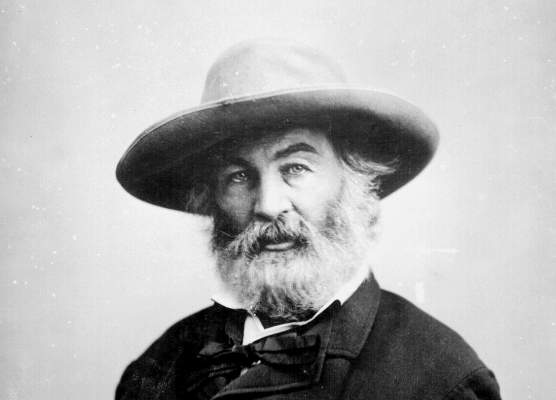
Then there’s ulti­mate jour­ney­man poet Walt Whit­man, who left school at 11 to get a job and var­i­ous­ly through­out his life “worked as a school teacher, print­er, news­pa­per edi­tor, jour­nal­ist, car­pen­ter, free­lance writer, civ­il ser­vant, and Union Army nurse in Wash­ing­ton D.C. dur­ing the Civ­il War,” as the Library of Con­gress (LOC) not­ed for the 200th anniver­sary of the poet’s 1819 birth. The LOC holds “the world’s largest Walt Whit­man man­u­script col­lec­tion” and last year they announced a vol­un­teer cam­paign to tran­scribe thou­sands of unpub­lished doc­u­ments.

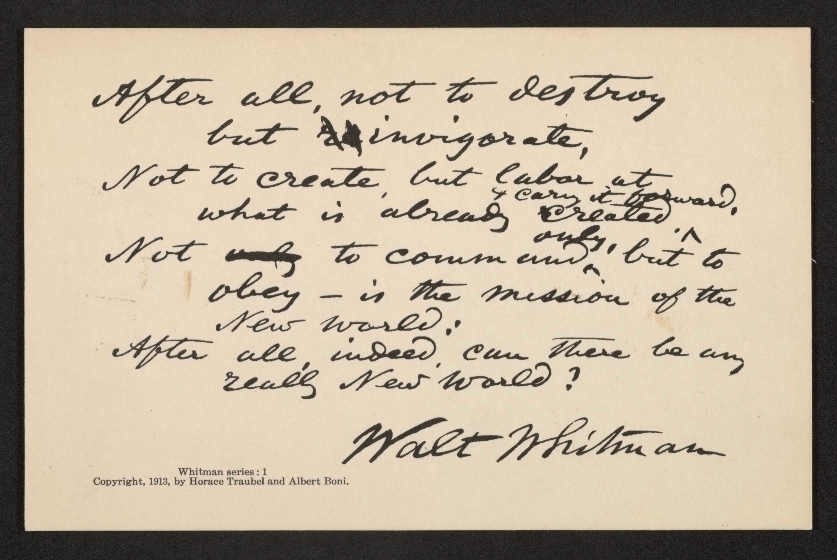
Whit­man offered his own pos­si­bly dubi­ous advice to aspir­ing writ­ers—“don’t write poet­ry”—but he him­self nev­er stopped writ­ing, no mat­ter the demands of the day. He also advised, “it is a good plan for every young man or woman hav­ing lit­er­ary aspi­ra­tions to car­ry a pen­cil and a piece of paper and con­stant­ly jot down strik­ing events in dai­ly life. They thus acquire a vast fund of infor­ma­tion.” Whitman’s “jot­tings” include typed and hand­writ­ten let­ters, orig­i­nal copies of poems, drafts of essays and reviews, and more.

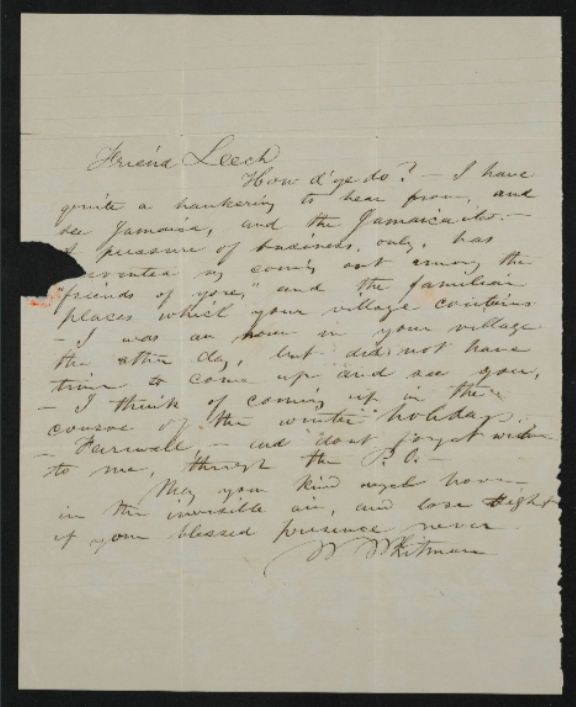
His prose is always live­ly and robust, full of exhor­ta­tions, exal­ta­tions, and admix­tures of the high lit­er­ary lan­guage and casu­al talk of city streets that were his hall­mark. Wit­ness the wild swings in tone in his brief let­ter to Abra­ham P. Leech (above) cir­ca 1881:

Friend Leech,

How d’ye do? — I have quite a han­ker­ing to hear from and see Jamaica, and the Jamaicaites. — A pres­sure of busi­ness only, has pre­vent­ed my com­ing out among the “friends of yore” and the famil­iar places which your vil­lage con­tains. –I was an hour in your vil­lage the oth­er day, but did not have time to come up and see you,–I think of com­ing up in the course of the win­ter holidays.–Farewell–and don’t for­get write to me, through the P.O.  May your kind angel hov­er in the invis­i­ble air, and lose sight of your blessed pres­ence nev­er.

                  Whit­man

There are many, many more such doc­u­ments remain­ing to be tran­scribed among the close to 4000 in the LoC’s dig­i­tized Whit­man col­lec­tion. “More than half of those have been com­plet­ed so far,” writes Men­tal Floss, and rough­ly 1860 tran­scrip­tions still need to be reviewed. Any­one can read the doc­u­ments that need approval and offi­cial­ly add them to the Whit­man archive.” This is a very wor­thy project, and it may or may not feel like work to vol­un­teer your time deci­pher­ing, read­ing, and tran­scrib­ing Whitman’s ebul­lient hand.

The ques­tion may still remain: How did Whit­man acquire the phys­i­cal and men­tal sta­mi­na to get so much excel­lent writ­ing done and still hold down steady gigs to make the rent? Per­haps a series of guides called “Man­ly Health and Train­ing” that he wrote between 1858 and 1860 hold a clue. The poet rec­om­mends rou­tine trips to the “gym­na­si­um” and a diet of meat, “to the exclu­sion of all else.” For those “stu­dents, clerks” and oth­ers “in seden­tary and men­tal employments”—including the “lit­er­ary man”—he has one word: “Up!”

As with all such pieces of advice, results may vary. Enter the two huge man­u­script archives—“Miscellaneous” and “Poetry”—at the Library of Con­gress dig­i­tal col­lec­tions and peruse, or tran­scribe, as much of Whit­man’s end­less stream of writ­ing as you like.

via Men­tal Floss

Relat­ed Con­tent:

Walt Whitman’s Unearthed Health Man­u­al, “Man­ly Health & Train­ing,” Urges Read­ers to Stand (Don’t Sit!) and Eat Plen­ty of Meat (1858)

Walt Whit­man Gives Advice to Aspir­ing Young Writ­ers: “Don’t Write Poet­ry” & Oth­er Prac­ti­cal Tips (1888)

Walt Whitman’s Poem “A Noise­less Patient Spi­der” Brought to Life in Three Ani­ma­tions

Josh Jones is a writer and musi­cian based in Durham, NC. Fol­low him at @jdmagness

Watch a Hand-Drawn Animation of Neil Gaiman’s Poem “The Mushroom Hunters,” Narrated by Amanda Palmer

The arrival of a new­born son has inspired no few poets to com­pose works pre­serv­ing the occa­sion. When Neil Gaiman wrote such a poem, he used its words to pay trib­ute to not just the cre­ation of new life but to the sci­en­tif­ic method as well. “Sci­ence, as you know, my lit­tle one, is the study / of the nature and behav­ior of the uni­verse,” begins Gaiman’s “The Mush­room Hunters.” An impor­tant thing for a child to know, cer­tain­ly, but Gaiman does­n’t hes­i­tate to get into even more detail: “It’s based on obser­va­tion, on exper­i­ment, and mea­sure­ment / and the for­mu­la­tion of laws to describe the facts revealed.” Go slight­ly over the head of a new­born as all this may, any par­ent of an old­er but still young child knows what ques­tion nat­u­ral­ly comes next: “Why?”

As if in antic­i­pa­tion of that inevitable expres­sion of curios­i­ty, Gaiman harks back to “the old times,” when “men came already fit­ted with brains / designed to fol­low flesh-beasts at a run,” and with any luck to come back with a slain ante­lope for din­ner. The women, “who did not need to run down prey / had brains that spot­ted land­marks and made paths between them,” tak­ing spe­cial note of the spots where they could find mush­rooms. It was these mush­room hunters who used “the first tool of all,” a sling to hold the baby but also to “put the berries and the mush­rooms in / the roots and the good leaves, the seeds and the crawlers. / Then a flint pes­tle to smash, to crush, to grind or break.” But how to know which of the mush­rooms — to say noth­ing of the berries, roots, and leaves — will kill you, which will “show you gods,” and which will “feed the hunger in our bel­lies?”

“Observe every­thing.” That’s what Gaiman’s poem rec­om­mends, and what it memo­ri­al­izes these mush­room hunters for hav­ing done: observ­ing the con­di­tions under which mush­rooms aren’t dead­ly to eat, observ­ing child­birth to “dis­cov­er how to bring babies safe­ly into the world,” observ­ing every­thing around them in order to cre­ate “the tools we make to build our lives / our clothes, our food, our path home…” In Gaiman’s poet­ic view, the obser­va­tions and for­mu­la­tions made by these ear­ly mush­room-hunt­ing women to serve only the imper­a­tive of sur­vival lead straight (if over a long dis­tance), to the mod­ern sci­en­tif­ic enter­prise, with its con­tin­ued gath­er­ing of facts, as well as its con­stant pro­pos­al and revi­sion of laws to describe the pat­terns in those facts.

You can see “The Mush­room Hunters” brought to life in the video above, a hand-drawn ani­ma­tion by Cre­ative Con­nec­tion scored by the com­pos­er Jherek Bischoff (pre­vi­ous­ly heard in the David Bowie trib­ute Strung Out in Heav­en). You can read the poem at Brain Pick­ings, whose cre­ator Maria Popo­va hosts “The Uni­verse in Verse,” an annu­al “char­i­ta­ble cel­e­bra­tion of sci­ence through poet­ry” where “The Mush­room Hunters” made its debut in 2017. There it was read aloud by the musi­cian Aman­da Palmer, Gaiman’s wife and the moth­er of the afore­men­tioned son, and so it is in this more recent ani­mat­ed video. Young Ash will sure­ly grow up faced with few obsta­cles to the appre­ci­a­tion of sci­ence, and even less so to the kind of imag­i­na­tion that sci­ence requires. As for all the oth­er chil­dren in the world — well, it cer­tain­ly would­n’t hurt to show them the mush­room hunters at work.

This read­ing will be added to our col­lec­tion, 1,000 Free Audio Books: Down­load Great Books for Free.

via Brain Pick­ings

Relat­ed Con­tent:

Watch Neil Gaiman & Aman­da Palmer’s Haunt­ing, Ani­mat­ed Take on Leonard Cohen’s “Democ­ra­cy”

Hear Strung Out in Heav­en, a Gor­geous Trib­ute to David Bowie by Aman­da Palmer & Jherek Bischoff’s, Made with Help from Neil Gaiman

Aman­da Palmer Ani­mates & Nar­rates Hus­band Neil Gaiman’s Uncon­scious Mus­ings

Watch Love­birds Aman­da Palmer and Neil Gaiman Sing “Makin’ Whoopee!” Live

Neil Gaiman’s Dark Christ­mas Poem Ani­mat­ed

Dis­cov­er Emi­ly Dickinson’s Herbar­i­um: A Beau­ti­ful Dig­i­tal Edi­tion of the Poet’s Col­lec­tion of Pressed Plants & Flow­ers Is Now Online

Based in Seoul, Col­in Mar­shall writes and broad­casts on cities and cul­ture. He’s at work on a book about Los Ange­les, A Los Ange­les Primer, the video series The City in Cin­e­maand the crowd­fund­ed jour­nal­ism project Where Is the City of the Future? Fol­low him on Twit­ter at @colinmarshall or on Face­book.

Joni Mitchell Publishes a Book of Her Rarely Seen Paintings & Poetry

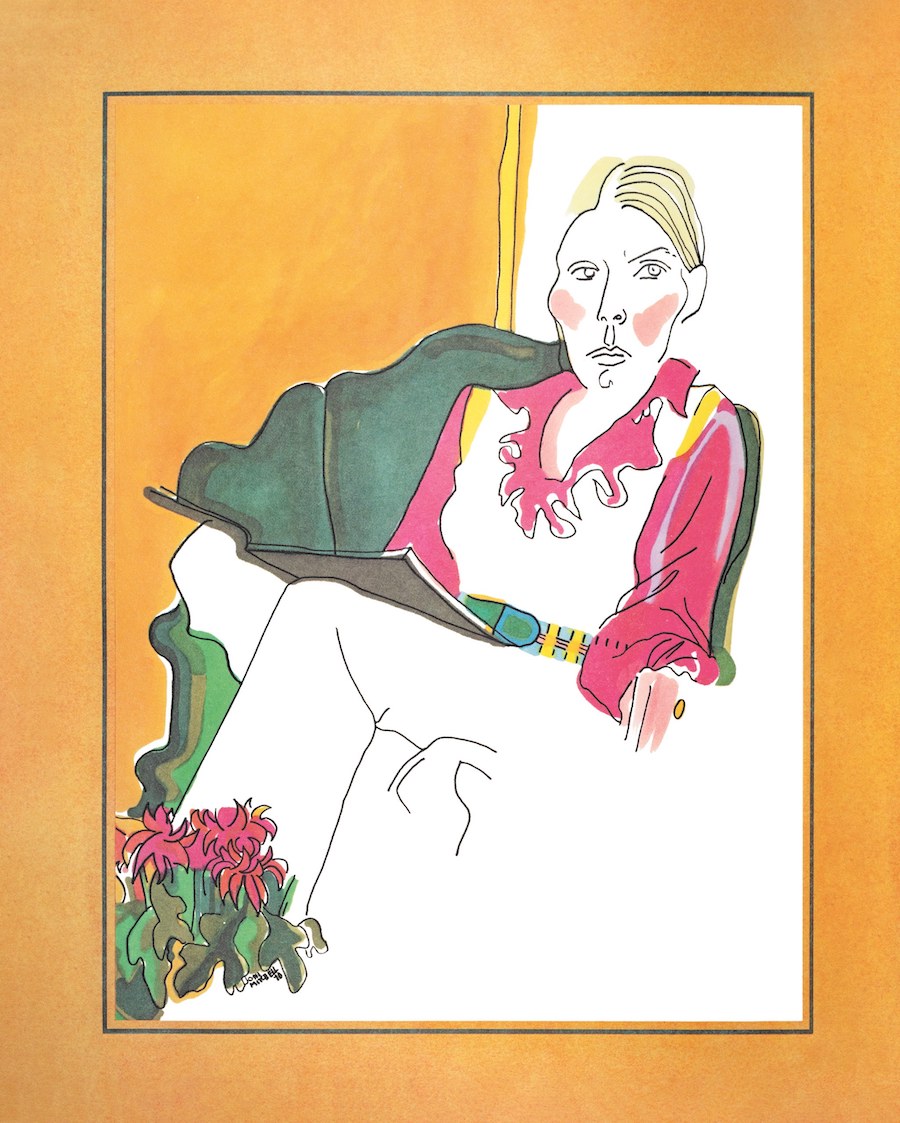
Self Portrait.”Art work by Joni Mitchell, from “Morn­ing Glo­ry on the Vine” / Cour­tesy Houghton Mif­flin Har­court

Joni Mitchell is a woman of many talents—too many for the label “singer-song­writer” to encom­pass. It does not cap­ture the lit­er­ary depth of her lyri­cism, the unique strength of her dis­tinc­tive voice, or the deft­ness and ver­sa­til­i­ty of her gui­tar play­ing. Nor the fact that she’s one of the most inter­est­ing per­son­al­i­ties in rock (or folk-rock­/­folk/­folk-jazz, what­ev­er). Mitchell’s biog­ra­phy is riv­et­ing; her chat­ty and can­tan­ker­ous inter­views a treat.

And, if you some­how didn’t know from her many album cov­ers, Mitchell is also an accom­plished visu­al artist. “I have always thought of myself as a painter derailed by cir­cum­stance,” she said in 2000. “I sing my sor­row and I paint my joy.” It’s a great quote, though she also sings her joy and paints sorrow—as in the por­trait of her hero, Miles Davis, made just after his death. (Davis was a painter too, and they bond­ed over art.)

Mitchell began sell­ing her work “when I was in high school to den­tists, doctors—small time,” she told Rolling Stone in 1990. She has writ­ten poet­ry since her teenage years. Her imag­is­tic song­writ­ing came from a love of lit­er­ary lan­guage. “I wrote poet­ry,” she says, “and I always want­ed to make music. But I nev­er put the two things togeth­er,” until she heard Dylan’s “Pos­i­tive­ly Fourth Street” and real­ized “you could make your songs lit­er­a­ture.”

Painter, poet, singer, song­writer, guitarist—all of the artis­tic sides of Mitchell have min­gled through­out her career in the visu­al splen­dor of her cov­ers, com­po­si­tions, and lyrics. They also came togeth­er in a rare 1971 book. After the release of Blue, Mitchell “gath­ered more than thir­ty draw­ings and water­col­ors in a ring binder and paired them with hand­writ­ten lyrics and bits of poet­ry,” writes Aman­da Petru­sich at The New York­er.

She had the book hand­bound in an edi­tion of 100 copies and gave it to friends for the hol­i­days, call­ing it “The Christ­mas Book.” Now it has a dif­fer­ent title, Morn­ing Glo­ry on the Vine, for a new edi­tion to be released Octo­ber 22nd. Part of the exten­sive cel­e­bra­tions for Mitchell’s 75th birth­day, this edi­tion ful­fills a decade-long desire for the artist. “I always want­ed to redo it and sim­pli­fy the pre­sen­ta­tion,” she tells Petru­sich. “Work is meant to be seen.”

The col­lec­tion “feels con­so­nant with Mitchell’s song­writ­ing” in that it cap­tures “tan­ta­liz­ing details about home,” in this case the home in Lau­rel Canyon that she shared with Gra­ham Nash, the inspi­ra­tion for the Cros­by, Stills & Nash song “Our House.” Still life com­po­si­tions and self-por­traits, both “vivid” and “inti­mate,” com­ple­ment her vul­ner­a­ble, play­ful, “fun­ny and weird,” lyrics and vers­es. You can see more of the paint­ings from Morn­ing Glo­ry on the Vine at The New York­er and order a copy of the book here.

Relat­ed Con­tent:

See Clas­sic Per­for­mances of Joni Mitchell from the Very Ear­ly Years–Before She Was Even Named Joni Mitchell (1965/66)

How Joni Mitchell Wrote “Wood­stock,” the Song that Defined the Leg­endary Music Fes­ti­val, Even Though She Wasn’t There (1969)

Songs by Joni Mitchell Re-Imag­ined as Pulp Fic­tion Book Cov­ers & Vin­tage Movie Posters

Josh Jones is a writer and musi­cian based in Durham, NC. Fol­low him at @jdmagness

How E.E. Cummings Writes a Poem

Most of us encounter E.E. Cum­mings at an ear­ly age; his poems for adults reg­u­lar­ly appear in poet­ry antholo­gies for chil­dren. We derive great plea­sure from his brazen mis­spellings, port­man­teaus, neol­o­gisms, and “typo­graph­i­cal high jinks,” as Paul Mul­doon writes at The New York­er. Look at this famous writer break­ing all the rules, and there­by giv­ing us occa­sion to talk about the rules, about how poet­ry is dif­fer­ent, about how, among poets, E.E. Cum­mings stands alone.

Only some­one with a keen facil­i­ty for lan­guage can bend it to their indi­vid­ual will, some­thing we may rec­og­nize when read­ing Cum­mings in high school, when we also rec­og­nize the irony and grim satire in his poems. The inven­tive whim­sy had veiled some­thing dark­er. In 1960, then-high-school stu­dent Peter Carl­ton got the chance to inter­view Cum­mings about his poem “Human­i­ty, I love you,” then post­ed the exchange online 37 years lat­er. “I, for one, do not love human­i­ty,” the poet told him, “I feel that human­i­ty itself is cru­el and unjust.”

A com­mon sen­ti­ment among mod­ernists, espe­cial­ly those, like Cum­mings, who had served in World War I. But few of his con­tem­po­raries, who includ­ed James Joyce, T.S. Eliot, and Ezra Pound, had his abil­i­ty to speak to so many dif­fer­ent audi­ences. It’s almost shock­ing to see the shift in voice between Cum­mings’ inter­view with young Carl­ton and a let­ter he wrote to Pound 20 years ear­li­er, full of the usu­al Cum­mings coinages (“innul­luxu­ls”) and vicious lit­er­ary barbs (Archibald MacLeish becomes “the macarchibald maclap­dog macleash”).

Was Cum­mings a rad­i­cal? A roman­tic? A lit­er­ary naïf? An out­sider? A savvy, cyn­i­cal play­er of the game? He con­tained mul­ti­tudes. From Eliot he “learned to dis­trust the hier­ar­chi­cal in every aspect of life,” writes Mul­doon, “begin­ning with his own being. In his poet­ry, ‘I’ becomes ‘i.’” What­ev­er atti­tudes he express­es, Cum­mings always forces us to wres­tle with language—its dura­bil­i­ty and mal­leabil­i­ty, its famil­iar strangenesses—first.

In his most acces­si­ble poem, “i car­ry your heart with me (i car­ry it in,” Cum­mings draws our atten­tion to the sim­plic­i­ty of his arche­typ­al images, as if to smirk­ing­ly announce, “this is a uni­ver­sal love poem.” Stan­dard fare. But such obvi­ous mir­ror­ing of form and con­tent does not dimin­ish the poem’s accom­plish­ment, argues Evan Puschak, the Nerd­writer, in the video above. On the con­trary, sim­ple rep­e­ti­tions lead us into far more com­pli­cat­ed recur­sions inside the poem.

Puschak quotes lines from Yeats to illus­trate the deft­ness of Cum­mings’ decep­tive sim­plic­i­ty: “A line will take us hours maybe; / yet if it does not seem a moment’s thought, / Our stitch­ing and unstitch­ing has been naught.” While many a poet has made the art seem easy, few have made it seem so play­ful or irrev­er­ent as Cum­mings, or have delight­ed so many peo­ple of so many ages and walks of life—so few of whom may sus­pect the con­cep­tu­al heft and rig­or that went into his work.

To read Cum­mings’ poet­ry your­self, pick up a copy of his com­plete poems.

Relat­ed Con­tent:

Two Child­hood Draw­ings from Poet E.E. Cum­mings Show the Young Artist’s Play­ful Seri­ous­ness

Cel­e­brate Valentine’s Day with a Charm­ing Stop Motion Ani­ma­tion of an E.E. Cum­mings’ Love Poem

E.E. Cum­mings Recites ‘Any­one Lived in a Pret­ty How Town,’ 1953

Josh Jones is a writer and musi­cian based in Durham, NC. Fol­low him at @jdmagness

An Introduction to Chilean Poet Pablo Neruda: Romantic, Radical & Revolutionary

Does pol­i­tics belong in art? The ques­tion arous­es heat­ed debate about cre­ative free­dom and moral respon­si­bil­i­ty. Assump­tions include the idea that pol­i­tics cheap­ens film, music, or lit­er­a­ture, or that polit­i­cal art should aban­don tra­di­tion­al ideas about beau­ty and tech­nique. As engag­ing as such dis­cus­sions might be in the abstract, they mean lit­tle to noth­ing if they don’t account for artists who show us that choos­ing between pol­i­tics and art can be as much a false dilem­ma as choos­ing between art and love.

In the work of writ­ers as var­ied as William Blake, Muriel Rukeyser, James Bald­win, and James Joyce, for exam­ple, themes of protest, pow­er, priv­i­lege, and pover­ty are insep­a­ra­ble from the sub­lime­ly erotic—all of them essen­tial aspects of human expe­ri­ence, and hence, of lit­er­a­ture. Fore­most among such polit­i­cal artists stands Chilean poet Pablo Neru­da, who—as the TED-Ed video above from Ilan Sta­vans informs us—was a roman­tic styl­ist, and also a fear­less polit­i­cal activist and rev­o­lu­tion­ary.

Neru­da won the Nobel Prize for Lit­er­a­ture in 1971, and, among his many oth­er lit­er­ary accom­plish­ments, he “res­cued 2,000 refugees, spent three years in polit­i­cal exile, and ran for pres­i­dent of Chile.” Neru­da used “straight­for­ward lan­guage and every­day expe­ri­ence to cre­ate last­ing impact.” He began his career writ­ing odes and love poems filled with can­did sex­u­al­i­ty and sen­su­ous descrip­tion that res­onat­ed with read­ers around the world.

Neruda’s inter­na­tion­al fame led to a series of diplo­mat­ic posts, and he even­tu­al­ly land­ed in Spain, where he served as con­sul in the mid-1930s dur­ing the Span­ish Civ­il War. He became a com­mit­ted com­mu­nist, and helped relo­cate hun­dreds of flee­ing Spaniards to Chile. Neru­da came to believe that “the work of art” is “insep­a­ra­ble from his­tor­i­cal and polit­i­cal con­text,” writes author Sal­va­tore Biz­zarro, and he “felt that the belief that one could write sole­ly for eter­ni­ty was roman­tic pos­tur­ing.”

Yet his life­long devo­tion to “rev­o­lu­tion­ary ideals,” as Sta­vans says, did not under­mine his devo­tion to poet­ry, nor did it blink­er his writ­ing with what we might call polit­i­cal cor­rect­ness. Instead, Neru­da became more expan­sive, tak­ing on such sub­jects as the “entire his­to­ry of Latin Amer­i­ca” in his 1950 epic Can­to Gen­er­al.

Neru­da died of can­cer just weeks after fas­cist dic­ta­tor Augus­to Pinochet seized pow­er from elect­ed pres­i­dent Sal­vador Allende in 1973. Today, he remains a beloved fig­ure for activists, his lines “recit­ed at protests and march­es world­wide.” And he remains a lit­er­ary giant, respect­ed, admired, and adored world­wide for work in which he engaged the strug­gles of the peo­ple with the same pas­sion­ate inten­si­ty and imag­i­na­tive breadth he brought to per­son­al poems of love, loss, and desire.

Relat­ed Con­tent:

Pablo Neruda’s His­toric First Read­ing in the US (1966)

Pablo Neruda’s Poem, “The Me Bird,” Becomes a Short, Beau­ti­ful­ly Ani­mat­ed Film

The Lost Poems of Pablo Neru­da: Help Bring Them to the Eng­lish Speak­ing World for the First Time

Hear Pablo Neru­da Read His Poet­ry In Eng­lish For the First Time, Days Before His Nobel Prize Accep­tance (1971)

Josh Jones is a writer and musi­cian based in Durham, NC. Fol­low him at @jdmagness.

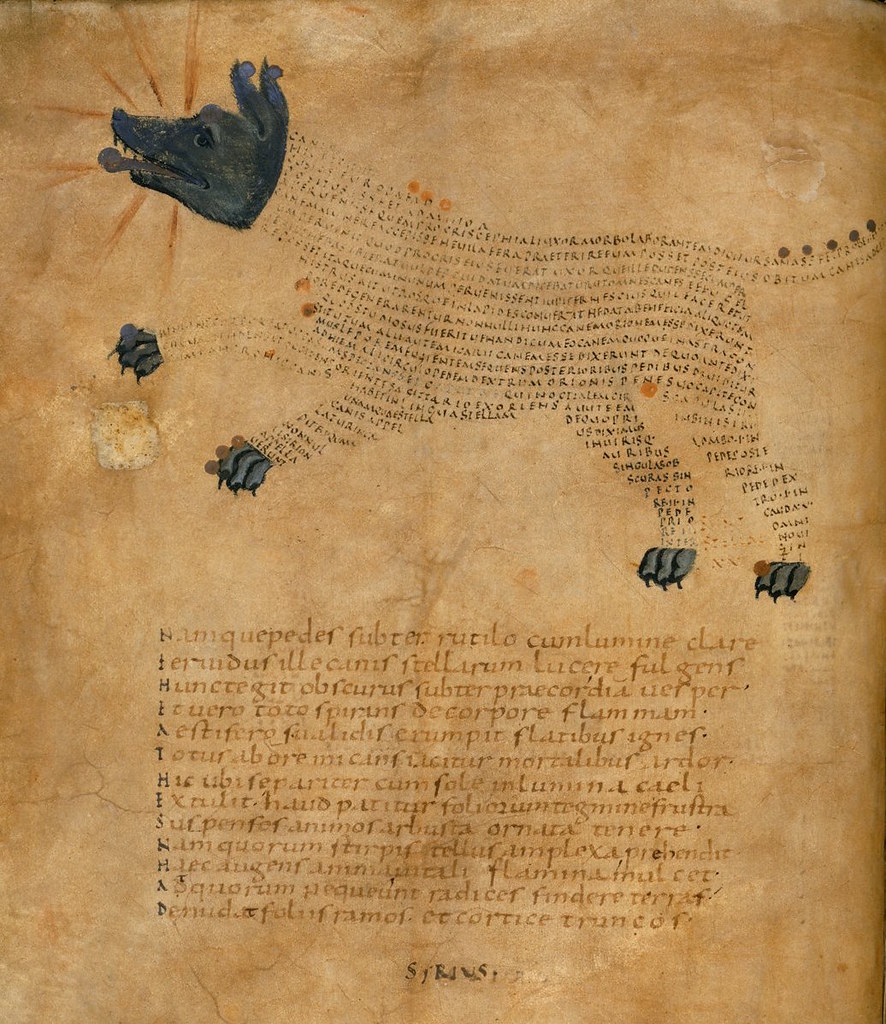
A 9th Century Manuscript Teaches Astronomy by Making Sublime Pictures Out of Words

Con­crete or visu­al poet­ry does not get much respect these days. Terse­ly defined at the Poet­ry Foun­da­tion as “verse that empha­sizes non­lin­guis­tic ele­ments in its mean­ing” arranged to cre­ate “a visu­al image of the top­ic,” the form looks like a clever but friv­o­lous nov­el­ty in our very seri­ous times. It has seemed so in times past as well.

When Guil­laume Apol­li­naire pub­lished his 1918 Cal­ligrammes, his major col­lec­tion of poems after he fought on the front lines of the first world war, he includ­ed sev­er­al visu­al poems. Crit­ics like Louis Aragon, “at his most hard-nosed,” notes Stephen Romer at The Guardian, “crit­i­cized it sharply for its aes­theti­cism and friv­o­li­ty.”

Apol­li­naire also wrote of war as a daz­zling spec­ta­cle, a ten­den­cy that “raised the hack­les of crit­ics.” One can see there is moral mer­it to the objec­tion, even if it mis­reads Apol­li­naire. But why should visu­al poet­ry not cred­i­bly illus­trate phe­nom­e­na we find sub­lime, just as well as it illus­trates pot­ted Christ­mas trees?

Indeed, the form has always done so, argues pro­lif­ic visu­al poet Karl Kemp­ton, until it took a “dystopi­an” turn after World War I. In his vast his­to­ry of visu­al poet­ry, Kemp­ton reach­es back into ancient Bud­dhist, Sufi, Euro­pean, and Indige­nous cul­tur­al his­to­ry. Forms of visu­al poet­ry, he writes, “are asso­ci­at­ed with ongo­ing tra­di­tions and numer­ous unfold­ing path­ways trace­able to humankind’s ear­li­est sur­viv­ing com­mu­ni­ca­tion marks.”

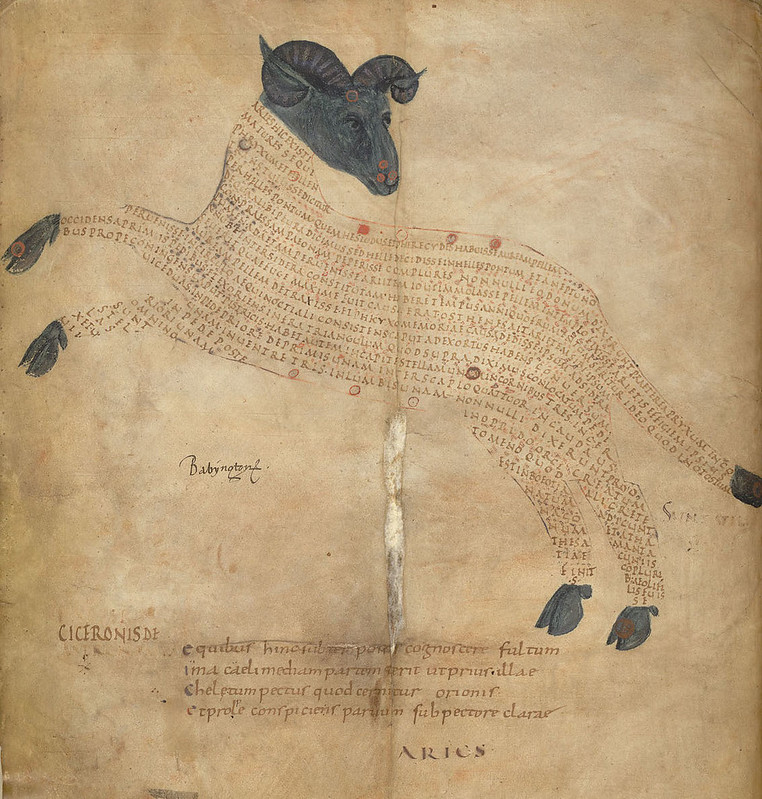
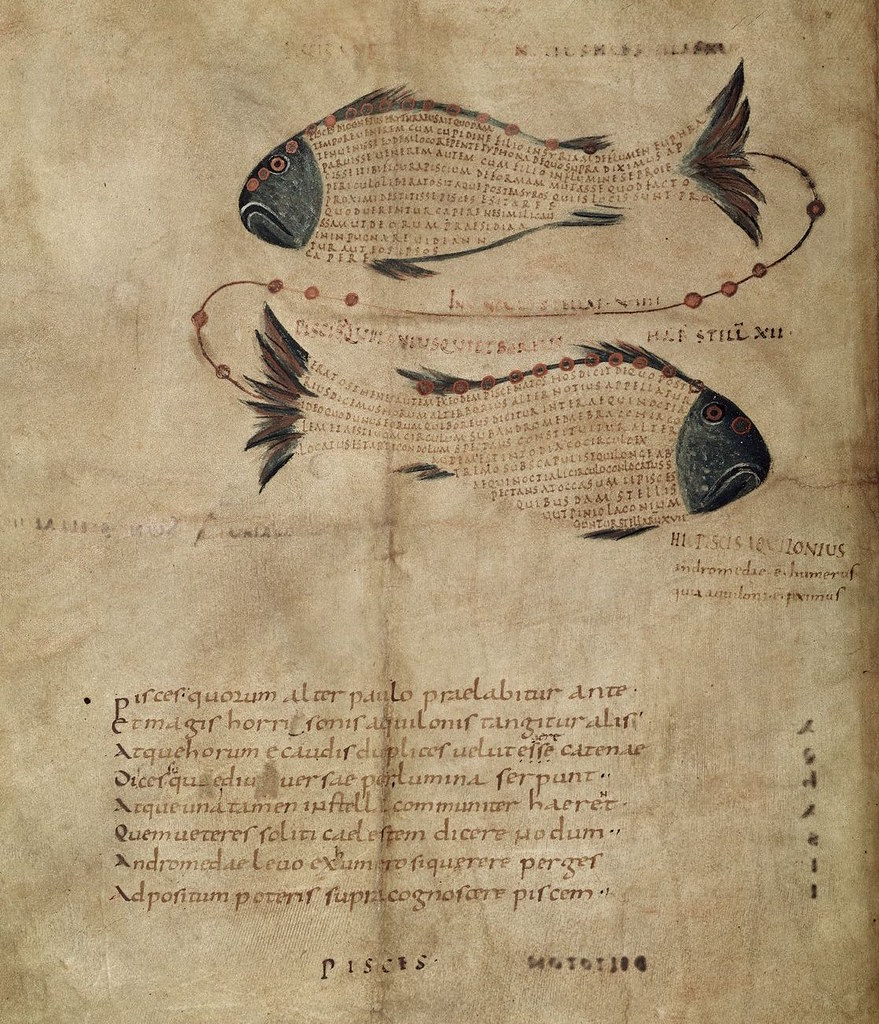
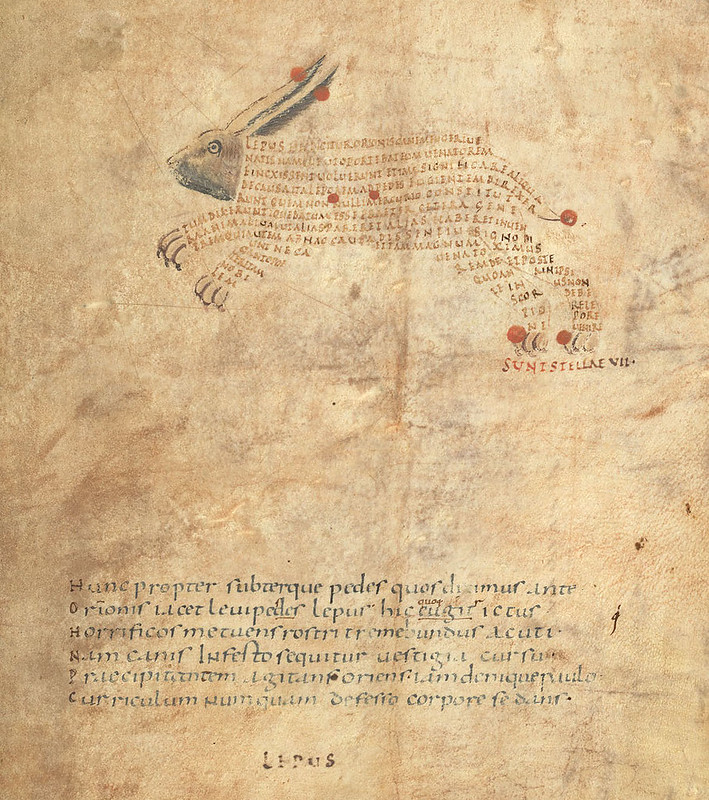
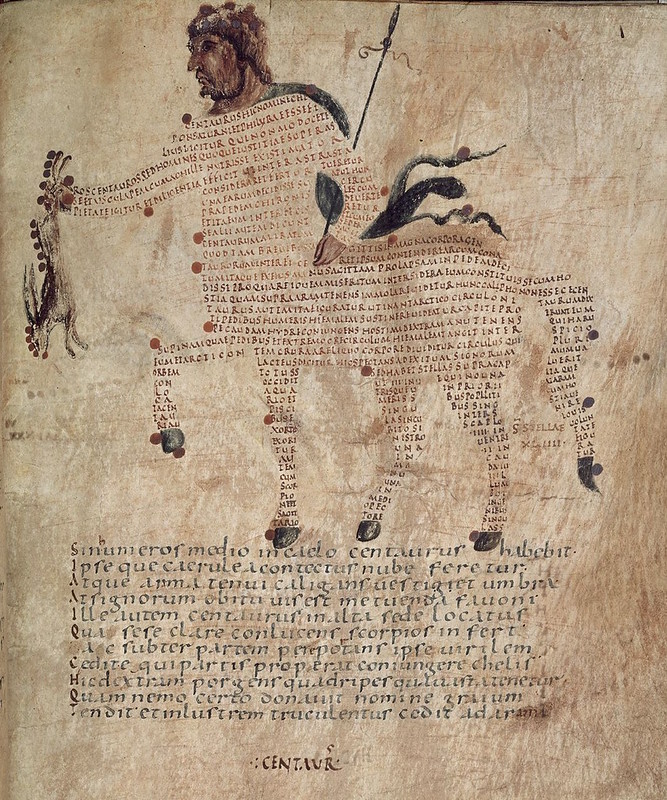
Not as ancient as the exam­ples into which Kemp­ton first dives, the pages here from a man­u­script called the Aratea nonethe­less show us a use of the form that dates back over 1000 years, and incor­po­rates “near­ly 2000 years of cul­tur­al his­to­ry,” writes the Pub­lic Domain Review. “Mak­ing use of two Roman texts on astron­o­my writ­ten in the 1st cen­tu­ry BC, the man­u­script was cre­at­ed in North­ern France in about 1820.”

The text that has been arranged into images wasn’t orig­i­nal­ly poet­ry, though one might argue that arrang­ing it thus makes us read it that way. Instead, the words are tak­en from Hygi­nus’ Astro­nom­i­ca, a “star atlas and book of sto­ries” of somewhat uncer­tain ori­gin. The poems in lined verse below each image are by 3rd cen­tu­ry BC Greek poet Ara­tus (hence the title), “trans­lat­ed into Latin by young Cicero.”

If this feels like hefty mate­r­i­al for a lit­er­ary pro­duc­tion that might seem more whim­si­cal than awe-inspir­ing, we must con­sid­er that the manuscript’s first—and nec­es­sar­i­ly few—readers would have seen it dif­fer­ent­ly. The text is a visu­al mnemon­ic device, the red dots show­ing the posi­tions of the stars in the con­stel­la­tions: an aes­thet­ic ped­a­gogy that threads togeth­er visu­al per­cep­tion, mem­o­ry, imag­i­na­tion, and cog­ni­tion.

“The pas­sages used to form the images describe the con­stel­la­tion which they cre­ate on the page,” the Pub­lic Domain Review writes, “and in this way they become tied to one anoth­er: nei­ther the words nor the images would make full sense with­out the oth­er to com­plete the scene.” We are encour­aged to read the stars through art and lit­er­a­ture and to read poet­ry with an illus­trat­ed mytho­log­i­cal star chart in hand.

The Aratea is a fas­ci­nat­ing man­u­script not only for its visu­al­ly poet­ic illu­mi­na­tions, but also for its sig­nif­i­cance across sev­er­al spans of time. Its phys­i­cal exis­tence is nec­es­sar­i­ly tied to the British Library where it resides. One of the institution’s first arti­facts, it was “sold to the nation in 1752 under the same Act of Par­lia­ment which cre­at­ed the British Muse­um.”

“Part of a larg­er mis­cel­lany of sci­en­tif­ic works,” includ­ing sev­er­al notes and com­men­taries on nat­ur­al phi­los­o­phy, as the British Library describes it, the medieval text uses clas­si­cal sources to con­tem­plate the heav­ens in a form that is not only pre-Chris­t­ian and pre-Roman, but per­haps, as Kemp­ton argues, dates to the ori­gins of writ­ing itself.

via The Pub­lic Domain Review

Relat­ed Con­tent:

Behold Fan­tas­ti­cal Illus­tra­tions from the 13th Cen­tu­ry Ara­bic Man­u­script Mar­vels of Things Cre­at­ed and Mirac­u­lous Aspects of Things Exist­ing

800 Illu­mi­nat­ed Medieval Man­u­scripts Are Now Online: Browse & Down­load Them Cour­tesy of the British Library and Bib­lio­thèque Nationale de France

700 Years of Per­sian Man­u­scripts Now Dig­i­tized and Avail­able Online

Josh Jones is a writer and musi­cian based in Durham, NC. Fol­low him at @jdmagness

Joy Harjo, Newly-Appointed U.S. Poet Laureate, Reads Her Poems, “Remember,” “A Poem to Get Rid of Fear,” “An American Sunrise” and More

In Car­olyn Forché’s stun­ning new mem­oir, What You Have Heard is True, the poet and activist makes a sad obser­va­tion about poet­ry in Amer­i­ca. When it is “men­tioned in the Amer­i­can press, if it is men­tioned, the sto­ry begins with ‘Poet­ry doesn’t mat­ter,’ or ‘No one reads poet­ry.’ No mat­ter what is said. It doesn’t mat­ter.”

But of course, Forché believed poet­ry mat­tered a great deal—that we need it in the strug­gle “against for­get­ting,” a phrase she took from Milan Kun­dera for the title of an anthol­o­gy of the “poet­ry of wit­ness.” Poets resist injus­tice and inhu­man­i­ty, she says “by virtue of recu­per­at­ing from the human soul its nat­ur­al prayer and con­scious­ness.”

Such a poet is Joy Har­jo, new­ly appoint­ed Poet Lau­re­ate in the Unit­ed States, the first Native Amer­i­can woman to hold the post. Har­jo asks us to remember—to remem­ber espe­cial­ly that the grand sweep of his­to­ry can­not sev­er us from the nat­ur­al world of which we are an inex­tri­ca­ble part, and which is itself the source of “the dance lan­guage is.”

Remem­ber the plants, trees, ani­mal life who all have 
      their
tribes, their fam­i­lies, their his­to­ries, too. Talk to 
      them,
lis­ten to them. They are alive poems.

The stargaz­ing, tree-hug­ging exhor­ta­tions in “Remem­ber” are rad­i­cal state­ments in every sense of the word. Maybe poet­ry doesn’t mat­ter much to most Amer­i­cans. We can­not, as William Car­los Williams wrote, “get the news from poems,” and our hunger for fresh news is nev­er sat­ed. But maybe what we find in poet­ry is far bet­ter suit­ed to sav­ing our lives, offer­ing a release, for exam­ple, from fear, as Har­jo speak/sings in her charis­mat­ic per­for­mance from HBO’s Def Poet­ry Jam in 2002.

Har­jo remem­bers the hor­rors her ances­tors endured, and tells the fear that fol­lowed through the cen­turies, “I release you. You were my beloved and hat­ed twin. But now I don’t know you as myself.” A mem­ber of the Muskoke/Creek Nation, Har­jo was born in Tul­sa, Okla­homa in 1951 and earned her MFA from the Iowa Writ­ers Work­shop in 1978. She went on to pub­lish sev­er­al books of poet­ry and non­fic­tion and win mul­ti­ple pres­ti­gious awards while also per­form­ing poet­ry across the coun­try and play­ing sax­o­phone with her band Poet­ic Jus­tice.

Her soul­ful deliv­ery con­veys a fun­da­men­tal­ly Amer­i­can expe­ri­ence of the strug­gle against era­sure, a strug­gle against pow­er that is waged, as Kun­dera wrote, with the weapon of remem­ber­ing. Echo­ing Langston Hugh­es, Har­jo weaves the sto­ry of her com­mu­ni­ty back into the coun­try’s past and its present—a sto­ry that includes with­in it demands for jus­tice that will not be for­got­ten. Poet­ry should mat­ter far more to us than it does. But those who hear the country’s newest Lau­re­ate may find she is exact­ly the fear­less voice we need to remind us of our unavoid­able con­nec­tions to the past, the earth, and our respon­si­bil­i­ties to each oth­er.

Har­jo stopped by the Acad­e­my of Amer­i­can Poets this month in cel­e­bra­tion of her appoint­ment. Just above, see her read “An Amer­i­can Sun­rise.” “We are still Amer­i­ca,” she says, “We / know the rumors of our demise. We spit them out. They die / soon.”

These read­ing will be added to the Poet­ry sec­tion of our col­lec­tion, 1,000 Free Audio Books: Down­load Great Books for Free.

Relat­ed Con­tent:

Hear Mary Oliv­er (RIP) Read Five of Her Poems: “The Sum­mer Day,” “Lit­tle Dog’s Rhap­sody in the Night,” “Many Miles” and “Night and the Riv­er”

“PoemTalk” Pod­cast, Where Impre­sario Al Fil­reis Hosts Live­ly Chats on Mod­ern Poet­ry

An 8‑Hour Marathon Read­ing of 500 Emi­ly Dick­in­son Poems

Josh Jones is a writer and musi­cian based in Durham, NC. Fol­low him at @jdmagness

« Go BackMore in this category... »
Quantcast