Watch How to Be at Home, a Beautiful Short Animation on the Realities of Social Isolation in 2020

I think, as social pri­mates, we want to feel a strong sense of belong­ing either in a rela­tion­ship or to a community—or both. But also intrin­sic to our human­i­ty is a feel­ing that we are tru­ly alone.

—Film­mak­er Andrea Dorf­man, 2010

When they first became friends, poet Tanya Davis and film­mak­er Andrea Dorf­man talked a lot about the plea­sures and hard­ships of being alone. Davis had just gone through a break up, and Dorf­man was just embark­ing on a rela­tion­ship after four years of fly­ing solo.

These con­ver­sa­tions led to a col­lab­o­ra­tion, 2010’s How to Be At Alone (see below), a whim­si­cal videopo­em that com­bines live action and ani­ma­tion to con­sid­er some of soli­tude’s sweet­er aspects, like sit­ting on a bench as sig­nal to the uni­verse that one is avail­able for impromp­tu con­ver­sa­tion with a stranger.

That bench reap­pears in their 2020 fol­low up, How to Be At Home, above. Now it is cor­doned off with black and yel­low cau­tion tape, a famil­iar pub­lic health mea­sure in 2020.

As with the ear­li­er project, a large part of Davis’ pur­pose was to reflect and reas­sure, both her­self, and by exten­sion, oth­ers.

Although she has become a poster child for the joys of soli­tude, she also rel­ish­es human con­tact, and found her­self miss­ing it ter­ri­bly while shel­ter­ing alone in the ear­ly days of the pan­dem­ic. Writ­ing the new poem gave her “an anchor” and a place to put her anx­i­ety.

Dorf­man notes that the project, which was com­mis­sioned by the Nation­al Film Board of Cana­da as part of a short film col­lec­tion about Cana­di­ans nav­i­gat­ing life dur­ing the pan­dem­ic, was “essen­tial­ly cat­alyzed by COVID.”

As she embarked on the project, she won­dered if the pan­dem­ic would be over by the time it was com­plete. As she told the CBC’s Tom Pow­er:

There was this feel­ing that this could go away in a month, so this bet­ter be fin­ished soon, so it’s still rel­e­vant. So as an artist, as a film­mak­er, I thought, “I have to crank this out” but there’s no fast and easy way to do ani­ma­tion. It just takes so long and as I got into it and real­ized that this was going to be a marathon, not a sprint, the images just kept com­ing to me and I real­ly just made it up as I went along. I’d go into my stu­dio every day not know­ing what lay ahead and I’d think, “Okay, so, what do we have up next? What’s the next line? And I’d spend maybe a week on a line of the poem, ani­mat­ing it. 

It appears to have been an effec­tive approach.

Dorfman’s paint­ed images rip­ple across the fast turn­ing pages of an old book. The titles change from time to time, and the choic­es seem delib­er­ate—The Lone Star Ranger, Le Secret du Manoir Han­té, a chap­ter in The Bro­ken Halo—“Rose­mary for Remem­brance.”

“It’s almost as though the way the poem is writ­ten there are many chap­ters in the book. (Davis) moves from one sub­ject to anoth­er so com­plete­ly,” Dorf­man told the Uni­ver­si­ty of King’s Col­lege stu­dent paper, The Sig­nal.

In the new work, the absence of oth­er peo­ple proves a much heav­ier bur­den than it does in How To Be Alone.

Davis flirts with many of the first poem’s set­tings, places where a lone indi­vid­ual might have gone to put them­selves in prox­im­i­ty to oth­er humans as recent­ly as Feb­ru­ary 2020:

Pub­lic trans­porta­tion

The gym

A dance club

A descrip­tion from 2010:

The lunch counter, where you will be sur­round­ed by chow-down­ers, employ­ees who only have an hour and their spous­es work across town, and they, like you, will be alone.

Resist the urge to hang out with your cell phone.

In 2020, she strug­gles to recre­ate that expe­ri­ence at home, her phone serv­ing as her most vital link to the out­side world, as she scrolls past images of a Black Lives Mat­ter protests and a masked essen­tial work­er:

I miss lunch coun­ters so much I’ve been eat­ing [pick­les and] toast­ed sand­wich­es while hang­ing unabashed­ly with my phone.

See How to Be at Home and the 29 oth­er films that com­prise The Curve, the Nation­al Film Board of Cana­da series about life in the era of COVID-19 here.

How to be at Home

By Tanya Davis

If you are, at first, real­ly fuck­ing anx­ious, just wait. It’ll get worse, and then you’ll get the hang of it. Maybe. 

Start with the rea­son­able feel­ings – dis­com­fort, lack of focus, the sad­ness of alone

you can try to do yoga

you can shut off the radio when it gets to you

you can mes­sage your fam­i­ly or your friends or your col­leagues, you’re not sup­posed to leave your home any­way, so it’s safe for you

There’s also the gym

you can’t go there but you could pre­tend to

you could bendy by your­self in your bed­room

And there’s pub­lic trans­porta­tion

prob­a­bly best to avoid it

but there’s prayer and med­i­ta­tion, yes always

employ it

if you have pains in your chest ‘cause your anx­i­ety won’t rest

take a moment, take a breath

Start sim­ple

things you can han­dle based on your inter­ests

your issues and your trig­gers

and your inner logis­tics 

I miss lunch coun­ters so much I’ve been eat­ing [pick­les and] toast­ed sand­wich­es while hang­ing unabashed­ly with my phone

When you are tired, again of still being alone

make your­self a din­ner

but don’t invite any­body over

put some­thing green in it, or maybe orange

chips are fine some­times but they won’t keep you charged 

feed your heart

if peo­ple are your nour­ish­ment, I get you

feel the feel­ings that undo you while you have to keep apart

Watch a movie, in the dark

and pre­tend some­one is with you 

watch all of the cred­its

because you have time, and not much else to do

or watch all of the cred­its to remem­ber 

how many peo­ple come togeth­er

just to tell a sto­ry

just to make a pic­ture move

And then, set your­self up danc­ing

like it’s a club where every­one knows you

and they’re all gonna hold you

all night long

they’re gonna dance around you and with you and on their own

it’s your favourite song 

with the hard­est bass and the cathar­tic drums

your heart pumps along/hard, you belong

you put your hands up to feel it

With the come down comes the weep­ing

those down­cast eyes and feel­ings

the truth is you can’t go danc­ing, not right now

not at any club or par­ty in any town

The heart­break of this astounds you

it joins old aches way down in you

you can vis­it them, but please don’t stay there

Go out­side if you’re able, breathe the air

there are trees for hug­ging

don’t be embar­rassed

it’s your friend, it’s your moth­er, it’s your new crush

lay your cheek against the bark, it’s a liv­ing thing to touch

Sad­ly, leave all bench­es emp­ty

appre­ci­ate the kind­ness in the dis­tance of strangers

as you pine for com­pa­ny and wave at your neigh­bours

savour the depths of your con­ver­sa­tions

the lay­ers uncov­ered

in this strange space and time

Soci­ety is afraid of change

and no one wants to die

not now, from a tiny virus

not lat­er from the world on fire

But death is a truth we all hate to know

we all get to live, and then we all have to go

In the mean­time, we’re sur­round­ed, we’re alone

each a thread woven in the fab­ric, unrav­el­ling in moments though

each a solo enti­ty spin­ning on its axis, for­get­ting that the galaxy includes us all

Here­in our fall

from grace from each oth­er from god what­ev­er, doesn’t mat­ter

the dis­as­ter is that we believe we’re sep­a­rate 

we’re not

As evi­denced by virus­es tak­ing down soci­eties

as proven by the lone­li­ness inher­ent in no gath­er­ings

as pal­pa­ble as the vacan­cy in the space of one per­son hug­ging

If this dis­rup­tion undoes you

if the absence of peo­ple unrav­els you

if touch was the teth­er that held you togeth­er

and now that it’s sev­ered you’re frag­ile too 

lean into lone­li­ness and know you’re not alone in it 

lean into lone­li­ness like it is hold­ing you

like it is a gen­er­ous rep­re­sen­ta­tive of a glar­ing truth

oh, we are con­nect­ed

we for­get this, yet we always knew.

How to Be at Home will be added to the Ani­ma­tion sec­tion of our col­lec­tion, 4,000+ Free Movies Online: Great Clas­sics, Indies, Noir, West­erns, Doc­u­men­taries & More.

Relat­ed Con­tent: 

Watch 66 Oscar-Nom­i­nat­ed-and-Award-Win­ning Ani­mat­ed Shorts Online, Cour­tesy of the Nation­al Film Board of Cana­da

Watch “Ryan,” Win­ner of an Oscar and 60 Oth­er Awards

2020: An Iso­la­tion Odyssey–A Short Film Reen­acts the Finale of Kubrick’s 2001: A Space Odyssey, with a COVID-19 Twist


Ayun Hal­l­i­day is an author, illus­tra­tor, the­ater mak­er and Chief Pri­ma­tol­o­gist of the East Vil­lage Inky zine.  Fol­low her @AyunHalliday.

Sean Connery (RIP) Reads C.P. Cavafy’s Epic Poem “Ithaca,” Set to the Music of Vangelis

This video com­bines three things that make me hap­py: the voice of Sean Con­nery (who passed away today), the music of Van­ge­lis (Blade Run­ner, Char­i­ots of Fire), and the poet­ry of C.P. Cavafy. Put them all togeth­er and you get a bliss­ful sound­scape of rolling synth lines, rolling Scot­tish R’s, and a suc­ces­sion of Home­r­ic images and anaphor­ic lines. And the video’s quite nice as well.

Cavafy, whose work, I’m told, is real­ly untrans­lat­able from the orig­i­nal Greek, always seems to come out pret­ty well to me in Eng­lish. “Itha­ca,” one of his most pop­u­lar poems, express­es what in less­er hands might be a banal sen­ti­ment akin to “it’s the jour­ney, not the des­ti­na­tion.” But in Cavafy’s poem, the jour­ney is both Odysseus’s and ours; it’s epic where our lives seem small, and it trans­lates our minor wan­der­ings to the realm of myth­ic his­to­ry.

Any­way, it seems rude to say much more and drown the poem in com­men­tary. So, fol­low along with Sean Con­nery.

Find the text of the poem after the jump. (more…)

by | Permalink | Make a Comment ( 11 ) |

An Animated Reading of “The Jabberwocky,” Lewis Carroll’s Nonsense Poem That Somehow Manages to Make Sense

“I can explain all the poems that ever were in­ vented—and a good many that haven’t been invent­ed just yet.” —Hump­ty Dump­ty

“The Jab­ber­wocky,” Lewis Carroll’s clas­sic poem from Through the Look­ing Glass, and What Alice Found There—the sec­ond install­ment of the most famous­ly non­sen­si­cal adven­ture in lit­er­ary history—is “full of seem­ing­ly non­sen­si­cal words that some­how man­age to make sense,” says nar­ra­tor Jack Cut­more-Scott in the ani­mat­ed read­ing above from TED-Ed Ani­ma­tion. That word, non­sense, is asso­ci­at­ed with Carroll’s fan­ta­sy world more than any oth­er, but what does it mean for a sto­ry to be non­sense and be intel­li­gi­ble at the same time?

Car­roll, a math­e­mati­cian by train­ing, under­stood the fun­da­men­tal prin­ci­ple of non­sense, which “T.S. Eliot remind­ed us, is not an absence of sense but a par­o­dy of it,” as J. Patrick Lewis writes at The New York Times. “Some of the port­man­teau words Car­roll invented—chortle, bur­ble, frab­jous and others—are now ful­ly vest­ed mem­bers of the lex­i­con. And the verse’s struc­ture is a mir­ror, as Alice dis­cov­ered, of clas­si­cal Eng­lish poet­ry.” Car­roll com­posed the first four lines ten years before Through the Look­ing Glass, as a par­o­d­ic “Stan­za of Anglo-Sax­on Poet­ry” to amuse his fam­i­ly.

It may help, or not, to keep in mind that Car­roll is not only mock­ing Eng­lish poet­ic forms and con­ven­tions, but a par­tic­u­lar his­tor­i­cal form of Eng­lish that is most­ly unrec­og­niz­able to mod­ern read­ers, and cer­tain­ly to Alice. But the poem’s syn­tax and struc­ture are so famil­iar that we can eas­i­ly piece togeth­er a mon­ster-slay­ing nar­ra­tive in which, as Alice remarks, “some­body killed some­thing.”

The ever-hum­ble Hump­ty Dump­ty is hap­py to explain, as was Car­roll in his orig­i­nal com­po­si­tion, to which he attached a glos­sary very sim­i­lar to the egg’s def­i­n­i­tions and gave “the lit­er­al Eng­lish” of the first stan­za as:

“It was evening, and the smooth active bad­gers were scratch­ing and bor­ing holes in the hill side; all unhap­py were the par­rots, and the grave tur­tles squeaked out“.

There were prob­a­bly sun dials on the top of the hill, and the “boro­goves” were afraid that their nests would be under­mined. The hill was prob­a­bly full of the nests of “raths”, which ran out squeak­ing with fear on hear­ing the “toves” scratch­ing out­side. This is an obscure, but yet deeply affect­ing, rel­ic of ancient Poet­ry.

Does this help? It does explain the mood Car­roll is after, and he achieves it. The Jab­ber­wocky is fun­ny and play­ful and all the rest, but it is also deeply unset­tling in its obscure mys­ter­ies and fright­en­ing descrip­tions of its title char­ac­ter.

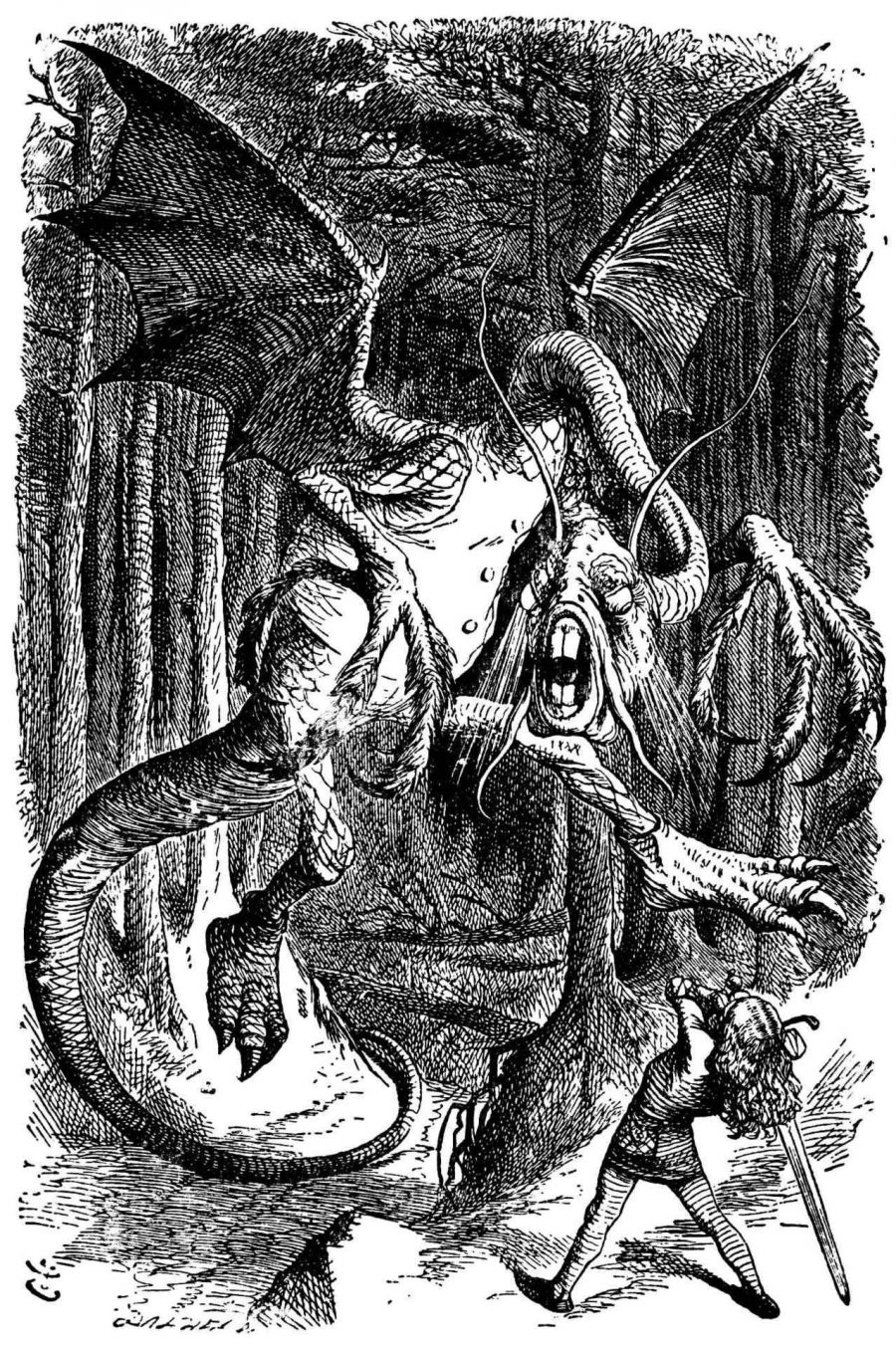
In John Tenniel’s famous illus­tra­tion of the beast, it appears as a scaly, leath­ery drag­on with a face some­where between a deep-sea fish and an over­grown sew­er rat. The ani­ma­tion by Sjaak Rood gives it a more clas­si­cal­ly drag­on-like appear­ance, in the crazed style of Ralph Stead­man, while the Ban­der­snatch looks like some­thing Paul Klee would have invent­ed. The choice of artis­tic influ­ences here shows Rood con­nect­ing deeply with the non­sense tra­di­tion in mod­ern art, one which also turns famil­iar forms into night­mar­ish beings that fill our heads with ideas.

Relat­ed Con­tent:

O Frab­jous Day! Neil Gaiman Recites Lewis Carroll’s “Jab­ber­wocky” from Mem­o­ry

Behold Lewis Carroll’s Orig­i­nal Hand­writ­ten & Illus­trat­ed Man­u­script for Alice’s Adven­tures in Won­der­land (1864)

Lewis Carroll’s Pho­tographs of Alice Lid­dell, the Inspi­ra­tion for Alice in Won­der­land

Alice’s Adven­tures in Won­der­land, Illus­trat­ed by Sal­vador Dalí in 1969, Final­ly Gets Reis­sued

Josh Jones is a writer and musi­cian based in Durham, NC. Fol­low him at @jdmagness

In 1183, a Chinese Poet Describes Being Domesticated by His Own Cats

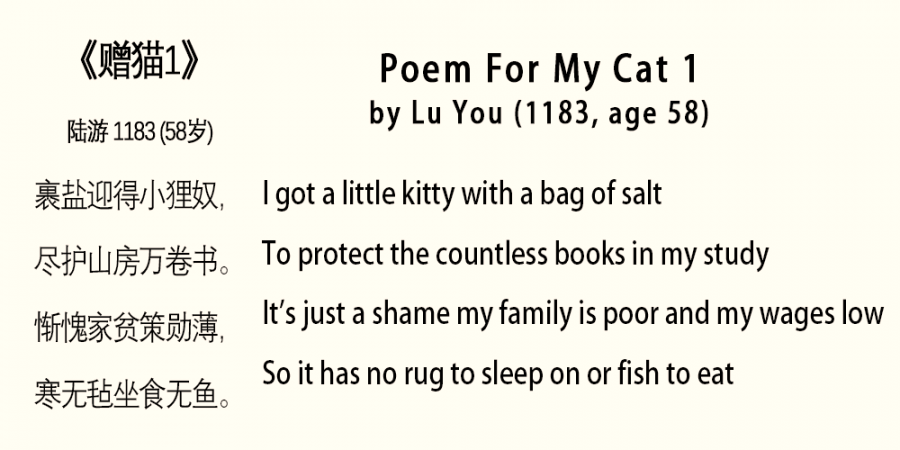
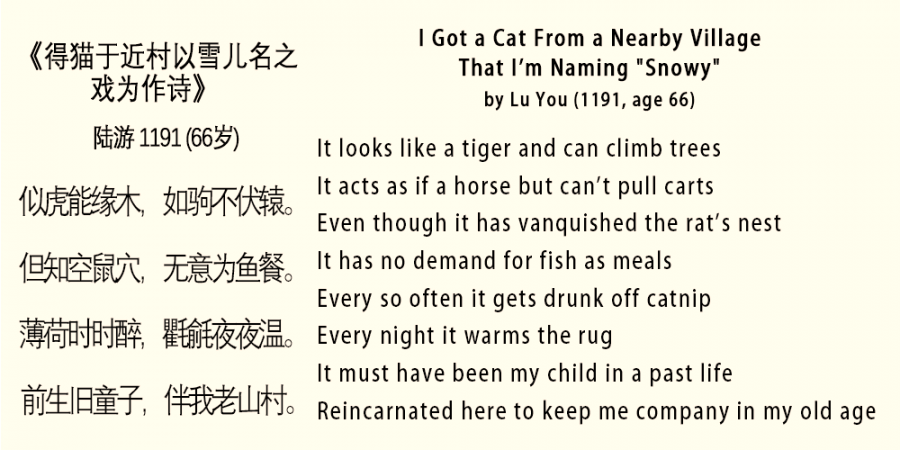
Here in Korea, where I live, cat own­ers aren’t called cat own­ers: they’re called goyan­gi jib­sa, lit­er­al­ly “cat but­lers.” Clear­ly the idea that felines have flipped the domes­tic-ani­mal script, not serv­ing humans but being served by humans, tran­scends cul­tures. It also goes far back in his­to­ry: wit­ness the 12th-cen­tu­ry vers­es recent­ly tweet­ed out in trans­la­tion by writer Xiran Jay Zhao, in which “Song dynasty poet Lu You” — one of the most pro­lif­ic lit­er­ary artists of his time and place — “poem-live­blogged his descent from cat own­er to cat slave.”

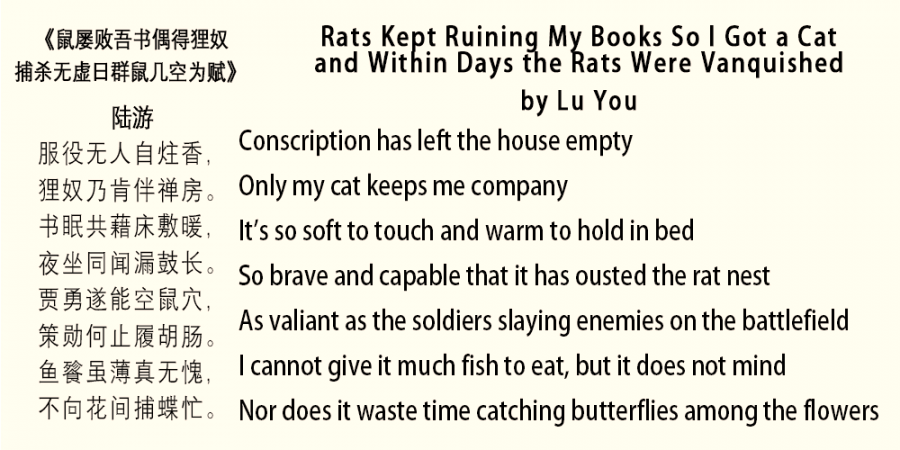
The sto­ry begins in 1138, writes Zhao, when “Down On His Luck schol­ar-offi­cial Lu You gets a cat because rats keep munch­ing on his books.” The eight poems in this series begin with praise for the ani­mal — “It’s so soft to touch and warm to hold in bed / So brave and capa­ble that it has oust­ed the rat nest” — and goes on to describe the cats he sub­se­quent­ly acquires, who self­less­ly van­quish the house­hold rats while indulging in noth­ing more than the occa­sion­al cat­nip binge.

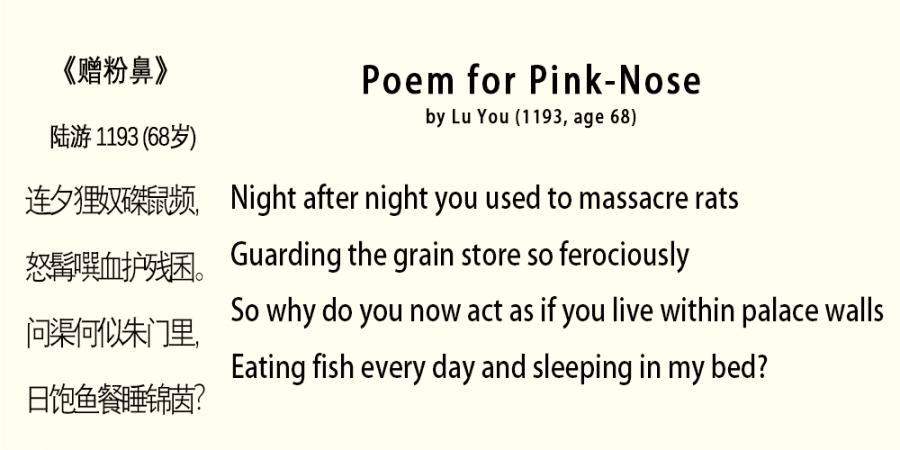
Or at least they do at first. “Night after night you used to mas­sacre rats / Guard­ing the grain store so fero­cious­ly,” Lu asks one in “Poem for Pink-Nose.” “So why do you now act as if you live with­in palace walls / Eat­ing fish every day and sleep­ing in my bed?”

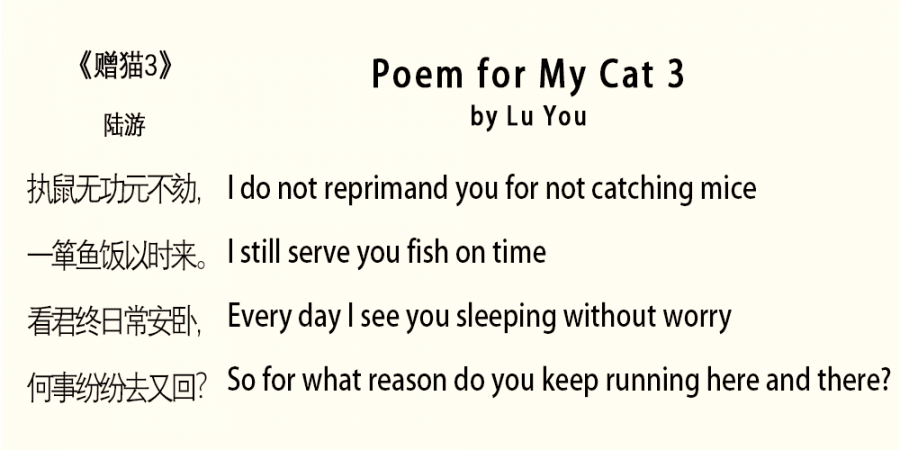
As time goes on, Lu finds him­self “serv­ing fish on time” to his cats only to find them “sleep­ing with­out wor­ry.” As the rats ram­page, he poet­i­cal­ly moans, “my books are get­ting ruined and the birds wake me before dawn.” Has it all been noth­ing more than “a ruse to get food from me?”

Yet it seems that Lu has no regrets about cat own­er­ship, if own­er­ship be the word. “Wind sweeps the world and rain dark­ens the vil­lage / Rum­bles roll off the moun­tains like ocean waves churn­ing,” he writes in 1192’s “A Rain­storm on the Fourth Day of the Eleventh Month.” Yet “the fur­nace is sooth­ing and the rug is warm / Me and my cat are not leav­ing the house.” This is relat­able con­tent for the cat but­lers of Korea (a cul­ture thor­ough­ly influ­enced by Chi­na in Lu’s day), or indeed any­where else in the world. The patri­ot­ic poet would sure­ly be pleased by the mod­ern-day ascent of Chi­na — and per­haps just as much by the high and ever-ris­ing sta­tus of the domes­tic cat.

via Xiran

Relat­ed Con­tent:

An Ani­mat­ed His­to­ry of Cats: How Over 10,000 Years the Cat Went from Wild Preda­tor to Sofa Side­kick

Two Cats Keep Try­ing to Get Into a Japan­ese Art Muse­um … and Keep Get­ting Turned Away: Meet the Thwart­ed Felines, Ken-chan and Go-chan

Medieval Cats Behav­ing Bad­ly: Kit­ties That Left Paw Prints … and Peed … on 15th Cen­tu­ry Man­u­scripts

T.S. Eliot Reads Old Possum’s Book of Prac­ti­cal Cats & Oth­er Clas­sic Poems (75 Min­utes, 1955)

What Ancient Chi­nese Phi­los­o­phy Can Teach Us About Liv­ing the Good Life Today: Lessons from Harvard’s Pop­u­lar Pro­fes­sor, Michael Puett

Free Chi­nese Lessons

Based in Seoul, Col­in Mar­shall writes and broad­casts on cities, lan­guage, and cul­ture. His projects include the book The State­less City: a Walk through 21st-Cen­tu­ry Los Ange­les and the video series The City in Cin­e­ma. Fol­low him on Twit­ter at @colinmarshall, on Face­book, or on Insta­gram.

William Blake’s Paintings Come to Life in Two Animations

The poet and painter William Blake toiled in obscu­ri­ty, for the most part, and died in pover­ty.

Twen­ty some years after his death, his rebel­lious spir­it gained trac­tion with the Pre-Raphaelites.

By the dawn­ing of the Age of Aquar­ius, Blake was ripe to be ven­er­at­ed as a counter-cul­tur­al hero, for hav­ing flown in the face of con­ven­tion, while cham­pi­oning gen­der and racial equal­i­ty, nature, and free love.

Reclin­ing half-naked on a “a fab­u­lous couch in Harlem,” poet Allen Gins­burg had a hal­lu­ci­na­to­ry encounter where­in Blake recit­ed to him “in earth­en mea­sure.”

Dit­to poet Michael McClure, though in his case, Bob Dylan’s “Gates of Eden” served as some­thing of a medi­um:

I had the idea that I was hal­lu­ci­nat­ing, that it was William Blake’s voice com­ing out of the walls and I stood up and put my hands on the walls and they were vibrat­ing.

Blake’s work (and world view) con­tin­ues to exert enor­mous influ­ence on graph­ic nov­el­iststhe­ater­mak­ers, and cre­atives of every stripe.

He’s also a dab hand at ani­ma­tion, col­lab­o­rat­ing from beyond the grave.

The short above, a com­mis­sion for a late ‘70s Blake exhi­bi­tion at The Tate, envi­sions a roundtrip jour­ney from Heav­en to Hell. Ani­ma­tor Sheila Graber parked her­self in the Sculp­ture Hall to cre­ate it in pub­lic view, pair­ing Blake’s line “Ener­gy is Eter­nal delight” with a per­son­al obser­va­tion:

Whether we use it to cre­ate or destroy—it’s the same ener­gy. The prac­tice of art can turn a per­son from a van­dal to a builder!

More recent­ly, the Tate gave direc­tor Sam Gains­bor­ough access to super high-res imagery of Blake’s orig­i­nal paint­ings, in order to cre­ate a pro­mo for last year’s block­buster exhi­bi­tion.

Gains­bor­ough and ani­ma­tor Renald­ho Pelle worked togeth­er to bring the cho­sen works to life, frame by frame, against a series of Lon­don build­ings and streets that were well known to Blake him­self.

The film opens with Blake’s Ghost of a Flea emerg­ing from the walls of Broad­wick Street, where its cre­ator was born, then stalk­ing off, bowl in hand, ced­ing the screen to God, The Ancient of Days, whose reach spreads like ink across the grit­ty facade of a white brick edi­fice.

Sey­mour Mil­ton’s orig­i­nal music and Jas­mine Black­borow’s nar­ra­tion of excerpts from Blake’s poem “Auguries of Inno­cence” seem to antic­i­pate the fraught cur­rent moment, as does the entire poem:

Auguries of Inno­cence

To see a World in a Grain of Sand

And a Heav­en in a Wild Flower 

Hold Infin­i­ty in the palm of your hand 

And Eter­ni­ty in an hour

A Robin Red breast in a Cage

Puts all Heav­en in a Rage 

A Dove house filld with Doves & Pigeons

Shud­ders Hell thr’ all its regions 

A dog starvd at his Mas­ters Gate

Pre­dicts the ruin of the State 

A Horse mis­usd upon the Road

Calls to Heav­en for Human blood 

Each out­cry of the hunt­ed Hare

A fibre from the Brain does tear 

A Sky­lark wound­ed in the wing 

A Cheru­bim does cease to sing 

The Game Cock clipd & armd for fight

Does the Ris­ing Sun affright 

Every Wolfs & Lions howl

Rais­es from Hell a Human Soul 

The wild deer, wan­dring here & there 

Keeps the Human Soul from Care 

The Lamb mis­usd breeds Pub­lic Strife

And yet for­gives the Butch­ers knife 

The Bat that flits at close of Eve

Has left the Brain that wont Believe

The Owl that calls upon the Night

Speaks the Unbe­liev­ers fright

He who shall hurt the lit­tle Wren

Shall nev­er be belovd by Men 

He who the Ox to wrath has movd

Shall nev­er be by Woman lovd

The wan­ton Boy that kills the Fly

Shall feel the Spi­ders enmi­ty 

He who tor­ments the Chafers Sprite

Weaves a Bow­er in end­less Night 

The Cat­ter­piller on the Leaf

Repeats to thee thy Moth­ers grief 

Kill not the Moth nor But­ter­fly 

For the Last Judg­ment draweth nigh 

He who shall train the Horse to War

Shall nev­er pass the Polar Bar 

The Beg­gars Dog & Wid­ows Cat 

Feed them & thou wilt grow fat 

The Gnat that sings his Sum­mers Song

Poi­son gets from Slan­ders tongue 

The poi­son of the Snake & Newt

Is the sweat of Envys Foot 

The poi­son of the Hon­ey Bee

Is the Artists Jeal­ousy

The Princes Robes & Beg­gars Rags

Are Toad­stools on the Misers Bags 

A Truth thats told with bad intent

Beats all the Lies you can invent 

It is right it should be so 

Man was made for Joy & Woe 

And when this we right­ly know 

Thro the World we safe­ly go 

Joy & Woe are woven fine 

A Cloth­ing for the soul divine 

Under every grief & pine

Runs a joy with silken twine 

The Babe is more than swadling Bands

Through­out all these Human Lands

Tools were made & Born were hands 

Every Farmer Under­stands

Every Tear from Every Eye

Becomes a Babe in Eter­ni­ty 

This is caught by Females bright

And returnd to its own delight 

The Bleat the Bark Bel­low & Roar 

Are Waves that Beat on Heav­ens Shore 

The Babe that weeps the Rod beneath

Writes Revenge in realms of Death 

The Beg­gars Rags flut­ter­ing in Air

Does to Rags the Heav­ens tear 

The Sol­dier armd with Sword & Gun 

Palsied strikes the Sum­mers Sun

The poor Mans Far­thing is worth more

Than all the Gold on Africs Shore

One Mite wrung from the Labr­ers hands

Shall buy & sell the Misers Lands 

Or if pro­tect­ed from on high 

Does that whole Nation sell & buy 

He who mocks the Infants Faith

Shall be mockd in Age & Death 

He who shall teach the Child to Doubt

The rot­ting Grave shall neer get out 

He who respects the Infants faith

Tri­umphs over Hell & Death 

The Childs Toys & the Old Mans Rea­sons

Are the Fruits of the Two sea­sons 

The Ques­tion­er who sits so sly 

Shall nev­er know how to Reply 

He who replies to words of Doubt

Doth put the Light of Knowl­edge out 

The Strongest Poi­son ever known

Came from Cae­sars Lau­rel Crown 

Nought can Deform the Human Race

Like to the Armours iron brace 

When Gold & Gems adorn the Plow

To peace­ful Arts shall Envy Bow 

A Rid­dle or the Crick­ets Cry

Is to Doubt a fit Reply 

The Emmets Inch & Eagles Mile

Make Lame Phi­los­o­phy to smile 

He who Doubts from what he sees

Will neer Believe do what you Please 

If the Sun & Moon should Doubt 

Theyd imme­di­ate­ly Go out 

To be in a Pas­sion you Good may Do 

But no Good if a Pas­sion is in you 

The Whore & Gam­bler by the State

Licencd build that Nations Fate 

The Har­lots cry from Street to Street 

Shall weave Old Eng­lands wind­ing Sheet 

The Win­ners Shout the Losers Curse 

Dance before dead Eng­lands Hearse 

Every Night & every Morn

Some to Mis­ery are Born 

Every Morn and every Night

Some are Born to sweet delight 

Some are Born to sweet delight 

Some are Born to End­less Night 

We are led to Believe a Lie

When we see not Thro the Eye

Which was Born in a Night to per­ish in a Night 

When the Soul Slept in Beams of Light 

God Appears & God is Light

To those poor Souls who dwell in Night 

But does a Human Form Dis­play

To those who Dwell in Realms of day

Relat­ed Con­tent:

Enter an Archive of William Blake’s Fan­tas­ti­cal “Illu­mi­nat­ed Books”: The Images Are Sub­lime, and in High Res­o­lu­tion

William Blake Illus­trates Mary Wollstonecraft’s Work of Children’s Lit­er­a­ture, Orig­i­nal Sto­ries from Real Life (1791)

William Blake’s Mas­ter­piece Illus­tra­tions of the Book of Job (1793–1827)

Ayun Hal­l­i­day is an author, illus­tra­tor, the­ater mak­er and Chief Pri­ma­tol­o­gist of the East Vil­lage Inky zine. Fol­low her @AyunHalliday.

Hear Patti Smith’s First Poetry Reading, Accompanied by Her Longtime Guitarist Lenny Kaye (St. Mark’s Church, 1971)

There are so many ori­gin sto­ries of punk that no sin­gle his­to­ry can count as defin­i­tive. But there’s also no dis­put­ing its roots in the New York poet­ry scene from which Pat­ti Smith emerged in the 1960s and 70s. She learned from Allen Gins­berg and William S. Bur­roughs, and Gre­go­ry Cor­so and Sam Shep­herd inspired the poetry/rock hybrid that would become the music of Hors­es.

Cor­so, who called him­self a “punk debauche” in his 1960 poem “1959,” lived up to the label. He would heck­le poets “dur­ing their list­less per­for­mances,” writes Kem­brew McLeod in Down­town Pop Under­ground, “yelling, ‘Shit! Shit! No blood! Get a trans­fu­sion!’ Sit­ting at Corso’s side,” dur­ing poet­ry read­ings host­ed by the Poet­ry Project at St. Mark’s Church, “Smith made a men­tal note not to be bor­ing.”

She fol­lowed her friend Sam Shepard’s advice to add music to her first pub­lic read­ing and called gui­tar play­er Lenny Kaye to accom­pa­ny her. “It was pri­mar­i­ly a solo poet­ry read­ing,” McLeod writes, “with occa­sion­al gui­tar accom­pa­ni­ment.” The 1971 appear­ance, which you can hear in the record­ing above, set the tone for almost all of her sub­se­quent per­for­mances for the next sev­er­al decades.

“We did ‘Mack the Knife,” Kaye recalls, “because it was Bertolt Brecht’s birth­day, and then I came back for the last three musi­cal pieces. I hes­i­tate to call them ‘songs,’ but in a sense they were the essence of what we would pur­sue.” Odd­ly, that year also marked the first usage of “punk” to describe a style of music, though it was applied to the garage rock of ? and the Mys­te­ri­ans, not to Smith and Kaye’s music. She her­self has said she didn’t con­sid­er what they were doing to be “punk” at all.

This does­n’t much mat­ter. It was atti­tude and the ener­gy Smith trans­lat­ed from St. Marks to the CBG­Bs scene that secures her “God­moth­er” sta­tus. She was impressed, as she says above, by Jim Mor­ri­son and Jimi Hen­drix. She was also impressed by a 1971 essay writ­ten by Andrew Wylie, who pub­lished her first book after her St. Mark’s read­ing. “Liv­ing as we were in an extreme­ly vio­lent, frag­ile time,” Smith’s Unau­tho­rized Biog­ra­phy recounts, “[Wylie] was drawn to short, almost ampu­tat­ed works.” He con­clud­ed that “just to be alive in such times was an act of vio­lence.”

Punk poet­ry, or what­ev­er we want to call it, was born in a church on St. Mark’s Place in New York City in 1971. From then on, what­ev­er oth­er strains came togeth­er to make punk rock, Smith’s chan­nel­ing of Cor­so, Shep­ard, Bur­roughs, Mor­ri­son, etc., backed by Kaye’s steady gui­tar work, has res­onat­ed through the music into the present.

Relat­ed Con­tent:

How Pat­ti Smith “Saved” Rock and Roll: A New Video Makes the Case

Pat­ti Smith’s List of Favorite Books: From Rim­baud to Susan Son­tag

Pat­ti Smith Sings “Peo­ple Have the Pow­er” with a Choir of 250 Fel­low Singers

Josh Jones is a writer and musi­cian based in Durham, NC. Fol­low him at @jdmagness

Documentary Portraits of Allen Ginsberg, John Ashbery, William Carlos Williams, Anne Sexton & Other American Poets (1965)

The annals of Amer­i­can his­to­ry offer lit­tle in the way of doc­u­men­tar­i­an-poets. But luck­i­ly for us today — and espe­cial­ly for those of us who enjoy Amer­i­can poet­ry of the mid-2oth cen­tu­ry — one of the coun­try’s few such hyphen­ates lived an uncom­mon­ly pro­duc­tive life. Though known pri­mar­i­ly as a poet of the San Fran­cis­co Renais­sance, Richard O. Moore also had a career in inde­pen­dent and pub­lic media, begin­ning in 1949 with the very first broad­cast of Berke­ley’s KPFA. In the ear­ly 1950s he moved to San Fran­cis­co’s new­ly found­ed KQED, one of the coun­try’s first pub­lic tele­vi­sion sta­tions. After a stint at Colum­bia study­ing Wittgen­stein, Moore returned to KQED in 1961, where­upon he began pro­duc­ing a wide vari­ety of doc­u­men­taries.

As sub­ject mat­ter, poet­ry may not nat­u­ral­ly lend itself to tele­vi­sion. But giv­en Moore’s con­nec­tions to major Amer­i­can poets on both coasts and else­where besides, if any­one could make it work, he could. It cer­tain­ly helped that so many of those poets had com­pelling per­son­al­i­ties, not least Allen Gins­berg and Lawrence Fer­linghet­ti, the stars of one episode of Moore’s 1965 doc­u­men­tary series USA: Poet­ry. “The footage he cap­tured is noth­ing short of mirac­u­lous, a nation­al trea­sure type time cap­sule of anoth­er, more lit­er­ary age,” says the web side of San­ta Cruz’s Bad Ani­mal Books, which has gath­ered a selec­tion of episodes togeth­er on one page. “Moore pro­vid­ed a rare glimpse of some of the finest Amer­i­can poets of the twen­ti­eth cen­tu­ry at the sum­mit of their pow­ers,” a line­up also includ­ing Ken­neth Koch, John Ash­bery, Anne Sex­ton, Frank O’Hara, Ed Sanders, Philip Whalen, and Gary Sny­der.

Moore’s doc­u­men­tary por­traits unfail­ing­ly include read­ings of the sub­jects’ work, but they don’t stop there. They also offer glimpses into these poets’ lives, pro­fes­sion­al, domes­tic, and oth­er­wise, show­ing us the cities, towns, homes, book­stores, and libraries they inhab­it. A few of these sub­jects, like Sanders, Sny­der, and the espe­cial­ly ven­er­a­ble Fer­linghet­ti con­tin­ue to inhab­it them, though most have by now shuf­fled off this mor­tal coil. William Car­los Williams had already done so by the time of USA: Poet­ry’s episode about him, and so in addi­tion to footage illus­trat­ing the bard of Pater­son­’s verse and let­ters (sights that may remind mod­ern-day view­ers of Pater­son, Jim Jar­musch’s trib­ute to the worka­day Amer­i­can poet), Moore fea­tures Williams’ son William E. Williams. Though Williams fils did­n’t fol­low Williams père into poet­ry, he did fol­low him into med­i­cine, which con­sti­tut­ed not just the poet­’s day job but —as we hear read aloud — “my food and drink, the very thing that made it pos­si­ble for me to write.”

Relat­ed Con­tent:

Ladies and Gen­tle­men… Mr. Leonard Cohen: The Poet-Musi­cian Fea­tured in a 1965 Doc­u­men­tary

John Ash­bery Reads “Self-Por­trait in a Con­vex Mir­ror”

13 Lec­tures from Allen Ginsberg’s “His­to­ry of Poet­ry” Course (1975)

Pablo Neruda’s Poem, “The Me Bird,” Becomes a Short, Beau­ti­ful­ly Ani­mat­ed Film

Poems as Short Films: Langston Hugh­es, Pablo Neru­da and More

Allen Ginsberg’s Top 10 Favorite Films

Based in Seoul, Col­in Mar­shall writes and broad­casts on cities, lan­guage, and cul­ture. His projects include the book The State­less City: a Walk through 21st-Cen­tu­ry Los Ange­les and the video series The City in Cin­e­ma. Fol­low him on Twit­ter at @colinmarshall, on Face­book, or on Insta­gram.

Scenes of Ezra Pound Wandering Through Venice and Reading from His Famous Pisan Cantos (1967)

Ezra Pound is a prob­lem for Mod­ernist lit­er­ary stud­ies in the same way Mar­tin Hei­deg­ger is for Con­ti­nen­tal phi­los­o­phy: it’s impos­si­ble to deny the over­whelm­ing influ­ence of either figure—and impos­si­ble to deny that both were devot­ed anti-Semit­ic fas­cists from at least the 1930s to the end of their days. Hei­deg­ger kept his views most­ly hid­den in his “Black Note­books.” Pound, on the oth­er hand, became an enthu­si­as­tic mouth­piece. He pub­licly idol­ized Ben­i­to Mus­soli­ni, signed let­ters with “Heil Hitler,” and broad­cast para­noid anti-Semit­ic hate speech on Ital­ian radio in over a hun­dred pro­pa­gan­da pieces for the Axis pow­ers dur­ing the war.

Pound was to be sen­tenced for trea­son in 1945 but was saved by an insan­i­ty defense pro­mot­ed by Ernest Hem­ing­way (who con­vinced him­self Pound must have been insane to say such things.) After a stay in St. Elizabeth’s, Pound recant­ed, but pri­vate­ly he nev­er changed. If he were a less­er poet, crit­ics and read­ers might assure them­selves they’d nev­er read the likes of him today. But not only is he insep­a­ra­ble from lit­er­ary his­to­ry as an influ­en­tial edi­tor and boost­er (with­out Pound, no Eliot’s The Waste Land), but he is right­ly rec­og­nized as one of the most gift­ed poets of the 20th cen­tu­ry.

“Is it wrong to love a fas­cist?” asked Ash Sarkar in a take on the Pound prob­lem that lists him among many “prob­lem­at­ic faves, along with The Simp­sons and Vybz Kar­tel.” The “vitu­per­a­tive” anti-Semi­tism of Pound’s lat­er years finds its way into his lat­er Can­tos—the mas­sive, unfin­ished, eclec­tic, eru­dite, and deeply obscure series of epic poems he worked on from 1915 to 1962. “Can­to XLV,” notes Sarkar, “one of his many attacks on financiers, is suf­fused with anti­se­mit­ic lan­guage and imagery.”

Can­to XVI con­tains what Mark Ford calls “a char­ac­ter­is­tic spec­i­men of Pound’s mim­ic­ry,” which Mus­soli­ni found “enter­tain­ing” dur­ing their first and only meet­ing. (“It’s my idea of how a Con­ti­nen­tal Jew would speak Eng­lish,” Pound sup­pos­ed­ly told Il Duce.) Such moments of racist mock­ery alter­nate in the Pisan Can­tos—pub­lished in 1948 and writ­ten dur­ing the war—with ele­gies, eco­nom­ic and polit­i­cal the­o­ries, and archa­ic lines in which many read­ers hear echoes of blood and soil mythol­o­gy. We may hear such an echo in Can­to LXXXI, from which Pound reads above, over footage of him wan­der­ing around Venice.

Allen Gins­berg described Can­to LXXXI as “a col­lage of Pound’s prison men­tal gos­sip (think­ing to him­self in prison, notat­ing down… lit­tle nos­tal­gic rec­ol­lec­tions of pre-World War I.)” There are, how­ev­er, ges­tures toward more recent events. He refers to the “friends of Fran­co” in one line, for exam­ple, and Hélène Aji iden­ti­fies Pound’s ref­er­ence to Thomas Jef­fer­son as an allu­sion to Mus­soli­ni. How did Pound him­self square his nation­al­ism with his cos­mopoli­tan mod­ernism? Lit­er­ary schol­ar David Barnes spec­u­lates:

The writer would have seen no con­flict here. Pound could eas­i­ly switch from his Hit­ler­ian fan­tasies to a rec­om­men­da­tion of the kind of artists (Joyce, Marinet­ti) that Führer would have classed as “degen­er­ate.” In his mind, the sharp lines of mod­ernism seem to have been equat­ed or even inter­change­able with the total­i­tar­i­an pol­i­tics of Nazi Fas­cism.

Except it wasn’t Nazi Fas­cism that Pound most­ly hawked—though he enthu­si­as­ti­cal­ly rec­om­mend­ed Mein Kampf. It was the Ital­ian orig­i­nal. Mus­soli­ni did not share Hitler’s extreme antipa­thy for mod­ern artists. He too saw mod­ernism and fas­cism as inter­change­able, as did the many Ital­ian artists he coopt­ed as pro­pa­gan­dists. Pound was not espe­cial­ly unique in such cir­cum­stances.

It’s not clear when this film footage was shot, but the read­ing was record­ed in Spo­le­to, Italy dur­ing the sum­mer of 1967. You can lis­ten to the full record­ing above, and hear anoth­er ver­sion, and dozens more record­ings of Pound, at Penn Sound.

via Ubuweb

Relat­ed Con­tent:

Ernest Hem­ing­way Writes of His Fas­cist Friend Ezra Pound: “He Deserves Pun­ish­ment and Dis­grace” (1943)

Read Ezra Pound’s List of 23 “Don’ts” For Writ­ing Poet­ry (1913)

Rare Ezra Pound Record­ings Now Online

Josh Jones is a writer and musi­cian based in Durham, NC. Fol­low him at @jdmagness

« Go BackMore in this category... »
Quantcast