The result isNixon’s The One, a fly-on-the-wall web series in which virtuoso improviser Shearer sticks scrupulously to the script, recreating every pause and awkward chuckle. Compare Shearer’s lead up to Nixon’s televised resignation above, to the real thing, below.
It’s uncomfortable, uncanny, dissociative, and strangely human.
The only false note is Shearer’s glaringly obvious prosthetic nose, though given the professional, period-accurate set, this may have been a deliberate choice. Despite his insistence on authenticity, a biopic is clearly not what creator Shearer had in mind.
He’s been in training for this project for close to half a century, long before the idea itself was hatched. His first turn as Nixon came as a young, make-up free member of the L.A. comedy group, the Credibility Gap.
The next was on Sunday Best, a 1991 mid-season replacement on NBC. “I did a sketch I don’t think ever aired,” he told the Wall Street Journal, “Nixon as a guest on an infomercial demonstrating a magical teeth-whitening preparation.”
Le Show, Shearer’s extremely funny radio show, provided a forum for yet another ridiculous exercise at Tricky Dick’s expense.
The one-time political science major has elected to play it straight with this verbatim, long form labor of love, in order let the weird, unintentional comedy of Richard Nixon shine through. Find all the videos in the Nixon’s the One series here.
Ayun Halliday is an author, homeschooler, and Chief Primatologist of the East Village Inky zine. She embarrassed her parents on a childhood tour of the Nixon White House uncharacteristically boisterous demands to see Tricky Dick and a queasy stomach that healed itself in time for a visit to a Lafayette Square hot dog vendor. Follow her @AyunHalliday
And you thought Ronald Reagan single-handedly brought down the Berlin Wall and ended the Cold War with his “Tear Down This Wall Speech” in 1987…. Well, a few other things happened before the wall finally came down two years later, including Mikhail Gorbechev’s reforms, the protests of the East German people, and that whole nuclear arms race thing. But if we’re looking for another famous American to credit for reunification, we should look to Bruce Springsteen, who in July of 1988—one year after the aged Gipper issued his famous command to the Soviet President—played an outdoor concert to 300,000 East German fans, “while millions more,” reports The Guardian, “watched the shaky and distorted transmission on state television.”
Springsteen played 32 songs in an epic four-hour performance. But which song was it that sent the Wall crumbling one year later? Was it, perhaps, “Born in the U.S.A.” (top)—the song about a bitter, disenfranchised Vietnam vet that the G.O.P. mistook for a patriotic anthem?
More likely it was his cover of Bob Dylan’s “Chimes of Freedom” (above). Before that song, writes The Guardian, Springsteen gives “a passionate speech, delivered in a creaky but understandable German.” “I’m not here for any government,” he says, “I’ve come to play rock ‘n’ roll for you in the hope that one day all the barriers will be torn down.” It could just as well have been “Promised Land” (below) that tore down that wall, or maybe “Cadillac Ranch”….
Sure, I’m being facetious, but the concert did have significant aftereffects. Historian Gerd Dietrich remarks that “Springsteen’s concert and speech certainly contributed in a large sense to the events leading up to the fall of the wall.” Thomas Wilke, an “expert on the impact of rock and pop music in East Germany,” comments, “there was clearly a different feeling and a different sentiment in East Germany after that concert.” The sentiment, says Dietrich, was an even greater desire for change. The Springsteen concert “showed people how locked up they really were.”
In this respect, it had exactly the opposite effect that the East German leadership intended. Evidence from the Stasi archives tells us it was supposed to “assuage the country’s youth,” who were “still reeling” from the beatings they’d received from police the previous year when they’d tried to listen in on David Bowie and the Eurythmics playing just over the Wall in the West. The Springsteen concert, by contrast, was deliberately situated “in the depths of East Berlin,” far from the border, to prevent “an impromptu revolution.” So much for appeasement.
So, were Reagan and Springsteen working together? Unlikely. Reagan’s attempt to co-opt “Born in the U.S.A.” for his 1984 re-election campaign may have, in fact, activated Springsteen’s latent lefty consciousness—or at least that’s what Professor Marc Dolan argues in the short video above and in this Politico essay. But even if the President and the Boss took different routes politically, there were “undeniable similarities” between them.
Both men liked to talk a lot to their audiences about freedom, and both tended to define that freedom in terms of the agency of the individual. Both men instinctively distrusted structures and institutions, precisely because they saw them as limiting individual freedom.
In that respect, they were the perfect representatives of the U.S. East Germans imagined, whether trying to hear Michael Jackson through a wall of troops stationed in front of the concrete behemoth that kept the West out, or waving homemade American flags while Max Weinberg pounded out the rousing drumbeat that announces “Born in the U.S.A.” Remembering the concert years later, Springsteen said, “Once in a while […] you play a show that ends up staying inside of you, living with you for the rest of your life. East Berlin in 1988 was certainly one of them.”
When the Republican party struggles to determine its future direction, it often looks back to its intellectual and political leaders of decades past. And while we often hear about novel ways to think of those figures, we rarely hear much about what they thought of each other. Such inquiries can show us the historical fault lines visible in current debates between libertarian, small-government types and so-called “values voters,” conflicts that reach back at least to Barry Goldwater, who had no sympathy for the religious right in his heyday. Even in his old age, the conservative senator from Arizona was, for example, “pretty secure in feeling that discriminating against gays is constitutionally wrong.” In a 1994 interview, Goldwater resisted what he called the “radical right […] fellows like Pat Robertson and others who are trying to take the Republican Party away from the Republican Party, and make a religious organization out of it.” “If that ever happens,” Goldwater said, “kiss politics goodbye.”
Thirteen years earlier, in 1981, another figure much-revered on the political right felt similarly about the rise of the “moral majority” after the election of Ronald Reagan. Asked what she thought of Reagan, Ayn Rand replied, “I don’t think of him. And the more I see, the less I think of him.” For Rand, “the appalling part of his administration was his connection with the so-called ‘Moral Majority’ and sundry other TV religionists, who are struggling, apparently with his approval, to take us back to the Middle Ages via the unconstitutional union of religion and politics.” Rand’s primary concern, it seems, is that this “unconstitutional union” represented a “threat to capitalism.” While she admired Reagan’s appeal to an “inspirational element” in American politics, “he will not find it,” remarked Rand, “in the God, family, tradition swamp.” Instead, she proclaims, we should be inspired by “the most typical American group… the businessmen.”
Rand made these remarks in her last public lecture, delivered in 1981 at the National Committee for Monetary Reform conference in New Orleans. You can see excerpts at the top of the post and the full speech above. She clarifies her position on the moral majority in the second clip in the top video, claiming that the lobbying groups and voting blocks of the religious right were seeking to impose their “religious ideas on other people by force.” Rand also supported abortion rights, stating unequivocally that a politician who opposes the right to an abortion is “not a defender of rights and not a defender of capitalism.” It’s not entirely clear how Rand saw religious legislation as a threat to capitalism, but there can be no doubt that she did. And though—as NPR political blogger Frank James writes—many people think that a good deal of “cherrypicking of her ideas has to be done to claim her as a modern conservative hero,” there are also obviously plenty of religious conservatives who can admire Rand without denying or excusing her hostility to their faith. Yet, as the applause she received for her forceful rejection of the religious right suggests, there may have been—at least in 1981—no small number of conservatives who agreed with her.
We well know of the most famous cases of banned books: James Joyce’s Ulysses, Henry Miller’s Tropic of Cancer, Allen Ginsberg’s Howl. In fact, a full 46 of Modern Library’s “100 Best Novels” have been suppressed or challenged in some way. The American Library Association maintains a page that details the charges against each one. Harper Lee’s To Kill a Mockingbird saw a challenge in the Vernon Verona Sherill, New York school district in 1980 as a “filthy, trashy novel” and in 1996, Lindale, Texas banned it from the advanced placement English reading list because it “conflicted with the values of the community.” Steinbeck’s Grapes of Wrath has a lengthy rap sheet, including total banning in Ireland (1953), Morris, Manitoba (1982), and all high school classes in Kanawha, Iowa (1980). The list of censored undisputed classics—every one of which surely has its own piece of giant store art in Barnes & Nobles nationwide—goes on.
In many ways this is typical. “The banned books lists you’ll find in many libraries and bookstores,” writes John Mark Ockerbloom at Everybody’s Libraries, “doesn’t [sic] focus much on the political samizdat, security exposés, or portrayals of Mohammed that are the objects of forcible suppression today. Instead, they’re often full of classics and popular titles sold widely in bookstores and online—or dominated by books written for young readers, or assigned for school reading.” Are these lists—and the banned books celebrations that occasion them—just “shameless propaganda” as conservative Thomas Sowell alleges? “Is it wrong to call these books banned?” asks Ockerbloom in his essay “Why Banned Books Week Matters.” Of course he answers in the negative; “not if you take readers seriously. An unread book, after all, has as little impact as an unpublished book.” Books that don’t pass muster with administrators, school boards, library associations, and legislators of all kinds, argues Ockerbloom, can be as inaccessible to young readers as those that get destroyed or fully suppressed in parts of the world without legal provisions for free speech.
This situation is in great part remediated by the free availability of texts on the internet, whether those currently under a ban or those that—even if they line the shelves in brick and mortar stores and Amazon warehouses—still meet with frequent challenges from community organizations eager to control what their citizens read. Today, in honor of this year’s Banned Books Week, we bring you free online texts of 14 banned books that appear on the Modern Library’s top 100 novels list. Next to each title, see some of the reasons these books were challenged, banned, or, in many cases, burned.
The Great Gatsby, by F. Scott Fitzgerald (Read Online)
This staple of high school English classes everywhere seems to mostly get a pass. It did, however, see a 1987 challenge at the Baptist College in Charleston, SC for “language and sexual references.”
Seized and burned by postal officials in New York when it arrived stateside in 1922, Joyce’s masterwork generally goes unread these days because of its legendary difficulty, but for ten years, until Judge John Woolsey’s decision in its favor in 1932, the novel was only available in the U.S. as a bootleg. Ulysses was also burned—and banned—in Ireland, Canada, and England.
Orwell’s totalitarian nightmare often seems like one of the very few things liberals and conservatives can agree on—no one wants to live in the future he imagines. Nonetheless, the novel was challenged in Jackson County, Florida in 1981 for its supposedly “pro-communist” message, in addition to its “explicit sexual matter.”
Again the target of right-wing ire, Orwell’s work was challenged in Wisconsin in 1963 by the John Birch Society, who objected to the words “masses will revolt.” A 1968 New Survey found that the novel regularly appeared on school lists of “problem books.” The reason most often cited: “Orwell was a communist.”
Slaughterhouse Five, by Kurt Vonnegut (Audio)
Vonnegut’s classic has been challenged by parents and school boards since 1973, when it was burned in Drake, North Dakota. Most recently, it’s been removed from a sophomore reading list at the Coventry, RI high school in 2000; challenged by an organization called LOVE (Livingstone Organization for Values in Education) in Howell, MI in 2007; and challenged, but retained, along with eight other books, in Arlington Heights, IL in 2006. In that case, a school board member, “elected amid promises to bring her Christian beliefs into all board decision-making, raised the controversy based on excerpts from the books she’d found on the internet.” Hear Vonnegut himself read the novel here.
The Call of the Wild, by Jack London (Read Online)
London’s most popular novel hasn’t seen any official suppression in the U.S., but it was banned in Italy and Yugoslavia in 1929. The book was burned in Nazi bonfires in 1933; something of a historical irony given London’s own racist politics.
The Nazis also burned Sinclair’s novel because of the author’s socialist views. In 1959, East Germany banned the book as “inimical to communism.”
Lady Chatterley’s Lover, by D.H. Lawrence (Read Online)
Lawrence courted controversy everywhere. Chatterly was banned by U.S. customs in 1929 and has since been banned in Ireland (1932), Poland (1932), Australia (1959), Japan (1959), India (1959), Canada (1960) and, most recently, China in 1987 because it “will corrupt the minds of young people and is also against the Chinese tradition.”
This true crime classic was banned, then reinstated, at Savannah, Georgia’s Windsor Forest High School in 2000 after a parent “complained about sex, violence, and profanity.”
Lawrence endured a great deal of persecution in his lifetime for his work, which was widely considered pornographic. Thirty years after his death, in 1961, a group in Oklahoma City calling itself Mothers Unite for Decency “hired a trailer, dubbed it ‘smutmobile,’ and displayed books deemed objectionable,” including Sons and Lovers.
If anyone belongs on a list of obscene authors, it’s Burroughs, which is only one reason of the many reasons he deserves to be read. In 1965, the Boston Superior Court banned Burroughs’ novel. The State Supreme Court reversed that decision the following year. Listen to Burroughs read the novel here.
Poor Lawrence could not catch a break. In one of many such acts against his work, the sensitive writer’s fifth novel was declared obscene in 1922 by the rather unimaginatively named New York Society for the Suppression of Vice.
An American Tragedy, by Theodore Dreiser (Read Online)
American literature’s foremost master of melodrama, Dreiser’s novel was banned in Boston in 1927 and burned by the Nazi bonfires because it “deals with low love affairs.”
You can learn much more about the many books that have been banned, suppressed, or censored at the University of Pennsylvania’s “Banned Books Online” page, and learn more about the many events and resources available for Banned Books Week at the American Library Association’s website.
Recent MacArthur Fellow and poet Terrence Hayes appeared on NPR yesterday to read and discuss his work; he was asked if he found “being defined as an African-American poet” to be limiting in some way. Hayes replied,
I think it’s a bonus. It’s a thing that makes me additionally interesting, is what I would say. So, black poet, Southern poet, male poet — many of those identities I try to fold into the poems and hope that they enrich them.
It seemed to me an odd question to ask a MacArthur-winning American poet. Issues of both personal and national identity have been central to American poetry at least since Walt Whitman or Langston Hughes, but especially since the 1950s with the emergence of confessional and beat poets like Allen Ginsberg. Without the celebration of personal identity, one might say that it’s hard to imagine American poetry.
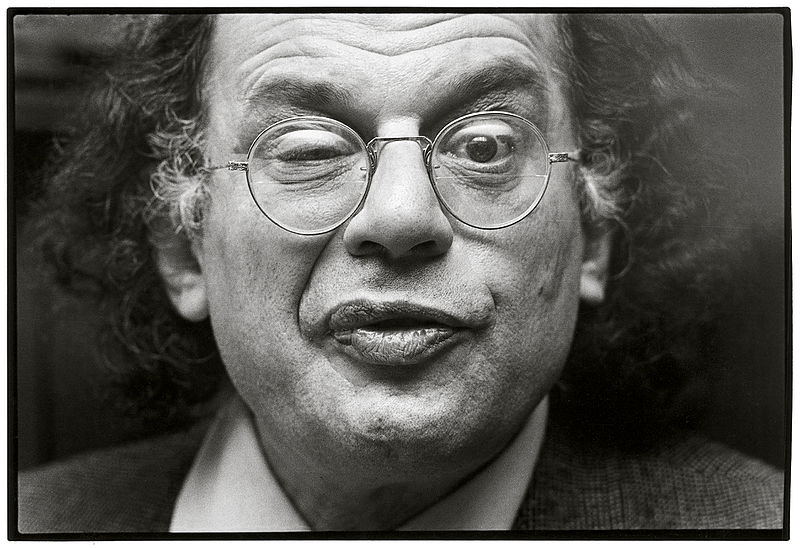
Like Hayes, Ginsberg enfolded his various identities—Jew, Buddhist, gay man—into his poetry in enriching ways. Thirty-six years ago, he gave a radio interview to “Stonewall Nation,” one of a handful of specifically gay radio programs broadcast in 1970s Western New York. In an occasionally NSFW conversation, he discussed the experience of coming out to his fellow Beats and to his family.
During the interview Ginsberg talks about being closeted and having a crush on Jack Kerouac, who was “very tolerant, friendly,” after Ginsberg confessed it. Above he tells a funny story about coming out to his father, then reads a moving untitled poem about his father’s eventual acceptance after their mutual “timidity and fear.” He also recalls how the rest of his family, particularly his brother, reacted.
The interview moves to broader topics. Ginsberg discusses his views on desire and compassion, defining the latter as “benevolent and indifferent attentiveness,” rather than “heart-love.” Buddhism pervades Ginsberg’s conversation as does a roguish vaudevillian sensibility mixed with sober reflection. He opens with a long, boozy sing-along whose first four lines concisely sum up core Buddhist doctrines; he ends with a funny, bawdy song that then becomes a dark exploration of homophobic and misogynistic violence.
Ginsberg and host also discuss the Briggs Initiative (above) a piece of legislation that would have been an effective purge in the California school system of gay teachers, their supporters, even those who might “take a neutral attitude which could be interpreted as approval.” This would preclude even the teaching of Whitman’s “Song of Myself” (or one particular section of it), which, Ginsberg says, “would make the teacher liable for encouraging homosexual activity.” The amendment—one that, apparently, former governor Ronald Reagan strongly opposed—failed to pass. These days such proposals target Ginsberg’s poetry as well, and we still have conversations about the value of things like “benevolent and indifferent attentiveness” in the classroom, or whether poets should feel limited by being who they are.
In the photo above, taken by Herbert Rusche in 1978, you can see Ginsberg (left) with his long-time partner, the poet Peter Orlovsky (right).
You’ve probably seen “Illusion of Choice,” a 2011 infographic detailing how six media conglomerates “control a staggering 90% of what we read, watch, or listen to.” (The entities named are GE, News Corp, Disney, Viacom, Time Warner, and CBS.) Another “Illusion of Choice” infographic from last year documents how “ten huge corporations control the production of almost everything the average person buys.” Are these webs of corporate connection kooky conspiracy theories or genuine cause for alarm? Do the correlations between business entities cause political currents that undermine democracy and media independence? It’s not particularly controversial to think so given the amount of money corporations spend on lobbying and political campaigns. It’s not even particularly controversial to say so, at least for those of us who aren’t employed by, say, Viacom, Time Warner, GE, etc.
But pointing fingers at the corporatocracy may have not gone over so well for famed comedy writer Robert Smigel in 1998 when his recurring animated “Saturday TV Funhouse” segment produced the “Conspiracy Theory Rock” bit above for Saturday Night Live. A parody of the beloved Schoolhouse Rock educational ‘toons of the 70s, “Conspiracy Theory Rock” features a disheveled gentleman—a stereotype of the outsider crackpot—leading a sing-along about the machinations of the “Media-opoly.” Figured as greedy octopi (reminiscent of Matt Taibbi’s “vampire squid”), the media giants here, including GE, Westinghouse, Fox, and Disney, devour the smaller guys—the traditional networks—and “use them to say whatever they please and put down the opinions of anyone who disagrees.” The segment may have raised the ire of GE, who own NBC. It aired once with the original episode but was subsequently pulled from the show in syndication, though it’s been included in subsequent DVD compilations of “Saturday TV Funhouse.”
Now “Conspiracy Theory Rock” is circulating online—amplified by a Marc Maron tweet—as a “banned” clip, a misleading description that feeds right into the story of conspiracy. Editing a sketch from a syndicated comedy show, after all, is not tantamount to banning it. While the short piece makes the usual compelling case against corporate rule, it does so in a tongue-in-cheek way that allows for the possibility that some of these allegations are tenuous exaggerations. Our unwashed presenter, for example, ends the segment mumbling an incoherent non sequitur about Lorne Michaels and Marion Barry attending the same high school. For his part, Michaels has said the segment was cut because it “wasn’t funny.” He’s got a point—it isn’t—but it’s hard to believe it didn’t raise other objections from network executives. It wouldn’t be the first time the show has been accused of censoring a political sketch.
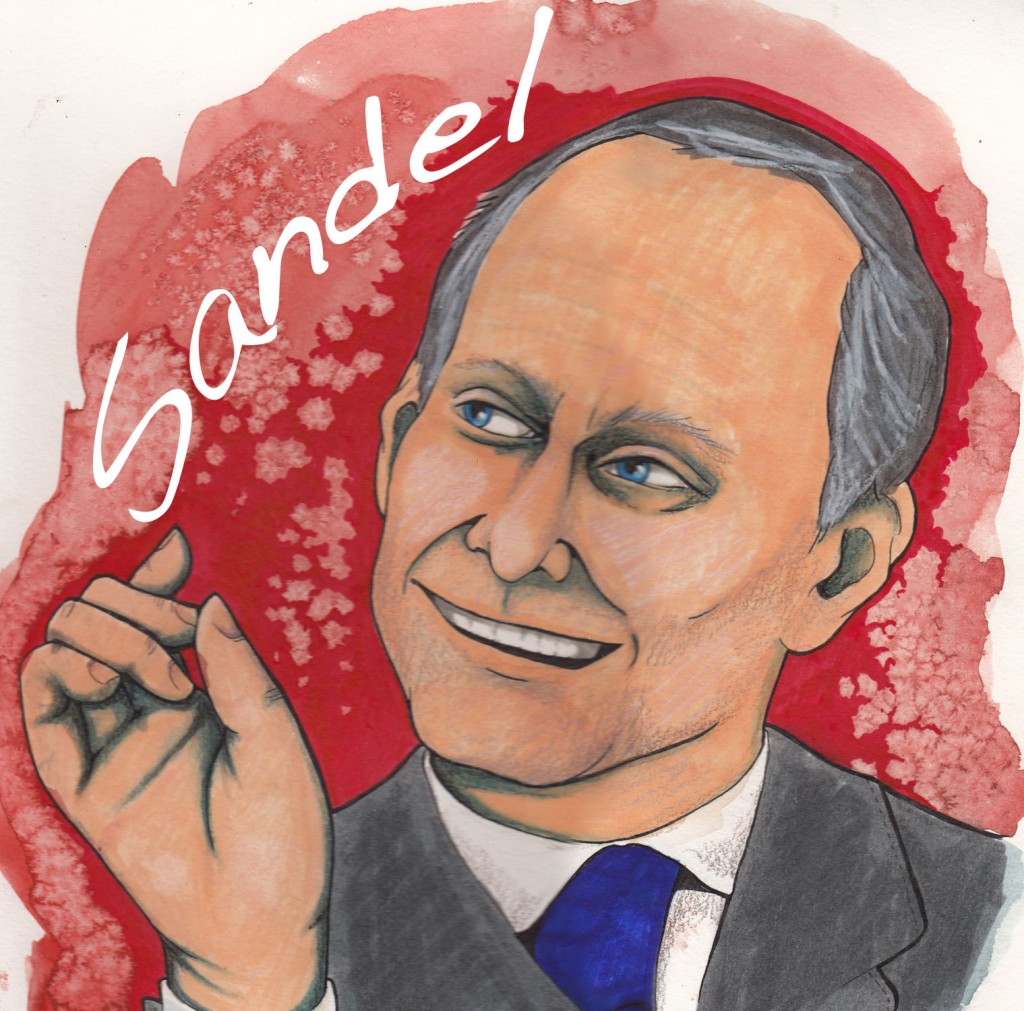
In July, the Partially Examined Life philosophy podcast discussed Sandel’s first (and most academically influential) book, 1982’s Liberalism and the Limits of Justice, in which he argued that society can’t be neutral with regard to claims about what the good life amounts to. Modern liberalism (by which he means the tradition coming from John Locke focusing on rights; this includes both America’s current liberals and conservatives) acknowledges that people want different things and tries to keep government in a merely mediating role, giving people as much freedom as possible.
So what’s the alternative? Sandel thinks that public discourse shouldn’t just be about people pushing for what they want, but a dialogue about what is really good for us. He gives the famous example of the Nazis marching in Skokie. A liberal would defend free speech, even if the speech is repellent. Sandel thinks that we can acknowledge that some speech is actually pernicious, that the interests of that community’s Holocaust survivors are simply more important than the interests of those who want to spread a message of hate.
A week later, a follow-up episode brought Sandel himself onto the podcast, primarily to speak about his most recent book, What Money Can’t Buy: The Moral Limits of Markets. A more popular work, this book considers numerous examples of the market society gone amok, where everything from sex to body parts to advertising space on the side of one’s house is potentially for sale.
Sandel helped us understand the connection between this and his earlier work: In remaining neutral among competing conceptions of what’s really good for us, liberalism has made an all-too-quick peace with unfettered exchange. If two people want to make a deal, who are the rest of us to step in and stop it? Liberal thinking does justify preventing supposedly free exchanges on the grounds that they might not actually be free, e.g. one side is under undue economic pressure, not mature or fully informed, in some way coerced or incompetent. But Sandel wants to argue that some practices can be merely degrading, even if performed willingly, and that a morally neutral society doesn’t have the conceptual apparatus to formulate such a claim. Instead, as exemplified by his course on justice, Sandel thinks that moral issues need to be a part of public debate. By extension, we can’t pretend that economics is a morally neutral science that merely measures human behavior. Our emphasis on economics in public policy crowds out other positive goods like citizenship and integrity.
Recent events in Missouri have brought back painful memories for many of the brutal treatment of protestors by police during the Civil Rights Movement. Others see specters of the riots in cities like Detroit, Washington, DC, and the beleaguered Watts neighborhood of Los Angeles in the wake of Martin Luther King Jr.’s murder. These are battles we would like to think belong to the past, but in remembering them, we should also remember peaceful expressions of solidarity and nonviolent responses to persistent social injustice. One such response came in the form of a massive concert at the L.A. Coliseum put on by Memphis’ Stax records in 1972, seven years after the Watts riots. Featuring some of Stax’ biggest names—Isaac Hayes, Albert King, The Staples Singers, and more—the Wattstax music festival brought in more than 100,000 attendees and raised thousands of dollars for local causes, becoming known informally as the “black Woodstock.”
The idea came from West Coast Stax exec Forrest Hamilton and future Stax president Al Bell, who hoped, he said, to “put on a small concert to help draw attention to, and to raise funds for the Watts Summer Festival” as well as “to create, motivate, and instill a sense of pride in the citizens of the Watts community.” To make sure everyone could attend, rich or poor, the organizers sold tickets for a dollar each. Rev. Jesse Jackson gave the invocation, leading the thousands of concertgoers in a call-and-response reading of William H. Borders’ poem “I Am – Somebody.”
There to film the event was Mel Stuart, director of Willy Wonka and the Chocolate Factory. The resulting documentary, which you can watch at the top of the post, features incredible performances from Stax’ full roster of artists at the time (see a swaggering Isaac Hayes play “Shaft” above). Despite security concerns from LA officials, still nervous about a gathering of “more than two black people” in one place, says Bell, the concert was a peaceful and joyously funky occasion: “you saw the Crips and Bloods sitting side by side—no problems.”
The film intercuts concert footage with man-on-the street interviews and “trenchant musings” from a then little-known Richard Pryor, who offers “sharp insight into the realities of life for black Americans, circa 1972.” It’s a moment of “get-down entertainment, raised-fist political rally, and stand-up spiritual revival” characteristic of the post-Civil Rights, Vietnam era movement, writes the PBS description of Wattstax. Unfortunately, the documentary “was considered too racy, political, and black to receive wide theatrical release or television broadcast” despite a “noted” Cannes screening and a 1974 Golden Globe nomination. It’s been a cult favorite for years, but deserves to be more widely seen, as a record of the hope and celebration of black America after the rage and despair of the late-60s. The messages of Wattstax still resonate. As Bell says, “forty years later, I hear African Americans in the audiences reacting to the same scenes, the same way they did forty years ago.”
We're hoping to rely on loyal readers, rather than erratic ads. Please click the Donate button and support Open Culture. You can use Paypal, Venmo, Patreon, even Crypto! We thank you!
Open Culture scours the web for the best educational media. We find the free courses and audio books you need, the language lessons & educational videos you want, and plenty of enlightenment in between.
 MP3
MP3